REVIEW 3 major objections 4 minor 10 cited by
Entanglement measures for causally connected subregions and holography
T0 review · 3 major / 4 minor · reviewed 2026-08-05 · deepseek-v4-flash
Pith's one-line read This paper claims a holographic duality for entanglement between timelike-separated subregions: the reflected entropy obtained by analytic continuation of twist correlators equals twice the timelike entanglement wedge cross section at leadi
desk verdict A careful, internally consistent proposal for timelike EWCS and reflected entropy, but the central match likely reflects shared analytic-continuation input rather than independent evidence of a new duality. read the letter →
The pith
A machine-rendered reading of the paper's core claim, the machinery that carries it, and where it could break.
The reading
What carries the argument
The load-bearing object is the transition operator $T_{AB}$, a generally non-Hermitian generalization of the reduced density matrix defined by $\operatorname{Tr}(T_{AB}O_AO_B(t))=\langle O_AO_B(t)\rangle_\psi$, prepared by a Schwinger-Keldysh path integral with cuts on the two time-separated subregions. Its replicated traces $\operatorname{Tr}(T_{AB}^n)$ are evaluated by the real-time replica method and become Lorentzian correlators of twist operators. On the bulk side, the machinery is the analytic continuation of the Euclidean RT surface, $\tau_0\to i t_0$ with the turning point following $z_\tau \to z_t$; this produces complex extremal surfaces whose areas split into real and imaginary pa
What would settle it
Compute the timelike reflected entropy for two intervals in a finite-dimensional system (e.g. a spin chain) directly from a purification of the non-Hermitian $T_{AB}$ via the real-time replica method, and compare with $2E_W$ evaluated on the analytic-continuation branch $\tau_0\to i t_0$; a mismatch, or sensitivity to the $i\epsilon$ ordering of the twist insertions, would rule out the claimed duality.
Extended reading notes
Core claim
On its own terms, the paper's discovery is that a consistent set of entanglement measures can be attached to timelike-separated subregions through the non-Hermitian transition operator $T_{AB}$, and that these measures have concrete holographic counterparts. For a single time interval, the entanglement entropy computed from $T_{AB}$ via the Schwinger-Keldysh replica method reproduces the known timelike entanglement entropy, and the corresponding RT surface is obtained by continuing the Euclidean extremal surface to $\tau_0\to i t_0$, producing a complex turning point. For two intervals, the entanglement wedge is bounded by such complex RT surfaces, and its cross section is defined by station
Load-bearing premise
All the holographic results rest on assuming that the correct bulk surface for a timelike interval is obtained by analytically continuing the Euclidean surface with the turning point following the chosen branch $\tau_0\to i t_0$; the paper adopts this branch from prior work without deriving it, so if another complex saddle is the one dual to the transition operator, the central duality collapses.
Editorial extensions
If this is right
- If correct, the timelike entanglement entropy defined from $T_{AB}$ is a bona fide boundary quantity whose holographic dual is the analytic continuation of the Euclidean RT surface, not just a formal Wick rotation.
- If correct, the reflected entropy of timelike intervals is holographically dual to the timelike entanglement wedge cross section, extending the spacelike reflected-entropy duality.
- If correct, the timelike EWCS is well defined and positive in AdS$_3$ examples even though the entangling surface itself is complex.
- If correct, the phase structure of two-interval timelike entanglement entropy corresponds to distinct RT-surface configurations, so the transition operator knows about bulk phase transitions.
- If correct, the real-time replica method yields a route to other timelike measures such as logarithmic negativity, with the adjacent-interval limit tied to timelike mutual information.
Reading between the lines
- Editorial inference: if the equality $S_R(T_1:T_2)=2E_W(T_1:T_2)$ survives beyond vacuum and thermal states, the stationarity condition on the complex area can serve as a working definition of a timelike entanglement wedge even where the usual notion of minimal surface is undefined.
- Editorial inference: the paper adopts the analytic-continuation branch $\tau_0\to i t_0$ for the turning point from earlier work; a direct real-time replica evaluation of $\operatorname{Tr}(T_{AB}^n)$ on the same backgrounds would test whether that branch is selected by the path integral rather than imposed.
- Editorial inference: because $T_{AB}$ encodes time evolution and scattering data, a holographic duality for its entropies suggests some dynamical information may be extractable from complexified bulk geodesics, though the paper does not demonstrate this.
- Editorial inference: the observed parity pattern (imaginary timelike entanglement entropy in AdS$_4$, real in AdS$_5$) points to a dimensional dichotomy in complexified holography that could be probed in other odd/even bulk dimensions.
Editorial analysis
A structured set of objections, weighed in public.
Referee Report
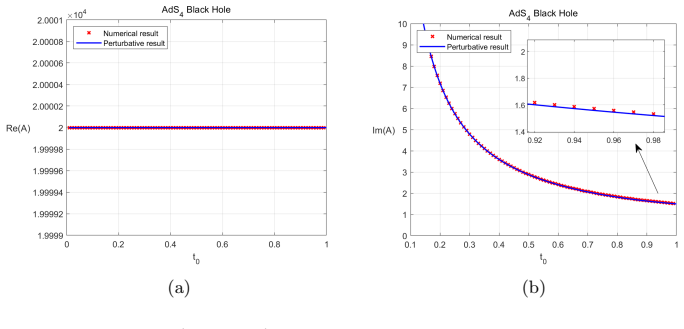
Summary. The paper extends entanglement measures from spacelike-separated to causally connected (timelike-separated) subregions in QFT and holography. It constructs a transition operator T_AB using the Schwinger-Keldysh path integral, computes its Rényi/von Neumann entropy via the real-time replica method, and shows that, in the examples considered, the result reduces to correlation functions of twist operators with timelike separations. On the holographic side, the paper adopts the procedure of analytically continuing Euclidean RT surfaces to select Lorentzian saddles, and verifies the resulting areas against exact analytic expressions and a numerical shooting method in AdS3, AdS4, AdS5, and BTZ geometries. It then proposes a timelike generalization of the entanglement wedge cross section by a stationarity condition on a complex area, and computes it in pure AdS3, global AdS3, and BTZ. Finally, by analytically continuing the spacelike reflected-entropy formula, it obtains a timelike reflected entropy and observes that at leading order in G it equals twice the timelike EWCS (Eq. (111)). The paper explicitly notes that no canonical purification for the non-Hermitian transition operator is known and that the timelike reflected entropy is only a candidate definition.
Significance. If the proposed duality were established, it would meaningfully extend holographic entanglement relations to causally connected regions and connect them to the transition-operator framework and pseudo-entropy. The paper contains several useful concrete results: a Schwinger-Keldysh path-integral representation of T_AB, explicit real-time replica computations, a numerical shooting method that agrees with analytic RT-area formulas, and closed-form expressions for the proposed timelike EWCS in multiple backgrounds. The authors are also transparent about the conceptual open problems, particularly the absence of a purification-based definition of timelike reflected entropy. However, the central equality S_R = 2E_W rests on two quantities that are themselves defined by analytic continuation, so as it stands the match is a consistency check among proposed definitions rather than an independent verification of a holographic duality. The paper is valuable as an exploratory proposal, but its main claim would need either a first-principles definition of the timelike reflected entropy or a substantially more cautious framing.
major comments (3)
- [§5.2 and §5.2.1, Eqs. (106), (111)] The central equality S_R = 2E_W is load-bearing but both sides are proposed definitions obtained by analytic continuation. Equation (106) defines timelike reflected entropy as the spacelike twist-correlator formula evaluated at τ_i → i t_i + ϵ_i, and §5.2.1 explicitly states that no canonical purification for the non-Hermitian T_A1A2B1B2 is known and that (106) is 'merely a candidate'. The right-hand side is the stationarity proposal (70). Since both sides are obtained from the same Euclidean spacelike duality by the same τ → it continuation and the same large-c conformal-block approximation, the match in (111) is a consistency check, not independent evidence. The claim 'supporting a holographic duality' should be either backed by a first-principles definition of the timelike reflected entropy or explicitly downgraded to a conjecture/consistency check.
- [§4.2, Eq. (70), footnote 2, Appendix D.1] The selection rule for the timelike EWCS is under-specified. Stationarity of a complex area can have multiple saddles; footnote 2 says to choose the 'appropriate surface' by 'physical or geometric principles', and Appendix D.1 lists several saddles, including (±Δ1, ±Δ2) and (±Δ1, ∓Δ2), before selecting (0,0) as 'minimal'. Since the area is complex-valued, the notion of 'minimal' is not defined without a prescribed ordering. Moreover, in §4.2.3 the BTZ complement example uses a different criterion, min{L^(1), L^(2)} in Eq. (83). This ambiguity affects the uniqueness of E_W(T1:T2) and therefore the comparison in Eq. (111).
- [§3.1, Eqs. (35)-(37)] The Lorentzian RT surface for a timelike boundary interval is obtained by the analytic continuation τ0 → i t0, z_τ → z_t from the Euclidean saddle. This branch choice is adopted from the procedure of Ref. [30], not derived from first principles. It is load-bearing because every subsequent RT area, the timelike entanglement wedge, and the EWCS depend on z_t. The agreement with the CFT computation is not a branch-selection test, since the CFT side (e.g., Eq. (15)) uses the same τ → it continuation of Euclidean twist correlators. Please state what observable would discriminate between different branches, or provide an independent derivation of the branch choice from the Schwinger-Keldysh replica path integral.
minor comments (4)
- [§1 and §3] There are several typos and small errors: 'labtory' in the Introduction; 'Talking into account' in §3.4.2; 'firslty' in Appendix A; 'extreme surface' used for 'extremal surface' in several places. In §3, after Eq. (25), G is described as 'the cosmological constant'; it should be Newton's constant.
- [Eq. (94)] The timelike logarithmic negativity for adjacent intervals is given up to an additive constant. Since the constant is not fixed, the reported relation (95) to the mutual information is only up to an undetermined shift; this should be stated more prominently.
- [§4.2.3, Eq. (83)] The definition of the EWCS for the complement intervals T1 = [-t,0] and T2 = (-∞,-t] ∪ [0,∞) uses a min{L^(1), L^(2)} rule. This is a different extremality/minimality prescription from the stationarity condition (70) used elsewhere, and the relation between the two prescriptions deserves comment.
- [Appendix A] The large-c conformal-block approximation is applied after analytic continuation to complex cross-ratios η_t and ar η_t. The validity of keeping only the vacuum block in this Lorentzian regime is not discussed; a comment on the relevant OPE limits and possible branch issues would help.
Circularity Check
Central timelike SR=2EW equality is the Wick rotation of the known spacelike duality; bulk RT branch is a load-bearing self-citation.
-
renaming known result
[Sec. 5.2, Eqs. (106)-(111); Sec. 4.2.1, Eq. (77)]
"For the timelike case, the reflected entropy for the timelike case is S_R(T1 : T2) := S_R(A : B)|τi→iti+ϵi, (106) ... by comparing (108) with (77) and (110) with (85), and using the Brown-Henneaux relation c = 3/(2G), we find the following correspondence at leading order in G: S_R(T1 : T2) = 2EW(T1 : T2). (111)"
The LHS of (111) is defined in (106) to be the spacelike reflected entropy S_R(A:B) of Eq. (103) evaluated at τ_i→i t_i+ε_i. The RHS (77)/(85) is the area of the timelike EWCS, whose defining RT surfaces were themselves obtained by the same τ→i t continuation (Sec. 3.1). In the Euclidean regime the identity S_R=2E_W is the known spacelike result cited to [18]; analytically continuing both sides of that identity gives (111) automatically. Thus the claimed timelike duality is the Wick rotation of the spacelike duality, not an independently derived prediction. The paper itself calls (106) only a 'candidate definition' (Sec. 5.2.1).
-
self citation load bearing
[Sec. 3.1, Eqs. (35)-(37); Sec. 1; Ref. [30]]
"There remains some ambiguity regarding how to determine the complex RT surface in the complexified geometry. In this section, we present a procedure for constructing the RT surface via analytical continuation from its Euclidean counterpart [30]. ... Under this Wick rotation, the conserved quantity and the turning point transform as p_t := −i p_τ|τ0→it0, z_t := z_τ|τ0→it0. (36)"
The bulk side of the timelike dictionary rests on the branch choice z_t := z_τ|_{τ0→i t0} in Eq. (36), which the paper adopts from [30] ('we present a procedure ... from its Euclidean counterpart [30]') without derivation. [30] is the authors' own prior work (Guo & Xu). The CFT timelike quantities are defined by the same τ→i t continuation (Eqs. (15),(19),(106)), so the holographic match verifies that both sides use the same continuation prescription, not that the prescription is the unique or correct Lorentzian saddle. The self-citation is load-bearing for every RT area and EWCS computed later.
full rationale
The paper contains no fitted parameters and substantial independent computation (Schwinger-Keldysh construction, replica twist correlators, numerical shooting, and checks against [28]/[29]). However, the headline result (111) is an analytic-continuation identity: both S_R(T1:T2) and E_W(T1:T2) are defined by applying the same τ→i t rule to the two sides of the known spacelike duality S_R=2E_W, so the equality is inherited by construction rather than independently established. Additionally, the timelike RT surface—the foundation of the bulk side—is adopted as a procedure from the authors' own prior work [30] rather than derived, making the holographic dictionary for timelike regions self-referential at its root. These are not fits, but they make the 'timelike duality' a consistency check among proposals. The paper is commendably explicit about these limitations (Sec. 5.2.1), but the central claim still reduces largely to a renaming of the spacelike result.
Assumptions & free parameters
free parameters (1)
- additive constant in timelike logarithmic negativity (Eq. 94)
assumptions (5)
- domain assumption The transition operator T_AB can be represented by the Schwinger-Keldysh path integral with cuts on the forward contour and satisfies Tr_A T_AB = rho_B and Tr_B T_AB = rho_A.
- domain assumption The physical RT surface for a timelike interval is obtained by Wick rotating the Euclidean extremal surface with tau_0 -> i t_0 and following the resulting complex branch.
- domain assumption Large-c CFT conformal block dominance and the vacuum block formulas (117)-(118) give the dominant twist correlator contributions.
- ad hoc to paper The timelike entanglement wedge cross section is defined by stationarity of the complex area, Eq. (70), with the selected saddle chosen by physical or minimality considerations.
- ad hoc to paper Timelike reflected entropy is defined by analytically continuing the Euclidean twist correlator formula, Eqs. (103)-(106).
invented entities (1)
-
Timelike entanglement wedge and its cross section
Cite this review
Pith. "Pith review of Entanglement measures for causally connected subregions and holography." pith.science (2026). https://pith.science/paper/ZYMJWFJK
@misc{pith2026250805158,
  author       = {Pith},
  title        = {Pith review of: Entanglement measures for causally connected subregions and holography},
  year         = {2026},
  howpublished = {\url{https://pith.science/paper/ZYMJWFJK}},
  note         = {Machine review of arXiv:2508.05158}
}
abstract
In this paper, we investigate entanglement for causally connected subregions $A$ and $B$ in quantum field theory and holography. Recent developments have established that a transition operator $T_{AB}$ can be well-defined for such subregions, which is generally non-Hermitian. By employing the Schwinger-Keldysh formalism and the real-time replica method, we show how to construct $T_{AB}$ and compute associated entanglement measures. In certain configurations, this leads to a notion of timelike entanglement entropy, for which we provide explicit quantum field theory computations and propose a holographic dual via analytic continuation from the Euclidean setup. Both analytical and numerical results are compared and found consistent. If entanglement between causally connected subregions is to be meaningful, it should also be able to define other entanglement measures. Motivated by the spacelike case, we propose a timelike extension of the entanglement wedge cross section, though we do not expect it to carry the same physical interpretation. In AdS$_3$/CFT$_2$, we compute explicit examples and find that the timelike entanglement wedge cross section is generally positive. Furthermore, we show that the reflected entropy for timelike intervals -- obtained via analytic continuation of twist correlators -- coincides with twice the timelike entanglement wedge cross section at leading order in $G$, supporting a holographic duality in the timelike case. We also discuss the extension of other entanglement measures, such as logarithmic negativity, to timelike separated regions using replica methods. We highlight conceptual challenges in defining reflected entropy via canonical purification for non-Hermitian operators.
Figures


Figures from the paper (21 more)




Forward citations
Cited by 10 Pith papers
-
Selecting Complex Extremal Surfaces with the Kontsevich--Segal--Witten Criterion
In AdS3, dS3, and AdS4 hyperbolic examples, the Kontsevich-Segal-Witten criterion uniquely selects a three-piece complex contour for timelike extremal surfaces, while timelike strips in AdS4 violate the criterion near...
-
Temporal Entanglement from Twist Correlators in 2d Conformal Field Theory and Holography
Timelike entanglement entropy in 2d CFT is defined by time-ordered twist correlators, whose holographic saddles are complex geodesics with smallest real length, and whose imaginary part counts causal-diamond crossings...
-
Linear Growth of Holographic Time-like Entanglement Entropy and Kasner exponents
Late-time linear growth of holographic TEE is governed by an interior critical surface Ac whose existence is guaranteed by NEC under Kasner asymptotics, with vacuum maximizing real growth and minimizing imaginary part.
-
Timelike Entanglement First Law and Linearized Field Equations in Higher Curvature Gravity
In Lovelock gravity duals of holographic CFTs, the timelike entanglement first law for hyperbolic regions is equivalent to the linearized bulk field equations about AdS, via a universal renormalization factor.
-
Timelike Entanglement First Law and Linearized Field Equations in Higher Curvature Gravity
Timelike entanglement first law holds in Lovelock gravity about AdS, with both entropy and modular Hamiltonian variations carrying the same coupling factor that renormalizes Newton's constant in the linearized equations.
-
Entanglement first law for timelike entanglement entropy and linearized Einstein's equation
For timelike boundary regions, the entanglement first law ΔS = Δ⟨H⟩ is equivalent, by the paper's proof, to the linearized Einstein equations around AdS.
-
Linear Growth of Holographic Time-like Entanglement Entropy and Kasner exponents
Late-time TEE growth in asymptotically AdS black holes with space-like singularities is governed by a critical extremal surface inside the horizon, with real/imaginary growth rates bounded by Schwarzschild-AdS under e...
-
Linear Growth of Holographic Time-like Entanglement Entropy and Kasner exponents
In asymptotically AdS black holes with space-like singularities, late-time linear growth of time-like entanglement entropy is governed by a critical extremal surface inside the event horizon, with growth rates bounded...
-
Entanglement inequalities for timelike intervals within dynamical holography
Timelike mutual information is positive and weak monotonicity holds for non-overlapping timelike subregions in AdS3-Vaidya holography, but the timelike strong subadditivity is violated for overlapping intervals while ...
-
Photonic Exceptional Points in Holography and QCD
A holographic toy model is constructed for third-order photonic exceptional points in ternary microrings, with numerical spectra, phase rigidity, and connections to the theta-vacuum of QCD via topological structures a...
Reference graph
Works this paper leans on
-
[30]
A duality of Ryu-Takayanagi surfaces inside and outside the horizon,
W. z. Guo and J. Xu, “A duality of Ryu-Takayanagi surfaces inside and outside the horizon,” [arXiv:2502.16774 [hep-th]]
-
[1]
Holographic derivation of entanglement en- tropy from AdS/CFT,
S. Ryu and T. Takayanagi, “Holographic derivation of entanglement en- tropy from AdS/CFT,” Phys. Rev. Lett. 96, 181602 (2006) [arXiv:hep- th/0603001]
arXiv 2006
-
[2]
A Covariant holographic entanglement entropy proposal,
V. E. Hubeny, M. Rangamani and T. Takayanagi, “A Covariant holographic entanglement entropy proposal,” JHEP 07, 062 (2007) [arXiv:0705.0016 [hep-th]]
arXiv 2007
-
[3]
Building up spacetime with quantum entangle- ment,
M. Van Raamsdonk, “Building up spacetime with quantum entangle- ment,” Gen. Rel. Grav. 42, 2323 (2010) [Int. J. Mod. Phys. D 19, 2429 (2010)] [arXiv:1005.3035 [hep-th]]
arXiv 2010
-
[4]
Entanglement Renormalization and Holography,
B. Swingle, “Entanglement Renormalization and Holography,” Phys. Rev. D 86 (2012), 065007 [arXiv:0905.1317 [cond-mat.str-el]]
arXiv 2012
-
[5]
Cool horizons for entangled black holes,
J. Maldacena and L. Susskind, “Cool horizons for entangled black holes,” Fortsch. Phys. 61 (2013), 781-811 [arXiv:1306.0533 [hep-th]]
arXiv 2013
-
[6]
Bulk Locality and Quantum Error Correction in AdS/CFT,
A. Almheiri, X. Dong and D. Harlow, “Bulk Locality and Quantum Error Correction in AdS/CFT,” JHEP 04 (2015), 163 [arXiv:1411.7041 [hep-th]]
arXiv 2015
-
[7]
Rel- ative entropy equals bulk relative entropy,
D. L. Jafferis, A. Lewkowycz, J. Maldacena and S. J. Suh, “Rel- ative entropy equals bulk relative entropy,” JHEP 06 (2016), 004 [arXiv:1512.06431 [hep-th]]
arXiv 2016
Show all 66 references
-
[8]
Reconstruction of Bulk Operators within the Entanglement Wedge in Gauge-Gravity Duality,
X. Dong, D. Harlow and A. C. Wall, “Reconstruction of Bulk Operators within the Entanglement Wedge in Gauge-Gravity Duality,” Phys. Rev. Lett. 117 (2016) no.2, 021601 [arXiv:1601.05416 [hep-th]]
2016 arXiv
-
[9]
Quantum Extremal Surfaces: Holo- graphic Entanglement Entropy beyond the Classical Regime,
N. Engelhardt and A. C. Wall, “Quantum Extremal Surfaces: Holo- graphic Entanglement Entropy beyond the Classical Regime,” JHEP 01 (2015), 073 [arXiv:1408.3203 [hep-th]]
2015 arXiv
-
[10]
Entanglement Wedge Reconstruction and the Informa- tion Paradox,
G. Penington, “Entanglement Wedge Reconstruction and the Informa- tion Paradox,” JHEP 09 (2020), 002 [arXiv:1905.08255 [hep-th]]. 62
2020 arXiv
-
[11]
The entropy of bulk quantum fields and the entanglement wedge of an evaporating black hole,
A. Almheiri, N. Engelhardt, D. Marolf and H. Maxfield, “The entropy of bulk quantum fields and the entanglement wedge of an evaporating black hole,” JHEP 12, 063 (2019) [arXiv:1905.08762 [hep-th]]
2019 arXiv
-
[12]
Replica wormholes and the black hole interior,
G. Penington, S. H. Shenker, D. Stanford and Z. Yang, “Replica wormholes and the black hole interior,” JHEP 03 (2022), 205 [arXiv:1911.11977 [hep-th]]
2022 arXiv
-
[13]
Replica Wormholes and the Entropy of Hawking Radiation,
A. Almheiri, T. Hartman, J. Maldacena, E. Shaghoulian and A. Tajdini, “Replica Wormholes and the Entropy of Hawking Radiation,” JHEP05 (2020), 013 [arXiv:1911.12333 [hep-th]]
2020 arXiv
-
[14]
The entropy of Hawking radiation,
A. Almheiri, T. Hartman, J. Maldacena, E. Shaghoulian and A. Tajdini, “The entropy of Hawking radiation,” Rev. Mod. Phys. 93 (2021) no.3, 035002 [arXiv:2006.06872 [hep-th]]
2021 arXiv
-
[15]
Essay: Emergent Holographic Spacetime from Quan- tum Information,
T. Takayanagi, “Essay: Emergent Holographic Spacetime from Quan- tum Information,” Phys. Rev. Lett. 134 (2025) no.24, 240001 [arXiv:2506.06595 [hep-th]]
2025 arXiv
-
[16]
Entanglement of purification through holographic duality,
T. Takayanagi and K. Umemoto, “Entanglement of purification through holographic duality,” Nature Phys. 14 (2018) no.6, 573-577 [arXiv:1708.09393 [hep-th]]
2018 arXiv
-
[17]
Entanglement of purification: from spin chains to holography,
P. Nguyen, T. Devakul, M. G. Halbasch, M. P. Zaletel and B. Swingle, “Entanglement of purification: from spin chains to holography,” JHEP 01 (2018), 098 [arXiv:1709.07424 [hep-th]]
2018 arXiv
-
[18]
A canonical purification for the entan- glement wedge cross-section,
S. Dutta and T. Faulkner, “A canonical purification for the entan- glement wedge cross-section,” JHEP 03 (2021), 178 [arXiv:1905.00577 [hep-th]]
2021 arXiv
-
[19]
Entanglement negativity in quan- tum field theory,
P. Calabrese, J. Cardy and E. Tonni, “Entanglement negativity in quan- tum field theory,” Phys. Rev. Lett.109 (2012), 130502 [arXiv:1206.3092 [cond-mat.stat-mech]]
2012 arXiv
-
[20]
Entanglement negativity in ex- tended systems: A field theoretical approach,
P. Calabrese, J. Cardy and E. Tonni, “Entanglement negativity in ex- tended systems: A field theoretical approach,” J. Stat. Mech. 1302 (2013), P02008 [arXiv:1210.5359 [cond-mat.stat-mech]]
2013 arXiv
-
[21]
The Gravity Dual of Renyi Entropy,
X. Dong, “The Gravity Dual of Renyi Entropy,” Nature Commun. 7 (2016), 12472 [arXiv:1601.06788 [hep-th]]
2016 arXiv
-
[22]
Entanglement Spectrum as a Generalization of Entanglement Entropy: Identification of Topological Order in Non- Abelian Fractional Quantum Hall Effect States,
H. Li, F. D. M. Haldane, “Entanglement Spectrum as a Generalization of Entanglement Entropy: Identification of Topological Order in Non- Abelian Fractional Quantum Hall Effect States,” Phys. Rev. Lett. 101, 010504 (2008) [arXiv:0805.0332[con-mat]] 63
2008 arXiv
-
[23]
Entanglement spectrum in one- dimensional systems,
P. Calabrese and A. Lefevre, “Entanglement spectrum in one- dimensional systems,” Phys. Rev. A 78, 032329 (2008)
2008
-
[24]
Quantum quenches in 1 + 1 dimensional conformal field theories,
P. Calabrese and J. Cardy, “Quantum quenches in 1 + 1 dimensional conformal field theories,” J. Stat. Mech. 1606 (2016) no.6, 064003 [arXiv:1603.02889 [cond-mat.stat-mech]]
2016 arXiv
-
[25]
Pseu- doentropy in dS/CFT and Timelike Entanglement Entropy,
K. Doi, J. Harper, A. Mollabashi, T. Takayanagi and Y. Taki, “Pseu- doentropy in dS/CFT and Timelike Entanglement Entropy,” Phys. Rev. Lett. 130, no.3, 031601 (2023) [arXiv:2210.09457 [hep-th]]
2023 arXiv
-
[26]
New holographic generalization of entanglement entropy,
Y. Nakata, T. Takayanagi, Y. Taki, K. Tamaoka and Z. Wei, “New holographic generalization of entanglement entropy,” Phys. Rev. D103 (2021) no.2, 026005 [arXiv:2005.13801 [hep-th]]
2021 arXiv
-
[27]
On holographic time-like entan- glement entropy,
Z. Li, Z. Q. Xiao and R. Q. Yang, “On holographic time-like entan- glement entropy,” JHEP 04 (2023), 004 doi:10.1007/JHEP04(2023)004 [arXiv:2211.14883 [hep-th]]
2023 arXiv
-
[28]
Timelike entanglement entropy,
K. Doi, J. Harper, A. Mollabashi, T. Takayanagi and Y. Taki, “Timelike entanglement entropy,” JHEP 05, 052 (2023) [arXiv:2302.11695 [hep- th]]
2023 arXiv
-
[29]
Geometric Interpretation of Timelike Entanglement Entropy,
M. P. Heller, F. Ori and A. Serantes, “Geometric Interpretation of Timelike Entanglement Entropy,” Phys. Rev. Lett. 134 (2025) no.13, 131601 [arXiv:2408.15752 [hep-th]]
2025 arXiv
-
[31]
Nunez and D
C. Nunez and D. Roychowdhury, [arXiv:2507.17805 [hep-th]]
-
[32]
M. P. Heller, F. Ori and A. Serantes, [arXiv:2507.17847 [hep-th]]
-
[33]
Relation between timelike and spacelike entanglement entropy,
W. z. Guo, S. He and Y. X. Zhang, “Relation between timelike and spacelike entanglement entropy,” [arXiv:2402.00268 [hep-th]]
-
[34]
Observable and computable entanglement in time,
A. Milekhin, Z. Adamska and J. Preskill, “Observable and computable entanglement in time,” [arXiv:2502.12240 [quant-ph]]
-
[35]
Entanglement entropy and quantum field theory,
P. Calabrese and J. L. Cardy, “Entanglement entropy and quantum field theory,” J. Stat. Mech. 0406 (2004), P06002 [arXiv:hep-th/0405152 [hep-th]]
2004 arXiv
-
[36]
Brownian motion of a quantum oscillator,
J. S. Schwinger, “Brownian motion of a quantum oscillator,” J. Math. Phys. 2 (1961), 407-432
1961
-
[37]
The Theory of a general quantum system interacting with a linear dissipative system,
R. P. Feynman and F. L. Vernon, Jr., “The Theory of a general quantum system interacting with a linear dissipative system,” Annals Phys. 24 (1963), 118-173 64
1963
-
[38]
Diagram Technique for Nonequilibrium Processes,
L. V. Keldysh, “Diagram Technique for Nonequilibrium Processes,” Sov. Phys. JETP 20 (1965), 1018-1026
1965
-
[39]
Deriving covariant holo- graphic entanglement,
X. Dong, A. Lewkowycz and M. Rangamani, “Deriving covariant holo- graphic entanglement,” JHEP 11 (2016), 028 [arXiv:1607.07506 [hep- th]]
2016 arXiv
-
[40]
Real-time gravitational replicas: Formalism and a variational princi- ple,
S. Colin-Ellerin, X. Dong, D. Marolf, M. Rangamani and Z. Wang, “Real-time gravitational replicas: Formalism and a variational princi- ple,” JHEP 05 (2021), 117 [arXiv:2012.00828 [hep-th]]
2021 arXiv
-
[41]
Real-time gravitational replicas: low dimensional examples,
S. Colin-Ellerin, X. Dong, D. Marolf, M. Rangamani and Z. Wang, “Real-time gravitational replicas: low dimensional examples,” JHEP 08 (2021), 171 [arXiv:2105.07002 [hep-th]]
2021 arXiv
-
[42]
Imaginary part of timelike entanglement en- tropy,
W. z. Guo and J. Xu, “Imaginary part of timelike entanglement en- tropy,” JHEP 02 (2025), 094 [arXiv:2410.22684 [hep-th]]
2025 arXiv
-
[43]
Measuring the Black Hole Interior from the Exterior,
W. z. Guo, “Measuring the Black Hole Interior from the Exterior,” [arXiv:2505.09878 [hep-th]]
-
[44]
Skenderis and B
K. Skenderis and B. C. van Rees, Phys. Rev. Lett. 101 (2008), 081601 doi:10.1103/PhysRevLett.101.081601 [arXiv:0805.0150 [hep-th]]
2008 arXiv
-
[45]
Real-time gauge/gravity duality: Prescription, Renormalization and Examples,
K. Skenderis and B. C. van Rees, “Real-time gauge/gravity duality: Prescription, Renormalization and Examples,” JHEP 05 (2009), 085 [arXiv:0812.2909 [hep-th]]
2009 arXiv
-
[46]
Measuring temporal entanglement in experiments as a hallmark for integrability,
A. Bou-Comas, C. R. Marim´ on, J. T. Schneider, S. Carignano and L. Tagliacozzo, “Measuring temporal entanglement in experiments as a hallmark for integrability,” [arXiv:2409.05517 [quant-ph]]
-
[47]
Causality Constraints in Confor- mal Field Theory,
T. Hartman, S. Jain and S. Kundu, “Causality Constraints in Confor- mal Field Theory,” JHEP 05 (2016), 099 [arXiv:1509.00014 [hep-th]]
2016 arXiv
-
[48]
Conformal Blocks and Negativity at Large Central Charge,
M. Kulaxizi, A. Parnachev and G. Policastro, “Conformal Blocks and Negativity at Large Central Charge,” JHEP 09 (2014), 010 [arXiv:1407.0324 [hep-th]]
2014 arXiv
-
[49]
Entanglement negativity and minimal entanglement wedge cross sections in holographic theories,
J. Kudler-Flam and S. Ryu, “Entanglement negativity and minimal entanglement wedge cross sections in holographic theories,” Phys. Rev. D 99, no.10, 106014 (2019) [arXiv:1808.00446 [hep-th]]
2019 arXiv
-
[50]
Derivation of holographic negativity in AdS3/CFT2,
Y. Kusuki, J. Kudler-Flam and S. Ryu, “Derivation of holographic negativity in AdS3/CFT2,” Phys. Rev. Lett. 123 (2019) no.13, 131603 [arXiv:1907.07824 [hep-th]]. 65
2019 arXiv
-
[51]
Entanglement negativity and replica symmetry breaking in general holographic states,
X. Dong, J. Kudler-Flam and P. Rath, “Entanglement negativity and replica symmetry breaking in general holographic states,” JHEP 01 (2025), 022 [arXiv:2409.13009 [hep-th]]
2025 arXiv
-
[52]
Entanglement Entropy at Large Central Charge,
T. Hartman, “Entanglement Entropy at Large Central Charge,” [arXiv:1303.6955 [hep-th]]
-
[53]
Time-dependence of correlation func- tions following a quantum quench,
P. Calabrese and J. L. Cardy, “Time-dependence of correlation func- tions following a quantum quench,” Phys. Rev. Lett. 96 (2006), 136801 [arXiv:cond-mat/0601225 [cond-mat]]
2006 arXiv
-
[54]
Entanglement and correlation functions following a local quench: a conformal field theory approach,
P. Calabrese and J. Cardy, “Entanglement and correlation functions following a local quench: a conformal field theory approach,” J. Stat. Mech. 0710 (2007) no.10, P10004 [arXiv:0708.3750 [cond-mat.stat- mech]]
2007 arXiv
-
[55]
Quantum dimension as entanglement entropy in two dimensional conformal field theories,
S. He, T. Numasawa, T. Takayanagi and K. Watanabe, “Quantum dimension as entanglement entropy in two dimensional conformal field theories,” Phys. Rev. D 90 (2014) no.4, 041701 [arXiv:1403.0702 [hep- th]]
2014 arXiv
-
[56]
Timelike entanglement entropy and phase transitions in non-conformal theories,
M. Afrasiar, J. K. Basak and D. Giataganas, “Timelike entanglement entropy and phase transitions in non-conformal theories,” JHEP 07 (2024), 243 [arXiv:2404.01393 [hep-th]]
2024 arXiv
-
[57]
Holographic Timelike c-function,
D. Giataganas, “Holographic Timelike c-function,” [arXiv:2505.20459 [hep-th]]
-
[58]
Time-like Entanglement Entropy: a top-down approach,
C. Nunez and D. Roychowdhury, “Time-like Entanglement Entropy: a top-down approach,” [arXiv:2505.20388 [hep-th]]
-
[59]
Generalized gravitational entropy,
A. Lewkowycz and J. Maldacena, “Generalized gravitational entropy,” JHEP 08 (2013), 090 [arXiv:1304.4926 [hep-th]]
2013 arXiv
-
[60]
Analytic States in Quantum Field The- ory on Curved Spacetimes,
A. Strohmaier and E. Witten, “Analytic States in Quantum Field The- ory on Curved Spacetimes,” Annales Henri Poincare 25 (2024) no.10, 4543-4590 [arXiv:2302.02709 [math-ph]]
2024 arXiv
-
[61]
The Timelike Tube Theorem in Curved Spacetime,
A. Strohmaier and E. Witten, “The Timelike Tube Theorem in Curved Spacetime,” Commun. Math. Phys. 405 (2024) no.7, 153 [arXiv:2303.16380 [hep-th]]
2024 arXiv
-
[62]
Algebras, regions, and observers.,
E. Witten, “Algebras, regions, and observers.,” Proc. Symp. Pure Math. 107 (2024), 247-276 [arXiv:2303.02837 [hep-th]]
2024 arXiv
-
[63]
Holographic representation of local bulk operators,
A. Hamilton, D. N. Kabat, G. Lifschytz and D. A. Lowe, “Holographic representation of local bulk operators,” Phys. Rev. D 74 (2006), 066009 [arXiv:hep-th/0606141 [hep-th]]. 66
2006 arXiv
-
[64]
Local bulk operators in AdS/CFT: A Holographic description of the black hole interior,
A. Hamilton, D. N. Kabat, G. Lifschytz and D. A. Lowe, “Local bulk operators in AdS/CFT: A Holographic description of the black hole interior,” Phys. Rev. D 75 (2007), 106001 [erratum: Phys. Rev. D 75 (2007), 129902] [arXiv:hep-th/0612053 [hep-th]]
2007 arXiv
-
[65]
Constructing local bulk ob- servables in interacting AdS/CFT,
D. Kabat, G. Lifschytz and D. A. Lowe, “Constructing local bulk ob- servables in interacting AdS/CFT,” Phys. Rev. D 83 (2011), 106009 [arXiv:1102.2910 [hep-th]]
2011 arXiv
-
[66]
Entanglement Wedge Cross Section from the Dual Density Matrix,
K. Tamaoka, “Entanglement Wedge Cross Section from the Dual Density Matrix,” Phys. Rev. Lett. 122 (2019) no.14, 141601 [arXiv:1809.09109 [hep-th]]. 67
2019 arXiv
Reviewed August 5, 2026 · model on record in the stance chip above.
Discussion (0). Sign in to comment.