Binary black holes in the heat of merger
Pith reviewed 2026-05-19 07:45 UTC · model grok-4.3
The pith
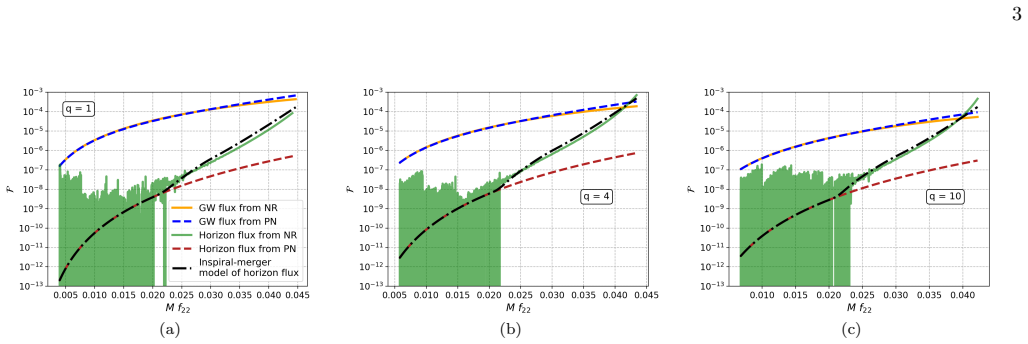
A frequency-domain approximant models tidal heating in nonspinning black hole binaries up to merger using horizon parameters.
A machine-rendered reading of the paper's core claim, the machinery that carries it, and where it could break.
Core claim
We present a frequency-domain approximant for nonspinning black hole binaries that accounts for tidal heating effects up to the merger frequency. The approximant includes horizon parameters that characterize the nature of the compact objects. By applying this model to a binary black hole baseline that incorporates tidal heating, one can construct a more accurate point-particle waveform, one that is devoid of finite-size effects of the component objects.
What carries the argument
The frequency-domain approximant calibrated to numerical relativity data that incorporates tidal heating and horizon parameters for compact objects.
If this is right
- More accurate point-particle waveforms can be constructed by including tidal heating in the baseline.
- The model can be used to study ramifications in modeling binary neutron star systems.
- Horizon parameters help characterize the nature of the compact objects in the binary.
- The approximant extends waveform modeling to include strong-field horizon effects up to merger.
Where Pith is reading between the lines
- This could reduce systematic errors in gravitational wave parameter estimation by accounting for horizon absorption.
- The horizon parameters might enable tests to distinguish black holes from exotic compact objects in observed signals.
- Extending the approach to spinning cases could further improve templates for current detectors.
Load-bearing premise
Numerical relativity simulations accurately isolate and capture the tidal heating effects without contamination from other phenomena or errors.
What would settle it
Comparing the approximant's predicted gravitational wave phase and amplitude against independent numerical relativity runs of binary black hole mergers that include horizon absorption.
Figures




read the original abstract
A black hole binary approaching merger undergoes changes in its inspiral rate as energy and angular momentum are lost from the orbits into the horizons. This effect strengthens as the black holes come closer. We use numerical relativity data to model this so-called tidal heating in the strong gravity regime. We present a frequency-domain approximant for nonspinning black hole binaries that accounts for tidal heating effects up to the merger frequency. The approximant includes horizon parameters that characterize the nature of the compact objects. By applying this model to a binary black hole baseline that incorporates tidal heating, one can construct a more accurate point-particle waveform, one that is devoid of finite-size effects of the component objects. We also discuss its ramifications in modeling binary neutron star systems.
Editorial analysis
A structured set of objections, weighed in public.
Referee Report
Summary. The manuscript presents a frequency-domain approximant for nonspinning black hole binaries that incorporates tidal heating effects up to merger, calibrated on numerical relativity data. Horizon parameters are introduced to characterize absorption of energy and angular momentum into the compact-object horizons, with the goal of enabling point-particle waveforms free of finite-size effects and with extensions to neutron-star binaries.
Significance. If the calibration isolates tidal heating cleanly and the horizon parameters prove robust, the approximant would be a useful addition to strong-field waveform modeling, particularly for late-inspiral accuracy and for distinguishing black holes from other compact objects. The direct use of NR data to extend the model into the merger regime is a positive feature.
major comments (2)
- [§3] §3 (calibration procedure): the manuscript states that horizon parameters are fitted to NR data but supplies no description of the functional form, optimizer, frequency window, number of simulations, or residual diagnostics. This is load-bearing for the central claim that the approximant accurately captures tidal heating without absorbing numerical artifacts or gauge effects.
- [§4.1] §4.1 (horizon-parameter definition): the parameters are determined by matching the same NR waveforms used to construct the approximant, so the reported agreement with data is not an independent test. A concrete validation on an independent NR run or on a different mass ratio is required to establish that the parameters reflect physical absorption rather than data-specific tuning.
minor comments (2)
- [Abstract] The abstract and introduction should explicitly state the mass-ratio and frequency range over which the approximant has been tested.
- [§2] Notation for the frequency-domain tidal-heating term should be introduced once and used consistently; several symbols appear without prior definition.
Simulated Author's Rebuttal
We thank the referee for their careful reading and constructive comments on our manuscript. We address each major comment point by point below and indicate the revisions we will make.
read point-by-point responses
-
Referee: [§3] §3 (calibration procedure): the manuscript states that horizon parameters are fitted to NR data but supplies no description of the functional form, optimizer, frequency window, number of simulations, or residual diagnostics. This is load-bearing for the central claim that the approximant accurately captures tidal heating without absorbing numerical artifacts or gauge effects.
Authors: We agree that the calibration procedure requires a more explicit description to support the central claims. In the revised manuscript we will expand §3 to specify the functional form of the horizon parameters, the optimizer and its settings, the exact frequency window(s) used for fitting, the number and mass-ratio range of the NR simulations, and quantitative residual diagnostics. These additions will clarify how the fit isolates tidal heating from numerical or gauge artifacts. revision: yes
-
Referee: [§4.1] §4.1 (horizon-parameter definition): the parameters are determined by matching the same NR waveforms used to construct the approximant, so the reported agreement with data is not an independent test. A concrete validation on an independent NR run or on a different mass ratio is required to establish that the parameters reflect physical absorption rather than data-specific tuning.
Authors: The referee is correct that the present validation uses the same NR data for both calibration and comparison, limiting independence. We will add a new validation test on at least one NR simulation withheld from the fitting set (including, where possible, a different mass ratio) and report the results in the revised §4.1. This will provide a clearer demonstration that the horizon parameters capture physical absorption. revision: yes
Circularity Check
No significant circularity in derivation chain
full rationale
The paper constructs a frequency-domain approximant by calibrating to external numerical relativity data for tidal heating effects up to merger. This follows standard waveform modeling practice where NR simulations serve as an independent benchmark rather than the model reducing to its own fitted inputs by definition or self-citation. No equations or steps are presented that exhibit self-definitional closure, fitted parameters renamed as predictions, or load-bearing self-citations whose validity depends on the current work. The horizon parameters characterize the objects within the calibrated model but do not force the central claim to be tautological with the calibration data itself. The derivation remains self-contained against the external NR benchmark.
Axiom & Free-Parameter Ledger
free parameters (1)
- horizon absorption coefficients
axioms (1)
- domain assumption Numerical relativity simulations provide an accurate representation of tidal heating in the strong-gravity regime.
Forward citations
Cited by 1 Pith paper
-
Plunge spectra as discriminators of black hole mimickers
Plunge spectra of extreme mass ratio events onto black hole mimickers show a low-frequency resonance comb and a high-frequency deviation from black hole behavior above Mω_th ≈ 0.39.
Reference graph
Works this paper leans on
-
[1]
J. B. Hartle, Tidal Friction in Slowly Rotating Black Holes, Phys. Rev. D 8, 1010 (1973)
work page 1973
-
[2]
I. Vega, E. Poisson, and R. Massey, Intrinsic and extrinsic geometries of a tidally deformed black hole, Classical and Quantum Gravity 28, 175006 (2011), arXiv:1106.0510 [gr-qc]
work page internal anchor Pith review Pith/arXiv arXiv 2011
- [3]
-
[4]
S. Mukherjee, S. Datta, S. Tiwari, K. S. Phukon, and S. Bose, Toward establishing the presence or absence of horizons in coalescing binaries of compact objects by us- ing their gravitational wave signals, Phys. Rev. D 106, 104032 (2022), arXiv:2202.08661 [gr-qc]
-
[5]
S. W. Hawking and J. B. Hartle, Energy and angular 6 momentum flow into a black hole, Communications in Mathematical Physics 27, 283 (1972)
work page 1972
-
[6]
S. A. Hughes, Evolution of circular, nonequatorial orbits of Kerr black holes due to gravitational wave emission. II. Inspiral trajectories and gravitational wave forms, Phys. Rev. D 64, 064004 (2001), [Erratum: Phys.Rev.D 88, 109902 (2013)], arXiv:gr-qc/0104041
work page internal anchor Pith review Pith/arXiv arXiv 2001
-
[7]
Modeling the horizon-absorbed gravitational flux for equatorial-circular orbits in Kerr spacetime
A. Taracchini, A. Buonanno, S. A. Hughes, and G. Khanna, Modeling the horizon-absorbed gravitational flux for equatorial-circular orbits in Kerr spacetime, Phys. Rev. D 88, 044001 (2013), [Erratum: Phys.Rev.D 88, 109903 (2013)], arXiv:1305.2184 [gr-qc]
work page internal anchor Pith review Pith/arXiv arXiv 2013
-
[8]
A new gravitational wave generation algorithm for particle perturbations of the Kerr spacetime
E. Harms, S. Bernuzzi, A. Nagar, and A. Zenginoglu, A new gravitational wave generation algorithm for particle perturbations of the Kerr spacetime, Class. Quant. Grav. 31, 245004 (2014), arXiv:1406.5983 [gr-qc]
work page internal anchor Pith review Pith/arXiv arXiv 2014
-
[9]
S. Datta and S. Bose, Probing the nature of central ob- jects in extreme-mass-ratio inspirals with gravitational waves, Phys. Rev. D99, 084001 (2019), arXiv:1902.01723 [gr-qc]
- [10]
- [11]
-
[12]
M. Colpi et al. , LISA Definition Study Report, (2024), arXiv:2402.07571 [astro-ph.CO]
work page internal anchor Pith review Pith/arXiv arXiv 2024
-
[13]
Testing the nature of dark compact objects: a status report
V. Cardoso and P. Pani, Testing the nature of dark com- pact objects: a status report, Living Rev. Rel. 22, 4 (2019), arXiv:1904.05363 [gr-qc]
work page internal anchor Pith review Pith/arXiv arXiv 2019
-
[14]
Probing Planckian corrections at the horizon scale with LISA binaries
A. Maselli, P. Pani, V. Cardoso, T. Abdelsalhin, L. Gualtieri, and V. Ferrari, Probing Planckian correc- tions at the horizon scale with LISA binaries, Phys. Rev. Lett. 120, 081101 (2018), arXiv:1703.10612 [gr-qc]
work page internal anchor Pith review Pith/arXiv arXiv 2018
-
[15]
Datta, Tidal heating of Quantum Black Holes and their imprints on gravitational waves, Phys
S. Datta, Tidal heating of Quantum Black Holes and their imprints on gravitational waves, Phys. Rev. D 102, 064040 (2020), arXiv:2002.04480 [gr-qc]
- [16]
-
[17]
C. E. Rhoades, Jr. and R. Ruffini, Maximum mass of a neutron star, Phys. Rev. Lett. 32, 324 (1974)
work page 1974
-
[18]
The Maximum Mass of a Neutron Star
V. Kalogera and G. Baym, The maximum mass of a neutron star, Astrophys. J. Lett. 470, L61 (1996), arXiv:astro-ph/9608059
work page internal anchor Pith review Pith/arXiv arXiv 1996
-
[19]
R. Abbott et al. (KAGRA, VIRGO, LIGO Scien- tific), GWTC-3: Compact Binary Coalescences Observed by LIGO and Virgo during the Second Part of the Third Observing Run, Phys. Rev. X 13, 041039 (2023), arXiv:2111.03606 [gr-qc]
work page internal anchor Pith review Pith/arXiv arXiv 2023
-
[20]
C. D. Bailyn, R. K. Jain, P. Coppi, and J. A. Orosz, The Mass distribution of stellar black holes, Astrophys. J. 499, 367 (1998), arXiv:astro-ph/9708032
work page internal anchor Pith review Pith/arXiv arXiv 1998
-
[21]
F. Ozel, D. Psaltis, R. Narayan, and J. E. McClintock, The Black Hole Mass Distribution in the Galaxy, As- trophys. J. 725, 1918 (2010), arXiv:1006.2834 [astro- ph.GA]
work page internal anchor Pith review Pith/arXiv arXiv 1918
-
[22]
W. M. Farr, N. Sravan, A. Cantrell, L. Kreidberg, C. D. Bailyn, I. Mandel, and V. Kalogera, The Mass Distribu- tion of Stellar-Mass Black Holes, Astrophys. J. 741, 103 (2011), arXiv:1011.1459 [astro-ph.GA]
work page internal anchor Pith review Pith/arXiv arXiv 2011
-
[23]
Mass Measurements of Black Holes in X-Ray Transients: Is There a Mass Gap?
L. Kreidberg, C. D. Bailyn, W. M. Farr, and V. Kalogera, Mass Measurements of Black Holes in X-Ray Transients: Is There a Mass Gap?, Astrophys. J. 757, 36 (2012), arXiv:1205.1805 [astro-ph.HE]
work page internal anchor Pith review Pith/arXiv arXiv 2012
-
[24]
R. Abbott et al. (LIGO Scientific, Virgo), GW190814: Gravitational Waves from the Coalescence of a 23 Solar Mass Black Hole with a 2.6 Solar Mass Compact Object, Astrophys. J. Lett. 896, L44 (2020), arXiv:2006.12611 [astro-ph.HE]
work page internal anchor Pith review Pith/arXiv arXiv 2020
-
[25]
R. Abbott et al. (LIGO Scientific, VIRGO), GWTC-2.1: Deep extended catalog of compact binary coalescences observed by LIGO and Virgo during the first half of the third observing run, Phys. Rev. D 109, 022001 (2024), arXiv:2108.01045 [gr-qc]
work page internal anchor Pith review Pith/arXiv arXiv 2024
-
[26]
The population of merging compact binaries inferred using gravitational waves through GWTC-3
R. Abbott et al. (KAGRA, VIRGO, LIGO Scientific), Population of Merging Compact Binaries Inferred Using Gravitational Waves through GWTC-3, Phys. Rev. X13, 011048 (2023), arXiv:2111.03634 [astro-ph.HE]
work page internal anchor Pith review Pith/arXiv arXiv 2023
- [27]
-
[28]
M. A. Scheel, M. Giesler, D. A. Hemberger, G. Lovelace, K. Kuper, M. Boyle, B. Szil´ agyi, and L. E. Kidder, Improved methods for simulating nearly extremal bi- nary black holes, Class. Quant. Grav. 32, 105009 (2015), arXiv:1412.1803 [gr-qc]
work page internal anchor Pith review Pith/arXiv arXiv 2015
-
[29]
Boyle et al., The SXS Collaboration catalog of binary black hole simulations, Class
M. Boyle et al., The SXS Collaboration catalog of binary black hole simulations, Class. Quant. Grav. 36, 195006 (2019), arXiv:1904.04831 [gr-qc]
- [30]
-
[31]
T. Dietrich, S. Bernuzzi, and W. Tichy, Closed-form tidal approximants for binary neutron star gravitational waveforms constructed from high-resolution numerical relativity simulations, Phys. Rev. D 96, 121501 (2017), arXiv:1706.02969 [gr-qc]
work page internal anchor Pith review Pith/arXiv arXiv 2017
-
[32]
T. Dietrich, A. Samajdar, S. Khan, N. K. Johnson- McDaniel, R. Dudi, and W. Tichy, Improving the NR- Tidal model for binary neutron star systems, Phys. Rev. D 100, 044003 (2019), arXiv:1905.06011 [gr-qc]
- [33]
-
[34]
J. Aasi et al. (LIGO Scientific), Advanced LIGO, Class. Quant. Grav. 32, 074001 (2015), arXiv:1411.4547 [gr-qc]
work page internal anchor Pith review Pith/arXiv arXiv 2015
-
[35]
Advanced Virgo: a 2nd generation interferometric gravitational wave detector
F. Acernese et al. (VIRGO), Advanced Virgo: a second- generation interferometric gravitational wave detector, Class. Quant. Grav. 32, 024001 (2015), arXiv:1408.3978 [gr-qc]
work page internal anchor Pith review Pith/arXiv arXiv 2015
- [36]
-
[37]
L. Blanchet, G. Faye, Q. Henry, F. Larrouturou, and D. Trestini, Gravitational-Wave Phasing of Quasicircular Compact Binary Systems to the Fourth-and-a-Half Post- Newtonian Order, Phys. Rev. Lett. 131, 121402 (2023), arXiv:2304.11185 [gr-qc]. 7
-
[38]
M. Boyle, A. Buonanno, L. E. Kidder, A. H. Mroue, Y. Pan, H. P. Pfeiffer, and M. A. Scheel, High-accuracy numerical simulation of black-hole binaries: Computa- tion of the gravitational-wave energy flux and compar- isons with post-Newtonian approximants, Phys. Rev. D 78, 104020 (2008), arXiv:0804.4184 [gr-qc]
work page internal anchor Pith review Pith/arXiv arXiv 2008
- [39]
-
[40]
The nonspinning binary black hole merger scenario revisited
J. Healy, C. O. Lousto, and Y. Zlochower, Nonspinning binary black hole merger scenario revisited, Phys. Rev. D 96, 024031 (2017), arXiv:1705.07034 [gr-qc]
work page internal anchor Pith review Pith/arXiv arXiv 2017
-
[41]
S. Mukherjee, K. S. Phukon, S. Datta, and S. Bose, Phe- nomenological gravitational waveform model of binary black holes incorporating horizon fluxes, Phys. Rev. D 110, 124027 (2024), arXiv:2311.17554 [gr-qc]
-
[42]
S. Ghosh and M. Hannam, On the Identification of Ex- otic Compact Binaries with Gravitational Waves: a Phe- nomenological approach, (2025), arXiv:2505.16380 [gr- qc]
-
[43]
S. Husa, S. Khan, M. Hannam, M. P¨ urrer, F. Ohme, X. Jim´ enez Forteza, and A. Boh´ e, Frequency-domain gravitational waves from nonprecessing black-hole bina- ries. I. New numerical waveforms and anatomy of the signal, Phys. Rev. D93, 044006 (2016), arXiv:1508.07250 [gr-qc]
work page internal anchor Pith review Pith/arXiv arXiv 2016
-
[44]
S. Khan, S. Husa, M. Hannam, F. Ohme, M. P¨ urrer, X. Jim´ enez Forteza, and A. Boh´ e, Frequency-domain gravitational waves from nonprecessing black-hole bi- naries. II. A phenomenological model for the ad- vanced detector era, Phys. Rev. D93, 044007 (2016), arXiv:1508.07253 [gr-qc]
work page internal anchor Pith review Pith/arXiv arXiv 2016
-
[45]
Tests for the existence of horizons through gravitational wave echoes
V. Cardoso and P. Pani, Tests for the existence of black holes through gravitational wave echoes, Nature Astron. 1, 586 (2017), arXiv:1709.01525 [gr-qc]
work page internal anchor Pith review Pith/arXiv arXiv 2017
- [46]
-
[47]
B. P. Abbott et al. (KAGRA Collaboration, LIGO Scien- tific Collaboration, and Virgo Collaboration), Prospects for Observing and Localizing Gravitational-Wave Tran- sients with Advanced LIGO, Advanced Virgo and KA- GRA, Living Rev. Relativity 23, 3 (2020), noise curves available from https://dcc.ligo.org/LIGO-T2000012/ public, arXiv:1304.0670 [gr-qc]
work page internal anchor Pith review Pith/arXiv arXiv 2020
-
[48]
T. Dietrich, T. Hinderer, and A. Samajdar, Interpret- ing Binary Neutron Star Mergers: Describing the Binary Neutron Star Dynamics, Modelling Gravitational Wave- forms, and Analyzing Detections, Gen. Rel. Grav. 53, 27 (2021), arXiv:2004.02527 [gr-qc]
-
[49]
Relativistic theory of tidal Love numbers
T. Binnington and E. Poisson, Relativistic theory of tidal Love numbers, Phys. Rev. D80, 084018 (2009), arXiv:0906.1366 [gr-qc]
work page internal anchor Pith review Pith/arXiv arXiv 2009
- [50]
- [51]
- [52]
- [53]
-
[54]
G. Pratten, P. Schmidt, and T. Hinderer, Gravitational- Wave Asteroseismology with Fundamental Modes from Compact Binary Inspirals, Nature Commun. 11, 2553 (2020), arXiv:1905.00817 [gr-qc]
-
[55]
B. Biswas and S. Datta, Constraining neutron star prop- erties with a new equation of state insensitive approach, Phys. Rev. D 106, 043012 (2022), arXiv:2112.10824 [astro-ph.HE]
-
[56]
LIGO Scientific Collaboration, Virgo Collaboration, and KAGRA Collaboration, LVK Algorithm Library - LAL- Suite, Free software (GPL) (2018)
work page 2018
-
[57]
A Horizon Study for Cosmic Explorer: Science, Observatories, and Community
M. Evans et al. , A Horizon Study for Cosmic Ex- plorer: Science, Observatories, and Community, (2021), arXiv:2109.09882 [astro-ph.IM]
work page internal anchor Pith review Pith/arXiv arXiv 2021
-
[58]
The Science of the Einstein Telescope
A. Abac et al. , The Science of the Einstein Telescope, (2025), arXiv:2503.12263 [gr-qc]
work page internal anchor Pith review Pith/arXiv arXiv 2025
-
[59]
C. R. Harris et al. , Array programming with NumPy, Nature 585, 357 (2020), arXiv:2006.10256 [cs.MS]
work page internal anchor Pith review arXiv 2020
-
[60]
J. D. Hunter, Matplotlib: A 2D Graphics Environment, Comput. Sci. Eng. 9, 90 (2007)
work page 2007
-
[61]
SciPy 1.0--Fundamental Algorithms for Scientific Computing in Python
P. Virtanen et al. , SciPy 1.0: Fundamental Algorithms for Scientific Computing in Python, Nat. Methods 17, 261 (2020), arXiv:1907.10121 [cs.MS]
work page internal anchor Pith review Pith/arXiv arXiv 2020
- [62]
discussion (0)
Sign in with ORCID, Apple, or X to comment. Anyone can read and Pith papers without signing in.