A LiDAR-Driven Fallback Longitudinal Controller for Safer Following in Sudden Braking Scenarios
Pith reviewed 2026-05-18 15:09 UTC · model grok-4.3
The pith
A LiDAR-based fallback controller enables safe vehicle following from standstill and prevents collisions in sudden braking using only distance and speed data.
A machine-rendered reading of the paper's core claim, the machinery that carries it, and where it could break.
Core claim
The central claim is that a novel fallback longitudinal controller relying solely on LiDAR-based distance measurements and the velocity of the follower vehicle enables vehicle-following from standstill and prevents collisions during emergency braking, even under minimal onboard information, because the time-independent design functions despite sensor delays or synchronization issues.
What carries the argument
The time-independent longitudinal controller driven by LiDAR distance measurements and follower velocity, which computes control actions without external timing or communication.
Load-bearing premise
The simulation accurately captures real-world vehicle dynamics, sensor noise, and actuator delays so the time-independent design remains effective on physical vehicles.
What would settle it
A physical vehicle test in which the lead car brakes suddenly from speed while the follower starts from standstill using only the proposed controller, with collision occurring or not as the decisive outcome.
Figures


read the original abstract
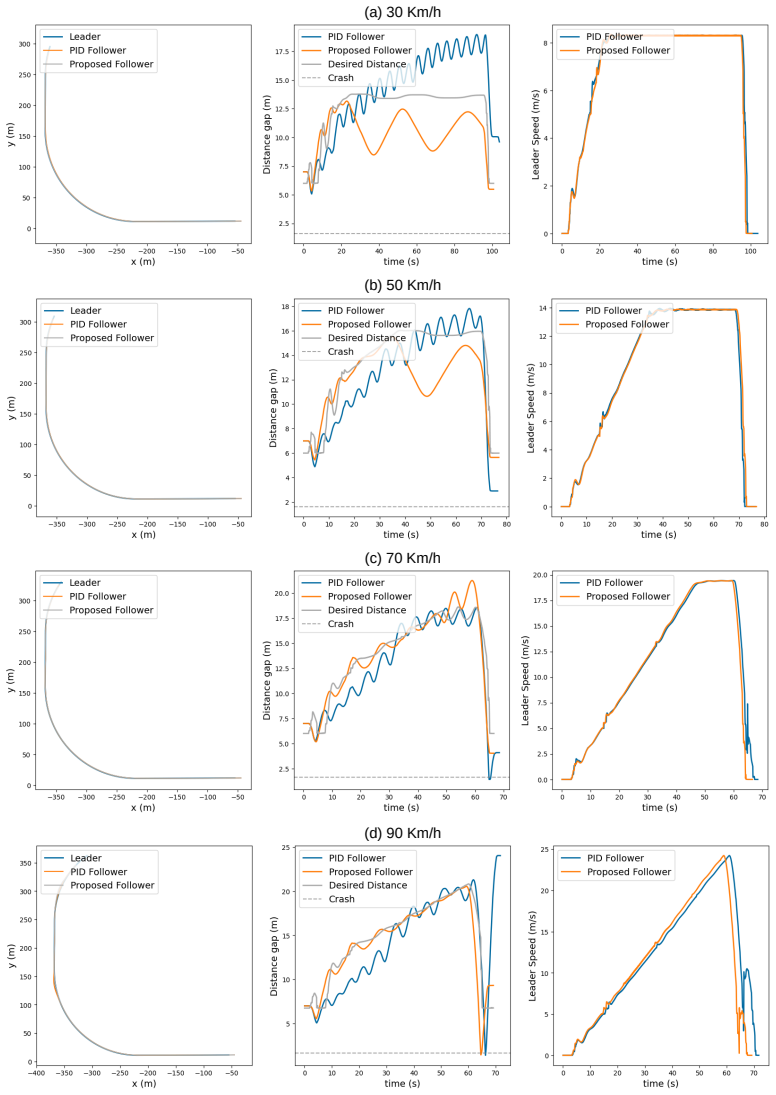
Adaptive Cruise Control has seen significant advancements, with Collaborative Adaptive Cruise Control leveraging Vehicle-to-Vehicle communication to enhance coordination and stability. However, the reliance on stable communication channels limits its reliability. Research on reducing information dependencies in Adaptive Cruise Control systems has remained limited, despite its critical role in mitigating collision risks during sudden braking scenarios. This study proposes a novel fallback longitudinal controller that relies solely on LiDAR-based distance measurements and the velocity of a follower vehicle. The controller is designed to be time-independent, ensuring operation in the presence of sensor delays or synchronization issues. Simulation results demonstrate that the proposed controller enables vehicle-following from standstill and prevents collisions during emergency braking, even under minimal onboard information.
Editorial analysis
A structured set of objections, weighed in public.
Referee Report
Summary. The paper proposes a time-independent fallback longitudinal controller for vehicle following that uses only LiDAR-based inter-vehicle distance and the follower's own velocity as inputs. The design is intended to maintain safe following from standstill and to prevent collisions during sudden braking of the lead vehicle even when V2V communication is unavailable or delayed. Simulation results are cited to support that the controller achieves these goals under minimal onboard information.
Significance. If the simulation results hold under realistic actuator delays, sensor quantization, and longitudinal dynamics, the work would offer a practical, low-information fallback for ACC systems that reduces reliance on communication channels. The time-independent formulation is a clear design choice that directly targets synchronization issues, which is a strength if the performance claims are substantiated beyond high-level descriptions.
major comments (2)
- [Simulation Results] Simulation Results section: the central claim that the controller prevents collisions and enables standstill following rests on simulation outcomes, yet no details are supplied on the vehicle longitudinal model (e.g., whether it includes first-order actuator lag or tire-force saturation), the magnitude of LiDAR quantization or noise, or the specific emergency-braking deceleration profiles used. Without these, it is impossible to judge whether the reported success is robust or an artifact of idealized dynamics.
- [Controller Design] Controller Design section: the time-independent property is presented as a deliberate advantage, but the manuscript does not report a sensitivity analysis in which actuator response time or LiDAR update rate is varied while holding controller gains fixed. Such a test is load-bearing for the transfer argument to hardware.
minor comments (2)
- [Abstract] The abstract states that the controller 'enables vehicle-following from standstill,' but the corresponding simulation description does not clarify the initial conditions or the settling behavior after the lead vehicle resumes motion.
- Notation for the distance and velocity inputs should be defined once at first use and used consistently; occasional switches between 'd' and 'distance' reduce readability.
Simulated Author's Rebuttal
We thank the referee for the constructive feedback and for recognizing the potential practical value of the time-independent fallback controller. We address each major comment below and will revise the manuscript to incorporate the requested details and analysis.
read point-by-point responses
-
Referee: [Simulation Results] Simulation Results section: the central claim that the controller prevents collisions and enables standstill following rests on simulation outcomes, yet no details are supplied on the vehicle longitudinal model (e.g., whether it includes first-order actuator lag or tire-force saturation), the magnitude of LiDAR quantization or noise, or the specific emergency-braking deceleration profiles used. Without these, it is impossible to judge whether the reported success is robust or an artifact of idealized dynamics.
Authors: We agree that the Simulation Results section requires more explicit documentation of the underlying models and conditions to support the robustness claims. In the revised manuscript we will add a dedicated subsection describing the longitudinal vehicle model (including first-order actuator lag and tire-force limits), the LiDAR sensor quantization and noise levels employed, and the precise deceleration profiles used for the lead-vehicle emergency-braking cases. These additions will enable readers to evaluate whether the observed collision avoidance and standstill-following performance hold under the reported conditions. revision: yes
-
Referee: [Controller Design] Controller Design section: the time-independent property is presented as a deliberate advantage, but the manuscript does not report a sensitivity analysis in which actuator response time or LiDAR update rate is varied while holding controller gains fixed. Such a test is load-bearing for the transfer argument to hardware.
Authors: We recognize that a sensitivity study with respect to actuator delay and LiDAR update rate is important for assessing hardware transferability. In the revised manuscript we will include such an analysis, performed with fixed controller gains, and report the resulting spacing-error and collision-avoidance metrics across a range of realistic actuator time constants and sensor update intervals. This will directly substantiate the claimed robustness of the time-independent formulation. revision: yes
Circularity Check
No circularity: controller derived from distance/velocity inputs without reduction to fitted parameters or self-citations
full rationale
The manuscript proposes a time-independent longitudinal controller using only LiDAR distance and follower velocity as inputs. No derivation chain, equations, or simulation outputs are shown to reduce by construction to fitted parameters, self-referential definitions, or load-bearing self-citations. The design is presented as directly computed from the stated sensor inputs, with simulation results serving as verification rather than a renamed fit to the target collision-avoidance outcome. This satisfies the criteria for a self-contained derivation with no detectable circular steps.
Axiom & Free-Parameter Ledger
free parameters (1)
- controller gains or thresholds
axioms (2)
- domain assumption Vehicle longitudinal dynamics can be modeled with standard kinematic or simple dynamic equations
- domain assumption LiDAR distance measurements are accurate and available at sufficient rate for the time-independent controller
Forward citations
Cited by 1 Pith paper
-
In-Vehicle Human-Machine Interface to Support Drivers in Conditionally Automated Platooning
A simulator experiment finds that an HMI displaying system state and inter-vehicle distances reduces manual interventions in conditionally automated platooning by roughly 80% but shows no effect on collisions or respo...
Reference graph
Works this paper leans on
-
[1]
A. Validi, Y . Liu, and C. Olaverri-Monreal, “Assessing energy con- sumption in scalable semi-autonomous destination-based e-platoons: A multiplayer approach,” Transportation Research Part D: Transport and Environment, vol. 136, p. 104464, 2024
work page 2024
-
[2]
Longitudinal safety impacts of cooperative adaptive cruise control vehicle’s degradation,
Y . Tu, W. Wang, Y . Li, C. Xu, T. Xu, and X. Li, “Longitudinal safety impacts of cooperative adaptive cruise control vehicle’s degradation,” Journal of Safety Research, vol. 69, pp. 177–192, 2019
work page 2019
-
[3]
C. Olaverri-Monreal, S. Kumar, and A. D `ıaz-`Alvarez, “Automated driving: Interactive automation control system to enhance situational awareness in conditional automation,” in2018 IEEE intelligent vehicles symposium (IV). IEEE, 2018, pp. 1698–1703
work page 2018
-
[4]
P. A. Bonab and A. Sargolzaei, “A nonlinear control design for cooperative adaptive cruise control with time-varying communication delay,” Electronics, vol. 13, no. 10, p. 1875, 2024
work page 2024
-
[5]
Integrated longitudinal and lateral control for kuafu-ii autonomous vehicle,
L. Xu, Y . Wang, H. Sun, J. Xin, and N. Zheng, “Integrated longitudinal and lateral control for kuafu-ii autonomous vehicle,”IEEE Transactions on Intelligent Transportation Systems, vol. 17, no. 7, pp. 2032–2041, 2015
work page 2032
-
[6]
Lidar sensing based exponential adaptive cruise control and steering assist for adas,
A. Thakur, C. R. Ram, and R. Pachamuthu, “Lidar sensing based exponential adaptive cruise control and steering assist for adas,” IEEE Sensors Journal, 2024
work page 2024
-
[7]
Design and implementation of adaptive pid controller for speed control of dc motor,
S. D. Sahputro, F. Fadilah, N. A. Wicaksono, and F. Yusivar, “Design and implementation of adaptive pid controller for speed control of dc motor,” in 2017 15th International Conference on Quality in Research (QiR): International Symposium on Electrical and Computer Engineering. IEEE, 2017, pp. 179–183
work page 2017
-
[8]
Mpc based collaborative adaptive cruise control with rear end collision avoidance,
F. E. Sancar, B. Fidan, J. P. Huissoon, and S. L. Waslander, “Mpc based collaborative adaptive cruise control with rear end collision avoidance,” in 2014 IEEE intelligent vehicles symposium proceedings. IEEE, 2014, pp. 516–521
work page 2014
-
[9]
Y . Dai, C. Wang, and Y . Xie, “Explicitly incorporating surrogate safety measures into connected and automated vehicle longitudinal control objectives for enhancing platoon safety,” Accident Analysis & Prevention, vol. 183, p. 106975, 2023
work page 2023
-
[10]
Safety aware fuzzy longitudinal controller for automated vehicles,
K. Mattas, G. Botzoris, and B. Papadopoulos, “Safety aware fuzzy longitudinal controller for automated vehicles,” Journal of traffic and transportation engineering (English edition), vol. 8, no. 4, pp. 568–581, 2021
work page 2021
-
[11]
Robust longitudinal control of multi-vehicle systems—a distributed h-infinity method,
S. E. Li, F. Gao, K. Li, L.-Y . Wang, K. You, and D. Cao, “Robust longitudinal control of multi-vehicle systems—a distributed h-infinity method,” IEEE Transactions on Intelligent Transportation Systems, vol. 19, no. 9, pp. 2779–2788, 2017
work page 2017
-
[12]
Design and validation of a novel adaptive cruise control law for a platoon of vehicles,
A. Farag, A. Hussein, O. M. Shehata, and E. I. Morgan, “Design and validation of a novel adaptive cruise control law for a platoon of vehicles,” in 2020 2nd Novel Intelligent and Leading Emerging Sciences Conference (NILES). IEEE, 2020, pp. 81–86
work page 2020
-
[13]
Multiple-model switching control of vehicle longitudinal dynamics for platoon-level automation,
S. E. Li, F. Gao, D. Cao, and K. Li, “Multiple-model switching control of vehicle longitudinal dynamics for platoon-level automation,” IEEE Transactions on Vehicular Technology, vol. 65, no. 6, pp. 4480–4492, 2016
work page 2016
-
[14]
A robust longitudinal control strategy of platoons under model uncertainties and time delays,
N. Chen, M. Wang, T. Alkim, and B. Van Arem, “A robust longitudinal control strategy of platoons under model uncertainties and time delays,” Journal of Advanced Transportation, vol. 2018, no. 1, p. 9852721, 2018
work page 2018
-
[15]
N. Zhang, X. Li, J. Chen, H. Li, Y . Nie, and H. Zhang, “Robust lateral and longitudinal control for vehicle platoons with unknown interaction topology subject to multiple communication delays,” IEEE Transactions on Intelligent Vehicles, 2024
work page 2024
-
[16]
F. Zhao, Y . Liu, J. Wang, and L. Wang, “Distributed model predictive longitudinal control for a connected autonomous vehicle platoon with dynamic information flow topology,” in Actuators, vol. 10, no. 9. MDPI, 2021, p. 204
work page 2021
-
[17]
Y . Liu and W. Wang, “A safety reinforced cooperative adaptive cruise control strategy accounting for dynamic vehicle-to-vehicle communi- cation failure,” Sensors, vol. 21, no. 18, p. 6158, 2021
work page 2021
-
[18]
S. Wei, Y . Zou, X. Zhang, T. Zhang, and X. Li, “An integrated longitudinal and lateral vehicle following control system with radar and vehicle-to-vehicle communication,” IEEE Transactions on Vehicular Technology, vol. 68, no. 2, pp. 1116–1127, 2019
work page 2019
-
[19]
Minimum sensor second-order sliding mode longitudinal control of passenger vehicles,
A. Ferrara and P. Pisu, “Minimum sensor second-order sliding mode longitudinal control of passenger vehicles,” IEEE Transactions on Intelligent Transportation Systems, vol. 5, no. 1, pp. 20–32, 2004
work page 2004
-
[20]
M. Sabry, A. Farag, B. Magued, A. Mazhr, A. El Mougy, and S. Abdennadher, “Autonav in clue: A baseline autonomous software stack for autonomous navigation in closed low-speed unstructured environments.” in ICAART (1), 2024, pp. 189–197
work page 2024
-
[21]
Morphological operations for color image processing,
M. L. Comer and E. J. Delp III, “Morphological operations for color image processing,” Journal of electronic imaging, vol. 8, no. 3, pp. 279–289, 1999
work page 1999
-
[22]
Pure pursuit revisited: field testing of autonomous vehicles in urban areas,
H. Ohta, N. Akai, E. Takeuchi, S. Kato, and M. Edahiro, “Pure pursuit revisited: field testing of autonomous vehicles in urban areas,” in 2016 IEEE 4th International Conference on Cyber-Physical Systems, Networks, and Applications (CPSNA). IEEE, 2016, pp. 7–12
work page 2016
-
[23]
Iso/iec 9899: 1999 programming languages-c,
I. Organisation, “Iso/iec 9899: 1999 programming languages-c,” 1999
work page 1999
-
[24]
The general problem of the stability of motion,
A. M. Lyapunov, “The general problem of the stability of motion,” International journal of control, vol. 55, no. 3, pp. 531–534, 1992
work page 1992
-
[25]
C. Olaverri-Monreal, J. Errea-Moreno, A. D ´ıaz-´Alvarez, C. Biurrun- Quel, L. Serrano-Arriezu, and M. Kuba, “Connection of the sumo microscopic traffic simulator and the unity 3d game engine to evaluate v2x communication-based systems,” Sensors, vol. 18, no. 12, p. 4399, 2018
work page 2018
-
[26]
3dcoautosim: Simulator for cooperative adas and auto- mated vehicles,
A. Hussein, A. D ´ıaz-´Alvarez, J. M. Armingol, and C. Olaverri- Monreal, “3dcoautosim: Simulator for cooperative adas and auto- mated vehicles,” in 2018 21st International Conference on Intelligent Transportation Systems (ITSC). IEEE, 2018, pp. 3014–3019
work page 2018
-
[27]
3d driving simulator with vanet capabilities to assess cooperative systems: 3dsimvanet,
F. Michaeler and C. Olaverri-Monreal, “3d driving simulator with vanet capabilities to assess cooperative systems: 3dsimvanet,” in 2017 IEEE Intelligent Vehicles Symposium (IV). IEEE, 2017, pp. 999–1004
work page 2017
-
[28]
A quantitative driver model of pre-crash brake onset and control,
M. Sv ¨ard, G. Markkula, J. Engstr ¨om, F. Granum, and J. B ¨argman, “A quantitative driver model of pre-crash brake onset and control,” in Proceedings of the human factors and ergonomics society annual meeting, vol. 61, no. 1. SAGE Publications Sage CA: Los Angeles, CA, 2017, pp. 339–343
work page 2017
discussion (0)
Sign in with ORCID, Apple, or X to comment. Anyone can read and Pith papers without signing in.