Information bottleneck for learning the phase space of dynamics from high-dimensional experimental data
Pith reviewed 2026-07-01 09:22 UTC · model grok-4.3
The pith
DySIB recovers the two-dimensional phase space of a pendulum from high-dimensional video data using an information bottleneck in latent space.
A machine-rendered reading of the paper's core claim, the machinery that carries it, and where it could break.
Core claim
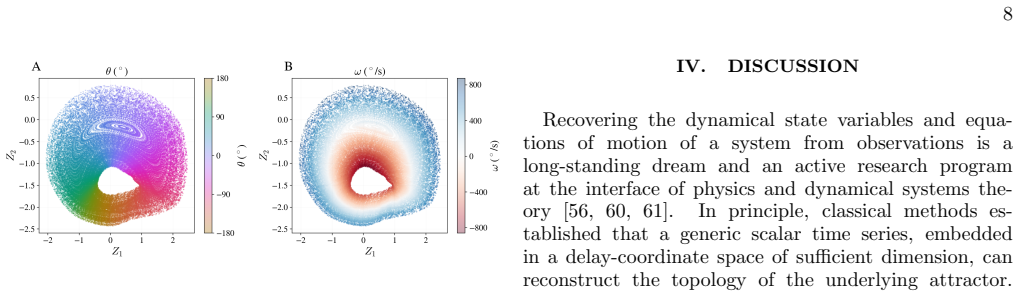
DySIB recovers a two-dimensional representation that matches the dimensionality, topology, and geometry of the pendulum phase space, with the learned coordinates aligning smoothly with the canonical angle and angular velocity, when the hyperparameters of the learning architecture are set self-consistently by the data.
What carries the argument
The Dynamical Symmetric Information Bottleneck (DySIB), which maximizes predictive mutual information between past and future observation windows while penalizing representation complexity, all in latent space.
If this is right
- The method identifies dynamical state variables from high-dimensional observations without any supervision or reconstruction of the data.
- Hyperparameters can be determined self-consistently by the data itself rather than through manual tuning.
- The recovered latent coordinates align with physically meaningful quantities like angle and angular velocity.
- The approach works on experimental data from a well-characterized system where the phase space is known a priori.
Where Pith is reading between the lines
- If the method succeeds on the pendulum, it may extend to other physical systems with unknown phase spaces by using the same predictive information objective.
- Combining DySIB with other latent space techniques could help handle more complex or higher-dimensional dynamics.
- The emphasis on predictive mutual information suggests it could apply to forecasting tasks in addition to state identification.
Load-bearing premise
That maximizing predictive mutual information between past and future observation windows in latent space while penalizing representation complexity recovers the true underlying dynamical coordinates without supervision.
What would settle it
Observing that the learned two-dimensional representation from the pendulum video data fails to match the known phase space in dimensionality, topology, or geometry, or that the coordinates do not align with angle and angular velocity.
Figures



read the original abstract
Identifying the dynamical state variables of a system from high-dimensional observations is a central problem across physical sciences. The challenge is that the state variables are not directly observable and must be inferred from raw high-dimensional data without supervision. Here we introduce DySIB (Dynamical Symmetric Information Bottleneck) as a method to learn low-dimensional representations of time-series data by maximizing predictive mutual information between past and future observation windows while penalizing representation complexity. This objective operates entirely in latent space and avoids reconstruction of the observations. We apply DySIB to an experimental video dataset of a physical pendulum, where the underlying state space is known. The method, with hyperparameters of the learning architecture set self-consistently by the data, recovers a two-dimensional representation that matches the dimensionality, topology, and geometry of the pendulum phase space, with the learned coordinates aligning smoothly with the canonical angle and angular velocity. These results demonstrate, on a well-characterized experimental system, that predictive information in latent space can be used to recover interpretable dynamical coordinates directly from high-dimensional data.
Editorial analysis
A structured set of objections, weighed in public.
Referee Report
Summary. The manuscript introduces DySIB (Dynamical Symmetric Information Bottleneck), a method to learn low-dimensional latent representations of time-series data by maximizing predictive mutual information between past and future observation windows in latent space while penalizing representation complexity, without any reconstruction loss or supervision. Applied to an experimental video dataset of a physical pendulum (where the ground-truth 2D phase space is known a priori), the method—with architecture hyperparameters set self-consistently from the data—recovers a two-dimensional representation whose dimensionality, topology, geometry, and coordinate alignment match the canonical angle and angular velocity.
Significance. If the central claim holds under quantitative scrutiny, the work would represent a meaningful contribution to unsupervised discovery of dynamical coordinates from high-dimensional experimental observations. The information-bottleneck objective operating entirely in latent space, combined with the use of a system whose phase space is independently known, provides an external test of whether predictive mutual information alone can recover interpretable state variables; this is a strength relative to purely reconstruction-based or supervised approaches.
major comments (2)
- [Abstract / Results] Abstract and Results: the central claim that the learned coordinates 'align smoothly with the canonical angle and angular velocity' and match 'geometry' is stated qualitatively, but the manuscript provides no quantitative metrics (e.g., Pearson correlation, mutual information, or reconstruction error between learned and ground-truth coordinates) or statistical tests of alignment. This absence leaves the support for the strongest claim preliminary.
- [Methods] Methods: the estimation procedure for predictive mutual information in latent space and the precise form of the complexity penalty are not specified with sufficient detail (e.g., no equations for the variational bounds or the self-consistent hyperparameter selection rule), making it impossible to assess whether the reported success is robust or sensitive to implementation choices.
minor comments (2)
- [Experimental setup] The manuscript should include a clear statement of the precise experimental video resolution, frame rate, and preprocessing steps applied to the pendulum dataset.
- [Figures] Figure captions should explicitly state the number of independent training runs and any error bars or variability measures shown.
Simulated Author's Rebuttal
We thank the referee for their constructive comments and positive evaluation of the potential significance of our work. We address each of the major comments below and will revise the manuscript accordingly to provide quantitative metrics and additional methodological details.
read point-by-point responses
-
Referee: [Abstract / Results] Abstract and Results: the central claim that the learned coordinates 'align smoothly with the canonical angle and angular velocity' and match 'geometry' is stated qualitatively, but the manuscript provides no quantitative metrics (e.g., Pearson correlation, mutual information, or reconstruction error between learned and ground-truth coordinates) or statistical tests of alignment. This absence leaves the support for the strongest claim preliminary.
Authors: We agree that the current presentation of the alignment is qualitative and that quantitative metrics would provide stronger support for the claim. In the revised manuscript, we will add Pearson correlation coefficients between the learned latent coordinates and the ground-truth angle and angular velocity, as well as mutual information between them. We will also include a quantitative measure of geometric alignment, such as the error in reconstructing the phase space topology, and report statistical significance where applicable. revision: yes
-
Referee: [Methods] Methods: the estimation procedure for predictive mutual information in latent space and the precise form of the complexity penalty are not specified with sufficient detail (e.g., no equations for the variational bounds or the self-consistent hyperparameter selection rule), making it impossible to assess whether the reported success is robust or sensitive to implementation choices.
Authors: We acknowledge that the manuscript lacks sufficient detail on the implementation. The revised version will include the explicit variational bounds used for estimating the predictive mutual information in latent space, the mathematical form of the complexity penalty, and the equations governing the self-consistent selection of architecture hyperparameters from the data. This will allow readers to fully reproduce and assess the robustness of the results. revision: yes
Circularity Check
No significant circularity
full rationale
The DySIB method is defined independently via maximization of predictive mutual information between past and future windows in latent space plus a complexity penalty, with no reconstruction or supervision. This objective does not reference the target pendulum coordinates. Validation occurs on an experimental dataset whose ground-truth phase space (angle and angular velocity) is known a priori and external to the method, allowing direct comparison of recovered dimensionality, topology, geometry, and alignment. No equations or steps reduce by construction to the inputs, no fitted parameters are relabeled as predictions, and no load-bearing claims rely on self-citation chains. The derivation chain is therefore self-contained against external benchmarks.
Axiom & Free-Parameter Ledger
free parameters (1)
- hyperparameters of the learning architecture
axioms (1)
- domain assumption Predictive mutual information in latent space captures the essential dynamical state variables.
Forward citations
Cited by 1 Pith paper
-
Contrast encodes inductive bias: separating slow noise from dynamics in predictive representation learning
Cross-trajectory negative sampling in contrastive predictive objectives causes encoding of slow noise over dynamics; intra-trajectory sampling eliminates the shortcut and recovers dynamical variables even under strong noise.
discussion (0)
Sign in with ORCID, Apple, or X to comment. Anyone can read and Pith papers without signing in.