REVIEW 3 minor 1 cited by
Mass-ratio reversal in isolated binaries produces GW241011-like systems as an alternative to hierarchical mergers.
Reviewed by Pith at T0; open to challenge. T0 means a machine referee read the full paper against a public rubric. the ladder, T0–T4 →
T0 review · grok-4.3
2026-06-29 03:10 UTC pith:3NG4IJ7R
load-bearing objection MRR can explain GW241011 under some binary-evolution assumptions, but the abstract leaves the actual rates and model robustness unclear.
Mass-Ratio Reversal as an Alternative to Hierarchical Mergers for GW241011
The pith
A machine-rendered reading of the paper's core claim, the machinery that carries it, and where it could break.
Core claim
The mass-ratio reversal channel in isolated binary evolution can generate binary black hole mergers with mass ratios around 0.3 and large effective spins matching GW241011, provided the models adopt particular prescriptions for stellar winds, mass transfer, and common-envelope evolution; this pathway therefore supplies a viable alternative to hierarchical mergers, which are disfavored by recoil and mass-ratio statistics.
What carries the argument
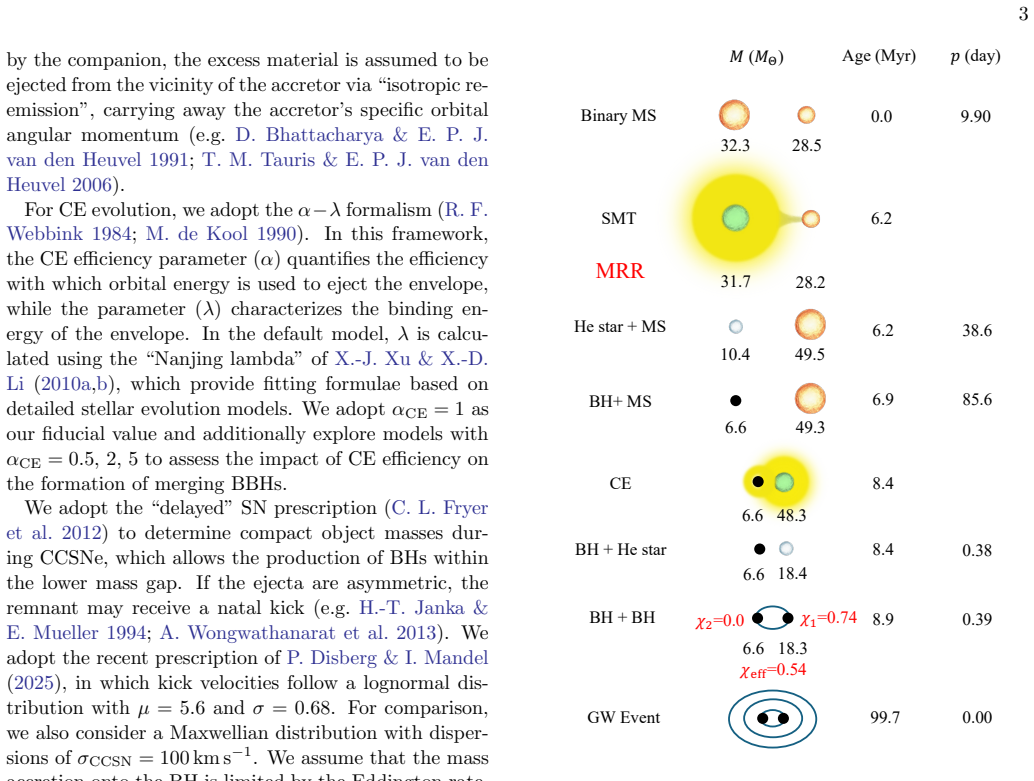
Mass-ratio reversal (MRR) channel, the process in which mass transfer reverses the initial mass ordering so the originally lighter star becomes the more massive black hole.
Load-bearing premise
The population-synthesis models used accurately represent the dominant uncertainties in stellar winds, mass transfer, and common-envelope evolution without requiring post-hoc tuning to match the target event.
What would settle it
Detection of a statistically large sample of extreme-mass-ratio, high-spin mergers whose host environments or delay times are inconsistent with isolated binary evolution would falsify the MRR explanation for GW241011-like events.
If this is right
- MRR supplies a pathway for extreme mass-ratio high-spin BBHs without requiring dense dynamical environments.
- Success of the channel depends on specific choices for stellar-wind strength and common-envelope efficiency.
- The same models that produce GW241011-like systems also constrain the allowed range of binary-interaction parameters.
- Hierarchical-merger explanations become less necessary once isolated channels are shown to reach the observed parameter space.
Where Pith is reading between the lines
- If MRR operates efficiently, the fraction of isolated binaries contributing to the observed high-spin, extreme-ratio population may be larger than current estimates assume.
- Future events with similar parameters but measured formation redshifts could distinguish MRR from hierarchical channels via delay-time distributions.
- Refining population-synthesis codes to track mass reversal explicitly would allow direct comparison of predicted rates against the growing GW catalog.
Editorial analysis
A structured set of objections, weighed in public.
Referee Report
Summary. The manuscript investigates the mass-ratio reversal (MRR) channel within isolated binary evolution as a formation pathway for GW241011-like binary black hole mergers, which exhibit an extreme mass ratio of ~0.3 and large effective spin. Using population-synthesis calculations across a range of binary-evolution models, the authors quantify formation probabilities, identify dependencies on stellar winds, mass transfer, and common-envelope evolution, and conclude that MRR provides a viable alternative to hierarchical mergers under certain conditions while constraining binary-evolution physics.
Significance. If the probability quantifications and model dependencies hold, the work supplies a concrete alternative channel for explaining GW events with extreme mass ratios that hierarchical mergers struggle to produce due to recoil kicks, thereby helping to constrain uncertain aspects of stellar and binary physics such as wind mass loss and envelope ejection efficiency.
minor comments (3)
- The abstract refers to 'quantifying the probability' and 'identifying key dependencies' but does not preview specific numerical results or model variants; adding a brief summary of the highest-probability model outcomes in the abstract would improve accessibility.
- Notation for effective spin (χ_eff) and mass ratio is introduced without an explicit definition or reference to the standard LIGO/Virgo conventions used in the GW241011 parameter estimation; a short footnote or sentence in §2 would clarify this.
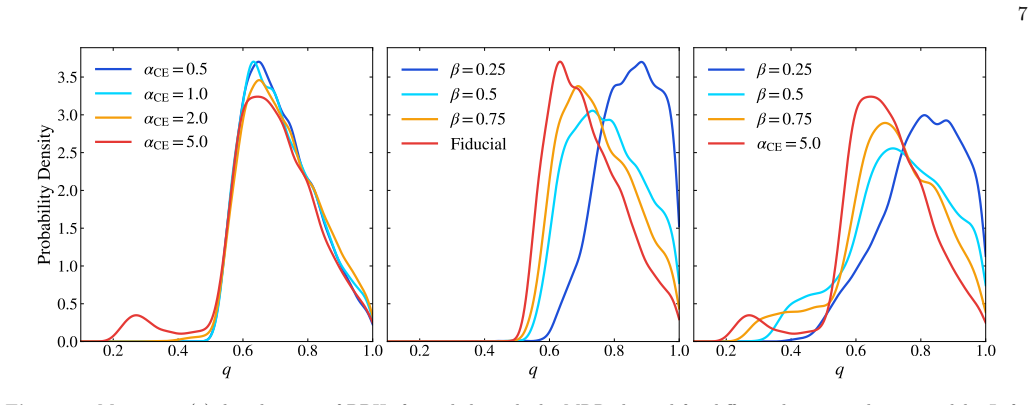
- Figure captions (where population-synthesis results are shown) should explicitly state the number of simulated binaries per model and the selection criteria for 'GW241011-like' events to allow direct assessment of statistical robustness.
Simulated Author's Rebuttal
We thank the referee for their positive assessment of our manuscript and the recommendation for minor revision. No major comments were raised in the report, so we have no specific points requiring response or revision at this stage.
Circularity Check
No significant circularity detected
full rationale
The paper's argument relies on running population-synthesis models drawn from prior literature to quantify formation probabilities for GW241011-like events under the MRR channel. No equation or result is shown to reduce by construction to a parameter fitted from the same target event, no self-citation is invoked as a uniqueness theorem that forces the conclusion, and no ansatz is smuggled via prior work by the same authors. The central claim therefore remains an independent modeling exercise whose validity rests on the external fidelity of the adopted binary-evolution prescriptions rather than on any definitional loop internal to this manuscript.
Axiom & Free-Parameter Ledger
read the original abstract
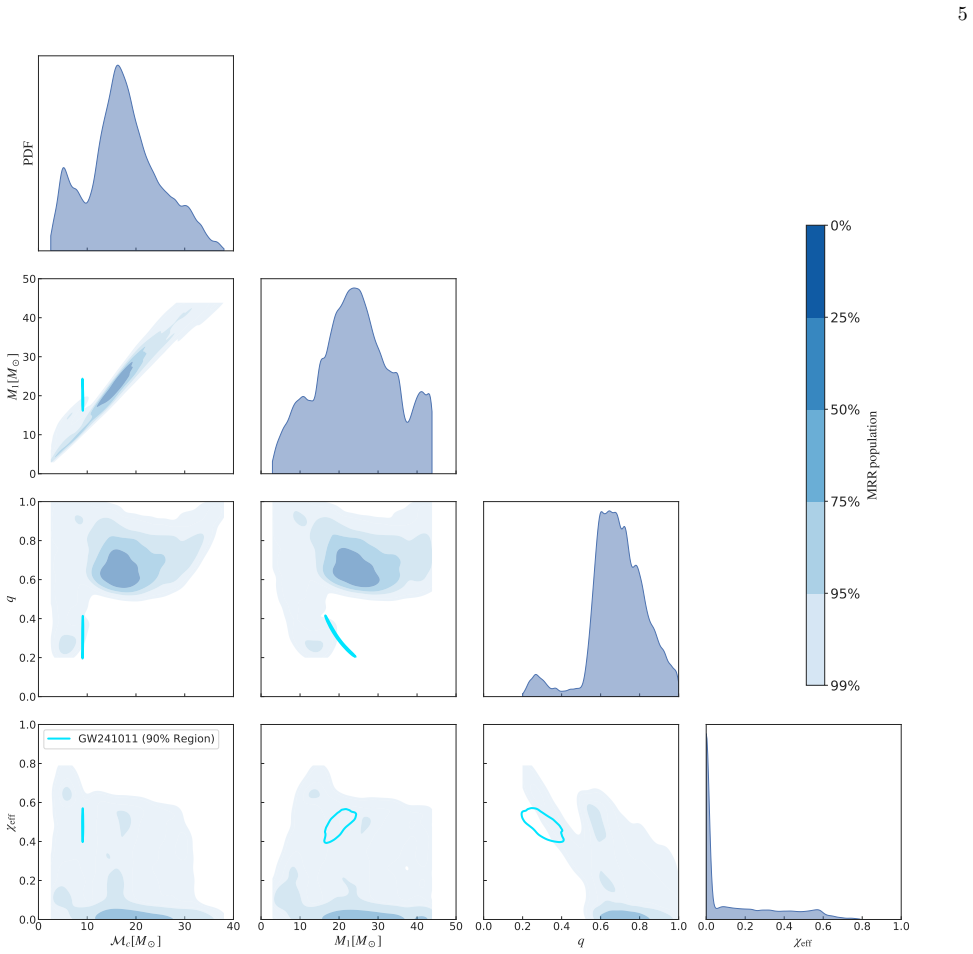
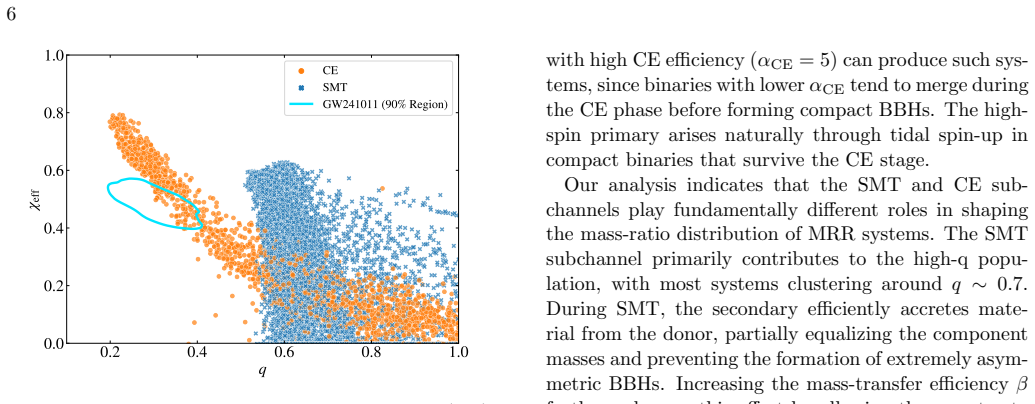
Recent gravitational-wave (GW) observations have revealed binary black hole (BBH) mergers with both extreme mass ratios and large effective spin parameters ($\chi_{\rm{eff}}$). GW241011 is a notable example that shows these properties. Although hierarchical mergers (second-generation + first-generation BHs) can naturally produce high spins, they rarely produce such an extreme mass ratio ($\sim 0.3$), and are further limited by gravitational recoil kicks that can eject the second-generation BH from the host environment. Moreover, recent studies have argued against a dynamical origin for GW241011. Here, we investigate the formation of GW241011-like systems through the mass-ratio reversal (MRR) channel in isolated binary evolution. By quantifying the probability of producing such systems across a range of binary-evolution models, we identify the key dependencies on stellar-evolution and binary-interaction physics. Our results demonstrate the conditions under which the MRR channel can provide a viable alternative to hierarchical mergers and place constraints on the physical processes governing binary evolution.
Figures
Forward citations
Cited by 1 Pith paper
-
Exploring Hierarchical Merger Scenarios for GW241011 and GW241110
GW241011 and GW241110 favor 2G+1G hierarchical-merger models over a fiducial 1G+1G population, with mild AGN-disk preference and one weak optical flare candidate.
Reference graph
Works this paper leans on
-
[1]
G., Abouelfettouh , I., Acernese , F., et al
Abac, A. G., Abouelfettouh, I., Acernese, F., et al. 2025, ApJL, 993, L21, doi: 10.3847/2041-8213/ae0d54
-
[2]
Abbott, R., Abbott, T. D., Abraham, S., et al. 2021, Physical Review X, 11, 021053, doi: 10.1103/PhysRevX.11.021053
-
[3]
2024, , 109, 022001, 10.1103/PhysRevD.109.022001
Abbott, R., Abbott, T. D., Acernese, F., et al. 2024, PhRvD, 109, 022001, doi: 10.1103/PhysRevD.109.022001
-
[4]
Antonini, F., Gieles, M., & Gualandris, A. 2019, MNRAS, 486, 5008, doi: 10.1093/mnras/stz1149
-
[5]
doi:10.1146/annurev.astro.46.060407.145222 , journal =
Asplund, M., Grevesse, N., Sauval, A. J., & Scott, P. 2009, ARA&A, 47, 481, doi: 10.1146/annurev.astro.46.060407.145222
-
[6]
Bavera, S. S., Zevin, M., & Fragos, T. 2021, Research Notes of the American Astronomical Society, 5, 127, doi: 10.3847/2515-5172/ac053c
-
[7]
Bavera, S. S., Fragos, T., Qin, Y., et al. 2020, A&A, 635, A97, doi: 10.1051/0004-6361/201936204
-
[8]
Nature534, 512–515 (2016) https://doi.org/10.1038/nature18322
Belczynski, K., Holz, D. E., Bulik, T., & O’Shaughnessy, R. 2016, Nature, 534, 512, doi: 10.1038/nature18322 8
-
[9]
Belczynski, K., Klencki, J., Fields, C. E., et al. 2020, A&A, 636, A104, doi: 10.1051/0004-6361/201936528
-
[10]
Bhattacharya, D., & van den Heuvel, E. P. J. 1991, PhR, 203, 1, doi: 10.1016/0370-1573(91)90064-S
-
[11]
S., Stevenson, S., & Thrane, E
Broekgaarden, F. S., Stevenson, S., & Thrane, E. 2022, ApJ, 938, 45, doi: 10.3847/1538-4357/ac8879
-
[12]
Broekgaarden, F. S., Berger, E., Neijssel, C. J., et al. 2021, MNRAS, 508, 5028, doi: 10.1093/mnras/stab2716 de Kool, M. 1990, ApJ, 358, 189, doi: 10.1086/168974 de Mink, S. E., Pols, O. R., & Hilditch, R. W. 2007, A&A, 467, 1181, doi: 10.1051/0004-6361:20067007
-
[13]
G., Langer, N., Podsiadlowski, P., & Izzard, R
Detmers, R. G., Langer, N., Podsiadlowski, P., & Izzard, R. G. 2008, A&A, 484, 831, doi: 10.1051/0004-6361:200809371
-
[14]
2025, The Astrophysical Journal Letters, 989, L8, doi: 10.3847/2041-8213/adf286
Disberg, P., & Mandel, I. 2025, ApJL, 989, L8, doi: 10.3847/2041-8213/adf286
-
[15]
doi:10.1088/0004-637X/749/1/91 , keywords =
Fryer, C. L., Belczynski, K., Wiktorowicz, G., et al. 2012, ApJ, 749, 91, doi: 10.1088/0004-637X/749/1/91
-
[16]
2019, title Most Black Holes Are Born Very Slowly Rotating , , 881, L1, 10.3847/2041-8213/ab339b
Fuller, J., & Ma, L. 2019, ApJL, 881, L1, doi: 10.3847/2041-8213/ab339b
-
[17]
Harris, C. R., Millman, K. J., van der Walt, S. J., et al. 2020, Nature, 585, 357, doi: 10.1038/s41586-020-2649-2
-
[18]
2026, ApJ, 999, 102, doi: 10.3847/1538-4357/ae3fa3
Hu, R.-C., & Zhang, B. 2026, ApJ, 999, 102, doi: 10.3847/1538-4357/ae3fa3
-
[19]
2022, ApJ, 928, 163, doi: 10.3847/1538-4357/ac573f
Hu, R.-C., Zhu, J.-P., Qin, Y., et al. 2022, ApJ, 928, 163, doi: 10.3847/1538-4357/ac573f
-
[20]
Hunter, J. D. 2007, Computing in Science & Engineering, 9, 90, doi: 10.1109/MCSE.2007.55
-
[21]
2000, MNRAS, 319, 902, doi: 10.1046/j.1365-8711.2000.03938.x
Hurley, J. R., Pols, O. R., & Tout, C. A. 2000, MNRAS, 315, 543, doi: 10.1046/j.1365-8711.2000.03426.x
-
[22]
Hurley, J. R., Tout, C. A., & Pols, O. R. 2002, MNRAS, 329, 897, doi: 10.1046/j.1365-8711.2002.05038.x
-
[23]
2013, A&A Rv, 21, 59, doi: 10.1007/s00159-013-0059-2
Ivanova, N., Justham, S., Chen, X., et al. 2013, A&A Rv, 21, 59, doi: 10.1007/s00159-013-0059-2
-
[24]
1994, A&A, 290, 496
Janka, H.-T., & Mueller, E. 1994, A&A, 290, 496
1994
-
[25]
2025, arXiv e-prints, arXiv:2512.20965, doi: 10.48550/arXiv.2512.20965
Li, G.-P., & Fan, X.-L. 2025, arXiv e-prints, arXiv:2512.20965, doi: 10.48550/arXiv.2512.20965
-
[26]
Remnant recoil and host environments of GWTC-4.0 binary black-hole mergers
Llobera-Querol, J., Hamilton, E., Singh, N., et al. 2026, arXiv e-prints, arXiv:2604.05492, doi: 10.48550/arXiv.2604.05492
work page internal anchor Pith review Pith/arXiv arXiv doi:10.48550/arxiv.2604.05492 2026
-
[27]
2023, ApJ, 952, 53, doi: 10.3847/1538-4357/acdb74
Ma, L., & Fuller, J. 2023, ApJ, 952, 53, doi: 10.3847/1538-4357/acdb74
-
[28]
Implications of modern mass-loss rates for massive stars
Merritt, J., Stevenson, S., Sander, A., et al. 2025, arXiv e-prints, arXiv:2507.17052, doi: 10.48550/arXiv.2507.17052
work page internal anchor Pith review Pith/arXiv arXiv doi:10.48550/arxiv.2507.17052 2025
-
[29]
J., Vigna-G \'o mez , A., Stevenson, S., et al
Neijssel, C. J., Vigna-G´ omez, A., Stevenson, S., et al. 2019, MNRAS, 490, 3740, doi: 10.1093/mnras/stz2840
-
[30]
2020, A&A Rv, 28, 4, doi: 10.1007/s00159-020-00125-0
Neumayer, N., Seth, A., & B¨ oker, T. 2020, A&A Rv, 28, 4, doi: 10.1007/s00159-020-00125-0
-
[31]
2025, A&A, 695, A117, doi: 10.1051/0004-6361/202451564
Nuijten, M., & Nelemans, G. 2025, A&A, 695, A117, doi: 10.1051/0004-6361/202451564
-
[32]
2021, ApJL, 921, L2, doi: 10.3847/2041-8213/ac2f48 Olejak, A., Belczynski, K., & Ivanova, N
Olejak, A., & Belczynski, K. 2021, ApJL, 921, L2, doi: 10.3847/2041-8213/ac2f48
-
[33]
Petrovic, J., Langer, N., & van der Hucht, K. A. 2005, A&A, 435, 1013, doi: 10.1051/0004-6361:20042368
-
[34]
Phinney, E. S. 1991, ApJL, 380, L17, doi: 10.1086/186163 Portegies Zwart, S. F., McMillan, S. L. W., & Gieles, M. 2010, ARA&A, 48, 431, doi: 10.1146/annurev-astro-081309-130834
-
[35]
2025, A&A, 699, A178, doi: 10.1051/0004-6361/202554603
Qi, S., Song, H., Meynet, G., et al. 2025, A&A, 699, A178, doi: 10.1051/0004-6361/202554603
-
[36]
2018, A&A, 616, A28, doi: 10.1051/0004-6361/201832839
Qin, Y., Fragos, T., Meynet, G., et al. 2018, A&A, 616, A28, doi: 10.1051/0004-6361/201832839
-
[37]
2023, A&A, 671, A62, doi: 10.1051/0004-6361/202244712
Qin, Y., Hu, R.-C., Meynet, G., et al. 2023, A&A, 671, A62, doi: 10.1051/0004-6361/202244712
-
[38]
2019, ApJL, 870, L18, doi: 10.3847/2041-8213/aaf97b
Qin, Y., Marchant, P., Fragos, T., Meynet, G., & Kalogera, V. 2019, ApJL, 870, L18, doi: 10.3847/2041-8213/aaf97b
-
[39]
2022, ApJ, 924, 129, doi: 10.3847/1538-4357/ac3982
Qin, Y., Wang, Y.-Z., Wu, D.-H., Meynet, G., & Song, H. 2022, ApJ, 924, 129, doi: 10.3847/1538-4357/ac3982
-
[40]
2023, ApJL, 942, L32, doi: 10.3847/2041-8213/aca4d3
Renzo, M., Zapartas, E., Justham, S., et al. 2023, ApJL, 942, L32, doi: 10.3847/2041-8213/aca4d3
-
[41]
Riley, J., Agrawal, P., Barrett, J. W., et al. 2022, ApJS, 258, 34, doi: 10.3847/1538-4365/ac416c
-
[42]
L., Zevin , M., Amaro-Seoane , P., et al
Rodriguez, C. L., Zevin, M., Amaro-Seoane, P., et al. 2019, PhRvD, 100, 043027, doi: 10.1103/PhysRevD.100.043027
-
[43]
2016, ApJ, 833, 108, doi: 10.3847/1538-4357/833/1/108
Shao, Y., & Li, X.-D. 2016, ApJ, 833, 108, doi: 10.3847/1538-4357/833/1/108
-
[44]
Smith, T. B., Broekgaarden, F., Levina, S., et al. 2026, arXiv e-prints, arXiv:2605.21580, doi: 10.48550/arXiv.2605.21580
work page internal anchor Pith review Pith/arXiv arXiv doi:10.48550/arxiv.2605.21580 2026
-
[45]
Spruit, H. C. 1999, A&A, 349, 189, doi: 10.48550/arXiv.astro-ph/9907138
work page internal anchor Pith review Pith/arXiv arXiv doi:10.48550/arxiv.astro-ph/9907138 1999
-
[46]
Spruit, H. C. 2002, A&A, 381, 923, doi: 10.1051/0004-6361:20011465
-
[47]
2017, Nature Communications, 8, 14906, doi: 10.1038/ncomms14906
Stevenson, S., Vigna-G´ omez, A., Mandel, I., et al. 2017, Nature Communications, 8, 14906, doi: 10.1038/ncomms14906
-
[48]
2021, in Practice and Experience in Advanced Research Computing 2021: Evolution Across All Dimensions (PEARC ’21) (New
Strande, S., Cai, H., Tatineni, M., & et al. 2021, in Practice and Experience in Advanced Research Computing 2021: Evolution Across All Dimensions (PEARC ’21) (New
2021
-
[49]
York, NY: ACM), doi: 10.1145/3437359.3465588
-
[50]
Tauris, T. M. 2022, ApJ, 938, 66, doi: 10.3847/1538-4357/ac86c8
-
[51]
M., & van den Heuvel, E
Tauris, T. M., & van den Heuvel, E. P. J. 2006, in Compact stellar X-ray sources, ed. W. H. G. Lewin & M. van der
2006
-
[52]
Formation and Evolution of Compact Stellar X-ray Sources
Klis, Vol. 39, 623–665, doi: 10.48550/arXiv.astro-ph/0303456 Team COMPAS: Mandel, I., Riley, J., Boesky, A., et al. 2025, ApJS, 280, 43, doi: 10.3847/1538-4365/adf8d0 9 Team COMPAS: Riley, J., Agrawal, P., Barrett, J. W., et al. 2022, ApJS, 258, 34, doi: 10.3847/1538-4365/ac416c
work page internal anchor Pith review Pith/arXiv arXiv doi:10.48550/arxiv.astro-ph/0303456 2025
-
[53]
1973, Nauchnye Informatsii, 27, 70 van Son, L
Tutukov, A., & Yungelson, L. 1973, Nauchnye Informatsii, 27, 70 van Son, L. A. C., Roy, S. K., Mandel, I., et al. 2025, ApJ, 979, 209, doi: 10.3847/1538-4357/ada14a Vigna-G´ omez, A., Neijssel, C. J., Stevenson, S., et al. 2018, MNRAS, 481, 4009, doi: 10.1093/mnras/sty2463
-
[54]
Vijaykumar, A., Farah, A. M., & Fishbach, M. 2026, ApJL, 999, L30, doi: 10.3847/2041-8213/ae4878
-
[55]
Vink, J. S. 2022, ARA&A, 60, 203, doi: 10.1146/annurev-astro-052920-094949
-
[56]
Waskom, M. L. 2021, Journal of Open Source Software, 6, 3021, doi: 10.21105/joss.03021
-
[57]
Webbink, R. F. 1984, ApJ, 277, 355, doi: 10.1086/161701
-
[58]
2013, A&A, 552, A126, doi: 10.1051/0004-6361/201220636
Wongwathanarat, A., Janka, H.-T., & M¨ uller, E. 2013, A&A, 552, A126, doi: 10.1051/0004-6361/201220636
-
[59]
2010, The Astrophysical Journal, 716, 114, 10.1088/0004-637X/716/1/114
Xu, X.-J., & Li, X.-D. 2010a, ApJ, 716, 114, doi: 10.1088/0004-637X/716/1/114
-
[60]
2010b, ApJ, 722, 1985, doi: 10.1088/0004-637X/722/2/1985
Xu, X.-J., & Li, X.-D. 2010b, ApJ, 722, 1985, doi: 10.1088/0004-637X/722/2/1985
-
[61]
Xu, X.-T., Langer, N., Klencki, J., Wang, C., & Li, X.-D. 2025, arXiv e-prints, arXiv:2512.20054, doi: 10.48550/arXiv.2512.20054
work page internal anchor Pith review doi:10.48550/arxiv.2512.20054 2025
-
[62]
S., Fishbach, M., Kremer, K., & Reina-Campos, M
Ye, C. S., Fishbach, M., Kremer, K., & Reina-Campos, M. 2026, ApJ, 997, 267, doi: 10.3847/1538-4357/ae317f
-
[63]
Zaldarriaga, M., Kushnir, D., & Kollmeier, J. A. 2018, MNRAS, 473, 4174, doi: 10.1093/mnras/stx2577
-
[64]
C., Fragione, G., Kimball, C., & Kalogera, V
Zhang, R. C., Fragione, G., Kimball, C., & Kalogera, V. 2023, ApJ, 954, 23, doi: 10.3847/1538-4357/ace4c1
discussion (0)
Sign in with ORCID, Apple, or X to comment. Anyone can read and Pith papers without signing in.