REVIEW 2 major objections 1 cited by
Lattice QCD determines Mellin moments of pion and kaon unpolarized PDFs using nonlocal Wilson-line operators.
Reviewed by Pith at T0; open to challenge. T0 means a machine referee read the full paper against a public rubric. the ladder, T0–T4 →
T0 review · grok-4.3
2026-06-29 01:46 UTC pith:3H2MQSTI
load-bearing objection First lattice moments for pion and kaon PDFs via nonlocal operators on a single ensemble; checks look reasonable but extrapolation is missing. the 2 major comments →
Mellin Moments of Pion and Kaon Unpolarized PDFs from Nonlocal Operators in Lattice QCD
The pith
A machine-rendered reading of the paper's core claim, the machinery that carries it, and where it could break.
Core claim
We present a first-principles lattice-QCD determination of Mellin moments of the unpolarized pion and kaon parton distribution functions using matrix elements of boosted mesons coupled to nonlocal operators containing a straight Wilson line. The calculation is performed on an Nf=2+1+1 ensemble of maximally twisted-mass fermions with a clover term, with lattice volume 32^3×64, lattice spacing a=0.0934 fm, and pion mass mπ=260 MeV. Matrix elements are computed for hadron momenta P3=0, 0.41, 0.83, 1.25, 1.66, and 2.07 GeV and analyzed within the short-distance factorization framework. Our final results are obtained from combined fits in (P3,z) space at next-to-next-to-leading-order and are quot
What carries the argument
Nonlocal operators containing a straight Wilson line in matrix elements of boosted mesons, analyzed through the short-distance factorization framework.
Load-bearing premise
The short-distance factorization framework remains valid and the perturbative Wilson coefficients at NNLO are sufficiently accurate for the operator-product expansion truncation and coordinate-space fit windows employed on this single ensemble.
What would settle it
An independent lattice calculation using local operators or a different discretization that produces moments differing by more than the quoted uncertainties would falsify the result; likewise, a mismatch with moments extracted from global fits to deep-inelastic scattering data on pions.
If this is right
- The moments allow reconstruction of valence PDFs for the pion and kaon.
- The calculation reveals the size of SU(3) symmetry-breaking effects in these distributions.
- Consistency checks across different perturbative orders and RG improvement support the reliability of the NNLO results.
- Dependence on OPE truncation and fit windows is quantified to assess systematic uncertainties.
Where Pith is reading between the lines
- These lattice moments can serve as benchmarks for phenomenological models of meson structure.
- Future work could extend the method to higher moments or to polarized distributions.
- The approach might be applied to other hadrons once computational resources allow finer lattices and physical quark masses.
Editorial analysis
A structured set of objections, weighed in public.
Referee Report
Summary. The manuscript claims a first-principles lattice-QCD determination of Mellin moments of unpolarized pion and kaon PDFs from matrix elements of boosted mesons coupled to nonlocal straight-Wilson-line operators. The computation uses a single N_f=2+1+1 twisted-mass ensemble (32^3×64, a=0.0934 fm, m_π=260 MeV) with P_3 up to 2.07 GeV; matrix elements are analyzed via short-distance factorization, with explicit studies of OPE truncation, coordinate-space fit windows, NLO vs. NNLO Wilson coefficients, and an RG-improved consistency check. Final results are obtained from combined (P_3,z) fits at NNLO and quoted at μ=2 GeV, together with an SU(3)-breaking study and valence-PDF reconstruction.
Significance. If the short-distance factorization remains valid in the accessed regime, the work adds to lattice meson-PDF determinations by supplying moments extracted from nonlocal operators together with internal perturbative-consistency tests. The explicit variation of OPE truncation order, fit window, and perturbative accuracy (including the RG-improved cross-check) is a methodological strength that improves transparency of the matching procedure.
major comments (2)
- [Abstract] Abstract: the calculation is performed on a single ensemble (a=0.0934 fm, m_π=260 MeV) with no continuum or chiral extrapolation. This is load-bearing for the central claim of a first-principles determination, because discretization effects at P_3 a ≈ 0.97 and quark-mass effects remain unquantified by explicit variation of a or m_π.
- [Abstract] Analysis method (abstract and paragraph describing the analysis): while NLO/NNLO and RG-improved comparisons test perturbative consistency, they do not directly probe the non-perturbative validity of the short-distance factorization assumption itself for the chosen fit windows at the accessed P_3 and z on this ensemble; higher-twist contributions therefore remain uncontrolled.
Simulated Author's Rebuttal
We thank the referee for the careful reading and constructive comments on our manuscript. We address the two major comments point by point below, agreeing that both the single-ensemble limitation and the lack of direct non-perturbative validation of the short-distance factorization should be stated more explicitly.
read point-by-point responses
-
Referee: [Abstract] Abstract: the calculation is performed on a single ensemble (a=0.0934 fm, m_π=260 MeV) with no continuum or chiral extrapolation. This is load-bearing for the central claim of a first-principles determination, because discretization effects at P_3 a ≈ 0.97 and quark-mass effects remain unquantified by explicit variation of a or m_π.
Authors: We agree that the results are obtained on a single ensemble at fixed lattice spacing and pion mass, with no continuum or chiral extrapolation performed. Discretization effects at the highest momenta (P_3 a ≈ 0.97) and quark-mass effects are therefore not quantified by explicit variation. We will revise the abstract to state explicitly that this is a single-ensemble calculation and that the quoted results do not include systematic uncertainties from continuum or chiral extrapolation. A corresponding statement will be added to the conclusions regarding the need for future multi-ensemble studies. revision: yes
-
Referee: [Abstract] Analysis method (abstract and paragraph describing the analysis): while NLO/NNLO and RG-improved comparisons test perturbative consistency, they do not directly probe the non-perturbative validity of the short-distance factorization assumption itself for the chosen fit windows at the accessed P_3 and z on this ensemble; higher-twist contributions therefore remain uncontrolled.
Authors: We agree that the NLO/NNLO and RG-improved comparisons test perturbative consistency but do not directly establish the non-perturbative validity of the short-distance factorization or quantify higher-twist contributions for the chosen fit windows. These checks provide indirect support, yet higher-twist effects remain an uncontrolled systematic uncertainty. We will revise the abstract and the analysis-method paragraph to explicitly acknowledge this limitation and to discuss the assumptions underlying the selected fit windows. revision: yes
Circularity Check
No circularity: direct lattice matrix elements + perturbative matching
full rationale
The paper computes matrix elements of nonlocal operators on a single ensemble, then extracts Mellin moments via short-distance factorization and combined fits in (P3,z) space using NNLO Wilson coefficients. This is a standard numerical extraction; the quoted moments are not equivalent by construction to any fitted input or self-citation. No self-definitional loops, fitted-input predictions, or load-bearing self-citations appear in the derivation chain. The result remains self-contained against external benchmarks.
Axiom & Free-Parameter Ledger
free parameters (2)
- coordinate-space fit window
- OPE truncation order
axioms (2)
- domain assumption Short-distance factorization applies to the nonlocal operators at the accessed lattice distances and momenta.
- domain assumption The maximally twisted-mass clover action on this ensemble provides a valid discretization of QCD for the quantities computed.
read the original abstract
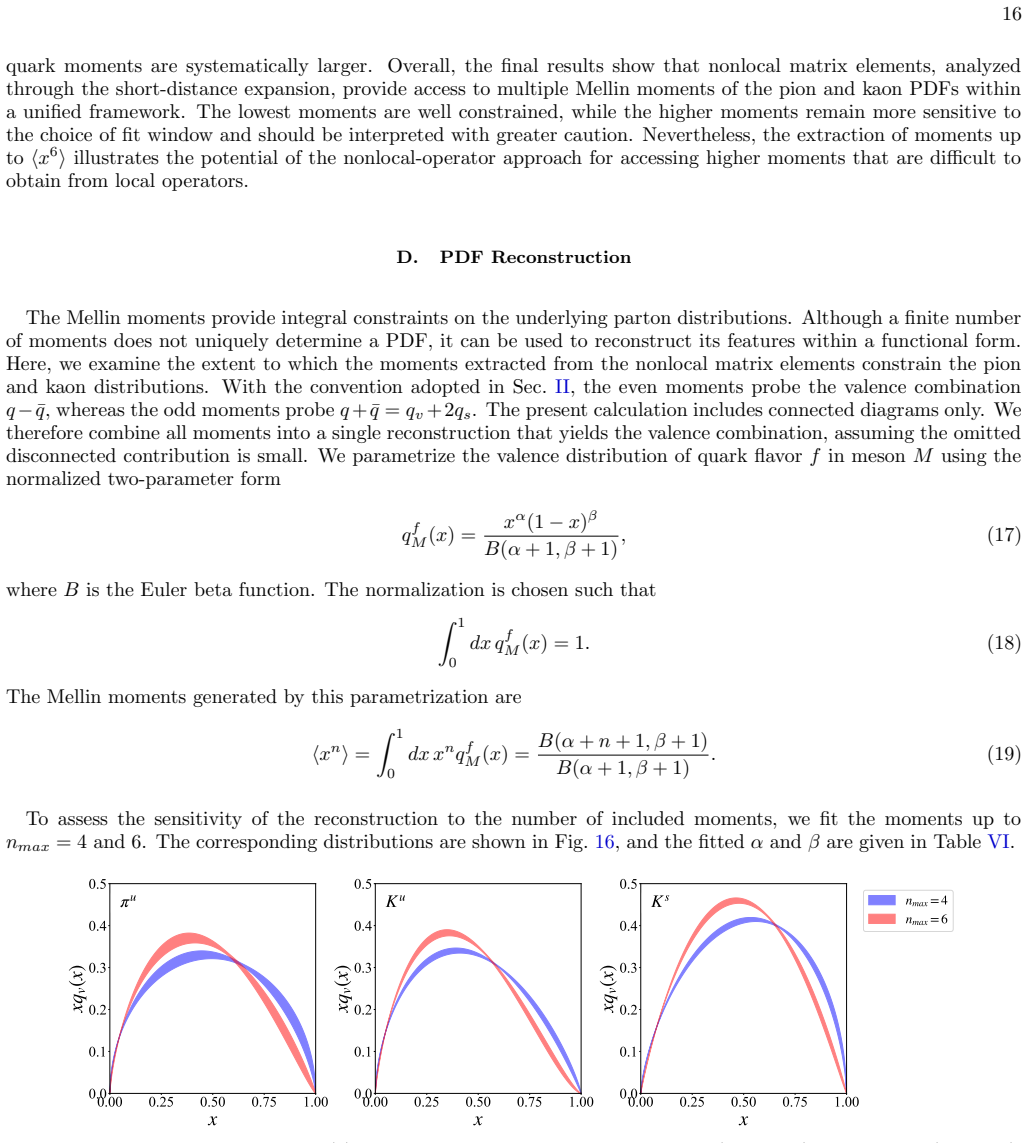
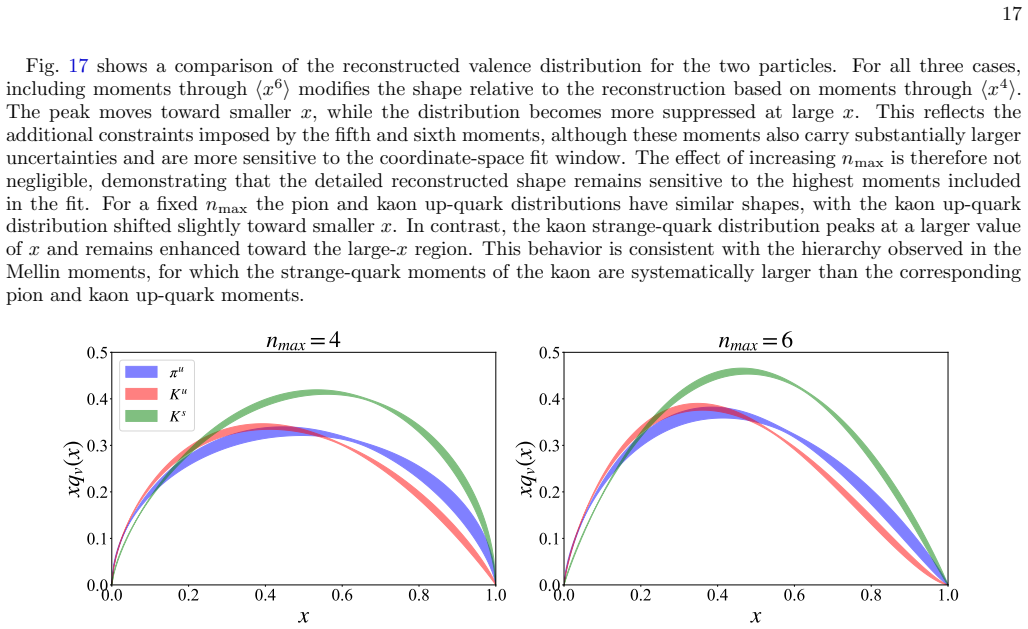
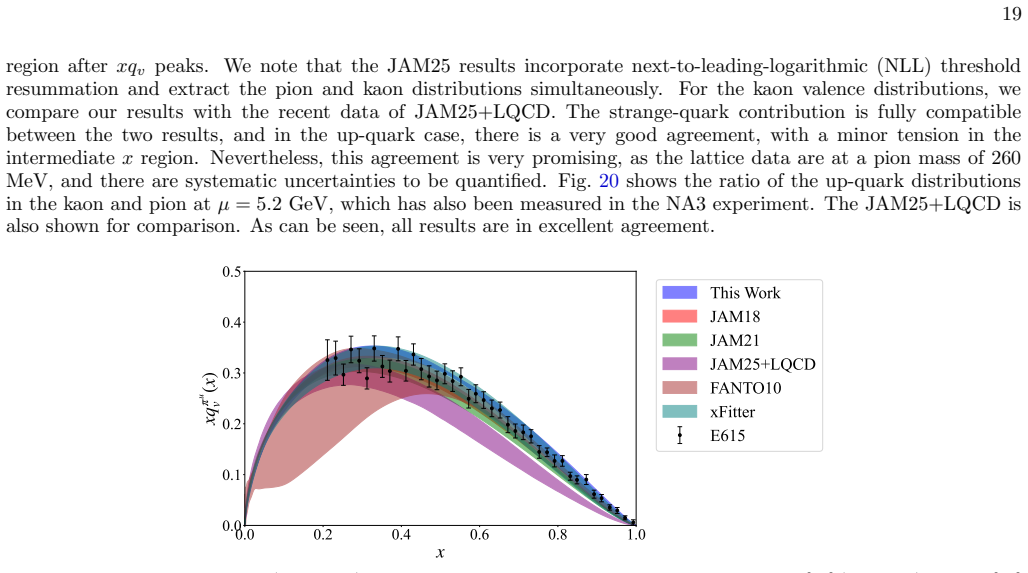
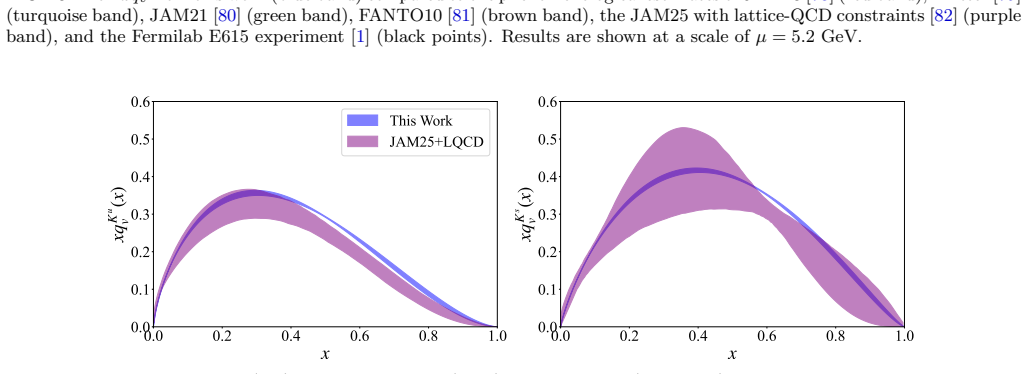
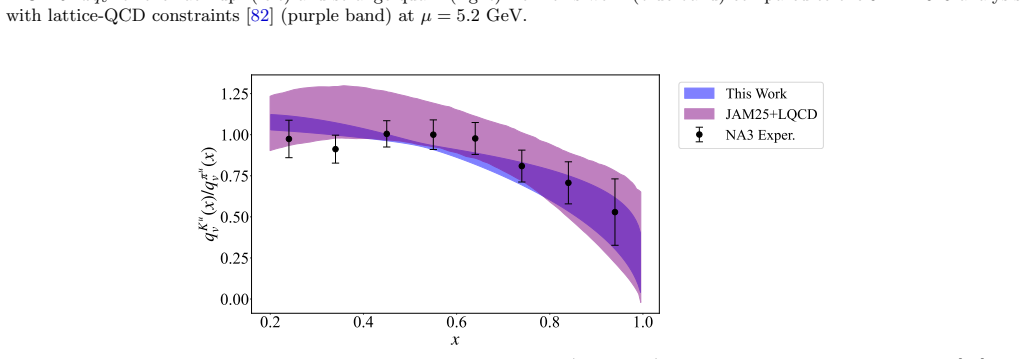
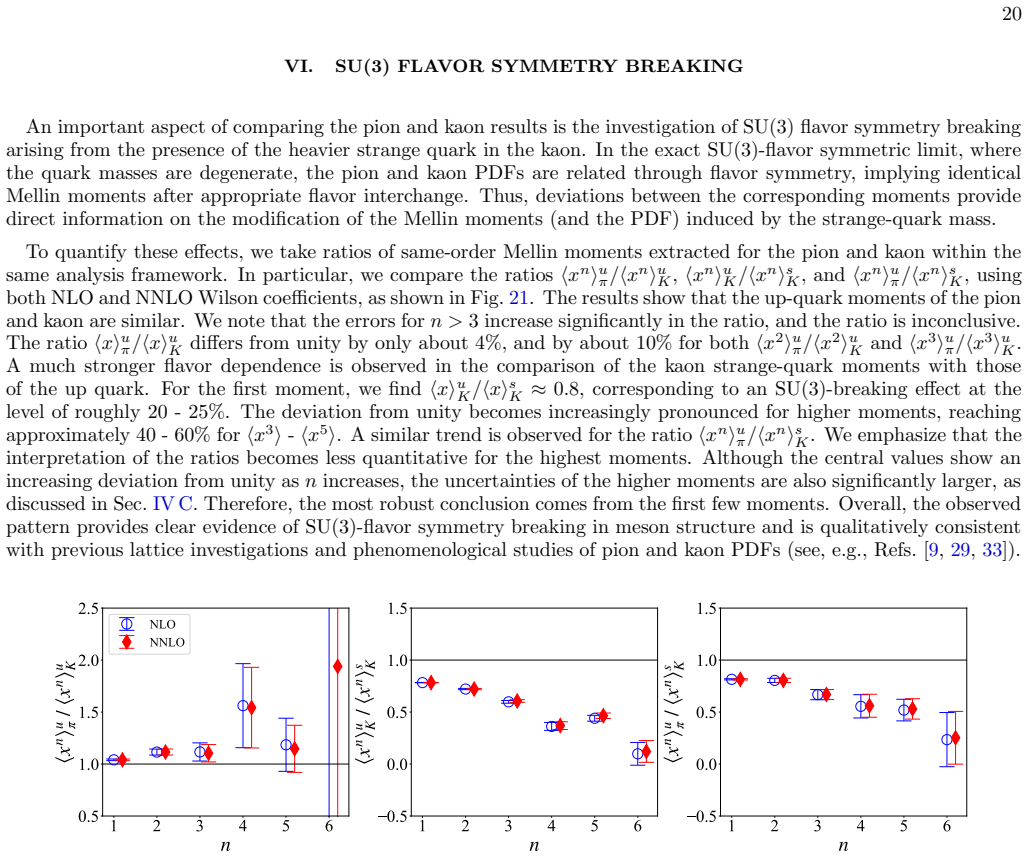
We present a first-principles lattice-QCD determination of Mellin moments of the unpolarized pion and kaon parton distribution functions using matrix elements of boosted mesons coupled to nonlocal operators containing a straight Wilson line. The calculation is performed on an $N_f=2+1+1$ ensemble of maximally twisted-mass fermions with a clover term, with lattice volume $32^3\times64$, lattice spacing $a=0.0934$ fm, and pion mass $m_\pi=260$ MeV. Matrix elements are computed for hadron momenta $P_3=0$, 0.41, 0.83, 1.25, 1.66, and 2.07 GeV and analyzed within the short-distance factorization framework. We investigate the dependence of the extracted moments on the truncation of the operator-product expansion, the coordinate-space fit window, and the perturbative accuracy of the Wilson coefficients, comparing next-to-leading-order and next-to-next-to-leading-order results. We also perform an RG-improved analysis as a consistency check of the perturbative treatment. Our final results are obtained from combined fits in $(P_3,z)$ space at next-to-next-to-leading-order and are quoted at $\mu=2$ GeV. We also study the SU(3) symmetry-breaking effect and reconstruct the valence PDFs from the moments.
Figures
Forward citations
Cited by 1 Pith paper
-
Parton distribution functions from lattice QCD
A review of lattice-QCD approaches to parton distribution functions concludes that the field is moving from feasibility studies to quantitatively controlled calculations.
Reference graph
Works this paper leans on
-
[1]
[52, 64, 65, 76]
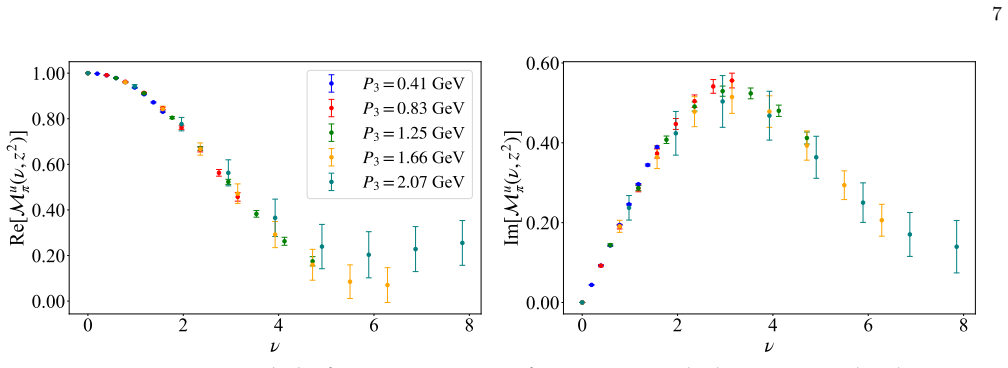
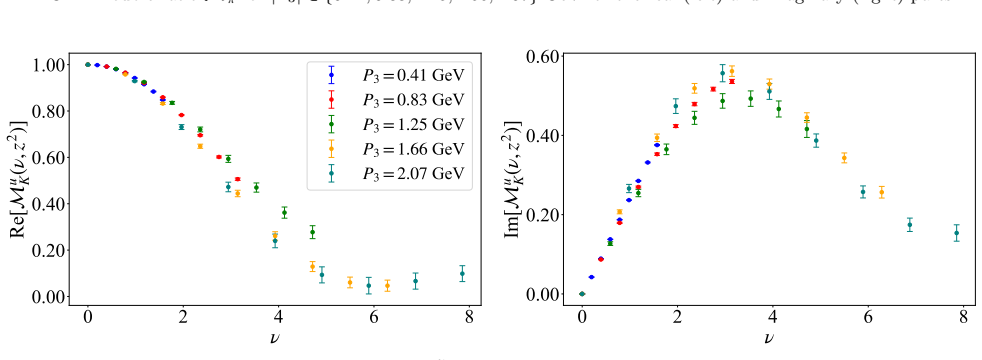
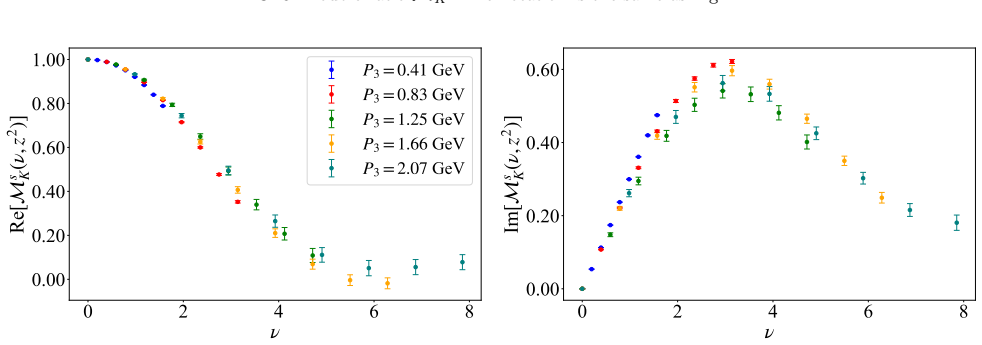
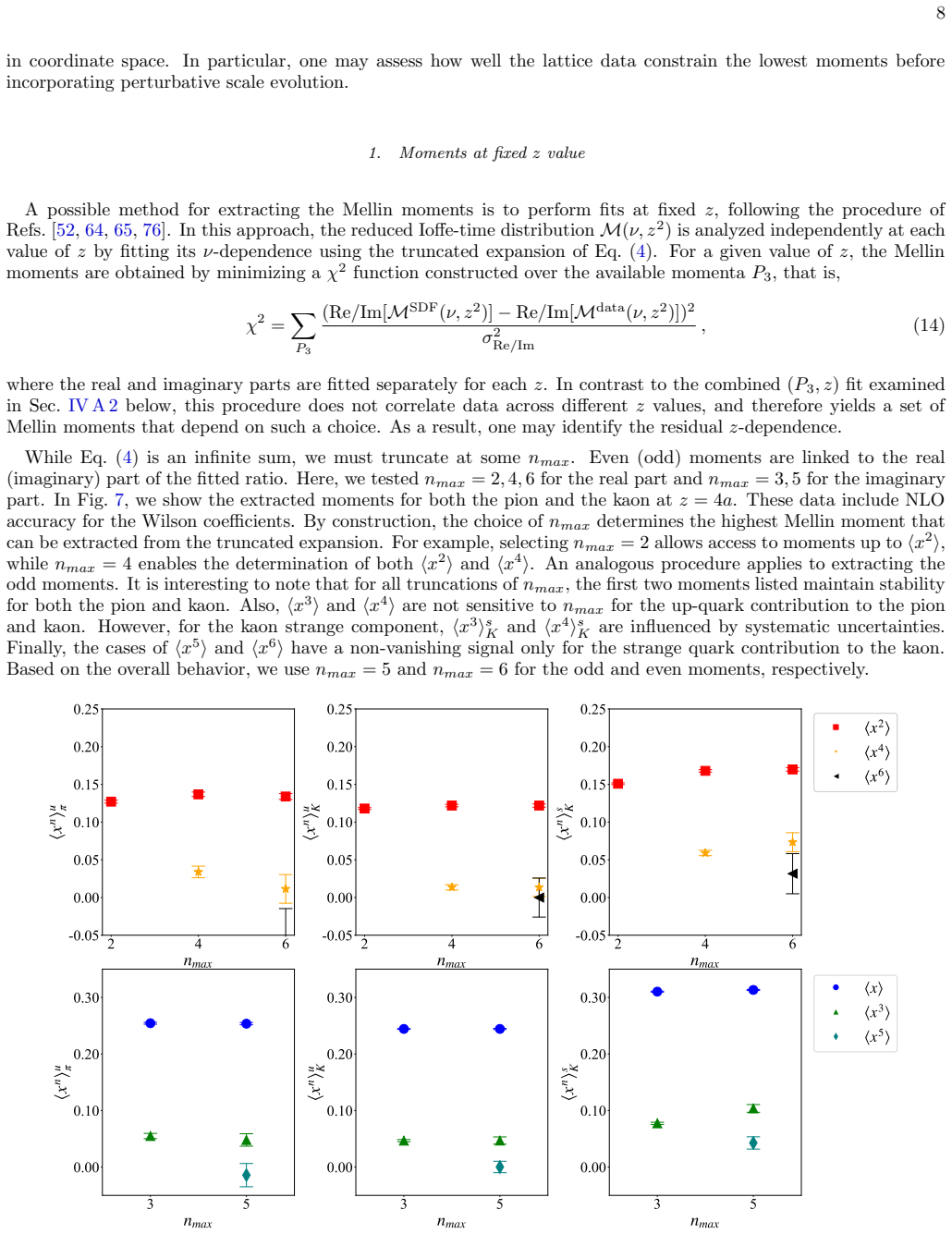
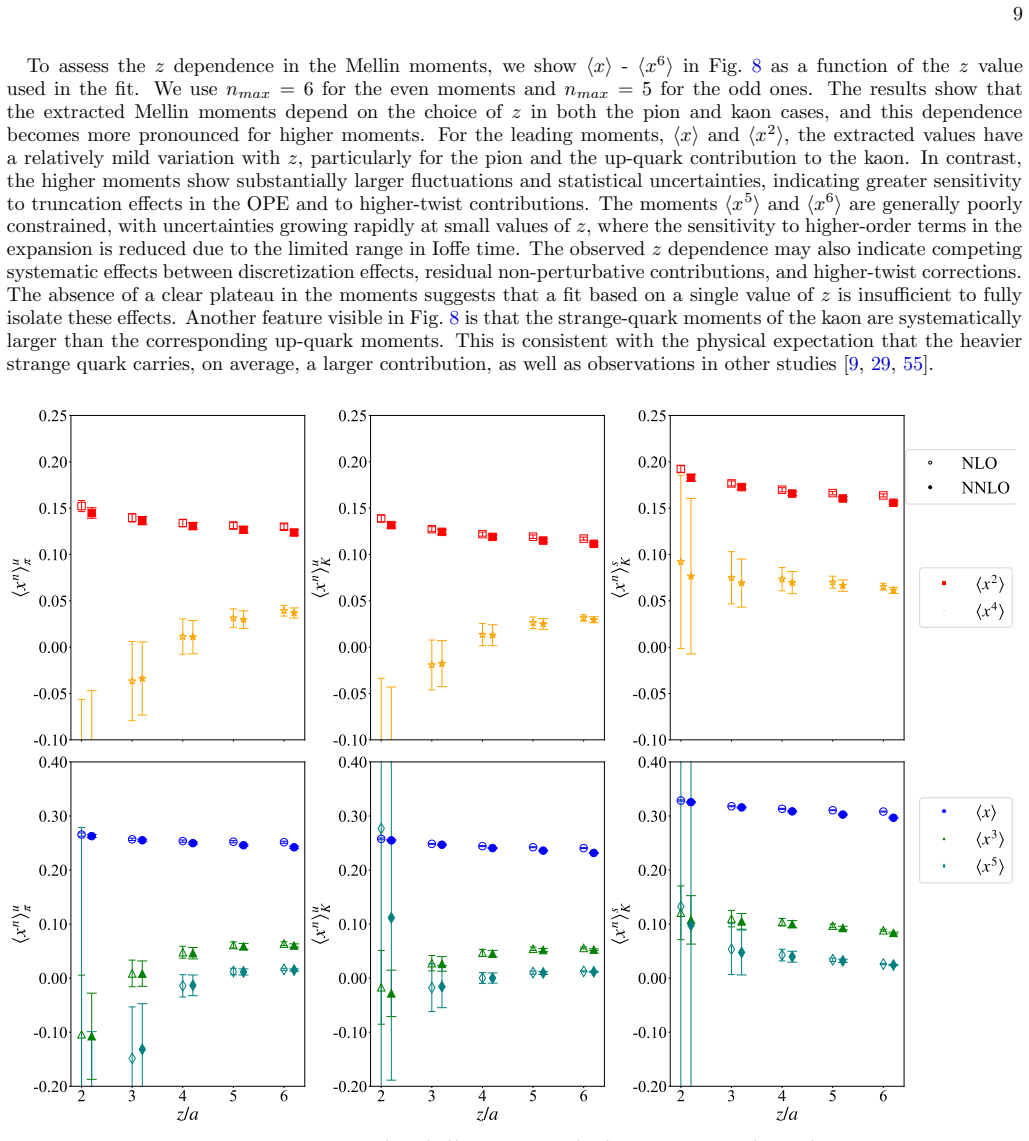
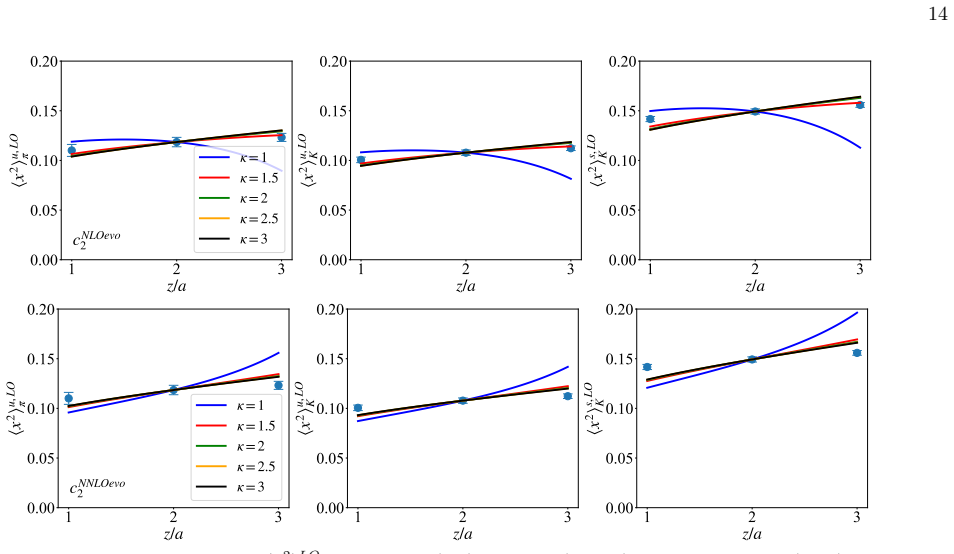
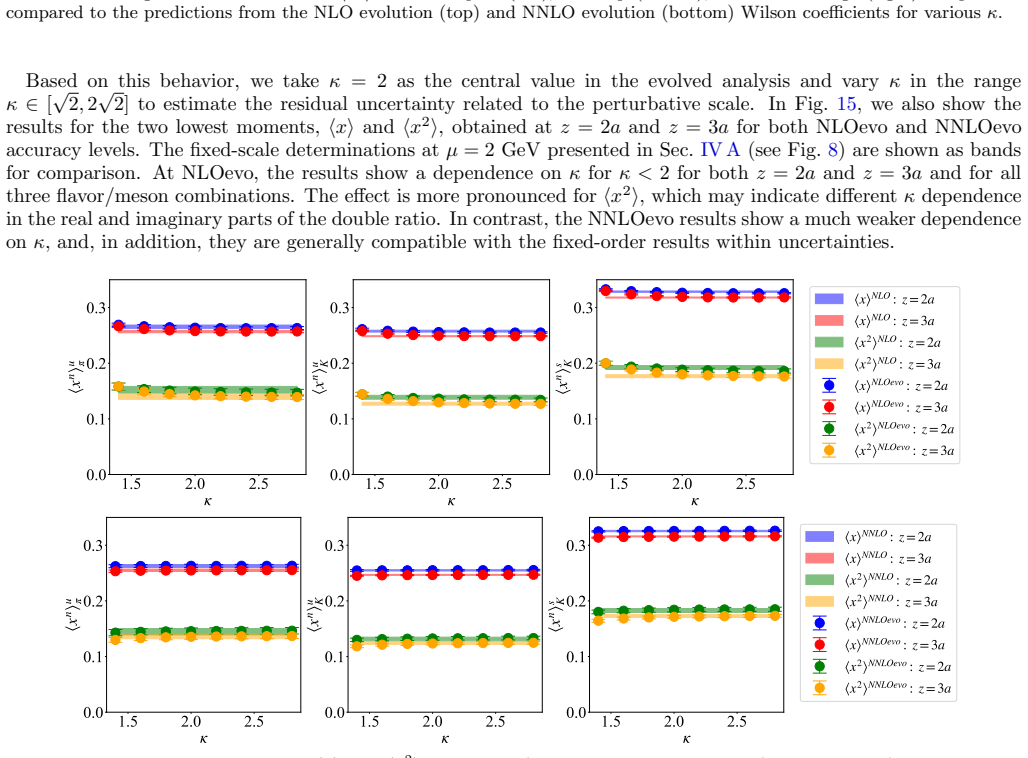
Moments at fixedzvalue A possible method for extracting the Mellin moments is to perform fits at fixedz, following the procedure of Refs. [52, 64, 65, 76]. In this approach, the reduced Ioffe-time distributionM(ν, z 2) is analyzed independently at each value ofzby fitting itsν-dependence using the truncated expansion of Eq. (4). For a given value ofz, the...
-
[2]
OPE”). By contrast, Refs. [50, 51] first reconstruct thex-dependent pion PDF and then determine its Mellin moments from the integral definition (“PDF fit
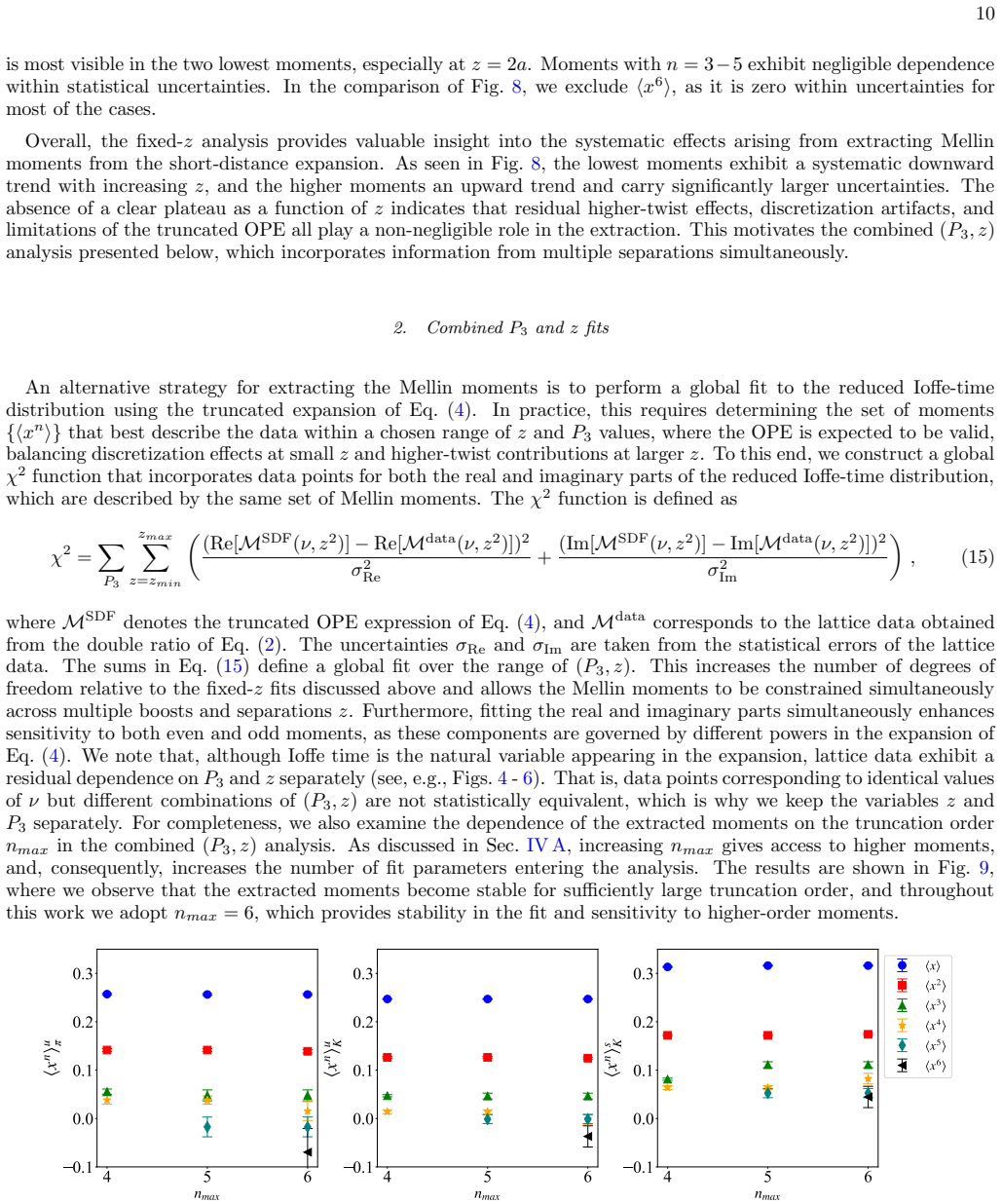
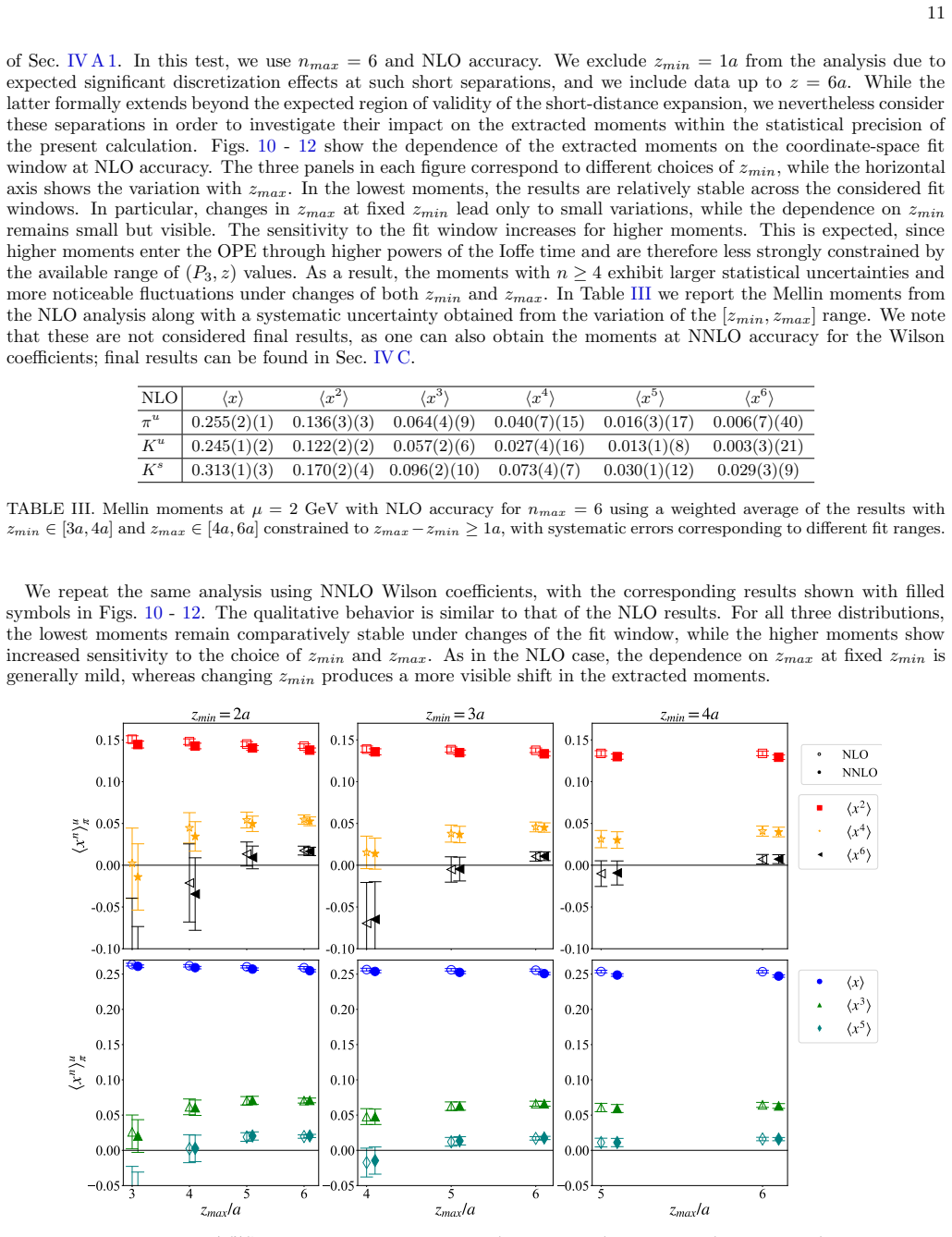
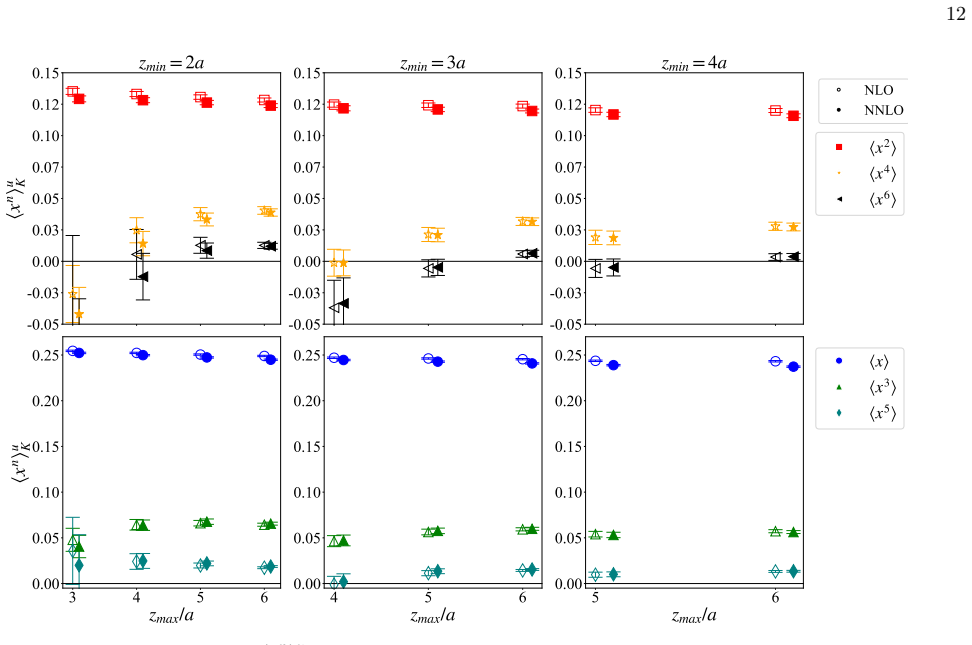
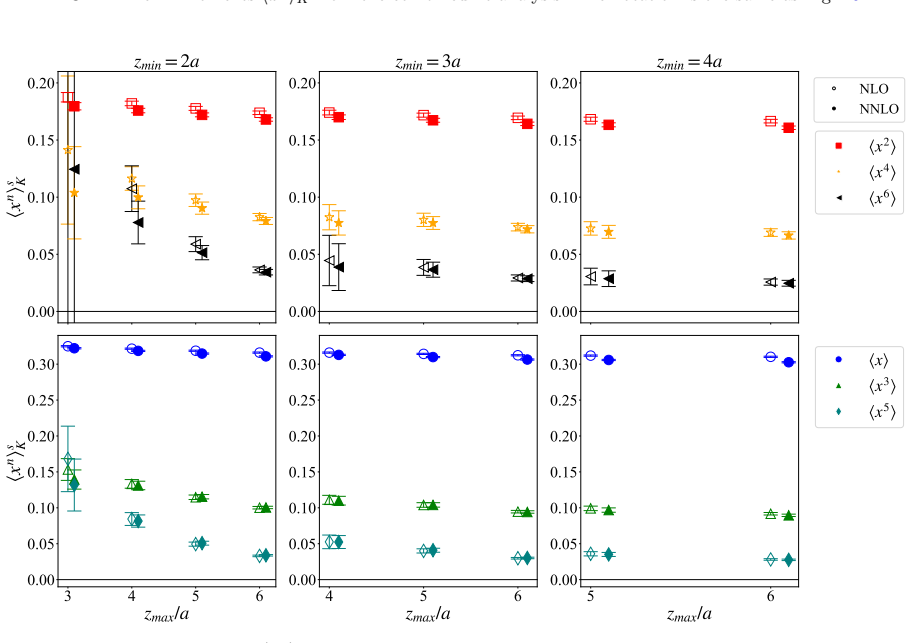
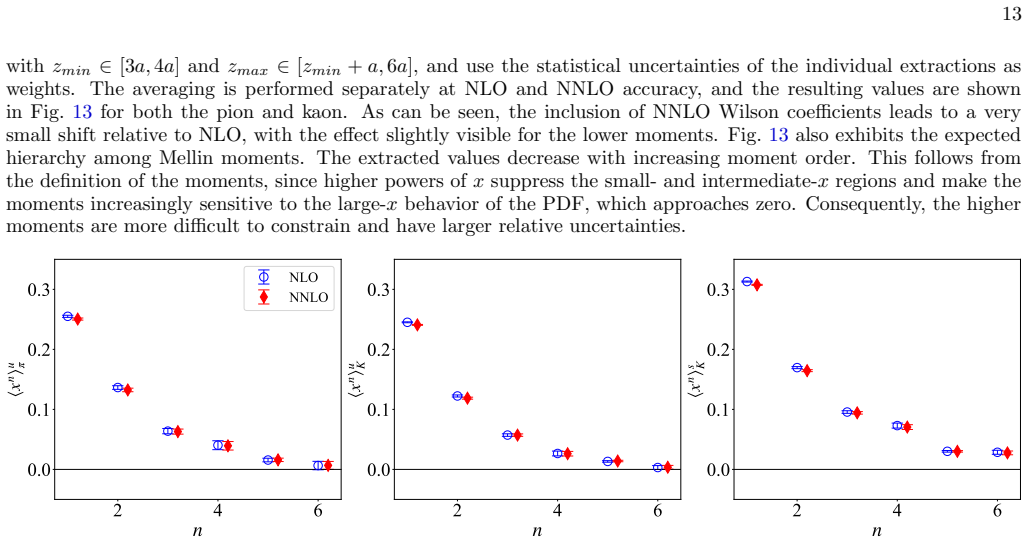
CombinedP 3 andzfits An alternative strategy for extracting the Mellin moments is to perform a global fit to the reduced Ioffe-time distribution using the truncated expansion of Eq. (4). In practice, this requires determining the set of moments {⟨xn⟩}that best describe the data within a chosen range ofzandP 3 values, where the OPE is expected to be valid,...
2025
-
[3]
J. S. Conway et al., Phys. Rev.D39, 92 (1989)
1989
-
[4]
Soft-Gluon Resummation and the Valence Parton Distribution Function of the Pion
M. Aicher, A. Schafer, and W. Vogelsang, Phys. Rev. Lett.105, 252003 (2010), arXiv:1009.2481 [hep-ph]
work page internal anchor Pith review Pith/arXiv arXiv 2010
-
[5]
Martinelli and C
G. Martinelli and C. T. Sachrajda, Phys. Lett. B190, 151 (1987)
1987
-
[6]
M. G¨ ockeler, R. Horsley, T. Manke, P. Rakow, G. Schierholz, and A. Schiller, Phys. Rev. D53, 2317 (1996), arXiv:hep- lat/9508004
-
[7]
A General Method for Non-Perturbative Renormalization of Lattice Operators
G. Martinelli, C. Pittori, C. T. Sachrajda, M. Testa, and A. Vladikas, Nucl. Phys. B445, 81 (1995), arXiv:hep-lat/9411010
work page internal anchor Pith review Pith/arXiv arXiv 1995
-
[8]
Nonperturbative Renormalisation of Composite Operators in Lattice QCD
M. Gockeler, R. Horsley, H. Oelrich, H. Perlt, D. Petters, P. E. L. Rakow, A. Schafer, G. Schierholz, and A. Schiller, Nucl. Phys.B544, 699 (1999), arXiv:hep-lat/9807044 [hep-lat]
work page internal anchor Pith review Pith/arXiv arXiv 1999
-
[9]
Parton distributions from lattice QCD
W. Detmold, W. Melnitchouk, and A. W. Thomas, Eur. Phys. J. direct3, 13 (2001), arXiv:hep-lat/0108002
work page internal anchor Pith review Pith/arXiv arXiv 2001
-
[10]
R. J. Holt and C. D. Roberts, Reviews of Modern Physics82, 2991–3044 (2010)
2010
-
[11]
C. Alexandrou, S. Bacchio, I. Clo¨ et, M. Constantinou, K. Hadjiyiannakou, G. Koutsou, and C. Lauer (ETM), Phys. Rev. D104, 054504 (2021), arXiv:2104.02247 [hep-lat]. 25
-
[12]
Brommel et al
D. Brommel et al. (QCDSF-UKQCD), Proceedings, 25th International Symposium on Lattice field theory , PoSLAT- TICE2007, 140 (2007)
2007
-
[13]
The pion form factor from lattice QCD with two dynamical flavours
D. Br¨ ommelet al. (QCDSF/UKQCD), Eur. Phys. J. C51, 335 (2007), arXiv:hep-lat/0608021
work page internal anchor Pith review Pith/arXiv arXiv 2007
-
[14]
Brommel, Pion Structure from the Lattice, Ph.D
D. Brommel, Pion Structure from the Lattice, Ph.D. thesis, Regensburg U. (2007)
2007
-
[15]
D. Brommel et al. (QCDSF, UKQCD), Phys. Rev. Lett.101, 122001 (2008), arXiv:0708.2249 [hep-lat]
-
[16]
P. A. Boyle, J. M. Flynn, A. Juttner, C. Kelly, H. P. de Lima, C. M. Maynard, C. T. Sachrajda, and J. M. Zanotti, JHEP 07, 112 (2008), arXiv:0804.3971 [hep-lat]
work page internal anchor Pith review Pith/arXiv arXiv 2008
-
[17]
Pion vector and scalar form factors with dynamical overlap quarks
T. Kaneko et al. (JLQCD, TWQCD), PoSLATTICE2008, 158 (2008), arXiv:0810.2590 [hep-lat]
work page internal anchor Pith review Pith/arXiv arXiv 2008
-
[18]
Pion form factors from two-flavor lattice QCD with exact chiral symmetry
S. Aoki et al. (JLQCD, TWQCD), Phys. Rev. D80, 034508 (2009), arXiv:0905.2465 [hep-lat]
work page internal anchor Pith review Pith/arXiv arXiv 2009
-
[19]
Light meson form factors in N_f=2+1 QCD with dynamical overlap quarks
T. Kaneko, S. Aoki, G. Cossu, H. Fukaya, S. Hashimoto, J. Noaki, and T. Onogi (JLQCD), PoSLATTICE2010, 146 (2010), arXiv:1012.0137 [hep-lat]
work page internal anchor Pith review Pith/arXiv arXiv 2010
-
[20]
G. Bali, S. Collins, B. Gl¨ assle, M. G¨ ockeler, N. Javadi-Motaghi, J. Najjar, W. S¨ oldner, and A. Sternbeck, PoSLAT- TICE2013, 447 (2014), arXiv:1311.7639 [hep-lat]
work page internal anchor Pith review Pith/arXiv arXiv 2014
-
[21]
The scalar pion form factor in two-flavor lattice QCD
V. G¨ ulpers, G. von Hippel, and H. Wittig, Phys. Rev. D89, 094503 (2014), arXiv:1309.2104 [hep-lat]
work page internal anchor Pith review Pith/arXiv arXiv 2014
-
[22]
Computation of the electromagnetic pion form factor from lattice QCD in the epsilon regime
H. Fukaya, S. Aoki, S. Hashimoto, T. Kaneko, H. Matsufuru, and J. Noaki, Phys. Rev. D90, 034506 (2014), arXiv:1405.4077 [hep-lat]
work page internal anchor Pith review Pith/arXiv arXiv 2014
-
[23]
B. Owen, W. Kamleh, D. Leinweber, B. Menadue, and S. Mahbub, Phys. Rev. D91, 074503 (2015), arXiv:1501.02561 [hep-lat]
work page internal anchor Pith review Pith/arXiv arXiv 2015
-
[24]
Nucleon and pion structure with lattice QCD simulations at physical value of the pion mass
A. Abdel-Rehim et al., Phys. Rev. D92, 114513 (2015), [Erratum: Phys.Rev.D 93, 039904 (2016)], arXiv:1507.04936 [hep-lat]
work page internal anchor Pith review Pith/arXiv arXiv 2015
-
[25]
A. J. Chambers et al. (QCDSF, UKQCD, CSSM), Phys. Rev.D96, 114509 (2017), arXiv:1702.01513 [hep-lat]
work page internal anchor Pith review Pith/arXiv arXiv 2017
-
[26]
Pion electromagnetic form factor from full lattice QCD
J. Koponen, F. Bursa, C. T. H. Davies, R. J. Dowdall, and G. P. Lepage, Proceedings, 35th International Symposium on Lattice Field Theory (Lattice 2017): Granada, Spain, June 18-24, 2017, PoSLATTICE2015, 119 (2015), arXiv:1710.07467 [hep-lat]
work page internal anchor Pith review Pith/arXiv arXiv 2017
-
[27]
The pion vector form factor from Lattice QCD at the physical point
C. Alexandrou et al. (ETM), Phys. Rev.D97, 014508 (2018), arXiv:1710.10401 [hep-lat]
work page internal anchor Pith review Pith/arXiv arXiv 2018
-
[28]
G. Wang, J. Liang, T. Draper, K.-F. Liu, and Y.-B. Yang (2018) arXiv:1810.12824 [hep-lat]
work page internal anchor Pith review Pith/arXiv arXiv 2018
- [29]
-
[30]
Two-pion contribution to hadronic vacuum polarization
G. Colangelo, M. Hoferichter, and P. Stoffer, JHEP02, 006 (2019), arXiv:1810.00007 [hep-ph]
work page internal anchor Pith review Pith/arXiv arXiv 2019
-
[31]
C. Alexandrou, S. Bacchio, I. Cloet, M. Constantinou, K. Hadjiyiannakou, G. Koutsou, and C. Lauer (ETM), Phys. Rev. D103, 014508 (2021), arXiv:2010.03495 [hep-lat]
- [32]
-
[33]
M. L¨ offler, P. Wein, T. Wurm, S. Weish¨ aupl, D. Jenkins, R. R¨ odl, A. Sch¨ afer, and L. Walter (RQCD), Phys. Rev. D105, 014505 (2022), arXiv:2108.07544 [hep-lat]
-
[34]
C. Alexandrou et al. (Extended Twisted Mass), Phys. Rev. Lett.127, 252001 (2021), arXiv:2109.10692 [hep-lat]
-
[35]
C. Alexandrou, S. Bacchio, I. Cloet, M. Constantinou, J. Delmar, K. Hadjiyiannakou, G. Koutsou, C. Lauer, and A. Vaquero (ETM), Phys. Rev. D105, 054502 (2022), arXiv:2111.08135 [hep-lat]
- [36]
-
[37]
D. C. Hackett, P. R. Oare, D. A. Pefkou, and P. E. Shanahan, Phys. Rev. D108, 114504 (2023), arXiv:2307.11707 [hep-lat]
work page Pith review arXiv 2023
-
[38]
C. Alexandrou et al. (Extended Twisted Mass), Phys. Rev. Lett.134, 131902 (2025), arXiv:2405.08529 [hep-lat]
-
[39]
C. Alexandrou, S. Bacchio, P. Jana, M. Petschlies, L. A. R. Chacon, G. Spanoudes, F. Steffens, C. Urbach, and U. Wenger, (2026), arXiv:2605.29998 [hep-lat]
-
[40]
Shindler,Moments of parton distribution functions of any order from lattice QCD,Phys
A. Shindler, Phys. Rev. D110, L051503 (2024), arXiv:2311.18704 [hep-lat]
-
[41]
A. Francis, P. Fritzsch, R. Karur, J. Kim, G. Pederiva, D. A. Pefkou, A. Rago, A. Shindler, A. Walker-Loud, and S. Zafeiropoulos, Phys. Rev. D113, 074520 (2026), arXiv:2510.26738 [hep-lat]
-
[42]
A. Francis et al., Phys. Rev. Lett.136, 171903 (2026), arXiv:2509.02472 [hep-lat]
-
[43]
Parton Physics on Euclidean Lattice
X. Ji, Phys. Rev. Lett.110, 262002 (2013), arXiv:1305.1539 [hep-ph]
work page internal anchor Pith review Pith/arXiv arXiv 2013
-
[44]
X. Ji, Sci. China Phys. Mech. Astron.57, 1407 (2014), arXiv:1404.6680 [hep-ph]
work page internal anchor Pith review Pith/arXiv arXiv 2014
-
[45]
A. V. Radyushkin, Phys. Rev. D96, 034025 (2017), arXiv:1705.01488 [hep-ph]
work page internal anchor Pith review Pith/arXiv arXiv 2017
-
[46]
One-loop evolution of parton pseudo-distribution functions on the lattice
A. Radyushkin, Phys. Rev. D98, 014019 (2018), arXiv:1801.02427 [hep-ph]
work page internal anchor Pith review Pith/arXiv arXiv 2018
-
[47]
J.-H. Zhang, J.-W. Chen, L. Jin, H.-W. Lin, A. Sch¨ afer, and Y. Zhao, Phys. Rev. D100, 034505 (2019), arXiv:1804.01483 [hep-lat]
-
[48]
T. Izubuchi, L. Jin, C. Kallidonis, N. Karthik, S. Mukherjee, P. Petreczky, C. Shugert, and S. Syritsyn, Phys. Rev.D100, 034516 (2019), arXiv:1905.06349 [hep-lat]
- [49]
-
[50]
R. S. Sufian, J. Karpie, C. Egerer, K. Orginos, J.-W. Qiu, and D. G. Richards, Phys. Rev.D99, 074507 (2019), arXiv:1901.03921 [hep-lat]
work page internal anchor Pith review Pith/arXiv arXiv 2019
- [51]
- [52]
- [53]
- [54]
-
[55]
J. Holligan and H.-W. Lin, J. Phys. G51, 065101 (2024), arXiv:2404.14525 [hep-lat]
- [56]
-
[57]
J. Miller, J. Torsiello, I. Anderson, K. Cichy, M. Constantinou, J. Delmar, and S. Lampreich, (2025), arXiv:2512.06121 [hep-lat]
work page internal anchor Pith review Pith/arXiv arXiv 2025
-
[58]
Moments of Ioffe time parton distribution functions from non-local matrix elements
J. Karpie, K. Orginos, and S. Zafeiropoulos, JHEP11, 178 (2018), arXiv:1807.10933 [hep-lat]
work page internal anchor Pith review Pith/arXiv arXiv 2018
- [59]
- [60]
- [61]
- [62]
- [63]
-
[64]
J.-W. Chen, H.-W. Lin, and J.-H. Zhang, Nucl. Phys. B952, 114940 (2020), arXiv:1904.12376 [hep-lat]
- [65]
-
[66]
S. Bhattacharya, K. Cichy, M. Constantinou, X. Gao, A. Metz, J. Miller, S. Mukherjee, P. Petreczky, F. Steffens, and Y. Zhao, Phys. Rev. D108, 014507 (2023), arXiv:2305.11117 [hep-lat]
-
[67]
S. Bhattacharya, K. Cichy, M. Constantinou, X. Gao, A. Metz, J. Miller, S. Mukherjee, P. Petreczky, F. Steffens, and Y. Zhao, JHEP01, 146 (2025), arXiv:2410.03539 [hep-lat]
-
[68]
H. Dutrieux, R. G. Edwards, C. Egerer, J. Karpie, C. Monahan, K. Orginos, A. Radyushkin, D. Richards, E. Romero, and S. Zafeiropoulos (HadStruc), JHEP08, 162 (2024), arXiv:2405.10304 [hep-lat]
- [69]
-
[70]
Perturbative Renormalization of quasi-PDFs
M. Constantinou and H. Panagopoulos, Phys. Rev. D96, 054506 (2017), arXiv:1705.11193 [hep-lat]
work page internal anchor Pith review Pith/arXiv arXiv 2017
-
[71]
A complete non-perturbative renormalization prescription for quasi-PDFs
C. Alexandrou, K. Cichy, M. Constantinou, K. Hadjiyiannakou, K. Jansen, H. Panagopoulos, and F. Steffens, Nucl. Phys. B923, 394 (2017), arXiv:1706.00265 [hep-lat]
work page internal anchor Pith review Pith/arXiv arXiv 2017
-
[72]
C. Alexandrou, K. Cichy, M. Constantinou, K. Hadjiyiannakou, K. Jansen, A. Scapellato, and F. Steffens, Phys. Rev. D99, 114504 (2019), arXiv:1902.00587 [hep-lat]
work page internal anchor Pith review Pith/arXiv arXiv 2019
- [73]
-
[74]
Li, Y.-Q
Z.-Y. Li, Y.-Q. Ma, and J.-W. Qiu, Phys. Rev. Lett.126, 072001 (2021)
2021
-
[75]
Simulating twisted mass fermions at physical light, strange and charm quark masses
C. Alexandrou et al., Phys. Rev. D98, 054518 (2018), arXiv:1807.00495 [hep-lat]
work page internal anchor Pith review Pith/arXiv arXiv 2018
-
[76]
C. Alexandrou et al. (Extended Twisted Mass), Phys. Rev. D104, 074515 (2021), arXiv:2104.13408 [hep-lat]
-
[77]
G. S. Bali, B. Lang, B. U. Musch, and A. Sch¨ afer, Phys. Rev. D93, 094515 (2016), arXiv:1602.05525 [hep-lat]
work page internal anchor Pith review Pith/arXiv arXiv 2016
-
[78]
Y. Su, J. Holligan, X. Ji, F. Yao, J.-H. Zhang, and R. Zhang, Nuclear Physics B991, 116201 (2023)
2023
-
[79]
Alexandrou, S
C. Alexandrou, S. Bacchio, I. Clo¨ et, M. Constantinou, K. Hadjiyiannakou, G. Koutsou, and C. Lauer (ETM Collaboration), Phys. Rev. D104, 054504 (2021)
2021
-
[80]
P. C. Barry, N. Sato, W. Melnitchouk, and C.-R. Ji, Phys. Rev. Lett.121, 152001 (2018), arXiv:1804.01965 [hep-ph]
work page internal anchor Pith review Pith/arXiv arXiv 2018
discussion (0)
Sign in with ORCID, Apple, or X to comment. Anyone can read and Pith papers without signing in.