Dark energy from neutrino interactions in Unimodular Gravity
Pith reviewed 2026-06-30 01:27 UTC · model grok-4.3
The pith
Neutrino interactions in unimodular gravity generate dynamical dark energy compatible with observations.
A machine-rendered reading of the paper's core claim, the machinery that carries it, and where it could break.
Core claim
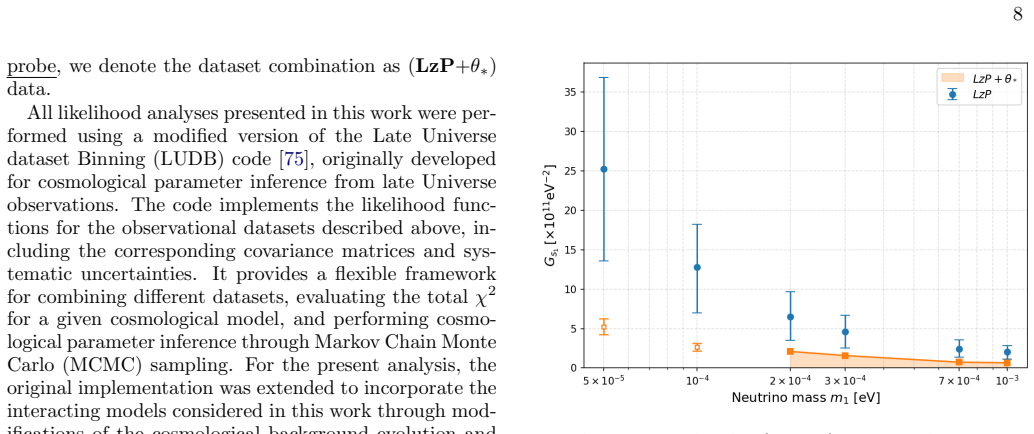
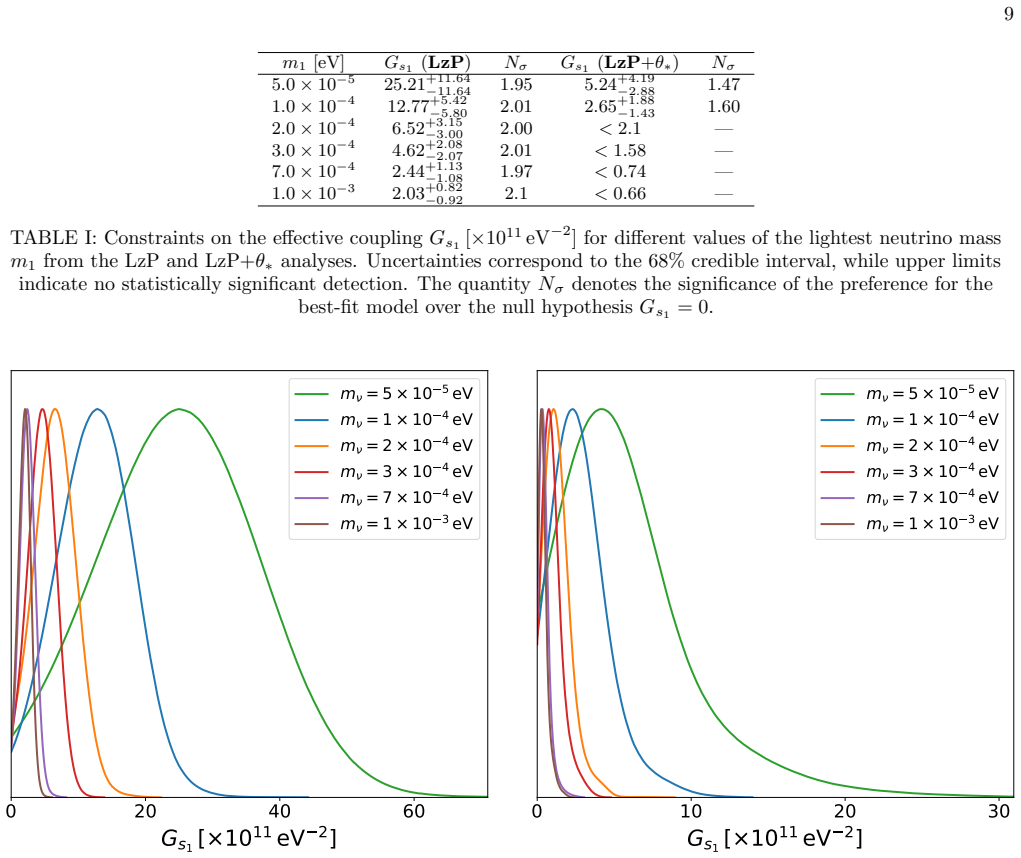
Within unimodular gravity, finite-temperature corrections to the neutrino mass from scalar-mediated interactions lead to a non-conservation current, which sources dynamical dark energy. This produces monotonic evolution for one neutrino species and non-monotonic evolution with a maximum at intermediate redshifts for two species. Late-time datasets constrain the effective interaction strength to values around 10^12 eV^{-2}, consistent with non-zero couplings for part of the explored mass range.
What carries the argument
The non-conservation current in unimodular gravity generated by the evolving effective neutrino mass due to interactions with a light scalar field.
If this is right
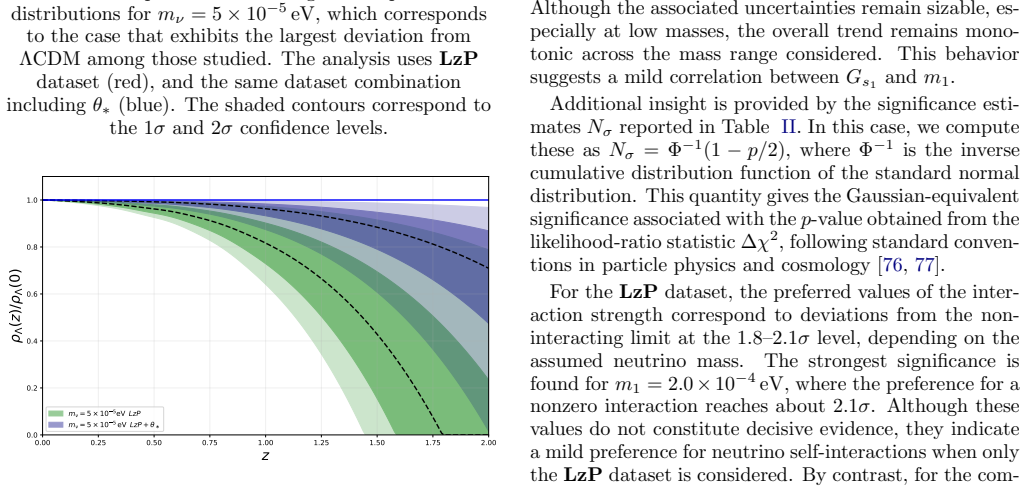
- Dark energy density evolves monotonically in the single-neutrino realization.
- In the two-neutrino realization the density reaches a maximum at intermediate redshifts before declining.
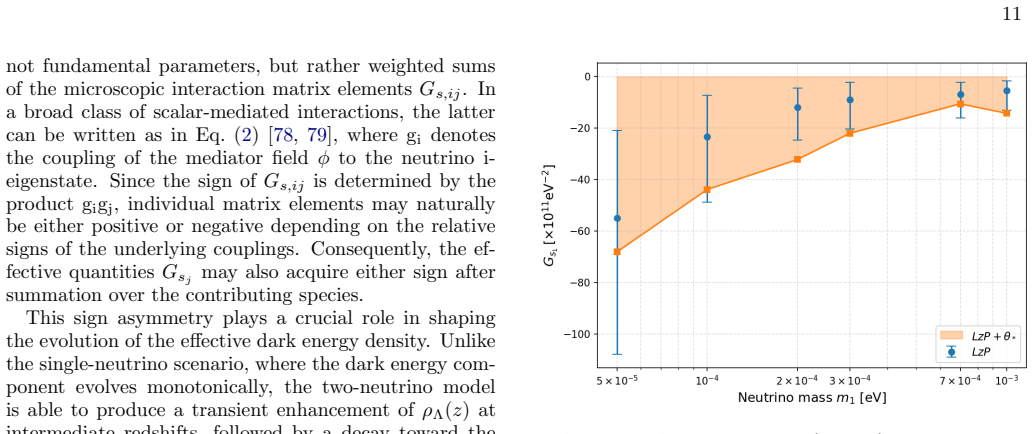
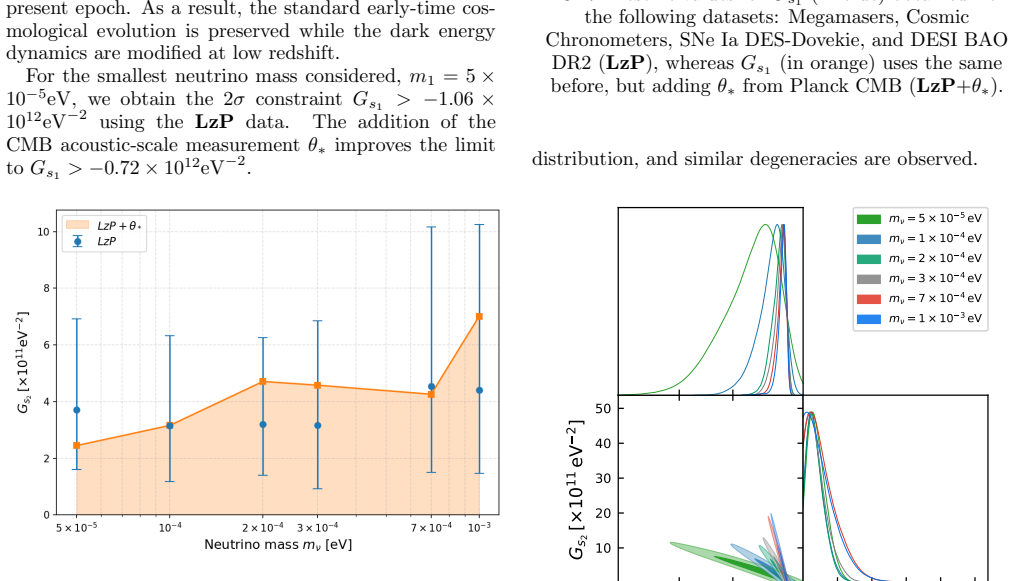
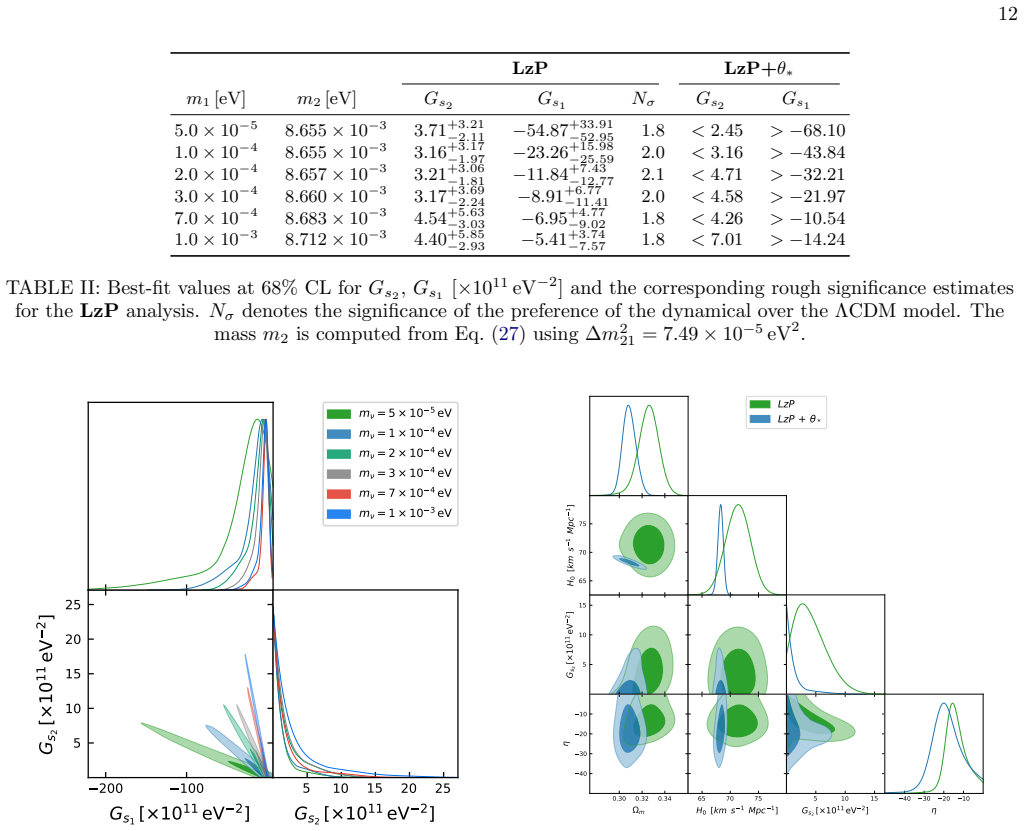
- Interaction strengths near 10^12 eV^{-2} are preferred at roughly two sigma for lightest-neutrino masses between 0.05 and 1 meV.
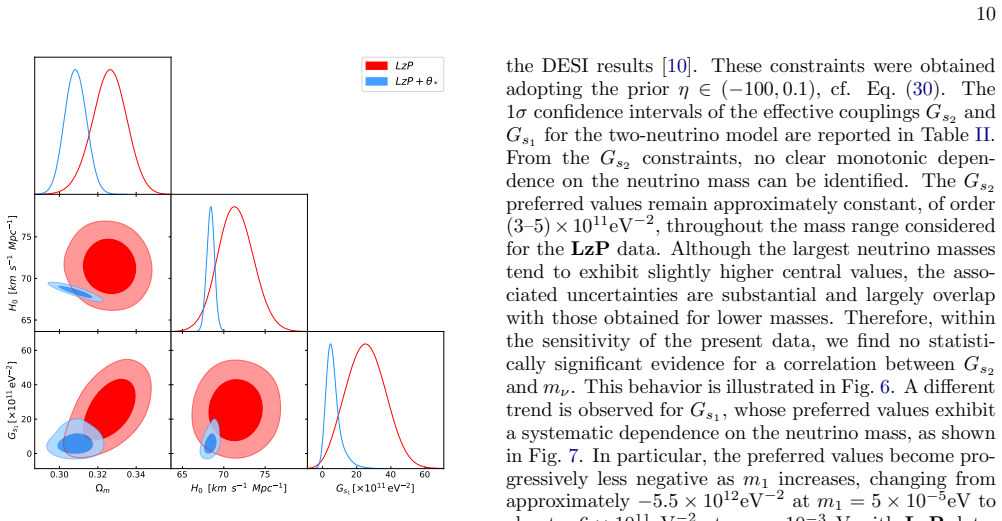
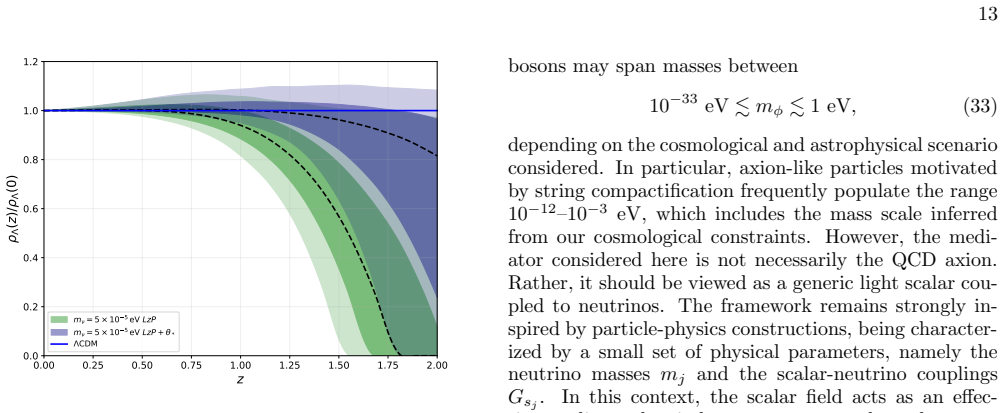
- Adding Planck distance priors shrinks parameter degeneracies and pulls the reconstructed evolution closer to a cosmological constant.
Where Pith is reading between the lines
- The mechanism directly links the acceleration of the universe to neutrino thermal history without a separate cosmological constant term.
- Future laboratory or cosmological bounds that tighten the lightest neutrino mass range could confirm or exclude the interaction scales required here.
- Extending the model to linear perturbations would test whether the same couplings remain consistent with structure-growth data.
Load-bearing premise
Unimodular gravity converts the neutrino-scalar interactions into a non-conservation current that drives the dark energy dynamics.
What would settle it
A measurement showing that the dark energy density remains exactly constant at all redshifts, or new bounds on the lightest neutrino mass that exclude the entire 0.05-1 meV interval where non-zero interactions remain allowed.
Figures
read the original abstract
We investigate a dark energy scenario generated by neutrino interactions mediated by a light scalar field, in which finite-temperature corrections induce an effective neutrino mass that evolves with the thermal history of the Universe. Within the framework of Unimodular Gravity, these interactions give rise to a non-conservation current, leading to dynamical dark energy. We study one- and two-neutrino realizations of the model. In the one-neutrino case, the dark energy density evolves monotonically, whereas in the two-neutrino scenario it can reach a maximum at intermediate redshifts before decreasing at late times. Using late time cosmological datasets, we constrain the effective interaction strength for lightest-neutrino masses in the range $0.05 \,{\rm meV}\le m_1 \le 1 \,{\rm meV}$. We find preferred interaction scales of order $G_s\sim10^{12} \, {\rm eV}^{-2}$ with a significance of $2 \sigma$, with the inferred coupling decreasing as the assumed neutrino mass increases. Assuming neutrino couplings of order unity, this $G_s$ value corresponds to an ultralight mediator with mass $m_\phi\sim10^{-6} \, {\rm eV}$. We further assess the impact of Planck distance-prior, finding a noticeable reduction in parameter degeneracies and a reconstructed dark energy evolution closer to that of a cosmological constant. Our results show that neutrino interactions can generate both monotonic and non-monotonic dark energy evolutions while remaining compatible with current cosmological observations. The inferred interaction strengths remain consistent with non-zero values for part of the explored neutrino-mass range, supporting neutrino-induced dark energy dynamics as a viable phenomenological extension of $\Lambda$CDM at the background level.
Editorial analysis
A structured set of objections, weighed in public.
Referee Report
Summary. The paper proposes a phenomenological model in which neutrino interactions mediated by a light scalar field, combined with finite-temperature mass corrections, generate an effective non-conservation current within Unimodular Gravity. This current is claimed to source dynamical dark energy whose density evolves either monotonically (one-neutrino case) or with a peak at intermediate redshifts (two-neutrino case). Using late-time cosmological datasets, the authors constrain the effective interaction strength Gs for lightest neutrino masses in 0.05–1 meV, reporting a ~2σ preference for Gs ~ 10^12 eV^{-2} that decreases with increasing m1; inclusion of Planck distance priors reduces degeneracies and yields DE evolution closer to a cosmological constant. The work concludes that neutrino-induced DE is compatible with observations as a background-level extension of ΛCDM.
Significance. If the central derivation holds, the model supplies a concrete mechanism linking neutrino thermal history to DE dynamics inside Unimodular Gravity and demonstrates that both monotonic and non-monotonic DE histories can arise from the same framework. The explicit one- versus two-neutrino distinction and the reported 2σ preference for non-zero Gs constitute falsifiable statements at the background level. The approach remains purely phenomenological, however, because Gs is fitted rather than predicted, and the absence of an independent derivation of the non-conservation current limits its status relative to models that derive the DE equation of state from first principles.
major comments (2)
- [Abstract] Abstract (paragraph on model setup): The statement that 'these interactions give rise to a non-conservation current, leading to dynamical dark energy' is asserted without an explicit derivation. No intermediate equation is shown that starts from the interaction Lagrangian, incorporates the finite-temperature correction to the neutrino mass, imposes the Unimodular Gravity constraint, and arrives at the modified continuity equation whose divergence produces the reported redshift dependence of ρ_DE. Because the monotonic versus peaked behaviors and the fitted values of Gs are direct consequences of this current, the central claim cannot be assessed until the derivation is supplied.
- [Abstract] Abstract (results paragraph): The reported 2σ preference for non-zero Gs and the distinction between one- and two-neutrino cases rest on the assumption that the non-conservation current yields the claimed DE evolution once the UG constraint is imposed. Without the explicit form of the current or the background equations, it is impossible to verify whether the fitted Gs values are physically required by the model or simply chosen to reproduce the data.
Simulated Author's Rebuttal
We thank the referee for their thorough review and constructive comments on the abstract. We address each major comment below. The full derivation of the non-conservation current is provided in the body of the manuscript (Sections 2–3), but we agree the abstract can be clarified without exceeding length constraints.
read point-by-point responses
-
Referee: [Abstract] Abstract (paragraph on model setup): The statement that 'these interactions give rise to a non-conservation current, leading to dynamical dark energy' is asserted without an explicit derivation. No intermediate equation is shown that starts from the interaction Lagrangian, incorporates the finite-temperature correction to the neutrino mass, imposes the Unimodular Gravity constraint, and arrives at the modified continuity equation whose divergence produces the reported redshift dependence of ρ_DE. Because the monotonic versus peaked behaviors and the fitted values of Gs are direct consequences of this current, the central claim cannot be assessed until the derivation is supplied.
Authors: The abstract is a concise summary and does not contain intermediate equations by design. The explicit derivation—from the interaction Lagrangian with finite-temperature mass corrections, through the Unimodular Gravity constraint, to the modified continuity equation—is given in full in Sections 2 and 3 of the manuscript, including the resulting redshift dependence of ρ_DE for the one- and two-neutrino cases. We will revise the abstract to add a parenthetical reference to these sections so readers can immediately locate the derivation. revision: partial
-
Referee: [Abstract] Abstract (results paragraph): The reported 2σ preference for non-zero Gs and the distinction between one- and two-neutrino cases rest on the assumption that the non-conservation current yields the claimed DE evolution once the UG constraint is imposed. Without the explicit form of the current or the background equations, it is impossible to verify whether the fitted Gs values are physically required by the model or simply chosen to reproduce the data.
Authors: The results paragraph summarizes the outcome of the analysis performed with the derived current and background equations (detailed in Sections 2–4). The one- versus two-neutrino distinction and the 2σ preference for Gs ~ 10^12 eV^{-2} follow directly from solving those equations with the late-time datasets. We will add a short clause in the abstract directing readers to the explicit current and background equations in the main text. revision: partial
Circularity Check
No significant circularity detected.
full rationale
The paper constructs a phenomenological model in which neutrino-scalar interactions are assumed to produce a non-conservation current inside Unimodular Gravity, thereby sourcing dynamical dark energy whose form (monotonic or peaked) depends on the number of neutrino species and the free parameter Gs. This parameter is subsequently constrained against late-time datasets. No quoted equation or step in the supplied text reduces the reported dark-energy evolution to a tautological re-expression of the fitted inputs, a self-definitional relation, or a load-bearing self-citation chain. The central claim therefore remains an independent model prediction once the interaction Lagrangian and UG framework are granted; the subsequent data fit is ordinary parameter estimation rather than a circular renaming of the fit itself.
Axiom & Free-Parameter Ledger
free parameters (2)
- G_s =
~10^{12} eV^{-2}
- m_1 =
0.05-1 meV
axioms (2)
- domain assumption Unimodular Gravity produces a non-conservation current from the neutrino interactions
- domain assumption Finite-temperature corrections generate an evolving effective neutrino mass
invented entities (1)
-
light scalar mediator phi
no independent evidence
Reference graph
Works this paper leans on
-
[1]
Single-neutrino model 6
-
[2]
Dark energy from neutrino interactions in Unimodular Gravity
Two-neutrino model 6 III. Cosmological constraints 7 A. Datasets 7 B. Cosmological inference for the one-neutrino model 8 C. Cosmological inference for the two-neutrino model 9 IV. Phenomenological implications 12 ∗ victor.gil@academicos.udg.mx † Josue.desantiago@cinvestav.mx ‡ mauricio.lopez@cinvestav.mx § jorge.cervantes@inin.gob.mx V. Conclusions 13 VI...
work page internal anchor Pith review Pith/arXiv arXiv 2026
-
[3]
(23) and restrict the discussion to the lightest neutrino mass eigen- state, making the couplingg 1 ̸= 0 whileg 2 =g 3 = 0
Single-neutrino model For the numerical analysis, we employ the full expres- sion for the dark energy density given by Eq. (23) and restrict the discussion to the lightest neutrino mass eigen- state, making the couplingg 1 ̸= 0 whileg 2 =g 3 = 0. This model corresponds to a minimal scenario in which only the lightest neutrino species contributes to the ef...
-
[4]
Two-neutrino model In this case, we consider the two lightest neutrinos, setting different values form 1 and the other given by Eq. (27). Each neutrino has itsG s-coupling, then using Eq. (23) for two-neutrino, we have: ρΛ(Tν) =ρ Λ(Tν,0)− 3ζ(3)g ν 4π4 " Gs1 m1 Z Tν T0,ν T ′ ν Z ∞ 0 ep/T ′ ν p3dpp p2 +m 2 1(ep/T ′ν + 1)2 ! dT ′ ν +G s2 m2 Z Tν T0,ν T ′ ν Z...
2018
-
[5]
A. G. Adame et al. (DESI), JCAP02(02), 021, arXiv:2404.03002 [astro-ph.CO]
work page internal anchor Pith review Pith/arXiv arXiv
-
[6]
DESI DR2 Results II: Measurements of Baryon Acoustic Oscillations and Cosmological Constraints
M. Abdul Karim et al. (DESI), Phys. Rev. D112, 083515 (2025), arXiv:2503.14738 [astro-ph.CO]
work page internal anchor Pith review Pith/arXiv arXiv 2025
-
[7]
Planck 2018 results. V. CMB power spectra and likelihoods
N. Aghanim et al. (Planck), Astron. Astrophys.641, A5 (2020), arXiv:1907.12875 [astro-ph.CO]
work page internal anchor Pith review Pith/arXiv arXiv 2020
-
[8]
The Pantheon+ Analysis: The Full Dataset and Light-Curve Release
D. Scolnic et al., Astrophys. J.938, 113 (2022), arXiv:2112.03863 [astro-ph.CO]
work page internal anchor Pith review Pith/arXiv arXiv 2022
-
[9]
The Pantheon+ Analysis: Cosmological Constraints
D. Brout et al., Astrophys. J.938, 110 (2022), arXiv:2202.04077 [astro-ph.CO]
work page internal anchor Pith review Pith/arXiv arXiv 2022
-
[10]
Union Through UNITY: Cosmology with 2,000 SNe Using a Unified Bayesian Framework
D. Rubin et al., Astrophys. J.986, 231 (2025), arXiv:2311.12098 [astro-ph.CO]
work page internal anchor Pith review Pith/arXiv arXiv 2025
-
[11]
T. M. C. Abbott et al. (DES), Astrophys. J. Lett.973, L14 (2024), arXiv:2401.02929 [astro-ph.CO]
work page internal anchor Pith review Pith/arXiv arXiv 2024
-
[12]
R. Calderon et al. (DESI), JCAP10(10), 048, arXiv:2405.04216 [astro-ph.CO]
-
[13]
K. Lodha et al. (DESI), Phys. Rev. D111, 023532 (2025), arXiv:2405.13588 [astro-ph.CO]
-
[14]
Extended Dark Energy analysis using DESI DR2 BAO measurements
K. Lodha et al. (DESI), Phys. Rev. D112, 083511 (2025), arXiv:2503.14743 [astro-ph.CO]
work page internal anchor Pith review Pith/arXiv arXiv 2025
-
[15]
A. G. Adame et al. (DESI), JCAP07(07), 028, arXiv:2411.12022 [astro-ph.CO]
work page internal anchor Pith review Pith/arXiv arXiv
-
[16]
NuFit-6.0: Updated global analysis of three-flavor neutrino oscillations
I. Esteban, M. C. Gonzalez-Garcia, M. Maltoni, I. Martinez-Soler, J. P. Pinheiro, and T. Schwetz, JHEP 12(12), 216, arXiv:2410.05380 [hep-ph]
work page internal anchor Pith review Pith/arXiv arXiv
-
[17]
E. Camphuis et al. (SPT-3G), Phys. Rev. D113, 083504 (2026), arXiv:2506.20707 [astro-ph.CO]
work page internal anchor Pith review Pith/arXiv arXiv 2026
-
[18]
Constraints on Neutrino Physics from DESI DR2 BAO and DR1 Full Shape
W. Elbers et al., Phys. Rev. D112, 083513 (2025), arXiv:2503.14744 [astro-ph.CO]
work page internal anchor Pith review Pith/arXiv arXiv 2025
-
[19]
H. Pulido-Hern´ andez and J. L. Cervantes-Cota, arXiv e- prints (2026), arXiv:2603.13208 [astro-ph.CO]
- [20]
-
[21]
Aguilar et al
A. Aguilar et al. (LSND Collaboration), Phys. Rev. D 64, 112007 (2001)
2001
-
[22]
A. A. Aguilar-Arevalo, B. C. Brown, L. Bugel, G. Cheng, J. M. Conrad, R. L. Cooper, et al. (MiniBooNE Collab- oration), Phys. Rev. Lett.121, 221801 (2018)
2018
-
[23]
Palomares-Ruiz, S
S. Palomares-Ruiz, S. Pascoli, and T. Schwetz, Journal of High Energy Physics2005, 048 (2005)
2005
-
[24]
N. F. Bell, E. Pierpaoli, and K. Sigurdson, Phys. Rev. D 73, 063523 (2006)
2006
-
[25]
Archidiacono and S
M. Archidiacono and S. Hannestad, Journal of Cosmol- ogy and Astroparticle Physics2014(07), 046
-
[26]
Cyr-Racine and K
F.-Y. Cyr-Racine and K. Sigurdson, Phys. Rev. D90, 123533 (2014)
2014
-
[28]
M. Park, C. D. Kreisch, J. Dunkley, B. Hadzhiyska, and F.-Y. Cyr-Racine, Phys. Rev. D100, 063524 (2019)
2019
-
[29]
M. Escudero and S. J. Witte, Eur. Phys. J. C80, 294 (2020), arXiv:1909.04044 [astro-ph.CO]
-
[30]
C. D. Kreisch, F.-Y. Cyr-Racine, and O. Dor´ e, Phys. Rev. D101, 123505 (2020)
2020
-
[31]
Knox and M
L. Knox and M. Millea, Physical Review D101, 043533 (2020)
2020
-
[32]
S. R. Choudhury, S. Hannestad, and T. Tram, Journal of Cosmology and Astroparticle Physics2021(03), 084
- [33]
-
[34]
I. M. Oldengott, C. Rampf, and Y. Y. Wong, Journal of Cosmology and Astroparticle Physics2015(04), 016
-
[35]
Lancaster, F.-Y
L. Lancaster, F.-Y. Cyr-Racine, L. Knox, and Z. Pan, Journal of Cosmology and Astroparticle Physics2017 (07), 033
-
[36]
I. M. Oldengott, T. Tram, C. Rampf, and Y. Y. Wong, Journal of Cosmology and Astroparticle Physics2017 (11), 027
-
[37]
J. F. Beacom, N. F. Bell, and S. Dodelson, Phys. Rev. Lett.93, 121302 (2004)
2004
-
[38]
Hannestad, Journal of Cosmology and Astroparticle Physics2005(02), 011
S. Hannestad, Journal of Cosmology and Astroparticle Physics2005(02), 011
-
[39]
Chacko, A
Z. Chacko, A. Dev, P. Du, V. Poulin, and Y. Tsai, Jour- nal of High Energy Physics2020, 20 (2020)
2020
-
[40]
Escudero, J
M. Escudero, J. Lopez-Pavon, N. Rius, and S. Sandner, Journal of High Energy Physics2020, 119 (2020)
2020
-
[41]
Esteban and J
I. Esteban and J. Salvado, Journal of Cosmology and Astroparticle Physics2021(05), 036
-
[42]
Barenboim, J
G. Barenboim, J. Z. Chen, S. Hannestad, I. M. Olden- gott, T. Tram, and Y. Y. Wong, Journal of Cosmology and Astroparticle Physics2021(03), 087
- [43]
-
[44]
Franco Abell´ an, (2026), arXiv:2601.04312 [astro- ph.CO]
G. Franco Abell´ an, Phys. Rev. D113, 123527 (2026), arXiv:2601.04312 [astro-ph.CO]
- [45]
-
[46]
I. Perez-Castro, J. De-Santiago, G. Garcia-Arroyo, J. Venzor, and A. Perez-Lorenzana, arXiv:2602.12477 [hep-ph] (2026), preprint
work page internal anchor Pith review Pith/arXiv arXiv 2026
-
[47]
Forastieri, M
F. Forastieri, M. Lattanzi, and P. Natoli, Journal of Cos- mology and Astroparticle Physics2015(07), 014
-
[48]
F. Forastieri, M. Lattanzi, and P. Natoli, Phys. Rev. D 100, 103526 (2019), arXiv:1904.07810 [astro-ph.CO]
- [49]
- [50]
-
[51]
Ge and S
S.-F. Ge and S. J. Parke, Phys. Rev. Lett.122, 211801 (2019)
2019
-
[52]
K. S. Babu, G. Chauhan, and P. S. B. Dev, Phys. Rev. D101, 095029 (2020)
2020
-
[53]
Probing Scalar Non-Standard Neutrino Interactions using High-Energy Astrophysical Neutrinos
A. Verma, C. A. Arg¨ uelles, P. S. B. Dev, B. Dutta, and I. Martinez-Soler, arXiv:2606.25050 [hep-ph] (2026), arXiv:2606.25050 [hep-ph]
work page internal anchor Pith review Pith/arXiv arXiv 2026
-
[54]
Einstein, Sitzungsber
A. Einstein, Sitzungsber. Preuss. Akad. Wiss. Berlin (Math. Phys. )1919, 349 (1919)
1919
-
[55]
G. F. Ellis, H. Van Elst, J. Murugan, and J.-P. Uzan, Classical and Quantum Gravity28, 225007 (2011)
2011
-
[56]
G. F. R. Ellis, Gen. Rel. Grav.46, 1619 (2014), arXiv:1306.3021 [gr-qc]
work page internal anchor Pith review Pith/arXiv arXiv 2014
-
[57]
Dark energy as the weight of violating energy conservation
T. Josset, A. Perez, and D. Sudarsky, Phys. Rev. Lett. 118, 21102 (2017), arXiv:1604.04183 [gr-qc]
work page internal anchor Pith review Pith/arXiv arXiv 2017
-
[58]
Dark energy from quantum gravity discreteness
A. Perez and D. Sudarsky, Phys. Rev. Lett.122, 221302 (2019), arXiv:1711.05183 [gr-qc]. 16
work page internal anchor Pith review Pith/arXiv arXiv 2019
-
[59]
A microscopic model for an emergent cosmological constant
A. Perez, D. Sudarsky, and J. D. Bjorken, Int. J. Mod. Phys. D27, 1846002 (2018), arXiv:1804.07162 [gr-qc]
work page internal anchor Pith review Pith/arXiv arXiv 2018
-
[60]
Corral, N
C. Corral, N. Cruz, and E. Gonz´ alez, Physical Review D 102, 023508 (2020)
2020
- [61]
- [62]
-
[63]
H. A. Weldon, Phys. Rev. D26, 2789 (1982)
1982
-
[64]
N¨ otzold and G
D. N¨ otzold and G. Raffelt, Nucl. Phys. B307, 924 (1988)
1988
-
[65]
Dodelson and F
S. Dodelson and F. Schmidt, Modern Cosmology, 3rd ed. (Elsevier, London, 2025)
2025
-
[66]
Rezzolla and O
L. Rezzolla and O. Zanotti, Relativistic Hydrodynamics (Oxford University Press, 2013)
2013
-
[67]
Neutrino masses and their ordering: Global Data, Priors and Models
S. Gariazzo, M. Archidiacono, P. F. de Salas, O. Mena, C. A. Ternes, and M. T´ ortola, JCAP03(03), 011, arXiv:1801.04946 [hep-ph]
work page internal anchor Pith review Pith/arXiv arXiv
-
[68]
A. J. Long, M. Raveri, W. Hu, and S. Dodelson, Phys. Rev. D97, 043510 (2018), arXiv:1711.08434 [astro- ph.CO]
work page internal anchor Pith review Pith/arXiv arXiv 2018
-
[69]
Updated Bounds on Sum of Neutrino Masses in Various Cosmological Scenarios
S. Roy Choudhury and S. Choubey, JCAP09(09), 017, arXiv:1806.10832 [astro-ph.CO]
work page internal anchor Pith review Pith/arXiv arXiv
-
[70]
Cosmology and the neutrino mass ordering
S. Hannestad and T. Schwetz, JCAP11(11), 35, arXiv:1606.04691 [astro-ph.CO]
work page internal anchor Pith review Pith/arXiv arXiv
-
[71]
Loureiro, A
A. Loureiro, A. Cuceu, F. B. Abdalla, B. Moraes, L. Whiteway, M. McLeod, S. T. Balan, O. Lahav, A. Benoit-Levy, M. Manera, R. P. Rollins, and H. S. Xavier, Phys. Rev. Lett.123, 081301 (2019)
2019
-
[72]
Chebat et al., JCAP01(01), 041, arXiv:2507.12401 [astro-ph.CO]
D. Chebat et al., JCAP01(01), 041, arXiv:2507.12401 [astro-ph.CO]
-
[73]
D. W. Pesce, J. A. Braatz, M. J. Reid, A. G. Riess, D. Scolnic, J. J. Condon, F. Gao, C. Henkel, C. M. V. Impellizzeri, C. Y. Kuo, and K. Y. Lo, The Astrophysical Journal Letters891, L1 (2020)
2020
-
[74]
M. Moresco, R. Jimenez, L. Verde, A. Cimatti, and L. Pozzetti, Astrophys. J.898, 82 (2020), arXiv:2003.07362 [astro-ph.GA]
-
[75]
Moresco, R
M. Moresco, R. Jimenez, L. Verde, A. Cimatti, and L. Pozzetti, The Astrophysical Journal898, 82 (2020)
2020
-
[76]
B. Popovic, P. Shah, W. D. Kenworthy, et al. (DES Collaboration), Mon. Not. Roy. Astron. Soc.548, 10.1093/mnras/stag632 (2026)
-
[77]
T. M. C. Abbott, M. Acevedo, M. Aguena, et al. (DES Collaboration), Astrophys. J. Lett.973, L14 (2024)
2024
-
[78]
Chen, Q.-G
L. Chen, Q.-G. Huang, and K. Wang, Journal of Cosmol- ogy and Astroparticle Physics2019(02), 028
-
[79]
Seehttps://github.com/MauLoHdz/LUDB
-
[80]
R. L. Workman et al., Progress of Theoretical and Ex- perimental Physics2022, 083C01 (2022)
2022
-
[81]
Cowan, Statistical Data Analysis (Oxford University Press, 1998)
G. Cowan, Statistical Data Analysis (Oxford University Press, 1998)
1998
discussion (0)
Sign in with ORCID, Apple, or X to comment. Anyone can read and Pith papers without signing in.