REVIEW 3 major objections 6 minor 7 cited by
Sparse Autoencoders Do Not Find Canonical Units of Analysis
T0 review · 3 major / 6 minor · reviewed 2026-08-08 · deepseek-v4-flash
Pith's one-line read Sparse autoencoders fail to find canonical units
desk verdict Stitching evidence for incompleteness is solid; the meta-SAE evidence for non-atomicity is underdetermined and needs a null-model control. read the letter →
The pith
A machine-rendered reading of the paper's core claim, the machinery that carries it, and where it could break.
The reading
What carries the argument
The two load-bearing mechanisms are SAE stitching and meta-SAEs. SAE stitching rewrites a reconstruction as a sum over latents drawn from two different SAEs, using the fact that decoder directions live in the same activation space; latents with maximum decoder cosine similarity below a threshold are classified as novel, those above it as reconstruction latents, and swapping connected subgraphs of a bipartite similarity graph lets the authors interpolate between dictionaries of different widths (with thresholds 0.7 for GPT-2 SAEs and 0.4 for Gemma Scope SAEs). A meta-SAE is an SAE trained on the decoder matrix of another SAE rather than on model activations, so its meta-latents are sparse directions that reconstruct the original latent directions; interpretable decompositions of a latent into several meta-latents are taken as evidence that the latent is not atomic. The meta-SAE is trained with the BatchTopK variant, and the claim that meta-latents resemble smaller-SAE latents is checked by replacing meta-SAE decoder directions with the most similar SAE decoder directions and observing only a small drop in reconstruction performance.
What would settle it
Train a meta-SAE on the same decoder matrix after randomly permuting the decoder columns or after replacing them with random vectors matched to the SAE's spectrum; if the resulting meta-latent explanations still let GPT-4o-mini pick the correct latent 73% of the time, the multiple-choice evaluation is not distinguishing composition from arbitrary sparse coding, and the non-atomicity conclusion would need that control before standing.
Extended reading notes
Core claim
On the paper's own terms, the discovery is that two defining properties of canonical units—completeness and atomicity—each fail at a different end of the width spectrum. In the stitching experiments with GPT-2 Small and Gemma 2 2B SAEs, latents from the larger dictionary fall into two classes: reconstruction latents, which are near-duplicates (decoder cosine similarity above a threshold) of smaller-SAE latents, and novel latents, which are not. Adding the novel latents to the smaller SAE reduces reconstruction error, meaning the smaller SAE was missing information the larger one captures. In the meta-SAE experiments, a BatchTopK SAE trained on the 49,152-direction decoder matrix of the largest GPT-2 SAE yields sparse, interpretable meta-latents; the 'Einstein' latent decomposes into 'scientist', 'Germany', and 'famous person', and on a five-way multiple-choice test GPT-4o-mini picks the correct latent from its meta-latent explanations 73% of the time. Because the meta-latents resemble latents found in smaller SAEs, the authors conclude that larger-SAE latents are often compositions of smaller-SAE latents, and no tested width is both complete and atomic.
Load-bearing premise
Everything rests on treating a latent's decoder direction as its complete semantics: if cosine similarity of decoder vectors is not a faithful measure of feature identity across SAE widths, and a sparse decomposition of a decoder vector is not evidence of compositional structure, then neither the novelty classification nor the atomicity conclusion is established.
Editorial extensions
If this is right
- Choosing an SAE width is a substantive modelling choice, not a neutral hyperparameter: smaller widths omit information that larger widths capture, and larger widths trade atomicity for sparsity through composition.
- There is no guaranteed 'right size'; practical interpretability work should evaluate several dictionary sizes and pick the one that best exposes the features under study.
- Comparisons between SAEs of different sizes must control for dictionary width, because the novel-versus-reconstruction classification changes with the threshold and with the pair of widths being compared.
- Interpretability results that rely on a single SAE width should be revisited, since the same behaviour may be described by composed latents at one width and by separate atomic latents at another.
- Mechanistic interpretability will need methods other than dictionary learning alone if canonical units are required; SAEs remain useful as instruments even though they are not canonical.
Reading between the lines
- An extension the authors leave implicit: if decoder-direction similarity is accepted as feature identity, the same stitching diagnostic can compare SAEs trained on different layers, models, or random seeds, not just widths.
- A direct test of the mechanism would be to train a meta-SAE on a synthetic SAE with known ground-truth atoms; recovering exactly those atoms would confirm that meta-latents track composition rather than merely providing another arbitrary sparse basis.
- The null-control version of the 73% interpretability score would be to run the same GPT-4o-mini multiple-choice evaluation on meta-SAEs trained on shuffled or randomized decoder directions; a similar score there would suggest the apparent decomposability is partly an artifact of the evaluation setup.
Editorial analysis
A structured set of objections, weighed in public.
Referee Report
Summary. The paper challenges the hypothesis that sparse autoencoders (SAEs) recover a canonical set of features: a unique, complete, and atomic dictionary of units for mechanistic interpretability. To do so it introduces two techniques. First, SAE stitching swaps or inserts latents between SAEs of different dictionary sizes and measures reconstruction loss; latents from a larger SAE that improve the smaller SAE's reconstruction are called novel latents, while those that replace similar latents are called reconstruction latents. The existence of novel latents is taken as evidence that smaller SAEs are incomplete. Second, meta-SAEs are SAEs trained on the decoder directions of another SAE; their sparse decompositions of large-SAE latents are interpreted as showing that large-SAE latents are compositions of smaller-SAE latents and hence not atomic. The paper concludes that no single SAE width yields canonical units and recommends a pragmatic, task-dependent choice of dictionary size. The empirical work spans GPT-2 Small SAEs of widths 768 to 98,304 and two Gemma Scope SAEs, with an interactive dashboard released for exploration.
Significance. If the conclusions hold, the paper would materially affect how the interpretability community interprets SAE dictionaries: it would undercut the 'true features' conjecture and shift practice toward task-dependent dictionary selection. The two proposed techniques, SAE stitching and meta-SAEs, are useful methodological contributions for comparing dictionaries across widths, and the paper includes a substantial amount of empirical validation: reconstruction-based interpolation between SAEs, decoder-bias interchangeability checks, comparisons across two model families, and an open dashboard. The incompleteness claim is supported by direct reconstruction improvements when novel latents are stitched in, and the meta-SAE idea is creative. However, the non-atomicity claim, which is load-bearing for the paper's central conclusion, is currently under-supported because a meta-SAE is itself an overcomplete sparse dictionary learner and therefore can always find sparse decompositions of arbitrary decoder directions; the reported decomposition fidelity and interpretability do not by themselves prove that the original latent is composed of those meta-latents in the model.
major comments (3)
- [Section 5] The claim that large-SAE latents are not atomic rests on finding sparse decompositions of decoder directions with a meta-SAE. Because a meta-SAE is an overcomplete sparse dictionary learner, every decoder direction in its span admits many sparse representations, and the training objective merely selects one. The interpretability of the selected decomposition (Table 1) and the 73% multiple-choice accuracy reported in Section 5.1 do not establish that the original latent is composed of those meta-latents in the model, since the meta-SAE was never trained to preserve the latent's causal effect on activations. The reported 55.47% explained variance of decoder directions (Section 5) also means the decomposition is far from faithful. I request a null-model control (for example, training a meta-SAE on a known-atomic synthetic dictionary or on random directions and showing that it does not produce similarly interpretable decompositions) and a behavioral check (for example, showing that replacing a latent by its meta-latent combination reproduces the latent's contribution to reconstructions on real inputs). Without these, the 'not atomic' half of the central claim is underdetermined.
- [Section 4.2, Eq. (6), Figure 4] The 'novel latent' conclusion—that smaller SAEs are incomplete because larger SAEs contain features that improve reconstruction—should rule out a capacity artifact. Adding any extra encoder-decoder pair with low cosine similarity to the existing dictionary could reduce MSE by providing additional approximation capacity rather than by capturing a semantically missing feature. I suggest a control in which random decoder directions, or latents from an unrelated SAE with matched norms, are stitched into the smaller SAE; if those also improve MSE, the inference from MSE gain to 'novel information' is not warranted. Relatedly, the thresholds θ=0.7 for GPT-2 and θ=0.4 for Gemma are set from exploratory analysis; reporting a hold-out evaluation or a confidence interval for the ROC curve in Appendix Figure 13 would make the binary novel/reconstruction classification more load-bearing.
- [Section 5.2, Figure 6, Appendix Figure 20] The demonstration that meta-SAE decoder directions resemble those of a smaller SAE (and that replacing them and retraining the encoder causes only a small performance drop) shows dictionary-level similarity, not that a large-SAE latent is a composition of smaller-SAE latents. The replacement experiment amounts to fitting a new encoder to a similar dictionary; it does not test whether the original large latent's behavior is the sum of the smaller latents' behaviors. A direct test would be to take a large latent, compute its meta-latent decomposition, and compare the reconstruction produced by the large latent alone with the reconstruction produced by the active meta-latents (using the corresponding small-SAE decoder directions) on inputs where the large latent fires. As it stands, the compositional interpretation is supported only by geometric similarity.
minor comments (6)
- [Figure 4] The caption notes that a few extreme outliers are not visible in the plot; please add an inset or a table listing those outliers so readers can assess their influence on the threshold choice.
- [Section 5] The sentence 'on average 4 of meta-latents active per SAE latent' should be reworded to 'on average 4 meta-latents are active per SAE latent'.
- [Appendix Figure 13] The ROC analysis would be more informative with the AUC reported and, ideally, with a validation-split procedure for selecting the threshold rather than a threshold chosen from exploratory analysis.
- [Appendix A.8.2] The phrase 'in the SHIFT method (Marks et al., 2024), a human evaluator debiases' appears to contain a stray 'in'; please proofread.
- [References] The citation '(Anonymous, 2024)' and the redacted URLs are appropriate for an anonymized submission but must be replaced with a full citation and public URLs in the published version.
- [Section 6] The conclusion states that 'there is no single SAE width at which it learns a unique and complete dictionary of atomic features,' which is stronger than the scope of the experiments (two LLMs, widths up to 98,304 for GPT-2 and 32,768 for Gemma 2 2B). Consider moving the limitation sentence earlier or softening the claim to 'no single SAE width among those studied.'
Circularity Check
The non-atomicity half of the central claim restates the meta-SAE's training objective as a finding; the stitching half remains empirical.
-
fitted input called prediction
[Section 5 (Meta-SAEs, training paragraph) and Section 6 (Conclusion)]
"Meta-SAEs are SAEs trained to reconstruct the decoder directions Wdec i of a standard SAE using a dictionary of meta-latents, rather than reconstructing network activations. ... The meta-SAE has a dictionary size of 2304 meta-latents, with on average 4 of meta-latents active per SAE latent. ... our meta-SAE experiments showed that, due to the sparsity penalty, latents in larger SAEs are often not atomic but compositions of interpretable meta-latents."
The meta-SAE is a fitted sparse dictionary learner whose objective is exactly to express each of the 49,152 decoder directions as a sparse combination of 2,304 meta-latents. The 'finding' that larger-SAE latents decompose into interpretable meta-latents is therefore the output of the fitted model on its own training data, not an independent observation about atomicity. Concluding that 'latents in larger SAEs are often not atomic but compositions' reduces the conclusion to the construction: the meta-SAE was built to produce such decompositions.
full rationale
The stitching analysis (Section 4) is not circular: novel and reconstruction latents are defined by a cosine threshold, but the claim of incompleteness is supported by measured MSE improvements when latents are added or swapped (Figures 4 and 5), so the empirical content is independent of the definition. The meta-SAE part is different. Section 5 trains an SAE on the decoder matrix and then reports that latents decompose; because a sparse autoencoder's output is by construction a sparse decomposition, the existence of a decomposition cannot by itself establish non-atomicity. Section 5.2 adds real empirical content by showing meta-latents resemble smaller-SAE latents, and the interpretability evaluation is an external LLM judgment; those parts could support a weaker 'usefully decomposable' claim. But the load-bearing conclusion in the abstract and Section 6—that larger-SAE latents are 'not atomic but compositions'—uses the fitted decomposition as if it were evidence, which is the fitted input renamed as a finding. Self-citations to BatchTopK and Gemma Scope are tool citations and are not load-bearing. Overall, one central pillar is partially circular, while the other is independent, giving score 6.
Assumptions & free parameters
free parameters (3)
- cosine similarity threshold theta =
0.7 (GPT-2), 0.4 (GemmaScope)
- meta-SAE dictionary size =
2304
- meta-SAE sparsity level =
on average 4 active meta-latents per SAE latent
assumptions (4)
- domain assumption Decoder directions of an SAE are faithful representations of latent features; a latent's semantics are captured by its decoder vector.
- domain assumption Decoder cosine similarity between latents across SAEs of different sizes measures semantic correspondence.
- domain assumption Stitching latents from different SAEs without retraining yields a valid estimate of a latent's marginal contribution to reconstruction.
- standard math Standard SAE training assumptions, including that the sparsity penalty produces meaningful features and that reconstruction loss is a valid quality metric.
invented entities (1)
-
Meta-latents
independent evidence
Cite this review
Pith. "Pith review of Sparse Autoencoders Do Not Find Canonical Units of Analysis." pith.science (2026). https://pith.science/paper/PWLSA3CR
@misc{pith2026250204878,
  author       = {Pith},
  title        = {Pith review of: Sparse Autoencoders Do Not Find Canonical Units of Analysis},
  year         = {2026},
  howpublished = {\url{https://pith.science/paper/PWLSA3CR}},
  note         = {Machine review of arXiv:2502.04878}
}
read the original abstract
A common goal of mechanistic interpretability is to decompose the activations of neural networks into features: interpretable properties of the input computed by the model. Sparse autoencoders (SAEs) are a popular method for finding these features in LLMs, and it has been postulated that they can be used to find a \textit{canonical} set of units: a unique and complete list of atomic features. We cast doubt on this belief using two novel techniques: SAE stitching to show they are incomplete, and meta-SAEs to show they are not atomic. SAE stitching involves inserting or swapping latents from a larger SAE into a smaller one. Latents from the larger SAE can be divided into two categories: \emph{novel latents}, which improve performance when added to the smaller SAE, indicating they capture novel information, and \emph{reconstruction latents}, which can replace corresponding latents in the smaller SAE that have similar behavior. The existence of novel features indicates incompleteness of smaller SAEs. Using meta-SAEs -- SAEs trained on the decoder matrix of another SAE -- we find that latents in SAEs often decompose into combinations of latents from a smaller SAE, showing that larger SAE latents are not atomic. The resulting decompositions are often interpretable; e.g. a latent representing ``Einstein'' decomposes into ``scientist'', ``Germany'', and ``famous person''. Even if SAEs do not find canonical units of analysis, they may still be useful tools. We suggest that future research should either pursue different approaches for identifying such units, or pragmatically choose the SAE size suited to their task. We provide an interactive dashboard to explore meta-SAEs: https://metasaes.streamlit.app/
Figures


Figures from the paper (20 more)




Forward citations
Cited by 7 Pith papers
-
Verbalizable Representations Form a Global Workspace in Language Models
Language models represent their current reasoning in a small, readable set of verbalizable vectors (the J-space) that functions like a global workspace.
-
Sign-Aware Gated Sparse Autoencoders: Modeling Anticorrelated Features with Bi-Jump-ReLU Activations
SA-GSAE with Bi-Jump-ReLU enables one latent to encode both polarities of anticorrelated features, Pareto-dominating or matching full-width gated SAEs while reducing dead latents by up to 500x on some LLM hookpoints.
-
Making Interpretable Discoveries from Unstructured Data: A High-Dimensional Multiple Hypothesis Testing Approach
A new framework combines AI-derived concept embeddings with high-dimensional selective inference to enable statistically principled, interpretable discovery from unstructured data in empirical economics.
-
Teach Old SAEs New Domain Tricks with Boosting
Training a small secondary sparse autoencoder on the reconstruction error of a pretrained SAE improves domain-specific reconstruction and language-model perplexity without hurting general performance.
-
Stochastic Parameter Decomposition
SPD uses stochastic masking and a learned causal importance function to decompose neural network parameters into sparsely active rank-one subcomponents, recovering ground-truth mechanisms in toy models where APD struggled.
-
Position: Mechanistic Interpretability Should Prioritize Feature Consistency in SAEs
A position paper proposing feature consistency, measured by PW-MCC, as a core SAE evaluation criterion, with evidence that TopK SAEs achieve high consistency on LLM activations.
-
Superposition Without Interference? Towards Isolated Interventions via Almost Orthogonal Features in Language Models
Orthogonality-regularizing a language model's sparse-autoencoder features modestly improves the model's ability to swap a named entity during generation, without hurting math-reasoning accuracy.
Reference graph
Works this paper leans on
-
[3]
Transcoders find interpretable llm feature circuits
Jacob Dunefsky, Philippe Chlenski, and Neel Nanda. Transcoders find interpretable llm feature circuits. arXiv preprint arXiv:2406.11944,
-
[6]
Scaling and evaluating sparse autoencoders.arXiv preprint arXiv:2406.04093,
Leo Gao, Tom Dupr ´e la Tour, Henk Tillman, Gabriel Goh, Rajan Troll, Alec Radford, Ilya Sutskever, Jan Leike, and Jeffrey Wu. Scaling and evaluating sparse autoencoders.arXiv preprint arXiv:2406.04093,
-
[7]
Dissecting recall of factual associations in auto-regressive language models
Mor Geva, Jasmijn Bastings, Katja Filippova, and Amir Globerson. Dissecting recall of factual associations in auto-regressive language models. arXiv preprint arXiv:2304.14767,
-
[8]
Language models represent space and time
Wes Gurnee and Max Tegmark. Language models represent space and time. arXiv preprint arXiv:2310.02207,
-
[9]
In- terpreting attention layer outputs with sparse autoencoders
Connor Kissane, Robert Krzyzanowski, Joseph Isaac Bloom, Arthur Conmy, and Neel Nanda. In- terpreting attention layer outputs with sparse autoencoders. arXiv preprint arXiv:2406.17759 ,
-
[11]
URL https://arxiv.org/abs/ 2408.05147. Johnny Lin. Neuronpedia: Interactive reference and tooling for analyzing neural networks,
-
[12]
Software available from neuronpedia.org
URL https://www.neuronpedia.org. Software available from neuronpedia.org. Aleksandar Makelov, George Lange, and Neel Nanda. Towards principled evaluations of sparse autoencoders for interpretability and control. arXiv preprint arXiv:2405.08366,
-
[14]
Locating and editing factual associations in gpt
10 Published as a conference paper at ICLR 2025 Kevin Meng, David Bau, Alex Andonian, and Yonatan Belinkov. Locating and editing factual associations in gpt. Advances in Neural Information Processing Systems, 35:17359–17372,
work page 2025
Show all 30 references
-
[15]
Progress measures for grokking via mechanistic interpretability
Neel Nanda, Lawrence Chan, Tom Lieberum, Jess Smith, and Jacob Steinhardt. Progress measures for grokking via mechanistic interpretability. arXiv preprint arXiv:2301.05217,
-
[16]
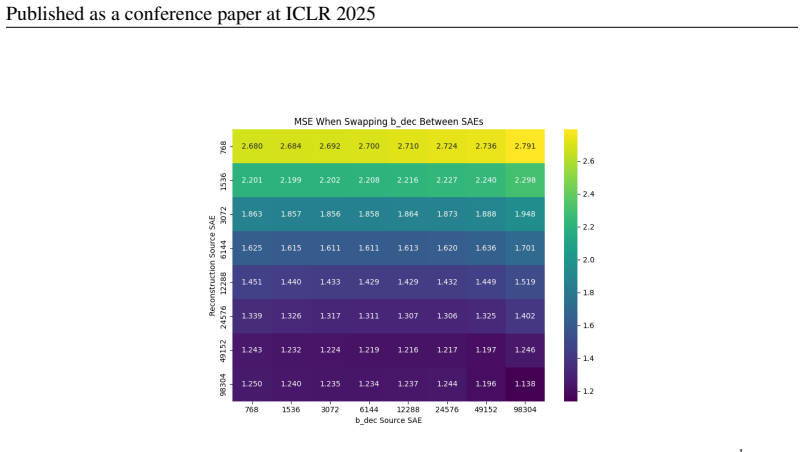
However, in practice we find that the bdecs of SAEs trained on the same latents are very similar (minimum cosine similarity of 0.9970, differing by less than 0.1% in magnitude)
A concern when stitching two different SAEs is the choice of bdec. However, in practice we find that the bdecs of SAEs trained on the same latents are very similar (minimum cosine similarity of 0.9970, differing by less than 0.1% in magnitude). Figure 17 shows that the decoder...
2025
-
[18]
Gemma 2: Improving open language models at a practical size
Gemma Team, Morgane Riviere, Shreya Pathak, Pier Giuseppe Sessa, Cassidy Hardin, Surya Bhu- patiraju, L´eonard Hussenot, Thomas Mesnard, Bobak Shahriari, Alexandre Ram ´e, et al. Gemma 2: Improving open language models at a practical size. arXiv preprint arXiv:2408.00118,
-
[19]
Inter- pretability in the wild: a circuit for indirect object identification in gpt-2 small
Kevin Wang, Alexandre Variengien, Arthur Conmy, Buck Shlegeris, and Jacob Steinhardt. Inter- pretability in the wild: a circuit for indirect object identification in gpt-2 small. arXiv preprint arXiv:2211.00593,
-
[20]
Relational composition in neural networks: A survey and call to action
Martin Wattenberg and Fernanda B Vi ´egas. Relational composition in neural networks: A survey and call to action. arXiv preprint arXiv:2407.14662,
-
[21]
Typically measured as average L0 across a batch: L0 = 1 n P i ∥f (xi)∥0
A A PPENDIX / SUPPLEMENTAL MATERIAL A.1 G LOSSARY OF TERMS Active Latents (L0): For an input x and SAE activation function f (x), the number of non-zero elements in f (x). Typically measured as average L0 across a batch: L0 = 1 n P i ∥f (xi)∥0. Canonical Unit: Hypothetical, fu...
2025
-
[22]
This provides a gradient for training unlike the L0-norm, but suppresses latent activations harming reconstruction performance (Rajamanoharan et al., 2024a)
use the L1-norm S(f ) := ||f ||1 as an approximation to the L0-norm for the sparsity penalty. This provides a gradient for training unlike the L0-norm, but suppresses latent activations harming reconstruction performance (Rajamanoharan et al., 2024a). Furthermore, the L1 penal...
2023
-
[23]
make sure
enforce sparsity by retaining only the top k activations per sample. The encoder is defined as: f (x) :=TopK(Wencx + benc) (7) where TopK zeroes out all but thek largest activations in each sample. This approach eliminates the need for an explicit sparsity penalty but imposes ...
2024
-
[24]
A.5 O PEN SOURCE SAE WEIGHTS All GPT-2 Small SAEs were trained on the layer 8 residual stream, which was chosen in line with Gao et al
Figure 11: Reconstruction MSE of SAEs on inputs where novel latents in the larger SAE are active and inactive 15 Published as a conference paper at ICLR 2025 A.4 L ATENT FAMILIES Figure 12: Connected subgraphs of the bipartite graph of latent in GPT2-768 and GPT2-1536. A.5 O P...
2024
-
[25]
We used the TransformerLens ( https://transformerlensorg.github.io/ TransformerLens/) implementations of GPT-2 and Gemma 2 2B
with dictionary size 16384 and 32768. We used the TransformerLens ( https://transformerlensorg.github.io/ TransformerLens/) implementations of GPT-2 and Gemma 2 2B. CELR is the cross entropy loss recovered from either zero or mean ablation. 16 Published as a conference paper a...
2025
-
[28]
is a benchmarking suite that is currently being developed, to which the researchers were kind enough to grant us early access to benchmark the models in this paper. This work is scheduled to be officially published in early December, well before the decision, and this section ...
2025
-
[29]
Figure 21: Sparse probing evaluation accuracy by GPT-2 SAE dictionary size across 8 benchmark datasets, with a sparse probe using the top latent
They show that the relationship between the size of the SAE and the evaluation accuracy is complex and dataset dependent. Figure 21: Sparse probing evaluation accuracy by GPT-2 SAE dictionary size across 8 benchmark datasets, with a sparse probe using the top latent. 21 Publis...
2025
-
[30]
22 Published as a conference paper at ICLR 2025 Figure 23: TPP evaluation accuracy by GPT-2 SAE dictionary size across 2 benchmark datasets, ablating up to 50 latents
Whilst here there is a general downward trend, the accuracy is not monotonically decreasing with SAE size. 22 Published as a conference paper at ICLR 2025 Figure 23: TPP evaluation accuracy by GPT-2 SAE dictionary size across 2 benchmark datasets, ablating up to 50 latents. 23
2025
-
[41]
We find a lower threshold for distinguishing novel features from reconstruction features (0.4)
and the second SAE has dictionary size 32768. We find a lower threshold for distinguishing novel features from reconstruction features (0.4). Using this threshold, we can also smoothly interpolate between SAEs of different sizes trained on Gemma- 2-2B. Figure 18: Change in MSE...
2024
-
[1997]
In-context learning and induction heads
Catherine Olsson, Nelson Elhage, Neel Nanda, Nicholas Joseph, Nova DasSarma, Tom Henighan, Ben Mann, Amanda Askell, Yuntao Bai, Anna Chen, et al. In-context learning and induction heads. arXiv preprint arXiv:2209.11895,
-
[2014]
Samuel Marks, Can Rager, Eric J Michaud, Yonatan Belinkov, David Bau, and Aaron Mueller
URLhttps://arxiv.org/ abs/1312.5663. Samuel Marks, Can Rager, Eric J Michaud, Yonatan Belinkov, David Bau, and Aaron Mueller. Sparse feature circuits: Discovering and editing interpretable causal graphs in language models. arXiv preprint arXiv:2403.19647,
-
[2015]
Emergent world representations: Exploring a sequence model trained on a synthetic task
Kenneth Li, Aspen K Hopkins, David Bau, Fernanda Vi´egas, Hanspeter Pfister, and Martin Watten- berg. Emergent world representations: Exploring a sequence model trained on a synthetic task. arXiv preprint arXiv:2210.13382,
-
[2019]
Improving dictionary learning with gated sparse autoen- coders
Senthooran Rajamanoharan, Arthur Conmy, Lewis Smith, Tom Lieberum, Vikrant Varma, J ´anos Kram´ar, Rohin Shah, and Neel Nanda. Improving dictionary learning with gated sparse autoen- coders. arXiv preprint arXiv:2404.16014, 2024a. Senthooran Rajamanoharan, Tom Lieberum, Nicola...
2024 arXiv
-
[2021]
Nelson Elhage, Tristan Hume, Catherine Olsson, Nicholas Schiefer, Tom Henighan, Shauna Kravec, Zac Hatfield-Dodds, Robert Lasenby, Dawn Drain, Carol Chen, et al
https://transformer-circuits.pub/2021/framework/index.html. Nelson Elhage, Tristan Hume, Catherine Olsson, Nicholas Schiefer, Tom Henighan, Shauna Kravec, Zac Hatfield-Dodds, Robert Lasenby, Dawn Drain, Carol Chen, et al. Toy models of superposi- tion. arXiv preprint arXiv:2209.10652,
2021 arXiv
-
[2022]
Not all language model features are linear
Joshua Engels, Isaac Liao, Eric J Michaud, Wes Gurnee, and Max Tegmark. Not all language model features are linear. arXiv preprint arXiv:2405.14860,
-
[2023]
Batchtopk sparse autoencoders
Bart Bussmann, Patrick Leask, and Neel Nanda. Batchtopk sparse autoencoders. arXiv preprint arXiv:2412.06410,
-
[2024]
Sparse autoen- coders find highly interpretable features in language models
9 Published as a conference paper at ICLR 2025 Hoagy Cunningham, Aidan Ewart, Logan Riggs, Robert Huben, and Lee Sharkey. Sparse autoen- coders find highly interpretable features in language models. arXiv preprint arXiv:2309.08600 ,
2025 arXiv
Reviewed August 8, 2026 · model on record in the stance chip above.
Discussion (0). Continue with ORCID to comment.