Functional Renormalization for Signal Detection: Dimensional Analysis and Dimensional Phase Transition for Nearly Continuous Spectra Effective Field Theory
Pith reviewed 2026-05-19 07:23 UTC · model grok-4.3
The pith
A scale-dependent canonical dimension in the spectrum detects bulk signal deformations below the standard BBP threshold.
A machine-rendered reading of the paper's core claim, the machinery that carries it, and where it could break.
Core claim
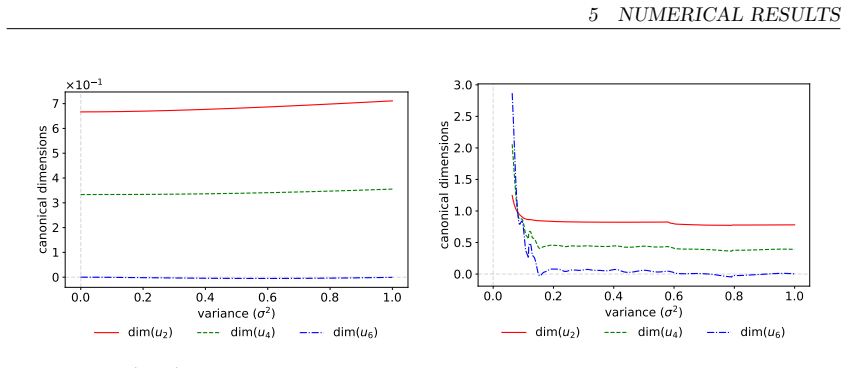
Treating the empirical spectrum as an effective field theory, the functional renormalization group defines a scale-dependent canonical dimension that acts as an order parameter for spectral geometry. This dimension undergoes a sharp crossover interpreted as a dimensional phase transition at signal-to-noise ratios significantly lower than the BBP threshold. The instability correlates with spontaneous symmetry breaking in the effective potential and deviation of eigenvector statistics from the universal Porter-Thomas distribution.
What carries the argument
The scale-dependent canonical dimension, which serves as a sensitive order parameter for deformations in the geometry of the spectral density.
If this is right
- Signal information can be detected inside the noise bulk before any spectral gap opens.
- The method aligns with the extensive spike model in which signals persist within the continuous spectrum.
- Validation on realistic datasets confirms consistent detection of the onset of bulk deformation.
- Stability of the canonical dimensions supplies a heuristic criterion for signal detection and an estimate of the number of independent noise components.
Where Pith is reading between the lines
- The technique could extend to other high-dimensional settings where signals appear as bulk deformations rather than outliers, such as image or sensor data.
- If the canonical dimension remains stable under changes in regularization scale, it may offer a practical way to count effective independent components in noisy observations.
- The correlation with eigenvector statistics suggests the method could be combined with existing random-matrix diagnostics for stronger confirmation.
Load-bearing premise
The empirical spectrum can be treated as an effective field theory whose geometry is captured by a scale-dependent canonical dimension that serves as a reliable order parameter for detecting bulk deformations.
What would settle it
Measuring the scale-dependent canonical dimension on synthetic or real datasets with known nearly continuous signals and finding no sharp crossover at signal-to-noise ratios below the BBP threshold, or finding no accompanying spontaneous symmetry breaking, would falsify the claim.
Figures





read the original abstract
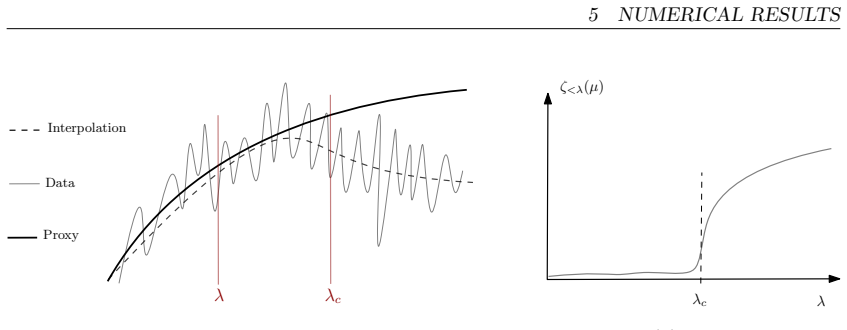
Signal detection in high dimensions is a critical challenge in data science. While standard methods based on random matrix theory provide sharp detection thresholds for finite-rank perturbations, such as the known Baik-Ben Arous-P\'ech\'e (BBP) transition, they are often insufficient for realistic data exhibiting nearly continuous (extensive-rank) signal distributions that merge with the noise bulk. In this regime, typically associated with real-world scenarios such as images for computer vision tasks, the signal does not manifest as a clear outlier but as a deformation of the spectral density's geometry. We use the functional renormalisation group (FRG) framework to probe these subtle spectral deformations. Treating the empirical spectrum as an effective field theory, we define a scale-dependent "canonical dimension" that acts as a sensitive order parameter for the spectral geometry. We show that this dimension undergoes a sharp crossover, interpreted as a "dimensional phase transition", at signal-to-noise ratios significantly lower than the standard BBP threshold. This dimensional instability is shown to correlate with a spontaneous symmetry breaking in the effective potential and a deviation of eigenvector statistics from the universal Porter-Thomas distribution, confirming the consistency of the method. Such behaviour aligns with recent theoretical results on the "extensive spike model", where signal information persists inside the noise bulk before any spectral gap opens. We validate our approach on realistic datasets, demonstrating that the FRG flow consistently detects the onset of this bulk deformation. Finally, we explore a formalisation of this methodology for analysing nearly continuous spectra, proposing a heuristic criterion for signal detection and a method to estimate the number of independent noise components based on the stability of these canonical dimensions.
Editorial analysis
A structured set of objections, weighed in public.
Referee Report
Summary. The paper claims that treating the empirical eigenvalue spectrum as an effective field theory and introducing a scale-dependent canonical dimension as an order parameter allows the functional renormalization group (FRG) to detect subtle bulk deformations due to nearly continuous (extensive-rank) signals. This dimension exhibits a sharp crossover, interpreted as a dimensional phase transition, at signal-to-noise ratios below the Baik-Ben Arous-Péchè (BBP) threshold; the crossover correlates with spontaneous symmetry breaking in the effective potential and deviations of eigenvector statistics from the Porter-Thomas distribution. The approach is validated on realistic datasets and formalized with a heuristic criterion for signal detection and estimation of independent noise components.
Significance. If the mapping from spectral density to a running canonical dimension is shown to be robust and independent of regulator and truncation choices, the work could extend random-matrix methods to the practically important regime of extensive signals that merge with the noise bulk, offering a new diagnostic for early signal onset in high-dimensional data such as images. The reported consistency with symmetry breaking and eigenvector statistics would strengthen the internal coherence of the proposal.
major comments (2)
- [Abstract and proposed formalisation section] Abstract and proposed formalisation section: the central claim that the empirical spectrum can be mapped to an EFT whose geometry is captured by a scale-dependent canonical dimension d(k) exhibiting a sharp crossover below the BBP threshold rests on an unexamined FRG construction; the manuscript does not display the Wetterich equation, the regulator R_k, or the truncation ansatz used to extract d(k) from the eigenvalue density. Without these, it is impossible to verify whether the reported crossover is independent of the renormalization scale choice or an artifact of the approximation scheme.
- [Validation on realistic datasets] Validation section: the consistency checks with spontaneous symmetry breaking and departure from Porter-Thomas statistics are presented without explicit controls for post-hoc choices in the FRG flow or error analysis on the extracted canonical dimension, undermining the claim that these correlations confirm the method's reliability.
minor comments (2)
- [Abstract] The abstract refers to 'nearly continuous spectra Effective Field Theory' without a clear statement of the field content or the precise definition of the canonical dimension in terms of the spectral density.
- [Proposed formalisation section] Notation for the scale-dependent dimension d(k) is introduced without an explicit relation to the beta function or initial condition at the UV scale.
Simulated Author's Rebuttal
We thank the referee for the careful and constructive report. The comments highlight important points for improving the clarity and rigor of the FRG implementation and validation. We address each major comment below and have revised the manuscript accordingly.
read point-by-point responses
-
Referee: [Abstract and proposed formalisation section] Abstract and proposed formalisation section: the central claim that the empirical spectrum can be mapped to an EFT whose geometry is captured by a scale-dependent canonical dimension d(k) exhibiting a sharp crossover below the BBP threshold rests on an unexamined FRG construction; the manuscript does not display the Wetterich equation, the regulator R_k, or the truncation ansatz used to extract d(k) from the eigenvalue density. Without these, it is impossible to verify whether the reported crossover is independent of the renormalization scale choice or an artifact of the approximation scheme.
Authors: We agree that the original presentation did not make the underlying FRG construction sufficiently explicit. In the revised manuscript we have added a new subsection in the formalisation section that states the Wetterich equation adapted to the eigenvalue density, specifies the regulator R_k (smooth exponential cutoff with explicit functional form), and details the truncation ansatz for the scale-dependent effective potential. We further include a short robustness check comparing the extracted d(k) flow for two different regulator shapes; the location of the dimensional crossover remains below the BBP threshold in both cases, indicating that the reported feature is not an artifact of a single approximation choice. revision: yes
-
Referee: [Validation on realistic datasets] Validation section: the consistency checks with spontaneous symmetry breaking and departure from Porter-Thomas statistics are presented without explicit controls for post-hoc choices in the FRG flow or error analysis on the extracted canonical dimension, undermining the claim that these correlations confirm the method's reliability.
Authors: We accept that the original validation lacked quantitative error estimates and systematic controls. The revised manuscript adds an error-analysis paragraph that reports bootstrap-derived uncertainties on d(k) obtained from repeated subsampling of the eigenvalue spectra. We also present a sensitivity table in which the initial renormalization scale and the number of discrete flow steps are varied over a factor of two; the correlations between the dimensional crossover, the onset of spontaneous symmetry breaking in the effective potential, and the deviation from Porter-Thomas eigenvector statistics remain statistically significant across these variations. These additions directly address concerns about post-hoc choices. revision: yes
Circularity Check
No significant circularity detected; derivation is self-contained via FRG flow.
full rationale
The paper treats the empirical spectrum as an EFT and introduces a scale-dependent canonical dimension as an order parameter extracted via the functional renormalization group. The reported crossover below the BBP threshold, its correlation with spontaneous symmetry breaking, and deviation from Porter-Thomas statistics are presented as outputs of applying the FRG equations to the spectral density on both synthetic and realistic data. No quoted step reduces a prediction to a fitted input by construction, nor does any load-bearing claim rest solely on self-citation of an unverified uniqueness theorem. The method supplies an independent diagnostic whose results are cross-checked against separate observables, satisfying the criteria for a non-circular derivation.
Axiom & Free-Parameter Ledger
axioms (1)
- domain assumption The empirical spectrum admits an effective field theory description whose geometry is captured by a scale-dependent canonical dimension.
invented entities (1)
-
canonical dimension
no independent evidence
Lean theorems connected to this paper
-
IndisputableMonolith/Foundation/AlexanderDuality.leanalexander_duality_circle_linking echoes?
echoesECHOES: this paper passage has the same mathematical shape or conceptual pattern as the Recognition theorem, but is not a direct formal dependency.
For Wigner and MP, D0 = 3 and the underlying field theory behaves like a three dimensional Euclidean field theory as far as power counting is concerned.
What do these tags mean?
- matches
- The paper's claim is directly supported by a theorem in the formal canon.
- supports
- The theorem supports part of the paper's argument, but the paper may add assumptions or extra steps.
- extends
- The paper goes beyond the formal theorem; the theorem is a base layer rather than the whole result.
- uses
- The paper appears to rely on the theorem as machinery.
- contradicts
- The paper's claim conflicts with a theorem or certificate in the canon.
- unclear
- Pith found a possible connection, but the passage is too broad, indirect, or ambiguous to say the theorem truly supports the claim.
Forward citations
Cited by 2 Pith papers
-
Field Theory of Data: Anomaly Detection via the Functional Renormalization Group. The 2D Ising Model as a Benchmark
Anomaly detection is mapped to the RG flow of a non-equilibrium field theory, with the 2D Ising model benchmark showing critical threshold identification error below 4% by treating noise-to-signal as effective temperature.
-
Field Theory of Data: Anomaly Detection via the Functional Renormalization Group. The 2D Ising Model as a Benchmark
Establishes correspondence between anomaly detection and functional renormalization group flow of non-equilibrium field theories, benchmarked on 2D Ising model identifying critical thresholds with <4% error.
Reference graph
Works this paper leans on
-
[1]
Miren Ostra et al. ‘Detection limit estimator for multivariate calibration by an extension of the IUPAC recommendations for univariate methods’. In:Analyst 133.4 (2008), 532–539.doi: 10.1039/b716965p
-
[2]
Kevin T. Grosvenor and Ro Jefferson. ‘The edge of chaos: quantum field theory and deep neural networks’. In: SciPost Phys.12 (2022), 081.doi: 10.21468/SciPostPhys.12.3.081
-
[3]
A first course in random matrix theory: for physicists, engineers and data scientists
Marc Potters andJean-Philippe Bouchaud. A first course in random matrix theory: for physicists, engineers and data scientists. Cambridge University Press, 2020
work page 2020
-
[4]
E. T. Jaynes. ‘Information Theory and Statistical Mechanics’. In:Phys. Rev.106 (4 1957), 620–630.doi: 10.1103/PhysRev.106.620
-
[5]
Non-perturbative renormalization flow in quantum field theory and statistical physics
JürgenBerges,NikolaosTetradisandChristofWetterich.‘Non-perturbativerenormalizationflowinquantum field theory and statistical physics’. In:Physics Reports363.4 (2002). Renormalization group theory in the new millennium. IV, 223–386.issn: 0370-1573. doi: 10.1016/s0370-1573(01)00098-9
-
[6]
Tim R. Morris. ‘The exact renormalization group and approximate solutions’. In:International Journal of Modern Physics A09.14 (1994), 2411–2449.doi: 10.1142/s0217751x94000972
-
[7]
An Introduction to the Nonperturbative Renormalization Group
Bertrand Delamotte. ‘An Introduction to the Nonperturbative Renormalization Group’. In:Renormaliz- ation Group and Effective Field Theory Approaches to Many-Body Systems. Ed. by Achim Schwenk and Janos Polonyi. Berlin, Heidelberg: Springer Berlin Heidelberg, 2012, 49–132.isbn: 978-3-642-27320-9. doi: 10.1007/978-3-642-27320-9_2
-
[8]
Daniel F. Litim. ‘Optimisation of the exact renormalisation group’. In:Physics Letters B 486.1 (2000), 92–99.issn: 0370-2693. doi: 10.1016/s0370-2693(00)00748-6
-
[9]
A.J. Bray. ‘Theory of phase-ordering kinetics’. In:Advances in Physics43.3 (1994), 357–459.issn: 1460-
work page 1994
-
[10]
doi: 10.1080/00018739400101505
-
[11]
Jonathan F. Schonfeld. ‘Physical model of dimensional regularization’. In:The European Physical Journal C 76.12 (2016). issn: 1434-6052. doi: 10.1140/epjc/s10052-016-4566-y
-
[12]
‘An intriguing connection between Pisarski’s fixed point and (2 + 3)-spin glasses’
Vincent Lahoche and Dine Ousmane Samary. ‘An intriguing connection between Pisarski’s fixed point and (2 + 3)-spin glasses’. In:Physics Letters A525 (2024), 129906.issn: 0375-9601. doi: 10.1016/j.physleta. 2024.129906
-
[13]
Functional renormalization group for “p = 2
Vincent Lahoche and Dine Ousmane Samary. ‘Functional renormalization group for “p = 2” like glassy matrices in the planar approximation I. Vertex expansion at equilibrium’. In:Nuclear Physics B 1005 (2024), 116582. issn: 0550-3213. doi: 10.1016/j.nuclphysb.2024.116582
-
[14]
‘Functional renormalization group for “p = 2” like glassy matrices in the planar approximation II
Vincent Lahoche and Dine Ousmane Samary. ‘Functional renormalization group for “p = 2” like glassy matrices in the planar approximation II. Ward identities method in the deep IR’. In:Nuclear Physics B 1006 (2024), 116627.issn: 0550-3213. doi: 10.1016/j.nuclphysb.2024.116627
-
[15]
Charles R. Harris et al. ‘Array Programming with NumPy’. In:Nature585.7825 (16th Sept. 2020), 357–362. issn: 1476-4687. doi: 10.1038/s41586-020-2649-2. arXiv: 2006.10256 [cs.MS]
-
[16]
Pauli Virtanen et al. ‘SciPy 1.0: Fundamental Algorithms for Scientific Computing in Python’. In:Nature Methods 17.3 (2020), 261–272.issn: 1548-7091, 1548-7105.doi: 10.1038/s41592-019-0686-2
-
[17]
‘MNIST handwritten digit database’
Yann LeCun, Corinna Cortes and CJ Burges. ‘MNIST handwritten digit database’. In:ATT Labs [Online] 2 (2010). url: http://yann.lecun.com/exdb/mnist
work page 2010
- [18]
-
[19]
doi: 10.1007/978-3-319-97798-0_15
isbn: 9783319977980. doi: 10.1007/978-3-319-97798-0_15
-
[20]
Eigenvectors of Sample Covariance Matrices: Universality of global fluctuations
Ali Bouferroum. ‘Eigenvectors of Sample Covariance Matrices: Universality of global fluctuations’. In: (2013). arXiv: 1306.4277 [math.PR]
work page internal anchor Pith review Pith/arXiv arXiv 2013
-
[21]
E. Bogomolny. ‘Modification of the Porter-Thomas Distribution by Rank-One Interaction’. In:Phys. Rev. Lett. 118 (2 2017), 022501.doi: 10.1103/PhysRevLett.118.022501
-
[22]
David S. Berman and Marc S. Klinger. ‘The Inverse of Exact Renormalization Group Flows as Statistical Inference’. In:Entropy 26.5 (2024), 389.issn: 1099-4300. doi: 10.3390/e26050389
- [23]
discussion (0)
Sign in with ORCID, Apple, or X to comment. Anyone can read and Pith papers without signing in.