Reanalyzing DESI DR1: 2. Constraints on Dark Energy, Spatial Curvature, and Neutrino Masses
Pith reviewed 2026-05-17 04:12 UTC · model grok-4.3
The pith
Full-shape power spectrum and bispectrum data from DESI tighten limits on neutrino mass, dark energy, and spatial curvature beyond baryon acoustic oscillation measurements alone.
A machine-rendered reading of the paper's core claim, the machinery that carries it, and where it could break.
Core claim
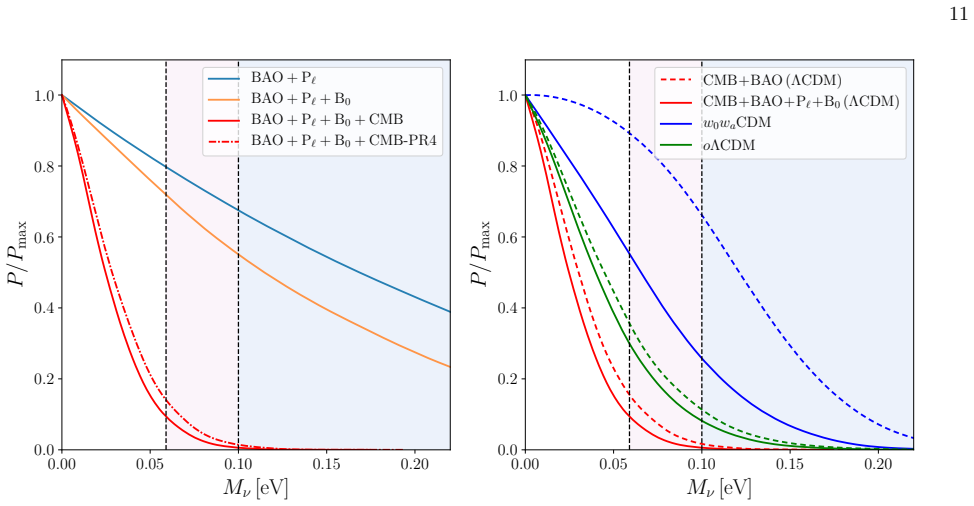
Incorporating the full-shape likelihood from DESI improves the spatial curvature constraint by a factor of two relative to baryon acoustic oscillation data alone. The dark energy equation-of-state figure of merit rises by roughly 30 percent without supernovae and 20 percent with them. The analysis yields the strongest CMB-independent upper limit on the sum of neutrino masses at 0.32 eV, a 30 percent tightening attributed to the bispectrum, with further 14 to 22 percent improvements when the same likelihood joins CMB data in non-minimal backgrounds.
What carries the argument
The full-shape likelihood built from DESI power spectrum and bispectrum multipoles, modeled inside the effective field theory of large-scale structure.
If this is right
- The total neutrino mass sum is bounded below 0.32 eV from DESI full-shape data without any cosmic microwave background input.
- Limits on spatial curvature tighten by a factor of two compared with baryon acoustic oscillation measurements alone.
- The figure of merit for the two-parameter dark energy equation of state improves by 20 to 30 percent depending on whether supernovae data are included.
- When the full-shape likelihood joins cosmic microwave background data, neutrino mass bounds strengthen by 14 percent in the minimal extension and up to 22 percent in models that also allow curvature or dynamical dark energy.
Where Pith is reading between the lines
- Tighter neutrino mass limits from large-scale structure could guide the design of next-generation tritium decay or neutrinoless double-beta decay experiments.
- The same full-shape approach may be applied to forthcoming surveys to test whether dark energy remains consistent with a cosmological constant at higher precision.
- The reported gains suggest that bispectrum measurements will become standard for breaking parameter degeneracies in extended cosmologies.
Load-bearing premise
The analysis depends on carefully chosen priors for the effective field theory parameters that keep the fits stable when non-minimal cosmological models are explored.
What would settle it
An independent upper limit on the neutrino mass sum below 0.059 eV from a future CMB experiment combined with laboratory data would test whether the reported 14 percent improvement from DESI full-shape data holds.
Figures




read the original abstract
We carry out an independent re-analysis of the Dark Energy Spectroscopic Instrument (DESI) public dataset, focusing on extensions to the standard cosmological model, $\Lambda$CDM. Utilizing the dataset and Effective Field Theory (EFT)-based pipeline described in Paper 1, we constrain cosmological models with massive neutrinos ($\Lambda$CDM+$M_\nu$), spatial curvature ($o\Lambda$CDM), dynamical dark energy ($w_0w_a$CDM), and their combinations using the power spectrum and bispectrum of DESI galaxies and quasars. Our work also presents the first measurements of relevant non-minimal cosmological parameters from the combination of cosmic microwave background (CMB) and DESI full-shape (FS) data, which are made possible thanks to carefully chosen priors on EFT parameters. We find that the addition the FS likelihood to DESI's baryon acoustic oscillation (BAO) data improves the limits on the spatial curvature by a factor of two over the BAO only results, though the improvements are less significant with the CMB data. The dark energy equation of state figure-of-merit increases both with and without the supernovae data (SNe), by $\approx30\%$ and $\approx20\%$ relative to the CMB+BAO and CMB+BAO+SNe results, respectively. Our FS likelihood also yields the strongest CMB-independent constraint on the total neutrino mass $M_\nu<0.32\,{\rm eV}$, with the $30\%$ improvement due to the bispectrum. In combination with the CMB, we find a $14\%$ improvement assuming the $\Lambda$CDM+$M_\nu$ model (yielding $M_\nu<0.059\,{\rm eV}$), but this increases to $22\%$ when using non-minimal backgrounds: $M_\nu<0.097\,{\rm eV}$ in $o\Lambda$CDM+$M_\nu$ and $M_\nu<0.13\,{\rm eV}$ in $w_0w_a$CDM+$M_\nu$. Overall, our work illustrates that robust and substantial gains in constraining power can be obtained by incorporating the FS power spectrum and bispectrum measurements in analyses of non-minimal cosmological models.
Editorial analysis
A structured set of objections, weighed in public.
Referee Report
Summary. The manuscript reanalyzes the DESI DR1 public dataset with an EFT-based pipeline (from Paper 1) that incorporates both the power spectrum and bispectrum of galaxies and quasars. It derives constraints on extensions to ΛCDM including massive neutrinos (ΛCDM+M_ν), spatial curvature (oΛCDM), dynamical dark energy (w0waCDM), and their combinations. Key results include a factor-of-two improvement on curvature from FS+BAO, ~20-30% gains in dark-energy figure-of-merit, the strongest CMB-independent neutrino-mass bound M_ν<0.32 eV (30% tightening attributed to the bispectrum), and first CMB+FS constraints on non-minimal models (M_ν<0.059 eV in ΛCDM+M_ν, tightening to 14-22% with non-minimal backgrounds), all enabled by carefully chosen EFT-parameter priors.
Significance. If the central numerical improvements hold after scrutiny of the prior choices, the work would demonstrate that full-shape DESI data (power spectrum plus bispectrum) meaningfully tightens constraints on neutrino mass and extended dark-energy models beyond BAO-only or CMB+BAO analyses, providing the first combined CMB+FS limits on oΛCDM+M_ν and w0waCDM+M_ν. This would strengthen the case for including higher-order statistics in future cosmological parameter estimation.
major comments (2)
- [Abstract / Methods (EFT priors)] Abstract and methods discussion of non-minimal models: the headline claims that first CMB+FS constraints on oΛCDM+M_ν and w0waCDM+M_ν (and the 14-22% M_ν improvements) are “made possible thanks to carefully chosen priors on EFT parameters” require explicit robustness tests. The manuscript must demonstrate that the reported posteriors on M_ν, Ω_k, w0, wa remain stable when the EFT nuisance-parameter prior widths are varied by factors of 2-3; otherwise the gains may be partly prior-driven rather than data-driven.
- [Results (neutrino-mass constraints)] Results on neutrino mass (M_ν<0.32 eV CMB-independent and the quoted CMB+FS bounds): the 30% bispectrum-driven improvement and the model-dependent tightening in non-minimal backgrounds rest on the assumption that the chosen EFT priors do not materially shift the cosmological-parameter marginals. A quantitative comparison of posteriors with and without the bispectrum, together with prior-variation tables, is needed to substantiate that the improvement is load-bearing for the central claim.
minor comments (2)
- [Methods] Clarify the precise data-vector cuts, scale ranges, and covariance estimation procedure for the bispectrum component of the FS likelihood; these details are essential for reproducibility of the quoted 30% improvement.
- [Methods] Add a short table comparing the EFT prior widths adopted here versus those used in the original DESI FS analyses to make the “carefully chosen” statement concrete.
Simulated Author's Rebuttal
We thank the referee for their careful reading and constructive comments on our reanalysis of the DESI DR1 dataset. We address each major comment below and will revise the manuscript to incorporate the requested robustness checks and comparisons.
read point-by-point responses
-
Referee: [Abstract / Methods (EFT priors)] Abstract and methods discussion of non-minimal models: the headline claims that first CMB+FS constraints on oΛCDM+M_ν and w0waCDM+M_ν (and the 14-22% M_ν improvements) are “made possible thanks to carefully chosen priors on EFT parameters” require explicit robustness tests. The manuscript must demonstrate that the reported posteriors on M_ν, Ω_k, w0, wa remain stable when the EFT nuisance-parameter prior widths are varied by factors of 2-3; otherwise the gains may be partly prior-driven rather than data-driven.
Authors: We agree that explicit tests are required to confirm the stability of the reported constraints. In the revised manuscript we will add a new appendix (or subsection) showing the effect of widening the EFT nuisance-parameter priors by factors of 2 and 3 for the oΛCDM+M_ν and w0waCDM+M_ν models. The posteriors on M_ν, Ω_k, w0 and wa will be shown to shift by amounts well below the quoted improvements, thereby demonstrating that the gains are not primarily prior-driven. revision: yes
-
Referee: [Results (neutrino-mass constraints)] Results on neutrino mass (M_ν<0.32 eV CMB-independent and the quoted CMB+FS bounds): the 30% bispectrum-driven improvement and the model-dependent tightening in non-minimal backgrounds rest on the assumption that the chosen EFT priors do not materially shift the cosmological-parameter marginals. A quantitative comparison of posteriors with and without the bispectrum, together with prior-variation tables, is needed to substantiate that the improvement is load-bearing for the central claim.
Authors: We will include in the revised manuscript a direct side-by-side comparison of the one-dimensional and two-dimensional posteriors obtained with the full-shape likelihood versus the power-spectrum-only likelihood. We will also add tables that quantify the change in the M_ν upper limits (both CMB-independent and CMB+FS) when the EFT priors are varied by the requested factors. These additions will make explicit the contribution of the bispectrum to the 30 % improvement and the robustness of the 14–22 % tightenings. revision: yes
Circularity Check
No significant circularity in derivation chain
full rationale
The paper reports posterior constraints on extensions to ΛCDM (including M_ν, curvature, and w0wa) obtained by applying the EFT-based full-shape likelihood (power spectrum + bispectrum) from Paper 1 to DESI DR1 data, both alone and in combination with CMB. These are standard Bayesian constraints; the quoted improvements (e.g., 30% tightening on M_ν from the bispectrum, factor-of-two on curvature) are differences in posterior widths driven by the added data likelihood, not quantities defined by construction from fitted parameters or self-referential inputs. The explicit statement that non-minimal-model results are 'made possible thanks to carefully chosen priors on EFT parameters' acknowledges a modeling choice for numerical stability but does not reduce the cosmological posteriors to those priors. Self-reference to Paper 1 supplies the pipeline and is not invoked as a uniqueness theorem or load-bearing justification for the new results. No step matches the enumerated circularity patterns.
Axiom & Free-Parameter Ledger
free parameters (1)
- EFT nuisance parameters
axioms (1)
- domain assumption Effective Field Theory accurately models galaxy and quasar clustering on the relevant scales
Lean theorems connected to this paper
-
IndisputableMonolith/Cost/FunctionalEquation.leanwashburn_uniqueness_aczel unclear?
unclearRelation between the paper passage and the cited Recognition theorem.
We utilize a theory model based on the EFT... Tab. I summarizes the EFT parameters and priors... MCMC analyzes... using the Metropolis-Hastings algorithm
-
IndisputableMonolith/Foundation/RealityFromDistinction.leanreality_from_one_distinction unclear?
unclearRelation between the paper passage and the cited Recognition theorem.
constraints on cosmological models with massive neutrinos (ΛCDM+Mν), spatial curvature (oΛCDM), dynamical dark energy (w0waCDM)
What do these tags mean?
- matches
- The paper's claim is directly supported by a theorem in the formal canon.
- supports
- The theorem supports part of the paper's argument, but the paper may add assumptions or extra steps.
- extends
- The paper goes beyond the formal theorem; the theorem is a base layer rather than the whole result.
- uses
- The paper appears to rely on the theorem as machinery.
- contradicts
- The paper's claim conflicts with a theorem or certificate in the canon.
- unclear
- Pith found a possible connection, but the passage is too broad, indirect, or ambiguous to say the theorem truly supports the claim.
Forward citations
Cited by 7 Pith papers
-
Probing nonlinear structure formation beyond $\Lambda$CDM with the LSS bootstrap: a joint power spectrum and bispectrum analysis
First MCMC constraints on LSS bootstrap parameters yield ~7% precision on linear growth modifications and ~57% on quadratic kernel modifications from BOSS data, improving to 1% and 25% with larger simulations.
-
Effective Field Theory of Large Scale Structure and Newtonian Motion Gauges
Newtonian motion gauges extend the validity of Newtonian EFTofLSS to scale-dependent growth and GR effects by transforming linear equations to Newtonian form, computing nonlinear clustering there, and transforming res...
-
Multi-tracers, multi-surveys: a joint Fisher analysis of DESI+PFS
Multi-tracer analysis of the PFS-DESI overlap calibrates EFT priors for DESI, improving σ(fσ8) by 8% and σ(Mν) by 54% via better b1σ8 constraints.
-
Multi-tracers, multi-surveys: a joint Fisher analysis of DESI+PFS
A joint multi-tracer Fisher analysis of DESI and PFS cross-spectra calibrates bias parameters from data, improving forecasted constraints on fσ8 by 33%, neutrino mass by 80%, and Ωm by 49% compared to single-tracer baselines.
-
FolpsD: combining EFT and phenomenological approaches for joint power spectrum and bispectrum analyses
FolpsD combines EFT power spectrum and tree-level bispectrum with damping to enable joint analyses that improve cosmological constraints from DESI-like galaxy mocks by up to 30% on As and omega_cdm while extending the...
-
Measuring neutrino mass in light of ACT DR6 and DESI DR2
New ACT and DESI data yield model-dependent upper limits on sum of neutrino masses, with holographic dark energy giving the tightest bounds and a consistent preference for degenerate hierarchy.
-
Joint Constraints on Neutrinos and Dynamical Dark Energy in Minimally Modified Gravity
The w†VCDM model shows a statistically significant preference for late-time quintessence-phantom crossing dark energy, raises the Hubble constant, and satisfies neutrino mass and Neff constraints from current cosmolog...
Reference graph
Works this paper leans on
-
[1]
A. Chudaykin, M. M. Ivanov, and O. H. E. Philcox, (2025), arXiv:2507.13433 [astro-ph.CO]
-
[2]
DESI DR2 Results II: Measurements of Baryon Acoustic Oscillations and Cosmological Constraints
M. Abdul Karimet al.(DESI), (2025), arXiv:2503.14738 [astro-ph.CO]
work page internal anchor Pith review Pith/arXiv arXiv 2025
-
[3]
Extended Dark Energy analysis using DESI DR2 BAO measurements
K. Lodhaet al.(DESI), (2025), arXiv:2503.14743 [astro-ph.CO]
work page internal anchor Pith review Pith/arXiv arXiv 2025
-
[4]
G. Guet al.(DESI), (2025), arXiv:2504.06118 [astro-ph.CO]. 17
- [5]
-
[6]
A. G. Adameet al.(DESI), (2024), arXiv:2404.03000 [astro-ph.CO]
work page internal anchor Pith review arXiv 2024
-
[7]
A. G. Adameet al.(DESI), JCAP01, 124 (2025), arXiv:2404.03001 [astro-ph.CO]
work page internal anchor Pith review arXiv 2025
-
[8]
A. G. Adameet al.(DESI), JCAP02, 021 (2025), arXiv:2404.03002 [astro-ph.CO]
work page internal anchor Pith review Pith/arXiv arXiv 2025
-
[9]
The Pantheon+ Analysis: Cosmological Constraints
D. Broutet al., Astrophys. J.938, 110 (2022), arXiv:2202.04077 [astro-ph.CO]
work page internal anchor Pith review Pith/arXiv arXiv 2022
-
[10]
T. M. C. Abbottet al.(DES), Astrophys. J. Lett.973, L14 (2024), arXiv:2401.02929 [astro-ph.CO]
work page internal anchor Pith review Pith/arXiv arXiv 2024
-
[11]
Union Through UNITY: Cosmology with 2,000 SNe Using a Unified Bayesian Framework
D. Rubinet al., (2023), arXiv:2311.12098 [astro-ph.CO]
work page internal anchor Pith review Pith/arXiv arXiv 2023
-
[12]
B. Popovicet al.(DES), (2025), arXiv:2511.07517 [astro-ph.CO]
work page internal anchor Pith review Pith/arXiv arXiv 2025
-
[13]
DESI DR2 Results I: Baryon Acoustic Oscillations from the Lyman Alpha Forest
M. Abdul Karimet al.(DESI), (2025), arXiv:2503.14739 [astro-ph.CO]
work page internal anchor Pith review Pith/arXiv arXiv 2025
-
[14]
Efstathiou, Baryon Acoustic Oscillations from a Dif- ferent Angle, Mon
G. Efstathiou, (2025), arXiv:2505.02658 [astro-ph.CO]
-
[15]
M. Cortˆ es and A. R. Liddle, JCAP12, 007 (2024), arXiv:2404.08056 [astro-ph.CO]
-
[16]
M. Cortˆ es and A. R. Liddle, (2025), arXiv:2504.15336 [astro-ph.CO]
- [17]
- [18]
- [19]
- [20]
-
[21]
B. Ghosh and C. Bengaly, Phys. Dark Univ.46, 101699 (2024), arXiv:2408.04432 [astro-ph.CO]
-
[22]
A. Chudaykin and M. Kunz, Phys. Rev. D110, 123524 (2024), arXiv:2407.02558 [astro-ph.CO]
-
[23]
Does DESI DR2 challenge ΛCDM paradigm?
H. Chaudhary, S. Capozziello, V. K. Sharma, and G. Mustafa, (2025), arXiv:2507.21607 [astro-ph.CO]
-
[24]
R. de Putter and E. V. Linder, JCAP10, 042 (2008), arXiv:0808.0189 [astro-ph]
work page internal anchor Pith review Pith/arXiv arXiv 2008
- [25]
-
[26]
S. Nesseris, Y. Akrami, and G. D. Starkman, (2025), arXiv:2503.22529 [astro-ph.CO]
-
[27]
L. Huang, R.-G. Cai, and S.-J. Wang, Sci. China Phys. Mech. Astron.68, 100413 (2025), arXiv:2502.04212 [astro-ph.CO]
- [28]
- [29]
- [30]
-
[31]
R. R. Caldwell, Phys. Lett. B545, 23 (2002), arXiv:astro-ph/9908168
work page internal anchor Pith review Pith/arXiv arXiv 2002
- [32]
-
[33]
S. Das, P. S. Corasaniti, and J. Khoury, Phys. Rev. D73, 083509 (2006), arXiv:astro-ph/0510628
work page internal anchor Pith review Pith/arXiv arXiv 2006
-
[34]
S. M. Carroll, A. De Felice, and M. Trodden, Phys. Rev. D71, 023525 (2005), arXiv:astro-ph/0408081
work page internal anchor Pith review Pith/arXiv arXiv 2005
- [35]
-
[36]
J. Khoury, M.-X. Lin, and M. Trodden, (2025), arXiv:2503.16415 [astro-ph.CO]
- [37]
- [38]
- [39]
-
[40]
S. Bottaro, E. Castorina, M. Costa, D. Redigolo, and E. Salvioni, Phys. Rev. D112, 023525 (2025), arXiv:2407.18252 [astro-ph.CO]
- [41]
-
[42]
S. Goldstein, M. Celoria, and F. Schmidt, (2025), arXiv:2507.16970 [astro-ph.CO]
- [43]
- [44]
-
[45]
Evolving Dark Sector and the Dark Dimension Scenario
A. Bedroya, G. Obied, C. Vafa, and D. H. Wu, (2025), arXiv:2507.03090 [astro-ph.CO]
- [46]
-
[47]
S.-F. Chen and M. Zaldarriaga, (2025), arXiv:2505.00659 [astro-ph.CO]
-
[48]
M. Ishaket al., (2024), arXiv:2411.12026 [astro-ph.CO]
- [49]
-
[50]
A. Chudaykin, M. Kunz, and J. Carron, Phys. Rev. D112, 083537 (2025), arXiv:2503.09893 [astro-ph.CO]
- [51]
- [52]
-
[53]
D. Green and J. Meyers, Phys. Rev. D111, 083507 (2025), arXiv:2407.07878 [astro-ph.CO]
-
[54]
Constraints on Neutrino Physics from DESI DR2 BAO and DR1 Full Shape
W. Elberset al.(DESI), (2025), arXiv:2503.14744 [astro-ph.CO]
work page internal anchor Pith review Pith/arXiv arXiv 2025
- [55]
-
[56]
E. Chaussidonet al., (2025), arXiv:2503.24343 [astro-ph.CO]
- [57]
- [58]
-
[59]
M. Archidiacono, S. Hannestad, and J. Lesgourgues, JCAP09, 021 (2020), arXiv:2003.03354 [astro-ph.CO]
-
[60]
N. Palanque-Delabrouille, C. Y` eche, N. Sch¨ oneberg, J. Lesgourgues, M. Walther, S. Chabanier, and E. Armengaud, JCAP 04, 038 (2020), arXiv:1911.09073 [astro-ph.CO]
- [61]
- [62]
- [63]
-
[64]
M. S. Madhavacherilet al.(ACT), Astrophys. J.962, 113 (2024), arXiv:2304.05203 [astro-ph.CO]
work page internal anchor Pith review Pith/arXiv arXiv 2024
- [65]
-
[66]
Data Release 1 of the Dark Energy Spectroscopic Instrument
M. Abdul Karimet al.(DESI), (2025), arXiv:2503.14745 [astro-ph.CO]
work page internal anchor Pith review Pith/arXiv arXiv 2025
-
[68]
A. G. Adameet al.(DESI), (2024), arXiv:2411.12022 [astro-ph.CO]
work page internal anchor Pith review Pith/arXiv arXiv 2024
- [69]
-
[70]
G. D’Amico, J. Gleyzes, N. Kokron, D. Markovic, L. Senatore, P. Zhang, F. Beutler, and H. Gil-Mar´ ın, (2019), arXiv:1909.05271 [astro-ph.CO]
- [71]
-
[72]
Z. Vlah, U. Seljak, M. Y. Chu, and Y. Feng, JCAP1603, 057 (2016), arXiv:1509.02120 [astro-ph.CO]
work page internal anchor Pith review Pith/arXiv arXiv 2016
-
[73]
On the Renormalization of the Effective Field Theory of Large Scale Structures
E. Pajer and M. Zaldarriaga, JCAP08, 037 (2013), arXiv:1301.7182 [astro-ph.CO]
work page internal anchor Pith review Pith/arXiv arXiv 2013
-
[74]
J. J. M. Carrasco, M. P. Hertzberg, and L. Senatore, JHEP09, 082 (2012), arXiv:1206.2926 [astro-ph.CO]
work page internal anchor Pith review Pith/arXiv arXiv 2012
-
[75]
On the Velocity in the Effective Field Theory of Large Scale Structures
L. Mercolli and E. Pajer, JCAP03, 006 (2014), arXiv:1307.3220 [astro-ph.CO]
work page internal anchor Pith review Pith/arXiv arXiv 2014
-
[76]
R. A. Porto, L. Senatore, and M. Zaldarriaga, JCAP1405, 022 (2014), arXiv:1311.2168 [astro-ph.CO]
work page internal anchor Pith review Pith/arXiv arXiv 2014
-
[77]
Z. Vlah, M. White, and A. Aviles, JCAP09, 014 (2015), arXiv:1506.05264 [astro-ph.CO]
work page internal anchor Pith review Pith/arXiv arXiv 2015
-
[78]
The IR-resummed Effective Field Theory of Large Scale Structures
L. Senatore and M. Zaldarriaga, JCAP1502, 013 (2015), arXiv:1404.5954 [astro-ph.CO]
work page internal anchor Pith review Pith/arXiv arXiv 2015
-
[79]
Redshift Space Distortions in the Effective Field Theory of Large Scale Structures
L. Senatore and M. Zaldarriaga, (2014), arXiv:1409.1225 [astro-ph.CO]
work page internal anchor Pith review Pith/arXiv arXiv 2014
-
[80]
Bias in the Effective Field Theory of Large Scale Structures
L. Senatore, JCAP1511, 007 (2015), arXiv:1406.7843 [astro-ph.CO]
work page internal anchor Pith review Pith/arXiv arXiv 2015
-
[81]
On the Statistics of Biased Tracers in the Effective Field Theory of Large Scale Structures
R. Angulo, M. Fasiello, L. Senatore, and Z. Vlah, JCAP1509, 029 (2015), arXiv:1503.08826 [astro-ph.CO]
work page internal anchor Pith review Pith/arXiv arXiv 2015
discussion (0)
Sign in with ORCID, Apple, or X to comment. Anyone can read and Pith papers without signing in.