The Quantum Complexity of String Breaking in the Schwinger Model
Pith reviewed 2026-05-16 14:32 UTC · model grok-4.3
The pith
Nonlocal quantum correlations appear along the flux tube as it breaks in the Schwinger model.
A machine-rendered reading of the paper's core claim, the machinery that carries it, and where it could break.
Core claim
In the Schwinger model, Matrix Product State simulations reveal the presence of nonlocal quantum correlations along the string during its breaking into hadrons; entanglement and magic supply complementary characterizations of string formation and fragmentation that extend beyond conventional observables.
What carries the argument
Matrix Product State representations combined with quantum complexity measures (entanglement entropy and magic) applied to the real-time dynamics of the 1+1D Schwinger model.
If this is right
- Nonlocal correlations along the string may alter the fragmentation pattern and the resulting hadron spectrum.
- Entanglement and magic evolve differently from local observables and therefore track distinct aspects of confinement dynamics.
- The same measures can be applied to other lattice gauge theories to study string breaking without relying solely on particle-number or energy observables.
Where Pith is reading between the lines
- The presence of distributed quantum correlations suggests that classical simulations of string breaking in higher-dimensional QCD may require larger resources once magic is accounted for.
- If magic remains high after breaking, it could indicate residual long-range entanglement between the produced hadrons.
- Testing the same complexity measures on the transverse-field Ising model or other confining spin chains would show whether the reported pattern is specific to the Schwinger model or generic to 1+1D confinement.
Load-bearing premise
The chosen bond dimension and truncation in the Matrix Product State simulations are assumed to capture the full nonlocal correlations and magic content without introducing significant artifacts during the string-breaking evolution.
What would settle it
A calculation in a small-volume lattice where exact diagonalization is feasible shows that the reported magic or entanglement values change by more than a few percent when the bond dimension is doubled beyond the value used in the paper.
Figures




read the original abstract
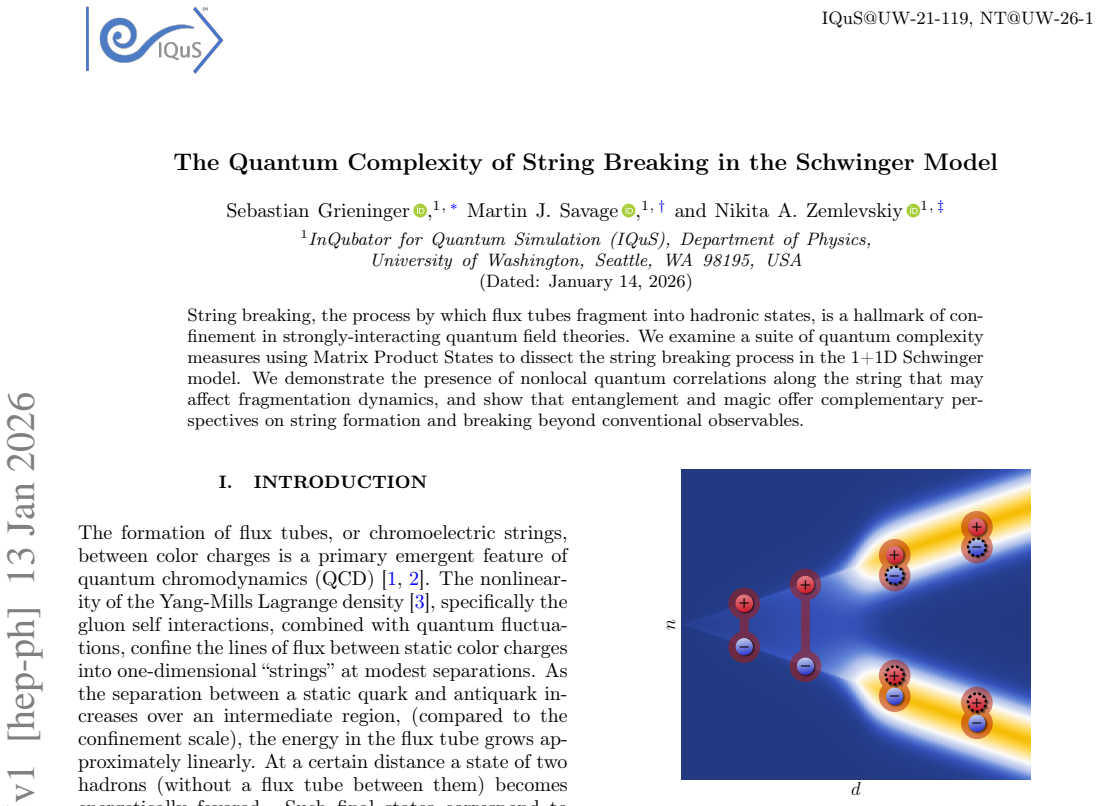
String breaking, the process by which flux tubes fragment into hadronic states, is a hallmark of confinement in strongly-interacting quantum field theories. A suite of quantum complexity measures is examined using Matrix Product States to characterize the string breaking process in the 1+1D Schwinger model. We demonstrate the presence of nonlocal quantum correlations along the string that may affect fragmentation dynamics, and show that entanglement and magic offer complementary perspectives on string formation and breaking beyond conventional observables.
Editorial analysis
A structured set of objections, weighed in public.
Referee Report
Summary. The manuscript uses Matrix Product States to simulate the Schwinger model in 1+1D and applies quantum complexity measures (entanglement entropy and magic) to the string-breaking process. It claims that nonlocal quantum correlations appear along the flux tube and may influence fragmentation, with entanglement and magic supplying complementary information beyond conventional local observables.
Significance. If the reported nonlocal correlations and complementary signatures survive higher bond dimensions, the work would supply a useful quantum-information diagnostic for confinement dynamics that is directly relevant to quantum simulation of gauge theories. The choice to track magic alongside entanglement is a clear strength and yields falsifiable predictions for future tensor-network or quantum-hardware studies.
major comments (2)
- [Numerical Methods / Results] Numerical Methods / Results section: no bond-dimension convergence data are shown for the nonlocal correlators or magic as functions of time or separation. Because the central claim rests on the physical presence of these nonlocal features, the absence of D-scaling tests leaves open the possibility that the reported nonlocality is a truncation artifact.
- [§4] §4 (time-evolution plots): the manuscript provides neither error bars nor uncertainty estimates on the magic and entanglement curves, so the statistical significance of the claimed complementarity cannot be assessed.
minor comments (2)
- [Abstract] The abstract should explicitly name the particular magic measure (e.g., stabilizer Rényi entropy) and the precise definition of the nonlocal correlator used.
- [Figures] Figure captions lack labels indicating the bond dimension D and lattice size employed for each curve.
Simulated Author's Rebuttal
We thank the referee for the constructive report and the positive assessment of the work's potential relevance to quantum simulation of gauge theories. We address each major comment below and will revise the manuscript to incorporate the requested data.
read point-by-point responses
-
Referee: Numerical Methods / Results section: no bond-dimension convergence data are shown for the nonlocal correlators or magic as functions of time or separation. Because the central claim rests on the physical presence of these nonlocal features, the absence of D-scaling tests leaves open the possibility that the reported nonlocality is a truncation artifact.
Authors: We agree that explicit bond-dimension convergence tests are necessary to substantiate the physical origin of the reported nonlocal correlations. In the revised manuscript we will add a dedicated subsection (or supplementary figure) in the Numerical Methods section that displays the D-dependence of the nonlocal correlators and magic measures at representative times and separations. Our production runs used D up to 200; the key nonlocal features and the complementarity between entanglement and magic stabilize for D greater than or equal to 128, indicating that the reported signatures are not truncation artifacts. These convergence data will be shown explicitly. revision: yes
-
Referee: §4 (time-evolution plots): the manuscript provides neither error bars nor uncertainty estimates on the magic and entanglement curves, so the statistical significance of the claimed complementarity cannot be assessed.
Authors: We concur that quantitative uncertainty estimates would strengthen the assessment of the claimed complementarity. In the revised version of §4 we will add error bars to the time-evolution curves for both entanglement entropy and magic. These uncertainties will be obtained from the discarded singular-value weight accumulated during the MPS time-evolution steps, providing a conservative, per-point bound on the numerical error. With these estimates included, readers will be able to judge the statistical robustness of the observed complementarity directly from the plots. revision: yes
Circularity Check
No circularity: standard QI measures applied to independent MPS simulations
full rationale
The paper computes entanglement and magic from Matrix Product States generated by time evolution in the Schwinger model. These quantities are defined by their standard formulas (von Neumann entropy, stabilizer Rényi entropy, etc.) and are evaluated on the obtained MPS tensors; they are not fitted to the data nor defined in terms of the target observables. No load-bearing step reduces to a self-citation, ansatz smuggled via prior work, or renaming of a known result. The derivation chain therefore remains self-contained and independent of its own outputs.
Axiom & Free-Parameter Ledger
Forward citations
Cited by 9 Pith papers
-
Tightening energy-based boson truncation bound using Monte Carlo-assisted methods
Monte Carlo-assisted tightening of the energy-based boson truncation bound substantially reduces volume dependence in (1+1)D scalar field theory and (2+1)D U(1) gauge theory.
-
Tightening energy-based boson truncation bound using Monte Carlo-assisted methods
A Monte Carlo-assisted analytic method tightens energy-based bounds on boson truncation errors, substantially reducing the volume dependence of the required cutoff in scalar and gauge theories.
-
Thermalization of SU(2) Lattice Gauge Fields on Quantum Computers
Quantum hardware simulation of SU(2) lattice gauge thermalization matches classical extrapolations up to 101 plaquettes after error mitigation, establishing feasibility for chaotic quantum field systems.
-
Gluon Entanglement Entropy inside a Nucleon: A Toy Model
In a toy honeycomb-lattice model of a nucleon, gluon entanglement entropy after a sudden quark removal is dominated by dynamically generated contributions during time evolution.
-
The nonlocal magic of a holographic Schwinger pair
Holographic Schwinger pair creation generates nonlocal magic for spacetime dimensions d>2, as shown by a non-flat entanglement spectrum that can be read from the probe brane free energy.
-
Quantum Information Dynamics of QED$_2$ in Expanding de Sitter Universe
In de Sitter QED2, a moving narrow-gap region creates a pseudo-critical line that governs loss of adiabaticity, excitation growth, and a detectable irreversibility front in relative entropy.
-
Exclusive Scattering Channels from Entanglement Structure in Real-Time Simulations
Introduces an entanglement-based technique using Schmidt decompositions to isolate exclusive scattering channels in Matrix Product State simulations of quantum field theories, demonstrated for heavy particle detection...
-
Tightening energy-based boson truncation bound using Monte Carlo-assisted methods
New analytic and Monte Carlo-assisted method tightens energy-based boson truncation bounds, reducing volume dependence in (1+1)D scalar and (2+1)D U(1) gauge theories.
-
Quantum Complexity and New Directions in Nuclear Physics and High-Energy Physics Phenomenology
A review of how quantum information science is expected to provide new tools and insights for nuclear and high-energy physics phenomenology and quantum simulations.
Reference graph
Works this paper leans on
-
[1]
and the Jordan-Wigner transformation [75, 76] to spin degrees of freedom, the lattice Hamiltonian of the Schwinger model is (for a derivation, see Ref. [73]) ˆH(d) = 1 4a N −1X n=1 ˆXn ˆXn+1 + ˆYn ˆYn+1 + mlat 2 NX n=1 (−1)n ˆZn + a 2 N −1X n=1 ˆEn + Eext,n(d) 2 ,(1) where the lattice sites are labeled from n = 1 to N, and the “link-sites” fromn = 1 to N ...
-
[2]
D. J. Gross and F. Wilczek, Ultraviolet Behavior of Nonabelian Gauge Theories, Phys. Rev. Lett.30, 1343 (1973)
work page 1973
-
[3]
Politzer, Reliable Perturbative Results for Strong Interactions?, Phys
H. Politzer, Reliable Perturbative Results for Strong Interactions?, Phys. Rev. Lett.30, 1346 (1973)
work page 1973
-
[4]
C. N. Yang and R. L. Mills, Conservation of isotopic spin and isotopic gauge invariance, Phys. Rev.96, 191 (1954)
work page 1954
-
[5]
R. D. Field and R. P. Feynman, A Parametrization of the Properties of Quark Jets, Nucl. Phys. B136, 1 (1978)
work page 1978
-
[6]
B. Andersson, G. Gustafson, G. Ingelman, and T. Sjostrand, Parton Fragmentation and String Dynamics, Phys. Rept. 97, 31 (1983)
work page 1983
-
[7]
B. Andersson,The Lund Model, Cambridge Monographs on Particle Physics, Nuclear Physics and Cosmology (Cambridge University Press, 1998)
work page 1998
-
[8]
Sjöstrand,The PYTHIA Event Generator: Past, Present and Future,Comput
T. Sjöstrand, The PYTHIA Event Generator: Past, Present and Future, Comput. Phys. Commun.246, 106910 (2020), arXiv:1907.09874 [hep-ph]
-
[9]
S. Agostinelli et al. (GEANT4), GEANT4 - A Simulation Toolkit, Nucl. Instrum. Meth. A506, 250 (2003)
work page 2003
-
[10]
R. Abir et al. , The case for an EIC Theory Alliance: Theoretical Challenges of the EIC, (2023), arXiv:2305.14572 [hep-ph]
-
[11]
Science Requirements and Detector Concepts for the Electron-Ion Collider: EIC Yellow Report
R. Abdul Khaleket al., Science Requirements and Detector Concepts for the Electron-Ion Collider: EIC Yellow Report, Nucl. Phys. A1026, 122447 (2022), arXiv:2103.05419 [physics.ins-det]
work page internal anchor Pith review Pith/arXiv arXiv 2022
-
[12]
J. C. Halimeh, N. Mueller, J. Knolle, Z. Papić, and Z. Davoudi, Quantum simulation of out-of-equilibrium dynamics in gauge theories, arXiv:2509.03586 [quant-ph] (2025)
work page internal anchor Pith review arXiv 2025
-
[13]
D. E. Kharzeev, The Maximal Entanglement Limit in Statistical and High Energy Physics (2026) arXiv:2601.00405 [quant-ph]
work page internal anchor Pith review Pith/arXiv arXiv 2026
- [14]
- [15]
-
[16]
SESAM, G. Bali, N. Eicker, L. Giusti, U. Glässner, S. Guesken, H. Hoeber, P. Lacock, T. Lippert, G. Martinelli, F. Rapuano, G. Ritzenhöfer, K. Schilling, G. Siegert, A. Spitz, P. Ueberholz, and J. Viehoff, Glueballs and string breaking from full qcd, Nuclear Physics B - Proceedings Supplements 63, 209 (1998), proceedings of the XVth International Symposiu...
work page 1998
-
[17]
G. S. Bali, H. Neff, T. Duessel, T. Lippert, and K. Schilling (SESAM), Observation of string breaking in QCD, Phys. Rev. D 71, 114513 (2005), arXiv:hep-lat/0505012
work page internal anchor Pith review Pith/arXiv arXiv 2005
-
[18]
String breaking in zero-temperature lattice QCD
P. Pennanen and C. Michael (UKQCD), String breaking in zero temperature lattice QCD, arXiv:hep-lat/0001015 (2000)
work page internal anchor Pith review Pith/arXiv arXiv 2000
- [19]
-
[20]
String breaking by light and strange quarks in QCD
J. Bulava, B. Hörz, F. Knechtli, V. Koch, G. Moir, C. Morningstar, and M. Peardon, String breaking by light and strange quarks in QCD, Phys. Lett. B793, 493 (2019), arXiv:1902.04006 [hep-lat]
work page internal anchor Pith review Pith/arXiv arXiv 2019
-
[21]
Confinement and string breaking for QED$_2$ in the Hamiltonian picture
B. Buyens, J. Haegeman, H. Verschelde, F. Verstraete, and K. Van Acoleyen, Confinement and string breaking for QED2 in the Hamiltonian picture, Phys. Rev. X6, 041040 (2016), arXiv:1509.00246 [hep-lat]
work page internal anchor Pith review Pith/arXiv arXiv 2016
-
[22]
S. Grieninger, D. E. Kharzeev, and E. Marroquin, Thermal nature of confining strings, (2025), arXiv:2510.23919 [hep-ph]
- [23]
- [24]
- [25]
- [26]
-
[27]
J. Barata and E. Rico, Real-time simulation of jet energy loss and entropy production in high-energy scattering with matter, arXiv:2502.17558 [hep-ph] (2025)
-
[28]
C. Artiaco, J. Barata, and E. Rico, Out-of-Equilibrium Dynamics in a U(1) Lattice Gauge Theory via Local Information Flows: Scattering and String Breaking, arXiv:2510.16101 [quant-ph] (2025)
- [29]
-
[30]
R. Verdel, G.-Y. Zhu, and M. Heyl, Dynamical Localization Transition of String Breaking in Quantum Spin Chains, Phys. Rev. Lett. 131, 230402 (2023), arXiv:2304.12957 [cond-mat.str-el]
-
[31]
A. Mallick, M. Lewenstein, J. Zakrzewski, and M. Płodzień, String-breaking dynamics in an Ising chain with local vibrations, Phys. Rev. B112, 024311 (2025), arXiv:2501.00604 [quant-ph]
- [32]
-
[33]
D. Gonzalez-Cuadra et al., Observation of string breaking on a (2 + 1)D Rydberg quantum simulator, Nature642, 321 (2025), arXiv:2410.16558 [quant-ph]
-
[34]
Transverse-field ising dynamics in a rydberg-dressed atomic gas,
U. Borla, J. J. Osborne, S. Moroz, and J. C. Halimeh, String Breaking in a 2 + 1D Z2 Lattice Gauge Theory, arXiv:2501.17929 [quant-ph] (2025)
-
[35]
G. Cataldi, S. Orlando, and J. C. Halimeh, Real-Time String Dynamics in a2 + 1D Non-Abelian Lattice Gauge Theory: String Breaking, Glueball Formation, Baryon Blockade, and Tension Reduction, arXiv:2509.08868 [hep-lat] (2025)
- [36]
-
[37]
F. Di Marcantonio, S. Pradhan, S. Vallecorsa, M. C. Bañuls, and E. R. Ortega, Roughening and dynamics of an electric flux string in a (2+1)D lattice gauge theory, arXiv:2505.23853 [hep-lat] (2025)
- [38]
- [39]
- [40]
- [41]
-
[42]
A. De et al., Observation of string-breaking dynamics in a quantum simulator, arXiv:2410.13815 [quant-ph] (2024)
-
[43]
F. M. Suraceet al., String-Breaking Dynamics in Quantum Adiabatic and Diabatic Processes, arXiv:2411.10652 [quant-ph] (2024)
work page internal anchor Pith review arXiv 2024
- [44]
-
[45]
C. Alexandrou, A. Athenodorou, K. Blekos, G. Polykratis, and S. Kühn, Realizing string breaking dynamics in aZ2 lattice gauge theory on quantum hardware, arXiv:2504.13760 [hep-lat] (2025)
-
[46]
D. Luoet al., Quantum simulation of bubble nucleation across a quantum phase transition, arXiv:2505.09607 [quant-ph] (2025)
-
[47]
J. Haferkamp, P. Faist, N. B. T. Kothakonda, J. Eisert, and N. Y. Halpern, Linear growth of quantum circuit complexity, Nature Phys. 18, 528 (2022), arXiv:2106.05305 [quant-ph]
-
[48]
E. Chitambar and G. Gour, Quantum resource theories, Rev. Mod. Phys.91, 025001 (2019), arXiv:1806.06107 [quant-ph]
work page internal anchor Pith review Pith/arXiv arXiv 2019
-
[49]
A. R. Brown and L. Susskind, Second law of quantum complexity, Phys. Rev. D97, 086015 (2018), arXiv:1701.01107 [hep-th]
work page internal anchor Pith review Pith/arXiv arXiv 2018
-
[50]
Area laws for the entanglement entropy - a review
J. Eisert, M. Cramer, and M. B. Plenio, Area laws for the entanglement entropy - a review, Rev. Mod. Phys.82, 277 (2010), arXiv:0808.3773 [quant-ph]
work page internal anchor Pith review Pith/arXiv arXiv 2010
- [51]
- [52]
-
[53]
T. Haug and L. Piroli, Stabilizer entropies and nonstabilizerness monotones, Quantum7, 1092 (2023), arXiv:2303.10152 [quant-ph]
- [54]
- [55]
- [56]
-
[57]
The Resource Theory of Stabilizer Computation
J. Emerson, D. Gottesman, S. A. H. Mousavian, and V. Veitch, The resource theory of stabilizer quantum computation, New J. Phys.16, 013009 (2014), arXiv:1307.7171 [quant-ph]
work page internal anchor Pith review Pith/arXiv arXiv 2014
-
[58]
Application of a resource theory for magic states to fault-tolerant quantum computing
M. Howard and E. T. Campbell, Application of a Resource Theory for Magic States to Fault-Tolerant Quantum Com- puting, Phys. Rev. Lett.118, 090501 (2017), arXiv:1609.07488 [quant-ph]
work page internal anchor Pith review Pith/arXiv arXiv 2017
-
[59]
H. Hamaguchi, K. Hamada, and N. Yoshioka, Handbook for Efficiently Quantifying Robustness of Magic, Quantum8, 1461 (2024), arXiv:2311.01362 [quant-ph]
-
[60]
E. Tirrito, P. S. Tarabunga, G. Lami, T. Chanda, L. Leone, S. F. E. Oliviero, M. Dalmonte, M. Collura, and A. Hamma, Quantifying nonstabilizerness through entanglement spectrum flatness, Phys. Rev. A109, L040401 (2024), arXiv:2304.01175 [quant-ph]
-
[61]
I. Chernyshev, C. E. P. Robin, and M. J. Savage, Quantum magic and computational complexity in the neutrino sector, Phys. Rev. Res.7, 023228 (2025), arXiv:2411.04203 [quant-ph]
- [62]
- [63]
-
[64]
F. Brökemeier, S. M. Hengstenberg, J. W. Keeble, C. E. Robin, F. Rocco, and M. J. Savage, Quantum magic and multipartite entanglement in the structure of nuclei, Physical Review C111, 034317 (2025). 17
work page 2025
- [65]
- [66]
-
[67]
S. Kühn, J. I. Cirac, and M.-C. Bañuls, Quantum simulation of the schwinger model: A study of feasibility, Phys. Rev. A 90, 042305 (2014)
work page 2014
-
[68]
U(1) Wilson lattice gauge theories in digital quantum simulators
C. Muschik, M. Heyl, E. Martinez, T. Monz, P. Schindler, B. Vogell, M. Dalmonte, P. Hauke, R. Blatt, and P. Zoller, U(1) Wilson lattice gauge theories in digital quantum simulators, New J. Phys.19, 103020 (2017), arXiv:1612.08653 [quant-ph]
work page internal anchor Pith review Pith/arXiv arXiv 2017
-
[69]
N. Klco, E. F. Dumitrescu, A. J. McCaskey, T. D. Morris, R. C. Pooser, M. Sanz, E. Solano, P. Lougovski, and M. J. Savage, Quantum-classical computation of Schwinger model dynamics using quantum computers, Phys. Rev. A98, 032331 (2018), arXiv:1803.03326 [quant-ph]
work page internal anchor Pith review Pith/arXiv arXiv 2018
- [70]
- [71]
- [72]
-
[73]
J. B. Kogut and L. Susskind, Hamiltonian Formulation of Wilson’s Lattice Gauge Theories, Phys. Rev. D11, 395 (1975)
work page 1975
- [74]
-
[75]
Susskind, Lattice Fermions, Phys
L. Susskind, Lattice Fermions, Phys. Rev. D16, 3031 (1977)
work page 1977
-
[76]
P. Jordan and E. P. Wigner, About the Pauli exclusion principle, Z. Phys.47, 631 (1928)
work page 1928
-
[77]
E. H. Lieb, T. Schultz, and D. Mattis, Two soluble models of an antiferromagnetic chain, Annals Phys.16, 407 (1961)
work page 1961
-
[78]
R. Dempsey, I. R. Klebanov, S. S. Pufu, and B. Zan, Discrete chiral symmetry and mass shift in the lattice Hamiltonian approach to the Schwinger model, Phys. Rev. Res.4, 043133 (2022), arXiv:2206.05308 [hep-th]
-
[79]
K. Huang and C. N. Yang, Quantum-mechanical many-body problem with hard-sphere interaction, Phys. Rev.105, 767 (1957)
work page 1957
-
[80]
H. W. Hamber, E. Marinari, G. Parisi, and C. Rebbi, Considerations on Numerical Analysis of QCD, Nucl. Phys. B225, 475 (1983)
work page 1983
discussion (0)
Sign in with ORCID, Apple, or X to comment. Anyone can read and Pith papers without signing in.