REVIEW 3 major objections 4 minor 1 cited by
Breaking coexistence: Zealotry vs. nonlinear social impact
T0 review · 3 major / 4 minor · reviewed 2026-08-07 · deepseek-v4-flash
Pith's one-line read The paper shows that in three standard models of opinion dynamics and games, one-sided zealotry can force consensus only when the social impact function rises steeply enough; sublinear influence always protects coexistence.
desk verdict The main result is right and the nonlinear voter model part is proven, but the same q<1 instability claim for evolutionary games and the partisan voter model is asserted from an undefined linearization, and Appendix C.5 has a sign error. read the letter →
The pith
A machine-rendered reading of the paper's core claim, the machinery that carries it, and where it could break.
The reading
What carries the argument
The motor of the argument is the social impact function $f$, a single curve that encodes how the influence of a group scales with its size, normalised so that $f(0) = 0$ and $f(1) = 1$, and with the microscopic update rates factorised as the number of potential adopters times $f$ of the size of the influencing group. The argument is carried by three stability inequalities, one per model, each of the form $(1 - z) f'(0) \times (\text{model factor}) < 1$; the model factors are $1$ for the nonlinear voter model, $(1-\alpha)/\alpha$ for evolutionary games, and $(1+\varepsilon^2)/(1-\varepsilon^2)$ for the partisan voter model. For the power-law choice $f(x) = x^q$, these reduce to $f'(0) = \infty$ when $q < 1$ and $f'(0) = 0$ when $q > 1$, which immediately decides the fate of consensus. Supporting machinery includes the trinomial-equation analysis that yields the critical zealotry as a convergent series with a closed-form approximation, and the finite-population fixation-time formula (Eq. 39) that connects the deterministic stability picture to mean absorption times and quasi-stationary distributions.
What would settle it
Take the nonlinear-voter rate equation (29) with a sublinear but saturating social impact function, e.g. $f(x) = (1 - e^{-kx})/(1 - e^{-k})$, which satisfies $f(0)=0$, $f(1)=1$, and has finite $f'(0) = k/(1-e^{-k})$. The paper's condition $(1-z) f'(0) < 1$ predicts that for any fixed $k$ the consensus point becomes locally stable once $z$ is large enough; a numerical fixed-point check of the resulting flow would confirm or refute whether the divergence of $f'(0)$ for pure power laws is the decisive feature.
Extended reading notes
Core claim
The central discovery is a unification: in all three models the local stability of the one-sided-zealot consensus fixed point $x^* = 1 - z$ reduces to a slope condition on a single social impact function $f(x)$, normalised by $f(0) = 0$ and $f(1) = 1$. For the nonlinear voter model the condition is $(1 - z) f'(0) < 1$; for evolutionary games with payoff parameter $\alpha$ it is $(1 - z) f'(0)(1-\alpha)/\alpha < 1$; for the partisan voter model with preference strength $\varepsilon$ it is $(1 - z) f'(0)(1+\varepsilon^2)/(1-\varepsilon^2) < 1$. With the canonical power law $f(x) = x^q$ these conditions fail for every $z < 1$ when $q < 1$, because $f'(0)$ diverges, and they hold for every $z > 0$ when $q > 1$, because $f'(0) = 0$. Hence sublinear social impact — which favours minorities — overrides one-sided zealotry and preserves coexistence in infinite populations, whereas superlinear impact — which amplifies majorities — lets any positive fraction of zealots locally stabilise consensus. The paper also supplies the critical zealotry levels (including a convergent series for the nonlinear voter model that extends earlier numerical results for integer $q$), and it analyses finite populations through mean fixation times and quasi-stationary distributions.
Load-bearing premise
The classification rests on assuming that social influence is captured by a single function $f(x)$ with $f(0)=0$ and $f(1)=1$, and that the microscopic update rates factor as the number of potential adopters times $f$ of the influencing group's size; if real influence does not have that form, or if $f(x) = x^q$ with its infinite slope at zero is replaced by a gentler sublinear curve, the threshold picture could change.
Editorial extensions
If this is right
- In infinite populations with one-sided zealotry, no amount of zealotry can make consensus locally stable in any of the three models once the social impact function has a diverging slope at zero, as happens for every pure power law with $q < 1$.
- For superlinear impact ($q > 1$), any positive fraction of one-sided zealots makes the consensus fixed point locally stable in all three models, although guaranteeing consensus from all initial conditions still requires zealotry above the critical curves (Eqs. 25–27).
- With linear social impact, evolutionary games and the partisan voter model always have a finite critical zealotry, so sufficiently strong zealotry enforces consensus for every value of their intrinsic parameters $\alpha$ and $\varepsilon$.
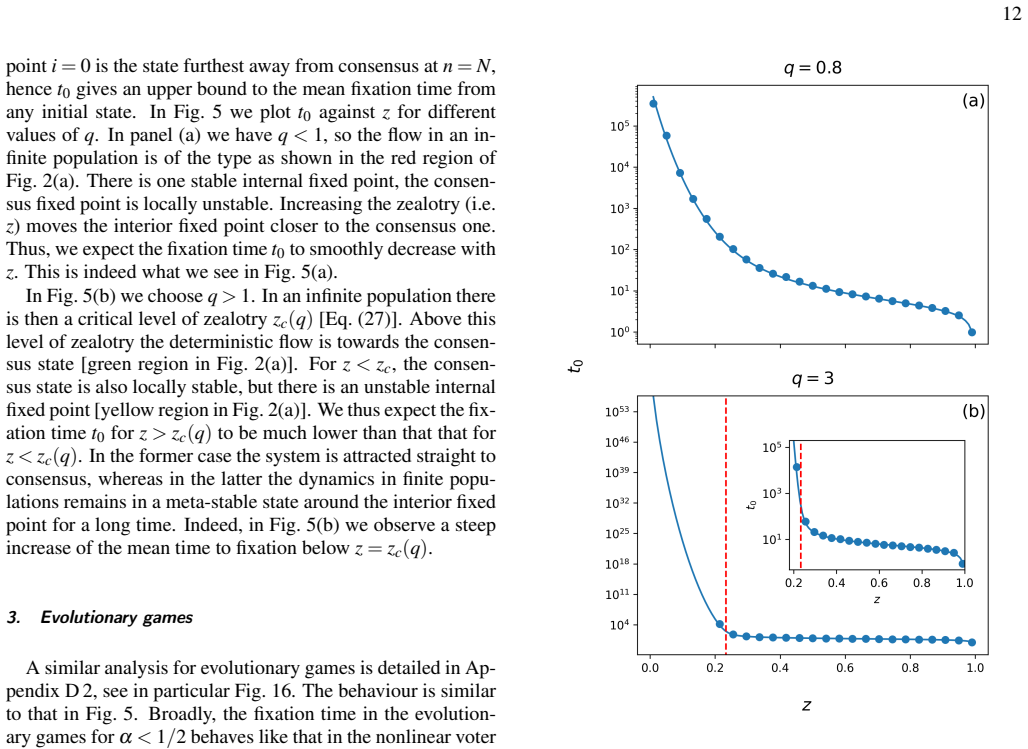
- In finite populations the zealous consensus state is the only absorbing state, but the mean fixation time jumps sharply when the deterministic system crosses the critical zealotry in the $q > 1$ regime, whereas for $q < 1$ it decreases smoothly with zealotry as the interior fixed point slides toward the boundary.
- For $q < 1$ the quasi-stationary distribution stays peaked at an interior coexistence state for all zealotry levels, so finite systems appear to 'resist' consensus for astronomically long times even though absorption is inevitable.
Reading between the lines
- If the social impact function is sublinear in the bulk but has a finite slope at zero, the paper's condition $(1-z) f'(0) < 1$ predicts that sufficiently strong zealotry can restore consensus; the distinction between 'sublinear everywhere' and 'sublinear with a regularised small-group limit' is therefore testable and potentially consequential.
- The same slope-at-zero criterion should generalise beyond all-to-all coupling: on a network, what would matter is the effective influence of a small contrarian group in the local neighbourhood of a nearly-consensual state, so the classification may survive in diluted or structured populations.
- A measurable prediction from the finite-population analysis is that in human or online settings with sublinear influence, even a large committed minority should fail to eliminate dissent, with opinion distributions remaining peaked away from the zealot state for very long times.
- The unification invites a direct stress test: construct a non-power-law impact function (saturating or logistic) and check numerically whether the three stability inequalities still predict the phase boundaries; the paper's framework makes this a routine computational exercise.
Editorial analysis
A structured set of objections, weighed in public.
Referee Report
Summary. The paper studies three opinion dynamics / evolutionary game models (nonlinear voter model, evolutionary games, partisan voter model) with zealots and nonlinear social impact. It derives local stability conditions for consensus fixed points in deterministic infinite-population rate equations, expressed through the slope f'(0) of a social impact function. For f(x)=x^q, the paper concludes that sublinear impact (q<1) always destabilizes consensus regardless of one-sided zealotry, while superlinear impact (q>1) stabilizes it. The authors provide an exact series expression for the critical zealotry in the nonlinear voter model, analyze finite-population fixation times and quasi-stationary distributions, and support their results with Gillespie simulations and a public code/data repository.
Significance. If the central classification is correct, the paper offers a valuable unifying framework connecting social impact theory to well-studied opinion and evolutionary dynamics. The derivation of exact critical zealotry via a trinomial equation is a notable technical contribution, and the finite-population analysis (fixation times, quasi-stationary distributions) is extensive and well supported by simulations. The availability of machine-checkable code and interactive plots strengthens the paper's reproducibility. The headline claim that sublinear social impact can override one-sided zealotry is empirically motivated and likely correct; however, as detailed below, a load-bearing proof gap and a sign error in an appendix currently prevent the manuscript from being accepted in its present form.
major comments (3)
- [§5.C, §5.D (Eqs. (32), (37))] The instability of consensus for q<1 is asserted from linear-stability conditions that are not defined when f'(0)=∞. For f(x)=x^q with q<1, the slope f'(0) is infinite, so inequalities (32) and (37) have no meaning; saying that the condition is 'violated' is only a heuristic. A rigorous nonlinear proof is required. For the nonlinear voter model, Appendix A supplies such a proof via the function A(x,z,q), but no equivalent argument is given for evolutionary games or the partisan voter model. For evolutionary games, a direct expansion of Eq. (B9) with y=1-z-x shows that the term proportional to y^q dominates for small y, so the consensus point repels; this argument is absent. The partisan voter model similarly lacks a nonlinear analysis. Because this is the central claim of the paper, the proof must be supplied (e.g., by a suitable Lyapunov function or a sign-of-flow analysis) for both of these models.
- [Appendix C.5] Appendix C.5 states: 'we know from Eq. (37) that the consensus fixed point C+ is stable when q<1 and unstable when q>1.' This is the opposite of the main-text conclusion (V.D.2 and Eq. (37)), where C+ is unstable for q<1 and stable for q>1. The subsequent sentence ('even though C+ is stable' for q>1) indicates the first clause is an error, but as written it is a direct contradiction of the main text. This needs to be corrected. Additionally, the coexistence analysis in C.5 is performed only for z=0, yet the main text claims (V.D.2) that coexistence is always a local attractor when q<1; a proof or a clear statement of the domain of validity is needed.
- [§5.B.2] A related technical imprecision appears in the nonlinear voter model discussion: the text says for q<1 'the condition in Eq. (30) cannot hold', but Eq. (30) is undefined when f'(0)=∞. The instability is proven in Appendix A, but the main text should explicitly state that the case q<1 requires the nonlinear analysis of Appendix A, not merely the failure of a linear condition. This matters because the same logic is then used without qualification in the evolutionary-game and partisan-voter sections.
minor comments (4)
- [Introduction] There is a duplicated phrase: 'we show that show that zealotry above a model-dependent critical magnitude' should read 'we show that zealotry above a model-dependent critical magnitude'.
- [Fig. 1 caption] The caption refers to 'the critical zealotries zc(q) [Eq. (A5)] and zc(α) [Eq. (B3)]', but Eqs. (A5) and (B3) are derived for balanced zealots, whereas the figure shows unbalanced zealots for several δ values and the text states the critical lines are determined numerically in Appendices A.3 and B.3. The equation references in the caption appear to be incorrect.
- [Eq. (A13) / Appendix A.4] The approximation zc(q) in Eq. (A13) relies on a linear interpolation (A39) and a curvature parameter p in (A44) tuned by 'a simple search'. The paper should state clearly that this is an empirical fit, not an exact result; the text mostly does this, but the phrase 'surprisingly accurate' in A.4 could be better framed as 'numerically accurate for the tested range'.
- [General notation] In Eq. (11), the expression for the average payoff φ appears to have a typo: the second term should be (1 - x + z-)π- but the manuscript writes '(1 − x + z−)π−'; this is likely a typesetting issue but should be checked and corrected.
Circularity Check
No significant circularity: the stability conditions, critical zealotries, and finite-size results are derived analytically from the stated model equations without fitting or self-referential forcing; identified proof gaps are correctness issues, not circular reductions.
full rationale
The paper's central claims are not circular. The general stability conditions in Eqs. (30), (32), and (37) are obtained by linearizing the explicitly written rate equations (29), (31), and (34) around the consensus fixed point, and the cited Jacobian calculation for the partisan voter model is reproduced in Appendix C.4. The exact critical zealotry for the nonlinear voter model, Eq. (27) / Eq. (A12), is derived by solving the trinomial equation Eq. (A11) from the fixed-point condition, not by fitting; the closed-form approximation Eq. (28) / Eq. (A13) is explicitly labeled an approximation, with the interpolation parameter p about 1.43 tuned to the exact series and presented as a convenience, not as independent evidence. Finite-population results are likewise derived: the mean fixation time in Eq. (39) follows from the one-step master-equation calculation in Appendix D.1, and the quasi-stationary distribution equations (42) come from conditioning the master equation; simulations are used to illustrate and confirm, not to define, these formulas. Self-citations (Refs. 21, 33, 46, 64) provide background, special cases, or complementary results, but the load-bearing derivations appear in the appendices (A.2, B.4, C.4), so no claim reduces to an unverified self-citation. The genuine weakness is a rigor gap, not circularity: for f(x)=x^q with q<1 one has f'(0)=+infinity, so invoking Eqs. (30), (32), and (37) as 'violated' is informal; Appendix A.2 provides a direct sign analysis for the nonlinear voter model, while equivalent nonlinear proofs for evolutionary games and the partisan voter model are absent. This is an omitted proof and a possible correctness risk, but it does not make the derivation equivalent to its inputs by construction.
Assumptions & free parameters
free parameters (2)
- curvature parameter p in Eq. (A44) =
approximately 1.43
- linear interpolation coefficients for alpha(n) in Eq. (A39) =
alpha(n) = n/3 + 2/3
assumptions (7)
- domain assumption Mean-field rate equations dx/dt = T+(x) - T-(x) describe the infinite-population deterministic dynamics.
- domain assumption Social impact can be represented by a single function f(x) with f(0)=0, f(1)=1, and a right-hand derivative at x=0.
- domain assumption The nonlinear voter model transition rates T+(x)=(s-x)(x+z+)^q and T-(x)=x(s-x+z-)^q are accepted from prior literature.
- domain assumption Evolutionary game dynamics follow the standard payoff-based copying rates with payoffs from the 2x2 matrix in Eq. (8).
- domain assumption In the partisan voter model, half of all susceptible agents prefer state +, half prefer state -, preferences are fixed, and the update probability depends on epsilon as in Eqs. (17).
- standard math The trinomial equation solution series from Ref. 67 is valid and can be used to solve Eq. (A11).
- standard math The quasi-stationary distribution formalism in Eqs. (41)-(42) follows Refs. 65,66.
Cite this review
Pith. "Pith review of Breaking coexistence: Zealotry vs. nonlinear social impact." pith.science (2026). https://pith.science/paper/JB33MAM6
@misc{pith2026250521407,
  author       = {Pith},
  title        = {Pith review of: Breaking coexistence: Zealotry vs. nonlinear social impact},
  year         = {2026},
  howpublished = {\url{https://pith.science/paper/JB33MAM6}},
  note         = {Machine review of arXiv:2505.21407}
}
read the original abstract
We study how zealotry and nonlinear social impact affect consensus formation in the nonlinear voter model, evolutionary games, and the partisan voter model. In all three models, consensus is an absorbing state in finite populations, while coexistence is a possible outcome of the deterministic dynamics. We show that sufficiently strong zealotry, i.e. the presence of agents who never change state, can drive infinite populations to consensus in all three models. However, while evolutionary games and the partisan voter model permit zealotry-induced consensus for all values of their model parameters, the nonlinear voter model does not. Central to this difference is the shape of the social impact function, which quantifies how the influence of a group scales with size, and is therefore a measure of majority and minority effects. We derive general conditions relating the slope of this function at small group sizes to the local stability of consensus. Sublinear impact favours minorities and can override zealotry to prevent consensus, whereas superlinear impact promotes majorities and therefore facilitates consensus. We extend the analysis to finite populations, exploring the time-to-consensus, and the shape of quasi-stationary distributions.
Figures


Figures from the paper (14 more)



Forward citations
Cited by 1 Pith paper
-
Reducibility of higher-order to pairwise interactions: Social impact models on hypergraphs
Higher-order group-interaction opinion dynamics on hypergraphs can be rewritten exactly as pairwise copy dynamics on a weighted projected network; with linear influence, macroscopic ordering equals the standard voter ...
Reference graph
Works this paper leans on
-
[1]
Stability condition for consensus We can generalize the rate equation for the nonlinear voter model [Eq. (6)] with one-sided zealots as follows, dx dt = (1 − x − z) f (x + z) − x f(1 − x − z), (29) where f (x) is the social impact function. Given that f (0) =0, we find that consensus at opinion state +, i.e. x∗ = 1 − z, is a fixed point for all q, as indi...
-
[2]
Thus, for any q < 1 we find f ′(x) → +∞ for x ↓ 0
Consequences in the stability diagram In the nonlinear voter model we have f (x) =xq, and there- fore f ′(x) =qxq−1. Thus, for any q < 1 we find f ′(x) → +∞ for x ↓ 0. Therefore the condition in Eq. (30) cannot hold for any q < 1. This means that the consensus fixed pointx∗ = 1−z can never be locally stable for q < 1, in-line with Fig. 2(a). For q > 1 on ...
-
[3]
Stability condition for consensus The rate equation for evolutionary games [Eq. (13)] can be generalised as follows, to account for a social impact function f , dx dt = (1 − x − z) f (x + z)π+(x, z) −x f(1 − x − z)π−(x, z). (31) The π± are given in Eqs. (9) and (10), withz+ = z and z− = 0. We have anticipated a general social impact function f (·), that i...
-
[4]
Evolutionary dynamics with linear social impact In conventional evolutionary games we have linear social impact, f (x) =x, and the condition for locally stable consen- 10 sus reduces to (1 − z)1 − α α < 1. (33) For α > 1/2 this condition is always fulfilled (for all z) as (1 − α)/α is then smaller than one. Thus the consensus fixed point x∗ = 1 − z is loc...
-
[5]
Evolutionary games with nonlinear social impact We can also consider the case where the social impact func- tion is nonlinear. We focus again on f (x) =xq, noting that q-deformed evolutionary dynamics without zealots were pre- viously studied in Ref. 46. The q-deformation is akin to non- linear social impact, and as shown in Ref. 46 this can produce types...
-
[6]
Allowing for a general social impact 11 function, Eqs
Stability criterion for general social impact The analysis of the effects of nonlinear social impact for the partisan voter model is more involved as there are now two degrees of freedom. Allowing for a general social impact 11 function, Eqs. (18) turn into dx+ + dt = x+ − f x+ + + x− + + z (1 + ε) − x+ + f x− − + x+ − (1 − ε), (34) and a similar relation...
-
[7]
Nonlinear partisan voter model with f (x) =xq Focusing on a nonlinear partisan voter model with impact function f (x) =xq (see also Ref. 64), Eq. (37) shows that C+ is unstable for q < 1, and stable for q > 1, irrespective of the preference parameter ε, and the amount of zealotry. An analysis of the coexistence fixed point (see Appendix C 5) re- veals tha...
-
[8]
This is restricted to the nonlinear voter model and evolu- tionary games
Analytical calculation of mean fixation times We now present analytical calculations of mean fixation time. This is restricted to the nonlinear voter model and evolu- tionary games. This is because for these models there is only one integer degree of freedom for the stochastic population dynamics. We do however present numerical results for the partisan v...
Show all 33 references
-
[9]
(5) T + n = N S − n N n + Z N − 1 q , T − n = N n N N − Z − n N − 1 q
Nonlinear voter model with one-sided zealots For the nonlinear voter model with one-sided zealots the transition rates are defined analogously to Eqs. (5) T + n = N S − n N n + Z N − 1 q , T − n = N n N N − Z − n N − 1 q . (40) While Eq. (39) provides the mean time to fixation...
-
[10]
Evolutionary games A similar analysis for evolutionary games is detailed in Ap- pendix D 2, see in particular Fig. 16. The behaviour is similar to that in Fig. 5. Broadly, the fixation time in the evolution- ary games for α < 1/2 behaves like that in the nonlinear voter model ...
-
[11]
We report simulation results in Fig
Partisan voter model Since the partisan voter model has two degrees of freedom, we cannot determine the fixation time in closed form analyti- cally. We report simulation results in Fig. 17 in Appendix C, noting that there is only one type of transition as a function of the zea...
-
[12]
For example in Fig
Definition The fixation time can become rather large if there are at- tracting internal fixed points of the deterministic rate equa- tions. For example in Fig. 5(b), for q > 1 and small z, fix- ation times are on the order of 10 50 generations (or equiva- lent, 10 50 Monte Car...
-
[13]
6 we plot the quasi-stationary distribution for the nonlinear voter model with varying numbers of zealots
Nonlinear voter model In Fig. 6 we plot the quasi-stationary distribution for the nonlinear voter model with varying numbers of zealots. In panel (a) q = 0.8 and in panel (b) q = 3. We know from the deterministic analysis (Sec. III C) that forq < 1 there is always a stable int...
-
[14]
For fixed model parameters (e.g
Critical zealotry in finite populations For finite systems we define ˜zc as the proportion of zealots at which the quasi-stationary distribution becomes peaked at n = N − Z − 1. For fixed model parameters (e.g. q or α) we can determine this quantity from a numerical integratio...
-
[15]
(6) becomes dx dt = (1 − x − z) x + z 2 q − x 1 − x − z 2 q
Balanced zealots For balanced zealots Eq. (6) becomes dx dt = (1 − x − z) x + z 2 q − x 1 − x − z 2 q . (A1) This equation always has the central fixed pointx∗ = 1 2 (1 − z). There exists potentially two more fixed points. These fixed points are roots of the function B(x, z, q...
-
[16]
(6) becomes dx dt = (1 − x − z)(x + z)q − x(1 − x − z)q
One-sided zealots For one-sided zealots Eq. (6) becomes dx dt = (1 − x − z)(x + z)q − x(1 − x − z)q. (A6) This equation always has the consensus fixed pointx∗ c = 1 − z. There are potentially further fixed points. To determine these we carry out a similar procedure as in Appen...
-
[17]
(A6) has two additional fixed points x∗ a and x∗ b where x∗ a < x∗ b < x∗ c
A(x1, z, q) < 0: There are two roots, hence Eq. (A6) has two additional fixed points x∗ a and x∗ b where x∗ a < x∗ b < x∗ c. x∗ a is always stable and x∗ b is always unstable. This is illustrated in Fig. 10(c). 16 FIG. 8. Plots of ˙ x [Eq. (A1)] in blue using the left hand axi...
-
[18]
(A6) has one additional fixed point x∗ a < x∗ c that is stable from the left and unstable from the right
A(x1, z, q) =0: There is one root that occurs exactly on the xa-axis, hence Eq. (A6) has one additional fixed point x∗ a < x∗ c that is stable from the left and unstable from the right. This is illustrated in Fig. 10(d)
-
[19]
(A6) has no additional fixed points
A(x1, z, q) > 0: There are no roots, hence Eq. (A6) has no additional fixed points. This is illustrated in Fig. 10(e). We note that the second scenario above separates the first and the third. We wish to determine the critical value of the zealotry, zc(q), at which this second...
-
[20]
(6)] becomes ˙x = (1 − x − z) x + 1 2 (1 + δ )z q − x 1 − x − 1 2 (1 + δ )z q
Unbalanced zealots For unbalanced zealots the rate equation [Eq. (6)] becomes ˙x = (1 − x − z) x + 1 2 (1 + δ )z q − x 1 − x − 1 2 (1 + δ )z q . (A14) Exactly like in Appendices. A 1 and A 2 we define a new func- tion U(x, z, q, δ ) whose zeros correspond to the fixed points o...
-
[21]
(A13) Here we derive a closed form approximation to Eq
Derivation of Eq. (A13) Here we derive a closed form approximation to Eq. (A11). We first define f (z) =z + (1 − n)n−1 nn zn − 1, (A18) where 0 < n < 1 and the domain is z ∈ (0,1). The goal is to find the root of Eq. (A18). With the substitution z = n 1 − nt, (A19) Eq. (A18) b...
-
[22]
α x + z 2 + (1 − α) 1 − x − z 2 # − x 1 − x − z 2 ×
Balanced zealots For balanced zealots Eq. (13) becomes dx dt = (1 − x − z) x + z 2 × " α x + z 2 + (1 − α) 1 − x − z 2 # − x 1 − x − z 2 × " (1 − α) x + z 2 + α 1 − x − z 2 # . (B1) This rate equation has up to three fixed points. The central fixed point x∗ 2 = 1 2 (1 − z) alw...
-
[23]
(B3) The stabilities of the various fixed points can be deduced by looking an interactive plot of Eq
These are x∗ 1,3 = x∗ 2 ± 1 2 r 1 + 2αz 1 − 2α , (B2) and are only physical when α > 1/2 and z < zc(α), where zc(α) =1 − 1 2α . (B3) The stabilities of the various fixed points can be deduced by looking an interactive plot of Eq. (B1) 62. There are three scenarios: • If α < 1/...
-
[24]
(13) becomes dx dt = (1 − x − z)(x + z) × α(x + z) + (1 − α)(1 − x − z) − x(1 − x − z) × (1 − α)(x + z) +α(1 − x − z)
One-sided zealots For one-sided zealots Eq. (13) becomes dx dt = (1 − x − z)(x + z) × α(x + z) + (1 − α)(1 − x − z) − x(1 − x − z) × (1 − α)(x + z) +α(1 − x − z) . (B4) This rate equation always has the consensus fixed point x∗ c = 1 − z. There are potentially two other fixed ...
-
[25]
α x + 1 + δ 2 z + (1 − α) 1 − x − 1 + δ 2 z # − x 1 − x − 1 + δ 2 z ×
Unbalanced zealots For unbalanced zealots Eq. (13) becomes dx dt = (1 − x − z) x + 1 + δ 2 z × " α x + 1 + δ 2 z + (1 − α) 1 − x − 1 + δ 2 z # − x 1 − x − 1 + δ 2 z × " (1 − α) x + 1 + δ 2 z + α 1 − x − 1 + δ 2 z # , (B8) When α < 1/2, there is always only one fixed point in t...
-
[26]
(B4) except with a nonlinear social impact function xq, dx dt = (1 − x − z)(x + z)q × α(x + z) + (1 − α)(1 − x − z) − x(1 − x − z)q × (1 − α)(x + z) +α(1 − x − z)
Nonlinear evolutionary dynamics The rate equation for nonlinear evolutionary dynamics with one-sided zealots is as in Eq. (B4) except with a nonlinear social impact function xq, dx dt = (1 − x − z)(x + z)q × α(x + z) + (1 − α)(1 − x − z) − x(1 − x − z)q × (1 − α)(x + z) +α(1 −...
-
[27]
(21) become Σ − (1 − z) ≤∆ ≤ −Σ + (1 − z), −Σ ≤∆ ≤ Σ
Balanced zealots For balanced zealots the restrictions on (∆, Σ) from Eqs. (21) become Σ − (1 − z) ≤∆ ≤ −Σ + (1 − z), −Σ ≤∆ ≤ Σ. (C1) The rate equations from Eqs. (22) become ˙∆ = −∆ h (1 + ε)z − ε(1 − 2Σ) i , (C2a) ˙Σ = 1 2 (1 + ε)(1 − z) − 2ε∆2 − Σ. (C2b) For 0 < ε < 1 we fi...
-
[28]
(21)] are identical to the conditions for balanced zealots [Eqs
One-sided zealots For one-sided zealotry the restrictions on (∆, Σ) [Eqs. (21)] are identical to the conditions for balanced zealots [Eqs. (C1)]. The rate equations from Eqs. (22) become ˙∆ = ε∆(1 − 2Σ) +1 2 z h (1 + ε)(1 − 2∆) − 2εΣ i − 1 2 z2(1 + ε), (C6a) ˙Σ = 1 2 (1 + ε)(1...
-
[29]
(21) are again the same as in the balanced and one-sided zealots cases, i.e
Unbalanced zealots For unbalanced zealots the restrictions on (∆, Σ) from Eqs. (21) are again the same as in the balanced and one-sided zealots cases, i.e. Eq. (C1). The rate equations from Eqs. (22) reduce to ˙∆ = ε∆(1 − 2Σ) + 1 2 δ z ( (1 + ε)(1 − z) − 2 h ∆ + ε(∆ + Σ) i) , ...
-
[30]
(35) we form the Jacobian matrix evaluated at C+ [Eq
Social impact function Using Eqs. (35) we form the Jacobian matrix evaluated at C+ [Eq. (36)], J = −1 + (1 − z) f ′(0) −ε −ε[1 + (1 − z) f ′(0)] −1 , (C11) where we have used the boundary conditions f (0) =0 and f (1) =1. The derivative f ′(0) is to be understood as the right-...
-
[31]
(37) that the consensus fixed point C+ is stable when q < 1 and unstable when q > 1
Nonlinear partisan voter model For the partisan voter model with a nonlinear social impact function f (x) =xq we know from Eq. (37) that the consensus fixed point C+ is stable when q < 1 and unstable when q > 1. We note however that when q > 1, consensus is not guar- anteed ev...
-
[32]
(39) We broadly follow the steps in Ref
Derivation of Eq. (39) We broadly follow the steps in Ref. 36. The unconditional fixation time t j starting from state j is determined by t j = 1 + T + j t j+1 + T − j t j−1 + (1 − T + j − T − j )t j, =⇒ t j+1 − t j = γ j(t j − t j−1) − 1 T + j , (D1) where γ j ≡ T − j /T + j ...
-
[33]
Stochastic evolutionary game dynamics,
Evolutionary games and the partisan voter model For evolutionary games the rates in finite populations are defined analogously to Eqs. (12), T + n = N S − n N n + Z N − 1 Π+, T − n = N n N S − n N − 1 Π−, (D8) where the Π± are the analogue Eqs. (9) and (10) for finite populati...
1972
Reviewed August 7, 2026 · model on record in the stance chip above.
Discussion (0). Sign in to comment.