REVIEW 5 major objections 6 minor 33 references
Sparse variational quantum circuits can preserve or improve accuracy after magnitude pruning, keeping as few as 26.0% of original parameters.
Reviewed by Pith at T0; open to challenge. T0 means a machine referee read the full paper against a public rubric. the ladder, T0–T4 →
T0 review · deepseek-v4-flash
2026-08-04 16:57 UTC pith:AFNAQJRG
load-bearing objection A credible weak-LTH transfer for small VQCs, but the barren-plateau win is overclaimed and the strong-LTH evidence needs a random-mask baseline. the 5 major comments →
Investigating the Lottery Ticket Hypothesis for Variational Quantum Circuits
The pith
A machine-rendered reading of the paper's core claim, the machinery that carries it, and where it could break.
Core claim
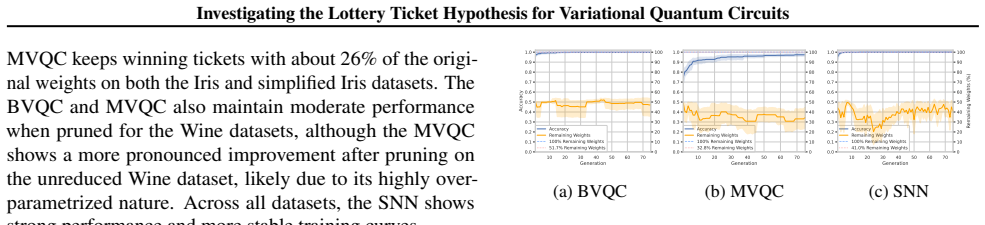
The paper's central claim is that the weak lottery ticket hypothesis holds for variational quantum circuits on the small classification tasks tested. It identifies winning tickets at 26.0% remaining parameters for the multi-class circuit on Iris and simplified Iris, and at 33.3% for the binary circuit on simplified Iris, with accuracy matching the full circuits. It further claims that on the full Wine dataset, pruning the multi-class circuit to 32.7% of its weights raises accuracy from 45% to 80%, a 35-percentage-point improvement the authors interpret as evidence that pruning can mitigate barren-plateau-like optimization failure when the unpruned circuit is sufficiently overparameterized. F
What carries the argument
The load-bearing mechanism is reset-to-initialization magnitude pruning. A full circuit is trained; its rotation parameters are ranked by absolute value; a fraction is set to zero; the surviving parameters are reset to their pre-training values; and the masked circuit is retrained. Iterative pruning repeats this while removing 20% of remaining weights per cycle, and one-shot pruning applies a single target ratio. The winning ticket is the sparse set of parameters plus the mask that isolates a trainable subcircuit. For the strong variant, the same parameter mask is searched by an evolutionary algorithm with crossover, mutation, and migration, with no training step, so the mask alone must enco
Load-bearing premise
The load-bearing premise is that the unpruned circuit is a fair baseline: in the Wine experiment (Section 4.1.4), the unpruned multi-class circuit sits at 45% accuracy, and the paper reports no convergence criterion, no error bars, and no gradient measurements to rule out underfitting before pruning gets credit for the jump to 80%.
What would settle it
Rerun the Wine multi-class circuit with the same architecture but longer training and several seeds while recording gradient magnitudes; if the unpruned model reaches 80% accuracy or any seed removes the pruned model's advantage, the winning-ticket claim on Wine collapses. A simpler check: repeat the simplified-Iris BVQC strong-LTH search with 20 random seeds and require all seeds to reach 100% at 45% weights; the current result does not demonstrate stability.
If this is right
- Sparse variational circuits can match full accuracy at roughly one-quarter to one-third of the original parameters on small classification tasks, lowering simulation and hardware load.
- If the Wine result generalizes, pruning can act as a rescue operation for circuits stuck at low accuracy, not just a compression technique.
- The strong-LTH success on simplified Iris shows that training-free mask search can yield a functional subcircuit for easy problems, but it does not replace training on harder data.
- Because iterative and one-shot pruning produced equivalent masks on these circuits, one training pass may suffice to find the ticket on small problems, skipping repeated train-prune cycles.
Where Pith is reading between the lines
- A testable extension of the Wine result: train the unpruned multi-class circuit for substantially more epochs or with a learning-rate schedule; if it reaches 80% without pruning, the reported gain is an artifact of a weak baseline, not evidence that pruning mitigates barren plateaus.
- Magnitude pruning might work by reducing the effective dimensionality of the variational search; measuring gradient variance before and after pruning would test whether the sparse circuit is genuinely easier to optimize.
- If pruned gates are physically removed rather than masked, the same winning tickets could translate into shallower circuits on real hardware, where shorter depth directly reduces noise and gradient decay; the paper simulates circuits and does not test this translation.
- The evolutionary search's failure on Wine suggests that strong-LTH masks may need at least a small amount of training signal; a hybrid that uses one short training run to seed the mask could close the gap.
Editorial analysis
A structured set of objections, weighed in public.
Referee Report
Summary. The paper tests the weak and strong lottery ticket hypotheses for variational quantum circuits (VQCs) on Iris and Wine classification tasks. For the weak LTH, it applies iterative and one-shot magnitude pruning with reset-to-initial retraining and reports that pruned VQCs can match or exceed full-circuit accuracy, e.g., a multi-class VQC retaining 26.0% of its parameters on Iris, and a Wine MVQC reaching 80% accuracy at 32.7% remaining weights versus 45% for the unpruned model. For the strong LTH, it uses an evolutionary algorithm to learn pruning masks without training, reporting a binary VQC winning ticket at approximately 45--48% remaining weights on simplified Iris. The paper concludes that the weak LTH holds for VQCs and that pruning may mitigate barren plateaus.
Significance. If established, this would be one of the first systematic demonstrations of the lottery ticket hypothesis for VQCs and a concrete step toward sparse, trainable variational circuits. The paper has strengths: it documents the pruning algorithms, reports seeds 0 through 9, performs hyperparameter optimization, and includes full pruning curves in the appendix. However, the headline quantitative claims are not yet supported: there are no error bars, no formal winning-ticket criterion, no random-mask baseline for the strong LTH, and no gradient diagnostics for the barren-plateau interpretation. The contribution is potentially valuable but currently under-supported.
major comments (5)
- [§4.1.4 / Fig. 5a / §5] The Wine MVQC result is the paper's strongest evidence that pruning improves over the full model (45% vs 80% accuracy, a claimed 35% improvement). The comparison rests on the unpruned run being a converged, fairly trained baseline. The protocol fixes 40 epochs for all runs, reports only aggregate curves despite seeds 0 through 9, and provides no loss or gradient convergence diagnostics. A flat 45% curve is equally consistent with an undertrained or poorly optimized model as with a barren plateau. If the baseline is undertrained, a smaller circuit can beat it merely by converging faster within the 40-epoch budget, making the result a fixed-budget artifact rather than a winning ticket. Please report per-seed curves or mean±std, add a convergence criterion, and measure gradient variance for pruned versus unpruned models before claiming BP mitigation.
- [§3.7 / Table 3] The 'winning ticket' level is never formally defined. It appears sometimes to mean 'accuracy equals or exceeds the unpruned accuracy' (Iris, simplified Iris), sometimes 'stabilizes at 94--96%' (§4.1.5), and sometimes 'surpasses unpruned accuracy' (§4.1.4). There is no stated tolerance, no aggregation rule across the ten seeds, and no statement about which accuracy (training or validation) is being used, even though §3.7 says both were tracked. Without an explicit criterion, Table 3 cannot be reproduced and the headline '26.0%' has no precise meaning. Please give the exact condition used to select the entries in Table 3.
- [§4.2 / Figs. 7--10] The strong LTH results are not compared with random pruning masks. On simplified Iris the unpruned models already reach 100% accuracy, so an EA-evolved mask reaching 100% with about 48% of weights does not demonstrate that the mask is specially structured: a random mask at the same sparsity may do equally well. Without a random-mask baseline, the abstract's strong-LTH claim ('a binary VQC achieving 100% accuracy with only 45% of the weights') is unsupported. Please add random-pruning curves at comparable remaining-weight levels.
- [§5 / §2.3] The abstract and conclusion state that LTH 'may mitigate barren plateaus' and that the Wine experiment shows LTH 'can overcome' BP. This claim is not measured anywhere: the paper does not report gradient norms, gradient variance, or loss-landscape diagnostics for full or pruned circuits. The accuracy gain alone cannot distinguish BP relief from faster optimization of an easier model. If the authors wish to retain the BP contribution, they should add direct gradient diagnostics; otherwise the claim should be explicitly downgraded to a conjecture.
- [Table 3 vs §4.1.5 / §5] The results for Simplified Wine are internally inconsistent. Table 3 appears to list '51.3% / 51.4%' across the VQC columns, while §4.1.5 says both BVQC and MVQC maintain accuracy only up to roughly 40% remaining weights, and §5 states that 'no winning ticket was found for the MVQC on the simplified Wine dataset' and that only the BVQC found one at 51.3%. Please clarify which model has a ticket at which level and correct the table or text.
minor comments (6)
- [§3.1.1 / §3.1.2] The reset-to-initial step is only implicit: the text says 'set the random seed' and 'create a new model' but does not explicitly state that this reproduces the original initialization. State this explicitly for clarity.
- [Abstract / §4.2.2] The abstract and conclusion state '45% of the weights' for the strong-LTH BVQC winning ticket, while §4.2.2 says 'about 48%'. Make the number consistent.
- [Table 3] The entry '51.3% / 51.4%' is ambiguous due to table formatting; it should be split into two unambiguous cells.
- [References] The Wine dataset reference is dated '1936'; the correct UCI citation is from the early 1990s. Please correct.
- [Algorithm 3] The EA description does not specify population size, mutation rate, crossover operator, migration rate, or the number of generations used in the experiments. Please provide these details for reproducibility.
- [§3.7] The paper says accuracy on 'training and validation sets' was tracked, but no data split is described. For small datasets, clarifying how validation accuracy was used to select tickets is important for interpreting the results.
Circularity Check
No significant circularity: empirical LTH study; the only self-citation is an algorithm implementation tool, not load-bearing evidence.
full rationale
This is an empirical study, not a derivation. The central claim—weak LTH holds for VQCs—is established by comparing pruned circuits against unpruned baselines under identical seeds; the definition of a winning ticket is the standard one from Frankle & Carbin and is not constructed to force the result. There is no equation-level reduction, no fitted parameter renamed as prediction, and no uniqueness theorem imported from prior work. The one self-citation (Altmann et al. 2024) supplies the evolutionary algorithm used for the strong-LTH search; it is a methodological tool, not independent evidence for the existence of winning tickets, and the strong-LTH results are measured, not derived. The Wine MVQC result does rest on an unpruned 45% baseline that may be undertrained, but that is a potential experimental artifact/correctness risk, not circularity: the comparison is exactly the LTH definition rather than a tautology. No circular step was found.
Axiom & Free-Parameter Ledger
free parameters (7)
- learning_rate =
See Table 4, ranges roughly 0.0013 to 0.1405 per model/dataset
- weight_decay =
See Table 4, ranges roughly 0.0001 to 0.0008
- number_of_layers =
10, 15, 16, 14, 9, or 16 depending on model/dataset (Table 4), some manually set
- data_re_uploading =
False for all reported configurations
- uniform_range =
Various values, e.g., 0.34, 0.997, 0.7666 (Table 4)
- EA hyperparameters =
Not reported (population size, generation count, mutation and crossover rates)
- winning_ticket_criterion =
Not quantified
axioms (4)
- domain assumption PennyLane simulation of the VQCs is an accurate proxy for the described circuits
- domain assumption The selected VQCs are representative of circuits that suffer from barren plateaus
- domain assumption Magnitude pruning of rotation angles is a meaningful importance criterion for VQCs
- domain assumption The unpruned model accuracy is the right reference for declaring a winning ticket
Cite this review
Pith. "Pith review of Investigating the Lottery Ticket Hypothesis for Variational Quantum Circuits." pith.science (2026). https://pith.science/paper/AFNAQJRG
@misc{pith2026250911190,
  author       = {Pith},
  title        = {Pith review of: Investigating the Lottery Ticket Hypothesis for Variational Quantum Circuits},
  year         = {2026},
  howpublished = {\url{https://pith.science/paper/AFNAQJRG}},
  note         = {Machine review of arXiv:2509.11190}
}
read the original abstract
Quantum computing is an emerging field in computer science that has seen considerable progress in recent years, especially in machine learning. By harnessing the principles of quantum physics, it can surpass the limitations of classical algorithms. However, variational quantum circuits (VQCs), which rely on adjustable parameters, often face the barren plateau phenomenon, hindering optimization. The Lottery Ticket Hypothesis (LTH) is a recent concept in classical machine learning that has led to notable improvements in parameter efficiency for neural networks. It states that within a large network, a smaller, more efficient subnetwork, or ''winning ticket,'' can achieve comparable performance, potentially circumventing plateau challenges. In this work, we investigate whether this idea can apply to VQCs. We show that the weak LTH holds for VQCs, revealing winning tickets that retain just 26.0\% of the original parameters. For the strong LTH, where a pruning mask is learned without any training, we discovered a winning ticket in a binary VQC, achieving 100\% accuracy with only 45\% of the weights. These findings indicate that LTH may mitigate barren plateaus by reducing parameter counts while preserving performance, thus enhancing the efficiency of VQCs in quantum machine learning tasks.
Figures




Reference graph
Works this paper leans on
-
[1]
write newline
" write newline "" before.all 'output.state := FUNCTION n.dashify 't := "" t empty not t #1 #1 substring "-" = t #1 #2 substring "--" = not "--" * t #2 global.max substring 't := t #1 #1 substring "-" = "-" * t #2 global.max substring 't := while if t #1 #1 substring * t #2 global.max substring 't := if while FUNCTION format.date year duplicate empty "emp...
-
[2]
Wine data set
Aeberhard, S., Coomans, D., and de Vel, O. Wine data set. https://archive.ics.uci.edu/ml/datasets/wine, 1936. UCI Machine Learning Repository
1936
-
[3]
Optuna: A next-generation hyperparameter optimization framework
Akiba, T., Sano, S., Yanase, T., Ohta, T., and Koyama, M. Optuna: A next-generation hyperparameter optimization framework. In Proceedings of the 25th ACM SIGKDD International Conference on Knowledge Discovery & Data Mining, pp.\ 2623--2631. ACM, 2019. doi:10.1145/3292500.3330701
arXiv 2019
-
[4]
Finding strong lottery ticket networks with genetic algorithms
Altmann, P., Schönberger, J., Zorn, M., and Gabor, T. Finding strong lottery ticket networks with genetic algorithms. In Proceedings of the 16th International Joint Conference on Computational Intelligence - Volume 1: NCTA, pp.\ 449--460. INSTICC, SciTePress, 2024. ISBN 978-989-758-721-4. doi:10.5220/0013010300003837
-
[5]
Bergholm, V., Izaac, J., Schuld, M., and Gogolin, C. e. a. Pennylane: Automatic differentiation of hybrid quantum-classical computations, 2022. URL https://arxiv.org/abs/1811.04968
Pith/arXiv arXiv 2022
-
[6]
Blalock, D., Ortiz, J. J. G., Frankle, J., and Guttag, J. What is the state of neural network pruning?, 2020. URL https://arxiv.org/abs/2003.03033
Pith/arXiv arXiv 2020
-
[7]
C., Endo, S., Fujii, K., and McClean, J
Cerezo, M., Arrasmith, A., Babbush, R., Benjamin, S. C., Endo, S., Fujii, K., and McClean, J. R. e. a. Variational quantum algorithms. Nature Reviews Physics, 3: 0 625--644, 2021 a . doi:10.1038/s42254-021-00348-9
-
[8]
Cerezo, M., Sone, A., Volkoff, T., Cincio, L., and Coles, P. J. Cost function dependent barren plateaus in shallow parametrized quantum circuits. Nature Communications, 12 0 (1): 0 1791, 2021 b . doi:10.1038/s41467-021-21728-w
-
[9]
Proving the lottery ticket hypothesis for convolutional neural networks
Cunha, A., Natale, E., and Viennot, L. Proving the lottery ticket hypothesis for convolutional neural networks. In International Conference on Learning Representations, 2022. URL https://openreview.net/forum?id=Vjki79-619-
2022
-
[10]
Cunningham, J. and Zhuang, J. Investigating and mitigating barren plateaus in variational quantum circuits: A survey. arXiv preprint arXiv:2407.17706, 2024
Pith/arXiv arXiv 2024
-
[11]
Quantum circuit architecture search for variational quantum algorithms
Du, Y., Huang, T., You, S., Hsieh, M.-H., and Tao, D. Quantum circuit architecture search for variational quantum algorithms. npj Quantum Information, 8 0 (1): 0 62, 2022. doi:10.1038/s41534-022-00570-y
-
[12]
A general framework for proving the equivariant strong lottery ticket hypothesis, 2023
Ferbach, D., Tsirigotis, C., Gidel, G., and Bose, A. A general framework for proving the equivariant strong lottery ticket hypothesis, 2023. URL https://arxiv.org/abs/2206.04270
Pith/arXiv arXiv 2023
-
[13]
Fisher, R. A. Iris data set. https://archive.ics.uci.edu/ml/datasets/iris, 1936. UCI Machine Learning Repository
1936
-
[14]
and Carbin, M
Frankle, J. and Carbin, M. The lottery ticket hypothesis: Finding sparse, trainable neural networks. In International Conference on Learning Representations, 2019. URL https://openreview.net/forum?id=rJl-b3RcF7
2019
-
[15]
The state of sparsity in deep neural networks, 2019
Gale, T., Elsen, E., and Hooker, S. The state of sparsity in deep neural networks, 2019. URL https://arxiv.org/abs/1902.09574
Pith/arXiv arXiv 2019
-
[16]
An initialization strategy for addressing barren plateaus in parametrized quantum circuits
Grant, E., Wossnig, L., Ostaszewski, M., and Benedetti, M. An initialization strategy for addressing barren plateaus in parametrized quantum circuits. Quantum, 3: 0 214, 2019. doi:10.22331/q-2019-12-09-214
-
[17]
Grumbling, E. and Horowitz, M. (eds.). Quantum Computing: Progress and Prospects. The National Academies Press, Washington, DC, 2019. ISBN 978-0-309-47969-1. doi:10.17226/25196. URL https://nap.nationalacademies.org/catalog/25196/quantum-computing-progress-and-prospects
doi:10.17226/25196 2019
-
[18]
Harada, T. and Alba, E. Parallel genetic algorithms: A useful survey. ACM Comput. Surv., 53 0 (4), August 2020. ISSN 0360-0300. doi:10.1145/3400031. URL https://doi.org/10.1145/3400031
-
[19]
Qadaprune: Adaptive parameter pruning for training variational quantum circuits, 2024
Kulshrestha, A., Liu, X., Ushijima-Mwesigwa, H., Bach, B., and Safro, I. Qadaprune: Adaptive parameter pruning for training variational quantum circuits, 2024. URL https://arxiv.org/abs/2408.13352
Pith/arXiv arXiv 2024
-
[20]
A survey of lottery ticket hypothesis, 2024
Liu, B., Zhang, Z., He, P., Wang, Z., Xiao, Y., Ye, R., Zhou, Y., Ku, W.-S., and Hui, B. A survey of lottery ticket hypothesis, 2024. URL https://arxiv.org/abs/2403.04861
Pith/arXiv arXiv 2024
-
[21]
Continuous evolution for efficient quantum architecture search
Ma, Q., Hao, C., Yang, X., Qian, L., Zhang, H., Si, N., Xu, M., and Qu, D. Continuous evolution for efficient quantum architecture search. EPJ Quantum Technology, 11 0 (1): 0 54, 2024. ISSN 2196-0763. doi:10.1140/epjqt/s40507-024-00265-7. URL https://doi.org/10.1140/epjqt/s40507-024-00265-7
-
[22]
Proving the lottery ticket hypothesis: Pruning is all you need, 2020
Malach, E., Yehudai, G., Shalev-Shwartz, S., and Shamir, O. Proving the lottery ticket hypothesis: Pruning is all you need, 2020. URL https://arxiv.org/abs/2002.00585
Pith/arXiv arXiv 2020
-
[23]
McClean, J. R., Boixo, S., Smelyanskiy, V. N., Babbush, R., and Neven, H. Barren plateaus in quantum neural network training landscapes. Nature Communications, 9 0 (1): 0 4812, 2018. doi:10.1038/s41467-018-07090-4
-
[24]
Nielsen, M. A. and Chuang, I. L. Quantum Computation and Quantum Information: 10th Anniversary Edition. Cambridge University Press, 2010. doi:10.1017/CBO9780511976667
-
[25]
Paszke, A., Gross, S., Massa, F., Lerer, A., Bradbury, J., and Chanan, G. e. a. Pytorch: An imperative style, high-performance deep learning library. In Advances in Neural Information Processing Systems, volume 32, pp.\ 8024--8035. Curran Associates, Inc., 2019
2019
-
[26]
Pedregosa, F., Varoquaux, G., Gramfort, A., Michel, V., and Thirion, B. e. a. Scikit-learn: Machine learning in python. Journal of Machine Learning Research, 12: 0 2825--2830, 2011
2011
-
[27]
Variational quantum algorithms: fundamental concepts, applications and challenges
Qi, H., Xiao, S., Liu, Z., Gong, C., and Gani, A. Variational quantum algorithms: fundamental concepts, applications and challenges. Quantum Information Processing, 23 0 (6): 0 224, 2024. doi:10.1007/s11128-024-04438-2
-
[28]
What's hidden in a randomly weighted neural network?, 2020
Ramanujan, V., Wortsman, M., Kembhavi, A., Farhadi, A., and Rastegari, M. What's hidden in a randomly weighted neural network?, 2020. URL https://arxiv.org/abs/1911.13299
Pith/arXiv arXiv 2020
-
[29]
Schuld, M. and Petruccione, F. Variational Circuits as Machine Learning Models, pp.\ 177--215. Springer International Publishing, Cham, 2021. ISBN 978-3-030-83098-4. doi:10.1007/978-3-030-83098-4_5. URL https://doi.org/10.1007/978-3-030-83098-4_5
-
[30]
Sim, S., Romero, J., Gonthier, J. F., and Kunitsa, A. A. Adaptive pruning-based optimization of parameterized quantum circuits. Quantum Science and Technology, 6 0 (2): 0 025019, 2021. doi:10.1088/2058-9565/abe107. URL https://dx.doi.org/10.1088/2058-9565/abe107
-
[31]
Sloss, A. N. and Gustafson, S. 2019 Evolutionary Algorithms Review, pp.\ 307--344. Springer International Publishing, 2020. doi:10.1007/978-3-030-39958-0_16. URL https://doi.org/10.1007/978-3-030-39958-0_16
-
[32]
Sood, V. and Chauhan, R. P. Archives of quantum computing: Research progress and challenges. Archives of Computational Methods in Engineering, 31 0 (1): 0 73--91, 2024. ISSN 1886-1784. doi:10.1007/s11831-023-09973-2. URL https://doi.org/10.1007/s11831-023-09973-2
-
[33]
Waskom, M. L. Seaborn: Statistical data visualization. Journal of Open Source Software, 6 0 (60): 0 3021, 2021. doi:10.21105/joss.03021
discussion (0)
Sign in with ORCID, Apple, or X to comment. Anyone can read and Pith papers without signing in.