REVIEW 3 major objections 5 minor 5 cited by
1+1D SU(2) gauge theory with dynamical fermions exhibits eigenstate thermalization: for local and nonlocal operators, matrix-element fluctuations shrink exponentially with system size at the entropy-density rate.
Reviewed by Pith at T0; open to challenge. T0 means a machine referee read the full paper against a public rubric. the ladder, T0–T4 →
T0 review · deepseek-v4-flash
2026-08-04 15:47 UTC pith:7VZQ2LGF
load-bearing objection First ETH test in 1+1D SU(2) with dynamical fermions, careful numerics, but the central e^{-S} variance claim rests on a truncation that the paper's own Fig. 13 shows is not converged. the 3 major comments →
Eigenstate Thermalization in 1+1-Dimensional SU(2) Lattice Gauge Theory Coupled with Dynamical Fermions
The pith
A machine-rendered reading of the paper's core claim, the machinery that carries it, and where it could break.
Core claim
The central claim is that ETH holds in 1+1D SU(2) lattice gauge theory with one flavor of dynamical fermions: within a chaotic regime (e.g., g^2=0.25, m=0.25), the diagonal matrix elements of local and nonlocal operators lie on a smooth microcanonical curve, and the variances of diagonal and off-diagonal matrix elements decrease like a e^{-bN} with nearly the same b for all considered operators, matching the entropy-density interpretation of e^{-S(E)}. In addition, the fluctuating parts of the matrix elements become GOE-distributed in sufficiently narrow energy windows; the extracted fO functions for string operators show a lowering zero-frequency plateau and a memory peak with increasing st
What carries the argument
The central machinery is the loop-string-hadron (LSH) formulation of SU(2) lattice gauge theory, which constructs the physical Hilbert space from manifestly gauge-invariant local excitations—loops, strings, and hadrons—labeled by quantum numbers (nl, ni, no), making exact diagonalization tractable. On top of this, the ETH ansatz ⟨Ea|O|Eb⟩ = Omc(Ē)δab + e^{-S(Ē)/2} fO(Ē,ω) Rab supplies the target structure, and the paper tests it using the mean restricted gap ratio ⟨r⟩, spectral form factors, band-matrix measures (Σ, Γ, Λn, and eigenvalue semicircle distributions), and the extracted fO function from off-diagonal matrix elements.
Load-bearing premise
The load-bearing premise is that the bosonic Hilbert-space truncation jmax=1/2 (or 3/2 where used) captures enough of the physics: if increasing jmax changes the ω→0 fO plateaus or the exponential decay rate b, the observed ETH signatures could be finite-truncation artifacts rather than genuine thermalization.
What would settle it
Recompute σ²_diag and σ²_off-diag for HE/N and HI/N at N=12 for jmax=1/2, 1, 3/2, and 5/2 in a fixed energy window with ω<0.1: if the fitted exponent b changes by more than the quoted few-percent error, the e^{-bN} scaling attributed to ETH is a truncation artifact.
If this is right
- In the chaotic parameter region, both local and extended operators show ETH's exponential suppression of fluctuations, with a decay rate b that is approximately operator-independent and set by the entropy density.
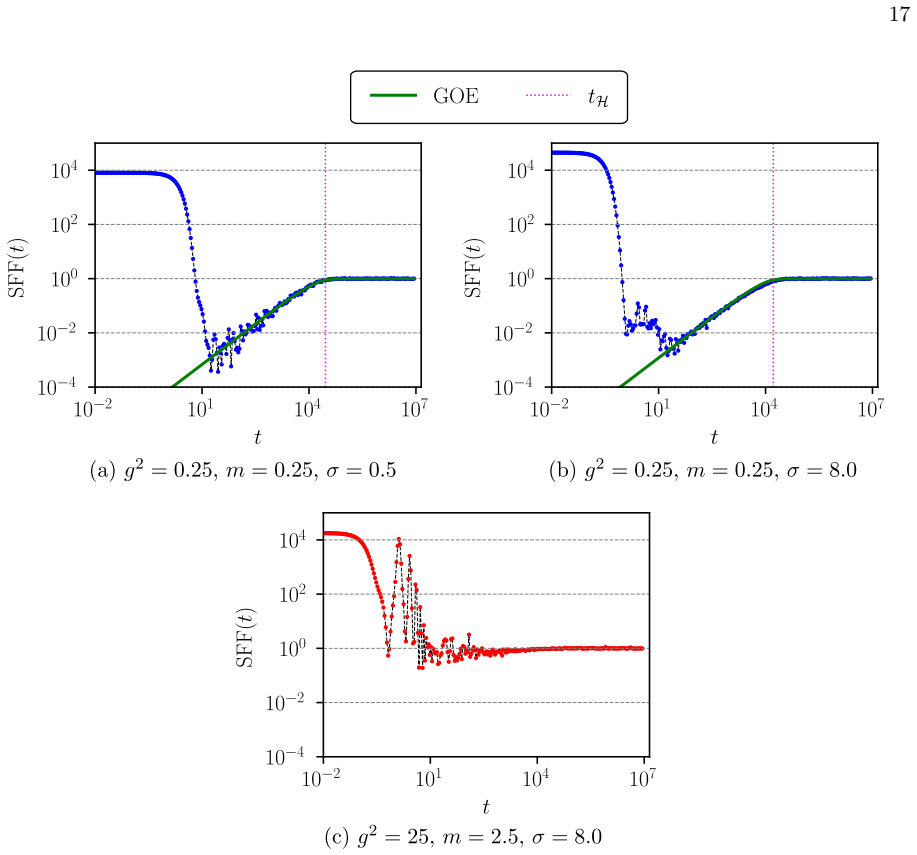
- The spectral form factor exhibits a slope-ramp-plateau structure matching the GOE prediction after a Thouless time tT≈21 for N=14, giving a concrete time scale for the onset of random-matrix behavior.
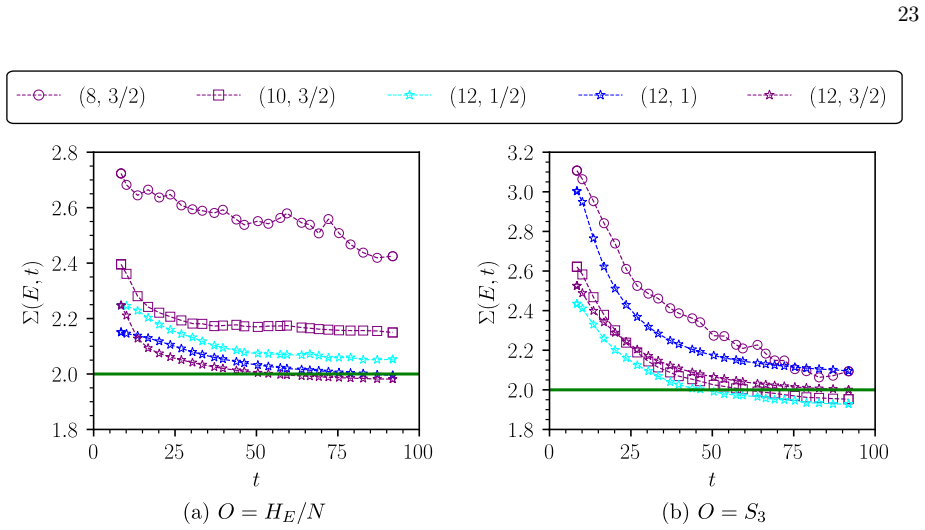
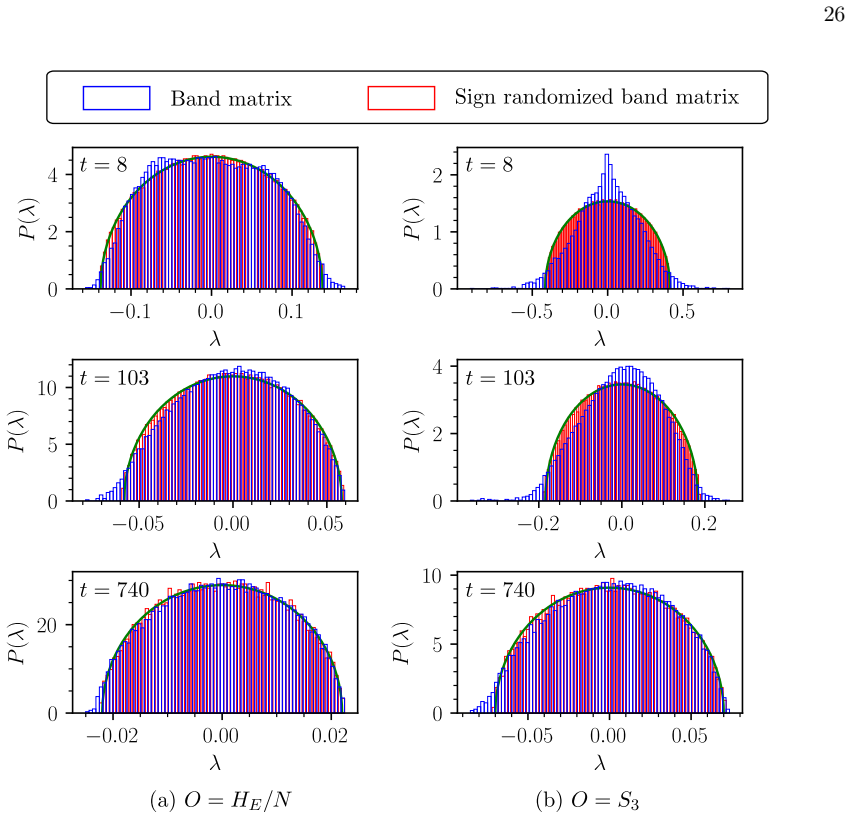
- Band-matrix measures such as Σ, Γ, Λn, and the eigenvalue semicircle distribution reach GOE behavior only in sufficiently small energy windows, and sign correlations in the matrix elements delay GOE onset more for extended operators.
- For long string operators, fO shows a decreasing zero-frequency plateau and a memory peak, indicating that nonlocal observables approach ETH-like behavior more slowly than local operators.
- Subsystem ETH in gauge theories requires using energy-dependent probabilities over cut-link boundary conditions, so the standard Garrison-Grover beta-scaling test must be modified for gauge theories.
Where Pith is reading between the lines
- Beyond the paper: if the exponential variance scaling survives extrapolation to larger jmax, ETH would be established for this theory in the continuum limit, and the same LSH-based exact-diagonalization workflow could be extended to SU(3), where thermalization questions are phenomenologically urgent.
- Beyond the paper: the memory peak observed for long string operators suggests that nonlocal probes in gauge theories can retain correlation on parametrically longer time scales than local energy densities—a feature that could matter for early-time hydrodynamization in heavy-ion collisions.
- Beyond the paper: the jmax non-convergence of fO in the ω→0 region means the zero-frequency plateau heights for HE/N and HI/N are not yet settled; a larger-jmax study could either confirm or weaken those specific plateau values.
Editorial analysis
A structured set of objections, weighed in public.
Referee Report
Summary. The paper tests the eigenstate thermalization hypothesis (ETH) in 1+1D SU(2) lattice gauge theory with one flavor of dynamical fermions, using the loop-string-hadron (LSH) formulation and exact diagonalization. It identifies a chaotic parameter region via the mean restricted gap ratio and the spectral form factor, computes diagonal and off-diagonal operator matrix elements for local operators (HE/N, HM/N, HI/N) and extended string operators (S3, S5, S7), and reports exponential suppression of the matrix-element variances with system size. It further studies RMT measures of the operator band matrices, extracts the fO function from off-diagonal matrix elements, and performs a preliminary subsystem-ETH analysis. The manuscript concludes that all considered operators approach ETH behavior in sufficiently small energy windows.
Significance. If the central exponential-suppression claim survives closer scrutiny, this would be a valuable extension of ETH tests to a non-Abelian lattice gauge theory with dynamical fermions, building on prior pure-gauge studies. The paper is careful in several respects: symmetry sectors are isolated, several independent RMT diagnostics are cross-checked, and the LSH framework is used to push exact diagonalization to N=14. The manuscript also explicitly discusses truncation effects in Appendix C, which is a strength. However, the central quantitative claim—the e^{-bN} decay of operator-matrix-element variances—is computed at fixed jmax=1/2 for all N, and the paper's own Appendix C and Fig. 13 show that the small-energy/small-frequency sector controlling this claim is not converged in jmax. Thus the significance of the result is high if the convergence gap can be closed, but the current support is incomplete.
major comments (3)
- The central quantitative ETH evidence is the exponential fit a e^{-bN} to sigma^2_diag and sigma^2_off-diag, shown in Fig. 6 and Table III. These data are all obtained at fixed jmax=1/2, and footnote 6 interprets the fitted b as the averaged entropy density. However, Appendix C (Fig. 18) shows that for N=10 the spectrum below E=15 converges only at jmax=5/2, and the central energy used for the fO analysis in Fig. 13(a), Ebar=14.7417, lies below that threshold. Moreover, Fig. 13(a) shows that fO(omega->0) for HE/N and HI/N continues to increase with jmax and is converged only for |omega|>~1. Since Eq. (1) links the small-omega off-diagonal variance directly to fO(omega->0), the fitted decay rates b in Table III may characterize the jmax=1/2 truncated model rather than the SU(2) lattice gauge theory. This is an internal convergence gap in the central observable. I request a jmax scan for t
- The memory-peak and spectral-gap claims for non-local operators are not convergent in jmax. Figure 14(a) shows no memory peak at jmax=1; the peak appears only at jmax=3/2. Figure 13(a) indicates that the small-omega sector generally requires larger jmax for convergence. The abstract and Conclusions nevertheless state these as findings without the truncation caveat. Please either demonstrate convergence of the memory-peak structure with increasing jmax, or explicitly qualify these observations as preliminary and truncation-dependent.
- The RMT-onset measures (Sigma, Gamma, Lambda_n, semicircle distribution) are mainly presented for (N,jmax)=(12,3/2), while N=8 and N=10 are at jmax=1/2. Figure 10 shows strong deviations from GOE for N=8 and N=10, so the conclusion that operator band matrices become GOE rests on a single jmax value at N=12. Given the jmax sensitivity in the same energy/frequency window documented in Appendix C and Fig. 13, a jmax scan at fixed N=12, or a demonstration that the relevant energy band lies in the converged sector, is needed before the GOE-onset claim can be regarded as robust.
minor comments (5)
- [III.D / Table IV] The text in Sec. III.D gives beta' values of 4.6086 for HE/N and 3.3299 for S3, but Table IV lists 4.9747 and 3.7390, respectively. These numbers should be reconciled.
- [III.B / footnote 6] Footnote 6 states that the N-independence of fO(E,omega) was numerically verified for N=10 and 12 but not shown. Please include the supporting plot or remove the claim.
- [III.C / Eq. (52)] In the definition of Gamma(E,t), the text says |O_off-diag|_avg is the average of absolute values, but the denominator notation uses |...|^2_avg. Please clarify whether the square is inside or outside the average.
- [IV / Fig. 16 caption] The caption's phrase 'microcanonical values of an operator that dominate its diagonal MEs according to ETH' is awkward; the blue dots are the diagonal matrix elements and the colored dots are Garrison-Grover predictions. Please rephrase for clarity.
- [V / Conclusions] The opening sentence of the Conclusions, 'all considered operators, local and non-local, approach the ETH behavior,' is stronger than the evidence presented in Figs. 13 and 14, where jmax dependence in the small-omega region is explicitly acknowledged. Please qualify this statement.
Circularity Check
No significant circularity: the paper tests exact-diagonalization data against independent ETH/RMT benchmarks; fitted functions are descriptive, not inputs that force the conclusions.
full rationale
The paper's central tests are comparisons of exact-diagonalization data against external, parameter-free benchmarks: the GOE gap-ratio distribution in Eq. (42), the connected SFF prediction in Eq. (46), the e^{-S(E)} variance suppression of the ETH ansatz in Eq. (1), the Lorentzian/exponential forms for fO, and the Garrison-Grover subsystem test. Fitted quantities (polynomial coefficients in Table II, a and b in Table III, Lorentzian/exponential parameters in Table IV) are descriptive characterizations of the computed matrix elements, not inputs that force the ETH behavior. For example, the exponential fit in Fig. 6 is made to four independent lattice sizes, and the theoretical content—that the decay rate b is approximately operator-independent—is observed rather than imposed. The LSH reformulation is cited from the same research group, but it is used only as a Hilbert-space construction whose symmetries are numerically verified in the paper, and it does not inject the ETH conclusion. The only material limitation is numerical convergence, which is openly disclosed: Appendix C and Fig. 18 show that the N=10 spectrum below E≈15 converges only at jmax=5/2, and Fig. 13 shows that fO(ω→0) for HE/N and HI/N is not converged at jmax=1/2, with the memory peak in Fig. 14(a) appearing only at larger jmax. These are honest caveats that could affect the quantitative ETH claim, but they are not circular: the paper does not derive the ETH scaling from the truncation, nor from any self-citation, and it explicitly draws attention to the jmax dependence. No step in the derivation reduces to its own input by construction.
Axiom & Free-Parameter Ledger
free parameters (4)
- Polynomial fit coefficients a0..a4 for microcanonical envelope Omc of each operator =
Table II
- Exponential fit parameters (a,b) for variance decay of diag and off-diag MEs =
Table III
- Lorentzian fit parameters (a,b,c) for fO at small omega =
Table IV
- Large-omega decay rate beta' for fO =
Table IV (beta' = 4.9747 for HE/N, 3.7390 for S3)
axioms (5)
- domain assumption The LSH formulation is unitarily equivalent to the Kogut-Susskind Hamiltonian formulation of the theory.
- domain assumption The bosonic Hilbert space truncation jmax (1/2 or 3/2) preserves the low-energy physics relevant for ETH tests.
- domain assumption The energy window defined by Eq. (40) and the frequency cutoff omega<0.1 isolate the thermal regime without edge effects.
- domain assumption The BGS conjecture (GOE level statistics implies quantum chaos) and the ETH ansatz in Eq. (1) are the correct diagnostic framework.
- ad hoc to paper The system sizes N=8,10,12,14 are large enough to extract exponential scaling of variances.
read the original abstract
We test the eigenstate thermalization hypothesis (ETH) in 1+1-dimensional SU(2) lattice gauge theory (LGT) with one flavor of dynamical fermions. Using the loop-string-hadron framework of the LGT with a bosonic cut-off, we exactly diagonalize the Hamiltonian for finite size systems and calculate matrix elements (MEs) in the eigenbasis for both local and non-local operators. We analyze different indicators to identify the parameter space for quantum chaos at finite lattice sizes and investigate how the ETH behavior emerges in both the diagonal and off-diagonal MEs. Our investigations allow us to study various time scales of thermalization and the emergence of random matrix behavior, and highlight the interplays of the several diagnostics with each other. Furthermore, from the off-diagonal MEs, we extract a smooth function that is closely related to the spectral function for both local and non-local operators. We find numerical evidence of the spectral gap and the memory peak in the non-local operator case. Finally, we investigate aspects of subsystem ETH in the lattice gauge theory and identify certain features in the subsystem reduced density matrix that are unique to gauge theories.
Figures








Forward citations
Cited by 5 Pith papers
-
Local Thermalization of SU(2) Lattice Gauge Fields on Quantum Computers
Quantum hardware simulation of SU(2) lattice gauge thermalization matches classical extrapolations up to 101 plaquettes after error mitigation, establishing feasibility for chaotic quantum field systems.
-
Tame the Umklapp Processes in Real-Time Lattice Simulation for Hydrodynamics: An Ising Field Theory Study
Real-time lattice Hamiltonian simulation of a three-particle Ising field theory suppresses Umklapp processes and produces relativistic hydrodynamics sound modes, extracting ζ/s=14.19±0.90 and c_s/c=0.76±0.02 at T≈7.14.
-
Photonic Analog Quantum Simulation of (1+1)-Dimensional $U(1)$ Lattice Gauge Theory with Dynamical Matter
A mapping of the Jaynes-Cummings-Hubbard model onto the spin-1/2 Quantum Link Model via tuned polaritonic resonances in cavity arrays enables analog simulation of U(1) LGT dynamics with matter, verified by exact diago...
-
Local Thermalization of SU(2) Lattice Gauge Fields on Quantum Computers
Error-mitigated IBM quantum hardware reproduces extrapolated classical simulations of entanglement growth and local thermalization for a truncated SU(2) gauge theory on chains up to 101 plaquettes.
-
Observation of Robust and Coherent Non-Abelian Hadron Dynamics on Noisy Quantum Processors
A 60-site SU(2) lattice gauge theory was run on 120 qubits, but the implemented dynamics approximate to non-interacting fermion hopping, and the abstract's claimed breathing-mode frequency is not extracted anywhere.
Reference graph
Works this paper leans on
-
[1]
This is ascribed to formation of spectral gap characteristics of integrable systems [120]
With increasing string size the zero frequency plateau height keeps decreasing. This is ascribed to formation of spectral gap characteristics of integrable systems [120]
-
[2]
slope” with added oscillations for the period before the Thouless time ( tT ), i.e., t ≤ tT , (ii) the “ramp
Spectral form factors Besides the distribution of level spacings, the spectral form factor (SFF) is another widely used tool to study chaotic behavior. It also encodes information of the approach to thermalization in real-time evolution of many different quantum systems [105, 106]. The SFF is defined as the 16 FIG. 3. The mean restricted gap ratio, ⟨r⟩, i...
2029
-
[3]
Thermalization, from Cold Atoms to Hot Quan- tum Chromodynamics
At low frequencies the fO function develops a memory peak indicative of a rapid late time oscillation in string auto-correlations computed in excited states. This contrasts with the late time behaviors of local operators, which decay rapidly, and hence is identified with memory. We find indications of both these effects in Fig. 14. In Fig. 14 (a), we plot...
2023
-
[4]
Quantum statistical mechanics in a closed system,
J. M. Deutsch, “Quantum statistical mechanics in a closed system,” Phys. Rev. A 43, 2046 (1991)
2046
-
[5]
Chaos and Quantum Thermalization,
Mark Srednicki, “Chaos and Quantum Thermalization,” Phys. Rev. E 50 (1994), 10.1103/Phys- RevE.50.888, arXiv:cond-mat/9403051
Pith/arXiv arXiv 1994
-
[6]
Thermalization and its mechanism for generic isolated quantum systems,
Marcos Rigol, Vanja Dunjko, and Maxim Olshanii, “Thermalization and its mechanism for generic isolated quantum systems,” Nature 452, 854–858 (2008)
2008
-
[7]
Onset of quantum chaos in one-dimensional bosonic and fermionic systems and its relation to thermalization,
Lea F. Santos and Marcos Rigol, “Onset of quantum chaos in one-dimensional bosonic and fermionic systems and its relation to thermalization,” Phys. Rev. E 81, 036206 (2010)
2010
-
[8]
A. Chandran, Marc D. Schulz, and F. J. Burnell, “The eigenstate thermalization hypothesis in constrained Hilbert spaces: A case study in non-Abelian anyon chains,” Phys. Rev. B 94, 235122 (2016), arXiv:1607.00388 [cond-mat.stat-mech]
Pith/arXiv arXiv 2016
-
[10]
Renyi Entropy of Chaotic Eigenstates,
Tsung-Cheng Lu and Tarun Grover, “Renyi Entropy of Chaotic Eigenstates,” Phys. Rev. E99, 032111 (2019), arXiv:1709.08784 [cond-mat.stat-mech]
Pith/arXiv arXiv 2019
-
[11]
Eigenstate Thermalization Hypothesis and Approximate Quantum Error Correction,
Ning Bao and Newton Cheng, “Eigenstate Thermalization Hypothesis and Approximate Quantum Error Correction,” JHEP 08, 152 (2019), arXiv:1906.03669 [hep-th]
Pith/arXiv arXiv 2019
-
[12]
Ultracold atoms out of equilibrium,
Tim Langen, Remi Geiger, and J¨ org Schmiedmayer, “Ultracold atoms out of equilibrium,” Ann. Rev. Condensed Matter Phys. 6, 201 (2015), arXiv:1408.6377 [cond-mat.quant-gas]
Pith/arXiv arXiv 2015
-
[13]
Eigenstate Thermalization Hypothesis in Con- formal Field Theory,
Nima Lashkari, Anatoly Dymarsky, and Hong Liu, “Eigenstate Thermalization Hypothesis in Con- formal Field Theory,” J. Stat. Mech. 1803, 033101 (2018), arXiv:1610.00302 [hep-th]
Pith/arXiv arXiv 2018
-
[14]
Thermality of eigenstates in conformal field theories,
Pallab Basu, Diptarka Das, Shouvik Datta, and Sridip Pal, “Thermality of eigenstates in conformal field theories,” Phys. Rev. E 96, 022149 (2017), arXiv:1705.03001 [hep-th]
Pith/arXiv arXiv 2017
-
[15]
Quantum simulation of out-of-equilibrium dynamics in gauge theories,
Jad C. Halimeh, Niklas Mueller, Johannes Knolle, Zlatko Papi´ c, and Zohreh Davoudi, “Quantum simulation of out-of-equilibrium dynamics in gauge theories,” (2025), arXiv:2509.03586 [quant-ph]
Pith/arXiv arXiv 2025
-
[16]
Quantum simulation of fundamental particles and forces,
Christian W. Bauer, Zohreh Davoudi, Natalie Klco, and Martin J. Savage, “Quantum simulation of fundamental particles and forces,” Nature Rev. Phys. 5, 420–432 (2023), arXiv:2404.06298 [hep-ph]
Pith/arXiv arXiv 2023
-
[17]
Quantum simulation of thermodynamics in an integrated quantum photonic processor,
F. H. B. Somhorst et al., “Quantum simulation of thermodynamics in an integrated quantum photonic processor,” Nature Commun. 14, 3895 (2023), arXiv:2201.00049 [quant-ph]
Pith/arXiv arXiv 2023
-
[18]
Quantum computing universal thermalization dynamics in a (2 + 1)D Lattice Gauge Theory,
Niklas Mueller, Tianyi Wang, Or Katz, Zohreh Davoudi, and Marko Cetina, “Quantum computing universal thermalization dynamics in a (2 + 1)D Lattice Gauge Theory,” Nature Commun. 16, 5492 (2025), arXiv:2408.00069 [quant-ph]
arXiv 2025
-
[19]
Steps toward quantum simulations of hadroniza- tion and energy loss in dense matter,
Roland C. Farrell, Marc Illa, and Martin J. Savage, “Steps toward quantum simulations of hadroniza- tion and energy loss in dense matter,” Phys. Rev. C 111, 015202 (2025), arXiv:2405.06620 [quant-ph]
Pith/arXiv arXiv 2025
-
[20]
Thermalization and criticality on an analogue–digital quantum simulator,
Trond I. Andersen et al., “Thermalization and criticality on an analogue–digital quantum simulator,” Nature 638, 79–85 (2025), arXiv:2405.17385 [quant-ph]
Pith/arXiv arXiv 2025
-
[21]
Dynamic thermaliza- tion on noisy quantum hardware,
Hugo Perrin, Thibault Scoquart, Andrei I. Pavlov, and Nikolay V. Gnezdilov, “Dynamic thermaliza- tion on noisy quantum hardware,” Commun. Phys. 8, 95 (2025), arXiv:2407.04770 [quant-ph]
Pith/arXiv arXiv 2025
-
[22]
Thermalization dynamics of a gauge theory on a quantum simulator,
Zhao-Yu Zhou, Guo-Xian Su, Jad C. Halimeh, Robert Ott, Hui Sun, Philipp Hauke, Bing Yang, Zhen-Sheng Yuan, J¨ urgen Berges, and Jian-Wei Pan, “Thermalization dynamics of a gauge theory on a quantum simulator,” Science 377, abl6277 (2022), arXiv:2107.13563 [cond-mat.quant-gas]. 38
Pith/arXiv arXiv 2022
-
[23]
Quantum simulation of nonequilibrium dynamics and thermalization in the Schwinger model,
Wibe A. de Jong, Kyle Lee, James Mulligan, Mateusz P losko´ n, Felix Ringer, and Xiaojun Yao, “Quantum simulation of nonequilibrium dynamics and thermalization in the Schwinger model,” Phys. Rev. D 106, 054508 (2022), arXiv:2106.08394 [quant-ph]
Pith/arXiv arXiv 2022
-
[24]
The phase diagram of quantum chromodynamics in one dimension on a quantum computer,
Anton T. Than et al., “The phase diagram of quantum chromodynamics in one dimension on a quantum computer,” (2024), arXiv:2501.00579 [quant-ph]
arXiv 2024
-
[25]
Quantum simulation of bubble nucleation across a quantum phase transition,
De Luo et al., “Quantum simulation of bubble nucleation across a quantum phase transition,” (2025), arXiv:2505.09607 [quant-ph]
Pith/arXiv arXiv 2025
-
[26]
Towards Quantum Computing Phase Dia- grams of Gauge Theories with Thermal Pure Quantum States,
Zohreh Davoudi, Niklas Mueller, and Connor Powers, “Towards Quantum Computing Phase Dia- grams of Gauge Theories with Thermal Pure Quantum States,” Phys. Rev. Lett. 131, 081901 (2023), arXiv:2208.13112 [hep-lat]
Pith/arXiv arXiv 2023
-
[27]
Decoherence and Entropy Production in Relativistic Nuclear Collisions,
Rainer J. Fries, Berndt Muller, and Andreas Schafer, “Decoherence and Entropy Production in Relativistic Nuclear Collisions,” Phys. Rev. C 79, 034904 (2009), arXiv:0807.1093 [nucl-th]
Pith/arXiv arXiv 2009
-
[28]
QCD thermaliza- tion: Ab initio approaches and interdisciplinary connections,
J¨ urgen Berges, Michal P. Heller, Aleksas Mazeliauskas, and Raju Venugopalan, “QCD thermaliza- tion: Ab initio approaches and interdisciplinary connections,” Rev. Mod. Phys. 93, 035003 (2021), arXiv:2005.12299 [hep-th]
Pith/arXiv arXiv 2021
-
[29]
’Bottom up’ thermalization in heavy ion collisions,
R. Baier, Alfred H. Mueller, D. Schiff, and D. T. Son, “’Bottom up’ thermalization in heavy ion collisions,” Phys. Lett. B 502, 51–58 (2001), arXiv:hep-ph/0009237
Pith/arXiv arXiv 2001
-
[30]
Aleksi Kurkela, Aleksas Mazeliauskas, Jean-Fran¸ cois Paquet, S¨ oren Schlichting, and Derek Teaney, “Matching the Nonequilibrium Initial Stage of Heavy Ion Collisions to Hydrodynamics with QCD Kinetic Theory,” Phys. Rev. Lett. 122, 122302 (2019), arXiv:1805.01604 [hep-ph]
Pith/arXiv arXiv 2019
-
[31]
Scaling and adiabaticity in a rapidly expanding gluon plasma,
Jasmine Brewer, Bruno Scheihing-Hitschfeld, and Yi Yin, “Scaling and adiabaticity in a rapidly expanding gluon plasma,” JHEP 05, 145 (2022), arXiv:2203.02427 [hep-ph]
Pith/arXiv arXiv 2022
-
[32]
Attractors Without Scaling: Adiabatic Hydrodynamization With and Without Inelastic Scattering,
Krishna Rajagopal, Bruno Scheihing-Hitschfeld, and Rachel Steinhorst, “Attractors Without Scaling: Adiabatic Hydrodynamization With and Without Inelastic Scattering,” (2025), arXiv:2507.21232 [hep-ph]
Pith/arXiv arXiv 2025
-
[33]
Role of quantum fluc- tuations in a system with strong fields: Onset of hydrodynamical flow,
Kevin Dusling, Thomas Epelbaum, Francois Gelis, and Raju Venugopalan, “Role of quantum fluc- tuations in a system with strong fields: Onset of hydrodynamical flow,” Nucl. Phys. A 850, 69–109 (2011), arXiv:1009.4363 [hep-ph]
Pith/arXiv arXiv 2011
-
[34]
Fluctuating Glasma initial conditions and flow in heavy ion collisions,
Bjoern Schenke, Prithwish Tribedy, and Raju Venugopalan, “Fluctuating Glasma initial conditions and flow in heavy ion collisions,” Phys. Rev. Lett. 108, 252301 (2012), arXiv:1202.6646 [nucl-th]
Pith/arXiv arXiv 2012
-
[35]
UV Cascade in Classical Yang-Mills Theory,
Aleksi Kurkela and Guy D. Moore, “UV Cascade in Classical Yang-Mills Theory,” Phys. Rev. D 86, 056008 (2012), arXiv:1207.1663 [hep-ph]
Pith/arXiv arXiv 2012
-
[36]
Horizon formation and far-from-equilibrium isotropization in supersymmetric Yang-Mills plasma,
Paul M. Chesler and Laurence G. Yaffe, “Horizon formation and far-from-equilibrium isotropization in supersymmetric Yang-Mills plasma,” Phys. Rev. Lett. 102, 211601 (2009), arXiv:0812.2053 [hep-th]
Pith/arXiv arXiv 2009
-
[37]
Thermalization of Strongly Coupled Field Theories,
V. Balasubramanian, A. Bernamonti, J. de Boer, N. Copland, B. Craps, E. Keski-Vakkuri, B. Muller, A. Schafer, M. Shigemori, and W. Staessens, “Thermalization of Strongly Coupled Field Theories,” Phys. Rev. Lett. 106, 191601 (2011), arXiv:1012.4753 [hep-th]
Pith/arXiv arXiv 2011
-
[38]
Thermalization in a Holographic Confining Gauge Theory,
Takaaki Ishii, Elias Kiritsis, and Christopher Rosen, “Thermalization in a Holographic Confining Gauge Theory,” JHEP 08, 008 (2015), arXiv:1503.07766 [hep-th]
Pith/arXiv arXiv 2015
-
[39]
Hamiltonian Formulation of Wilson’s Lattice Gauge Theories,
John B. Kogut and Leonard Susskind, “Hamiltonian Formulation of Wilson’s Lattice Gauge Theories,” Phys. Rev. D 11, 395–408 (1975)
1975
-
[40]
Simulating (2+1)D SU(2) Yang-Mills lattice gauge theory at finite density with tensor networks,
Giovanni Cataldi, Giuseppe Magnifico, Pietro Silvi, and Simone Montangero, “Simulating (2+1)D SU(2) Yang-Mills lattice gauge theory at finite density with tensor networks,” Phys. Rev. Res. 6, 033057 (2024), arXiv:2307.09396 [hep-lat]
Pith/arXiv arXiv 2024
-
[41]
Tensor networks for lattice gauge theories beyond one dimension,
Giuseppe Magnifico, Giovanni Cataldi, Marco Rigobello, Peter Majcen, Daniel Jaschke, Pietro Silvi, and Simone Montangero, “Tensor networks for lattice gauge theories beyond one dimension,” Com- mun. Phys. 8, 322 (2025), arXiv:2407.03058 [hep-lat]
Pith/arXiv arXiv 2025
-
[42]
Review on Novel Methods for Lattice Gauge Theories,
Mari Carmen Ba˜ nuls and Krzysztof Cichy, “Review on Novel Methods for Lattice Gauge Theories,” Rept. Prog. Phys. 83, 024401 (2020), arXiv:1910.00257 [hep-lat]
Pith/arXiv arXiv 2020
-
[43]
Simulating Lattice Gauge Theories within Quantum Technologies,
M. C. Ba˜ nulset al., “Simulating Lattice Gauge Theories within Quantum Technologies,” Eur. Phys. J. D 74, 165 (2020), arXiv:1911.00003 [quant-ph]
Pith/arXiv arXiv 2020
-
[44]
Ron Belyansky, Seth Whitsitt, Niklas Mueller, Ali Fahimniya, Elizabeth R. Bennewitz, Zohreh Davoudi, and Alexey V. Gorshkov, “High-Energy Collision of Quarks and Mesons in the Schwinger Model: From Tensor Networks to Circuit QED,” Phys. Rev. Lett. 132, 091903 (2024), arXiv:2307.02522 [quant-ph]
Pith/arXiv arXiv 2024
-
[45]
Real-time scattering in the lattice Schwinger model,
Irene Papaefstathiou, Johannes Knolle, and Mari Carmen Ba˜ nuls, “Real-time scattering in the lattice Schwinger model,” Phys. Rev. D 111, 014504 (2025), arXiv:2402.18429 [hep-lat]
Pith/arXiv arXiv 2025
-
[46]
Tensor-network toolbox for probing dynamics of non-Abelian gauge 39 theories,
Emil Mathew, Navya Gupta, Saurabh V. Kadam, Aniruddha Bapat, Jesse Stryker, Zohreh Davoudi, and Indrakshi Raychowdhury, “Tensor-network toolbox for probing dynamics of non-Abelian gauge 39 theories,” PoS LA TTICE2024, 472 (2025), arXiv:2501.18301 [hep-lat]
Pith/arXiv arXiv 2025
-
[47]
Dense QCD 2 with matrix product states,
Tomoya Hayata, Yoshimasa Hidaka, and Kentaro Nishimura, “Dense QCD 2 with matrix product states,” JHEP 07, 106 (2024), arXiv:2311.11643 [hep-lat]
Pith/arXiv arXiv 2024
-
[48]
DMRG study of the theta-dependent mass spectrum in the 2-flavor Schwinger model,
Etsuko Itou, Akira Matsumoto, and Yuya Tanizaki, “DMRG study of the theta-dependent mass spectrum in the 2-flavor Schwinger model,” JHEP 09, 155 (2024), arXiv:2407.11391 [hep-lat]
Pith/arXiv arXiv 2024
-
[49]
Real-time dynamics of the Schwinger model as an open quantum system with Neural Density Operators,
Joshua Lin, Di Luo, Xiaojun Yao, and Phiala E. Shanahan, “Real-time dynamics of the Schwinger model as an open quantum system with Neural Density Operators,” JHEP 06, 211 (2024), arXiv:2402.06607 [hep-ph]
Pith/arXiv arXiv 2024
-
[50]
Solving lattice gauge theories using the quantum Krylov algorithm and qubitization,
Lewis W. Anderson, Martin Kiffner, Tom O’Leary, Jason Crain, and Dieter Jaksch, “Solving lattice gauge theories using the quantum Krylov algorithm and qubitization,” Quantum 9, 1669 (2025), arXiv:2403.08859 [quant-ph]
Pith/arXiv arXiv 2025
-
[51]
Quantum-Centric Algorithm for Sample-Based Krylov Diagonalization,
Jeffery Yu et al., “Quantum-Centric Algorithm for Sample-Based Krylov Diagonalization,” (2025), arXiv:2501.09702 [quant-ph]
arXiv 2025
-
[52]
Zohreh Davoudi, Alexander F. Shaw, and Jesse R. Stryker, “General quantum algorithms for Hamil- tonian simulation with applications to a non-Abelian lattice gauge theory,” Quantum 7, 1213 (2023), arXiv:2212.14030 [hep-lat]
Pith/arXiv arXiv 2023
-
[53]
Quantum Algorithms for Simulating the Lattice Schwinger Model,
Alexander F. Shaw, Pavel Lougovski, Jesse R. Stryker, and Nathan Wiebe, “Quantum Algorithms for Simulating the Lattice Schwinger Model,” Quantum 4, 306 (2020), arXiv:2002.11146 [quant-ph]
Pith/arXiv arXiv 2020
-
[54]
Simulating lattice gauge theories on a quantum computer,
Tim Byrnes and Yoshihisa Yamamoto, “Simulating lattice gauge theories on a quantum computer,” Phys. Rev. A 73, 022328 (2006), arXiv:quant-ph/0510027
Pith/arXiv arXiv 2006
-
[55]
General Methods for Digital Quantum Simulation of Gauge Theories,
Henry Lamm, Scott Lawrence, and Yukari Yamauchi (NuQS), “General Methods for Digital Quantum Simulation of Gauge Theories,” Phys. Rev. D 100, 034518 (2019), arXiv:1903.08807 [hep-lat]
Pith/arXiv arXiv 2019
-
[56]
Exponential Improvements in the Simulation of Lattice Gauge Theories Using Near-Optimal Techniques,
Mason L. Rhodes, Michael Kreshchuk, and Shivesh Pathak, “Exponential Improvements in the Simulation of Lattice Gauge Theories Using Near-Optimal Techniques,” PRX Quantum 5, 040347 (2024), arXiv:2405.10416 [quant-ph]
Pith/arXiv arXiv 2024
-
[57]
Quantum Circuits for SU(3) Lattice Gauge Theory,
Praveen Balaji, Cian´ an Conefrey-Shinozaki, Patrick Draper, Jason K. Elhaderi, Drishti Gupta, Luis Hidalgo, Andrew Lytle, and Enrico Rinaldi, “Quantum Circuits for SU(3) Lattice Gauge Theory,” (2025), arXiv:2503.08866 [hep-lat]
Pith/arXiv arXiv 2025
-
[58]
Xiaojun Yao, “SU(2) gauge theory in 2+1 dimensions on a plaquette chain obeys the eigenstate thermalization hypothesis,” Phys. Rev. D 108, L031504 (2023), arXiv:2303.14264 [hep-lat]
Pith/arXiv arXiv 2023
-
[59]
Eigenstate ther- malization in (2+1)-dimensional SU(2) lattice gauge theory,
Lukas Ebner, Berndt M¨ uller, Andreas Sch¨ afer, Clemens Seidl, and Xiaojun Yao, “Eigenstate ther- malization in (2+1)-dimensional SU(2) lattice gauge theory,” Phys. Rev. D 109, 014504 (2024), arXiv:2308.16202 [hep-lat]
Pith/arXiv arXiv 2024
-
[60]
Entanglement entropy of (2+1)-dimensional SU(2) lattice gauge theory on plaquette chains,
Lukas Ebner, Andreas Sch¨ afer, Clemens Seidl, Berndt M¨ uller, and Xiaojun Yao, “Entanglement entropy of (2+1)-dimensional SU(2) lattice gauge theory on plaquette chains,” Phys. Rev. D 110, 014505 (2024), arXiv:2401.15184 [hep-lat]
Pith/arXiv arXiv 2024
-
[61]
Entanglement Properties of SU(2) Gauge Theory,
Lukas Ebner, Berndt M¨ uller, Andreas Sch¨ afer, Leonhard Schmotzer, Clemens Seidl, and Xiaojun Yao, “Entanglement Properties of SU(2) Gauge Theory,” (2024), arXiv:2411.04550 [hep-lat]
arXiv 2024
-
[62]
Emergent hydrodynamic mode on SU(2) plaquette chains and quantum simulation,
Francesco Turro and Xiaojun Yao, “Emergent hydrodynamic mode on SU(2) plaquette chains and quantum simulation,” Phys. Rev. D 111, 094502 (2025), arXiv:2502.17551 [hep-ph]
Pith/arXiv arXiv 2025
-
[63]
Robust quantum many-body scars in lattice gauge theories,
Jad C. Halimeh, Luca Barbiero, Philipp Hauke, Fabian Grusdt, and Annabelle Bohrdt, “Robust quantum many-body scars in lattice gauge theories,” Quantum 7, 1004 (2023), arXiv:2203.08828 [cond-mat.quant-gas]
Pith/arXiv arXiv 2023
-
[64]
Loop, string, and hadron dynamics in SU(2) Hamil- tonian lattice gauge theories,
Indrakshi Raychowdhury and Jesse R. Stryker, “Loop, string, and hadron dynamics in SU(2) Hamil- tonian lattice gauge theories,” Phys. Rev. D 101, 114502 (2020), arXiv:1912.06133 [hep-lat]
Pith/arXiv arXiv 2020
-
[65]
Loop-string-hadron formulation of an SU(3) gauge theory with dynamical quarks,
Saurabh V. Kadam, Indrakshi Raychowdhury, and Jesse R. Stryker, “Loop-string-hadron formulation of an SU(3) gauge theory with dynamical quarks,” Phys. Rev. D107, 094513 (2023), arXiv:2212.04490 [hep-lat]
Pith/arXiv arXiv 2023
-
[66]
Saurabh V. Kadam, Aahiri Naskar, Indrakshi Raychowdhury, and Jesse R. Stryker, “Loop-string- hadron approach to SU(3) lattice Yang-Mills theory: Hilbert space of a trivalent vertex,” Phys. Rev. D 111, 074516 (2025), arXiv:2407.19181 [hep-lat]
Pith/arXiv arXiv 2025
-
[67]
Search for efficient formulations for Hamiltonian simulation of non-Abelian lattice gauge theories,
Zohreh Davoudi, Indrakshi Raychowdhury, and Andrew Shaw, “Search for efficient formulations for Hamiltonian simulation of non-Abelian lattice gauge theories,” Phys. Rev. D 104, 074505 (2021), arXiv:2009.11802 [hep-lat]
Pith/arXiv arXiv 2021
-
[68]
Proof of the ergodic theorem and the H-theorem in quantum mechanics,
John von Neumann, “Proof of the ergodic theorem and the H-theorem in quantum mechanics,” Eur. Phys. J. H 35, 201–237 (2010), arXiv:1003.2133 [physics.hist-ph]
Pith/arXiv arXiv 2010
-
[69]
Level clustering in the regular spectrum,
Michael Victor Berry and Michael Tabor, “Level clustering in the regular spectrum,” Proceedings of the Royal Society of London. A. Mathematical and Physical Sciences 356, 375–394 (1977). 40
1977
-
[70]
Characterization of chaotic quantum spectra and universality of level fluctuation laws,
O. Bohigas, M. J. Giannoni, and C. Schmit, “Characterization of chaotic quantum spectra and universality of level fluctuation laws,” Phys. Rev. Lett. 52, 1–4 (1984)
1984
-
[71]
Statistical theory of the energy levels of complex systems. I,
F. J. Dyson, “Statistical theory of the energy levels of complex systems. I,” J. Math. Phys. 3, 140–156 (1962)
1962
-
[72]
Statistical Theory of the Energy Levels of Complex Systems. II,
Freeman J. Dyson, “Statistical Theory of the Energy Levels of Complex Systems. II,” Journal of Mathematical Physics 3, 157–165 (1962)
1962
-
[73]
Statistical Theory of the Energy Levels of Complex Systems. III,
Freeman J. Dyson, “Statistical Theory of the Energy Levels of Complex Systems. III,” J. Math. Phys. 3, 166 (1962)
1962
-
[74]
Bound on Eigenstate Thermalization from Transport,
Anatoly Dymarsky, “Bound on Eigenstate Thermalization from Transport,” Phys. Rev. Lett. 128, 190601 (2022), arXiv:1804.08626 [cond-mat.stat-mech]
Pith/arXiv arXiv 2022
-
[75]
Jonas Richter, Anatoly Dymarsky, Robin Steinigeweg, and Jochen Gemmer, “Eigenstate thermaliza- tion hypothesis beyond standard indicators: Emergence of random-matrix behavior at small frequen- cies,” Phys. Rev. E 102, 042127 (2020), arXiv:2007.15070 [cond-mat.stat-mech]
Pith/arXiv arXiv 2020
-
[76]
Bounds on chaos from the eigenstate thermalization hypoth- esis,
Chaitanya Murthy and Mark Srednicki, “Bounds on chaos from the eigenstate thermalization hypoth- esis,” Phys. Rev. Lett. 123, 230606 (2019), arXiv:1906.10808 [cond-mat.stat-mech]
Pith/arXiv arXiv 2019
-
[77]
Does a single eigenstate encode the full Hamiltonian?
James R. Garrison and Tarun Grover, “Does a single eigenstate encode the full Hamiltonian?” Phys. Rev. X 8, 021026 (2018), arXiv:1503.00729 [cond-mat.str-el]
Pith/arXiv arXiv 2018
-
[78]
Anatoly Dymarsky, Nima Lashkari, and Hong Liu, “Subsystem ETH,” Phys. Rev. E 97, 012140 (2018), arXiv:1611.08764 [cond-mat.stat-mech]
Pith/arXiv arXiv 2018
-
[79]
From quantum chaos and eigenstate thermalization to statistical mechanics and thermodynamics,
Luca D’Alessio, Yariv Kafri, Anatoli Polkovnikov, and Marcos Rigol, “From quantum chaos and eigenstate thermalization to statistical mechanics and thermodynamics,” Adv. Phys. 65, 239–362 (2016), arXiv:1509.06411 [cond-mat.stat-mech]
Pith/arXiv arXiv 2016
-
[80]
Mari Carmen Ba˜ nuls, Krzysztof Cichy, J. Ignacio Cirac, Karl Jansen, and Stefan K¨ uhn, “Efficient basis formulation for 1+1 dimensional SU(2) lattice gauge theory: Spectral calculations with matrix product states,” Phys. Rev. X 7, 041046 (2017), arXiv:1707.06434 [hep-lat]
Pith/arXiv arXiv 2017
-
[81]
Quantum link models: A Discrete approach to gauge theories,
S. Chandrasekharan and U. J. Wiese, “Quantum link models: A Discrete approach to gauge theories,” Nucl. Phys. B 492, 455–474 (1997), arXiv:hep-lat/9609042
Pith/arXiv arXiv 1997
discussion (0)
Sign in with ORCID, Apple, or X to comment. Anyone can read and Pith papers without signing in.