Probing the Nature of Dark Matter Self-Interactions Through Observations of Massive Black Hole Mergers
Pith reviewed 2026-05-17 21:04 UTC · model grok-4.3
The pith
LISA observations of massive black hole mergers can distinguish cold dark matter from self-interacting dark matter.
A machine-rendered reading of the paper's core claim, the machinery that carries it, and where it could break.
Core claim
Previous work shows that SIDM with a constant cross section of 1 cm²/g delays MBH mergers as compared to CDM when the host halo has a flattened central density profile. In this work, we use mock gravitational wave observations of MBH mergers to test LISA's capability to indirectly probe dark matter physics. As a proof of concept, we use zoom-in simulations of two galaxy evolutionary histories to show that LISA may be able to distinguish (with a p-value ≤ 0.05) between CDM and SIDM with a short-range interaction and a constant cross section of 1 cm²/g, provided at least ∼70 MBH mergers are observed with signal-to-noise ratios greater than 10.
What carries the argument
The delay in massive black hole merger timescales induced by the cored density profiles in self-interacting dark matter halos.
If this is right
- At least seventy high signal-to-noise ratio massive black hole mergers are needed for LISA to achieve statistical distinction between the models.
- This provides a pathway to probe dark matter self-interactions through gravitational wave observations.
- The approach motivates future studies with velocity-dependent cross sections and larger simulation sets.
Where Pith is reading between the lines
- Similar techniques could be applied to data from other future gravitational wave detectors to test dark matter models.
- If the distinction holds, it would offer constraints on dark matter that are independent of small-scale structure problems.
- The number of required observations might change with more complex dark matter interaction models.
Load-bearing premise
The merger delay effect found in prior small-sample Milky Way-mass simulations will produce observable differences in LISA data for a realistic population of galaxies without being washed out by other astrophysical variables.
What would settle it
Collecting observations of at least seventy massive black hole mergers with LISA and finding no significant difference in merger properties between CDM and SIDM predictions.
Figures
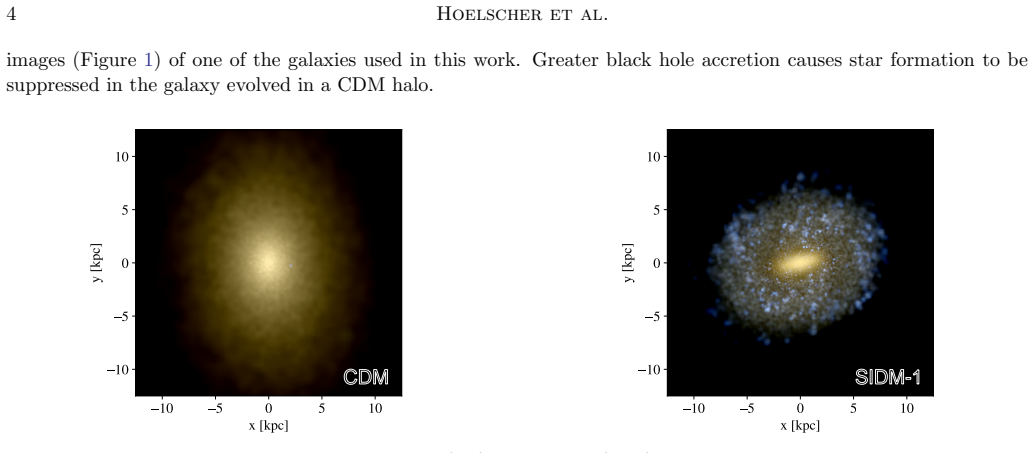


read the original abstract
Though the nature of dark matter remains elusive, two models have come to prominence with testable predictions: cold dark matter (CDM) and self-interacting dark matter (SIDM). While CDM remains the widely accepted model, SIDM was introduced to potentially help resolve the discrepancies between the predictions of the CDM model and observational data, in particular the predicted central density profiles. Previous work involving simulations of small numbers of Milky Way-mass galaxies shows that SIDM with a constant cross section of 1 $\rm{cm^2/g}$ delays massive black hole (MBH) mergers as compared to CDM when the host halo has a flattened central density profile. In this work, we use mock gravitational wave observations of MBH mergers to test LISA's capability to indirectly probe dark matter physics. As a proof of concept, we use zoom-in simulations of two galaxy evolutionary histories to show that LISA may be able to distinguish (with a p--value $\leq$ 0.05) between CDM and SIDM with a short-range interaction and a constant cross section of 1 $\rm{cm^2/g}$, provided at least $\sim70$ MBH mergers are observed with signal-to-noise ratios greater than 10. Given our small sample size, this should be regarded as illustrative, rather than definitive. We emphasize that our work does not consider more realistic models with a velocity-dependent cross section, though our exploratory work shows that LISA may provide a pathway to probe dark matter self-interactions, motivating future work with more realistic, currently-favored models and larger simulation suites.
Editorial analysis
A structured set of objections, weighed in public.
Referee Report
Summary. The manuscript presents a proof-of-concept analysis showing that mock LISA observations of massive black hole (MBH) mergers, drawn from zoom-in simulations of two galaxy evolutionary histories, may allow distinction between cold dark matter (CDM) and self-interacting dark matter (SIDM) with a constant cross-section of 1 cm²/g at a p-value ≤0.05, provided at least ~70 events with signal-to-noise ratio >10 are observed. The result is explicitly labeled illustrative due to the limited sample.
Significance. If the reported merger-time delay generalizes beyond the two histories examined, the work would establish a novel, falsifiable pathway to constrain dark matter self-interactions via gravitational-wave astronomy. The direct, independent comparison of CDM and SIDM simulations together with the generation of LISA mock catalogs constitutes a concrete technical strength that future larger-scale studies can build upon.
major comments (2)
- [Abstract] Abstract and the quantitative claim paragraph: the p-value ≤0.05 separation with ~70 high-SNR mergers is derived from the SIDM-induced delay observed in only two zoom-in histories. No error bars, bootstrap estimates, or ensemble variance across additional merger trees are reported, so the statistical separability remains load-bearing for the central claim yet rests on an unquantified extrapolation from the small sample explicitly flagged as illustrative.
- [Simulation and results section] Simulation and results section (where the two evolutionary histories are compared): the analysis does not marginalize over realistic galaxy-to-galaxy scatter in gas dynamics, MBH seeding, or alternate astrophysical prescriptions. If the delay amplitude is comparable to or smaller than this scatter, the LISA-observable distribution shift vanishes even at N=70; this assumption is therefore central and requires explicit sensitivity tests.
minor comments (2)
- [Abstract] The abstract and main text should state the numerical value of the merger delay (in Gyr or redshift) for each of the two histories so readers can judge its magnitude relative to typical astrophysical scatter.
- Notation for signal-to-noise ratio threshold and the precise definition of the p-value test statistic should be clarified with a short equation or reference to the mock-observation pipeline.
Simulated Author's Rebuttal
We thank the referee for their constructive comments, which help clarify the scope and limitations of this proof-of-concept study. We address each major comment below and have revised the manuscript to better reflect the illustrative nature of the results while defending the core approach.
read point-by-point responses
-
Referee: [Abstract] Abstract and the quantitative claim paragraph: the p-value ≤0.05 separation with ~70 high-SNR mergers is derived from the SIDM-induced delay observed in only two zoom-in histories. No error bars, bootstrap estimates, or ensemble variance across additional merger trees are reported, so the statistical separability remains load-bearing for the central claim yet rests on an unquantified extrapolation from the small sample explicitly flagged as illustrative.
Authors: We agree that the reported separation relies on the two available zoom-in histories and that no ensemble variance or bootstrap estimates are provided. The manuscript already flags the result as illustrative due to the small sample. In the revised version we have expanded the abstract and discussion to explicitly state that the p-value is computed from the merger-time distributions in these specific cases and to stress that larger simulation suites will be required to quantify variance across merger trees. The claim is framed as demonstrating a possible pathway rather than a statistically robust measurement from a representative ensemble. revision: partial
-
Referee: [Simulation and results section] Simulation and results section (where the two evolutionary histories are compared): the analysis does not marginalize over realistic galaxy-to-galaxy scatter in gas dynamics, MBH seeding, or alternate astrophysical prescriptions. If the delay amplitude is comparable to or smaller than this scatter, the LISA-observable distribution shift vanishes even at N=70; this assumption is therefore central and requires explicit sensitivity tests.
Authors: We concur that the present analysis employs fixed prescriptions for gas dynamics and MBH seeding without marginalizing over galaxy-to-galaxy variations or alternate models. The delay is observed in both examined histories, but we have not conducted explicit sensitivity tests. In the revised manuscript we have added a dedicated paragraph in the discussion section acknowledging this limitation and noting that if astrophysical scatter exceeds the SIDM-induced delay, distinguishability at N=70 would be compromised. The work is presented as a proof-of-concept intended to motivate future studies that incorporate such marginalization. revision: yes
Circularity Check
No circularity: direct comparison of independent simulations yields forecast
full rationale
The paper imports the constant 1 cm²/g cross-section and the qualitative merger-delay effect from prior external literature on Milky Way-mass zoom-ins, then runs mock LISA observations on its own two CDM/SIDM evolutionary histories to compute a statistical separation (p ≤ 0.05 at N ≈ 70). No parameter is fitted to the LISA mock catalog, no self-citation supplies the load-bearing premise, and the claimed distinguishability is an output of the simulation comparison rather than a redefinition or renaming of the inputs. The limited sample of two histories affects robustness but does not reduce the derivation to its own assumptions by construction.
Axiom & Free-Parameter Ledger
free parameters (1)
- SIDM cross section =
1 cm²/g
axioms (1)
- domain assumption SIDM with constant cross-section delays massive black hole mergers relative to CDM in flattened central density profiles
Reference graph
Works this paper leans on
-
[1]
, " * write output.state after.block = add.period write newline
ENTRY address archivePrefix author booktitle chapter doi edition editor eprint howpublished institution journal key month number organization pages publisher school series title misctitle type volume year version url label extra.label sort.label short.list INTEGERS output.state before.all mid.sentence after.sentence after.block FUNCTION init.state.consts ...
-
[2]
" write newline "" before.all 'output.state := FUNCTION format.url url empty "" new.block "" url * "" * if FUNCTION format.eprint eprint empty "" archivePrefix empty "" archivePrefix "arXiv" = new.block " " eprint * " " * new.block " " eprint * " " * if if if FUNCTION format.doi doi empty "" " " doi * " " * if FUNCTION format.pid doi empty eprint empty ur...
-
[3]
thebibliography [1] 20pt to REFERENCES 6pt =0pt \@twocolumntrue 12pt -12pt 10pt plus 3pt =0pt =0pt =1pt plus 1pt =0pt =0pt -12pt =13pt plus 1pt =20pt =13pt plus 1pt \@M =10000 =-1.0em =0pt =0pt 0pt =0pt =1.0em @enumiv\@empty 10000 10000 `\.\@m \@noitemerr \@latex@warning Empty `thebibliography' environment \@ifnextchar \@reference \@latexerr Missing key o...
work page 2017
-
[4]
DESI DR2 Results II: Measurements of Baryon Acoustic Oscillations and Cosmological Constraints
Abdul-Karim, M., et al. 2025, title DESI DR2 Results II: Measurements of Baryon Acoustic Oscillations and Cosmological Constraints, 2503.14738
work page internal anchor Pith review Pith/arXiv arXiv 2025
-
[5]
Adame, A., et al. 2025, title DESI 2024 VI: cosmological constraints from the measurements of baryon acoustic oscillations, Journal of Cosmology and Astroparticle Physics, 2025, 021, 10.1088/1475-7516/2025/02/021
-
[6]
Ahn, K., & Shapiro, P. R. 2005, title Formation and evolution of self-interacting dark matter haloes, Monthly Notices of the Royal Astronomical Society, 363, 1092, 10.1111/j.1365-2966.2005.09492.x
-
[7]
Andrade, K. E., et al. 2021, title A stringent upper limit on dark matter self-interaction cross-section from cluster strong lensing, Monthly Notices of the Royal Astronomical Society, 510, 54, 10.1093/mnras/stab3241
-
[8]
Applebaum , E., Brooks , A. M., Christensen , C. R., et al. 2021, title Ultrafaint Dwarfs in a Milky Way Context: Introducing the Mint Condition DC Justice League Simulations, The Astrophysical Journal, 906, 96, 10.3847/1538-4357/abcafa
-
[9]
Arbey , A., & Mahmoudi , F. 2021, title Dark matter and the early Universe: A review, Progress in Particle and Nuclear Physics, 119, 103865, https://doi.org/10.1016/j.ppnp.2021.103865
-
[10]
Arfken , G. B., Weber , H. J., & Harris , F. E. 2013, Mathematical Methods for Physicists, 7th edn. (Elsevier Academic Press)
work page 2013
-
[11]
Astropy Collaboration , Price-Whelan , A. M., Lim , P. L., et al. 2022, title The Astropy Project: Sustaining and Growing a Community-oriented Open-source Project and the Latest Major Release (v5.0) of the Core Package , , 935, 167, 10.3847/1538-4357/ac7c74
work page internal anchor Pith review doi:10.3847/1538-4357/ac7c74 2022
-
[12]
Azartash-Namin, B., et al. 2024, title Bursting with Feedback: The Relationship between Feedback Model and Bursty Star Formation Histories in Dwarf Galaxies, The Astrophysical Journal, 970, 40, 10.3847/1538-4357/ad49a5
-
[13]
Balberg, S., Shapiro, S. L., & Inagaki, S. 2002, title Self-Interacting Dark Matter Halos and the Gravothermal Catastrophe, The Astrophysical Journal, 568, 475, 10.1086/339038
- [14]
-
[15]
Begelman , M. C., Blandford , R. D., & Rees , M. J. 1980, title Massive black hole binaries in active galactic nuclei , , 287, 307, 10.1038/287307a0
-
[16]
2024, title Intermediate Mass Ratio Inspirals in Milky Way Galaxies, 2411.12117
Bellovary , J., Luo , Y., Quinn , T., et al. 2024, title Intermediate Mass Ratio Inspirals in Milky Way Galaxies, 2411.12117
-
[17]
Bellovary , J., Volonteri , M., Governato , F., et al. 2011, title The First Massive Black Hole Seeds and Their Hosts , , 742, 13, 10.1088/0004-637X/742/1/13
-
[18]
Bellovary , J. M., Low , M.-M. M., McKernan , B., & Ford , K. E. S. 2016, title Migration Traps in Disks Around Supermassive Black Holes, The Astrophysical Journal Letters, 819, L17, 10.3847/2041-8205/819/2/L17
-
[19]
Benítez-Llambay , A., Frenk, C. S., Ludlow , A. D., & Navarro , J. F. 2019, title Baryon-induced dark matter cores in the eagle simulations , Monthly Notices of the Royal Astronomical Society, 488, 2387, 10.1093/mnras/stz1890
-
[20]
1952, Monthly Notices of the Royal Astronomical Society, 112, 195, doi: 10.1093/mnras/112.2.195
Bondi , H. 1952, title On spherically symmetrical accretion , , 112, 195, 10.1093/mnras/112.2.195
-
[21]
Bondi , H., & Hoyle , F. 1944, title On the mechanism of accretion by stars , , 104, 273, 10.1093/mnras/104.5.273
-
[22]
2009, MNRAS, 394, 2255, doi: 10.1111/j.1365-2966.2009.14499.x 24
Booth , C. M., & Schaye , J. 2009, title Cosmological simulations of the growth of supermassive black holes and feedback from active galactic nuclei: method and tests , , 398, 53, 10.1111/j.1365-2966.2009.15043.x
-
[23]
Boylan-Kolchin , M., & Ma , C.-P. 2004, title Major mergers of galaxy haloes: cuspy or cored inner density profile? , Monthly Notices of the Royal Astronomical Society, 349, 1117, 10.1111/j.1365-2966.2004.07585.x
-
[24]
Burkert, A. 2000, title The Structure and Evolution of Weakly Self-interacting Cold Dark Matter Halos, The Astrophysical Journal, 534, L143, 10.1086/312674
-
[25]
Chan, T. K., et al. 2015, title The impact of baryonic physics on the structure of dark matter haloes: the view from the FIRE cosmological simulations, Monthly Notices of the Royal Astronomical Society, 454, 2981, 10.1093/mnras/stv2165
-
[26]
1943, title Dynamical friction
Chandrasekhar, S. 1943, title Dynamical friction. I. General considerations: the coefficient of dynamical friction, Astrophysical Journal, 97, 255
work page 1943
-
[27]
Clowe, D., Bradač, M., Gonzalez, A. H., et al. 2006, title A Direct Empirical Proof of the Existence of Dark Matter*, The Astrophysical Journal, 648, L109, 10.1086/508162
-
[28]
Astro2020 science white paper: The gravitational wave view of massive black holes
Colpi , M., Holley-Bockelmann , K., Bogdanovic , T., et al. 2019, title Astro2020 science white paper: The gravitational wave view of massive black holes , arXiv e-prints, arXiv:1903.06867, 10.48550/arXiv.1903.06867
work page internal anchor Pith review Pith/arXiv arXiv doi:10.48550/arxiv.1903.06867 2019
-
[29]
Colpi, M., Danzmann, K., Hewitson, M., et al. 2024, title LISA definition study report, arXiv preprint arXiv:2402.07571
work page internal anchor Pith review Pith/arXiv arXiv 2024
-
[30]
Correa, C. A. 2021, title Constraining velocity-dependent self-interacting dark matter with the Milky Way’s dwarf spheroidal galaxies, Monthly Notices of the Royal Astronomical Society, 503, 920, 10.1093/mnras/stab506
-
[31]
Correa, C. A., et al. 2022, title TangoSIDM: tantalizing models of self-interacting dark matter, Monthly Notices of the Royal Astronomical Society, 517, 3045, 10.1093/mnras/stac2830
-
[32]
Cruz , A., Pontzen , A., Volonteri , M., et al. 2020, title Self-interacting dark matter and the delay of supermassive black hole growth, Monthly Notices of the Royal Astronomical Society, 500, 2177–2187, 10.1093/mnras/staa3389
-
[33]
Cruz , A., Brooks , A., Lisanti , M., et al. 2025, title Dwarf diversity in Λ CDM with baryons , arXiv e-prints, arXiv:2510.11800. 2510.11800
-
[34]
Di Cintio, A., Tremmel, M., Governato, F., et al. 2017, title A rumble in the dark: signatures of self-interacting dark matter in supermassive black hole dynamics and galaxy density profiles, Monthly Notices of the Royal Astronomical Society, 469, 2845, 10.1093/mnras/stx1043
-
[35]
Di Cintio, A., et al. 2013, title The dependence of dark matter profiles on the stellar-to-halo mass ratio: a prediction for cusps versus cores, Monthly Notices of the Royal Astronomical Society, 437, 415, 10.1093/mnras/stt1891
-
[36]
Di Cintio, A., et al. 2019, title NIHAO XXI: the emergence of low surface brightness galaxies, Monthly Notices of the Royal Astronomical Society, 486, 2535, 10.1093/mnras/stz985
-
[37]
Dubinski , J., & Carlberg , R. G. 1991, title The Structure of Cold Dark Matter Halos, The Astrophysical Journal, 378, 496, 10.1086/170451
-
[38]
Dunn , G., Bellovary , J., Holley-Bockelmann , K., Christensen , C., & Quinn , T. 2018, title Sowing Black Hole Seeds: Direct Collapse Black Hole Formation with Realistic Lyman–Werner Radiation in Cosmological Simulations, The Astrophysical Journal, 861, 39, 10.3847/1538-4357/aac7c2
-
[39]
K., Holley-Bockelmann , K., & Bellovary , J
Dunn , G. K., Holley-Bockelmann , K., & Bellovary , J. M. 2020, title The Role of Gravitational Recoil in the Assembly of Massive Black Hole Seeds, The Astrophysical Journal, 896, 10.3847/1538-4357/ab7cd2
-
[40]
Dutton, A. A., et al. 2019, title NIHAO XX: the impact of the star formation threshold on the cusp–core transformation of cold dark matter haloes, Monthly Notices of the Royal Astronomical Society, 486, 655, 10.1093/mnras/stz889
-
[41]
Eckert , D., Ettori , S., Robertson , A., et al. 2022, title Constraints on dark matter self-interaction from the internal density profiles of X-COP galaxy clusters, , 666, A41, 10.1051/0004-6361/202243205
-
[42]
Elbert, O. D., Bullock, J. S., Garrison-Kimmel, S., et al. 2015, title Core formation in dwarf haloes with self-interacting dark matter: no fine-tuning necessary, Monthly Notices of the Royal Astronomical Society, 453, 29, 10.1093/mnras/stv1470
-
[43]
Essig, R., McDermott, S. D., Yu, H.-B., & Zhong, Y.-M. 2019, title Constraining Dissipative Dark Matter Self-Interactions, Phys. Rev. Lett., 123, 121102, 10.1103/PhysRevLett.123.121102
-
[44]
Fritsch , F. N., & Carlson , R. E. 1980, title Monotone Piecewise Cubic Interpolation, SIAM Journal on Numerical Analysis, 17, 238, 10.1137/0717021
-
[45]
Fry, A. B., et al. 2015, title All about baryons: revisiting SIDM predictions at small halo masses, Monthly Notices of the Royal Astronomical Society, 452, 1468, 10.1093/mnras/stv1330
-
[46]
Garc\' a-Quir\'os, C., Colleoni, M., Husa, S., et al. 2020, title Multimode frequency-domain model for the gravitational wave signal from nonprecessing black-hole binaries, Phys. Rev. D, 102, 064002, 10.1103/PhysRevD.102.064002
-
[47]
Garza, S. L., Werk, J. K., Oppenheimer, B. D., et al. 2024, title The COS-Holes Survey: Connecting Galaxy Black Hole Mass with the State of the CGM, The Astrophysical Journal, 970, 115, 10.3847/1538-4357/ad4ecc
-
[48]
Gentile , G., Salucci , P., Klein , U., Vergani , D., & Kalberla , P. 2004, title The cored distribution of dark matter in spiral galaxies, Monthly Notices of the Royal Astronomical Society, 351, 903, 10.1111/j.1365-2966.2004.07836.x
-
[49]
Governato, F., et al. 2012, title Cuspy no more: how outflows affect the central dark matter and baryon distribution in Λ cold dark matter galaxies, Monthly Notices of the Royal Astronomical Society, 422, 1231, 10.1111/j.1365-2966.2012.20696.x
-
[50]
Hennawi, J. F., & Ostriker, J. P. 2002, title Observational Constraints on the Self-interacting Dark Matter Scenario and the Growth of Supermassive Black Holes, The Astrophysical Journal, 572, 41, 10.1086/340226
-
[51]
M., Protopapas, P., Sandvik, H
Holley-Bockelmann , K., Weinberg , M., & Katz , N. 2005, title Bar-induced evolution of dark matter cusps, Monthly Notices of the Royal Astronomical Society, 363, 991, 10.1111/j.1365-2966.2005.09501.x
-
[52]
Hoyle , F., & Lyttleton , R. A. 1939, title The effect of interstellar matter on climatic variation , Proceedings of the Cambridge Philosophical Society, 35, 405, 10.1017/S0305004100021150
-
[53]
Jahn, E. D., et al. 2023, title Real and counterfeit cores: how feedback expands haloes and disrupts tracers of inner gravitational potential in dwarf galaxies, Monthly Notices of the Royal Astronomical Society, 520, 461, 10.1093/mnras/stad109
-
[54]
Physics of the Dark Universe , keywords =
K., G., & Desai, S. 2023, title Constraints on Self-Interacting dark matter from relaxed galaxy groups, Physics of the Dark Universe, 42, 101291, https://doi.org/10.1016/j.dark.2023.101291
-
[55]
Kamada, A., Kaplinghat, M., Pace, A. B., & Yu, H.-B. 2017, title Self-Interacting Dark Matter Can Explain Diverse Galactic Rotation Curves, Phys. Rev. Lett., 119, 111102, 10.1103/PhysRevLett.119.111102
-
[56]
Khan , F. M., & Holley-Bockelmann , K. 2021, title Extremely efficient mergers of intermediate-mass black hole binaries in nucleated dwarf galaxies , , 508, 1174, 10.1093/mnras/stab2646
-
[57]
M., Holley-Bockelmann , K., Berczik , P., & Just , A
Khan , F. M., Holley-Bockelmann , K., Berczik , P., & Just , A. 2013, title Supermassive Black Hole Binary Evolution in Axisymmetric Galaxies: The Final Parsec Problem is Not a Problem , , 773, 100, 10.1088/0004-637X/773/2/100
-
[58]
Kim, S. Y., Peter, A. H. G., & Wittman, D. 2017, title In the wake of dark giants: new signatures of dark matter self-interactions in equal-mass mergers of galaxy clusters, Monthly Notices of the Royal Astronomical Society, 469, 1414, 10.1093/mnras/stx896
-
[59]
Koda, J., & Shapiro, P. R. 2011, title Gravothermal collapse of isolated self-interacting dark matter haloes: N-body simulation versus the fluid model, Monthly Notices of the Royal Astronomical Society, 415, 1125, 10.1111/j.1365-2966.2011.18684.x
-
[60]
Kolmogorov , A. 1933, title Sulla determinazione emp \'i rica di una legge di distribuzione, Giornale dell’Istituto Italiano degli Attuari, 4, 83
work page 1933
-
[61]
Lazar, A., et al. 2020, title A dark matter profile to model diverse feedback-induced core sizes of ΛCDM haloes, Monthly Notices of the Royal Astronomical Society, 497, 2393, 10.1093/mnras/staa2101
-
[62]
Ludlow, A. D., et al. 2013, title The mass profile and accretion history of cold dark matter haloes, Monthly Notices of the Royal Astronomical Society, 432, 1103, 10.1093/mnras/stt526
-
[63]
2024, A&A, 691, A145, doi: 10.1051/0004-6361/202347640
Maiolino , R., Scholtz , J., Curtis-Lake , E., et al. 2024, title JADES: The diverse population of infant black holes at 4 < z < 11: Merging, tiny, poor, but mighty , , 691, A145, 10.1051/0004-6361/202347640
-
[64]
Mandelbaum, R., et al. 2006, title Density profiles of galaxy groups and clusters from SDSS galaxy–galaxy weak lensing, Monthly Notices of the Royal Astronomical Society, 372, 758, 10.1111/j.1365-2966.2006.10906.x
-
[65]
Menon , H., Wesolowski , L., & Zheng , G. e. a. 2015, title Adaptive techniques for clustered N-body cosmological simulations, Computational Astrophysics and Cosmology, 2, https://doi.org/10.1186/s40668-015-0007-9
-
[66]
Munshi, F., et al. 2021, title Quantifying Scatter in Galaxy Formation at the Lowest Masses, The Astrophysical Journal, 923, 35, 10.3847/1538-4357/ac0db6
-
[67]
2024, ApJL, 960, L1, doi: 10.3847/2041-8213/ad0e76
Natarajan , P., Pacucci , F., Ricarte , A., et al. 2024, title First Detection of an Overmassive Black Hole Galaxy UHZ1: Evidence for Heavy Black Hole Seed Formation from Direct Collapse , , 960, L1, 10.3847/2041-8213/ad0e76
-
[68]
Navarro , J. F., Eke , V. R., & Frenk , C. S. 1996, title The cores of dwarf galaxy haloes , Monthly Notices of the Royal Astronomical Society, 283, L72, 10.1093/mnras/283.3.L72
-
[69]
Navarro, J. F., Frenk, C. S., & White, S. D. M. 1996, title The Structure of Cold Dark Matter Halos, The Astrophysical Journal, 462, 563, 10.1086/177173
-
[70]
Navarro, J. F., Frenk, C. S., & White, S. D. M. 1997, title A Universal Density Profile from Hierarchical Clustering, The Astrophysical Journal, 490, 493, 10.1086/304888
-
[71]
2024, title gwastro/pycbc: v2.3.3 release of PyCBC, , v2.3.3 Zenodo, 10.5281/zenodo.10473621
Nitz, A., Harry, I., Brown, D., et al. 2024, title gwastro/pycbc: v2.3.3 release of PyCBC, , v2.3.3 Zenodo, 10.5281/zenodo.10473621
-
[72]
Oman, K. A., et al. 2015, title The unexpected diversity of dwarf galaxy rotation curves, Monthly Notices of the Royal Astronomical Society, 452, 3650, 10.1093/mnras/stv1504
-
[73]
Ostriker, J. P. 2000, title Collisional Dark Matter and the Origin of Massive Black Holes, Phys. Rev. Lett., 84, 5258, 10.1103/PhysRevLett.84.5258
-
[74]
Oñorbe, J., Boylan-Kolchin, M., Bullock, J. S., et al. 2015, title Forged in fire: cusps, cores and baryons in low-mass dwarf galaxies, Monthly Notices of the Royal Astronomical Society, 454, 2092, 10.1093/mnras/stv2072
-
[75]
Peebles , P. J. E. 1982, title Large-scale background temperature and mass fluctuations due to scale-invariant primeval perturbations , , 263, L1, 10.1086/183911
-
[76]
Peter, A. H. G., Rocha, M., Bullock, J. S., & Kaplinghat, M. 2013, title Cosmological simulations with self-interacting dark matter – II. Halo shapes versus observations, Monthly Notices of the Royal Astronomical Society, 430, 105, 10.1093/mnras/sts535
-
[77]
2014, title Planck 2013 results
Planck Collaboration . 2014, title Planck 2013 results. XVI. Cosmological parameters, A & A, 571, A16, 10.1051/0004-6361/201321591
-
[78]
2020, A&A, 641, A6, doi: 10.1051/0004-6361/201833910
Planck Collaboration , Aghanim, N. , Akrami, Y. , et al. 2020, title Planck 2018 results - VI. Cosmological parameters, , 641, A6, 10.1051/0004-6361/201833910
-
[79]
Pontzen, A., & Governato, F. 2012, title How supernova feedback turns dark matter cusps into cores, Monthly Notices of the Royal Astronomical Society, 421, 3464, 10.1111/j.1365-2966.2012.20571.x
-
[80]
Pontzen , A., Ro s kar , R., Stinson , G., & Woods , R. 2013, title pynbody: N-Body/SPH analysis for python , , Astrophysics Source Code Library, record ascl:1305.002
work page 2013
discussion (0)
Sign in with ORCID, Apple, or X to comment. Anyone can read and Pith papers without signing in.