REVIEW 3 major objections 4 minor 29 cited by
Dark Energy Is Not That Into You: Variable Couplings after DESI DR2 BAO
T0 review · 3 major / 4 minor · reviewed 2026-08-05 · deepseek-v4-flash
Pith's one-line read A time-varying dark-energy–dark-matter coupling is preferred over no coupling at more than 95% confidence in one of four interacting models, with energy flowing from dark energy into dark matter.
desk verdict Competent DESI DR2 update on variable dark-sector couplings; the headline IVS1a detection is internally consistent but rests on an unverified perturbation stability treatment and is oversold relative to the paper's own Bayes factors. read the letter →
The pith
A machine-rendered reading of the paper's core claim, the machinery that carries it, and where it could break.
The reading
What carries the argument
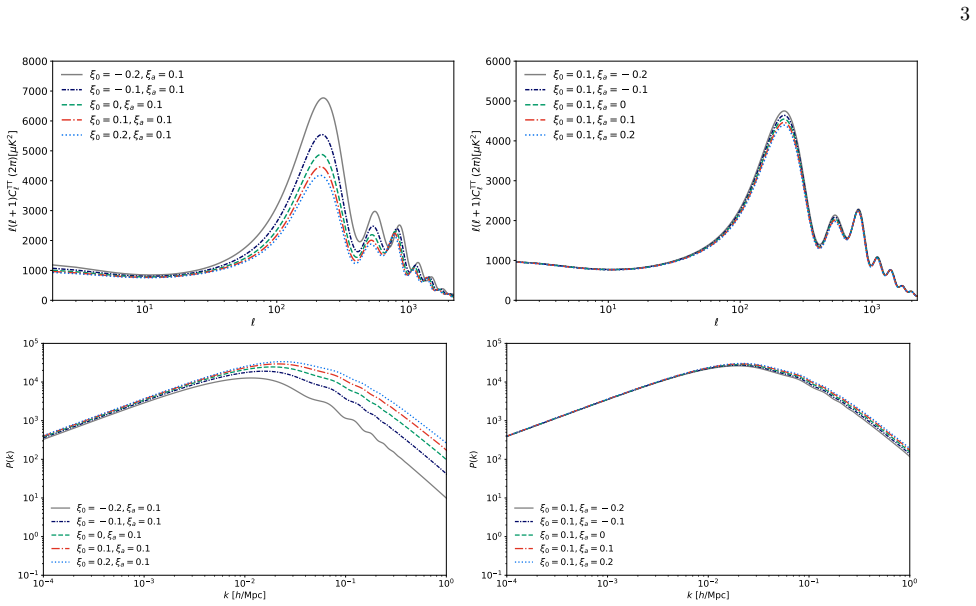
The central object is a time-dependent dark-sector coupling ξ(a) inserted into two interaction rates: Q=3ξ(a)Hρ_x, proportional to the dark-energy density, and Q=3ξ(a)Hρ_cρ_x/(ρ_c+ρ_x), proportional to the product of the two dark densities divided by their sum. Two parametrizations are used: a two-parameter Taylor form ξ(a)=ξ0+ξa(1−a), and a one-parameter, divergence-free form ξ(a)=ξ0[1+(1−a)/(a^2+(1−a)^2)] adapted from a dark-energy equation-of-state parametrization. These functions change the energy flow between the dark sectors at both background and perturbation level, altering the CMB temperature spectrum (acoustic peak heights and the low-multipole integrated Sachs-Wolfe region) and th
What would settle it
Run the cited interacting-fluid stability check for IVS1a at the best-fit values ξ0≈-0.15 and ξa≈0.34: if the criterion flags a negative effective sound speed squared in that region, the posterior is sampling an unstable fluid and the >95% evidence is not physical. A dataset-level falsifier is to repeat the CMB+DESI+supernova fit with an independent high-resolution CMB likelihood; if the negative-ξ0 posterior disappears, the signal is tied to the Planck likelihood.
Extended reading notes
Core claim
The paper's central claim is that, after the DESI DR2 BAO data are added to Planck CMB and Type Ia supernova samples, the interacting model IVS1a—defined by Q=3ξ(a)Hρ_x with ξ(a)=ξ0+ξa(1−a)—produces a present-day coupling ξ0 that is negative at more than 95% confidence (for example ξ0=-0.146 with 68% uncertainties +0.045/-0.074 for CMB+DESI+PantheonPlus), while the time-variation parameter ξa is nonzero at more than 68% confidence and at more than 95% for the DESY5 sample. In the authors' reading, this points to genuine energy exchange between dark energy and dark matter, with a coupling that changes with cosmic time, and the sign of the effect is robust across the three supernova compilatio
Load-bearing premise
The result depends on the assumption that the model's equations stay stable at the negative couplings the data prefer; if that assumption fails, the detected signal is an artifact.
Editorial extensions
If this is right
- If the IVS1a result holds, dark energy and dark matter are not separately conserved: energy flows from dark energy into dark matter today, at a rate set by ξ0 about -0.15.
- The same data combination raises the inferred matter density (Ωm≈0.35) and lowers the clustering amplitude (S8≈0.76), easing the S8 tension relative to Planck-ΛCDM while keeping H0 near 68 km/s/Mpc.
- The sign of the coupling flips from positive in CMB-only fits to negative in CMB+DESI fits, indicating that the DESI BAO measurements are driving the >95% evidence.
- The result is parametrization-dependent: only the two-parameter linear-in-(1−a) coupling reaches >95% confidence; the one-parameter divergence-free form does not cross that threshold.
- In none of the five data combinations does the Bayesian evidence prefer an interacting model over ΛCDM, so the paper's claim is a preference inside a restricted model family, not a decisive detection.
Reading between the lines
- My inference: the same negative-coupling preference should be tested in models where the dark-energy equation of state is also time-dependent, since the DESI DR2 BAO data independently favour dynamical dark energy; the two effects could reinforce or cancel.
- My inference: the Bayesian penalty from two extra parameters is the main reason ΛCDM stays preferred; a theoretically motivated one-parameter coupling that reproduces IVS1a's late-time behaviour would be a sharper test of the interaction.
- My inference: because the >95% result emerges when any of the three supernova compilations is added, a single re-analysis with one unified supernova likelihood plus low-redshift growth data would either consolidate or challenge the signal.
Editorial analysis
A structured set of objections, weighed in public.
Referee Report
Summary. The paper constrains four interacting dark-energy (DE) / dark-matter (DM) models with time-dependent coupling ξ(a) using Planck 2018 CMB, DESI DR2 BAO, and three Type Ia supernova compilations (PantheonPlus, Union3, DESY5). The models combine two interaction functions, Q = 3ξ(a)Hρ_x (IVS1) and Q = 3ξ(a)H ρ_cρ_x/(ρ_c+ρ_x) (IVS2), with two coupling parametrizations, ξ(a)=ξ0+ξa(1−a) (IVS1a/IVS2a) and ξ(a)=ξ0[1+(1−a)/(a^2+(1−a)^2)] (IVS1b/IVS2b). The central result is that for IVS1a the combination CMB+DESI plus any of the three SN samples excludes ξ0=0 at more than 95% confidence (e.g., ξ0 = −0.146, 95% interval [−0.256, −0.016] for CMB+DESI+PantheonPlus), while the other cases show at most mild evidence. The paper also reports that Bayesian model comparison always favors ΛCDM over the interacting models, with log Bayes factors lnB_ij typically between −4 and −12.
Significance. If the perturbation treatment is valid, the IVS1a result is a nontrivial constraint on an interesting class of varying-coupling interacting dark sector models, and the paper usefully documents the dataset and model dependence of such constraints. The analysis uses modern external datasets and a nested null model, and it reports both parameter constraints and Bayesian evidences. However, the headline claim is currently overstated: the 95% credible interval excludes zero within a model that is itself strongly disfavored relative to ΛCDM by the paper's own evidence calculation. In addition, the paper does not demonstrate that the perturbed-fluid implementation is stable in the negative-ξ0 region that drives the IVS1a claim. Both issues need to be addressed before the result can be taken as evidence for a nonzero dark-sector interaction.
major comments (3)
- [II (Eqs. (6)–(7)), III (methodology), Table II] The central >95% claim depends on the perturbed-fluid implementation in the modified CAMB, but the manuscript never states the perturbed conservation equations for DE when Q=3ξ(a)Hρ_x and w_x=−1, nor does it apply a stability criterion. For negative ξ0, which is the preferred IVS1a region (e.g., ξ0=−0.146 for CMB+DESI+PantheonPlus in Table II), the DE perturbation sector can develop instabilities of the type discussed in Valiviita et al. [11]. If the code instead treats DE as a homogeneous vacuum (δρ_x=θ_x=0), the model is different and the concern disappears. The text cites [11] but does not state which treatment is used, and the modified code is not released. Please report the perturbed conservation equations, provide stability conditions for Eqs. (6)–(7) with ξ(a) from Eqs. (9) and (11), and verify that the posterior samples lie in the stable region, or compare with the vacuum-interac
- [Abstract; Section IV.A; Table II (lnBij row)] The abstract and conclusions describe the IVS1a result as 'evidence for a non-zero interaction at more than 95% CL'. However, Table II reports lnBij=−5.8 for CMB+DESI+PantheonPlus (and −5.5 and −4.0 for the other SN combinations), which is strong evidence against IVS1a relative to ΛCDM on the revised Jeffreys scale stated in Section III. A 95% credible interval that excludes ξ0=0 inside a strongly disfavored model is not evidence for an interaction over ΛCDM; it is a parameter constraint within that model. Please rephrase the abstract and conclusions to separate these two statements, e.g., 'within IVS1a the data exclude ξ0=0 at >95% CL, but the model as a whole is disfavored relative to ΛCDM'.
- [Section II, Eqs. (9) and (11); Section V] The conclusion that the coupling is 'dynamical' is partly built into the parametrizations and is not an independent prediction of the data. For IVS1a, ξ(a)=ξ0+ξa(1−a) has a time-dependent term by construction, so finding ξa≠0 is a fit of the assumed functional form rather than a discovery of time variation. The paper should be explicit that it is testing the viability of specific parametrizations, not reconstructing the time dependence of ξ in a model-independent way. This does not invalidate the parameter constraints, but it should frame the robustness claim.
minor comments (4)
- [Table II] In the CMB+DESI+Union3 column, the reported Ω_bh^2 value is '0.00246+0.00014...' which appears to be a typo for 0.02246. Please correct.
- [Figure 7 caption] The caption notes that the dotted zero line is 'not clearly visible' in the right panel. Please use a different line style or add a small legend so the reader can identify the no-interaction case.
- [Section III] The modified CAMB code is not released. Releasing the code or providing a public repository would substantially improve reproducibility, especially since the perturbation treatment is a key part of the central claim.
- [Section II] Equation (5) uses κ^2 without explicitly defining it as 8πG. Defining it would make the paper more self-contained.
Circularity Check
No significant circularity: IVS1a detection is a conditional fit to external data; self-cited parametrizations are transparent ansätze, not load-bearing.
full rationale
The paper's central claim—that IVS1a gives ξ0<0 at >95% CL with CMB+DESI plus any of the three SNIa samples—is a Bayesian parameter constraint obtained by MCMC against external datasets (Planck 2018 CMB, DESI DR2 BAO, PantheonPlus/Union3/DESY5). These datasets are independent of the paper's model parameters and of the authors' prior work. The interaction functions Q=3ξ(a)Hρx and Q=3ξ(a)Hρcρx/(ρc+ρx), with ξ(a) from Eqs. (9) and (11), are adopted as explicit ansätze; the paper states 'The choice of ξ(a) is not unique' and concludes that the 'observational outcome strongly depends on both the form of the interaction function and the parametrization chosen for ξ(a).' Thus the >95% exclusion is a data-driven constraint conditional on that parametrization, not a quantity derived from the parametrization itself. The null model ξ=0 is nested, so the nested-model comparison is meaningful and the evidence values (lnBij<0) are reported honestly. Reference [122], a prior paper by several of the same authors, supplies Eq. (9) and the IVS1/IVS2 labels, but this self-citation is not load-bearing: no uniqueness theorem is invoked, no alternative is forbidden, and the paper explicitly concedes that the choice of ξ(a) is not unique. Eq. (11) is proposed in this paper with motivation from the independent Barboza–Alcaniz parametrization [123]. The reviewer's stability concern about the perturbed-fluid implementation for negative ξ0 is a correctness/validation risk rather than circularity: if the modified CAMB implementation were internally inconsistent, the result would be invalid, but it would not reduce to the paper's inputs by construction. No derived quantity is equal to a fitted input, and no external result is imported solely from self-citations. Accordingly, no significant circularity is present.
Assumptions & free parameters
free parameters (2)
- xi_0 (IVS1a) =
-0.146 (68% CL [-0.220,-0.101], CMB+DESI+PantheonPlus); 0.19 (CMB only)
- xi_a (IVS1a) =
0.34 (68% CL [0.18,0.52], CMB+DESI+PantheonPlus)
assumptions (4)
- standard math Spatially flat FLRW geometry with GR as the gravitational theory (Eq. 1).
- domain assumption Dark sector energy exchange is described by Q=3xi(a)H*rho_x or Q=3xi(a)H*rho_c*rho_x/(rho_c+rho_x) (Eqs. 6-7).
- ad hoc to paper Time-dependent coupling follows either the Taylor-truncated form xi_0+xi_a(1-a) or the Barboza-Alcaniz-inspired one-parameter form (Eqs. 9 and 11).
- domain assumption Perturbation equations for the interaction models, as coded in the modified CAMB, are stable over the sampled parameter space.
invented entities (1)
-
Time-dependent coupling xi(a)
Cite this review
Pith. "Pith review of Dark Energy Is Not That Into You: Variable Couplings after DESI DR2 BAO." pith.science (2026). https://pith.science/paper/25S5DE5B
@misc{pith2026250819109,
  author       = {Pith},
  title        = {Pith review of: Dark Energy Is Not That Into You: Variable Couplings after DESI DR2 BAO},
  year         = {2026},
  howpublished = {\url{https://pith.science/paper/25S5DE5B}},
  note         = {Machine review of arXiv:2508.19109}
}
abstract
In interacting dark energy (DE) and dark matter (DM) scenarios, the interaction function typically includes a coupling parameter $\xi$ that quantifies the strength of energy exchange between the dark sectors. While $\xi$ is often assumed to be constant, there is no fundamental reason to exclude a time-dependent coupling, which could provide a more general and realistic description of dark sector dynamics. In this work, we study two widely used interacting models involving pressureless DM and DE, where the coupling parameter is allowed to vary with the scale factor $a$. Specifically, we consider two parametrizations: $\xi(a) = \xi_0 + \xi_a (1-a)$ and $\xi(a) = \xi_0 \left(1 + \frac{1-a}{a^2 + (1-a)^2} \right)$, and constrain them using the latest cosmological observations, including Planck 2018 CMB data, DESI DR2 BAO measurements, and multiple Type Ia supernovae samples. Our results show that one scenario yields evidence for a non-zero interaction at more than 95\% confidence level, while the remaining cases indicate at most mild or inconclusive signs of interaction. These findings highlight the potential of variable coupling models and the importance of continued investigation into the nature of the dark sectors.
Figures


Figures from the paper (7 more)


Forward citations
Cited by 29 Pith papers
-
Non-linear Structure Formation in Planck+DESI Favoured Interacting Dark Energy Cosmologies
N-body simulations of IDE with Q=ξHρ_x show scale-dependent deviations in the matter power spectrum, density morphology, and halo abundance that standard ΛCDM-calibrated prescriptions cannot reproduce.
-
Saturation Mechanisms in the Interacting Dark Sector
Nonlinear dark-sector interaction models with a half-saturation sparseness scale are observationally preferred over their linear counterparts at >95% confidence for two of three cases.
-
Non-minimally coupled quintessence with sign-switching interaction
A new quintessence model with non-minimal coupling produces an effective sign-switching interaction that fits current data better than LambdaCDM or w0waCDM and accounts for late-time dark energy weakening without phan...
-
Evidence for deviation in gravitational light deflection from general relativity at cosmological scales with KiDS-Legacy and CMB lensing
KiDS-Legacy weak lensing plus CMB data yields a 3 sigma deviation in light deflection from GR in a Lambda CDM background, with the signal driven by large-scale CMB lensing amplitudes.
-
Nonlinear Matter Power Spectrum from relativistic $N$-body Simulations: $\Lambda_{\rm s}$CDM versus $\Lambda$CDM
Relativistic N-body simulations of Lambda_s CDM produce a redshift-dependent crest in the matter power spectrum ratio, peaking at 20-25% near the transition and leaving a 15-20% uplift at z=0 on group scales.
-
Background-level reconstruction of scalar-field potentials from dark-energy histories and comparison with analytic potential families
A background reconstruction maps prescribed ρ_de(z) histories to V(φ) and ranks analytic potentials by Bayesian evidence, with exponential preferred for CPL and shifted-tanh for sign-switching targets.
-
Metastability in Emergent Dark Energy: A New Framework Confronting Cosmological Observations
MEDE sets w(z)=-1-Δ tanh[log10((1+z)/(1+zt))] with fitted zt≈0.425 and Δ≈0.87, yielding ΔDIC=-9.29 versus ΛCDM on Planck+DESI+PantheonPlus while matching CPL performance.
-
Signatures of Modified Gravity on Linear Scales in a Dynamical Dark Energy Background
Modified gravity below O(10) Mpc in a CPL dynamical dark energy background is required to suppress structure growth at low redshifts while satisfying CMB constraints from ISW and lensing.
-
Signatures of Modified Gravity on Linear Scales in a Dynamical Dark Energy Background
Using Planck, DESI, supernovae, and redshift-space distortions, the authors infer that modified gravity, if present, must act only below ~30 Mpc and cannot modify the large scales previously considered.
-
Coupled quintessence with a potential from supergravity exhibits sign-changing interaction
Coupled SUGRA quintessence is preferred by current data at >4σ over the uncoupled case, with sign-changing interaction producing phantom-crossing behavior statistically similar to the CPL parametrization.
-
Effective field theory interpretation of ATLAS measurements involving the Higgs boson, electroweak bosons and the top quark
A simultaneous fit to multiple ATLAS datasets constrains 48 SMEFT Wilson coefficients and matches subsets to 2HDM and heavy-vector models, finding consistency with the Standard Model.
-
Probing Dynamical Dark Energy with Late-Time Data: Evidence, Tensions, and the Limits of the $w_0w_a$CDM Framework
Evidence for dynamical dark energy in the w0waCDM framework is strongly dataset-dependent, driven by mismatches in low-redshift BAO distance ratios that produce divergent expansion histories and inconsistent Hubble te...
-
Revisiting the Matter Creation Process: Observational Constraints on Gravitationally Induced Dark Energy and the Hubble Tension
Gravitationally induced particle creation models fit cosmological data as well as ΛCDM and reduce the Hubble tension from 4.3σ to 2.4–3σ.
-
Robust Preference for Dark Sector Interactions
Interacting dark matter–dark energy models fit DESI BAO and CMB data as well as evolving-dark-energy (CPL) models, with a coupling preference that persists under DES-Dovekie supernova recalibration.
-
Neutrino mass constraints in the Schwarzschild-de Sitter black-hole dark energy model with ACT DR6 and DESI DR2 data
SdSDE dark energy yields a ~0.16–0.21 eV positive neutrino-mass preference with DESI+ACT data, but χ² strongly favors extended ΛCDM and the shift is likely compensation.
-
Cosmological Viability of Exponential Infrared $f(T)$ Gravity
Exponential IR f(T) gravity Model I alleviates Hubble tension but is disfavoured by combined Planck/ACT/SPT+DESI+Pantheon+ data; Model II is ruled out because background constraints force unphysical shifts in CMB parameters.
-
Generalizing the interacting dilatonic ghost condensate as a dark energy model
Generalizes the interacting dilatonic ghost condensate dark energy model, performs phase-space analysis for non-interacting and two interacting cases, and reports parameter constraints from Cosmic Chronometers, Panthe...
-
Unifying the Dark Sector with the New Generalized Chaplygin Gas: Observational Constraints
A generalized Chaplygin gas with redshift-dependent exponent unifies the dark sector but is statistically equivalent to ΛCDM after penalizing for extra parameters in Bayesian fits to late-time data.
-
Neutrino mass constraints in interacting dark energy models after DESI DR2
Upper bounds on total neutrino mass in four phenomenological interacting dark energy models are derived from DESI DR2 BAO plus CMB and SNIa data, showing strong dependence on the interaction term form and statistical ...
-
Effective field theory interpretation of ATLAS measurements involving the Higgs boson, electroweak bosons and the top quark
Three nonlinear interacting dark energy models with a saturation ('sparseness') scale are constrained against late-time cosmological data, showing mild preference for nonzero sparseness but no decisive improvement over ΛCDM.
-
Constraints on Coupled Dark Energy in the DESI Era
New cosmological data mildly favor a small coupling between dark matter and a scalar dark energy field at |β| ≈ 0.03 while allowing an effective phantom-crossing equation of state.
-
Redshift evolution of the Hubble constant: Constraints and new insights from an interacting dark energy model
Modified IDE model with interaction parameter alpha ~0.01 from late-universe data shows H0 decreasing with redshift, tightening to 10^-5 when CMB priors are added.
-
Alleviating the $H_0$ tension through the interacting dark energy model from quantum gravitational field theory in light of DESI DR2
With DESI DR2 BAO plus CMB and a SH0ES prior, the two-parameter eeΛCDM model gives δΛ=-0.41±0.14 and H0=71.9±1.0, easing the Hubble tension to 0.8σ, but SN datasets erase the signal.
-
Dark Energy in the DESI Era: A Brief Review of Evidence, Beyond-$\Lambda$CDM Interpretations, and Tensions
DESI data hint that dark energy evolves (w0>−1, wa<0, phantom crossing) at 2.5–4.2σ, but the same expansion history can also be produced by interacting dark sectors, modified gravity, or non-cold dark matter.
-
Breaking Free from the Swampland of Impossible Universes through the DESI Portal
DESI data favoring time-evolving dark energy may place constant-Λ cosmology in the string swampland and favor string-inspired dynamical dark energy.
-
Breaking Free from the Swampland of Impossible Universes through the DESI Portal
A review of string-inspired dynamical dark energy models claiming compatibility with DESI's hints of evolving dark energy under swampland constraints.
-
Breaking Free from the Swampland of Impossible Universes through the DESI Portal
A review summarizing advancements over the past two years that link DESI baryon acoustic oscillation data to string-inspired scenarios with dynamic dark energy.
-
Breaking Free from the Swampland of Impossible Universes through the DESI Portal
DESI data indicating evolving dark energy may allow string theory to describe observed universes without violating swampland constraints on constant dark energy.
-
Dark Energy in the DESI Era: A Brief Review of Evidence, Beyond-$\Lambda$CDM Interpretations, and Tensions
Review of DESI evidence for dynamical dark energy, its dependence on parametrization and datasets, and alternative beyond-LambdaCDM interpretations that may address cosmological tensions.
Reference graph
Works this paper leans on
-
[11]
J. Valiviita, E. Majerotto, and R. Maartens, Instability in interacting dark energy and dark matter fluids, JCAP 07, 020, arXiv:0804.0232 [astro-ph]
-
[1]
Amendola, Coupled quintessence, Phys
L. Amendola, Coupled quintessence, Phys. Rev. D 62, 043511 (2000), arXiv:astro-ph/9908023
arXiv 2000
-
[2]
L. Amendola and C. Quercellini, Tracking and coupled dark energy as seen by WMAP, Phys. Rev. D68, 023514 (2003), arXiv:astro-ph/0303228
arXiv 2003
- [3]
-
[4]
G. Huey and B. D. Wandelt, Interacting quintessence. The Coincidence problem and cosmic acceleration, Phys. Rev. D 74, 023519 (2006), arXiv:astro- ph/0407196
arXiv 2006
-
[5]
B. Gumjudpai, T. Naskar, M. Sami, and S. Tsujikawa, Coupled dark energy: Towards a general description of the dynamics, JCAP 06, 007, arXiv:hep-th/0502191
-
[6]
A. W. Brookfield, C. van de Bruck, D. F. Mota, and D. Tocchini-Valentini, Cosmology with massive neutri- nos coupled to dark energy, Phys. Rev. Lett. 96, 061301 (2006), arXiv:astro-ph/0503349
arXiv 2006
-
[7]
M. S. Berger and H. Shojaei, Interacting dark energy and the cosmic coincidence problem, Phys. Rev. D 73, 083528 (2006), arXiv:gr-qc/0601086
arXiv 2006
Show all 135 references
-
[8]
del Campo, R
S. del Campo, R. Herrera, G. Olivares, and D. Pavon, Interacting models of soft coincidence, Phys. Rev. D 74, 023501 (2006), arXiv:astro-ph/0606520
2006 arXiv
-
[9]
J. D. Barrow and T. Clifton, Cosmologies with energy exchange, Phys. Rev. D 73, 103520 (2006), arXiv:gr- qc/0604063
2006
-
[10]
del Campo, R
S. del Campo, R. Herrera, and D. Pavon, Toward a so- lution of the coincidence problem, Phys. Rev. D 78, 021302 (2008), arXiv:0806.2116 [astro-ph]
2008 arXiv
-
[12]
Chongchitnan, Cosmological Perturbations in Mod- els of Coupled Dark Energy, Phys
S. Chongchitnan, Cosmological Perturbations in Mod- els of Coupled Dark Energy, Phys. Rev. D 79, 043522 (2009), arXiv:0810.5411 [astro-ph]
2009 arXiv
-
[13]
M. B. Gavela, D. Hernandez, L. Lopez Honorez, O. Mena, and S. Rigolin, Dark coupling, JCAP 07, 034, [Erratum: JCAP 05, E01 (2010)], arXiv:0901.1611 13 [astro-ph.CO]
2010 arXiv
-
[14]
Xia, Constraint on coupled dark energy models from observations, Phys
J.-Q. Xia, Constraint on coupled dark energy models from observations, Phys. Rev. D 80, 103514 (2009), arXiv:0911.4820 [astro-ph.CO]
2009 arXiv
-
[15]
M. B. Gavela, L. Lopez Honorez, O. Mena, and S. Rigolin, Dark Coupling and Gauge Invariance, JCAP 11, 044, arXiv:1005.0295 [astro-ph.CO]
-
[16]
Mena, Low redshift probes and coupled dark matter- dark energy models, J
O. Mena, Low redshift probes and coupled dark matter- dark energy models, J. Phys. Conf. Ser. 259, 012084 (2010)
2010
-
[17]
Baldi and V
M. Baldi and V. Pettorino, High-z massive clusters as a test for dynamical coupled dark energy, Mon. Not. Roy. Astron. Soc. 412, L1 (2011), arXiv:1006.3761 [astro- ph.CO]
2011 arXiv
-
[18]
Lopez Honorez, B
L. Lopez Honorez, B. A. Reid, O. Mena, L. Verde, and R. Jimenez, Coupled dark matter-dark energy in light of near Universe observations, JCAP 09, 029, arXiv:1006.0877 [astro-ph.CO]
-
[19]
Lee and M
J. Lee and M. Baldi, Can Coupled Dark Energy Speed Up the Bullet Cluster?, Astrophys. J. 747, 45 (2012), arXiv:1110.0015 [astro-ph.CO]
2012 arXiv
-
[20]
Beynon, M
E. Beynon, M. Baldi, D. J. Bacon, K. Koyama, and C. Sabiu, Weak lensing predictions for coupled dark en- ergy cosmologies at non-linear scales, Mon. Not. Roy. Astron. Soc. 422, 3546 (2012), arXiv:1111.6974 [astro- ph.CO]
2012 arXiv
-
[21]
Amendola, V
L. Amendola, V. Pettorino, C. Quercellini, and A. Vollmer, Testing coupled dark energy with next- generation large-scale observations, Phys. Rev. D 85, 103008 (2012), arXiv:1111.1404 [astro-ph.CO]
2012 arXiv
-
[22]
Farajollahi, A
H. Farajollahi, A. Ravanpak, and G. F. Fadakar, Inter- acting agegraphic dark energy model in tachyon cosmol- ogy coupled to matter, Phys. Lett. B 711, 225 (2012), arXiv:1206.5796 [physics.gen-ph]
2012 arXiv
-
[23]
Pettorino, L
V. Pettorino, L. Amendola, C. Baccigalupi, and C. Quercellini, Constraints on coupled dark energy us- ing CMB data from WMAP and SPT, Phys. Rev. D 86, 103507 (2012), arXiv:1207.3293 [astro-ph.CO]
2012 arXiv
-
[24]
L. P. Chimento and M. G. Richarte, Dark mat- ter, dark energy, and dark radiation coupled with a transversal interaction, Phys. Rev. D86, 103501 (2012), arXiv:1210.5505 [gr-qc]
2012 arXiv
-
[25]
Salvatelli, A
V. Salvatelli, A. Marchini, L. Lopez-Honorez, and O. Mena, New constraints on Coupled Dark Energy from the Planck satellite experiment, Phys. Rev. D 88, 023531 (2013), arXiv:1304.7119 [astro-ph.CO]
2013 arXiv
-
[26]
Pettorino, Testing modified gravity with Planck: the case of coupled dark energy, Phys
V. Pettorino, Testing modified gravity with Planck: the case of coupled dark energy, Phys. Rev. D 88, 063519 (2013), arXiv:1305.7457 [astro-ph.CO]
2013 arXiv
-
[27]
Xia, New Limits on Coupled Dark Energy from Planck, JCAP 11, 022, arXiv:1311.2131 [astro-ph.CO]
J.-Q. Xia, New Limits on Coupled Dark Energy from Planck, JCAP 11, 022, arXiv:1311.2131 [astro-ph.CO]
-
[28]
Li and X
Y.-H. Li and X. Zhang, Large-scale stable interacting dark energy model: Cosmological perturbations and ob- servational constraints, Phys. Rev. D89, 083009 (2014), arXiv:1312.6328 [astro-ph.CO]
2014 arXiv
-
[29]
Yang and L
W. Yang and L. Xu, Testing coupled dark energy with large scale structure observation, JCAP 08, 034, arXiv:1401.5177 [astro-ph.CO]
-
[30]
Yang and L
W. Yang and L. Xu, Cosmological constraints on in- teracting dark energy with redshift-space distortion af- ter Planck data, Phys. Rev. D 89, 083517 (2014), arXiv:1401.1286 [astro-ph.CO]
2014 arXiv
-
[31]
Salvatelli, N
V. Salvatelli, N. Said, M. Bruni, A. Melchiorri, and D. Wands, Indications of a late-time interaction in the dark sector, Phys. Rev. Lett. 113, 181301 (2014), arXiv:1406.7297 [astro-ph.CO]
2014 arXiv
-
[32]
Y. Wang, D. Wands, G.-B. Zhao, and L. Xu, Post- P lanckconstraints on interacting vacuum energy, Phys. Rev. D 90, 023502 (2014), arXiv:1404.5706 [astro- ph.CO]
2014 arXiv
-
[33]
E.-K. Li, Y. Zhang, and J.-L. Geng, Modified holo- graphic Ricci dark energy coupled to interacting relativistic and non-relativistic dark matter in the nonflat universe, Phys. Rev. D 90, 083534 (2014), arXiv:1412.5482 [gr-qc]
2014 arXiv
-
[34]
S. Pan, S. Bhattacharya, and S. Chakraborty, An an- alytic model for interacting dark energy and its obser- vational constraints, Mon. Not. Roy. Astron. Soc. 452, 3038 (2015), arXiv:1210.0396 [gr-qc]
2015 arXiv
-
[35]
Li, J.-F
Y.-H. Li, J.-F. Zhang, and X. Zhang, Testing mod- els of vacuum energy interacting with cold dark mat- ter, Phys. Rev. D 93, 023002 (2016), arXiv:1506.06349 [astro-ph.CO]
2016 arXiv
-
[36]
J.-L. Cui, L. Yin, L.-F. Wang, Y.-H. Li, and X. Zhang, A closer look at interacting dark energy with statefinder hierarchy and growth rate of structure, JCAP 09, 024, arXiv:1503.08948 [astro-ph.CO]
-
[37]
R. C. G. Landim, Coupled dark energy: a dynamical analysis with complex scalar field, Eur. Phys. J. C 76, 31 (2016), arXiv:1507.00902 [gr-qc]
2016 arXiv
-
[38]
W. Yang, H. Li, Y. Wu, and J. Lu, Cosmological constraints on coupled dark energy, JCAP 10, 007, arXiv:1608.07039 [astro-ph.CO]
-
[39]
B. Wang, E. Abdalla, F. Atrio-Barandela, and D. Pavon, Dark Matter and Dark Energy Interactions: Theoretical Challenges, Cosmological Implications and Observational Signatures, Rept. Prog. Phys. 79, 096901 (2016), arXiv:1603.08299 [astro-ph.CO]
2016 arXiv
-
[40]
R. C. Nunes, S. Pan, and E. N. Saridakis, New constraints on interacting dark energy from cos- mic chronometers, Phys. Rev. D 94, 023508 (2016), arXiv:1605.01712 [astro-ph.CO]
2016 arXiv
-
[41]
van de Bruck, J
C. van de Bruck, J. Mifsud, and J. Morrice, Testing coupled dark energy models with their cosmological background evolution, Phys. Rev. D 95, 043513 (2017), arXiv:1609.09855 [astro-ph.CO]
2017 arXiv
-
[42]
Xia and S
D.-M. Xia and S. Wang, Constraining interacting dark energy models with latest cosmological observa- tions, Mon. Not. Roy. Astron. Soc. 463, 952 (2016), arXiv:1608.04545 [astro-ph.CO]
2016 arXiv
-
[43]
Pan and G
S. Pan and G. Sharov, A model with interaction of dark components and recent observational data, Mon. Not. Roy. Astron. Soc. 472, 4736 (2017), arXiv:1609.02287 [gr-qc]
2017 arXiv
-
[44]
Fay, Constraints from growth-rate data on some cou- pled dark energy models mimicking a ΛCDM expan- sion, Mon
S. Fay, Constraints from growth-rate data on some cou- pled dark energy models mimicking a ΛCDM expan- sion, Mon. Not. Roy. Astron. Soc. 460, 1863 (2016), arXiv:1605.01644 [astro-ph.CO]
2016 arXiv
-
[45]
Kumar and R
S. Kumar and R. C. Nunes, Echo of interactions in the dark sector, Phys. Rev. D96, 103511 (2017), arXiv:1702.02143 [astro-ph.CO]
2017 arXiv
-
[46]
Di Valentino, A
E. Di Valentino, A. Melchiorri, and O. Mena, Can in- teracting dark energy solve the H0 tension?, Phys. Rev. D 96, 043503 (2017), arXiv:1704.08342 [astro-ph.CO]
2017 arXiv
-
[47]
G. S. Sharov, S. Bhattacharya, S. Pan, R. C. Nunes, and S. Chakraborty, A new interacting two fluid model and its consequences, Mon. Not. Roy. Astron. Soc. 466, 3497 (2017), arXiv:1701.00780 [gr-qc]. 14
2017 arXiv
-
[48]
W. Yang, N. Banerjee, and S. Pan, Constraining a dark matter and dark energy interaction scenario with a dy- namical equation of state, Phys. Rev. D 95, 123527 (2017), arXiv:1705.09278 [astro-ph.CO]
2017 arXiv
-
[49]
W. Yang, S. Pan, and D. F. Mota, Novel approach to- ward the large-scale stable interacting dark-energy mod- els and their astronomical bounds, Phys. Rev. D 96, 123508 (2017), arXiv:1709.00006 [astro-ph.CO]
2017 arXiv
-
[50]
S. Pan, A. Mukherjee, and N. Banerjee, Astronomical bounds on a cosmological model allowing a general in- teraction in the dark sector, Mon. Not. Roy. Astron. Soc. 477, 1189 (2018), arXiv:1710.03725 [astro-ph.CO]
2018 arXiv
-
[51]
Mifsud and C
J. Mifsud and C. Van De Bruck, Probing the imprints of generalized interacting dark energy on the growth of perturbations, JCAP 11, 001, arXiv:1707.07667 [astro- ph.CO]
-
[52]
Van De Bruck and J
C. Van De Bruck and J. Mifsud, Searching for dark matter - dark energy interactions: going beyond the conformal case, Phys. Rev. D 97, 023506 (2018), arXiv:1709.04882 [astro-ph.CO]
2018 arXiv
-
[53]
W. Yang, S. Pan, and J. D. Barrow, Large-scale Sta- bility and Astronomical Constraints for Coupled Dark- Energy Models, Phys. Rev. D 97, 043529 (2018), arXiv:1706.04953 [astro-ph.CO]
2018 arXiv
-
[54]
W. Yang, S. Pan, E. Di Valentino, R. C. Nunes, S. Vagnozzi, and D. F. Mota, Tale of stable interacting dark energy, observational signatures, and the H0 ten- sion, JCAP 09, 019, arXiv:1805.08252 [astro-ph.CO]
-
[55]
W. Yang, S. Pan, R. Herrera, and S. Chakraborty, Large-scale (in) stability analysis of an exactly solved coupled dark-energy model, Phys. Rev. D 98, 043517 (2018), arXiv:1808.01669 [gr-qc]
2018 arXiv
-
[56]
H. Li, W. Yang, Y. Wu, and Y. Jiang, New limits on cou- pled dark energy model after Planck 2015, Phys. Dark Univ. 20, 78 (2018)
2015
-
[57]
B. J. Barros, Kinetically coupled dark energy, Phys. Rev. D 99, 064051 (2019), arXiv:1901.03972 [gr-qc]
2019 arXiv
-
[58]
E. M. Teixeira, A. Nunes, and N. J. Nunes, Conformally Coupled Tachyonic Dark Energy, Phys. Rev. D 100, 043539 (2019), arXiv:1903.06028 [gr-qc]
2019 arXiv
-
[59]
Di Valentino, A
E. Di Valentino, A. Melchiorri, O. Mena, and S. Vagnozzi, Nonminimal dark sector physics and cos- mological tensions, Phys. Rev. D 101, 063502 (2020), arXiv:1910.09853 [astro-ph.CO]
2020 arXiv
-
[60]
Paliathanasis, S
A. Paliathanasis, S. Pan, and W. Yang, Dynamics of nonlinear interacting dark energy models, Int. J. Mod. Phys. D 28, 1950161 (2019), arXiv:1903.02370 [gr-qc]
2019 arXiv
-
[61]
W. Yang, S. Pan, R. C. Nunes, and D. F. Mota, Dark calling Dark: Interaction in the dark sector in presence of neutrino properties after Planck CMB final release, JCAP 04, 008, arXiv:1910.08821 [astro-ph.CO]
1910 arXiv
-
[62]
S. Pan, W. Yang, E. Di Valentino, E. N. Saridakis, and S. Chakraborty, Interacting scenarios with dynamical dark energy: Observational constraints and alleviation of the H0 tension, Phys. Rev. D 100, 103520 (2019), arXiv:1907.07540 [astro-ph.CO]
2019 arXiv
-
[63]
Nakamura, R
S. Nakamura, R. Kase, and S. Tsujikawa, Coupled vec- tor dark energy, JCAP 12, 032, arXiv:1907.12216 [gr- qc]
1907 arXiv
-
[64]
Di Valentino, A
E. Di Valentino, A. Melchiorri, O. Mena, and S. Vagnozzi, Interacting dark energy in the early 2020s: A promising solution to the H0 and cosmic shear tensions, Phys. Dark Univ. 30, 100666 (2020), arXiv:1908.04281 [astro-ph.CO]
2020 arXiv
-
[65]
W. Yang, S. Pan, E. Di Valentino, B. Wang, and A. Wang, Forecasting interacting vacuum-energy models using gravitational waves, JCAP 05, 050, arXiv:1904.11980 [astro-ph.CO]
1904 arXiv
-
[66]
Kumar, R
S. Kumar, R. C. Nunes, and S. K. Yadav, Dark sec- tor interaction: a remedy of the tensions between CMB and LSS data, Eur. Phys. J. C79, 576 (2019), arXiv:1903.04865 [astro-ph.CO]
2019 arXiv
-
[67]
Martinelli, N
M. Martinelli, N. B. Hogg, S. Peirone, M. Bruni, and D. Wands, Constraints on the interacting vacuum- geodesic CDM scenario, Mon. Not. Roy. Astron. Soc. 488, 3423 (2019), arXiv:1902.10694 [astro-ph.CO]
2019 arXiv
-
[68]
A. A. Costa et al., J-PAS: forecasts on interacting dark energy from baryon acoustic oscillations and redshift- space distortions, Mon. Not. Roy. Astron. Soc. 488, 78 (2019), arXiv:1901.02540 [astro-ph.CO]
2019 arXiv
-
[69]
Arevalo, A
F. Arevalo, A. Cid, L. P. Chimento, and P. Mella, On sign-changeable interaction in FLR W cosmology, Eur. Phys. J. C 79, 355 (2019), arXiv:1901.04300 [gr-qc]
2019 arXiv
-
[70]
S. Pan, W. Yang, C. Singha, and E. N. Saridakis, Ob- servational constraints on sign-changeable interaction models and alleviation of the H0 tension, Phys. Rev. D 100, 083539 (2019), arXiv:1903.10969 [astro-ph.CO]
2019 arXiv
-
[71]
Cheng, Y.-Z
G. Cheng, Y.-Z. Ma, F. Wu, J. Zhang, and X. Chen, Testing interacting dark matter and dark energy model with cosmological data, Phys. Rev. D 102, 043517 (2020), arXiv:1911.04520 [astro-ph.CO]
2020 arXiv
-
[72]
V. K. Oikonomou, Generalized logarithmic equation of state in classical and loop quantum cosmology dark en- ergy–dark matter coupled systems, Annals Phys. 409, 167934 (2019), arXiv:1907.02600 [gr-qc]
2019 arXiv
-
[73]
Kase and S
R. Kase and S. Tsujikawa, Scalar-Field Dark Energy Nonminimally and Kinetically Coupled to Dark Matter, Phys. Rev. D 101, 063511 (2020), arXiv:1910.02699 [gr- qc]
2020 arXiv
-
[74]
S. Pan, G. S. Sharov, and W. Yang, Field theoretic in- terpretations of interacting dark energy scenarios and recent observations, Phys. Rev. D 101, 103533 (2020), arXiv:2001.03120 [astro-ph.CO]
2020 arXiv
-
[75]
G´ omez-Valent, V
A. G´ omez-Valent, V. Pettorino, and L. Amendola, Up- date on coupled dark energy and the H0 tension, Phys. Rev. D 101, 123513 (2020), arXiv:2004.00610 [astro- ph.CO]
2020 arXiv
-
[76]
Di Valentino and O
E. Di Valentino and O. Mena, A fake Interacting Dark Energy detection?, Mon. Not. Roy. Astron. Soc. 500, L22 (2020), arXiv:2009.12620 [astro-ph.CO]
2020 arXiv
-
[77]
W. Yang, E. Di Valentino, O. Mena, S. Pan, and R. C. Nunes, All-inclusive interacting dark sector cosmologies, Phys. Rev. D 101, 083509 (2020), arXiv:2001.10852 [astro-ph.CO]
2020 arXiv
-
[78]
Lucca and D
M. Lucca and D. C. Hooper, Shedding light on dark matter-dark energy interactions, Phys. Rev. D 102, 123502 (2020), arXiv:2002.06127 [astro-ph.CO]
2020 arXiv
-
[79]
Di Valentino, A
E. Di Valentino, A. Melchiorri, O. Mena, S. Pan, and W. Yang, Interacting Dark Energy in a closed uni- verse, Mon. Not. Roy. Astron. Soc. 502, L23 (2021), arXiv:2011.00283 [astro-ph.CO]
2021 arXiv
-
[80]
N. B. Hogg, M. Bruni, R. Crittenden, M. Martinelli, and S. Peirone, Latest evidence for a late time vac- uum–geodesic CDM interaction, Phys. Dark Univ. 29, 100583 (2020), arXiv:2002.10449 [astro-ph.CO]
2020 arXiv
-
[81]
Yao and X.-H
Y.-H. Yao and X.-H. Meng, A new coupled three-form dark energy model and implications for the H0 tension, Phys. Dark Univ. 30, 100729 (2020), arXiv:2205.14928 15 [astro-ph.CO]
2020 arXiv
-
[82]
Beltr´ an Jim´ enez, D
J. Beltr´ an Jim´ enez, D. Bettoni, D. Figueruelo, F. A. Teppa Pannia, and S. Tsujikawa, Velocity-dependent interacting dark energy and dark matter with a La- grangian description of perfect fluids, JCAP 03, 085, arXiv:2012.12204 [astro-ph.CO]
2012 arXiv
-
[83]
Yao and X.-H
Y. Yao and X.-H. Meng, Relieve the H0 tension with a new coupled generalized three-form dark energy model, Phys. Dark Univ. 33, 100852 (2021), arXiv:2011.09160 [astro-ph.CO]
2021 arXiv
-
[84]
Lucca, Dark energy–dark matter interactions as a solution to the S8 tension, Phys
M. Lucca, Dark energy–dark matter interactions as a solution to the S8 tension, Phys. Dark Univ. 34, 100899 (2021), arXiv:2105.09249 [astro-ph.CO]
2021 arXiv
-
[85]
Lucca, Multi-interacting dark energy and its cosmo- logical implications, Phys
M. Lucca, Multi-interacting dark energy and its cosmo- logical implications, Phys. Rev. D 104, 083510 (2021), arXiv:2106.15196 [astro-ph.CO]
2021 arXiv
-
[86]
R. C. Nunes and E. Di Valentino, Dark sector inter- action and the supernova absolute magnitude tension, Phys. Rev. D 104, 063529 (2021), arXiv:2107.09151 [astro-ph.CO]
2021 arXiv
-
[87]
Gariazzo, E
S. Gariazzo, E. Di Valentino, O. Mena, and R. C. Nunes, Late-time interacting cosmologies and the Hub- ble constant tension, Phys. Rev. D 106, 023530 (2022), arXiv:2111.03152 [astro-ph.CO]
2022 arXiv
-
[88]
Potting and P
R. Potting and P. M. S´ a, Coupled quintessence with a generalized interaction term, Int. J. Mod. Phys. D 31, 2250111 (2022), arXiv:2112.07608 [gr-qc]
2022 arXiv
-
[89]
P. M. S´ a, Late-time evolution of the Universe within a two-scalar-field cosmological model, Phys. Rev. D 103, 123517 (2021), arXiv:2103.01693 [gr-qc]
2021 arXiv
-
[90]
da Fonseca, T
V. da Fonseca, T. Barreiro, and N. J. Nunes, A sim- ple parametrisation for coupled dark energy, Phys. Dark Univ. 35, 100940 (2022), arXiv:2104.14889 [astro- ph.CO]
2022 arXiv
-
[91]
Gao, Z.-W
L.-Y. Gao, Z.-W. Zhao, S.-S. Xue, and X. Zhang, Reliev- ing the H 0 tension with a new interacting dark energy model, JCAP 07, 005, arXiv:2101.10714 [astro-ph.CO]
-
[92]
Thipaksorn, S
W. Thipaksorn, S. Sapa, and K. Karwan, Coupled dark energy model inspired from general conformal transformation, Phys. Rev. D 105, 063527 (2022), arXiv:2201.03261 [gr-qc]
2022 arXiv
-
[93]
G´ omez-Valent, Z
A. G´ omez-Valent, Z. Zheng, L. Amendola, C. Wetterich, and V. Pettorino, Coupled and uncoupled early dark en- ergy, massive neutrinos, and the cosmological tensions, Phys. Rev. D 106, 103522 (2022), arXiv:2207.14487 [astro-ph.CO]
2022 arXiv
-
[94]
Harko, K
T. Harko, K. Asadi, H. Moshafi, and H. Sheikhahmadi, Observational constraints on the interacting dark en- ergy — Dark matter (IDM) cosmological models, Phys. Dark Univ. 38, 101131 (2022), arXiv:2203.08907 [gr-qc]
2022 arXiv
-
[95]
M. G. Yengejeh, S. Fakhry, J. T. Firouzjaee, and H. Fathi, The integrated Sachs–Wolfe effect in interact- ing dark matter–dark energy models, Phys. Dark Univ. 39, 101144 (2023), arXiv:2206.01030 [astro-ph.CO]
2023 arXiv
-
[96]
R. C. Nunes, S. Vagnozzi, S. Kumar, E. Di Valentino, and O. Mena, New tests of dark sector interactions from the full-shape galaxy power spectrum, Phys. Rev. D 105, 123506 (2022), arXiv:2203.08093 [astro-ph.CO]
2022 arXiv
-
[97]
R. G. Landim, Note on interacting holographic dark energy with a Hubble-scale cutoff, Phys. Rev. D 106, 043527 (2022), arXiv:2206.10205 [astro-ph.CO]
2022 arXiv
-
[98]
Yao and X.-H
Y.-H. Yao and X.-H. Meng, Can interacting dark energy with dynamical coupling resolve the Hubble tension, Phys. Dark Univ. 39, 101165 (2023), arXiv:2207.05955 [astro-ph.CO]
2023 arXiv
-
[99]
Li, S.-J
T.-N. Li, S.-J. Jin, H.-L. Li, J.-F. Zhang, and X. Zhang, Prospects for Probing the Interaction between Dark En- ergy and Dark Matter Using Gravitational-wave Dark Sirens with Neutron Star Tidal Deformation, Astrophys. J. 963, 52 (2024), arXiv:2310.15879 [astro-ph.CO]
2024 arXiv
-
[100]
Giar` e, Y
W. Giar` e, Y. Zhai, S. Pan, E. Di Valentino, R. C. Nunes, and C. van de Bruck, Tightening the reins on nonmin- imal dark sector physics: Interacting dark energy with dynamical and nondynamical equation of state, Phys. Rev. D 110, 063527 (2024), arXiv:2404.02110 [astro- ph.CO]
2024 arXiv
-
[101]
Kritpetch, N
C. Kritpetch, N. Roy, and N. Banerjee, Interacting dark sector: A dynamical system perspective, Phys. Rev. D 111, 103501 (2025), arXiv:2405.10604 [gr-qc]
2025 arXiv
-
[102]
Giar` e, M
W. Giar` e, M. A. Sabogal, R. C. Nunes, and E. Di Valentino, Interacting Dark Energy after DESI Baryon Acoustic Oscillation Measurements, Phys. Rev. Lett. 133, 251003 (2024), arXiv:2404.15232 [astro- ph.CO]
2024 arXiv
-
[103]
Li, P.-J
T.-N. Li, P.-J. Wu, G.-H. Du, S.-J. Jin, H.-L. Li, J.-F. Zhang, and X. Zhang, Constraints on Interacting Dark Energy Models from the DESI Baryon Acoustic Oscil- lation and DES Supernovae Data, Astrophys. J. 976, 1 (2024), arXiv:2407.14934 [astro-ph.CO]
2024 arXiv
-
[104]
Halder, S
S. Halder, S. Pan, P. M. S´ a, and T. Saha, Coupled phan- tom cosmological model motivated by the warm infla- tionary paradigm, Phys. Rev. D 110, 063529 (2024), arXiv:2407.15804 [gr-qc]
2024 arXiv
-
[105]
Carrion, A
K. Carrion, A. Spurio Mancini, D. Piras, and J. C. Hi- dalgo, Testing interacting dark energy with Stage IV cosmic shear surveys through differentiable neural em- ulators, Mon. Not. Roy. Astron. Soc. 539, 3220 (2025), arXiv:2410.10603 [astro-ph.CO]
2025 arXiv
-
[106]
Giani, R
L. Giani, R. Von Marttens, and R. Camilleri, Novel Approach to Cosmological Nonlinearities as an Ef- fective Fluid, Phys. Rev. Lett. 135, 071004 (2025), arXiv:2410.15295 [astro-ph.CO]
2025 arXiv
-
[107]
Tsedrik et al
M. Tsedrik et al. , Interacting dark energy constraints from the full-shape analyses of BOSS DR12 and DES Year 3 measurements (2025), arXiv:2502.03390 [astro- ph.CO]
2025 arXiv
-
[108]
K. Liu, X. Fu, B. Xu, C. Ding, Y. Huang, and X. Qing, The growth of linear perturbations in the interact- ing dark energy models and observational constraints (2025), arXiv:2503.05208 [astro-ph.CO]
2025
-
[109]
Y. Zhai, M. de Cesare, C. van de Bruck, E. Di Valentino, and E. Wilson-Ewing, A low-redshift preference for an interacting dark energy model (2025), arXiv:2503.15659 [astro-ph.CO]
2025 arXiv
-
[110]
Li, G.-H
T.-N. Li, G.-H. Du, Y.-H. Li, P.-J. Wu, S.-J. Jin, J.- F. Zhang, and X. Zhang, Probing the sign-changeable interaction between dark energy and dark matter with DESI baryon acoustic oscillations and DES supernovae data (2025), arXiv:2501.07361 [astro-ph.CO]
2025
-
[111]
Silva, M
E. Silva, M. A. Sabogal, M. Scherer, R. C. Nunes, E. Di Valentino, and S. Kumar, New constraints on interacting dark energy from DESI DR2 BAO observations, Phys. Rev. D 111, 123511 (2025), arXiv:2503.23225 [astro-ph.CO]
2025 arXiv
-
[112]
C. You, D. Wang, and T. Yang, Dynamical dark energy implies a coupled dark sector: Insights from DESI DR2 via a data-driven approach, Phys. Rev. D 112, 043503 (2025), arXiv:2504.00985 [astro-ph.CO]. 16
2025 arXiv
-
[113]
K. Aoki, J. Beltr´ an Jim´ enez, M. C. Pookkillath, and S. Tsujikawa, Effective field theory of coupled dark en- ergy and dark matter (2025), arXiv:2504.17293 [astro- ph.CO]
2025
-
[114]
W. Yang, S. Pan, E. Di Valentino, O. Mena, D. F. Mota, and S. Chakraborty, Probing the cold nature of dark matter, Phys. Rev. D 111, 103509 (2025), arXiv:2504.11973 [astro-ph.CO]
2025 arXiv
-
[115]
Abedin, G.-J
M. Abedin, G.-J. Wang, Y.-Z. Ma, and S. Pan, In search of an interaction in the dark sector through Gaussian Process and ANN approaches (2025), arXiv:2505.04336 [astro-ph.CO]
2025 arXiv
-
[116]
S. Pan, S. Paul, E. N. Saridakis, and W. Yang, Interact- ing dark energy after DESI DR2: a challenge for ΛCDM paradigm? (2025), arXiv:2504.00994 [astro-ph.CO]
2025
-
[117]
W. Liu, Y. Wu, S. Pan, and W. Yang, Solving an inter- acting quintessence model with a sound horizon initial condition and its observational constraints, JHEAp 47, 100403 (2025)
2025
-
[118]
Y. Yang, X. Dai, and Y. Wang, New cosmological con- straints on the evolution of dark matter energy den- sity, Phys. Rev. D111, 103534 (2025), arXiv:2505.09879 [astro-ph.CO]
2025 arXiv
-
[119]
Li and X
Y.-H. Li and X. Zhang, Cosmic Sign-Reversal: Non- Parametric Reconstruction of Interacting Dark En- ergy with DESI DR2 (2025), arXiv:2506.18477 [astro- ph.CO]
2025
-
[120]
H. Yan, Y. Pan, J.-X. Wang, W.-X. Xu, and Z.- H. Peng, Investigating Interacting Dark Energy Mod- els Using Fast Radio Burst Observations (2025), arXiv:2507.16308 [astro-ph.CO]
2025 arXiv
-
[121]
Wang, R.-G
J.-Q. Wang, R.-G. Cai, Z.-K. Guo, and S.-J. Wang, Resolving the Planck-DESI tension by non-minimally coupled quintessence (2025), arXiv:2508.01759 [astro- ph.CO]
2025 arXiv
-
[122]
W. Yang, O. Mena, S. Pan, and E. Di Valentino, Dark sectors with dynamical coupling, Phys. Rev. D 100, 083509 (2019), arXiv:1906.11697 [astro-ph.CO]
2019 arXiv
-
[123]
E. M. Barboza, Jr. and J. S. Alcaniz, A parametric model for dark energy, Phys. Lett. B 666, 415 (2008), arXiv:0805.1713 [astro-ph]
2008 arXiv
-
[124]
Aghanim et al
N. Aghanim et al. (Planck), Planck 2018 results. VI. Cosmological parameters, Astron. Astrophys. 641, A6 (2020), [Erratum: Astron.Astrophys. 652, C4 (2021)], arXiv:1807.06209 [astro-ph.CO]
2018 arXiv
-
[125]
Aghanim et al
N. Aghanim et al. (Planck), Planck 2018 results. V. CMB power spectra and likelihoods, Astron. Astrophys. 641, A5 (2020), arXiv:1907.12875 [astro-ph.CO]
2018 arXiv
-
[126]
Abdul Karim et al
M. Abdul Karim et al. (DESI), DESI DR2 Results II: Measurements of Baryon Acoustic Oscillations and Cos- mological Constraints (2025), arXiv:2503.14738 [astro- ph.CO]
2025 arXiv
-
[127]
Scolnic et al
D. Scolnic et al. , The Pantheon+ Analysis: The Full Data Set and Light-curve Release, Astrophys. J. 938, 113 (2022), arXiv:2112.03863 [astro-ph.CO]
2022 arXiv
-
[128]
Rubin et al
D. Rubin et al. , Union Through UNITY: Cosmology with 2,000 SNe Using a Unified Bayesian Framework (2023), arXiv:2311.12098 [astro-ph.CO]
2023 arXiv
-
[129]
T. M. C. Abbott et al. (DES), The Dark Energy Sur- vey: Cosmology Results with ∼1500 New High-redshift Type Ia Supernovae Using the Full 5 yr Data Set, Astro- phys. J. Lett. 973, L14 (2024), arXiv:2401.02929 [astro- ph.CO]
2024 arXiv
-
[130]
Lewis, A
A. Lewis, A. Challinor, and A. Lasenby, Efficient com- putation of CMB anisotropies in closed FR W models, Astrophys. J. 538, 473 (2000), arXiv:astro-ph/9911177
2000 arXiv
-
[131]
Howlett, A
C. Howlett, A. Lewis, A. Hall, and A. Challinor, CMB power spectrum parameter degeneracies in the era of precision cosmology, JCAP 04, 027, arXiv:1201.3654 [astro-ph.CO]
-
[132]
Torrado and A
J. Torrado and A. Lewis, Cobaya: Code for Bayesian Analysis of hierarchical physical models, JCAP 05, 057, arXiv:2005.05290 [astro-ph.IM]
2005 arXiv
-
[133]
Gelman and D
A. Gelman and D. B. Rubin, Inference from Iterative Simulation Using Multiple Sequences, Statist. Sci. 7, 457 (1992)
1992
-
[134]
Heavens, Y
A. Heavens, Y. Fantaye, A. Mootoovaloo, H. Eg- gers, Z. Hosenie, S. Kroon, and E. Sellentin, Marginal Likelihoods from Monte Carlo Markov Chains (2017), arXiv:1704.03472 [stat.CO]
2017 arXiv
-
[135]
R. E. Kass and A. E. Raftery, Bayes Factors, J. Am. Statist. Assoc. 90, 773 (1995)
1995
Reviewed August 5, 2026 · model on record in the stance chip above.
Discussion (0). Sign in to comment.