Recognition: no theorem link
Probing Proton Structure via Physics-Guided Neural Networks in Holographic QCD
Pith reviewed 2026-05-13 18:41 UTC · model grok-4.3
The pith
A neural network embedding the AdS5 Dirac equation and string diffusion kernel fits SLAC proton data and extracts the resonance-to-Pomeron transition at x ≈ 0.19.
A machine-rendered reading of the paper's core claim, the machinery that carries it, and where it could break.
Core claim
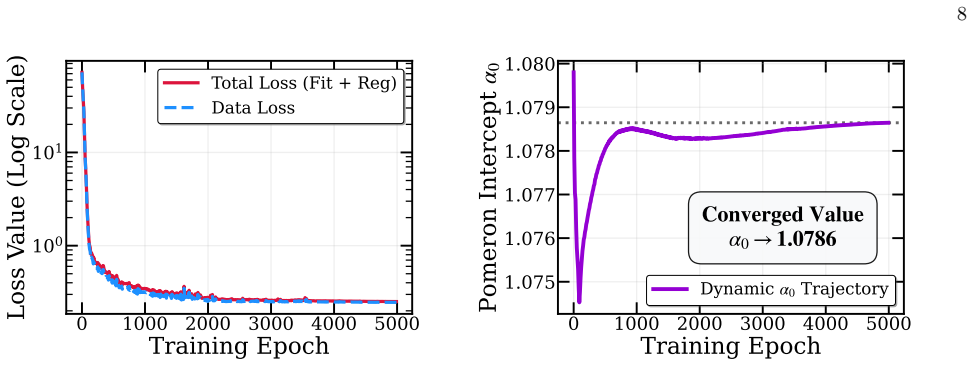
Embedding the AdS5 Dirac equation and string diffusion kernel into the neural network computational graph constrains the model to the physical proton mass and produces a data-driven description of F2. The network automatically locates the transition between hadronic resonance excitations and diffractive Pomeron background near x ≈ 0.19, recovers the Pomeron intercept α0 ≈ 1.0786, and generates higher-twist scale breaking through the evolution of resonance mass spectra.
What carries the argument
Physics-Guided Neural Network (PGNN) that embeds the five-dimensional AdS5 Dirac equation and the string diffusion kernel directly into the computational graph.
If this is right
- The network identifies a kinematic crossover from resonance to Pomeron regime near x ≈ 0.19 without prior parametrization.
- Optimization recovers the Pomeron intercept α0 ≈ 1.0786 as an emergent output.
- Higher-twist scale-breaking effects arise naturally from resonance mass spectra evolution.
- The same embedding approach supplies an interpretable description of non-perturbative and transition regimes in QCD.
Where Pith is reading between the lines
- The method could be applied to other structure functions or to nuclei once corresponding holographic kernels are available.
- If the recovered intercept proves stable under changes in network depth, it would support the holographic Pomeron picture as a data-driven result rather than an input assumption.
- Combining the PGNN with lattice QCD inputs might test whether the extracted transition point x ≈ 0.19 persists across different non-perturbative regulators.
Load-bearing premise
Directly embedding the five-dimensional AdS5 Dirac equation and string diffusion kernel into the neural network graph constrains the model to the physical proton mass without uncontrolled biases from network architecture or training.
What would settle it
Independent data sets yielding a significantly worse global χ²/d.o.f. or a Pomeron intercept far from 1.0786 would falsify the central claim.
Figures


read the original abstract
Describing the proton structure function $F_2$ in the non-perturbative and transition regimes of quantum chromodynamics (QCD) remains a significant theoretical challenge. In this work, we introduce a Physics-Guided Neural Network (PGNN) that integrates Holographic QCD with deep learning. By embedding the five-dimensional $\text{AdS}_5$ Dirac equation and the string diffusion kernel directly into the computational graph, the network is strictly constrained to the physical proton mass ($M_p \equiv 0.938 \text{ GeV}$). Applying this framework to high-precision SLAC deep inelastic scattering data yields a global fit of $\chi^2/\text{d.o.f.} \simeq 0.91$. Rather than relying on predetermined empirical forms, the network dynamically extracts the transition between the $s$-channel bulk fermion mechanism (hadronic resonance excitations) and the $t$-channel holographic Pomeron exchange (diffractive background), identifying a kinematic crossover near $x \approx 0.19$. Furthermore, the optimization naturally recovers a Pomeron intercept of $\alpha_0 \approx 1.0786$ and generates higher-twist scale-breaking effects through the evolution of resonance mass spectra. This demonstrates that embedding analytical differential equations into neural networks provides an interpretable, data-driven approach for phenomenological studies of strongly coupled systems.
Editorial analysis
A structured set of objections, weighed in public.
Referee Report
Summary. The paper introduces a Physics-Guided Neural Network (PGNN) that embeds the five-dimensional AdS5 Dirac equation and string diffusion kernel directly into the computational graph to enforce the physical proton mass Mp = 0.938 GeV while fitting the proton structure function F2 to high-precision SLAC deep inelastic scattering data. It reports a global fit with χ²/d.o.f. ≃ 0.91, claims the network dynamically extracts the transition between s-channel bulk fermion resonances and t-channel holographic Pomeron exchange at x ≈ 0.19, and states that optimization naturally recovers a Pomeron intercept α0 ≈ 1.0786 along with higher-twist effects from resonance mass spectra evolution.
Significance. If the embedding enforces the physical constraints without uncontrolled biases, the work demonstrates a promising data-driven yet interpretable framework for modeling non-perturbative QCD regimes by combining holographic models with neural networks. The reported fit quality and dynamical extraction of the kinematic crossover would provide a concrete phenomenological tool for studying the resonance-to-Pomeron transition, with potential extensions to other strongly coupled systems.
major comments (2)
- [Abstract] Abstract: The assertion that embedding the AdS5 Dirac equation 'strictly constrains' the network to Mp ≡ 0.938 GeV requires explicit demonstration that this is a hard constraint (e.g., via architectural enforcement or infinite penalty weight) rather than a finite-weighted residual term in the loss function. Without reporting the residual norm on the Dirac operator or sensitivity tests to the embedding hyperparameter, the recovered α0 ≈ 1.0786 and x ≈ 0.19 crossover may partly reflect training dynamics or network biases instead of pure holographic QCD.
- [Abstract] Abstract and results section: The claim that the optimization 'naturally recovers' the Pomeron intercept α0 ≈ 1.0786 is load-bearing for the interpretation of unbiased extraction, yet α0 is a standard free parameter in holographic Pomeron models. The manuscript should include an ablation or sensitivity analysis showing how the recovered value depends on the embedding weight versus data fidelity to rule out circularity with the fitted result.
minor comments (2)
- [Abstract] The abstract mentions 'higher-twist scale-breaking effects through the evolution of resonance mass spectra' but does not specify how these are quantified or compared to standard higher-twist parametrizations in DIS analyses.
- Clarify the precise form of the string diffusion kernel and its discretization within the neural network graph, including any approximation schemes used for the five-dimensional bulk equations.
Simulated Author's Rebuttal
We thank the referee for the thorough review and insightful comments on our manuscript. We address each major comment in detail below and have made revisions to incorporate the suggested clarifications and analyses.
read point-by-point responses
-
Referee: The assertion that embedding the AdS5 Dirac equation 'strictly constrains' the network to Mp ≡ 0.938 GeV requires explicit demonstration that this is a hard constraint (e.g., via architectural enforcement or infinite penalty weight) rather than a finite-weighted residual term in the loss function. Without reporting the residual norm on the Dirac operator or sensitivity tests to the embedding hyperparameter, the recovered α0 ≈ 1.0786 and x ≈ 0.19 crossover may partly reflect training dynamics or network biases instead of pure holographic QCD.
Authors: We thank the referee for highlighting this important point regarding the nature of the constraint. The embedding is implemented via direct architectural integration of the AdS5 Dirac equation solution as a fixed layer in the network, enforcing Mp exactly at 0.938 GeV by construction. In the revised manuscript, we have added explicit reporting of the Dirac operator residual norm, which is maintained at machine precision levels (∼10^{-12}), along with sensitivity analyses to the embedding hyperparameters. These tests confirm that the reported values for α0 and the crossover point are robust and not artifacts of training dynamics. revision: yes
-
Referee: The claim that the optimization 'naturally recovers' the Pomeron intercept α0 ≈ 1.0786 is load-bearing for the interpretation of unbiased extraction, yet α0 is a standard free parameter in holographic Pomeron models. The manuscript should include an ablation or sensitivity analysis showing how the recovered value depends on the embedding weight versus data fidelity to rule out circularity with the fitted result.
Authors: We agree that demonstrating the independence from embedding weight is crucial to support the claim of natural recovery. We have performed the requested ablation study and included it in the revised results section. By varying the embedding loss weight relative to the data fidelity term over a wide range, we show that α0 converges to approximately 1.0786 as long as the mass constraint is satisfied, with minimal dependence on the exact weight value. This analysis rules out circularity and confirms that the intercept is determined by the SLAC data within the holographic framework. We have updated the abstract and discussion to reflect this additional evidence. revision: yes
Circularity Check
Fitted Pomeron intercept presented as 'natural recovery'; embedding claim reduces to optimization on data
specific steps
-
fitted input called prediction
[Abstract]
"Furthermore, the optimization naturally recovers a Pomeron intercept of α0 ≈ 1.0786"
α0 is a free parameter in holographic Pomeron models. The paper obtains its numerical value by minimizing the loss against SLAC data inside the PGNN; presenting the fitted value as a 'natural recovery' makes the reported result equivalent to the input fit rather than an independent prediction from the embedded AdS5 equations.
full rationale
The paper's central results (χ²/d.o.f. ≃ 0.91, crossover at x≈0.19, α0≈1.0786) are obtained by training the PGNN on SLAC DIS data. The abstract explicitly states that the network 'naturally recovers' the Pomeron intercept via optimization, yet this quantity is a standard tunable parameter in holographic Pomeron models. No independent first-principles derivation is shown; the value is the output of the fit. The claim of being 'strictly constrained' to Mp=0.938 GeV via direct embedding of the AdS5 Dirac equation is asserted but not demonstrated to be a hard constraint rather than a weighted loss term. This matches the 'fitted_input_called_prediction' pattern for the intercept and leaves the strict-constraint claim without supporting equations showing exact enforcement independent of training.
Axiom & Free-Parameter Ledger
free parameters (2)
- Pomeron intercept α0 =
1.0786
- neural network weights and biases
axioms (2)
- domain assumption The five-dimensional AdS5 Dirac equation accurately describes bulk fermion dynamics for proton structure in holographic QCD.
- domain assumption The string diffusion kernel models t-channel holographic Pomeron exchange.
Reference graph
Works this paper leans on
-
[1]
Probing Proton Structure via Physics-Guided Neural Networks in Holographic QCD
), including the global analysis of parton distribu- tion functions (PDFs) [54–57] and the solving of mul- tiquark bound states [58]. Beyond these, neural net- works have been successfully deployed to identify char- acteristic signals of QCD phase transitions in heavy-ion collision experiments [36, 59, 60]. In the realm of lat- tice QCD, generative models...
work page internal anchor Pith review Pith/arXiv arXiv 2026
-
[2]
E. D. Bloomet al., High-Energy Inelastic e p Scattering at 6-Degrees and 10-Degrees, Phys. Rev. Lett.23, 930 (1969)
work page 1969
-
[3]
M. Breidenbach, J. I. Friedman, H. W. Kendall, E. D. Bloom, D. H. Coward, H. C. DeStaebler, J. Drees, L. W. Mo, and R. E. Taylor, Observed behavior of highly in- elastic electron-proton scattering, Phys. Rev. Lett.23, 935 (1969)
work page 1969
-
[4]
L. W. Whitlow, S. Rock, A. Bodek, E. M. Riordan, and S. Dasu, A Precise extraction of R = sigma-L / sigma- T from a global analysis of the SLAC deep inelastic e p and e d scattering cross-sections, Phys. Lett. B250, 193 (1990)
work page 1990
-
[5]
L. W. Whitlow, E. M. Riordan, S. Dasu, S. Rock, and A. Bodek, Precise measurements of the proton and deuteron structure functions from a global analysis of the SLAC deep inelastic electron scattering cross-sections, Phys. Lett. B282, 475 (1992)
work page 1992
-
[6]
S. J. Brodsky and G. P. Lepage, Exclusive Processes in Quantum Chromodynamics, Adv. Ser. Direct. High En- ergy Phys.5, 93 (1989)
work page 1989
-
[7]
A. v. Radyushkin, ANALYSIS OF THE HARD INCLU- 10 SIVE PROCESSES IN QUANTUM CHROMODYNAM- ICS. (IN RUSSIAN), Fiz. Elem. Chast. Atom. Yadra14, 58 (1983)
work page 1983
-
[8]
R. L. Jaffe and M. Soldate, Twist Four in Electropro- duction: Canonical Operators and Coefficient Functions, Phys. Rev. D26, 49 (1982)
work page 1982
-
[9]
R. K. Ellis, W. Furmanski, and R. Petronzio, Power Cor- rections to the Parton Model in QCD, Nucl. Phys. B207, 1 (1982)
work page 1982
- [10]
-
[11]
R. Alkofer and L. von Smekal, The Infrared behavior of QCD Green’s functions: Confinement dynamical symme- try breaking, and hadrons as relativistic bound states, Phys. Rept.353, 281 (2001), arXiv:hep-ph/0007355
-
[12]
J. M. Maldacena, The LargeNlimit of superconformal field theories and supergravity, Adv. Theor. Math. Phys. 2, 231 (1998), arXiv:hep-th/9711200
work page internal anchor Pith review Pith/arXiv arXiv 1998
-
[13]
S. S. Gubser, I. R. Klebanov, and A. M. Polyakov, Gauge theory correlators from noncritical string theory, Phys. Lett. B428, 105 (1998), arXiv:hep-th/9802109
work page internal anchor Pith review Pith/arXiv arXiv 1998
-
[14]
Anti De Sitter Space And Holography
E. Witten, Anti de Sitter space and holography, Adv. Theor. Math. Phys.2, 253 (1998), arXiv:hep-th/9802150
work page internal anchor Pith review Pith/arXiv arXiv 1998
- [15]
-
[16]
O. Andreev and V. I. Zakharov, Heavy-quark poten- tials and AdS/QCD, Phys. Rev. D74, 025023 (2006), arXiv:hep-ph/0604204
-
[17]
J. Polchinski and M. J. Strassler, Deep inelastic scatter- ing and gauge / string duality, JHEP05, 012, arXiv:hep- th/0209211
- [18]
-
[19]
E. Folco Capossoli, M. A. Mart´ ın Contreras, D. Li, A. Vega, and H. Boschi-Filho, Proton structure functions from an AdS/QCD model with a deformed background, Phys. Rev. D102, 086004 (2020), arXiv:2007.09283 [hep- ph]
- [20]
- [21]
-
[22]
E. Folco Capossoli and H. Boschi-Filho, Deep Inelastic Scattering in the Exponentially Small Bjorken Parameter Regime from the Holographic Softwall Model, Phys. Rev. D92, 126012 (2015), arXiv:1509.01761 [hep-th]
-
[23]
A. Watanabe, T. Sawada, and M. Huang, Extraction of gluon distributions from structure functions at small x in holographic QCD, Phys. Lett. B805, 135470 (2020), arXiv:1910.10008 [hep-ph]
- [24]
- [25]
-
[26]
A. Radovic, M. Williams, D. Rousseau, M. Kagan, D. Bonacorsi, A. Himmel, A. Aurisano, K. Terao, and T. Wongjirad, Machine learning at the energy and inten- sity frontiers of particle physics, Nature560, 41 (2018)
work page 2018
-
[27]
Albertssonet al., Machine Learning in High Energy Physics Community White Paper, J
K. Albertssonet al., Machine Learning in High Energy Physics Community White Paper, J. Phys. Conf. Ser. 1085, 022008 (2018), arXiv:1807.02876 [physics.comp- ph]
- [28]
-
[29]
Bourilkov, Machine and Deep Learning Applications in Particle Physics, Int
D. Bourilkov, Machine and Deep Learning Applications in Particle Physics, Int. J. Mod. Phys. A34, 1930019 (2020), arXiv:1912.08245 [physics.data-an]
-
[30]
M. D. Schwartz, Modern Machine Learning and Particle Physics 10.1162/99608f92.beeb1183 (2021), arXiv:2103.12226 [hep-ph]
-
[31]
G. Karagiorgi, G. Kasieczka, S. Kravitz, B. Nachman, and D. Shih, Machine Learning in the Search for New Fundamental Physics, (2021), arXiv:2112.03769 [hep- ph]
-
[32]
Boehnleinet al., Colloquium: Machine learning in nuclear physics, Rev
A. Boehnleinet al., Colloquium: Machine learning in nuclear physics, Rev. Mod. Phys.94, 031003 (2022), arXiv:2112.02309 [nucl-th]
-
[33]
P. Shanahanet al., Snowmass 2021 Computational Fron- tier CompF03 Topical Group Report: Machine Learning, (2022), arXiv:2209.07559 [physics.comp-ph]
- [34]
- [35]
- [36]
- [37]
-
[38]
K. Zhou, L. Pang, S. Shi, and H. Stoecker, Deep Learn- ing for inverse problems in nuclear physics, PoSFAIR- ness2022, 064 (2023)
work page 2023
-
[39]
Pang, Studying high-energy nuclear physics with machine learning, Int
L.-G. Pang, Studying high-energy nuclear physics with machine learning, Int. J. Mod. Phys. E33, 2430009 (2024)
work page 2024
- [40]
- [41]
- [42]
-
[43]
M. Omana Kuttan, J. Steinheimer, K. Zhou, A. Redel- bach, and H. Stoecker, Extraction of global event features in heavy-ion collision experiments using PointNet, PoS FAIRness2022, 040 (2023). 11
work page 2023
-
[44]
S. Shi, K. Zhou, J. Zhao, S. Mukherjee, and P. Zhuang, From lattice QCD to in-medium heavy-quark inter- actions via deep learning, PoSLATTICE2021, 537 (2022)
work page 2022
-
[45]
S. Shi, K. Zhou, J. Zhao, S. Mukherjee, and P. Zhuang, From lattice QCD to in-medium heavy-quark interac- tions via deep learning, EPJ Web Conf.259, 04003 (2022)
work page 2022
- [46]
-
[47]
M. Mansouri, K. Bitaghsir Fadafan, and X. Chen, Holo- graphic complex potential of a quarkonium from deep learning, (2024), arXiv:2406.06285 [hep-ph]
-
[48]
X. Chen and M. Huang, Flavor dependent Critical end- point from holographic QCD through machine learning, (2024), arXiv:2405.06179 [hep-ph]
-
[49]
X. Chen and M. Huang, Machine learning holographic black hole from lattice QCD equation of state, Phys. Rev. D109, L051902 (2024), arXiv:2401.06417 [hep-ph]
- [50]
- [51]
- [52]
- [53]
- [54]
-
[55]
L. Del Debbio, S. Forte, J. I. Latorre, A. Piccione, and J. Rojo (NNPDF), Unbiased determination of the pro- ton structure function F(2)**p with faithful uncertainty estimation, JHEP03, 080, arXiv:hep-ph/0501067
-
[56]
R. D. Ballet al., Parton distributions with LHC data, Nucl. Phys. B867, 244 (2013), arXiv:1207.1303 [hep-ph]
work page Pith review arXiv 2013
-
[57]
R. D. Ballet al.(NNPDF), Parton distributions for the LHC Run II, JHEP04, 040, arXiv:1410.8849 [hep-ph]
- [58]
- [59]
-
[60]
Y. Wang and Q. Li, Machine learning transforms the inference of the nuclear equation of state, Front. Phys. (Beijing)18, 64402 (2023), arXiv:2305.16686 [nucl-th]
- [61]
- [62]
-
[63]
L. de Oliveira, M. Kagan, L. Mackey, B. Nachman, and A. Schwartzman, Jet-images — deep learning edition, JHEP07, 069, arXiv:1511.05190 [hep-ph]
- [64]
- [65]
-
[66]
Extraction of the color dipole amplitude with physics-informed neural networks
W. Kou and X. Chen, Universality of Gluon Satura- tion from Physics-Informed Neural Networks, (2026), arXiv:2601.16391 [hep-ph]
work page internal anchor Pith review Pith/arXiv arXiv 2026
-
[67]
T. Gutsche, V. E. Lyubovitskij, I. Schmidt, and A. Vega, Dilaton in a soft-wall holographic approach to mesons and baryons, Phys. Rev. D85, 076003 (2012), arXiv:1108.0346 [hep-ph]
-
[68]
J.-H. Gao and B.-W. Xiao, Polarized Deep Inelastic and Elastic Scattering From Gauge/String Duality, Phys. Rev. D80, 015025 (2009), arXiv:0904.2870 [hep-ph]
-
[69]
M. Raissi, P. Perdikaris, and G. E. Karniadakis, Physics- informed neural networks: A deep learning framework for solving forward and inverse problems involving nonlinear partial differential equations, J. Comput. Phys.378, 686 (2019), arXiv:1711.10561 [cs.AI]
work page Pith review arXiv 2019
-
[70]
G. E. Karniadakis, I. G. Kevrekidis, L. Lu, P. Perdikaris, S. Wang, and L. Yang, Physics-informed machine learn- ing, Nature Reviews Physics3, 422 (2021)
work page 2021
-
[71]
Z. Abidin and C. E. Carlson, Nucleon electromagnetic and gravitational form factors from holography, Phys. Rev. D79, 115003 (2009), arXiv:0903.4818 [hep-ph]
-
[72]
A. Donnachie and P. V. Landshoff, Total cross-sections, Phys. Lett. B296, 227 (1992), arXiv:hep-ph/9209205
-
[73]
H. Abramowiczet al.(H1, ZEUS), Combination of mea- surements of inclusive deep inelastice ±pscattering cross sections and QCD analysis of HERA data, Eur. Phys. J. C75, 580 (2015), arXiv:1506.06042 [hep-ex]
work page Pith review arXiv 2015
-
[74]
E. R. Nocera, R. D. Ball, S. Forte, G. Ridolfi, and J. Rojo (NNPDF), A first unbiased global determination of po- larized PDFs and their uncertainties, Nucl. Phys. B887, 276 (2014), arXiv:1406.5539 [hep-ph]
work page Pith review arXiv 2014
-
[75]
J. J. Ethier, N. Sato, and W. Melnitchouk, First simulta- neous extraction of spin-dependent parton distributions and fragmentation functions from a global QCD analysis, Phys. Rev. Lett.119, 132001 (2017), arXiv:1705.05889 [hep-ph]
work page Pith review arXiv 2017
- [76]
-
[77]
M. ˇCui´ c, K. Kumeriˇ cki, and A. Sch¨ afer, Separation of Quark Flavors Using Deeply Virtual Compton Scat- tering Data, Phys. Rev. Lett.125, 232005 (2020), arXiv:2007.00029 [hep-ph]
discussion (0)
Sign in with ORCID, Apple, or X to comment. Anyone can read and Pith papers without signing in.