Recognition: unknown
Efficient Routing of Quantum LDPC Codes on Programmable 2D Toric Architectures
Pith reviewed 2026-05-10 04:42 UTC · model grok-4.3
The pith
A 2D toric network of oscillators routes bivariate bicycle quantum LDPC codes using only O(sqrt(n)) long-range couplers.
A machine-rendered reading of the paper's core claim, the machinery that carries it, and where it could break.
Core claim
The paper establishes that a 2D toric network of oscillators can serve as an efficient communication fabric for routing the long-range interactions in bivariate bicycle codes. By exploiting code symmetries for parallel gate execution and employing dual-rail encoding with specific swap gates, the architecture achieves scalable syndrome extraction cycles while requiring only square-root scaling in long-range couplers. Simulations confirm improved logical error rates under realistic hardware noise.
What carries the argument
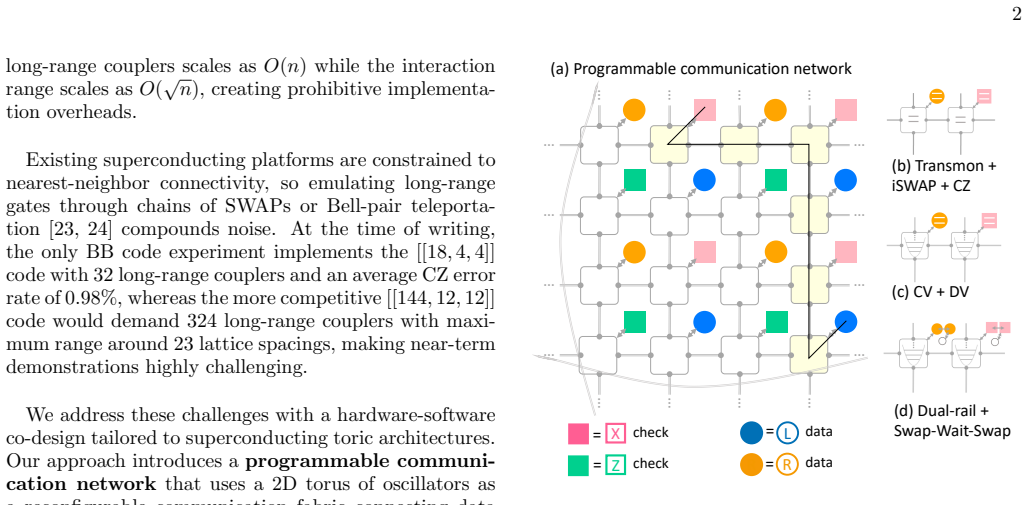
The 2D toric network of oscillators acting as a flexible communication fabric between qubit sites, supporting Swap-Wait-Swap gates and beamsplitter SWAPs for long-range two-qubit operations.
Load-bearing premise
The 2D toric network of oscillators can be implemented with high-fidelity, low-latency long-range gates matching the realistic noise model, without unaccounted hardware imperfections or connectivity limits.
What would settle it
Implementing a prototype 2D toric oscillator network on superconducting hardware and comparing the measured logical error rate for the [[18,4,4]] BB code against the simulated 3.06% value.
Figures




read the original abstract
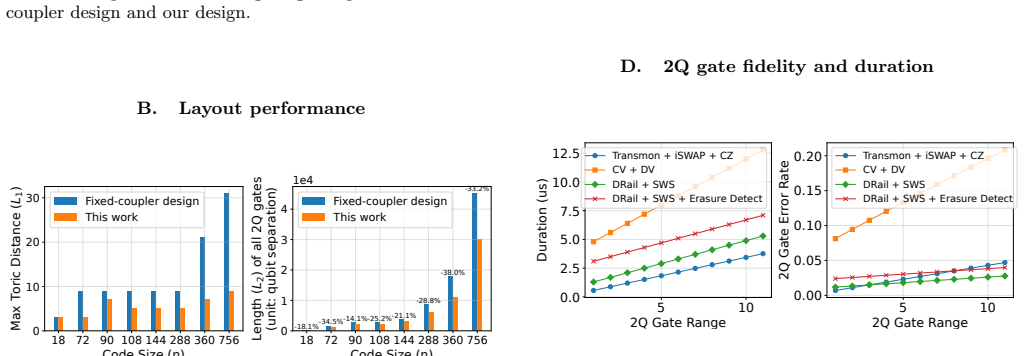
Quantum low-density parity-check codes are promising candidates towards scalable fault-tolerant quantum computation. Among these, bivariate bicycle (BB) codes offer superior encoding rates and large code distance compared to surface codes. However, their requirement on long-range stabilizer measurements poses significant challenges for implementation on realistic hardware with limited connectivity, such as superconducting circuit platforms. In this work, we introduce a novel hardware-software co-design that leverages a programmable communication network architecture to address these limitations. Our approach utilizes a 2D toric network of oscillators as a flexible communication fabric linking qubits at each site. Such architecture significantly reduces the number of long-range couplers required from $O(n)$ to $O(\sqrt{n})$. Dual-rail qubits, along with native gates including Swap-Wait-Swap gates and beamsplitter SWAPs, ensure that long-range two-qubit gates can be executed with high fidelity and low latency. To further enhance performance, our qubit layout and routing algorithm utilize symmetries of the codes and enable maximum parallelism for long-range two-qubit gates, maintaining a low syndrome extraction cycle duration and scalability over the code length. We perform circuit-level simulation with realistic noise modeling based on experimental hardware parameters, observing an logical error rate per logical qubit per cycle of 3.06\% for $[[18, 4, 4]]$ BB code, 2.6$\times$ less than the existing experimental result. These findings provide a practical roadmap and identify key technological advancements needed to achieve low-overhead fault-tolerant quantum computing at scale.
Editorial analysis
A structured set of objections, weighed in public.
Referee Report
Summary. The manuscript proposes a hardware-software co-design for implementing bivariate bicycle (BB) quantum LDPC codes on superconducting platforms with limited connectivity. It introduces a programmable 2D toric network of oscillators as a flexible communication fabric that reduces long-range couplers from O(n) to O(sqrt(n)), uses dual-rail qubits with native Swap-Wait-Swap and beamsplitter SWAP gates for high-fidelity long-range operations, and employs a symmetry-aware routing algorithm to maximize parallelism while keeping syndrome extraction cycles short. Circuit-level simulations with realistic noise modeling based on experimental parameters report a logical error rate per logical qubit per cycle of 3.06% for the [[18,4,4]] BB code, stated to be 2.6× lower than existing experimental results.
Significance. If the central hardware assumptions hold, the work provides a concrete and scalable route to realizing high-rate LDPC codes on near-term hardware, substantially lowering connectivity overhead compared with direct long-range coupling schemes. The emphasis on code symmetries for parallel routing and the reported error-rate improvement constitute a practical contribution toward low-overhead fault-tolerant quantum computation.
major comments (2)
- [Abstract] Abstract and simulation results: the reported 3.06% logical error rate per logical qubit per cycle (and the 2.6× improvement) is obtained from circuit-level simulations whose exact noise parameters, gate error rates, circuit decompositions of the Swap-Wait-Swap and beamsplitter SWAP operations, and comparison baselines are not specified. This prevents independent verification of whether the performance numbers are robust or sensitive to post-hoc choices in the noise model.
- [Hardware Architecture] Hardware architecture and assumptions: the central claims rest on the 2D toric oscillator network supporting long-range gates at fidelities and latencies that exactly match the modeled realistic noise without additional imperfections (crosstalk, calibration drift, or path-dependent latency). No sensitivity analysis or bounds are given on how deviations from this assumption would propagate to the logical error rate, leaving the 3.06% figure and the O(sqrt(n)) coupler reduction vulnerable to unmodeled hardware effects.
minor comments (1)
- [Abstract] The abstract contains the grammatical error 'an logical error rate'; this should be corrected to 'a logical error rate'.
Simulated Author's Rebuttal
We thank the referee for their thorough review and valuable feedback on our manuscript. We address each major comment below with specific clarifications and commit to revisions that enhance transparency and robustness without altering the core contributions.
read point-by-point responses
-
Referee: [Abstract] Abstract and simulation results: the reported 3.06% logical error rate per logical qubit per cycle (and the 2.6× improvement) is obtained from circuit-level simulations whose exact noise parameters, gate error rates, circuit decompositions of the Swap-Wait-Swap and beamsplitter SWAP operations, and comparison baselines are not specified. This prevents independent verification of whether the performance numbers are robust or sensitive to post-hoc choices in the noise model.
Authors: We agree that additional detail on the simulation setup is necessary for independent verification. The noise model in the manuscript is constructed from experimental parameters in the superconducting qubit literature (e.g., T1/T2 times, gate durations, and error rates from recent device characterizations), but we acknowledge that the abstract and main text do not list every numerical value or decomposition explicitly. In the revised version we will add a new subsection (and an accompanying table) that specifies: (i) all single- and two-qubit gate error rates and durations used, (ii) the exact gate decompositions and pulse sequences for Swap-Wait-Swap and beamsplitter SWAP operations, (iii) the precise circuit-level noise model (including measurement and reset errors), and (iv) the exact baseline circuits and codes against which the 2.6× improvement is measured. These additions will allow readers to reproduce the 3.06 % figure and test its sensitivity to parameter choices. revision: yes
-
Referee: [Hardware Architecture] Hardware architecture and assumptions: the central claims rest on the 2D toric oscillator network supporting long-range gates at fidelities and latencies that exactly match the modeled realistic noise without additional imperfections (crosstalk, calibration drift, or path-dependent latency). No sensitivity analysis or bounds are given on how deviations from this assumption would propagate to the logical error rate, leaving the 3.06% figure and the O(sqrt(n)) coupler reduction vulnerable to unmodeled hardware effects.
Authors: The referee correctly notes the absence of a sensitivity study. Our noise model assumes that the programmable toric network can realize the modeled long-range operations at the stated fidelities and latencies; we did not quantify the impact of unmodeled effects such as crosstalk, path-dependent latency, or calibration drift. In the revision we will include a new analysis section that (a) introduces bounded perturbations to gate fidelity and latency consistent with current experimental variability, (b) re-runs the circuit-level simulations under these perturbations, and (c) reports the resulting range of logical error rates together with a discussion of how the O(sqrt(n)) coupler scaling remains advantageous even under moderate degradation. This will directly address the robustness concern while preserving the manuscript’s central hardware-software co-design claims. revision: yes
Circularity Check
No circularity: architecture proposal and simulation results are independent of inputs
full rationale
The paper proposes a 2D toric oscillator network for routing BB codes, derives the O(sqrt(n)) coupler reduction from the layout geometry and routing algorithm, and reports simulated logical error rates from circuit-level noise modeling with external hardware parameters. No equations, predictions, or central claims reduce by construction to fitted inputs, self-definitions, or load-bearing self-citations. The derivation chain remains self-contained against the stated assumptions and external benchmarks.
Axiom & Free-Parameter Ledger
free parameters (1)
- noise model parameters
axioms (1)
- domain assumption The 2D toric oscillator network provides scalable, high-fidelity long-range connectivity without introducing dominant new error sources.
invented entities (1)
-
programmable 2D toric network of oscillators
no independent evidence
Reference graph
Works this paper leans on
-
[1]
Each SWAP takes one iSWAP and one CZ gate, according to Figure 1(d) in [53], and we ignore single-qubit gate errors and durations
iSWAP + CZ long-range gate To simplify the analysis, we optimistically assume p2Q(1) = 0.001 is the 2Q gate error rate of local iSWAP/CZ/CNOT gate among transmon qubits and lo- cal gate durationt 2Q(1) = 80 ns, though the experimen- tal results [53] are worse than these values. Each SWAP takes one iSWAP and one CZ gate, according to Figure 1(d) in [53], a...
-
[2]
CV + DV long-range gate In this architecture, the 2Q gate error rate comprises two parts: (1) transmon decay and dephasing during idling and mode traveling; (2) photon loss. From [54, Figure 20(a)], we can write the duration as tdur(r) = 4·(t CD +r·t SWAP).(A3) We model transmon decay and dephasing by applying Pauli twirling to the amplitude damping and d...
-
[3]
The total 2Q gate error rate is the idling error rate from both control and target qubits, plus the photon loss error rate, p2Q(t) =p X(t) +p Y (t) +p Z(t) +p loss(t), t=t idle(r) (A6)
-
[4]
Following Mehta et al
Effective cavity duration This section explains why the cavity-loss model for the control dual-rail qubit uses an effective cavity duration tdur(r)−t SWS/2. Following Mehta et al. [44], the SWS gate acts on (a 1, a2, c, b1, b2),wherea 1 anda 2 are the control dual-rail cavities,cis the coupler, andb 1 and b2 are the target dual-rail cavities. In our long-...
-
[5]
No-jump backaction arises when the two logical ba- sis states experience different effective decay rates [56– 58]
No-jump backaction in the SWAP network This section analyzes no-jump backaction for the con- trol dual-rail qubit during a long-range SWS gate and justifies its exclusion from the main error model. No-jump backaction arises when the two logical ba- sis states experience different effective decay rates [56– 58]. In our protocol,|1 L⟩has its excitation in c...
-
[6]
M. E. Beverland, P. Murali, M. Troyer, K. M. Svore, T. Hoefler, V. Kliuchnikov, G. H. Low, M. Soeken, A. Sundaram, and A. Vaschillo, Assessing require- ments to scale to practical quantum advantage (2022), arXiv:2211.07629
work page internal anchor Pith review arXiv 2022
-
[7]
S. B. Bravyi and A. Y. Kitaev, Quantum codes on a lattice with boundary (1998), arXiv:quant-ph/9811052
work page Pith review arXiv 1998
- [8]
-
[9]
A. Y. Kitaev, Fault-tolerant quantum computation by anyons, Annals of Physics303, 2 (2003)
2003
- [10]
-
[11]
Krinner, N
S. Krinner, N. Lacroix, A. Remm, A. Di Paolo, E. Genois, C. Leroux, C. Hellings, S. Lazar, F. Swiadek, J. Her- rmann, G. J. Norris, C. K. Andersen, M. M¨ uller, A. Blais, C. Eichler, and A. Wallraff, Realizing repeated quantum error correction in a distance-three surface code, Nature 605, 669 (2022)
2022
- [12]
-
[13]
V. V. Sivak, A. Eickbusch, B. Royer, S. Singh, I. Tsiout- sios, S. Ganjam, A. Miano, B. L. Brock, A. Z. Ding, L. Frunzio, S. M. Girvin, R. J. Schoelkopf, and M. H. De- voret, Real-time quantum error correction beyond break- even, Nature616, 50 (2023)
2023
- [14]
-
[15]
Y. Zhao, Y. Ye, H.-L. Huang, Y. Zhang, D. Wu, H. Guan, 12 Q. Zhu, Z. Wei, T. He, S. Cao, F. Chen, T.-H. Chung, H. Deng, D. Fan, M. Gong, C. Guo, S. Guo, L. Han, N. Li, S. Li, Y. Li, F. Liang, J. Lin, H. Qian, H. Rong, H. Su, L. Sun, S. Wang, Y. Wu, Y. Xu, C. Ying, J. Yu, C. Zha, K. Zhang, Y.-H. Huo, C.-Y. Lu, C.-Z. Peng, X. Zhu, and J.-W. Pan, Realization...
-
[16]
T. J. Yoder, E. Schoute, P. Rall, E. Pritchett, J. M. Gam- betta, A. W. Cross, M. Carroll, and M. E. Beverland, Tour de gross: A modular quantum computer based on bivariate bicycle codes (2025), arXiv:2506.03094 [quant- ph]
work page internal anchor Pith review arXiv 2025
- [17]
-
[18]
Fault-tolerant quantum computa- tion with constant overhead,
D. Gottesman, Fault-Tolerant Quantum Computation with Constant Overhead (2014), arXiv:1310.2984
-
[19]
P. Panteleev and G. Kalachev, Degenerate Quantum LDPC Codes With Good Finite Length Performance, Quantum5, 585 (2021), arXiv:1904.02703 [quant-ph]
-
[20]
P. Panteleev and G. Kalachev, Quantum LDPC Codes with Almost Linear Minimum Distance, IEEE Transactions on Information Theory68, 213 (2022), arXiv:2012.04068 [quant-ph]
-
[21]
J.-P. Tillich and G. Zemor, Quantum LDPC codes with positive rate and minimum distance proportional to nˆ{1/2}, IEEE Transactions on Information Theory60, 1193 (2014), arXiv:0903.0566 [quant-ph]
-
[22]
Bravyi, A
S. Bravyi, A. W. Cross, J. M. Gambetta, D. Maslov, P. Rall, and T. J. Yoder, High-threshold and low- overhead fault-tolerant quantum memory, Nature627, 778 (2024)
2024
- [23]
-
[24]
A. Cowtan, Z. He, D. J. Williamson, and T. J. Yo- der, Parallel Logical Measurements via Quantum Code Surgery (2025), arXiv:2503.05003 [quant-ph]
work page internal anchor Pith review arXiv 2025
- [25]
- [26]
-
[27]
D. J. Williamson and T. J. Yoder, Low-overhead fault- tolerant quantum computation by gauging logical opera- tors (2024)
2024
-
[28]
E. B¨ aumer, V. Tripathi, D. S. Wang, P. Rall, E. H. Chen, S. Majumder, A. Seif, and Z. K. Minev, Effi- cient Long-Range Entanglement using Dynamic Circuits (2023), arXiv:2308.13065 [quant-ph]
-
[29]
Toward a 2D local implementation of quantum LDPC codes
N. Berthusen, D. Devulapalli, E. Schoute, A. M. Childs, M. J. Gullans, A. V. Gorshkov, and D. Gottesman, To- ward a 2D Local Implementation of Quantum LDPC Codes (2024), arXiv:2404.17676 [quant-ph]
-
[30]
K. Wang, Z. Lu, C. Zhang, G. Liu, J. Chen, Y. Wang, Y. Wu, S. Xu, X. Zhu, F. Jin, Y. Gao, Z. Tan, Z. Cui, N. Wang, Y. Zou, A. Zhang, T. Li, F. Shen, J. Zhong, Z. Bao, Z. Zhu, Y. Han, Y. He, J. Shen, H. Wang, J.- N. Yang, Z. Song, J. Deng, H. Dong, Z.-Z. Sun, W. Li, Q. Ye, S. Jiang, Y. Ma, P.-X. Shen, P. Zhang, H. Li, Q. Guo, Z. Wang, C. Song, H. Wang, and...
-
[31]
N. Delfosse, M. E. Beverland, and M. A. Tremblay, Bounds on stabilizer measurement circuits and obstruc- tions to local implementations of quantum LDPC codes (2021), arXiv:2109.14599 [quant-ph]
-
[32]
N. Baspin and A. Krishna, Quantifying nonlocality: how outperforming local quantum codes is expensive, Physi- cal Review Letters129, 050505 (2022), arXiv:2109.10982 [quant-ph]
-
[33]
J. Viszlai, W. Yang, S. F. Lin, J. Liu, N. Nottingham, J. M. Baker, and F. T. Chong, Matching Generalized- Bicycle Codes to Neutral Atoms for Low-Overhead Fault- Tolerance (2024), arXiv:2311.16980 [quant-ph]
- [34]
-
[35]
Bluvstein, et al., Logical quantum processor based on reconfigurable atom arrays
D. Bluvstein, S. J. Evered, A. A. Geim, S. H. Li, H. Zhou, T. Manovitz, S. Ebadi, M. Cain, M. Kalinowski, D. Hangleiter, J. P. B. Ataides, N. Maskara, I. Cong, X. Gao, P. S. Rodriguez, T. Karolyshyn, G. Semeghini, M. J. Gullans, M. Greiner, V. Vuletic, and M. D. Lukin, Logical quantum processor based on reconfigurable atom arrays (2023), arXiv:2312.03982
- [36]
- [37]
-
[38]
M. R. Lam, N. Peter, T. Groh, W. Alt, C. Robens, D. Meschede, A. Negretti, S. Montangero, T. Calarco, and A. Alberti, Demonstration of Quantum Brachis- tochrones between Distant States of an Atom, Physical Review X11, 011035 (2021)
2021
- [39]
-
[40]
Placing and routing quantum LDPC codes in multilayer superconducting hardware
M. Mathews, L. Pahl, D. Pahl, V. L. Addala, C. Tang, W. D. Oliver, and J. A. Grover, Placing and rout- ing quantum LDPC codes in multilayer superconducting hardware (2025), arXiv:2507.23011 [quant-ph] version: 2
work page internal anchor Pith review arXiv 2025
- [41]
- [42]
- [43]
- [44]
-
[45]
Y. Wu, S. Kolkowitz, S. Puri, and J. D. Thompson, Era- sure conversion for fault-tolerant quantum computing in 13 alkaline earth Rydberg atom arrays (2022)
2022
-
[46]
J. D. Teoh, P. Winkel, H. K. Babla, B. J. Chapman, J. Claes, S. J. de Graaf, J. W. O. Garmon, W. D. Kalfus, Y. Lu, A. Maiti, K. Sahay, N. Thakur, T. Tsun- oda, S. H. Xue, L. Frunzio, S. M. Girvin, S. Puri, and R. J. Schoelkopf, Dual-rail encoding with superconduct- ing cavities, Proceedings of the National Academy of Sci- ences120, e2221736120 (2023), arX...
-
[47]
K. S. Chou, T. Shemma, H. McCarrick, T.-C. Chien, J. D. Teoh, P. Winkel, A. Anderson, J. Chen, J. C. Cur- tis, S. J. de Graaf, J. W. O. Garmon, B. Gudlewski, W. D. Kalfus, T. Keen, N. Khedkar, C. U. Lei, G. Liu, P. Lu, Y. Lu, A. Maiti, L. Mastalli-Kelly, N. Mehta, S. O. Mundhada, A. Narla, T. Noh, T. Tsunoda, S. H. Xue, J. O. Yuan, L. Frunzio, J. Aumentad...
2024
-
[48]
S. J. d. Graaf, S. H. Xue, B. J. Chapman, J. D. Teoh, T. Tsunoda, P. Winkel, J. W. O. Garmon, K. M. Chang, L. Frunzio, S. Puri, and R. J. Schoelkopf, A mid-circuit erasure check on a dual-rail cavity qubit using the joint- photon number-splitting regime of circuit QED (2024), arXiv:2406.14621 [quant-ph]
-
[49]
N. Mehta, J. D. Teoh, T. Noh, A. Agrawal, R. Cham- berlain, T.-C. Chien, J. C. Curtis, B. H. Elfeky, S. M. Farzaneh, B. Gudlewski, T. Keen, N. Khed- kar, C. Kurter, R. Li, G. Liu, P. Lu, H. McCar- rick, A. Narla, S. Satapathy, T. Shemma, R. A. Shi, D. K. Weiss, J. Aumentado, C. U. Lei, J. O. Yuan, S. O. Mundhada, S. H. M. Jr, K. S. Chou, and R. J. Schoelk...
- [50]
-
[51]
N. Connolly, V. Londe, A. Leverrier, and N. Delfosse, Fast erasure decoder for hypergraph product codes, Quantum8, 1450 (2024), arXiv:2208.01002 [quant-ph]
-
[52]
M. G¨ okduman, H. Yao, and H. D. Pfister, Erasure De- coding for Quantum LDPC Codes via Belief Propagation with Guided Decimation, inThe 60th Allerton Confer- ence on Communication, Control, and Computing(2024) pp. 1–8, arXiv:2411.08177 [cs]
-
[53]
Quantum LDPC codes for erasure-biased atomic quan- tum processors
L. Pecorari and G. Pupillo, Quantum LDPC codes for erasure-biased atomic quantum processors (2025), arXiv:2502.20189 [quant-ph]
- [54]
-
[55]
A. B. Kahng, J. Lienig, I. L. Markov, and J. Hu,VLSI Physical Design: From Graph Partitioning to Timing Closure(Springer Netherlands, Dordrecht, 2011)
2011
- [56]
-
[57]
Gambetta, From Surface Codes to BB Codes: The Path Towards Making FTQC a Reality (2025)
J. Gambetta, From Surface Codes to BB Codes: The Path Towards Making FTQC a Reality (2025)
2025
-
[58]
C. Kriˇ zan, J. Bizn´ arov´ a, L. Chen, E. Hogedal, A. Osman, C. W. Warren, S. Kosen, H.-X. Li, T. Abad, A. Ag- garwal, M. Caputo, J. Fern´ andez-Pend´ as, A. Gaikwad, L. Gr¨ onberg, A. Nylander, R. Rehammar, M. Rommel, O. I. Yuzephovich, A. F. Kockum, J. Govenius, G. Tan- credi, and J. Bylander, Quantum SWAP gate realized with CZ and iSWAP gates in a sup...
-
[59]
Y. Liu, S. Singh, K. C. Smith, E. Crane, J. M. Mar- tyn, A. Eickbusch, A. Schuckert, R. D. Li, J. Sinanan- Singh, M. B. Soley, T. Tsunoda, I. L. Chuang, N. Wiebe, and S. M. Girvin, Hybrid Oscillator-Qubit Quantum Processors: Instruction Set Architectures, Abstract Ma- chine Models, and Applications (2024), arXiv:2407.10381 [quant-ph]
-
[60]
N. E. Jerger, T. Krishna, and L.-S. Peh,On-Chip Net- works, Second Edition(Springer Nature, 2022) google- Books-ID: fYZyEAAAQBAJ
2022
-
[61]
M. H. Michael, M. Silveri, R. Brierley, V. V. Albert, J. Salmilehto, L. Jiang, and S. M. Girvin, New class of quantum error-correcting codes for a bosonic mode, Physical Review X6, 031006 (2016)
2016
-
[62]
Koottandavida, I
A. Koottandavida, I. Tsioutsios, A. Kargioti, C. R. Smith, V. R. Joshi, W. Dai, J. D. Teoh, J. C. Curtis, L. Frunzio, R. J. Schoelkopf, and M. H. Devoret, Erasure Detection of a Dual-Rail Qubit Encoded in a Double-Post Superconducting Cavity, Physical Review Letters132, 180601 (2024)
2024
-
[63]
J. D. Teoh,Error detection in bosonic circuit quantum electrodynamics, Ph.D. thesis, Yale University (2023)
2023
-
[64]
doi:10.22331/q-2021-07-06-497 , title =
C. Gidney, Stim: a fast stabilizer circuit simulator, arXiv:2103.02202 [quant-ph] 10.22331/q-2021-07-06-497 (2021), arXiv: 2103.02202
-
[65]
Decoding across the quan- tum low-density parity-check code landscape
J. Roffe, D. R. White, S. Burton, and E. T. Camp- bell, Decoding Across the Quantum LDPC Code Land- scape, Physical Review Research2, 043423 (2020), arXiv:2005.07016 [quant-ph]
- [66]
- [67]
-
[68]
Eickbusch, V
A. Eickbusch, V. Sivak, A. Z. Ding, S. S. Elder, S. R. Jha, J. Venkatraman, B. Royer, S. M. Girvin, R. J. Schoelkopf, and M. H. Devoret, Fast universal control of an oscillator with weak dispersive coupling to a qubit, Nature Physics 18, 1464 (2022)
2022
-
[69]
Tsunoda, J
T. Tsunoda, J. D. Teoh, W. D. Kalfus, S. J. de Graaf, B. J. Chapman, J. C. Curtis, N. Thakur, S. M. Girvin, and R. J. Schoelkopf, Error-Detectable Bosonic Entan- gling Gates with a Noisy Ancilla, PRX Quantum4, 020354 (2023)
2023
-
[70]
G. P. Geh´ er, M. Jastrzebski, E. T. Campbell, and O. Crawford, To reset, or not to reset – that is the ques- tion (2024)
2024
discussion (0)
Sign in with ORCID, Apple, or X to comment. Anyone can read and Pith papers without signing in.