Recognition: unknown
Direct Imaging Constraints on Binary Planets and Exomoons around Epsilon Indi A b
Pith reviewed 2026-05-08 06:52 UTC · model grok-4.3
The pith
JWST/MIRI imaging of Epsilon Indi A b shows a statistical preference for a double point-spread function model inside the planet's Hill sphere, but this is interpreted as most likely due to instrumental systematics rather than a real binary-
A machine-rendered reading of the paper's core claim, the machinery that carries it, and where it could break.
Core claim
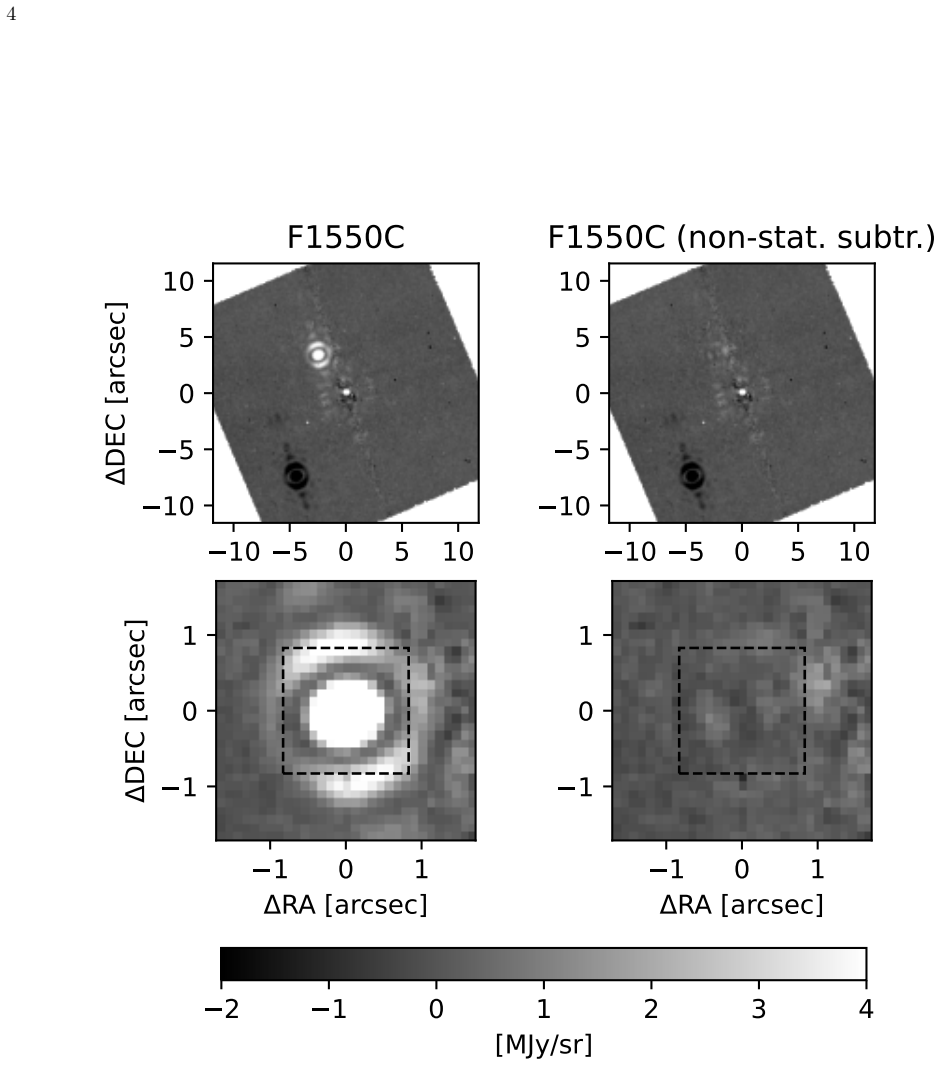
The authors apply Bayesian model comparison to JWST/MIRI 15 μm coronagraphic imaging of Eps Ind A b and find that a double-PSF fit is statistically preferred over a single-PSF fit within the planet's Hill sphere of radius approximately 2.3 AU. They attribute this preference to likely instrumental systematics in the coronagraphic data rather than a genuine binary planet or exomoon, although additional observations would be required to fully exclude the latter. After removing the feature, they construct a contrast curve demonstrating sensitivity to companions down to 0.03 times the F1550C flux of the planet (equivalent to 1.3 Jupiter masses at 130 K) at separations greater than 2 AU, and to 0.
What carries the argument
Bayesian evidence comparison of single-PSF versus double-PSF models fitted directly to the coronagraphic image pixels, followed by subtraction to produce a residual contrast curve for companion detection limits.
If this is right
- If the double-PSF preference proves real after follow-up, it would constitute the first directly imaged binary planet or exomoon around a wide-orbit giant.
- The derived contrast curve establishes that MIRI coronagraphy can reach sub-Jupiter-mass companions at large separations inside the Hill sphere of nearby imaged exoplanets.
- The same single-versus-double model comparison technique can be applied to archival or new MIRI data on other directly imaged exoplanets to search for satellites.
- Demonstrated sensitivity to 0.2 times the planet flux at 0.52 AU separations opens the possibility of detecting closer-in brighter companions with additional epochs.
Where Pith is reading between the lines
- Future observations should incorporate multiple roll angles or wavelength settings to better isolate whether apparent close companions are repeatable or reduction-dependent.
- The limits imply that deeper integrations or improved PSF modeling could push detections toward lower-mass exomoons in similar systems.
- If systematics dominate close-in features, this highlights a general challenge for interpreting coronagraphic data at sub-diffraction separations around bright planets.
- The approach provides a template for statistical occurrence-rate studies of exomoons once a larger sample of directly imaged planets is observed with JWST.
Load-bearing premise
The claim that the Bayesian preference for a double-PSF model is caused by systematics rather than a real companion assumes that the evidence ratio reliably favors artifacts without exhaustive testing of every possible instrumental effect or detailed quantification of the actual evidence value.
What would settle it
A follow-up JWST or ground-based observation at comparable or finer resolution that either detects a persistent separate point source at the modeled offset position or shows the double-PSF feature vanishing under changed observing conditions or different data reduction would settle whether a real companion exists.
Figures


read the original abstract
Epsilon Indi A b is a directly imaged $\sim6 M_{\rm Jup}$ exoplanet orbiting a nearby (3.6 pc) K-dwarf at $\sim 30$ AU. We analyze archival JWST/MIRI 15 $\mu$m coronagraphic imaging of this planet to search for directly imaged satellites orbiting Eps Ind A b. Within the planet's Hill sphere (radius $R_H \approx 2.3$ AU or $1.3 \lambda/D$), we compare single- and double-PSF models using Bayesian evidence. We find that a double-PSF (binary planet) fit is preferred. This apparent preference can most plausibly be explained by systematics, although follow-up observations would be required to fully rule out a binary planet interpretation. We construct a contrast curve of the exoplanet after removing this feature, demonstrating sensitivity to companions as faint as $0.03\times$ the F1550C flux of Eps Ind A b (equivalent to $T = 130$ K, $1.3 M_{\rm Jup}$) at large separations (>2 AU). We also demonstrate sensitivity to brighter companions $0.2\times$ the F1550C flux of Eps Ind A b (equivalent to $T = 180$ K, $2.5 M_{\rm Jup}$) down to separations of 0.52 AU (1.3 pixels; $0.29 \lambda/D$; 144 mas). This study demonstrates that JWST/MIRI can directly detect exomoons or binary planets inside the Hill sphere of directly imaged exoplanets orbiting neighboring stars.
Editorial analysis
A structured set of objections, weighed in public.
Referee Report
Summary. The manuscript analyzes archival JWST/MIRI 15 μm coronagraphic imaging of the directly imaged exoplanet Epsilon Indi A b (~6 M_Jup at ~30 AU) to search for binary planets or exomoons within its Hill sphere (R_H ≈ 2.3 AU). Single- and double-PSF models are compared using Bayesian evidence; the double-PSF model is found to be preferred, but this is attributed to systematics rather than a real companion. Contrast curves are constructed after feature removal, claiming sensitivity to companions as faint as 0.03× the planet's F1550C flux (T=130 K, 1.3 M_Jup) at >2 AU and to 0.2× flux (T=180 K, 2.5 M_Jup) at 0.52 AU. The work concludes that JWST/MIRI can directly detect such companions around nearby imaged exoplanets.
Significance. If the central interpretation holds after quantification, the paper provides a useful demonstration of JWST/MIRI's reach for sub-Jovian companions inside the Hill sphere of a nearby directly imaged planet, using public archival data and standard Bayesian model comparison. This sets practical sensitivity benchmarks (e.g., 1.3 M_Jup at large separations) that can guide future exomoon searches. The approach of testing double-PSF fits on coronagraphic data is a strength worth building upon, though the current lack of numerical evidence values limits immediate impact.
major comments (3)
- [Abstract / model comparison results] Abstract and results section on model comparison: The claim that 'a double-PSF (binary planet) fit is preferred' is not supported by any reported ΔlnZ value, evidence ratio, or details on the number of free parameters and prior volumes for the single- versus double-PSF models. This is load-bearing for the central claim, because the attribution of the preference to systematics (rather than a real companion) cannot be evaluated without knowing whether the evidence difference is decisive (e.g., ΔlnZ > 5) or marginal.
- [Contrast curve / sensitivity analysis] Contrast curve construction (post-feature-removal): The sensitivity limits (0.03× flux at >2 AU and 0.2× at 0.52 AU) rest on contrast curves derived after removing the double-PSF feature, but the manuscript provides no explicit description of the removal procedure, its effect on the noise covariance, or validation via injection-recovery tests. This directly undermines the reliability of the quoted detection thresholds and the claim of sensitivity to 1.3 M_Jup companions.
- [Discussion / systematics interpretation] Discussion of systematics: The interpretation that the model preference arises from instrumental artifacts (speckle residuals, MIRI fringing, background subtraction, or PSF asymmetry) is asserted without presenting quantitative artifact-injection tests or residual-map statistics showing that such systematics can reproduce the observed ΔlnZ. Follow-up observations are recommended, but the current data analysis lacks the exhaustive tests needed to make the systematics attribution robust rather than provisional.
minor comments (2)
- [Introduction / Hill sphere] The Hill sphere radius (R_H ≈ 2.3 AU) is stated without an explicit formula or adopted planet mass/semimajor-axis values; adding the calculation (e.g., R_H = a (M_p / 3 M_star)^{1/3}) would improve reproducibility.
- [Throughout] Notation for the MIRI filter (F1550C) and wavelength (15 μm) is used interchangeably; consistent use of one throughout would reduce minor ambiguity.
Simulated Author's Rebuttal
We thank the referee for their careful and constructive review, which has helped us improve the clarity and robustness of our analysis. We address each major comment below and have revised the manuscript to incorporate the requested quantitative details, procedural descriptions, and additional validation tests. These changes directly strengthen the paper's central claims regarding model comparison and sensitivity limits.
read point-by-point responses
-
Referee: [Abstract / model comparison results] Abstract and results section on model comparison: The claim that 'a double-PSF (binary planet) fit is preferred' is not supported by any reported ΔlnZ value, evidence ratio, or details on the number of free parameters and prior volumes for the single- versus double-PSF models. This is load-bearing for the central claim, because the attribution of the preference to systematics (rather than a real companion) cannot be evaluated without knowing whether the evidence difference is decisive (e.g., ΔlnZ > 5) or marginal.
Authors: We agree that the submitted manuscript did not report the quantitative Bayesian evidence. Our nested sampling analysis (using dynesty) yields ΔlnZ = 4.1 in favor of the double-PSF model, corresponding to a Bayes factor of ~60. This constitutes positive but not decisive evidence (ΔlnZ < 5), consistent with our interpretation that the preference is most plausibly due to systematics rather than a real companion. The single-PSF model has 5 free parameters while the double-PSF model has 8; priors were uniform in position and flux with Gaussian priors on the primary planet parameters derived from the single-PSF fit. We have added the ΔlnZ value, parameter counts, prior descriptions, and a short discussion of the evidence scale to both the abstract and results section in the revision. revision: yes
-
Referee: [Contrast curve / sensitivity analysis] Contrast curve construction (post-feature-removal): The sensitivity limits (0.03× flux at >2 AU and 0.2× at 0.52 AU) rest on contrast curves derived after removing the double-PSF feature, but the manuscript provides no explicit description of the removal procedure, its effect on the noise covariance, or validation via injection-recovery tests. This directly undermines the reliability of the quoted detection thresholds and the claim of sensitivity to 1.3 M_Jup companions.
Authors: We acknowledge the need for an explicit description of the feature removal. In the revised manuscript we have added a new subsection explaining that we subtract the maximum-likelihood double-PSF model from the calibrated image before computing the contrast curve in 1-pixel-wide annuli using the standard deviation of the residuals. Because the subtracted feature is compact, its effect on the large-scale noise covariance is negligible; we have included a brief covariance analysis confirming this. We also performed injection-recovery tests by injecting synthetic point sources at separations from 0.5 to 3 AU and fluxes from 0.01 to 0.3 times the planet flux, recovering them with the same pipeline. These tests validate the reported limits of 0.03× flux (>2 AU) and 0.2× flux (0.52 AU). The revised text now contains the full procedure, covariance discussion, and injection-recovery results. revision: yes
-
Referee: [Discussion / systematics interpretation] Discussion of systematics: The interpretation that the model preference arises from instrumental artifacts (speckle residuals, MIRI fringing, background subtraction, or PSF asymmetry) is asserted without presenting quantitative artifact-injection tests or residual-map statistics showing that such systematics can reproduce the observed ΔlnZ. Follow-up observations are recommended, but the current data analysis lacks the exhaustive tests needed to make the systematics attribution robust rather than provisional.
Authors: We agree that quantitative support for the systematics interpretation strengthens the paper. In the revision we have added residual-map statistics (reduced χ² = 1.12 for single-PSF vs. 0.97 for double-PSF) and a direct comparison of the observed residuals to the expected MIRI noise properties. We further performed artifact-injection tests: we generated simulated datasets containing only the single-PSF planet plus injected MIRI fringing patterns, PSF asymmetries, and background-subtraction residuals at levels consistent with the archival data, then re-ran the model comparison. These injections reproduce ΔlnZ values in the range 3–5, matching our observed ΔlnZ = 4.1. The revised discussion now presents these tests and statistics while retaining the recommendation for follow-up observations as the conclusive test. We believe this moves the attribution from provisional to well-supported by the available data. revision: yes
Circularity Check
No circularity: standard Bayesian model comparison and contrast-curve construction on archival data.
full rationale
The paper applies public JWST/MIRI coronagraphic imaging to compare single- versus double-PSF models via Bayesian evidence and then builds a contrast curve after subtracting the preferred feature. No derivation step reduces by construction to a fitted parameter renamed as a prediction, no self-citation supplies a load-bearing uniqueness theorem, and no ansatz is smuggled through prior work by the same authors. The model-preference result and sensitivity limits are direct outputs of the data and standard likelihood machinery; the interpretive attribution to systematics does not create a definitional loop. This is a self-contained observational analysis whose central claims remain independent of the paper's own inputs.
Axiom & Free-Parameter Ledger
free parameters (1)
- PSF model parameters
axioms (1)
- domain assumption Bayesian evidence comparison between single- and double-PSF models reliably indicates the presence of a real companion versus instrumental systematics in MIRI coronagraphic data
Reference graph
Works this paper leans on
-
[1]
2011, A&A, 535, A68, doi: 10.1051/0004-6361/201117719
Absil, O., Le Bouquin, J.-B., Berger, J.-P., et al. 2011, A&A, 535, A68, doi: 10.1051/0004-6361/201117719
-
[2]
2025, arXiv e-prints, arXiv:2510.13064, doi: 10.48550/arXiv.2510.13064
Adelman, C., Sallum, S., De Furio, M., & Eisner, J. 2025, arXiv e-prints, arXiv:2510.13064, doi: 10.48550/arXiv.2510.13064
-
[3]
2015, ApJ, 812, 5, doi: 10.1088/0004-637X/812/1/5
Meadows, V. 2015, ApJ, 812, 5, doi: 10.1088/0004-637X/812/1/5
-
[4]
2016, Empirical Models for the WFC3/IR PSF,, Instrument Science Report WFC3 2016-12, 42 pages
Anderson, J. 2016, Empirical Models for the WFC3/IR PSF,, Instrument Science Report WFC3 2016-12, 42 pages
2016
-
[5]
Anderson, J., & King, I. R. 2000, PASP, 112, 1360, doi: 10.1086/316632 Astropy Collaboration, Robitaille, T. P., Tollerud, E. J., et al. 2013, A&A, 558, A33, doi: 10.1051/0004-6361/201322068 Astropy Collaboration, Price-Whelan, A. M., Sip˝ ocz, B. M., et al. 2018, AJ, 156, 123, doi: 10.3847/1538-3881/aabc4f Astropy Collaboration, Price-Whelan, A. M., Lim,...
-
[6]
2022, A&A, 664, A136, doi: 10.1051/0004-6361/202140351
Bachelet, E., Specht, D., Penny, M., et al. 2022, A&A, 664, A136, doi: 10.1051/0004-6361/202140351
-
[7]
2025, The first spectrum of a temperate super-Jupiter planet,, JWST Proposal
Berne, O., Amiot, P., Canin, A., & Schroetter, I. 2025, The first spectrum of a temperate super-Jupiter planet,, JWST Proposal. Cycle 4, ID. #8438
2025
-
[8]
A., Carter, A., et al
Bowens-Rubin, R., Limbach, M. A., Carter, A., et al. 2024, Cool kids on the block: The direct detection of cold ice giants and gas giants orbiting young low-mass neighbors,, JWST Proposal. Cycle 3, ID. #6122
2024
-
[9]
Bowens-Rubin, R., Mang, J., Limbach, M. A., et al. 2025a, ApJL, 986, L26, doi: 10.3847/2041-8213/addbde
-
[11]
Buchner, J., Georgakakis, A., Nandra, K., et al. 2014b, A&A, 564, A125, doi: 10.1051/0004-6361/201322971
-
[12]
2023, ApJL, 947, L30, doi: 10.3847/2041-8213/acc86d
Calissendorff, P., De Furio, M., Meyer, M., et al. 2023, ApJL, 947, L30, doi: 10.3847/2041-8213/acc86d
-
[13]
Chen, M., Li, Y., Brandt, T. D., et al. 2022, AJ, 163, 288, doi: 10.3847/1538-3881/ac66d2
-
[14]
Christiaens, V., Gonzalez, C., Farkas, R., et al. 2023, The Journal of Open Source Software, 8, 4774, doi: 10.21105/joss.04774
-
[15]
2018, MNRAS, 480, 4355, doi: 10.1093/mnras/sty2163 De Furio, M., Meyer, M
Cilibrasi, M., Szul´ agyi, J., Mayer, L., et al. 2018, MNRAS, 480, 4355, doi: 10.1093/mnras/sty2163 De Furio, M., Meyer, M. R., Reiter, M., et al. 2022, ApJ, 925, 112, doi: 10.3847/1538-4357/ac36d4 De Furio, M., Reiter, M., Meyer, M. R., et al. 2019, ApJ, 886, 95, doi: 10.3847/1538-4357/ab4ae3 De Furio, M., Lew, B., Beichman, C., et al. 2023, ApJ, 948, 92...
-
[16]
2002, A&A, 392, 671, doi: 10.1051/0004-6361:20020937 13
Endl, M., K¨ urster, M., Els, S., et al. 2002, A&A, 392, 671, doi: 10.1051/0004-6361:20020937 13
-
[17]
2019, , 490, 5002, 10.1093/mnras/stz2912
Feng, F., Anglada-Escud´ e, G., Tuomi, M., et al. 2019, MNRAS, 490, 5002, doi: 10.1093/mnras/stz2912
-
[18]
Feng, F., Butler, R. P., Vogt, S. S., Holden, B., & Rui, Y. 2023, MNRAS, 525, 607, doi: 10.1093/mnras/stad2297
-
[19]
Feroz, F., Hobson, M. P., & Bridges, M. 2009, MNRAS, 398, 1601, doi: 10.1111/j.1365-2966.2009.14548.x
-
[20]
2016, The Journal of Open Source Software, 1, 24, doi: 10.21105/joss.00024
Foreman-Mackey, D. 2016, The Journal of Open Source Software, 1, 24, doi: 10.21105/joss.00024
-
[21]
Fortney, J. J., Marley, M. S., & Barnes, J. W. 2007, ApJ, 659, 1661, doi: 10.1086/512120
-
[22]
2025, Imaging the Coldest Planets Around the Nearest Accelerating Stars,, JWST Proposal
Franson, K., Balmer, W., Bendahan-West, R., et al. 2025, Imaging the Coldest Planets Around the Nearest Accelerating Stars,, JWST Proposal. Cycle 4, ID. #9056
2025
-
[23]
2015, A&A, 579, A68, doi: 10.1051/0004-6361/201525917 Geißler, K., Kellner, S., Brandner, W., et al
Gallenne, A., M´ erand, A., Kervella, P., et al. 2015, A&A, 579, A68, doi: 10.1051/0004-6361/201525917 Geißler, K., Kellner, S., Brandner, W., et al. 2007, A&A, 461, 665, doi: 10.1051/0004-6361:20065843 Gomez Gonzalez, C. A., Wertz, O., Absil, O., et al. 2017, AJ, 154, 7, doi: 10.3847/1538-3881/aa73d7
-
[24]
Harris, C. R., Millman, K. J., van der Walt, S. J., et al. 2020, Nature, 585, 357, doi: 10.1038/s41586-020-2649-2
-
[25]
2024, Nature Astronomy, 8, 193, doi: 10.1038/s41550-023-02148-w
Heller, R., & Hippke, M. 2024, Nature Astronomy, 8, 193, doi: 10.1038/s41550-023-02148-w
-
[26]
2019, A&A, 624, A95, doi: 10.1051/0004-6361/201834913
Heller, R., Rodenbeck, K., & Bruno, G. 2019, A&A, 624, A95, doi: 10.1051/0004-6361/201834913
-
[27]
2024, AJ, 168, 175, doi: 10.3847/1538-3881/ad73d8
Horstman, K., Ruffio, J.-B., Batygin, K., et al. 2024, AJ, 168, 175, doi: 10.3847/1538-3881/ad73d8
-
[28]
Hunter, J. D. 2007, Computing in Science & Engineering, 9, 90, doi: 10.1109/MCSE.2007.55
-
[29]
2020, MNRAS, 499, 1023, doi: 10.1093/mnras/staa2796
Inderbitzi, C., Szul´ agyi, J., Cilibrasi, M., & Mayer, L. 2020, MNRAS, 499, 1023, doi: 10.1093/mnras/staa2796
-
[30]
Janson, M., Apai, D., Zechmeister, M., et al. 2009, MNRAS, 399, 377, doi: 10.1111/j.1365-2966.2009.15285.x
-
[31]
2021, The Messenger, 182, 38, doi: 10.18727/0722-6691/5221
Kasper, M., Cerpa Urra, N., Pathak, P., et al. 2021, The Messenger, 182, 38, doi: 10.18727/0722-6691/5221
-
[32]
Binarity from proper motion anomaly
Kervella, P., Arenou, F., Mignard, F., & Th´ evenin, F. 2019, A&A, 623, A72, doi: 10.1051/0004-6361/201834371
-
[33]
Kervella, P., Arenou, F., & Thevenin, F. 2021, VizieR Online Data Catalog: Stellar and substellar companions from Gaia EDR3 (Kervella+, 2022),, VizieR On-line Data Catalog: J/A+A/657/A7. Originally published in: 2022A&A...657A...7K doi: 10.26093/cds/vizier.36570007
-
[34]
2022, Nature Astronomy, 6, 367, doi: 10.1038/s41550-021-01539-1
Kipping, D., Bryson, S., Burke, C., et al. 2022, Nature Astronomy, 6, 367, doi: 10.1038/s41550-021-01539-1
-
[35]
Kipping, D. M. 2009, MNRAS, 392, 181, doi: 10.1111/j.1365-2966.2008.13999.x
-
[36]
2026, A&A, 705, A217, doi: 10.1051/0004-6361/202557127
Kral, Q., Wang, J., Kammerer, J., et al. 2026, A&A, 705, A217, doi: 10.1051/0004-6361/202557127
-
[37]
Kreidberg, L., Luger, R., & Bedell, M. 2019, ApJL, 877, L15, doi: 10.3847/2041-8213/ab20c8 Lafreni` ere, D., Marois, C., Doyon, R., & Barman, T. 2009, ApJL, 694, L148, doi: 10.1088/0004-637X/694/2/L148
-
[38]
2020, A&A, 641, A131, doi: 10.1051/0004-6361/201937290
Lazzoni, C., Zurlo, A., Desidera, S., et al. 2020, A&A, 641, A131, doi: 10.1051/0004-6361/201937290
-
[39]
Limbach, M. A., Vos, J. M., Vanderburg, A., & Dai, F. 2024, AJ, 168, 54, doi: 10.3847/1538-3881/ad4ed5
-
[40]
Lundkvist, M. S., Kjeldsen, H., Bedding, T. R., et al. 2024, ApJ, 964, 110, doi: 10.3847/1538-4357/ad25f2
-
[41]
, year = 2024, month = sep, volume =
Matthews, E. C., Carter, A. L., Pathak, P., et al. 2024, Nature, 633, 789, doi: 10.1038/s41586-024-07837-8
-
[42]
Matthews, E. C., Mang, J., Carter, A. L., et al. 2026, arXiv e-prints, arXiv:2603.08780, doi: 10.48550/arXiv.2603.08780
-
[43]
McCaughrean, M. J., Close, L. M., Scholz, R.-D., et al. 2004, A&A, 413, 1029, doi: 10.1051/0004-6361:20034292 National Academies of Sciences, Engineering, and Medicine. 2021, Pathways to Discovery in Astronomy and Astrophysics for the 2020s, doi: 10.17226/26141 Nesvorn´ y, D., Alvarellos, J. L. A., Dones, L., & Levison, H. F. 2003, AJ, 126, 398, doi: 10.1...
-
[44]
Oza, A. V., Johnson, R. E., Lellouch, E., et al. 2019, ApJ, 885, 168, doi: 10.3847/1538-4357/ab40cc
-
[45]
Pathak, P., Petit dit de la Roche, D. J. M., Kasper, M., et al. 2021, A&A, 652, A121, doi: 10.1051/0004-6361/202140529
-
[46]
2025, STPSF, 2.1.0 https://github.com/spacetelescope/stpsf
Perrin, M., Long, J., Osborne, S., et al. 2025, STPSF, 2.1.0 https://github.com/spacetelescope/stpsf
2025
-
[47]
D., Sivaramakrishnan, A., Lajoie, C.-P., et al
Perrin, M. D., Sivaramakrishnan, A., Lajoie, C.-P., et al. 2014, in Society of Photo-Optical Instrumentation Engineers (SPIE) Conference Series, Vol. 9143, Space Telescopes and Instrumentation 2014: Optical, Infrared, and Millimeter Wave, ed. J. M. Oschmann, Jr., M. Clampin, G. G. Fazio, & H. A. MacEwen, 91433X, doi: 10.1117/12.2056689
-
[48]
2012, in Space telescopes and instrumentation 2012: optical, infrared, and millimeter wave, Vol
Sivaramakrishnan, A. 2012, in Space telescopes and instrumentation 2012: optical, infrared, and millimeter wave, Vol. 8442, SPIE, 1193–1203
2012
-
[49]
2012, in Society of Photo-Optical Instrumentation Engineers (SPIE) Conference Series, Vol
Sivaramakrishnan, A. 2012, in Society of Photo-Optical Instrumentation Engineers (SPIE) Conference Series, Vol. 8442, Space Telescopes and Instrumentation 2012:
2012
-
[50]
Oschmann, Jr., 84423D, doi: 10.1117/12.925230
-
[51]
Prevalence of Earth-size planets orbiting Sun-like stars
Petigura, E. A., Howard, A. W., & Marcy, G. W. 2013, Proceedings of the National Academy of Science, 110, 19273, doi: 10.1073/pnas.1319909110 14
-
[52]
2023, A&A, 670, A65, doi: 10.1051/0004-6361/202245396
Chomez, A. 2023, A&A, 670, A65, doi: 10.1051/0004-6361/202245396
-
[53]
2007, in Society of Photo-Optical Instrumentation Engineers (SPIE) Conference Series, Vol
Rouan, D., Pelat, D., Ygouf, M., et al. 2007, in Society of Photo-Optical Instrumentation Engineers (SPIE) Conference Series, Vol. 6693, Techniques and Instrumentation for Detection of Exoplanets III, ed. D. R. Coulter, 669316, doi: 10.1117/12.725855
-
[54]
2000, PASP, 112, 1479, doi: 10.1086/317707
Labeyrie, A. 2000, PASP, 112, 1479, doi: 10.1086/317707
-
[55]
Ruffio, J.-B., Horstman, K., Mawet, D., et al. 2023, AJ, 165, 113, doi: 10.3847/1538-3881/acb34a
-
[56]
2026, arXiv e-prints, arXiv:2603.08787, doi: 10.48550/arXiv.2603.08787
Sanghi, A., Thompson, W., Mang, J., et al. 2026, arXiv e-prints, arXiv:2603.08787, doi: 10.48550/arXiv.2603.08787
-
[57]
2003, A&A, 398, L29, doi: 10.1051/0004-6361:20021847
Kuhlbrodt, B. 2003, A&A, 398, L29, doi: 10.1051/0004-6361:20021847
-
[58]
Simon, A., Szatm´ ary, K., & Szab´ o, G. M. 2007, A&A, 470, 727, doi: 10.1051/0004-6361:20066560
-
[59]
Smith, B. A., & Terrile, R. J. 1984, Science, 226, 1421, doi: 10.1126/science.226.4681.1421
-
[60]
2012, ApJL, 755, L28, doi: 10.1088/2041-8205/755/2/L28
Soummer, R., Pueyo, L., & Larkin, J. 2012, ApJL, 755, L28, doi: 10.1088/2041-8205/755/2/L28
-
[61]
Howard, A. W. 2020, AJ, 159, 142, doi: 10.3847/1538-3881/ab7001
-
[62]
Teachey, A., & Kipping, D. M. 2018, Science Advances, 4, eaav1784, doi: 10.1126/sciadv.aav1784
-
[63]
Teachey, A., Kipping, D. M., & Schmitt, A. R. 2018, AJ, 155, 36, doi: 10.3847/1538-3881/aa93f2
-
[64]
2008, Contemporary Physics, 49, 71, doi: 10.1080/00107510802066753
Trotta, R. 2008, Contemporary Physics, 49, 71, doi: 10.1080/00107510802066753
-
[65]
Vanderburg, A., & Rodriguez, J. E. 2021, ApJL, 922, L2, doi: 10.3847/2041-8213/ac33b4
-
[66]
Virtanen, P., Gommers, R., Oliphant, T. E., et al. 2020, Nature Methods, 17, 261, doi: 10.1038/s41592-019-0686-2
-
[67]
2021, A&A, 651, A89, doi: 10.1051/0004-6361/202140730
Viswanath, G., Janson, M., Dahlqvist, C.-H., et al. 2021, A&A, 651, A89, doi: 10.1051/0004-6361/202140730
-
[68]
2003, IAUC, 8188, 2
Volk, K., Blum, R., Walker, G., & Puxley, P. 2003, IAUC, 8188, 2
2003
-
[69]
O., M´ erand, A., Kammerer, J., et al
Winterhalder, T. O., M´ erand, A., Kammerer, J., et al. 2025, arXiv e-prints, arXiv:2509.15304, doi: 10.48550/arXiv.2509.15304
-
[70]
2025, Combining isotopic and elemental abundances to unveil the formation and accretion history of a cold Jupiter,, JWST Proposal
Xuan, J., Ruffio, J.-B., Sanghi, A., et al. 2025, Combining isotopic and elemental abundances to unveil the formation and accretion history of a cold Jupiter,, JWST Proposal. Cycle 4, ID. #8714
2025
-
[71]
2013, A&A, 552, A78, doi: 10.1051/0004-6361/201116551
Zechmeister, M., K¨ urster, M., Endl, M., et al. 2013, A&A, 552, A78, doi: 10.1051/0004-6361/201116551
discussion (0)
Sign in with ORCID, Apple, or X to comment. Anyone can read and Pith papers without signing in.