Entropic Trapping of Hard Spheres in Spherical Confinement
Pith reviewed 2026-05-07 17:35 UTC · model grok-4.3
The pith
Entropic forces drive large hard spheres to icosahedron vertices in spherical confinement
A machine-rendered reading of the paper's core claim, the machinery that carries it, and where it could break.
Core claim
Entropic forces drive the large spheres to the cluster surface, where they settle into free energy minima at the icosahedron vertices. Notably, the addition of twelve large spheres results in the formation of a perfect icosahedral frame. Free energy calculations via umbrella sampling are used to quantify this process and show that both the migration to the cluster surface and the trapping at the vertices with trapping strength of multiple k_B T results from free energy minimization. Moreover, the crystallization pathway and dynamics of large spheres are consistent across different systems, suggesting robustness of entropic trapping.
What carries the argument
Entropic forces arising from concentric shells of small spheres near the crystallization transition, leading to free energy minima at icosahedral vertices via umbrella sampling
If this is right
- The addition of twelve large spheres results in the formation of a perfect icosahedral frame.
- The crystallization pathway and dynamics of large spheres are consistent across different systems.
- Both migration to the surface and trapping at vertices with strength of multiple k_B T result from free energy minimization.
Where Pith is reading between the lines
- This trapping could be exploited to position defects precisely in self-assembled colloidal structures.
- The effect may be observable in other confined colloidal systems with different particle size ratios.
- Extensions to non-hard interactions or deformable confinement could test the limits of this entropic mechanism.
Load-bearing premise
Purely repulsive hard-sphere interactions in a perfectly spherical container capture all relevant physics without contributions from polydispersity or surface forces.
What would settle it
Finding that large spheres do not preferentially occupy icosahedron vertices in a hard-sphere simulation under spherical confinement near the crystallization transition.
Figures


read the original abstract
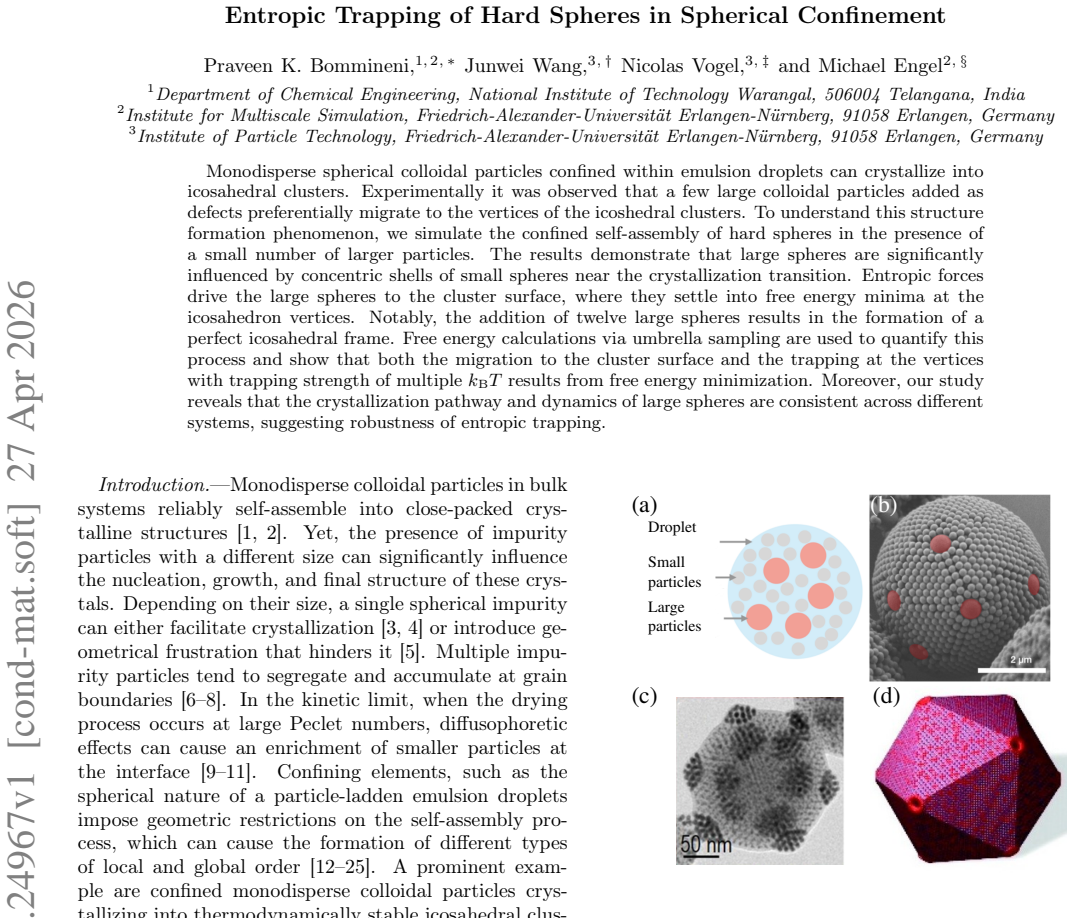
Monodisperse spherical colloidal particles confined within emulsion droplets can crystallize into icosahedral clusters. Experimentally it was observed that a few large colloidal particles added as defects preferentially migrate to the vertices of the icoshedral clusters. To understand this structure formation phenomenon, we simulate the confined self-assembly of hard spheres in the presence of a small number of larger particles. The results demonstrate that large spheres are significantly influenced by concentric shells of small spheres near the crystallization transition. Entropic forces drive the large spheres to the cluster surface, where they settle into free energy minima at the icosahedron vertices. Notably, the addition of twelve large spheres results in the formation of a perfect icosahedral frame. Free energy calculations via umbrella sampling are used to quantify this process and show that both the migration to the cluster surface and the trapping at the vertices with trapping strength of multiple $k_\text{B}T$ results from free energy minimization. Moreover, our study reveals that the crystallization pathway and dynamics of large spheres are consistent across different systems, suggesting robustness of entropic trapping.
Editorial analysis
A structured set of objections, weighed in public.
Referee Report
Summary. The paper claims that in molecular dynamics simulations of hard spheres in rigid spherical confinement, a small number of larger spheres are driven by entropic forces arising from concentric shells of small spheres near the crystallization transition to migrate to the cluster surface and become trapped at icosahedral vertices, with free-energy minima of several kBT quantified via umbrella sampling. Adding exactly twelve large spheres produces a perfect icosahedral frame, and the crystallization pathway and large-sphere dynamics are asserted to be robust across systems.
Significance. If the central claims hold, the work supplies a quantitative entropic mechanism for the experimentally observed localization of defects at icosahedral vertices in colloidal clusters, supported by explicit simulations and umbrella-sampling free-energy calculations rather than fitted parameters. The reported consistency of pathways across systems and the parameter-free character of the hard-sphere model are strengths that could inform design of confined self-assembly.
major comments (2)
- [Abstract] Abstract and implied methods: the central claim of robustness of entropic trapping rests on strictly hard-sphere repulsions inside a rigid spherical boundary, yet the manuscript provides no explicit sensitivity tests to polydispersity, weak attractions, surface roughness, or boundary fluctuations that are known to exist in real emulsion droplets; because the reported vertex minima are only several kBT, even modest perturbations could eliminate the trapping, directly undermining the assertion that the mechanism explains experimental observations.
- [Abstract] The free-energy calculations via umbrella sampling are invoked to quantify both surface migration and vertex trapping, but without reported error bars, convergence checks, or raw histograms in the main text or supplementary material, it is impossible to assess whether the stated minima of multiple kBT are statistically resolved from zero or from other surface sites.
minor comments (1)
- [Abstract] The abstract refers to 'concentric shells of small spheres near the crystallization transition' without defining how the transition density or temperature is identified in the simulations or how shell structure is quantified.
Simulated Author's Rebuttal
We thank the referee for their careful reading and constructive comments. We address the two major points below, providing honest clarifications on the scope of our hard-sphere study while indicating revisions that will strengthen the presentation without altering the core results.
read point-by-point responses
-
Referee: [Abstract] Abstract and implied methods: the central claim of robustness of entropic trapping rests on strictly hard-sphere repulsions inside a rigid spherical boundary, yet the manuscript provides no explicit sensitivity tests to polydispersity, weak attractions, surface roughness, or boundary fluctuations that are known to exist in real emulsion droplets; because the reported vertex minima are only several kBT, even modest perturbations could eliminate the trapping, directly undermining the assertion that the mechanism explains experimental observations.
Authors: We agree that the manuscript contains no sensitivity tests to polydispersity, weak attractions, surface roughness, or boundary fluctuations, and that the reported minima of several kBT leave open the possibility that modest perturbations could reduce or eliminate the trapping. Our work is strictly limited to the ideal hard-sphere model with rigid confinement; the abstract and discussion frame the entropic trapping and its apparent robustness as features of this controlled setting, motivated by but not directly claiming to explain all aspects of experimental emulsion-droplet systems. We will revise the abstract and add a dedicated paragraph in the discussion to explicitly state these limitations, emphasize that the mechanism is demonstrated only in the hard-sphere limit, and note that assessing robustness under realistic perturbations is an important direction for future work. This constitutes a partial revision: we add clarifying text but do not perform new simulations. revision: partial
-
Referee: [Abstract] The free-energy calculations via umbrella sampling are invoked to quantify both surface migration and vertex trapping, but without reported error bars, convergence checks, or raw histograms in the main text or supplementary material, it is impossible to assess whether the stated minima of multiple kBT are statistically resolved from zero or from other surface sites.
Authors: We acknowledge that the current version of the manuscript does not report error bars, convergence checks, or raw histograms for the umbrella-sampling free-energy profiles. These statistical details were omitted for brevity but are available from our analysis. We will add the missing information—error bars on the free-energy curves, a statement on convergence criteria, and representative histograms—to the supplementary material in the revised submission, allowing readers to evaluate whether the reported minima of multiple kBT are statistically resolved. This will be a full revision on this point. revision: yes
Circularity Check
No circularity: results from explicit MD and umbrella sampling free-energy calculations
full rationale
The paper derives its claims about entropic trapping and icosahedral vertex localization through direct molecular dynamics simulations of hard spheres under spherical confinement, followed by umbrella sampling to compute free-energy landscapes. These are first-principles computations from the hard-sphere potential and rigid boundary conditions; the observed migration to the surface and minima at vertices (several kBT deep) emerge from the sampled trajectories rather than from any parameter fitted to a subset of the data and then reused as a prediction. No equations, ansatzes, or self-citations are invoked in a load-bearing way that would make the reported structures equivalent to the inputs by construction. The consistency across systems is an observed outcome of the simulations, not a definitional tautology.
Axiom & Free-Parameter Ledger
free parameters (1)
- size ratio of large to small spheres
axioms (1)
- domain assumption Purely repulsive hard-sphere interactions with no attractive or soft potentials
Reference graph
Works this paper leans on
-
[1]
Phase Transition for a Hard Sphere System,
B. J. Alder and T. E. Wainwright, “Phase Transition for a Hard Sphere System,” The Journal of Chemical Physics 27, 1208–1209 (1957)
work page 1957
-
[2]
Prediction of absolute crystal- nucleation rate in hard-sphere colloids,
S. Auer and D. Frenkel, “Prediction of absolute crystal- nucleation rate in hard-sphere colloids,” Nature409, 1020–1023 (2001)
work page 2001
-
[3]
Onset of het- erogeneous crystal nucleation in colloidal suspensions,
A. Cacciuto, S. Auer, and D. Frenkel, “Onset of het- erogeneous crystal nucleation in colloidal suspensions,” Nature428, 404–406 (2004)
work page 2004
-
[4]
Crystallization seeds favour crystallization only during initial growth,
E. Allahyarov, K. Sandomirski, S. U. Egelhaaf, and H. Löwen, “Crystallization seeds favour crystallization only during initial growth,” Nature Communications6, 8110 (2015)
work page 2015
-
[5]
Colloidal hard-sphere crystal growth frustrated by large spherical impurities,
V. W. A. de Villeneuve, R. P. A. Dullens, E. Groen- eveld D. G. A. L. Aarts, W. K. Kegel J. H. Scherff, and H. N. W. Lekkerkerker, “Colloidal hard-sphere crystal growth frustrated by large spherical impurities,” Science 309, 1231–1233 (2005)
work page 2005
-
[6]
Impurity parti- tioning during colloidal crystallization,
J. Nozawa, S. Uda, Y. Naradate, H. Koizumi, K. Fuji- wara, A. Toyotama, and J. Yamanaka, “Impurity parti- tioning during colloidal crystallization,” Journal of Phys- ical Chemistry B117, 5289–5295 (2013)
work page 2013
-
[7]
F. A. Lavergne, S. Diana, D. G. A. L. Aarts, and R. P. A. Dullens, “Equilibrium Grain Boundary Segrega- tion and Clustering of Impurities in Colloidal Polycrys- talline Monolayers,” Langmuir32, 12716–12724 (2016)
work page 2016
-
[8]
PartitioningofSize-Mismatched Impurities to Grain Boundaries in 2d Solid Hard-Sphere Monolayers,
Z.GuoandJ.T.Kindt,“PartitioningofSize-Mismatched Impurities to Grain Boundaries in 2d Solid Hard-Sphere Monolayers,” Langmuir34, 12947–12956 (2018)
work page 2018
-
[9]
Hierarchical structure formation of nanopar- ticulate spray-dried composite aggregates,
S.Zellmer, G.Garnweitner, T.Breinlinger, T.Kraft, and C. Schilde, “Hierarchical structure formation of nanopar- ticulate spray-dried composite aggregates,” ACS Nano9, 10749–10757 (2015)
work page 2015
-
[10]
Dynamic stratification in drying films of colloidal mixtures,
A. Fortini, I. Martín-Fabiani, J. L. De La Haye, P. Y. Dugas, M. Lansalot, F. D’Agosto, E. Bourgeat-Lami, J. L. Keddie, and R. P. Sear, “Dynamic stratification in drying films of colloidal mixtures,” Physical Review Letters116, 118301 (2016)
work page 2016
-
[11]
Segregation in drying binary col- loidal droplets,
W. Liu, J. Midya, M. Kappl, H. J. Butt, and A. Nikoubashman, “Segregation in drying binary col- loidal droplets,” ACS Nano13, 4972–4979 (2019)
work page 2019
-
[12]
Dense packing and symmetry in small clusters of microspheres,
V. N. Manoharan, M. T. Elsesser, and D. J. Pine, “Dense packing and symmetry in small clusters of microspheres,” Science301, 483–487 (2003)
work page 2003
-
[13]
Entropy-driven formation of large icosahe- dral colloidal clusters by spherical confinement,
B.DeNijs, S.Dussi, F.Smallenburg, J.D.Meeldijk, D.J. Groenendijk, L. Filion, A. Imhof, A. Van Blaaderen, and M. Dijkstra, “Entropy-driven formation of large icosahe- dral colloidal clusters by spherical confinement,” Nature Materials14, 56–60 (2015)
work page 2015
-
[14]
Clusters of polyhedra in spherical confinement,
E. G. Teich, G. van Anders, D. Klotsa, J. Dshemuchadse, and S. C. Glotzer, “Clusters of polyhedra in spherical confinement,” Proceedings of the National Academy of Sciences113, E669–E678 (2016)
work page 2016
-
[15]
Pressure-controlled formation of crystalline, Janus, and core-shell supraparticles,
T. Kister, M. Mravlak, T. Schilling, and T. Kraus, “Pressure-controlled formation of crystalline, Janus, and core-shell supraparticles,” Nanoscale8, 13377–13384 (2016)
work page 2016
-
[16]
Magic num- ber colloidal clusters as minimum free energy structures,
J. Wang, T. Mbah, C. F.and Przybilla, B. Apeleo Zu- biri, E. Spiecker, M. Engel, and N. Vogel, “Magic num- ber colloidal clusters as minimum free energy structures,” Nature Communications9, 5259 (2018)
work page 2018
-
[17]
Interplay between spherical confinement and particle shape on the self-assembly of rounded cubes,
D. Wang, M. Hermes, R. Kotni, Y. Wu, N. Tasios, Y. Liu, B. de Nijs, E. B. van der Wee, C. B. Murray, M. Dijk- stra, and A. van Blaaderen, “Interplay between spherical confinement and particle shape on the self-assembly of rounded cubes,” Nature Communications9, 2228 (2018)
work page 2018
-
[18]
Crystallization of Nanocrystals in Spher- ical Confinement Probed by in Situ X-ray Scattering,
F. Montanarella, J. J. Geuchies, T. Dasgupta, P. T. Prins, C. Van Overbeek, R. Dattani, P. Baesjou, M. Di- jkstra, A. V. Petukhov, A. Van Blaaderen, and D. Van- maekelbergh, “Crystallization of Nanocrystals in Spher- ical Confinement Probed by in Situ X-ray Scattering,” Nano Letters18, 3675–3681 (2018)
work page 2018
-
[19]
Free Energy Land- scape of Colloidal Clusters in Spherical Confinement,
J. Wang, C. F. Mbah, T. Przybilla, S. Englisch, E. Spiecker, M. Engel, and N. Vogel, “Free Energy Land- scape of Colloidal Clusters in Spherical Confinement,” ACS Nano13, 9005–9015 (2019)
work page 2019
-
[20]
Controlled assembly of icosahedral colloidal clusters for structural coloration,
C. Kim, K. Jung, J. W. Yu, S. Park, S. H. Kim, W. B. Lee, H. Hwang, V. N. Manoharan, and J. H. Moon, “Controlled assembly of icosahedral colloidal clusters for structural coloration,” Chemistry of Materials32, 9704– 9712 (2020)
work page 2020
-
[21]
Binary icosahedral clusters of hard spheres in spherical confinement,
D. Wang, T. Dasgupta, E. B. van der Wee, D. Zanaga, 6 T. Altantzis, Y. Wu, G. M. Coli, C. B. Murray, S. Bals, M. Dijkstra, and A. van Blaaderen, “Binary icosahedral clusters of hard spheres in spherical confinement,” Nature Physics17, 128–134 (2021)
work page 2021
-
[22]
Quantitative 3d real-space anal- ysis of laves phase supraparticles,
D. Wang, E. B. van der Wee, D. Zanaga, T. Altantzis, Y. Wu, T. Dasgupta, M. Dijkstra, C. B. Murray, S. Bals, and A. van Blaaderen, “Quantitative 3d real-space anal- ysis of laves phase supraparticles,” Nature Communica- tions12, 3980 (2021)
work page 2021
-
[23]
G. Zhu, L. Gao, Z. Xu, X. Dai, X. Zhang, and L. T. Yan, “Entropy-Driven Unconventional Crystallization of SphericalColloidalNanocrystalsConfinedinWideCylin- ders,” Nano Letters21, 8439–8446 (2021)
work page 2021
-
[24]
S. Lee and S. C. Glotzer, “Entropically engineered forma- tion of fivefold and icosahedral twinned clusters of col- loidal shapes,” Nature Communications13, 7362 (2022)
work page 2022
-
[25]
Early-stage bifurcation of crystallization in a sphere,
C. F. Mbah, J. Wang, S. Englisch, P. Bommineni, N. R Varela-Rosales, E. Spiecker, N. Vogel, and M. Engel, “Early-stage bifurcation of crystallization in a sphere,” Nature Communications14, 5299 (2023)
work page 2023
-
[26]
Nanoparticle clusters with lennard-jones geometries,
J. Lacava, P. Born, and T. Kraus, “Nanoparticle clusters with lennard-jones geometries,” Nano Letters12, 3279– 3282 (2012)
work page 2012
-
[27]
Influ- ence of sphericity on surface termination of icosahedral colloidal clusters,
Y. H. Choi, J. Lee, E. Amstad, and S. H. Kim, “Influ- ence of sphericity on surface termination of icosahedral colloidal clusters,” Small20, 2309512 (2024)
work page 2024
-
[28]
Impurity dif- fusion in magic-size icosahedral clusters,
D. Nelli, F. Pietrucci, and R. Ferrando, “Impurity dif- fusion in magic-size icosahedral clusters,” The Journal of Chemical Physics155, 144304 (2021)
work page 2021
-
[29]
M. Xu, E. J. Kim, Y. J. Lee, H. Lee, K. Jung, J. Choi, S. H. Kim, Y. Kim, H. Yun, and B. J. Kim, “Icosahedral supracrystal assembly from polymer-grafted nanoparti- cles via interplay of interfacial energy and confinement effect,” Science Advances10, eado0745 (2024)
work page 2024
-
[30]
Shape control through molecular segregation in gi- ant surfactant aggregates,
M. Dubois, V. Lizunov, A. Meister, T. Gulik-Krzywicki, J. M. Verbavatz, E. Perez, J. Zimmerberg, and T. Zemb, “Shape control through molecular segregation in gi- ant surfactant aggregates,” Proceedings of the National Academy of Sciences101, 15082–15087 (2004)
work page 2004
-
[31]
Layering transitions and dynamics of confined liquid films,
J. Gao, W. D. Luedtke, and U. Landman, “Layering transitions and dynamics of confined liquid films,” Phys- ical Review Letters79, 705–708 (1997)
work page 1997
-
[32]
Layering and position-dependent diffusive dynam- ics of confined fluids,
J. Mittal, T. M. Truskett, J. R. Errington, and G. Hum- mer, “Layering and position-dependent diffusive dynam- ics of confined fluids,” Physical Review Letters100, 145901 (2008)
work page 2008
-
[33]
Density fluctuations of hard-sphere fluids in nar- row confinement,
K. Nygård, S. Sarman, K. Hyltegren, S. Chodankar, E. Perret, J. Buitenhuis, J. F. van der Veen, and R. Kjel- lander, “Density fluctuations of hard-sphere fluids in nar- row confinement,” Physical Review X6, 011014 (2016)
work page 2016
-
[34]
A. Fortini and M. Dijkstra, “Phase behaviour of hard spheres confined between parallel hard plates: manip- ulation of colloidal crystal structures by confinement,” Journal of Physics: Condensed Matter18, L371 (2006)
work page 2006
-
[35]
Morphology selection kinetics of crystallization in a sphere,
Y. Chen, Z. Yao, S. Tang, H. Tong, T. Yanagishima, H. Tanaka, and P. Tan, “Morphology selection kinetics of crystallization in a sphere,” Nature Physics17, 121– 127 (2021)
work page 2021
-
[36]
Melting transition and communal entropy for hard spheres,
W. G. Hoover and F. H. Ree, “Melting transition and communal entropy for hard spheres,” The Journal of Chemical Physics49, 3609–3617 (1968)
work page 1968
-
[37]
Phase diagram of hard tetrahedra,
A. Haji-Akbari, M. Engel, and S. C. Glotzer, “Phase diagram of hard tetrahedra,” The Journal of Chemical Physics135, 194101 (2011)
work page 2011
- [38]
-
[39]
Optimized monte carlo data analysis,
A. M. FerrenbergandR. H.Swendsen,“Optimized monte carlo data analysis,” Physical Review Letters63, 1195– 1198 (1989)
work page 1989
-
[40]
The weighted histogram analysis method for free-energy calculations on biomolecules. i. the method,
S. Kumar, J. M. Rosenberg, D. Bouzida, R. H. Swendsen, and P. A. Kollman, “The weighted histogram analysis method for free-energy calculations on biomolecules. i. the method,” Journal of Computational Chemistry13, 1011–1021 (1992)
work page 1992
-
[41]
WHAM: the weighted histogram anal- ysis method-2.010,
A. Grossfield, “WHAM: the weighted histogram anal- ysis method-2.010,”http://membrane.urmc.rochester. edu/wordpress/?page_id=126(2024)
work page 2024
-
[42]
J. Kästner, “Umbrella sampling,” WIREs Computational Molecular Science1, 932–942 (2011)
work page 2011
-
[43]
Colloido- somes: Selectively permeable capsules composed of col- loidal particles,
A. D. Dinsmore, Ming F. Hsu, M. G. Nikolaides, Manuel Marquez, A. R. Bausch, and D. A. Weitz, “Colloido- somes: Selectively permeable capsules composed of col- loidal particles,” Science298, 1006–1009 (2002)
work page 2002
-
[44]
Curvature-controlled defect localization in elastic surface crystals,
F. L. Jiménez, N. Stoop, R. Lagrange, J. Dunkel, and P. M. Reis, “Curvature-controlled defect localization in elastic surface crystals,” Physical Review Letters116, 104301 (2016)
work page 2016
-
[45]
Topology-driven surface patterning of liq- uid spheres,
S. Das, A. V. Butenko, Y. Mastai, M. Deutsch, and E. Sloutskin, “Topology-driven surface patterning of liq- uid spheres,” Nature Physics18, 1177–1180 (2022)
work page 2022
-
[46]
S. Hacmon, S. R. Liber, L. Shool, A. V. Butenko, A. Atkins, and E. Sloutskin, ““magic numbers” in self- faceting of alcohol-doped emulsion droplets,” Small19, 2301637 (2023)
work page 2023
-
[47]
Flower-shaped2dcrystalsgrownincurvedfluid vesicle membranes,
H. Wan, G. Jeon, W. Xin, G. M. Grason, and M. M. Santore,“Flower-shaped2dcrystalsgrownincurvedfluid vesicle membranes,” Nature Communications15, 3442 (2024)
work page 2024
-
[48]
Programmable potentials choreograph defects in a col- loidal crystal shell,
G. Zhu, L. Gao, Y. Wang, T. Tlusty, and L. T. Yan, “Programmable potentials choreograph defects in a col- loidal crystal shell,” Physical Review Letters132, 048201 (2024)
work page 2024
-
[49]
General theory for packing icosahedral shells into multi-component aggregates,
Nicolò Canestrari, Diana Nelli, and Riccardo Fer- rando, “General theory for packing icosahedral shells into multi-component aggregates,” Nature Communications 16(2025), 10.1038/s41467-025-56952-1
-
[50]
Effect of mechanical properties on multicomponent shell patterning,
S. Li, D. A. Matoz-Fernandez, and M. Olvera de la Cruz, “Effect of mechanical properties on multicomponent shell patterning,” ACS Nano15, 14804–14812 (2021)
work page 2021
-
[51]
A. Zlotnick, “To build a virus capsid,” Journal of Molec- ular Biology241, 59–67 (1994)
work page 1994
-
[52]
M.F.Hagan,“Modelingviralcapsidassembly,” Advances in Chemical Physics155, 1–68 (2014)
work page 2014
-
[53]
Accurate design of megadalton- scale two-component icosahedral protein complexes,
J. B. Bale, S. Gonen, Y. Liu, W. Sheffler, D. Ellis, C. Thomas, D. Cascio, T. O. Yeates, T.r Gonen, N. P. King, and D. Baker, “Accurate design of megadalton- scale two-component icosahedral protein complexes,” Sci- ence353, 389–394 (2016)
work page 2016
-
[54]
Complex Crystals from Size-Disperse Spheres,
P. K. Bommineni, N. R. Varela-Rosales, M. Klement, and M. Engel, “Complex Crystals from Size-Disperse Spheres,” Physical Review Letters122, 128005 (2019)
work page 2019
-
[55]
Sponta- neous Crystallization in Systems of Binary Hard Sphere Colloids,
P. K. Bommineni, M. Klement, and M. Engel, “Sponta- neous Crystallization in Systems of Binary Hard Sphere Colloids,” Physical Review Letters124, 218003 (2020)
work page 2020
-
[56]
Hard sphere simulation in statistical physics – methodologies and applications,
Masaharu Isobe, “Hard sphere simulation in statistical physics – methodologies and applications,” Molecular Simulation42, 1317–1329 (2016). 7 0 2 4 6 8 10 0 0.5 1 1.5 2 2.5 3 3.5 4 4.4 4.6 4.8 5 5.2 5.4 5.6 Mean squared displacement [ σL2] Pressure P* Simulation time t[106t0] FIG. S1. Evolution of dimensionless pressureP∗ and mean squared displacement of ...
work page 2016
-
[57]
This introduced a factor √ 2, which was not present in the particle-wall collision case. Asymmetric particle-particle collision Finally, we consider the most general case, the collision of two sphere of different diametersσ1 andσ 2 and different massesm 1 andm 2. Consider particle 1 and 2 have normal velocitiesv1 andv 2 right before the collision. The col...
discussion (0)
Sign in with ORCID, Apple, or X to comment. Anyone can read and Pith papers without signing in.