Recognition: unknown
The properties and predictions of quasi-periodic oscillations around a black hole in nonlocal gravity
Pith reviewed 2026-05-07 15:21 UTC · model grok-4.3
The pith
Nonlocal gravity reduces energies of circular orbits around black holes and increases their QPO frequencies, limiting the parameter α to at most 0.452M.
A machine-rendered reading of the paper's core claim, the machinery that carries it, and where it could break.
Core claim
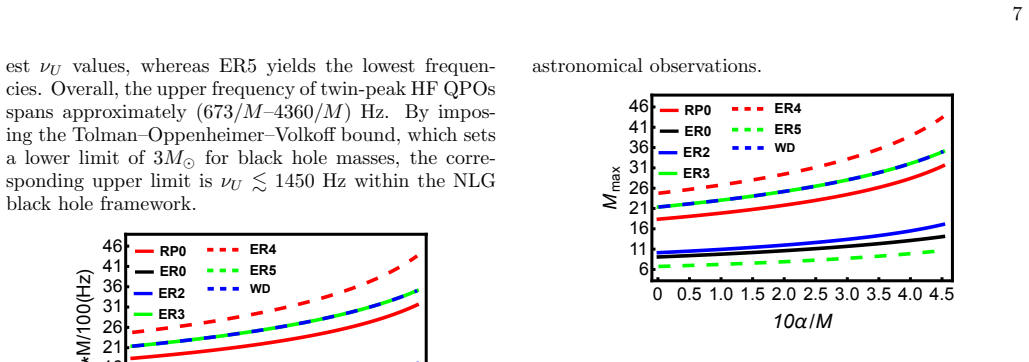
In the spacetime of a static black hole in nonlocal gravity, the parameter α increases the effective potential for massive test particles. This leads to a systematic reduction in the energy and angular momentum of circular orbits, a monotonic decrease in the ISCO radius, and an increase in radiative efficiency up to approximately 8.9%. The Keplerian frequency and vertical epicyclic frequency are suppressed by α, while the radial epicyclic frequency is enhanced. Imposing the 2ν_U = 3ν_L resonance condition on twin-peak HF QPO models shows that the resonant radius decreases with α, the upper QPO frequency increases spanning ν_U ∼ (673/M − 4360/M) Hz, and the black hole mass must satisfy M ≲ 43
What carries the argument
The effective potential V_eff in the nonlocal black hole metric, which governs circular orbits and the epicyclic frequencies Ω_r, Ω_θ, Ω_φ used to compute QPO resonances under the 2:3 condition.
Load-bearing premise
The 2:3 resonance condition between upper and lower QPO frequencies remains valid for twin-peak models in this nonlocal spacetime, and the static black hole solution correctly describes the background for the orbital dynamics.
What would settle it
Observation of an upper QPO frequency above 4360 Hz divided by the black hole mass in solar units, or a black hole mass above 43.6 solar masses with ν_U above 100 Hz, would contradict the model's constraints under the resonance assumption.
Figures




read the original abstract
We investigate the dynamics of massive test particles around a static black hole in nonlocal gravity and examine the corresponding properties of HF QPOs, constraining the nonlocal parameter to $\alpha/M \leq 0.452$. The nonlocal parameter $\alpha$ enhances the effective potential $V_{eff}$ and leads to a systematic reduction in the energy E and angular momentum L of circular orbits. Consequently, the ISCO radius, along with the associated energy and angular momentum, decreases monotonically with $\alpha$, while the radiative efficiency increases, reaching a maximum of approximately $8.9\%$. Due to the spherical symmetry of the spacetime, the Keplerian frequency $\Omega_{\phi}$ and the vertical epicyclic frequency $\Omega_{\theta}$ coincide and are suppressed by $\alpha$, whereas the radial epicyclic frequency $\Omega_{r}$ is enhanced. The impact of $\alpha$ on several twin-peak HF QPO models is examined, revealing that $\alpha$ increases both the lower and upper bounds of the predicted QPO frequency ranges. By imposing the $2\nu_U = 3\nu_L$ resonance condition, we analyze the resonant radius, upper QPO frequency, maximum allowed black hole mass, and the time delay between the shadow and QPO signals. We find that the resonant radius decreases with $\alpha$, while the upper QPO frequency increases, spanning the range $\nu_U \sim(673/M-4360/M)$Hz. When the TOV imit is imposed, the upper frequency is further constrained to $\nu_U \lesssim 1450$Hz. Combining astronomical observations for the classification of QPOs, where $\nu_U \geq 100$Hz, the black hole mass in the nonlocal gravity should satisfy $M \lesssim 43.6M_\odot$. Although the radial separation between the resonant radius and the photon sphere decreases with $\alpha$, the associated gravitational time delay increases, remaining below $\sim 1.3$ms and thus negligible for current observational capabilities.
Editorial analysis
A structured set of objections, weighed in public.
Referee Report
Summary. The manuscript investigates geodesic motion of massive test particles around a static black hole in nonlocal gravity, showing that the nonlocal parameter α enhances the effective potential, reduces the energy E and angular momentum L of circular orbits, decreases the ISCO radius, and increases radiative efficiency up to ~8.9%. Due to spherical symmetry, Ω_φ = Ω_θ are suppressed while Ω_r is enhanced by α. The work then examines twin-peak HF QPO models and imposes the 2ν_U = 3ν_L resonance to derive constraints α/M ≤ 0.452, upper QPO frequency ranges ν_U ∼ (673/M − 4360/M) Hz, and black-hole mass limits M ≲ 43.6 M_⊙ when combined with ν_U ≥ 100 Hz and TOV bounds; it also computes the time delay between shadow and QPO signals.
Significance. If the results hold, the paper supplies concrete, observationally testable constraints on nonlocal gravity from HF QPOs, including monotonic trends in orbital quantities and falsifiable frequency spans that could be confronted with X-ray timing data. The inclusion of gravitational time-delay estimates between photon-sphere and resonant-radius signals adds a multi-messenger element. However, the overall significance is limited by the absence of explicit derivations or error analysis for the reported numerical bounds.
major comments (2)
- [Section on twin-peak HF QPO models] The section discussing the impact of α on several twin-peak HF QPO models: the 2ν_U = 3ν_L resonance condition is applied directly to the α-modified epicyclic frequencies Ω_r and Ω_φ (with resonant radius determined by the GR-standard ratio) without re-derivation or justification that the underlying parametric-resonance or disk-oscillation mechanism continues to select precisely this commensurability in the nonlocal metric. Because α raises Ω_r while lowering Ω_φ, this modeling choice is load-bearing for every subsequent bound (α/M ≤ 0.452, the ν_U range, and M ≲ 43.6 M_⊙).
- [Abstract and numerical-results sections] Abstract and the sections presenting numerical results for circular orbits and epicyclic frequencies: the manuscript states monotonic trends (e.g., ISCO radius and E, L decreasing with α; radiative efficiency reaching 8.9%) and specific bounds (α/M ≤ 0.452) but supplies neither analytic expressions for Ω_r(α), Ω_φ(α), nor error estimates, convergence checks, or tabulated data from the numerical integrations. This absence undermines reproducibility of the central constraints.
minor comments (2)
- [Introduction and metric section] Clarify the precise definition and numerical implementation of the nonlocal parameter α (including its relation to the metric function) in the opening sections to aid readers unfamiliar with the specific nonlocal gravity model.
- [References] Add references to standard GR QPO resonance literature and prior works on epicyclic frequencies in modified gravity to contextualize the choice of the 2:3 model.
Simulated Author's Rebuttal
We thank the referee for the careful reading and constructive feedback. We address each major comment below and outline the revisions we will make to strengthen the manuscript.
read point-by-point responses
-
Referee: The 2ν_U = 3ν_L resonance condition is applied directly to the α-modified epicyclic frequencies Ω_r and Ω_φ (with resonant radius determined by the GR-standard ratio) without re-derivation or justification that the underlying parametric-resonance or disk-oscillation mechanism continues to select precisely this commensurability in the nonlocal metric. Because α raises Ω_r while lowering Ω_φ, this modeling choice is load-bearing for every subsequent bound.
Authors: We agree that the resonance model is phenomenological and that a full re-derivation of the disk-oscillation mechanism in the nonlocal spacetime would be ideal. In the literature on modified gravity, it is standard to compute the geodesic frequencies from the new metric and then impose the same commensurability ratios (e.g., 2:3) that are observationally motivated in GR; this allows direct comparison with data while testing the modified dynamics. The spherical symmetry ensures Ω_φ = Ω_θ, and the effective-potential derivation of Ω_r remains valid. We will add a dedicated paragraph in the revised manuscript explicitly stating this assumption, citing prior works that apply identical resonance models to non-GR metrics, and noting that a complete hydrodynamical treatment of the disk lies beyond the present scope. The bounds therefore remain conditional on the resonance hypothesis. revision: partial
-
Referee: The manuscript states monotonic trends (e.g., ISCO radius and E, L decreasing with α; radiative efficiency reaching 8.9%) and specific bounds (α/M ≤ 0.452) but supplies neither analytic expressions for Ω_r(α), Ω_φ(α), nor error estimates, convergence checks, or tabulated data from the numerical integrations. This absence undermines reproducibility.
Authors: We acknowledge the need for greater transparency in the numerical results. The metric function in nonlocal gravity precludes simple closed-form expressions for the epicyclic frequencies; we will therefore insert the explicit general-relativistic formulas for Ω_r and Ω_φ in terms of the metric components and their derivatives, evaluated at the circular-orbit radius. In addition, we will include a table of representative numerical values for E, L, ISCO radius, and frequencies at several α/M values, together with the integration tolerances (typically 10^{-8}) and root-finding convergence criteria used. We performed convergence tests by varying step sizes and initial guesses; the reported trends are stable to better than 0.1% and the bound α/M ≤ 0.452 is insensitive to these choices within the explored range. These additions will be placed in the revised numerical-results section. revision: yes
Circularity Check
No significant circularity; derivation computes modified frequencies from the metric then applies external resonance assumption and observational bounds
full rationale
The paper starts from the static nonlocal metric (presumably taken as given from prior literature), derives the effective potential and epicyclic frequencies Ω_r, Ω_θ=Ω_φ directly from the geodesic Lagrangian, and obtains explicit α-dependent expressions for E, L, ISCO, and the frequencies. It then imposes the external 2ν_U=3ν_L commensurability condition to locate a resonant radius, evaluates ν_U(M,α) at that radius, and intersects the resulting range with independent observational cuts (ν_U≥100 Hz) and the TOV mass limit to produce the quoted bounds on α/M and M. None of these steps reduces the final constraints to the inputs by algebraic identity, by fitting a parameter and relabeling it a prediction, or by a self-citation chain that supplies the load-bearing premise; the resonance condition is an additional modeling assumption whose validity is not re-derived but is not required for the frequency expressions themselves to be well-defined.
Axiom & Free-Parameter Ledger
free parameters (1)
- α
axioms (2)
- domain assumption The background is the exact static black-hole solution of nonlocal gravity.
- domain assumption The 2ν_U = 3ν_L resonance condition applies to the twin-peak HF QPO models.
Reference graph
Works this paper leans on
-
[1]
C. M. Will, The Confrontation between General Rela- tivity and Experiment , Living Rev. Rel. 17, (2014) 4, arXiv:1403.7377
work page internal anchor Pith review arXiv 2014
-
[2]
GRA VITYcollaboration, R. Abuter et al., Detection of the Schwarzschild precession in the orbit of the star S2 near the Galactic centre massive black hole , Astron. As- trophys. 636, (2020) L5, arXiv:2004.07187
-
[3]
LIGO Scientific, Virgo collaboration, B. P. Abbott et al., Observation of Gravitational Waves from a Binary Black Hole Merger, Phys. Rev. Lett. 116, (2016) 061102, arXiv:1602.03837
work page internal anchor Pith review arXiv 2016
-
[4]
LIGO Scientific, Virgo collaboration, B. P. Abbott et al., Tests of general relativity with GW150914 , Phys. Rev. Lett. 116, (2016) 221101, arXiv:1602.03841
work page Pith review arXiv 2016
-
[5]
LIGO Scientific, Virgo collaboration, B. P. Abbott et al., GW151226: Observation of Gravitational Waves from a 22-Solar-Mass Binary Black Hole Coalescence , Phys. Rev. Lett. 116, (2016) 241103, arXiv:1606.04855
work page Pith review arXiv 2016
-
[6]
LIGO Scientific, Virgo collaboration, B. P. Abbott et al., Tests of General Relativity with the Binary Black Hole Signals from the LIGO-Virgo Catalog GWTC-1 , Phys. Rev. D 100, (2019) 104036, arXiv:1903.04467
work page internal anchor Pith review arXiv 2019
-
[7]
LIGO Scientific, Virgo, KAGRA collaboration, A. G. Abac et al., GW250114: Testing Hawking’s Area Law and the Kerr Nature of Black Holes, Phys. Rev. Lett. 135, (2025) 111403, arXiv:2509.08054
work page internal anchor Pith review arXiv 2025
-
[8]
First M87 Event Horizon Telescope Results. I. The Shadow of the Supermassive Black Hole
Event Horizon Telescope collaboration, K. Akiyama et al., First M87 Event Horizon Telescope Results. I. The Shadow of the Supermassive Black Hole , Astrophys. J. Lett. 875, (2019) L1, arXiv:1906.11238
work page internal anchor Pith review arXiv 2019
-
[9]
First M87 Event Horizon Telescope Results. IV. Imaging the Central Supermassive Black Hole
Event Horizon Telescope collaboration, K. Akiyama et al., First M87 Event Horizon Telescope Results. IV. Imaging the Central Supermassive Black Hole, Astrophys. J. Lett. 875, (2019) L4, arXiv:1906.11241
work page Pith review arXiv 2019
-
[10]
Akiyama et al., First Sagittarius A* Event Horizon Telescope Re- sults
Event Horizon Telescope collaboration, K. Akiyama et al., First Sagittarius A* Event Horizon Telescope Re- sults. I. The Shadow of the Supermassive Black Hole in the Center of the Milky Way , Astrophys. J. Lett. 930, (2022) L12
2022
-
[11]
Akiyama et al., First Sagittarius A* Event Horizon Telescope Re- sults
Event Horizon Telescope collaboration, K. Akiyama et al., First Sagittarius A* Event Horizon Telescope Re- sults. VI. Testing the Black Hole Metric , Astrophys. J. Lett. 930, (2022) L17
2022
-
[12]
Penrose, Gravitational collapse and space-time singu- larities, Phys
R. Penrose, Gravitational collapse and space-time singu- larities, Phys. Rev. Lett. 14, (1965) 57–59
1965
-
[13]
Penrose, Gravitational collapse: The role of general relativity, Riv
R. Penrose, Gravitational collapse: The role of general relativity, Riv. Nuovo Cim. 1, (1969) 252–276
1969
-
[14]
S. W. Hawking and R. Penrose, The Singularities of grav- itational collapse and cosmology , Proc. Roy. Soc. Lond. A 314, (1970) 529–548
1970
-
[15]
Rovelli, Quantum gravity
C. Rovelli, Quantum gravity. Cambridge university press, 2004
2004
-
[16]
A. Ashtekar and J. Lewandowski, Background indepen- dent quantum gravity: A Status report , Class. Quant. Grav. 21, (2004) R53, gr-qc/0404018
- [17]
-
[18]
L. Modesto and I. L. Shapiro, Superrenormalizable quan- tum gravity with complex ghosts , Phys. Lett. B 755, (2016) 279–284, arXiv:1512.07600
-
[19]
Modesto, Super-renormalizable or finite Lee–Wick quantum gravity , Nucl
L. Modesto, Super-renormalizable or finite Lee–Wick quantum gravity , Nucl. Phys. B 909, (2016) 584–606, arXiv:1602.02421
- [20]
-
[21]
E. Elizalde and S. D. Odintsov, A Renormaliza- tion group improved nonlocal gravitational effective La- grangian, Mod. Phys. Lett. A 10, (1995) 1821–1828, gr-qc/9508041. 9
-
[22]
L. Modesto, J. W. Moffat and P. Nicolini, Black holes in an ultraviolet complete quantum gravity , Phys. Lett. B 695, (2011) 397–400, arXiv:1010.0680
-
[23]
C. Chicone and B. Mashhoon, Linearized Gravitational Waves in Nonlocal General Relativity , Phys. Rev. D 87, (2013) 064015, arXiv:1210.3860
- [24]
- [25]
- [26]
-
[27]
Modesto,Super-renormalizable quantum gravity,Phys
L. Modesto, Super-renormalizable Quantum Gravity , Phys. Rev. D 86, (2012) 044005, arXiv:1107.2403
-
[28]
L. Modesto and L. Rachwal, Super-renormalizable and finite gravitational theories , Nucl. Phys. B 889, (2014) 228–248, arXiv:1407.8036
-
[29]
S. Deser and R. P. Woodard, Nonlocal Cosmology, Phys. Rev. Lett. 99, (2007) 111301, arXiv:0706.2151
-
[30]
S. Nojiri and S. D. Odintsov, Modified non-local-F(R) gravity as the key for the inflation and dark energy , Phys. Lett. B 659, (2008) 821–826, arXiv:0708.0924
-
[31]
S. Jhingan, S. Nojiri, S. D. Odintsov, M. Sami, I. Thongkool and S. Zerbini, Phantom and non-phantom dark energy: The Cosmological relevance of non-locally corrected gravity, Phys. Lett. B 663, (2008) 424–428, arXiv:0803.2613
-
[32]
S. Capozziello, E. Elizalde, S. Nojiri and S. D. Odintsov, Accelerating cosmologies from non-local higher- derivative gravity , Phys. Lett. B 671, (2009) 193–198, arXiv:0809.1535
-
[33]
S. Bahamonde, S. Capozziello and K. F. Dialektopou- los, Constraining Generalized Non-local Cosmology from Noether Symmetries , Eur. Phys. J. C 77, (2017) 722, arXiv:1708.06310
-
[34]
S. Deser and R. P. Woodard, Nonlocal Cosmology II — Cosmic acceleration without fine tuning or dark energy , JCAP 06, (2019) 034, arXiv:1902.08075
-
[35]
Non-local gravity and dark energy
M. Maggiore and M. Mancarella, Nonlocal gravity and dark energy , Phys. Rev. D 90, (2014) 023005, arXiv:1402.0448
work page Pith review arXiv 2014
- [36]
- [37]
- [38]
-
[39]
Nicolini, Nonlocal and generalized uncertainty princi- ple black holes , arXiv:1202.2102
P. Nicolini, Nonlocal and generalized uncertainty princi- ple black holes , arXiv:1202.2102
- [40]
- [41]
-
[42]
M. Knipfer, S. K¨ oppel, J. Mureika and P. Nicolini,Gen- eralized Uncertainty Principle and Black Holes in Higher Dimensional Self-Complete Gravity , JCAP 08, (2019) 008, arXiv:1905.03233
-
[43]
R. D’Agostino and V. De Falco, Black hole solutions in the revised Deser-Woodard nonlocal theory of gravity , JCAP 07, (2025) 046, arXiv:2502.15460
- [44]
-
[45]
R. Fujita and W. Hikida, Analytical solutions of bound timelike geodesic orbits in Kerr spacetime , Class. Quant. Grav. 26, (2009) 135002, arXiv:0906.1420
-
[46]
D. Pugliese, H. Quevedo and R. Ruffini, Equatorial circular orbits of neutral test particles in the Kerr- Newman spacetime , Phys. Rev. D 88, (2013) 024042, arXiv:1303.6250
-
[47]
R. A. Hennigar, M. B. Jahani Poshteh and R. B. Mann, Shadows, Signals, and Stability in Einsteinian Cubic Gravity, Phys. Rev. D 97, (2018) 064041
2018
- [48]
- [49]
-
[50]
Y.-P. Zhang, S.-W. Wei, W.-D. Guo, T.-T. Sui and Y.-X. Liu, Innermost stable circular orbit of spinning particle in charged spinning black hole background , Phys. Rev. D 97, (2018) 084056, arXiv:1711.09361
-
[51]
Motion of test particle in rotating boson star,
Y.-P. Zhang, Y.-B. Zeng, Y.-Q. Wang, S.-W. Wei and Y.-X. Liu, Motion of test particle in rotating boson star , Phys. Rev. D 105, (2022) 044021, arXiv:2107.04848
-
[52]
K. Yang, B.-M. Gu and Y.-P. Zhang, Motion of spin- ning particles around electrically charged black hole in Eddington-inspired Born–Infeld gravity, Eur. Phys. J. C 82, (2022) 293, arXiv:2111.00864
- [53]
- [54]
-
[55]
K. Yang, B.-M. Gu, S.-W. Wei and Y.-X. Liu, Born–Infeld black holes in 4D Einstein–Gauss–Bonnet gravity, Eur. Phys. J. C 80, (2020) 662, arXiv:2004.14468
-
[56]
J. M. Bardeen, W. H. Press and S. A. Teukolsky, Rotat- ing black holes: Locally nonrotating frames, energy ex- traction, and scalar synchrotron radiation , Astrophys. J. 178, (1972) 347
1972
-
[57]
Syunyaev, Variability of x rays from black holes with accretion disks , Astronomicheskii Zhurnal 49, (1972) 1153
R. Syunyaev, Variability of x rays from black holes with accretion disks , Astronomicheskii Zhurnal 49, (1972) 1153
1972
- [58]
-
[59]
W. Kluzniak and M. A. Abramowicz, The physics of khz qpos–strong gravity’s coupled anharmonic oscillators, astro-ph/0105057. 10
- [60]
- [61]
- [62]
- [63]
- [64]
- [65]
-
[66]
J. Rayimbaev, K. F. Dialektopoulos, F. Sarikulov and A. Abdujabbarov, Quasiperiodic oscillations around hairy black holes in Horndeski gravity , Eur. Phys. J. C 83, (2023) 572, arXiv:2307.03019
-
[67]
F. Abdulkhamidov, P. Nedkova, J. Rayimbaev, J. Kunz and B. Ahmedov, Parameter constraints on traversable wormholes within beyond Horndeski theories through quasiperiodic oscillations , Phys. Rev. D 109, (2024) 104074, arXiv:2403.08356
-
[68]
Jumaniyozov, S
S. Jumaniyozov, S. U. Khan, J. Rayimbaev, A. Abdu- jabbarov, S. Urinbaev and S. Murodov, Circular motion and QPOs near black holes in Kalb–Ramond gravity, Eur. Phys. J. C 84, (2024) 964
2024
- [69]
-
[70]
H.-Y. Zhang, Y.-P. Hu and Y.-S. An, Curled orbit and epicyclic oscillation of charged particles around the weakly magnetized black hole in the presence of Lorentz violation , Eur. Phys. J. C 85, (2025) 725, arXiv:2503.02323
-
[71]
T.-T. Sui and X.-Y. Wang, The characteristics of cir- cular motion and quasiperiodic oscillations around ac- celerating black hole , Eur. Phys. J. C 85, (2025) 1112, arXiv:2509.23187
-
[72]
M. Shahzadi, M. Koloˇ s, R. Saleem and Z. Stuchl´ ık, Testing alternative spacetimes by high-frequency quasi- periodic oscillations observed in microquasars and active galactic nuclei , Class. Quant. Grav. 41, (2024) 075014, arXiv:2309.09712
- [73]
- [74]
-
[75]
Y. Kurmanov, K. Boshkayev, T. Konysbayev, O. Lu- ongo, N. Saiyp, A. Urazalina et al., Accretion disks prop- erties around regular black hole solutions obtained from non-linear electrodynamics, Phys. Dark Univ. 46, (2024) 101566, arXiv:2404.15437
- [76]
-
[77]
Stuchl´ ık and M
Z. Stuchl´ ık and M. Koloˇ s,Models of quasi-periodic oscil- lations related to mass and spin of the gro j1655-40 black hole, Astronomy & Astrophysics 586, (Feb., 2016) A130
2016
- [78]
-
[79]
Kato, Excitation of disk oscillations by warps: A Model of kHz QPOs , Publ
S. Kato, Excitation of disk oscillations by warps: A Model of kHz QPOs , Publ. Astron. Soc. Jap. 56, (2004) 905, astro-ph/0409051
-
[80]
Kato, Frequency Correlation of QPOs Based on a Resonantly-Excited Disk-Oscillation Model , Publ
S. Kato, Frequency Correlation of QPOs Based on a Resonantly-Excited Disk-Oscillation Model , Publ. As- tron. Soc. Jap. 60, (2008) 889, arXiv:0803.2384
discussion (0)
Sign in with ORCID, Apple, or X to comment. Anyone can read and Pith papers without signing in.