Recognition: 1 theorem link
· Lean TheoremResponse-G1: Explicit Scene Graph Modeling for Proactive Streaming Video Understanding
Pith reviewed 2026-05-12 02:49 UTC · model grok-4.3
The pith
Response-G1 aligns video evidence with query conditions through explicit scene graphs to decide response timing in streaming video.
A machine-rendered reading of the paper's core claim, the machinery that carries it, and where it could break.
Core claim
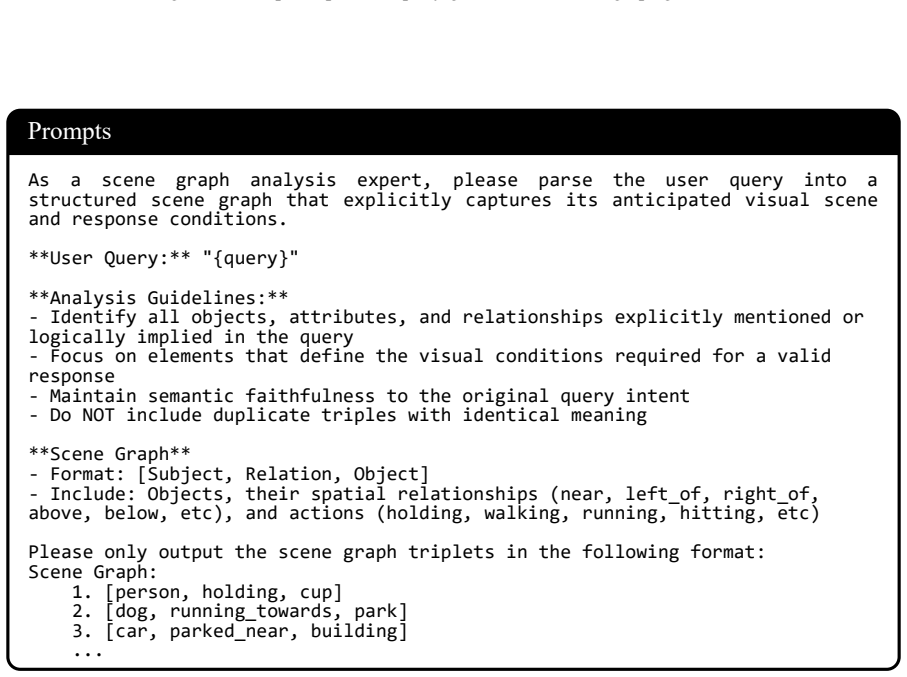
Response-G1 establishes explicit, structured alignment between the accumulated video evidence and the query's expected response conditions via scene graphs. The framework operates in three fine-tuning-free stages: (1) online query-guided scene graph generation from streaming clips; (2) memory-based retrieval of the most semantically relevant historical scene graphs; and (3) retrieval-augmented trigger prompting for per-frame silence/response decisions. By grounding both evidence and conditions in a shared graph representation, Response-G1 achieves more interpretable and accurate response timing decisions.
What carries the argument
Explicit scene graph modeling that grounds both video evidence and query response conditions in a shared graph representation to enable memory retrieval and trigger prompting.
If this is right
- The method shows higher accuracy than prior approaches on both proactive and reactive streaming video tasks.
- Decisions become more interpretable because they rest on explicit graph alignments rather than hidden representations.
- No fine-tuning is required because the three stages rely on generation, retrieval, and prompting.
- Performance gains hold across established benchmarks for streaming video understanding.
Where Pith is reading between the lines
- If reliable online scene graph generators become available for new domains, the same three-stage structure could apply to other timing-sensitive multimodal tasks such as live captioning or robotic monitoring.
- The memory retrieval step suggests a path toward longer-term video memory in Video-LLMs beyond single-clip processing.
- Replacing the scene graph generator with a stronger model would directly test whether the claimed gains scale with graph quality.
Load-bearing premise
Online query-guided scene graph generation from streaming clips works reliably and memory retrieval of historical graphs consistently surfaces relevant evidence for the timing decision.
What would settle it
An experiment in which query-guided scene graph generation produces noisy or incomplete graphs on a benchmark clip set, or memory retrieval returns irrelevant graphs, resulting in response timing accuracy no better than implicit baselines.
Figures




read the original abstract
Proactive streaming video understanding requires Video-LLMs to decide when to respond as a video unfolds, a task where existing methods often fall short due to their implicit, query-agnostic modeling of visual evidence. We introduce Response-G1, a novel framework that establishes explicit, structured alignment between the accumulated video evidence and the query's expected response conditions via scene graphs. The framework operates in three fine-tuning-free stages: (1) online query-guided scene graph generation from streaming clips; (2) memory-based retrieval of the most semantically relevant historical scene graphs; and (3) retrieval-augmented trigger prompting for per-frame "silence/response" decisions. By grounding both evidence and conditions in a shared graph representation, Response-G1 achieves more interpretable and accurate response timing decisions. Experimental results on established benchmarks demonstrate the superiority of our method in both proactive and reactive tasks, validating the advantage of explicit scene graph modeling and retrieval in streaming video understanding.
Editorial analysis
A structured set of objections, weighed in public.
Referee Report
Summary. The paper introduces Response-G1, a three-stage framework for proactive streaming video understanding in Video-LLMs. It performs online query-guided scene graph generation from streaming clips, memory-based retrieval of semantically relevant historical scene graphs, and retrieval-augmented prompting to decide per-frame whether to output a response or remain silent. By grounding both visual evidence and query response conditions in an explicit shared scene-graph representation, the method claims to deliver more interpretable and accurate trigger decisions than implicit, query-agnostic baselines, with reported superiority on established benchmarks for both proactive and reactive tasks.
Significance. If the empirical claims hold, the work offers a structured alternative to black-box modeling in streaming video understanding, leveraging scene graphs for explicit alignment between evidence and query conditions. The fine-tuning-free pipeline and emphasis on retrieval-augmented interpretability represent a concrete advance that could improve reliability in applications such as real-time monitoring or interactive video systems.
major comments (1)
- Experimental Results section: The manuscript asserts experimental superiority on benchmarks yet provides no details on the specific datasets, baseline methods, evaluation metrics, error bars, statistical tests, or ablation studies. This absence leaves the central claim of improved response timing without visible empirical support and prevents assessment of whether the gains are attributable to the scene-graph grounding or to other factors.
minor comments (2)
- The description of the memory-based retrieval step would benefit from an explicit algorithmic outline or pseudocode to clarify how semantic relevance is computed and how historical graphs are stored and queried.
- A pipeline diagram illustrating the three stages, the flow of streaming clips, and the per-frame decision process would improve readability and help readers follow the retrieval-augmented prompting mechanism.
Simulated Author's Rebuttal
We thank the referee for their constructive feedback and the opportunity to improve the manuscript. We address the major comment below.
read point-by-point responses
-
Referee: Experimental Results section: The manuscript asserts experimental superiority on benchmarks yet provides no details on the specific datasets, baseline methods, evaluation metrics, error bars, statistical tests, or ablation studies. This absence leaves the central claim of improved response timing without visible empirical support and prevents assessment of whether the gains are attributable to the scene-graph grounding or to other factors.
Authors: We agree that the Experimental Results section requires substantially more detail to support the claims of superiority. In the revised manuscript we will expand this section to specify the exact datasets and benchmarks used for both proactive and reactive tasks, describe all baseline methods in full, list the evaluation metrics, report error bars from multiple runs, include statistical significance tests, and present comprehensive ablation studies that isolate the contributions of query-guided scene graph generation, memory-based retrieval, and retrieval-augmented prompting. These additions will make the empirical support explicit and allow readers to assess the role of explicit scene-graph grounding. revision: yes
Circularity Check
No significant circularity; procedural framework with no derivations
full rationale
The paper presents Response-G1 as a three-stage procedural pipeline (online query-guided scene graph generation from streaming clips; memory-based retrieval of historical scene graphs; retrieval-augmented trigger prompting) without any equations, parameter fittings, or mathematical derivations. Claims of improved interpretability and accuracy rest on explicit shared graph representations and external benchmark comparisons rather than self-referential definitions or predictions that reduce to inputs by construction. No self-citation chains or ansatzes are invoked as load-bearing elements in the provided description, rendering the method self-contained.
Axiom & Free-Parameter Ledger
axioms (1)
- domain assumption Scene graphs generated from streaming clips can be aligned with query-expected response conditions in a way that supports accurate silence/response decisions
Lean theorems connected to this paper
-
IndisputableMonolith/Foundation/AbsoluteFloorClosure.leanreality_from_one_distinction unclear?
unclearRelation between the paper passage and the cited Recognition theorem.
three fine-tuning-free stages: (1) online query-guided scene graph generation from streaming clips; (2) memory-based retrieval...; (3) retrieval-augmented trigger prompting
What do these tags mean?
- matches
- The paper's claim is directly supported by a theorem in the formal canon.
- supports
- The theorem supports part of the paper's argument, but the paper may add assumptions or extra steps.
- extends
- The paper goes beyond the formal theorem; the theorem is a base layer rather than the whole result.
- uses
- The paper appears to rely on the theorem as machinery.
- contradicts
- The paper's claim conflicts with a theorem or certificate in the canon.
- unclear
- Pith found a possible connection, but the passage is too broad, indirect, or ambiguous to say the theorem truly supports the claim.
Reference graph
Works this paper leans on
- [1]
-
[2]
Publications Manual , year = "1983", publisher =
work page 1983
-
[3]
Ashok K. Chandra and Dexter C. Kozen and Larry J. Stockmeyer , year = "1981", title =. doi:10.1145/322234.322243
- [4]
-
[5]
Dan Gusfield , title =. 1997
work page 1997
-
[6]
Mohammad Sadegh Rasooli and Joel R. Tetreault , title =. Computing Research Repository , volume =. 2015 , url =
work page 2015
-
[7]
A Framework for Learning Predictive Structures from Multiple Tasks and Unlabeled Data , Volume =
Ando, Rie Kubota and Zhang, Tong , Issn =. A Framework for Learning Predictive Structures from Multiple Tasks and Unlabeled Data , Volume =. Journal of Machine Learning Research , Month = dec, Numpages =
-
[8]
Proceedings of the 33rd ACM International Conference on Multimedia , pages=
Timechat-online: 80\ author=. Proceedings of the 33rd ACM International Conference on Multimedia , pages=
-
[9]
Proceedings of the IEEE/CVF Conference on Computer Vision and Pattern Recognition , pages=
Streaming dense video captioning , author=. Proceedings of the IEEE/CVF Conference on Computer Vision and Pattern Recognition , pages=
-
[10]
Proceedings of the IEEE/CVF Conference on Computer Vision and Pattern Recognition , pages=
Videollm-online: Online video large language model for streaming video , author=. Proceedings of the IEEE/CVF Conference on Computer Vision and Pattern Recognition , pages=
-
[11]
Proceedings of the Computer Vision and Pattern Recognition Conference , pages=
Lion-fs: Fast & slow video-language thinker as online video assistant , author=. Proceedings of the Computer Vision and Pattern Recognition Conference , pages=
-
[12]
Proceedings of the Computer Vision and Pattern Recognition Conference , pages=
Dispider: Enabling video llms with active real-time interaction via disentangled perception, decision, and reaction , author=. Proceedings of the Computer Vision and Pattern Recognition Conference , pages=
-
[13]
arXiv preprint arXiv:2505.05467 , year=
StreamBridge: Turning Your Offline Video Large Language Model into a Proactive Streaming Assistant , author=. arXiv preprint arXiv:2505.05467 , year=
-
[14]
StreamAgent: Towards Anticipatory Agents for Streaming Video Understanding
Streamagent: Towards anticipatory agents for streaming video understanding , author=. arXiv preprint arXiv:2508.01875 , year=
work page internal anchor Pith review Pith/arXiv arXiv
-
[15]
Proceedings of the Computer Vision and Pattern Recognition Conference , pages=
OVO-Bench: How Far is Your Video-LLMs from Real-World Online Video Understanding? , author=. Proceedings of the Computer Vision and Pattern Recognition Conference , pages=
-
[16]
Scene graph generation: A comprehensive survey , author=. Neurocomputing , volume=. 2024 , publisher=
work page 2024
-
[17]
arXiv preprint arXiv:2510.14359 , year=
AI for Service: Proactive Assistance with AI Glasses , author=. arXiv preprint arXiv:2510.14359 , year=
-
[18]
arXiv preprint arXiv:2510.14560 , year=
Eyes wide open: Ego proactive video-llm for streaming video , author=. arXiv preprint arXiv:2510.14560 , year=
-
[19]
Qwen2-VL: Enhancing Vision-Language Model's Perception of the World at Any Resolution
Qwen2-vl: Enhancing vision-language model's perception of the world at any resolution , author=. arXiv preprint arXiv:2409.12191 , year=
work page internal anchor Pith review Pith/arXiv arXiv
-
[20]
arXiv preprint arXiv:2501.13468 , year=
Streaming video understanding and multi-round interaction with memory-enhanced knowledge , author=. arXiv preprint arXiv:2501.13468 , year=
-
[21]
arXiv preprint arXiv:2509.24871 , year=
Streamforest: Efficient online video understanding with persistent event memory , author=. arXiv preprint arXiv:2509.24871 , year=
-
[22]
arXiv preprint arXiv:2503.00540 , year=
Streaming video question-answering with in-context video kv-cache retrieval , author=. arXiv preprint arXiv:2503.00540 , year=
-
[23]
arXiv preprint arXiv:2506.23825 , year=
Flash-VStream: Efficient Real-Time Understanding for Long Video Streams , author=. arXiv preprint arXiv:2506.23825 , year=
-
[24]
Advances in Neural Information Processing Systems , volume=
Streaming long video understanding with large language models , author=. Advances in Neural Information Processing Systems , volume=
-
[25]
VideoLLaMA 3: Frontier Multimodal Foundation Models for Image and Video Understanding
Videollama 3: Frontier multimodal foundation models for image and video understanding , author=. arXiv preprint arXiv:2501.13106 , year=
work page internal anchor Pith review Pith/arXiv arXiv
-
[26]
Qwen3 technical report , author=. arXiv preprint arXiv:2505.09388 , year=
work page internal anchor Pith review Pith/arXiv arXiv
-
[27]
Streamingbench: Assessing the gap for mllms to achieve streaming video understanding , author=. arXiv preprint arXiv:2411.03628 , year=
-
[28]
European Conference on Computer Vision , pages=
ActionSwitch: Class-Agnostic Detection of Simultaneous Actions in Streaming Videos , author=. European Conference on Computer Vision , pages=. 2024 , organization=
work page 2024
-
[29]
Proceedings of the IEEE/CVF International Conference on Computer Vision , pages=
Hierarchical Event Memory for Accurate and Low-latency Online Video Temporal Grounding , author=. Proceedings of the IEEE/CVF International Conference on Computer Vision , pages=
-
[30]
Proceedings of the Computer Vision and Pattern Recognition Conference , pages=
Online Video Understanding: OVBench and VideoChat-Online , author=. Proceedings of the Computer Vision and Pattern Recognition Conference , pages=
-
[31]
Proceedings of the IEEE/CVF Conference on Computer Vision and Pattern Recognition , pages=
Learning situation hyper-graphs for video question answering , author=. Proceedings of the IEEE/CVF Conference on Computer Vision and Pattern Recognition , pages=
-
[32]
IEEE Transactions on Pattern Analysis and Machine Intelligence , volume=
Contrastive video question answering via video graph transformer , author=. IEEE Transactions on Pattern Analysis and Machine Intelligence , volume=. 2023 , publisher=
work page 2023
-
[33]
Forty-second International Conference on Machine Learning , year=
Fine-Grained Captioning of Long Videos through Scene Graph Consolidation , author=. Forty-second International Conference on Machine Learning , year=
-
[34]
Proceedings of the IEEE conference on computer vision and pattern recognition , pages=
Image retrieval using scene graphs , author=. Proceedings of the IEEE conference on computer vision and pattern recognition , pages=
-
[35]
Proceedings of the IEEE/CVF conference on computer vision and pattern recognition workshops , pages=
Structured query-based image retrieval using scene graphs , author=. Proceedings of the IEEE/CVF conference on computer vision and pattern recognition workshops , pages=
-
[36]
Proceedings of the AAAI Conference on Artificial Intelligence , volume=
Image-to-image retrieval by learning similarity between scene graphs , author=. Proceedings of the AAAI Conference on Artificial Intelligence , volume=
-
[37]
Proceedings of the IEEE/CVF international conference on computer vision , pages=
Spatial-temporal transformer for dynamic scene graph generation , author=. Proceedings of the IEEE/CVF international conference on computer vision , pages=
-
[38]
Proceedings of the IEEE/CVF Conference on Computer Vision and Pattern Recognition , pages=
Hig: Hierarchical interlacement graph approach to scene graph generation in video understanding , author=. Proceedings of the IEEE/CVF Conference on Computer Vision and Pattern Recognition , pages=
-
[39]
Advances in neural information processing systems , volume=
Faster r-cnn: Towards real-time object detection with region proposal networks , author=. Advances in neural information processing systems , volume=
-
[40]
Proceedings of the IEEE/CVF conference on computer vision and pattern recognition , pages=
From pixels to graphs: Open-vocabulary scene graph generation with vision-language models , author=. Proceedings of the IEEE/CVF conference on computer vision and pattern recognition , pages=
-
[41]
Llm meets scene graph: Can large language models understand and generate scene graphs? a benchmark and empirical study , author=. Proceedings of the 63rd Annual Meeting of the Association for Computational Linguistics (Volume 1: Long Papers) , pages=
-
[42]
Proceedings of the Computer Vision and Pattern Recognition Conference , pages=
Hyperglm: Hypergraph for video scene graph generation and anticipation , author=. Proceedings of the Computer Vision and Pattern Recognition Conference , pages=
-
[43]
Advances in Neural Information Processing Systems , volume=
Et bench: Towards open-ended event-level video-language understanding , author=. Advances in Neural Information Processing Systems , volume=
-
[44]
Qwen3-VL Technical Report , author=. arXiv preprint arXiv:2511.21631 , year=
work page internal anchor Pith review Pith/arXiv arXiv
-
[45]
Gemini 1.5: Unlocking multimodal understanding across millions of tokens of context
Gemini 1.5: Unlocking multimodal understanding across millions of tokens of context , author=. arXiv preprint arXiv:2403.05530 , year=
work page internal anchor Pith review Pith/arXiv arXiv
-
[46]
Gpt-4o system card , author=. arXiv preprint arXiv:2410.21276 , year=
work page internal anchor Pith review Pith/arXiv arXiv
- [47]
-
[48]
VideoLLaMA 2: Advancing Spatial-Temporal Modeling and Audio Understanding in Video-LLMs
Videollama 2: Advancing spatial-temporal modeling and audio understanding in video-llms , author=. arXiv preprint arXiv:2406.07476 , year=
work page internal anchor Pith review Pith/arXiv arXiv
-
[49]
Proceedings of the IEEE/CVF conference on computer vision and pattern recognition , pages=
Vila: On pre-training for visual language models , author=. Proceedings of the IEEE/CVF conference on computer vision and pattern recognition , pages=
-
[50]
Video-ccam: Enhancing video-language understanding with causal cross-attention masks for short and long videos , author=. arXiv preprint arXiv:2408.14023 , year=
-
[51]
Long Context Transfer from Language to Vision
Long context transfer from language to vision , author=. arXiv preprint arXiv:2406.16852 , year=
work page internal anchor Pith review arXiv
-
[52]
Science China Information Sciences , volume=
How far are we to gpt-4v? closing the gap to commercial multimodal models with open-source suites , author=. Science China Information Sciences , volume=. 2024 , publisher=
work page 2024
-
[53]
Haotian Liu, Chunyuan Li, Yuheng Li, Bo Li, Yuanhan Zhang, Sheng Shen, and Yong Jae Lee
Kangaroo: A powerful video-language model supporting long-context video input , author=. arXiv preprint arXiv:2408.15542 , year=
-
[54]
Llavanext: Improved reasoning, ocr, and world knowledge , author=
-
[55]
MiniCPM: Unveiling the Potential of Small Language Models with Scalable Training Strategies
Minicpm: Unveiling the potential of small language models with scalable training strategies , author=. arXiv preprint arXiv:2404.06395 , year=
work page internal anchor Pith review arXiv
-
[56]
LLaVA-OneVision: Easy Visual Task Transfer
Llava-onevision: Easy visual task transfer , author=. arXiv preprint arXiv:2408.03326 , year=
work page internal anchor Pith review Pith/arXiv arXiv
-
[57]
Qwen2. 5-vl technical report , author=. arXiv preprint arXiv:2502.13923 , year=
work page internal anchor Pith review Pith/arXiv arXiv
-
[58]
Longvu: Spatiotemporal adaptive compression for long video-language understanding , author=. arXiv preprint arXiv:2410.17434 , year=
-
[59]
Timemarker: A versatile video-llm for long and short video understanding with superior temporal localization ability , author=. arXiv preprint arXiv:2411.18211 , year=
-
[60]
Proceedings of the Computer Vision and Pattern Recognition Conference , pages=
STEP: Enhancing Video-LLMs' Compositional Reasoning by Spatio-Temporal Graph-guided Self-Training , author=. Proceedings of the Computer Vision and Pattern Recognition Conference , pages=
-
[61]
Frontiers of Computer Science , volume=
Cascade context-oriented spatio-temporal attention network for efficient and fine-grained video-grounded dialogues , author=. Frontiers of Computer Science , volume=. 2025 , publisher=
work page 2025
-
[62]
ACM Transactions on Information Systems , volume=
Enabling harmonious human-machine interaction with visual-context augmented dialogue system: A review , author=. ACM Transactions on Information Systems , volume=. 2025 , publisher=
work page 2025
-
[63]
Advances in Neural Information Processing Systems , volume=
Hawk: Learning to understand open-world video anomalies , author=. Advances in Neural Information Processing Systems , volume=
-
[64]
Proceedings of the IEEE/CVF Conference on Computer Vision and Pattern Recognition , pages=
Surgeon: Memory-adaptive fully test-time adaptation via dynamic activation sparsity , author=. Proceedings of the IEEE/CVF Conference on Computer Vision and Pattern Recognition , pages=
-
[65]
IEEE Transactions on Mobile Computing , year=
AdaShift: Anti-Collapse and Real-Time Deep Model Evolution for Mobile Vision Applications , author=. IEEE Transactions on Mobile Computing , year=
-
[66]
LLaVA-OneVision-1.5: Fully Open Framework for Democratized Multimodal Training
Llava-onevision-1.5: Fully open framework for democratized multimodal training , author=. arXiv preprint arXiv:2509.23661 , year=
work page internal anchor Pith review arXiv
discussion (0)
Sign in with ORCID, Apple, or X to comment. Anyone can read and Pith papers without signing in.