Emergent Neutrino Texture Geometry from Dark Matter and Lepton Flavor Violation in the Scotogenic Model
Pith reviewed 2026-05-22 04:43 UTC · model grok-4.3
The pith
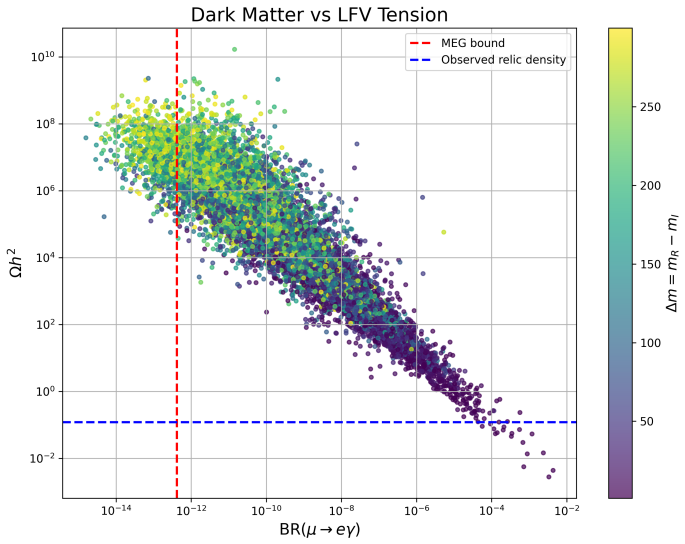
In the scotogenic model, constraints from dark matter relic density and lepton flavor violation dynamically induce approximate suppressions in the neutrino mass matrix elements.
A machine-rendered reading of the paper's core claim, the machinery that carries it, and where it could break.
Core claim
Approximate suppressions can dynamically emerge from phenomenological consistency conditions. The interplay between relic density requirements, radiative neutrino mass generation, and lepton flavor violating observables induces a nontrivial flavor geometry in parameter space, with particular suppressions in the (eμ) and (eτ) sectors arising naturally while diagonal entries strongly resist cancellation.
What carries the argument
The Casas-Ibarra parametrization of the scotogenic Yukawa matrix under simultaneous dark matter relic density and lepton flavor violation constraints.
If this is right
- Normal and inverted neutrino mass hierarchies produce distinct patterns in the emergent flavor geometry.
- Approximate scaling relations connect dark matter mass to lepton flavor violation rates.
- Reduced Casas-Ibarra parametrizations yield similar texture structures to the full geometry.
- Diagonal neutrino mass matrix entries remain robust against suppression across the viable parameter space.
Where Pith is reading between the lines
- Emergent textures may arise in other radiative neutrino mass models whenever dark matter and flavor constraints are imposed together.
- Precision measurements of lepton flavor violation at future facilities could directly probe the predicted sector-specific suppressions.
- Model builders could explore whether similar dynamical geometries appear when additional observables such as the effective Majorana mass are included in the scans.
Load-bearing premise
The assumption that the Casas-Ibarra parametrization combined with the chosen scan ranges and constraint thresholds sufficiently covers the physically relevant parameter space without introducing artificial biases or missing viable regions.
What would settle it
A broader scan that uncovers viable regions satisfying all constraints yet lacking the reported suppressions in the electron-muon and electron-tau sectors would falsify the claimed emergence of this flavor geometry.
Figures




read the original abstract
We investigate the emergence of approximate neutrino texture structures in the minimal scotogenic model through large-scale Casas--Ibarra parameter scans subject to lepton flavor violation and dark matter constraints. We demonstrate that approximate suppressions can dynamically emerge from phenomenological consistency conditions. The interplay between relic density requirements, radiative neutrino mass generation, and lepton flavor violating observables induces a nontrivial flavor geometry in parameter space. Particular suppressions in the $(e\mu)$ and $(e\tau)$ sectors arise naturally, while diagonal entries strongly resist cancellation. We further compare normal and inverted mass hierarchies, analyze reduced versus full Casas--Ibarra geometries, and identify approximate scaling relations linking dark matter and flavor observables. Our results suggest that emergent flavor structures may represent dynamical consequences of radiative neutrino mass generation rather than externally imposed flavor symmetries.
Editorial analysis
A structured set of objections, weighed in public.
Referee Report
Summary. The manuscript investigates the minimal scotogenic model via large-scale numerical scans in the Casas-Ibarra parametrization, subject to dark-matter relic-density and lepton-flavor-violation constraints. It claims that approximate suppressions in the (eμ) and (eτ) entries of the neutrino Yukawa matrix emerge dynamically from the interplay of these phenomenological requirements together with radiative neutrino-mass generation, producing a nontrivial flavor geometry in parameter space; the work further contrasts normal versus inverted hierarchies, reduced versus full Casas-Ibarra geometries, and reports approximate scaling relations between dark-matter and flavor observables.
Significance. If the reported geometry proves robust to scan-range and prior variations, the result would be of moderate significance: it would illustrate how consistency conditions alone can induce effective neutrino textures in a radiative model without additional flavor symmetries, thereby linking dark-matter phenomenology directly to lepton-flavor structure. The absence of quantitative scan diagnostics, however, currently limits the strength of this interpretation.
major comments (3)
- [Section 4 (parameter scan and results)] The central claim that the (eμ) and (eτ) suppressions arise dynamically from consistency conditions rather than scan artifacts requires explicit demonstration that the observed geometry survives changes in the bounds or priors on the complex angles of the Casas-Ibarra matrix R. The manuscript provides no such variation study, leaving open the possibility that the reported nontrivial structure is induced by the chosen scan ranges.
- [Section 4 and Figure 3] No information is given on the total number of sampled points, acceptance fraction after relic-density and LFV cuts, convergence diagnostics, or uncertainty on the reported suppression factors. Without these statistics it is impossible to judge whether the claimed flavor geometry is statistically stable or sensitive to threshold choices.
- [Section 5.2] The comparison of reduced versus full Casas-Ibarra geometries (Section 5.2) shows differences but does not test robustness against the skeptic’s concern: whether the log-uniform priors and angle bounds preferentially exclude unsuppressed regions that would still satisfy the relic-density and LFV constraints.
minor comments (2)
- [Section 3] Notation for the Casas-Ibarra angles and phases is introduced without a compact summary table; a single table collecting definitions, ranges, and priors would improve readability.
- [Figures 4–6] Several figures lack explicit labels for the color scale or contour levels corresponding to the suppression factors; this makes quantitative comparison between panels difficult.
Simulated Author's Rebuttal
We thank the referee for the careful reading of our manuscript and the constructive comments, which help clarify the presentation of our numerical results. We address each major comment below and indicate the revisions we will make.
read point-by-point responses
-
Referee: [Section 4 (parameter scan and results)] The central claim that the (eμ) and (eτ) suppressions arise dynamically from consistency conditions rather than scan artifacts requires explicit demonstration that the observed geometry survives changes in the bounds or priors on the complex angles of the Casas-Ibarra matrix R. The manuscript provides no such variation study, leaving open the possibility that the reported nontrivial structure is induced by the chosen scan ranges.
Authors: We agree that a dedicated robustness study against variations in the Casas-Ibarra parameters is required to strengthen the claim that the observed suppressions emerge dynamically. In the revised manuscript we will add a new subsection in Section 4 presenting additional scans performed with expanded ranges for the complex angles of R and with alternative (flat and log-flat) priors. These results will demonstrate that the (eμ) and (eτ) suppressions persist under such changes. revision: yes
-
Referee: [Section 4 and Figure 3] No information is given on the total number of sampled points, acceptance fraction after relic-density and LFV cuts, convergence diagnostics, or uncertainty on the reported suppression factors. Without these statistics it is impossible to judge whether the claimed flavor geometry is statistically stable or sensitive to threshold choices.
Authors: We acknowledge that the current version lacks quantitative scan diagnostics. In the revision we will report the total number of sampled points, the acceptance fraction after the relic-density and LFV cuts, the convergence criteria employed, and estimated uncertainties on the quoted suppression factors. This information will be inserted in Section 4 and in the caption of Figure 3. revision: yes
-
Referee: [Section 5.2] The comparison of reduced versus full Casas-Ibarra geometries (Section 5.2) shows differences but does not test robustness against the skeptic’s concern: whether the log-uniform priors and angle bounds preferentially exclude unsuppressed regions that would still satisfy the relic-density and LFV constraints.
Authors: We agree that the skeptic’s concern about possible prior-induced bias should be addressed explicitly. In the revised Section 5.2 we will include a dedicated test using alternative prior choices and wider angle bounds, checking whether unsuppressed (eμ) and (eτ) entries remain compatible with the relic-density and LFV constraints. The outcome of this test will be reported together with the existing reduced-versus-full comparison. revision: yes
Circularity Check
Flavor geometry reported as emergent is shaped by imposed LFV/DM scan constraints
specific steps
-
fitted input called prediction
[Abstract]
"We demonstrate that approximate suppressions can dynamically emerge from phenomenological consistency conditions. The interplay between relic density requirements, radiative neutrino mass generation, and lepton flavor violating observables induces a nontrivial flavor geometry in parameter space."
The paper scans parameters subject to relic-density, LFV, and mass-generation constraints, then presents the resulting distribution of flavor entries as an emergent geometry induced by those same conditions. The reported suppressions are therefore the filtered output of the imposed thresholds and scan ranges rather than an independent model prediction.
full rationale
The paper's central result—that approximate (eμ) and (eτ) suppressions and nontrivial flavor geometry arise dynamically—is obtained by performing large-scale scans in the Casas-Ibarra parametrization while enforcing relic density, radiative neutrino mass, and LFV bounds. The observed structure is therefore the direct statistical consequence of the selection criteria applied to the scanned parameters. While the underlying scotogenic model equations are independent, the specific geometry highlighted as 'emergent' reduces to the output of the constrained sampling procedure rather than a parameter-free derivation. No load-bearing self-citation or ansatz smuggling is evident from the provided text, keeping the circularity partial rather than total.
Axiom & Free-Parameter Ledger
free parameters (2)
- Casas-Ibarra complex angles and phases
- Dark matter mass and coupling parameters
axioms (2)
- domain assumption Neutrino masses are generated radiatively via the scotogenic loop involving the inert doublet and right-handed neutrinos.
- domain assumption Lepton flavor violation bounds and dark matter relic density are independent external constraints that can be applied simultaneously without internal inconsistency.
Lean theorems connected to this paper
-
IndisputableMonolith/Foundation/RealityFromDistinction.leanreality_from_one_distinction unclear?
unclearRelation between the paper passage and the cited Recognition theorem.
We investigate the emergence of approximate neutrino texture structures in the minimal scotogenic model through large-scale Casas–Ibarra parameter scans subject to lepton flavor violation and dark matter constraints.
-
IndisputableMonolith/Cost/FunctionalEquation.leanwashburn_uniqueness_aczel unclear?
unclearRelation between the paper passage and the cited Recognition theorem.
The neutrino mass matrix entries can be written explicitly as (Mν)αβ = Σi mi Uαi Uβi ... cancellation ratio ϵαβ = |(Mν)αβ| / Σi |mi Uαi Uβi|
What do these tags mean?
- matches
- The paper's claim is directly supported by a theorem in the formal canon.
- supports
- The theorem supports part of the paper's argument, but the paper may add assumptions or extra steps.
- extends
- The paper goes beyond the formal theorem; the theorem is a base layer rather than the whole result.
- uses
- The paper appears to rely on the theorem as machinery.
- contradicts
- The paper's claim conflicts with a theorem or certificate in the canon.
- unclear
- Pith found a possible connection, but the passage is too broad, indirect, or ambiguous to say the theorem truly supports the claim.
Reference graph
Works this paper leans on
-
[1]
K. Abeet al.[T2K Collaboration], “Constraint on the Matter–Antimatter Symmetry- Violating Phase in Neutrino Oscillations,” Nature580, 339-344 (2020) doi:10.1038/s41586- 020-2177-0 [arXiv:1910.03887 [hep-ex]]
-
[2]
An Improved Measurement of Neutrino Oscillation Parameters by the NOvA Experiment,
M. A. Aceroet al.[NOvA Collaboration], “An Improved Measurement of Neutrino Oscillation Parameters by the NOvA Experiment,” Phys. Rev. D106, 032004 (2022) doi:10.1103/PhysRevD.106.032004 [arXiv:2108.08219 [hep-ex]]
-
[3]
Evidence for oscillation of atmospheric neutrinos
Y. Fukudaet al.[Super-Kamiokande Collaboration], “Evidence for Oscil- lation of Atmospheric Neutrinos,” Phys. Rev. Lett.81, 1562-1567 (1998) doi:10.1103/PhysRevLett.81.1562 [arXiv:hep-ex/9807003]
work page internal anchor Pith review Pith/arXiv arXiv doi:10.1103/physrevlett.81.1562 1998
-
[4]
Measurement of electron antineutrino oscillation with 1958 days of operation at Daya Bay
F. P. Anet al.[Daya Bay Collaboration], “Measurement of Electron Antineutrino Oscil- lation with 1958 Days of Operation at Daya Bay,” Phys. Rev. Lett.121, 241805 (2018) doi:10.1103/PhysRevLett.121.241805 [arXiv:1809.02261 [hep-ex]]
work page internal anchor Pith review Pith/arXiv arXiv doi:10.1103/physrevlett.121.241805 1958
-
[5]
Measurement of Reactor Antineutrino Oscillation Amplitude and Frequency at RENO
G. Baket al.[RENO Collaboration], “Measurement of Reactor Antineutrino Oscil- lation Amplitude and Frequency at RENO,” Phys. Rev. Lett.121, 201801 (2018) doi:10.1103/PhysRevLett.121.201801 [arXiv:1806.00248 [hep-ex]]. 24
work page internal anchor Pith review Pith/arXiv arXiv doi:10.1103/physrevlett.121.201801 2018
-
[6]
First Double Choozθ 13 Measurement via Total Neutron Capture Detection,
H. de Kerretet al.[Double Chooz Collaboration], “First Double Choozθ 13 Measurement via Total Neutron Capture Detection,” Nature Phys.16, 558-564 (2020) doi:10.1038/s41567- 020-0831-y [arXiv:1901.09445 [hep-ex]]
-
[7]
Q. R. Ahmadet al.[SNO Collaboration], “Direct Evidence for Neutrino Flavor Transfor- mation from Neutral-Current Interactions in the Sudbury Neutrino Observatory,” Phys. Rev. Lett.89, 011301 (2002) doi:10.1103/PhysRevLett.89.011301 [arXiv:nucl-ex/0204008]
work page internal anchor Pith review Pith/arXiv arXiv doi:10.1103/physrevlett.89.011301 2002
-
[8]
First Results from KamLAND: Evidence for Reactor Anti-Neutrino Disappearance
K. Eguchiet al.[KamLAND Collaboration], “First Results from KamLAND: Evi- dence for Reactor Antineutrino Disappearance,” Phys. Rev. Lett.90, 021802 (2003) doi:10.1103/PhysRevLett.90.021802 [arXiv:hep-ex/0212021]
work page internal anchor Pith review Pith/arXiv arXiv doi:10.1103/physrevlett.90.021802 2003
-
[9]
Deep Underground Neutrino Experiment (DUNE), Far Detector Technical Design Report,
B. Abiet al.[DUNE Collaboration], “Deep Underground Neutrino Experiment (DUNE), Far Detector Technical Design Report,” JINST15, T08008 (2020) doi:10.1088/1748- 0221/15/08/T08008 [arXiv:2002.02967 [physics.ins-det]]
-
[10]
Hyper-Kamiokande Design Report
K. Abeet al.[Hyper-Kamiokande Collaboration], “Hyper-Kamiokande Design Report,” arXiv:1805.04163 [physics.ins-det]
work page internal anchor Pith review Pith/arXiv arXiv
-
[11]
F. Anet al.[JUNO Collaboration], “Neutrino Physics with JUNO,” J. Phys. G43, 030401 (2016) doi:10.1088/0954-3899/43/3/030401 [arXiv:1507.05613 [physics.ins-det]]
work page internal anchor Pith review Pith/arXiv arXiv doi:10.1088/0954-3899/43/3/030401 2016
-
[12]
The fate of hints: updated global analysis of three-flavor neutrino oscillations,
I. Esteban, M. C. Gonzalez-Garcia, M. Maltoni, T. Schwetz and A. Zhou, “The fate of hints: updated global analysis of three-flavor neutrino oscillations,” JHEP09, 178 (2020) doi:10.1007/JHEP09(2020)178 [arXiv:2007.14792 [hep-ph]]
-
[13]
Zeroes of the Neutrino Mass Ma- trix,
P. H. Frampton, S. L. Glashow and D. Marfatia, “Zeroes of the Neutrino Mass Ma- trix,” Phys. Lett. B536, 79-82 (2002) doi:10.1016/S0370-2693(02)01817-8 [arXiv:hep- ph/0201008]
-
[14]
Texture Zeros and Majorana Phases of the Neutrino Mass Matrix
Z. z. Xing, “Texture zeros and Majorana phases of the neutrino mass matrix,” Phys. Lett. B530, 159-166 (2002) doi:10.1016/S0370-2693(02)01354-0 [arXiv:hep-ph/0201151]
work page internal anchor Pith review Pith/arXiv arXiv doi:10.1016/s0370-2693(02)01354-0 2002
-
[15]
See-Saw Realization of the Texture Zeros in the Neutrino Mass Matrix
A. Kageyama, S. Kaneko, N. Shimoyama and M. Tanimoto, “See-Saw Realization of the Texture Zeros in the Neutrino Mass Matrix,” Phys. Lett. B538, 96-102 (2002) doi:10.1016/S0370-2693(02)01939-1 [arXiv:hep-ph/0204291]
work page internal anchor Pith review Pith/arXiv arXiv doi:10.1016/s0370-2693(02)01939-1 2002
-
[16]
Two-zero Textures of the Majorana Neutrino Mass Matrix and Current Experimental Tests
H. Fritzsch, Z. z. Xing and S. Zhou, “Two-zero Textures of the Majorana Neutrino Mass Matrix and Current Experimental Tests,” JHEP09, 083 (2011) doi:10.1007/JHEP09(2011)083 [arXiv:1108.4534 [hep-ph]]
work page internal anchor Pith review Pith/arXiv arXiv doi:10.1007/jhep09(2011)083 2011
-
[17]
Revisiting the texture zero neutrino mass matrices,
M. Singh, G. Ahuja and M. Gupta, “Revisiting the texture zero neutrino mass matrices,” PTEP2016, 123B08 (2016) doi:10.1093/ptep/ptw165 [arXiv:1603.08083 [hep-ph]]
-
[18]
Neutrino Mass Matrices with a Texture Zero and a Vanishing Minor
S. Dev, S. Verma, S. Gupta and R. R. Gautam, “Zero Textures of the Neu- trino Mass Matrix from Cyclic Family Symmetry,” Phys. Rev. D81, 053010 (2010) doi:10.1103/PhysRevD.81.053010 [arXiv:1003.1006 [hep-ph]]
work page internal anchor Pith review Pith/arXiv arXiv doi:10.1103/physrevd.81.053010 2010
-
[19]
A modularA 4 symmetry realization of two-zero textures of the Majorana neu- trino mass matrix,
D. Zhang, “A modularA 4 symmetry realization of two-zero textures of the Majorana neu- trino mass matrix,” Nucl. Phys. B952, 114935 (2020) doi:10.1016/j.nuclphysb.2020.114935 [arXiv:1910.07869 [hep-ph]]
-
[20]
Texture and Cofactor Zeros of the Neutrino Mass Matrix
J. Liao, D. Marfatia and K. Whisnant, “Texture and Cofactor Zeros of the Neutrino Mass Matrix,” JHEP01, 071 (2014) doi:10.1007/JHEP01(2014)071 [arXiv:1311.2639 [hep-ph]]
work page internal anchor Pith review Pith/arXiv arXiv doi:10.1007/jhep01(2014)071 2014
-
[21]
Zero minors of the neutrino mass matrix
E. I. Lashin and N. Chamoun, “Zero minors of the neutrino mass matrix,” Phys. Rev. D 78, 073002 (2008) doi:10.1103/PhysRevD.78.073002 [arXiv:0708.2423 [hep-ph]]. 25
work page internal anchor Pith review Pith/arXiv arXiv doi:10.1103/physrevd.78.073002 2008
-
[22]
A complete survey of texture zeros in the lepton mass matrices
P. O. Ludl and W. Grimus, “A complete survey of texture zeros in the lepton mass matri- ces,” JHEP07, 090 (2014) doi:10.1007/JHEP07(2014)090 [arXiv:1406.3546 [hep-ph]]
work page internal anchor Pith review Pith/arXiv arXiv doi:10.1007/jhep07(2014)090 2014
-
[23]
Texture Zeros and Weak Basis Transformations
G. C. Branco, D. Emmanuel-Costa and R. Gonzalez Felipe, “Texture zeros and weak basis transformations,” Phys. Lett. B477, 147-155 (2000) doi:10.1016/S0370-2693(00)00211-6 [arXiv:hep-ph/9911418]
work page internal anchor Pith review Pith/arXiv arXiv doi:10.1016/s0370-2693(00)00211-6 2000
-
[24]
Phenomenological Analysis of Hybrid Textures of Neutrinos
S. Dev, S. Verma and S. Gupta, “Phenomenology of two-texture zero neutrino mass matri- ces,” Phys. Lett. B687, 53-56 (2010) doi:10.1016/j.physletb.2010.03.024 [arXiv:0909.3182 [hep-ph]]
work page internal anchor Pith review Pith/arXiv arXiv doi:10.1016/j.physletb.2010.03.024 2010
-
[25]
'Mu-Tau' symmetry, tribimaximal mixing and four zero neutrino Yukawa textures
B. Adhikary, A. Ghosal and P. Roy, “µ−τsymmetry, tribimaximal mixing and four zero neutrino Yukawa textures,” JHEP10, 040 (2009) doi:10.1088/1126-6708/2009/10/040 [arXiv:0908.2686 [hep-ph]]
work page internal anchor Pith review Pith/arXiv arXiv doi:10.1088/1126-6708/2009/10/040 2009
-
[26]
Predictions of the most minimal see-saw model
M. Raidal and A. Strumia, “Predictions of the most minimal seesaw model,” Phys. Lett. B553, 72-78 (2003) doi:10.1016/S0370-2693(02)03124-6 [arXiv:hep-ph/0210021]
work page internal anchor Pith review Pith/arXiv arXiv doi:10.1016/s0370-2693(02)03124-6 2003
-
[27]
Fine-tuning and naturalness issues in the two-zero neutrino mass textures
D. Meloni and G. Blankenburg, “Fine-tuning and naturalness issues in the two-zero neutrino mass textures,” Nucl. Phys. B867, 749-762 (2013) doi:10.1016/j.nuclphysb.2012.10.017 [arXiv:1204.2706 [hep-ph]]
work page internal anchor Pith review Pith/arXiv arXiv doi:10.1016/j.nuclphysb.2012.10.017 2013
-
[28]
A. Zee, “A Theory of Lepton Number Violation, Neutrino Majorana Mass, and Oscillation,” Phys. Lett. B93, 389 (1980) [erratum: Phys. Lett. B95, 461 (1980)]. doi:10.1016/0370- 2693(80)90349-4
-
[29]
Model of ’Calculable’ Majorana Neutrino Masses,
K. S. Babu, “Model of ’Calculable’ Majorana Neutrino Masses,” Phys. Lett. B203, 132-136 (1988) doi:10.1016/0370-2693(88)91584-5
-
[30]
From the trees to the forest: a review of radiative neutrino mass models,
Y. Cai, J. Herrero-Garcia, M. A. Schmidt, A. Vicente and R. R. Volkas, “From the trees to the forest: a review of radiative neutrino mass models,” Front. in Phys.5, 63 (2017) doi:10.3389/fphy.2017.00063 [arXiv:1706.08524 [hep-ph]]
-
[31]
Interpretation of precision tests in the Higgs sector in terms of physics beyond the Standard Model
F. Bonnet, D. Hernandez, T. Ota and W. Winter, “Systematic study of the d=5 Wein- berg operator at one-loop order,” JHEP10, 076 (2012) doi:10.1007/JHEP10(2012)076 [arXiv:1207.4599 [hep-ph]]
work page internal anchor Pith review Pith/arXiv arXiv doi:10.1007/jhep10(2012)076 2012
-
[32]
Systematic classification of two-loop realizations of the Weinberg operator
D. Aristizabal Sierra, A. Degee, L. Dorin and M. Hirsch, “Systematic classifi- cation of two-loop realizations of the Weinberg operator,” JHEP03, 040 (2015) doi:10.1007/JHEP03(2015)040 [arXiv:1411.7038 [hep-ph]]
work page internal anchor Pith review Pith/arXiv arXiv doi:10.1007/jhep03(2015)040 2015
-
[33]
The Scotogenic Model: A Review,
S. T. Petcov, H. Sugiyama and Y. L. Zhou, “The Scotogenic Model: A Review,” Universe 10, no.1, 1 (2024) doi:10.3390/universe10010001
-
[34]
A Model for Neutrino Masses and Dark Matter
L. M. Krauss, S. Nasri and M. Trodden, “A Model for neutrino masses and dark matter,” Phys. Rev. D67, 085002 (2003) doi:10.1103/PhysRevD.67.085002 [arXiv:hep-ph/0210389]
work page internal anchor Pith review Pith/arXiv arXiv doi:10.1103/physrevd.67.085002 2003
-
[35]
Pattern of Symmetry Breaking with Two Higgs Doublets,
N. G. Deshpande and E. Ma, “Pattern of Symmetry Breaking with Two Higgs Doublets,” Phys. Rev. D18, 2574 (1978) doi:10.1103/PhysRevD.18.2574
-
[36]
T. Hambye, K. Kannike, E. Ma and M. Raidal, “Emanations of dark matter: Muon anoma- lous magnetic moment, radiative neutrino masses, and novel leptogenesis at the TeV scale,” Phys. Rev. D75, 095003 (2007) doi:10.1103/PhysRevD.75.095003 [arXiv:hep-ph/0609228]
work page internal anchor Pith review Pith/arXiv arXiv doi:10.1103/physrevd.75.095003 2007
-
[37]
Verifiable Radiative Seesaw Mechanism of Neutrino Mass and Dark Matter
E. Ma, “Verifiable radiative seesaw mechanism of neutrino mass and dark matter,” Phys. Rev. D73, 077301 (2006) doi:10.1103/PhysRevD.73.077301 [arXiv:hep-ph/0601225]. 26
work page internal anchor Pith review Pith/arXiv arXiv doi:10.1103/physrevd.73.077301 2006
-
[38]
Cold Dark Matter, Radiative Neutrino Mass, mu to e gamma, and Neutrinoless Double Beta Decay
J. Kubo, E. Ma and D. Suematsu, “Cold Dark Matter, Radiative Neutrino Mass, µ→eγ, and Neutrinoless Double Beta Decay,” Phys. Lett. B642, 18-23 (2006) doi:10.1016/j.physletb.2006.08.085 [arXiv:hep-ph/0604114]
work page internal anchor Pith review Pith/arXiv arXiv doi:10.1016/j.physletb.2006.08.085 2006
-
[39]
The Inert Doublet Model: an Archetype for Dark Matter
L. Lopez Honorez, E. Nezri, J. F. Oliver and M. H. G. Tytgat, “The Inert Doublet Model: An Archetype for Dark Matter,” JCAP02, 028 (2007) doi:10.1088/1475-7516/2007/02/028 [arXiv:hep-ph/0612275]
work page internal anchor Pith review Pith/arXiv arXiv doi:10.1088/1475-7516/2007/02/028 2007
-
[40]
Lepton Flavor Violation in the Scotogenic Model
T. Toma and A. Vicente, “Lepton Flavor Violation in the Scotogenic Model,” JHEP01, 160 (2014) doi:10.1007/JHEP01(2014)160 [arXiv:1312.2840 [hep-ph]]
work page internal anchor Pith review Pith/arXiv arXiv doi:10.1007/jhep01(2014)160 2014
-
[41]
Models with radiative neutrino masses and viable dark matter candidates
D. Restrepo, O. Zapata and C. E. Yaguna, “Models with radiative neutrino masses and viable dark matter candidates,” JHEP11, 011 (2013) doi:10.1007/JHEP11(2013)011 [arXiv:1308.3655 [hep-ph]]
work page internal anchor Pith review Pith/arXiv arXiv doi:10.1007/jhep11(2013)011 2013
-
[42]
FIMP realization of the scotogenic model
E. Molinaro, C. E. Yaguna and O. Zapata, “FIMP realization of the scotogenic model,” JCAP07, 015 (2014) doi:10.1088/1475-7516/2014/07/015 [arXiv:1405.1259 [hep-ph]]
work page internal anchor Pith review Pith/arXiv arXiv doi:10.1088/1475-7516/2014/07/015 2014
-
[43]
M. Hirsch, S. Morisi, E. Peinado and J. W. F. Valle, “Discrete dark matter,” Phys. Rev. D82, 116003 (2010) doi:10.1103/PhysRevD.82.116003 [arXiv:1007.0871 [hep-ph]]
work page internal anchor Pith review Pith/arXiv arXiv doi:10.1103/physrevd.82.116003 2010
-
[44]
Probing the scotogenic model with lepton flavor violating processes
A. Vicente and C. E. Yaguna, “Probing the scotogenic model with lepton flavor violating processes,” JHEP02, 144 (2015) doi:10.1007/JHEP02(2015)144 [arXiv:1412.2545 [hep- ph]]
work page internal anchor Pith review Pith/arXiv arXiv doi:10.1007/jhep02(2015)144 2015
-
[45]
A. M. Baldiniet al.[MEG Collaboration], “Search for the Lepton Flavour Violating Decay µ+ →e +γwith the Full Dataset of the MEG Experiment,” Eur. Phys. J. C76, no.8, 434 (2016) doi:10.1140/epjc/s10052-016-4271-x [arXiv:1605.05081 [hep-ex]]
work page internal anchor Pith review Pith/arXiv arXiv doi:10.1140/epjc/s10052-016-4271-x 2016
-
[46]
The design of the MEG II experiment
A. M. Baldiniet al.[MEG II Collaboration], “The design of the MEG II experiment,” Eur. Phys. J. C78, no.5, 380 (2018) doi:10.1140/epjc/s10052-018-5845-6 [arXiv:1801.04688 [physics.ins-det]]
work page internal anchor Pith review Pith/arXiv arXiv doi:10.1140/epjc/s10052-018-5845-6 2018
-
[47]
New Limit for the Family-Number Non-conserving Decay mu+ to e+_gamma
M. L. Brookset al.[MEGA Collaboration], “New Limit for the Family-Number Nonconserving Decayµ + →e +γ,” Phys. Rev. Lett.83, 1521-1524 (1999) doi:10.1103/PhysRevLett.83.1521 [arXiv:hep-ex/9905013]
work page internal anchor Pith review Pith/arXiv arXiv doi:10.1103/physrevlett.83.1521 1999
-
[48]
Lepton-Flavor Violation via Right-Handed Neutrino Yukawa Couplings in Supersymmetric Standard Model
J. Hisano, T. Moroi, K. Tobe and M. Yamaguchi, “Lepton-Flavor Violation via Right- Handed Neutrino Yukawa Couplings in Supersymmetric Standard Model,” Phys. Rev. D 53, 2442-2459 (1996) doi:10.1103/PhysRevD.53.2442 [arXiv:hep-ph/9510309]
work page internal anchor Pith review Pith/arXiv arXiv doi:10.1103/physrevd.53.2442 1996
-
[49]
Muon Decay and Physics Beyond the Standard Model
Y. Kuno and Y. Okada, “Muon decay and physics beyond the standard model,” Rev. Mod. Phys.73, 151-202 (2001) doi:10.1103/RevModPhys.73.151 [arXiv:hep-ph/9909265]
work page internal anchor Pith review Pith/arXiv arXiv doi:10.1103/revmodphys.73.151 2001
-
[50]
Charged Lepton Flavour Violation: An Experimental and Theoretical Introduction
L. Calibbi and G. Signorelli, “Charged Lepton Flavour Violation: An Experimental and Theoretical Introduction,” Riv. Nuovo Cim.41, no.2, 71-174 (2018) doi:10.1393/ncr/i2018- 10144-0 [arXiv:1709.00294 [hep-ph]]
work page internal anchor Pith review Pith/arXiv arXiv doi:10.1393/ncr/i2018- 2018
-
[51]
Reconciliation of CDM abundance and $\mu\to e\gamma$ in a radiative seesaw model
D. Suematsu, T. Toma and T. Yoshida, “Reconciliation of CDM abundance andµ→eγin a radiative seesaw model,” Phys. Rev. D79, 093004 (2009) doi:10.1103/PhysRevD.79.093004 [arXiv:0903.0287 [hep-ph]]
work page internal anchor Pith review Pith/arXiv arXiv doi:10.1103/physrevd.79.093004 2009
-
[52]
Electroweak corrections to the direct detection cross section of inert higgs dark matter
M. Klasen, C. E. Yaguna and J. D. Ruiz-Alvarez, “Electroweak corrections to the direct detection cross section of inert Higgs dark matter,” Phys. Rev. D87, no.7, 075025 (2013) doi:10.1103/PhysRevD.87.075025 [arXiv:1302.1657 [hep-ph]]. 27
work page internal anchor Pith review Pith/arXiv arXiv doi:10.1103/physrevd.87.075025 2013
-
[53]
Low-Scale Leptogenesis in the Scotogenic Neutrino Mass Model
T. Hugle, M. Platscher and K. Schmitz, “Low-Scale Leptogenesis in the Scotogenic Neutrino Mass Model,” Phys. Rev. D98, no.2, 023020 (2018) doi:10.1103/PhysRevD.98.023020 [arXiv:1804.09660 [hep-ph]]
work page internal anchor Pith review Pith/arXiv arXiv doi:10.1103/physrevd.98.023020 2018
-
[54]
E. M. Dolle and S. Su, “The Inert Dark Matter,” Phys. Rev. D80, 055012 (2009) doi:10.1103/PhysRevD.80.055012 [arXiv:0906.1609 [hep-ph]]
work page internal anchor Pith review Pith/arXiv arXiv doi:10.1103/physrevd.80.055012 2009
-
[55]
Simplest Scoto-Seesaw Mechanism
N. Rojas, R. Srivastava and J. W. F. Valle, “Scotogenic neutrino masses and dark mat- ter complementarity from LEP and XENON1T,” Phys. Lett. B789, 132-136 (2019) doi:10.1016/j.physletb.2018.12.006 [arXiv:1807.11447 [hep-ph]]
work page internal anchor Pith review Pith/arXiv arXiv doi:10.1016/j.physletb.2018.12.006 2019
-
[56]
Common Origin of Neutrino Mass, Dark Matter and Dirac Leptogenesis
D. Borah and A. Dasgupta, “Probing Majorana Neutrino Dark Matter and Radia- tive Neutrino Mass in a Scotogenic Model,” JCAP11, 003 (2016) doi:10.1088/1475- 7516/2016/11/003 [arXiv:1608.03872 [hep-ph]]
work page internal anchor Pith review Pith/arXiv arXiv doi:10.1088/1475- 2016
-
[57]
The singlet scalar as FIMP dark matter
C. E. Yaguna, “The Singlet Scalar as FIMP Dark Matter,” JHEP08, 060 (2011) doi:10.1007/JHEP08(2011)060 [arXiv:1105.1654 [hep-ph]]
work page internal anchor Pith review Pith/arXiv arXiv doi:10.1007/jhep08(2011)060 2011
-
[58]
Dark matter and U(1)' symmetry for the right-handed neutrinos
M. Lindner, D. Schmidt and A. Watanabe, “Dark Matter and Neutrino Masses from GlobalU(1) B−L Symmetry Breaking,” Phys. Rev. D89, no.1, 013007 (2014) doi:10.1103/PhysRevD.89.013007 [arXiv:1310.6582 [hep-ph]]
work page internal anchor Pith review Pith/arXiv arXiv doi:10.1103/physrevd.89.013007 2014
-
[59]
Oscillating neutrinos and mu --> e, gamma
J. A. Casas and A. Ibarra, “Oscillating neutrinos andµ→e, γ,” Nucl. Phys. B618, 171-204 (2001) doi:10.1016/S0550-3213(01)00475-8 [arXiv:hep-ph/0103065]
work page internal anchor Pith review Pith/arXiv arXiv doi:10.1016/s0550-3213(01)00475-8 2001
-
[60]
Inverse Beta Processes and Nonconservation of Lepton Charge,
B. Pontecorvo, “Inverse Beta Processes and Nonconservation of Lepton Charge,” Sov. Phys. JETP7, 172-173 (1958)
work page 1958
-
[61]
Remarks on the Unified Model of Elementary Particles,
Z. Maki, M. Nakagawa and S. Sakata, “Remarks on the Unified Model of Elementary Particles,” Prog. Theor. Phys.28, 870-880 (1962) doi:10.1143/PTP.28.870
-
[62]
S. Navaset al.[Particle Data Group], “Review of Particle Physics,” Phys. Rev. D110, no.3, 030001 (2024) doi:10.1103/PhysRevD.110.030001
-
[63]
G. B´ elanger, F. Boudjema, A. Pukhov and A. Semenov, “micrOMEGAs6.0: N-component Dark Matter,” Comput. Phys. Commun.231, 173-186 (2018) doi:10.1016/j.cpc.2018.04.027 [arXiv:1801.03509 [hep-ph]]. 28
work page internal anchor Pith review Pith/arXiv arXiv doi:10.1016/j.cpc.2018.04.027 2018
discussion (0)
Sign in with ORCID, Apple, or X to comment. Anyone can read and Pith papers without signing in.