Hawking atmosphere of anti-de Sitter black holes
Pith reviewed 2026-06-30 15:17 UTC · model grok-4.3
The pith
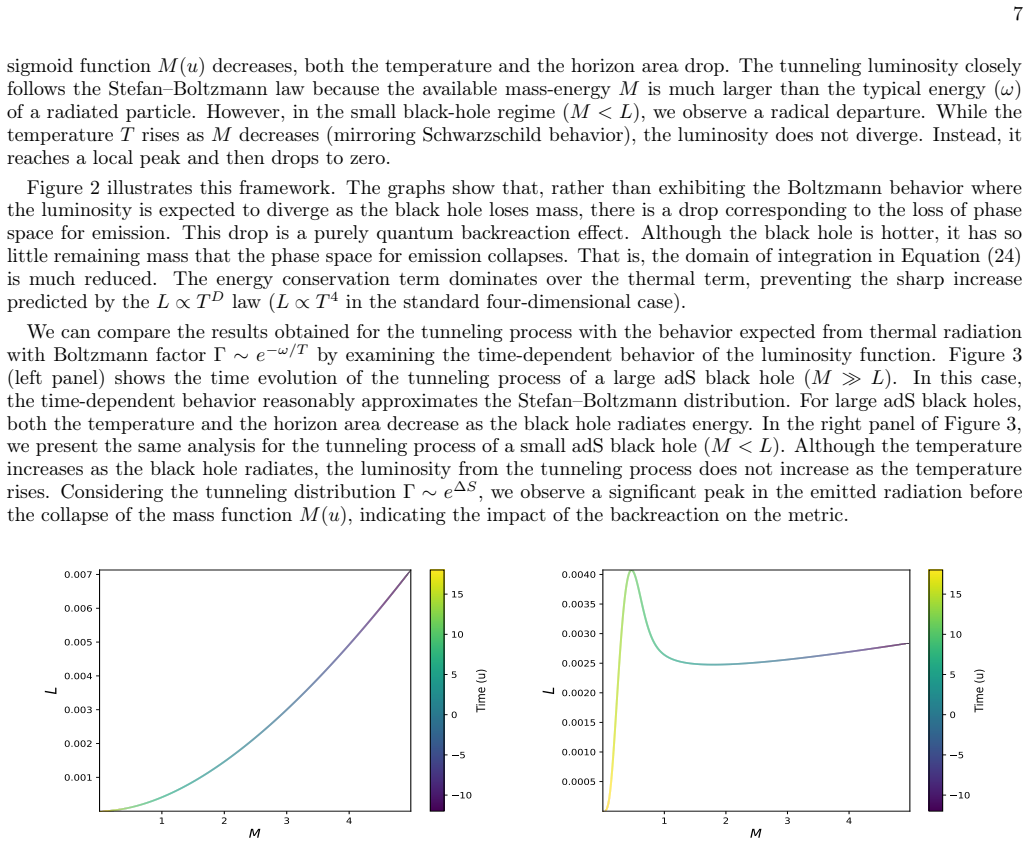
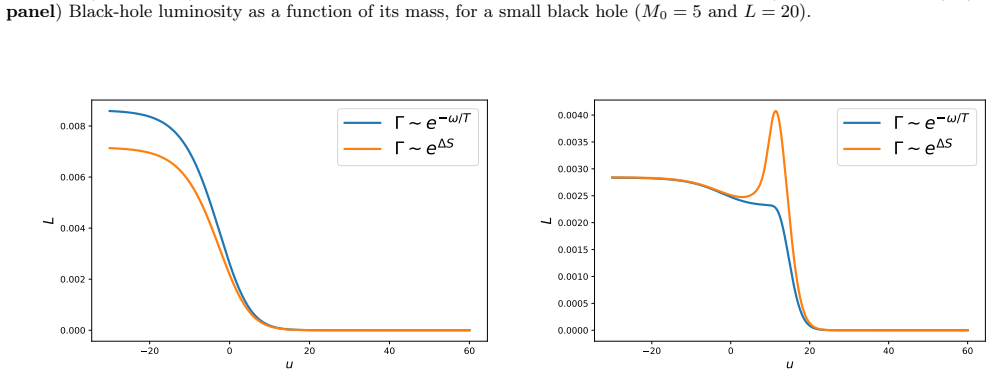
Small anti-de Sitter black holes show luminosity that falls rather than rises as temperature increases during evaporation.
A machine-rendered reading of the paper's core claim, the machinery that carries it, and where it could break.
Core claim
Applying the Parikh-Wilczek tunneling method to spherically symmetric AdS black holes in a Vaidya-AdS geometry, the emission probability is set equal to the change in Bekenstein-Hawking entropy; the resulting luminosity is then computed as a function of time and shown to deviate markedly from ideal blackbody emission, with the deviation becoming strongest for small black holes where mass variations during evaporation prevent luminosity from increasing with temperature.
What carries the argument
Parikh-Wilczek tunneling probability linked directly to the change in Bekenstein-Hawking entropy inside the Vaidya-AdS dynamical metric, used to obtain time-dependent luminosity and to compute the renormalized energy-momentum tensor of the Hawking atmosphere.
If this is right
- Evaporation in asymptotically AdS spacetimes produces a Hawking atmosphere whose energy flux is suppressed relative to flat-space expectations once mass loss is accounted for.
- The thermodynamic relation between temperature and luminosity is altered for small black holes, affecting how quickly they shrink.
- The renormalized stress tensor obtained in the Vaidya-AdS background quantifies the deviation of the quantum field from thermal equilibrium.
- Backreaction must be retained to obtain consistent semiclassical evolution of the horizon in curved asymptotics.
Where Pith is reading between the lines
- The same tunneling-plus-backreaction construction could be repeated for other dynamical metrics to test whether the luminosity suppression is generic to negative cosmological constant.
- The computed stress tensor supplies boundary data that might be matched to a dual field theory description of the evaporating geometry.
- Numerical integration of the Vaidya-AdS metric with the derived luminosity as source term would provide an independent consistency check on the analytic tunneling result.
Load-bearing premise
The tunneling probability can be tied exactly to the entropy change while the Vaidya-AdS geometry captures all dynamical backreaction on the quantum fields.
What would settle it
A direct evaluation of the luminosity or the renormalized energy-momentum tensor for small AdS black holes that shows radiation output still rising with temperature once backreaction is included.
Figures
read the original abstract
This work investigates the semiclassical evolution of the Hawking atmosphere surrounding evaporating, spherically symmetric anti-de Sitter (adS) black holes. We model the evaporation process within a dynamical framework, treating the emission of Hawking radiation as a quantum tunneling process through the black-hole horizon. Using the Parikh-Wilczek tunneling method, we incorporate backreaction effects, with the emission probability being linked to the resulting change in the Bekenstein-Hawking entropy of the black hole. This probability is then used to compute the time-dependent luminosity of the system, revealing significant deviations from ideal blackbody behavior, particularly for small adS black holes. For these objects, the luminosity does not increase with temperature due to strong mass variations during evaporation. To complement this microscopic approach, we compute the renormalized energy-momentum tensor for a quantum field propagating in the Vaidya-adS geometry modelling the evaporation process. Together, these approaches clarify the interplay between geometry, quantum fields, and thermodynamics in shaping the Hawking atmosphere and the evaporation dynamics of black holes in asymptotically adS spacetimes.
Editorial analysis
A structured set of objections, weighed in public.
Referee Report
Summary. The paper models the semiclassical evaporation of spherically symmetric AdS black holes via the Parikh-Wilczek tunneling method, linking emission probability to the change in Bekenstein-Hawking entropy to incorporate backreaction and compute time-dependent luminosity; it reports that for small AdS black holes luminosity does not increase with temperature owing to strong mass variations during evaporation. This is supplemented by a computation of the renormalized energy-momentum tensor for a quantum field in the Vaidya-AdS geometry.
Significance. If the central result holds, the work would demonstrate important backreaction-induced deviations from blackbody scaling in the Hawking atmosphere of small AdS black holes, clarifying the coupled evolution of geometry, quantum fields, and thermodynamics in asymptotically AdS spacetimes. The dual use of tunneling rates and explicit EMT evaluation is a constructive feature that could support reproducible checks if derivations are made explicit.
major comments (2)
- [Tunneling and luminosity section] The tunneling-probability construction (abstract and associated method): emission probability is defined via ΔS_BH, so that Γ ~ exp(ΔS) is used to obtain L(M(t)); this reduces the luminosity derivation to a thermodynamic identity by construction and supplies no independent dynamical input from the quantum-field modes, directly undermining the claim that the L(T) relation for small AdS black holes follows from dynamical backreaction.
- [Vaidya-AdS backreaction modeling] Vaidya-AdS modeling (section on dynamical geometry and EMT computation): the paper assumes the Vaidya ansatz fully encodes the backreaction on field modes for both the tunneling integral and the separate ⟨T_μν⟩ evaluation, yet provides no verification that AdS boundary fluxes or non-spherical perturbations are captured; without such a check the derived luminosity result remains unreliable.
minor comments (1)
- [Abstract] The abstract supplies no explicit derivations, numerical checks, or error estimates, so the consistency of the backreaction implementation cannot be assessed from the summary alone.
Simulated Author's Rebuttal
We thank the referee for the careful review and constructive comments on our manuscript. We respond point-by-point to the major comments below.
read point-by-point responses
-
Referee: [Tunneling and luminosity section] The tunneling-probability construction (abstract and associated method): emission probability is defined via ΔS_BH, so that Γ ~ exp(ΔS) is used to obtain L(M(t)); this reduces the luminosity derivation to a thermodynamic identity by construction and supplies no independent dynamical input from the quantum-field modes, directly undermining the claim that the L(T) relation for small AdS black holes follows from dynamical backreaction.
Authors: The Parikh-Wilczek tunneling calculation evaluates the imaginary part of the action for a massless particle traversing the horizon in the dynamical Vaidya-AdS metric, where the mass parameter M decreases continuously with each emission. Although the resulting probability takes the form exp(ΔS_BH), this expression is obtained directly from the contour integral over the time-dependent geometry rather than imposed by hand. The backreaction enters through the metric's explicit M(t) dependence in the tunneling integral, which modifies the effective barrier and yields a spectrum whose integrated luminosity deviates from the Stefan-Boltzmann law once dM/dt becomes comparable to the instantaneous mass. This supplies dynamical input from the quantum-field modes via the WKB approximation in the backreacted spacetime. revision: no
-
Referee: [Vaidya-AdS backreaction modeling] Vaidya-AdS modeling (section on dynamical geometry and EMT computation): the paper assumes the Vaidya ansatz fully encodes the backreaction on field modes for both the tunneling integral and the separate ⟨T_μν⟩ evaluation, yet provides no verification that AdS boundary fluxes or non-spherical perturbations are captured; without such a check the derived luminosity result remains unreliable.
Authors: The Vaidya-AdS ansatz is the unique spherically symmetric solution of the Einstein equations sourced by outgoing null dust, thereby encoding the leading semiclassical backreaction on the geometry. Asymptotic AdS boundary conditions are preserved by construction, ensuring that the boundary fluxes are those required by the AdS/CFT dictionary for spherical symmetry. The renormalized ⟨T_μν⟩ is computed directly in this geometry to cross-check the energy flux obtained from the tunneling rate. Non-spherical perturbations lie outside the scope of the present spherically symmetric analysis; extending the metric ansatz would be a separate investigation. revision: no
Circularity Check
No significant circularity; derivation uses standard tunneling result plus independent Vaidya computation
full rationale
The paper applies the established Parikh-Wilczek method, in which the tunneling probability is obtained from the imaginary part of the action integral and shown to equal exp(ΔS_BH); this is a derived equality, not a definitional input. Luminosity follows from the resulting mass-loss rate dM/dt in the Vaidya-AdS background, while the renormalized ⟨T_μν⟩ is computed separately via standard regularization on the same metric. No equation reduces the final L(T) relation to a tautology or to a self-citation chain, and the AdS-specific mass variation during evaporation supplies independent dynamical content. The central claim therefore rests on the geometry and the tunneling calculation rather than on re-labeling its own inputs.
Axiom & Free-Parameter Ledger
axioms (2)
- domain assumption Parikh-Wilczek tunneling method remains valid for dynamical AdS black holes with backreaction.
- domain assumption Vaidya-AdS metric adequately models the evaporating geometry for computing the renormalized stress-energy tensor.
Reference graph
Works this paper leans on
-
[1]
Gauge Theory Correlators from Non-Critical String Theory
Gubser, S.S.; Klebanov, I.R.; Polyakov, A.M. Gauge theory correlators from non-critical string theory.Phys. Lett. B1998, 428, 105–114. arXiv:hep-th/9802109
work page internal anchor Pith review Pith/arXiv arXiv
-
[2]
The Large N Limit of Superconformal Field Theories and Supergravity
Maldacena, J.M. The Large N limit of superconformal field theories and supergravity.Adv. Theor. Math. Phys.1998,2, 231–252. arXiv:hep-th/9711200
work page internal anchor Pith review Pith/arXiv arXiv 1998
-
[3]
Anti De Sitter Space And Holography
Witten, E. Anti-de Sitter space and holography.Adv. Theor. Math. Phys.1998,2, 253–291. arXiv:hep-th/9802150
work page internal anchor Pith review Pith/arXiv arXiv 1998
-
[4]
Thermodynamics of black holes in anti-de Sitter space.Commun
Hawking, S.W.; Page, D.N. Thermodynamics of black holes in anti-de Sitter space.Commun. Math. Phys.1983,87, 577–588.https://doi.org/10.1007/BF01208266
-
[5]
Rotation and the AdS/CFT correspondence
Hawking, S.W.; Hunter, C.J.; Taylor-Robinson, M.M. Rotation and the AdS/CFT correspondence.Phys. Rev. D1999, 59, 064005. arXiv:hep-th/9811056
work page internal anchor Pith review Pith/arXiv arXiv
-
[6]
The First Law of Thermodynamics for Kerr-Anti-de Sitter Black Holes
Gibbons, G.W.; Perry, M.J.; Pope, C.N. The First Law of Thermodynamics for Kerr-Anti-de Sitter Black Holes.Class. Quant. Grav.2005,22, 1503. arXiv:hep-th/0408217
work page internal anchor Pith review Pith/arXiv arXiv 2005
-
[7]
Enthalpy and the Mechanics of AdS Black Holes
Kastor, D.; Ray, S.; Traschen, J. Enthalpy and the mechanics of adS black holes.Class. Quant. Grav.2009,26, 195011. arXiv:0904.2765
work page internal anchor Pith review Pith/arXiv arXiv 2009
-
[8]
Pressure and volume in the first law of black hole thermodynamics
Dolan, B.P. Pressure and volume in the first law of black hole thermodynamics.Class. Quant. Grav.2011,28, 235017. arXiv:1106.6260
work page internal anchor Pith review Pith/arXiv arXiv 2011
-
[9]
Page, D.N. Finite upper bound for the Hawking decay time of an arbitrarily large black hole in anti–de Sitter spacetime. Phys. Rev. D2018,97, 024004. arXiv:1507.02682
work page internal anchor Pith review Pith/arXiv arXiv
-
[10]
A Hamiltonian approach for the Thermodynamics of AdS black holes
Baldiotti, M.C.; Fresneda, R.; Molina, C. A Hamiltonian approach for the Thermodynamics of AdS black holes.Ann. Phys.2017,382, 22–35. arXiv:1701.01119
work page internal anchor Pith review Pith/arXiv arXiv 2017
-
[11]
Extended quasilocal Thermodynamics of Schwarzchild-anti de Sitter black holes.Ann
Fontana, W.B.; Baldiotti, M.C.; Fresneda, R.; Molina, C. Extended quasilocal Thermodynamics of Schwarzchild-anti de Sitter black holes.Ann. Phys.2019,411, 167954. arXiv:1806.05699
-
[12]
Generating Kerr-anti-de Sitter thermodynamics.Phys
Campos, T.; Baldiotti, M.C.; Molina, C. Generating Kerr-anti-de Sitter thermodynamics.Phys. Rev. D2024,110, 024049. arXiv:2407.09610
- [13]
-
[14]
Black-Hole thermodynamics from gauge freedom in extended Iyer-Wald formalism
Campos, T.; Baldiotti, M.C.; Molina, C. Black-Hole thermodynamics from gauge freedom in extended Iyer-Wald formalism. Universe2025,11, 215. arXiv:2507.03751
-
[15]
Particle creation by black holes.Commun
Hawking, S.W. Particle creation by black holes.Commun. Math. Phys.1975,43, 199–220.https://doi.org/10.1007/ BF01608497
1975
-
[16]
The self-screening Hawking atmosphere
’t Hooft, G. The self-screening Hawking atmosphere, a new approach to quantum black hole microstates.Nucl. Phys. B Proc. Suppl.1998,68, 174–184. arXiv:gr-qc/9706058
work page internal anchor Pith review Pith/arXiv arXiv 1998
-
[17]
The Thermodynamics of Black Holes
Wald, R.M. The thermodynamics of black holes.Living Rev. Rel.2001,4, 6. arXiv:gr-qc/9912119
work page internal anchor Pith review Pith/arXiv arXiv 2001
-
[18]
Thermodynamics of Large AdS Black Holes
Hemming, S.; Thorlacius, L. Thermodynamics of large adS black holes.J. High Energy Phys.2007,2007, 086. arXiv:0709.3738
work page internal anchor Pith review Pith/arXiv arXiv 2007
-
[19]
The Semi-Classical Back Reaction to Black Hole Evaporation
Massar, S. Semiclassical back reaction to black hole evaporation.Phys. Rev. D1995,52, 5857. arXiv:gr-qc/9411039
work page internal anchor Pith review Pith/arXiv arXiv
-
[20]
The gravitational field of a radiating star.Proc
Vaidya, P.C. The gravitational field of a radiating star.Proc. Indian Acad. Sci. A1951,33, 264–276.https://doi.org/ 10.1023/A:1018875606950
-
[21]
Wang, A.; Wu, Y. Generalized vaidya solutions.Gen. Relativ. Gravit.1999,31, 107–114. arXiv:gr-qc/9803038
work page internal anchor Pith review Pith/arXiv arXiv 1999
-
[23]
Hiscock, W. A. Models of evaporating black holes. I.Phys. Rev. D1981,23, 2813.https://doi.org/10.1103/PhysRevD. 23.2813. 11
-
[24]
Hiscock, W. A. Models of evaporating black holes. II. Effects of the outgoing created radiation.Phys. Rev. D1981,23, 2823.https://doi.org/10.1103/PhysRevD.23.2823
-
[25]
Campos, T. L.; Molina, C.; Baldiotti, M. C. Dynamical black holes and accretion-induced backreaction.Universe2025, 11, 202. arXiv:2507.03082
-
[26]
Campos, T. L.; Molina, C.; Lima, J. A. S. Black-hole evaporation for cosmological observers.Universe2025,12, 394. arXiv:2411.08114
-
[27]
Hawking Radiation as Tunneling
Parikh, M.K.; Wilczek, F. Hawking Radiation as Tunneling.Phys. Rev. Lett.2000,85, 5042–5045. arXiv:hep-th/9907001
work page internal anchor Pith review Pith/arXiv arXiv 2000
-
[28]
Tunnelling Effect and Hawking Radiation from a Vaidya Black Hole
Jun, R.; Jing-Yi, Z.; Zheng, Z. Tunnelling effect and Hawking radiation from a Vaidya black hole.Chin. Phys. Lett.2006, 23, 2019. arXiv:gr-qc/0606066
work page internal anchor Pith review Pith/arXiv arXiv 2006
-
[29]
150–190.https://doi.org/10.1017/CBO9780511622632
Birrell, N.D.; Davies, P.C.W.Quantum Fields in Curved Space; Cambridge University Press: Cambridge, UK, 1982; pp. 150–190.https://doi.org/10.1017/CBO9780511622632
-
[30]
Hobson, M. P.; Efstathiou, G. P.; Lasenby, A. N.General Relativity: An Introduction for Physicists; Cambridge University Press: Cambridge, UK, 2006.https://doi.org/10.1017/CBO9780511790904
-
[31]
General Laws of Black-Hole Dynamics
Hayward, S.A. General laws of black-hole dynamics.Phys. Rev. D1994,49, 6467. arXiv:gr-qc/9303006
work page internal anchor Pith review Pith/arXiv arXiv
-
[32]
Gravitational Energy in Spherical Symmetry
Hayward, S.A. Gravitational energy in spherical symmetry.Phys. Rev. D1996,53, 1938. arXiv:gr-qc/9408002
work page internal anchor Pith review Pith/arXiv arXiv 1938
-
[33]
Unified first law of black-hole dynamics and relativistic thermodynamics.Class
Hayward, S.A. Unified first law of black-hole dynamics and relativistic thermodynamics.Class. Quant. Grav.,1988,15,
1988
-
[34]
Quantum field theory in anti-de Sitter space-time.Phys
Avis, S.J.; Isham, C.J.; Storey, D. Quantum field theory in anti-de Sitter space-time.Phys. Rev. D1978,18, 3565–3576. https://doi.org/10.1103/PhysRevD.18.3565
-
[35]
Thermodynamics of bosonic systems in adS spacetime
Elias, W.S.; Molina, C.; Baldiotti, M.C. Thermodynamics of bosonic systems in anti-de Sitter spacetime.Phys. Rev. D 2019,99, 084028. arXiv:1803.05921
work page internal anchor Pith review Pith/arXiv arXiv 2019
-
[36]
Quasinormal Modes of AdS Black Holes and the Approach to Thermal Equilibrium
Horowitz, G. T.; Hubeny, V. E. Quasinormal modes of AdS black holes and the approach to thermal equilibrium.Phys. Rev. D2000,62, 024027. arXiv:hep-th/9909056
work page internal anchor Pith review Pith/arXiv arXiv
-
[37]
Evolving of a massless scalar field in Reissner--Nordstr\"{o}m Anti--de Sitter spacetimes
Wang, B.; Molina, C.; Abdalla, E. Evolving of a massless scalar field in Reissner–Nordström anti-de Sitter space-times. Phys. Rev. D2001,63, 084001. arXiv:hep-th/0005143
work page internal anchor Pith review Pith/arXiv arXiv
-
[38]
Abdalla, E.; Chirenti, C. B. M. H.; Saa, A. Quasinormal mode characterization of evaporating mini black holes.J. High Energy Phys.2007,10, 086. arXiv:gr-qc/0703071
work page internal anchor Pith review Pith/arXiv arXiv 2007
-
[39]
Essential and inessential features of Hawking radiation.Int
Visser, M. Essential and inessential features of Hawking radiation.Int. J. Mod. Phys. D2003,12, 649–661. arXiv:hep- th/0106111
-
[40]
1–100.https: //doi.org/10.1142/p378
Fabbri, A.; Navarro-Salas, J.Modeling Black Hole Evaporation; World Scientific: Singapore, 2005; pp. 1–100.https: //doi.org/10.1142/p378
-
[41]
Evaporation of (quantum) black holes and energy conservation
Torres, R.; Fayos, F.; Lorente-Espín, O. Evaporation of (quantum) black holes and energy conservation.Phys. Lett. B 2013,720, 198–204. arXiv:1308.4318
work page internal anchor Pith review Pith/arXiv arXiv 2013
-
[42]
Black holes do evaporate thermally.Phys
Bardeen, J.M. Black holes do evaporate thermally.Phys. Rev. Lett.1981,46, 382.https://doi.org/10.1103/ PhysRevLett.46.382
1981
-
[43]
Trace anomalies and the Hawking effect.Phys
Christensen, S.M.; Fulling, S.A. Trace anomalies and the Hawking effect.Phys. Rev. D1977,15, 2088–2104.https: //doi.org/10.1103/PhysRevD.15.2088
-
[44]
Evaporating black hole in Vaidya metric.Phys
Beciu, M.I. Evaporating black hole in Vaidya metric.Phys. Lett. A1984,100, 77–79.https://doi.org/10.1016/ 0375-9601(84)90665-0
discussion (0)
Sign in with ORCID, Apple, or X to comment. Anyone can read and Pith papers without signing in.