Shaping black hole resonances I. Black hole ringdown as a spectral filtering process
Pith reviewed 2026-06-30 12:54 UTC · model grok-4.3
The pith
Black hole ringdown excites each quasinormal mode according to the Fourier content of the perturbation at that mode's frequency.
A machine-rendered reading of the paper's core claim, the machinery that carries it, and where it could break.
Core claim
QNM excitation is governed by a simple spectral rule: each mode is excited according to the Fourier content of the perturbation evaluated at its characteristic frequency. This result follows from the factorization of the excitation coefficients and establishes a direct, quantitative connection between the spectral properties of the perturbation and the resulting ringdown amplitudes. The excitation amplitude of each mode equals the weighted spatial Fourier transform of the initial data evaluated at wavenumber k ~ ω_n so that the filter selectively excites modes whose frequencies lie within the spectral support of the perturbation while suppressing others.
What carries the argument
Factorization of the excitation coefficients that isolates the Fourier transform of the initial data evaluated at the mode frequency.
If this is right
- The filter selectively excites modes whose frequencies lie within the spectral support of the perturbation.
- Excitation is maximized when the dominant perturbation frequency lies close to the real part of the QNM frequency.
- Modes outside the spectral support of the perturbation are suppressed.
- The rule is validated at the percent level with fits to time-domain numerical evolutions using sliding windows.
Where Pith is reading between the lines
- The same spectral matching could predict how different astrophysical perturbations, such as those from surrounding matter, imprint on observed ringdown signals.
- The rule suggests a way to design initial-data sets in numerical simulations that target specific modes while minimizing unwanted excitations.
- Similar filtering behavior may appear in other wave systems with resonant modes, such as neutron-star oscillations or cavity resonances.
Load-bearing premise
The factorization of the excitation coefficients into a form that isolates the Fourier transform of the initial data at the mode frequency holds for the class of localized perturbations considered.
What would settle it
A numerical evolution or gravitational-wave observation in which measured ringdown amplitudes deviate from the values predicted by the perturbation's Fourier transform evaluated at each quasinormal-mode frequency would falsify the spectral rule.
Figures
read the original abstract
The ringdown of a perturbed black hole (BH) can be described as a superposition of quasinormal modes (QNMs), whose frequencies are determined by the spacetime geometry while their amplitudes depend also on the perturbing source. However, the physical mechanism governing mode excitation remains unclear and is typically treated on a case by case basis. In this work, we show that QNM excitation is governed by a simple spectral rule: each mode is excited according to the Fourier content of the perturbation evaluated at its characteristic frequency. This result follows from the factorization of the excitation coefficients and establishes a direct, quantitative connection between the spectral properties of the perturbation and the resulting ringdown amplitudes. To make this mechanism explicit and controllable, we construct localized perturbations with independently tunable spectral bandwidth and carrier frequency. We demonstrate analytically and numerically that BHs act as resonant spectral filters. We show analytically that the excitation amplitude of each mode equals the weighted spatial Fourier transform of the initial data evaluated at wavenumber $k\sim\omega_n$ so that the filter selectively excites modes whose frequencies lie within the spectral support of the perturbation while suppressing others. Consequently, the excitation is maximized when the dominant perturbation frequency lies close to the real part of the QNM frequency, and we validate this at the percent level with fits to time-domain numerical evolutions. To robustly perform these fits, we have developed a new fitting algorithm, $\mathtt{QNMToolkit}$, which performs ringdown fits over large ensembles of sliding time-domain windows and quantifies the resulting fitting variance.
Editorial analysis
A structured set of objections, weighed in public.
Referee Report
Summary. The paper claims that black hole ringdown is a spectral filtering process in which each QNM is excited according to the Fourier content of the perturbation evaluated at its characteristic frequency. This follows from an analytic factorization of the excitation coefficients into a form that isolates the weighted spatial Fourier transform of the initial data at wavenumber k ∼ ω_n (with ω_n complex). The authors construct localized perturbations with tunable spectral bandwidth and carrier frequency, derive the exact equality analytically, and validate the resulting filter behavior at the percent level via time-domain evolutions using a new sliding-window fitting algorithm QNMToolkit.
Significance. If the central derivation holds, the result supplies a general, quantitative rule linking perturbation spectra directly to ringdown amplitudes, replacing case-by-case excitation calculations with a transparent spectral criterion. The construction of controllable perturbations and the new fitting tool are concrete strengths that enable reproducible tests of the filter picture.
major comments (2)
- [§3] §3 (derivation of excitation coefficients): the factorization that isolates the weighted spatial Fourier transform at complex k ∼ ω_n requires an explicit justification of the analytic continuation of the weighted integral off the real axis. The manuscript must state the precise decay or support conditions on the localized perturbation that guarantee the continuation introduces no additional terms or contour contributions; without this, the claimed exact equality between excitation amplitude and the Fourier transform does not follow rigorously from the wave equation.
- [§4.2] §4.2 (numerical validation): the percent-level agreement between the predicted spectral-filter amplitudes and the fitted ringdown coefficients is reported for an ensemble of perturbations, but the manuscript does not detail the precise criteria used to exclude early-time or late-time windows in the QNMToolkit fits. Because the central claim is quantitative, the fitting protocol and variance quantification must be specified so that the agreement cannot be attributed to post-hoc window selection.
minor comments (2)
- [§2] Notation for the weighting function arising from the adjoint projection should be introduced once and used consistently; its dependence on the specific wave operator is currently introduced only in passing.
- [Figure 4] Figure 4 (spectral support vs. mode excitation): the vertical lines marking Re(ω_n) would be clearer if accompanied by a short inset showing the corresponding imaginary-part shift for one representative mode.
Simulated Author's Rebuttal
We thank the referee for the careful reading and constructive comments on our manuscript. We address each major comment below and will incorporate clarifications to strengthen the presentation.
read point-by-point responses
-
Referee: [§3] §3 (derivation of excitation coefficients): the factorization that isolates the weighted spatial Fourier transform at complex k ∼ ω_n requires an explicit justification of the analytic continuation of the weighted integral off the real axis. The manuscript must state the precise decay or support conditions on the localized perturbation that guarantee the continuation introduces no additional terms or contour contributions; without this, the claimed exact equality between excitation amplitude and the Fourier transform does not follow rigorously from the wave equation.
Authors: We agree that an explicit statement of the support/decay conditions is needed for full rigor. Our localized perturbations are constructed with compact spatial support (or Gaussian profiles whose parameters ensure absolute convergence of the integral in a complex strip containing the relevant QNM frequencies). For compactly supported initial data the weighted Fourier transform is an entire function, permitting analytic continuation with no additional contour contributions from the wave equation. We will add a paragraph in §3 stating these conditions, citing the relevant properties of Fourier transforms of compactly supported functions, and confirming that the factorization holds exactly under them. revision: yes
-
Referee: [§4.2] §4.2 (numerical validation): the percent-level agreement between the predicted spectral-filter amplitudes and the fitted ringdown coefficients is reported for an ensemble of perturbations, but the manuscript does not detail the precise criteria used to exclude early-time or late-time windows in the QNMToolkit fits. Because the central claim is quantitative, the fitting protocol and variance quantification must be specified so that the agreement cannot be attributed to post-hoc window selection.
Authors: We acknowledge that the precise window-selection criteria were not fully detailed. QNMToolkit selects early-time cutoffs once the initial perturbation has decayed below a fixed threshold (10^{-10} of peak amplitude) and late-time cutoffs before the onset of numerical noise or power-law tails (determined per simulation by monitoring the residual). Variance is computed as the standard deviation over an ensemble of at least 100 sliding windows per run. We will expand §4.2 with an explicit subsection describing these thresholds, the sliding-window parameters, and how variance is reported, ensuring the protocol is fully reproducible. revision: yes
Circularity Check
No circularity; derivation self-contained from wave equation factorization
full rationale
The central result—that excitation amplitude equals the weighted spatial Fourier transform of initial data at k∼ω_n—follows analytically from factorization of the excitation coefficients for the class of localized perturbations. This is presented as a direct consequence of the wave equation projection rather than a fit or self-citation. Numerical validation uses independent time-domain evolutions and a new fitting tool, with no evidence that the factorization or analytic continuation step reduces to the target amplitudes by construction. No load-bearing self-citations, ansatz smuggling, or renaming of known results appear in the derivation chain.
Axiom & Free-Parameter Ledger
axioms (2)
- domain assumption Black hole ringdown is a linear superposition of quasinormal modes whose amplitudes are determined by initial data
- ad hoc to paper Factorization of excitation coefficients isolates the Fourier transform of the perturbation
Forward citations
Cited by 1 Pith paper
-
Spectral suppression of black hole ringdown tails
Spectral properties of oscillatory sources suppress the branch-cut contribution to black hole ringdown tails, explaining their absence in quasi-circular mergers.
Reference graph
Works this paper leans on
-
[1]
the spectral properties of the perturbation and the exci- tation of QNMs
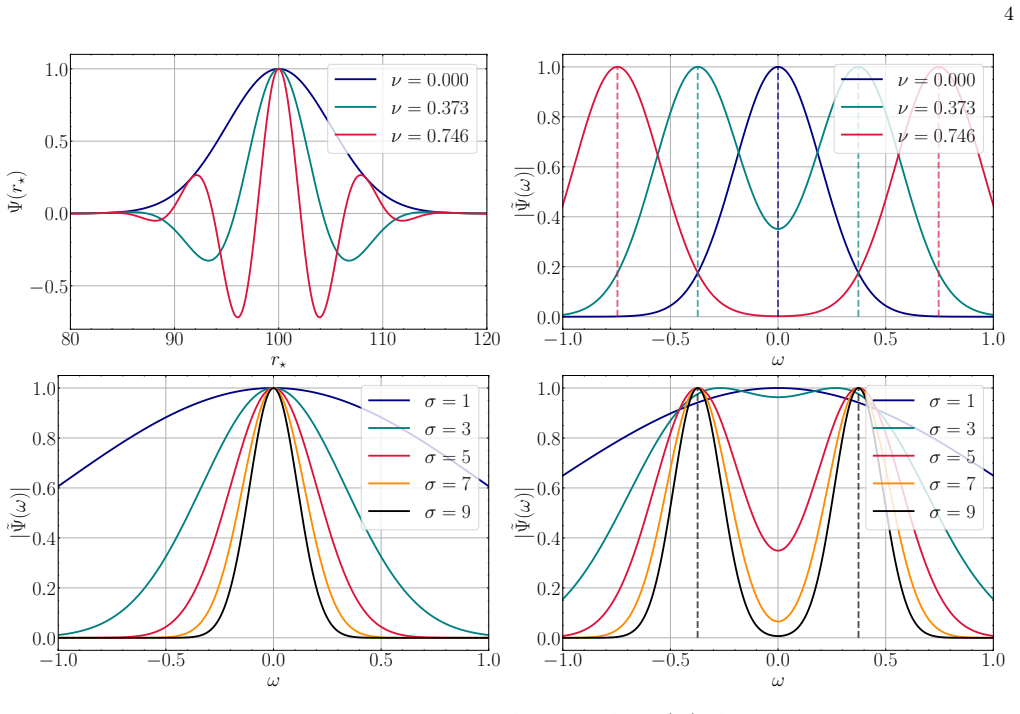
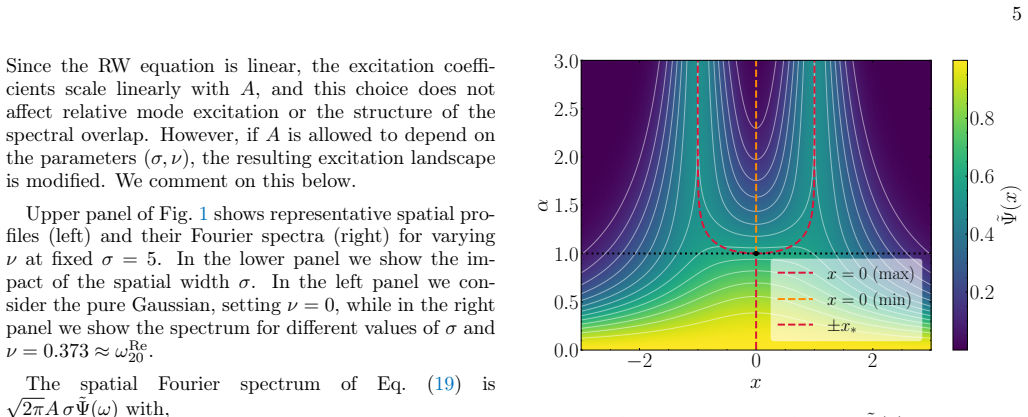
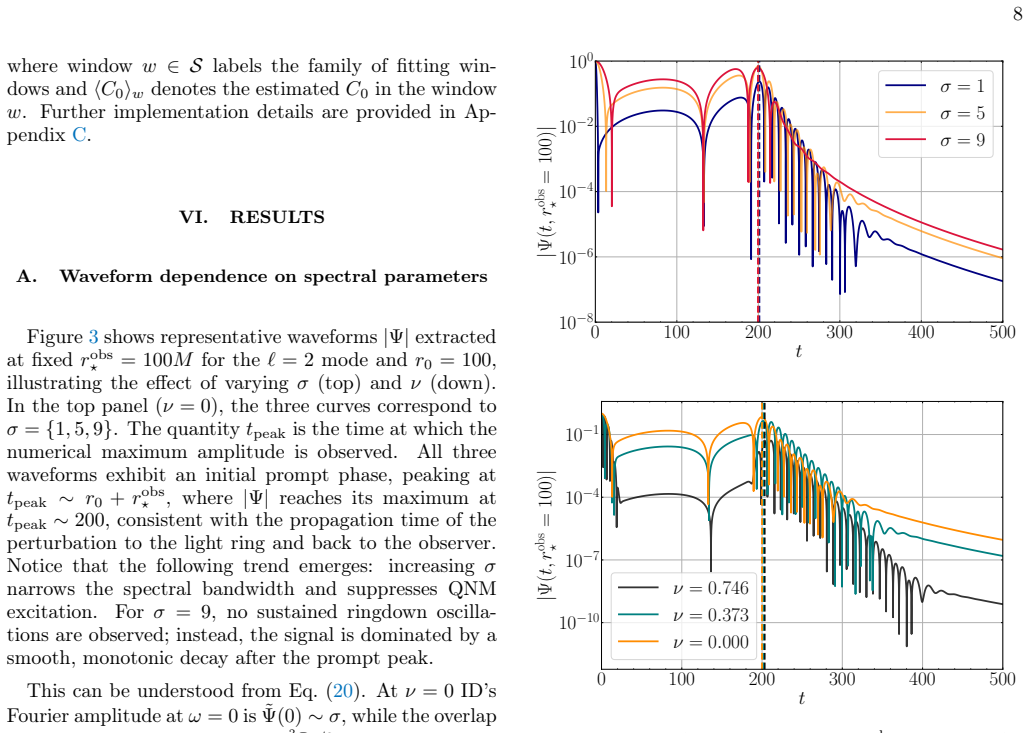
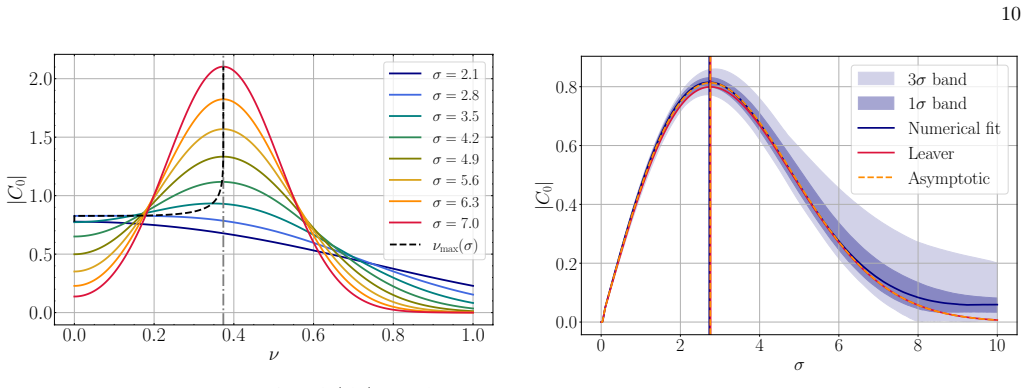
The spectral structure depends onα=σν: forα <1the spectrum is single-peaked nearω= 0, while forα >1two peaks develop nearω=±ν. the spectral properties of the perturbation and the exci- tation of QNMs. III. SPECTRAL CONTROL VIA TUNABLE INITIAL DATA To probe the spectral filtering mechanism, we con- struct families of localized ID with independently tunable...
-
[2]
This symmetric response scales withσlike a Gaussian of width1/σ
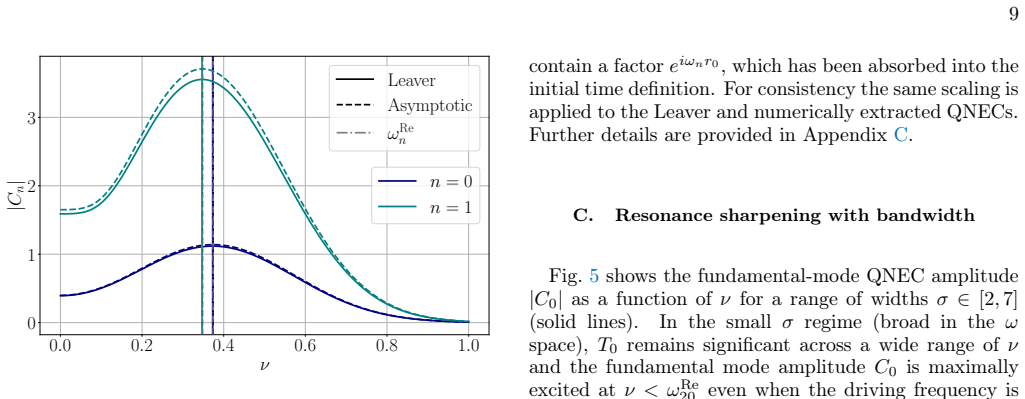
In the neigh- borhood of the maximum, Tn = An peak e− σ2 2 ν−ωRe n 2 ,(33) forα≫1. This symmetric response scales withσlike a Gaussian of width1/σ. Therefore, as observed in the figure, sharpening the ID via increasingσallows the ex- citation profile to become increasingly localized around the resonant frequencyν≃ω Re n . In the resonant regime withα≫1, t...
-
[3]
For the pure Gaussian case (ν= 0) we vary the width σat fixed source locationr 0 = 100M
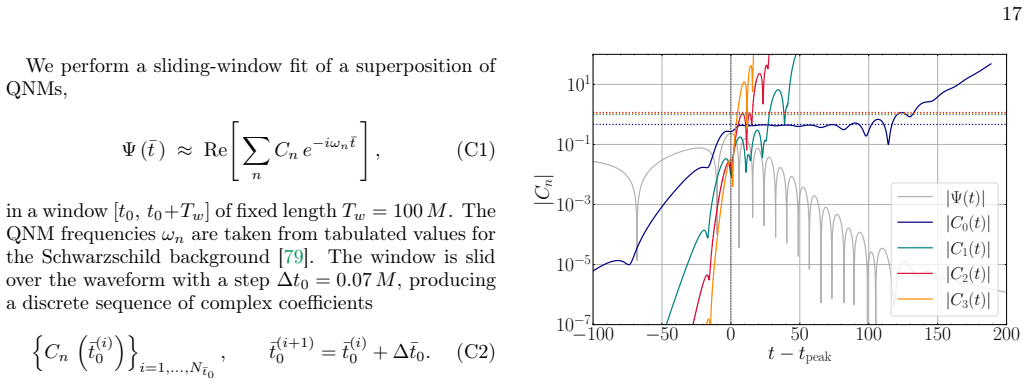
Spectral fingerprint of the QNM frequency. For the pure Gaussian case (ν= 0) we vary the width σat fixed source locationr 0 = 100M. Fig. 6 shows the resulting|C 0(σ)|obtained by fitting the numerical extraction pipeline described in Appendix C. In particu- lar, each waveform is first centred around its peak time ¯t≡t−t peak and the QNM content is extracte...
-
[4]
The departure of the dashed orange curve from the solid red curve is, in this sense, a direct outcome of the spatial structure of the QNM in the near zone (see Sec
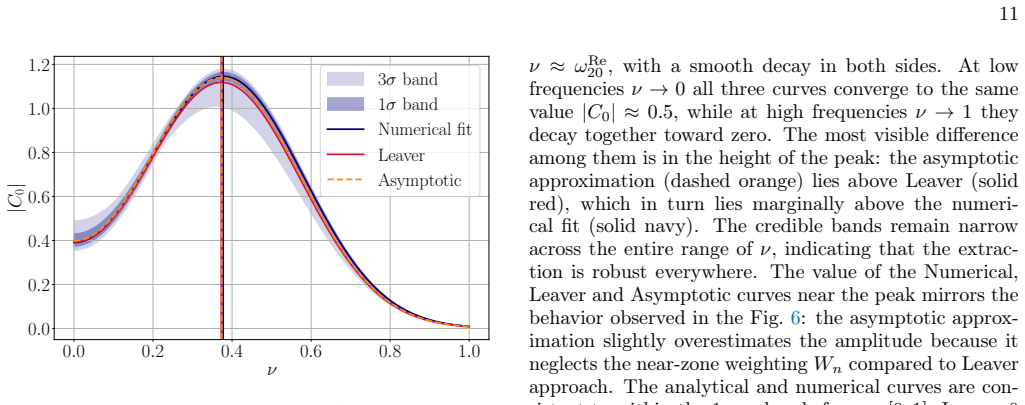
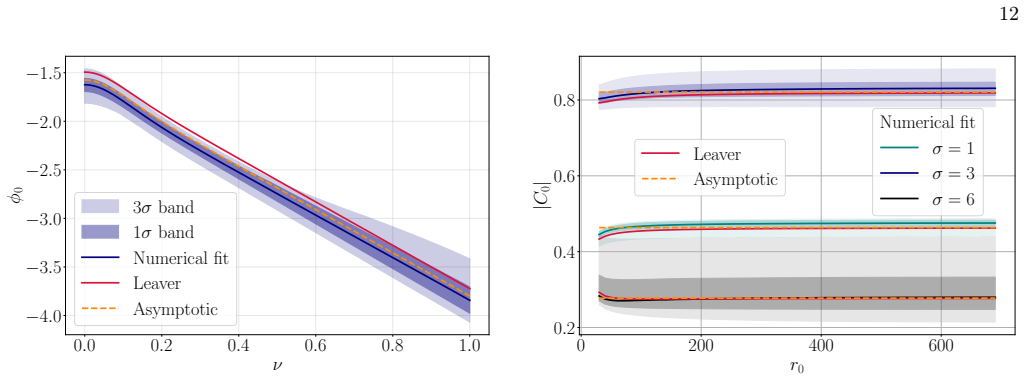
This is the quantitative signature of the near-zone weighting func- tionW n(r⋆): theasymptoticlimitassumesW n = 1, while Leaver retains the full radial dependence of the QNM wavefunction. The departure of the dashed orange curve from the solid red curve is, in this sense, a direct outcome of the spatial structure of the QNM in the near zone (see Sec. IVC)...
-
[5]
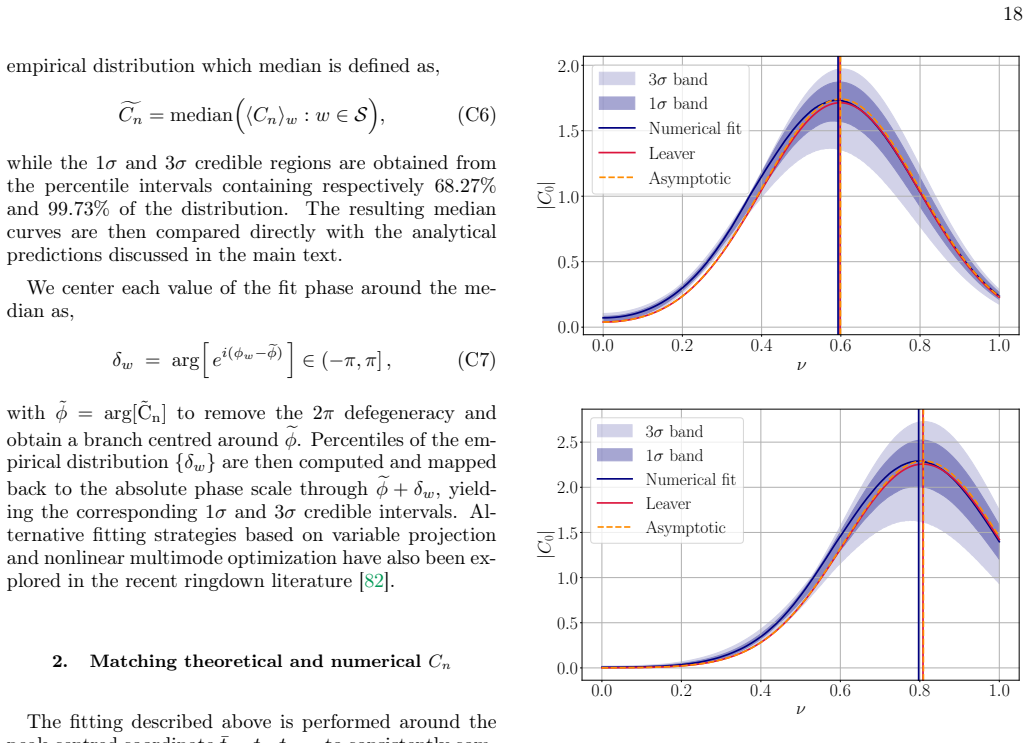
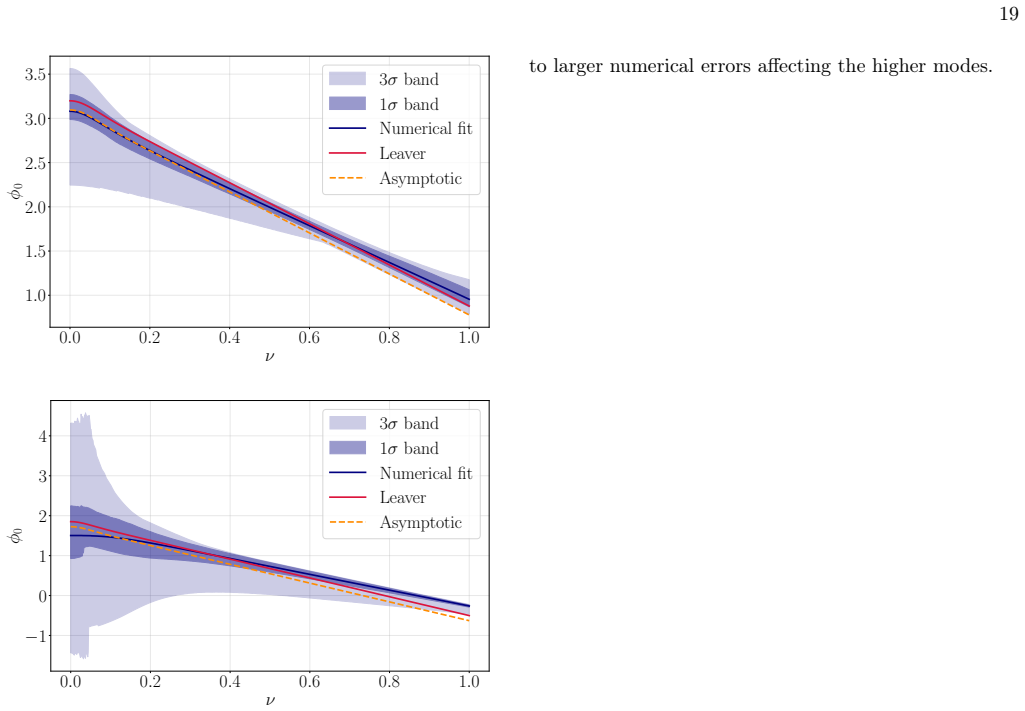
Resonance frequency: spectroscopy of the BH We now fixσ= 5and vary the driving frequencyν, to scan the spectral content of the source across the QNM frequencies and its effects on the excitation amplitude C0(ν). Fig. 7 shows the resulting|C 0|in terms of the excitation frequencyν. The three curves shown in Fig. 7 (Numerical fit, Leaver prediction and asym...
-
[6]
Statistical analysis over extraction windows A standard practice is to fix a single extraction window [¯tmin 0 , ¯tmax 0 ]and quote a value of|C0|together with a sta- tistical uncertainty derived from the dispersion ofC0(¯t0) inside that window. This approach hides a strong sen- sitivity of the fit results to the choice of fitting window, −100 −50 0 50 10...
-
[7]
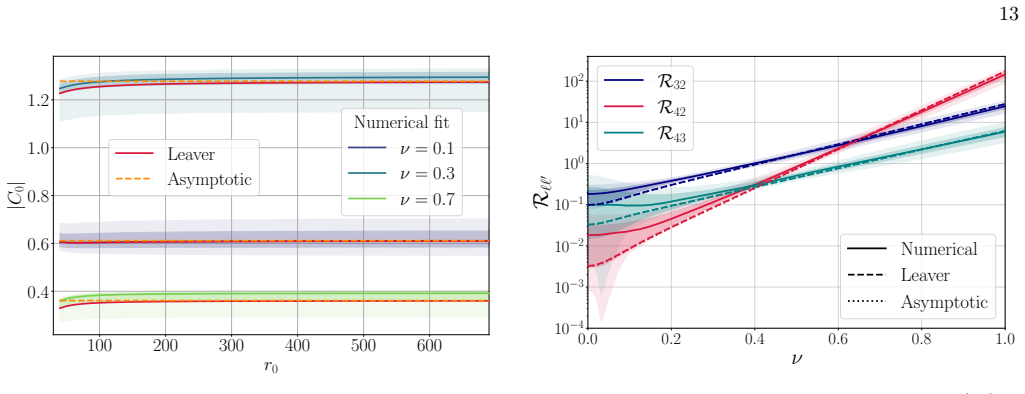
Matching theoretical and numericalC n The fitting described above is performed around the peak-centred coordinate¯t=t−t peak to consistently com- pare numerical extractions obtained from different wave- forms with different parameters(ν, σ). The position of this peak for each method used to solve the RW equation is consistent withtm peak =r obs ⋆ +r 0 +δt...
-
[8]
C. V. Vishveshwara, Nature227, 936 (1970)
1970
-
[9]
C. V. Vishveshwara, Phys. Rev. D1, 2870 (1970)
1970
-
[10]
Chandrasekhar and S
S. Chandrasekhar and S. Detweiler, Proceedings of the Royal Society of London. A. Mathematical and Physical Sciences344, 441 (1975)
1975
-
[11]
S. A. Teukolsky, Astrophys. J.185, 635 (1973)
1973
-
[12]
W. H. Press and S. A. Teukolsky, Astrophys. J.185, 649 (1973)
1973
-
[13]
W. H. Press, Astrophys. J.170, L105 (1971)
1971
-
[14]
Introduction to Isolated Horizons in Numerical Relativity
O. Dreyer, B. Krishnan, D. Shoemaker, and E. Schnet- ter,Phys. Rev.D67, 024018 (2003),arXiv:gr-qc/0206008 [gr-qc]
work page internal anchor Pith review Pith/arXiv arXiv 2003
-
[15]
S. L. Detweiler, Astrophys. J.239, 292 (1980)
1980
-
[16]
Eigenvalues and eigenfunctions of spin-weighted spheroidal harmonics in four and higher dimensions
E. Berti, V. Cardoso, and M. Casals, Phys.Rev.D73, 024013 (2006), arXiv:gr-qc/0511111 [gr-qc]
work page internal anchor Pith review Pith/arXiv arXiv 2006
-
[17]
Bayesian model selection for testing the no-hair theorem with black hole ringdowns
S. Gossan, J. Veitch, and B. Sathyaprakash, Phys. Rev. D85, 124056 (2012), arXiv:1111.5819 [gr-qc]
work page internal anchor Pith review Pith/arXiv arXiv 2012
-
[18]
B. P. Abbottet al.(LIGO Scientific, Virgo), Phys. Rev. D100, 104036 (2019), arXiv:1903.04467 [gr-qc]
work page internal anchor Pith review Pith/arXiv arXiv 2019
-
[19]
A. G. Abacet al.(LIGO Scientific, Virgo, KAGRA), Phys. Rev. Lett.136, 041403 (2026), arXiv:2509.08099 [gr-qc]
work page internal anchor Pith review Pith/arXiv arXiv 2026
-
[20]
M. Isi, M. Giesler, W. M. Farr, M. A. Scheel, and S. A. Teukolsky, Phys. Rev. Lett.123, 111102 (2019), arXiv:1905.00869 [gr-qc]
work page internal anchor Pith review Pith/arXiv arXiv 2019
-
[21]
Observational Black Hole Spectroscopy: A time-domain multimode analysis of GW150914
G. Carullo, W. Del Pozzo, and J. Veitch, Phys. Rev. D 99, 123029 (2019), arXiv:1902.07527 [gr-qc]
work page internal anchor Pith review Pith/arXiv arXiv 2019
-
[22]
R. Abbottet al.(LIGO Scientific and Virgo), Phys. Rev. D103, 122002 (2021), arXiv:2010.14529 [gr-qc]
work page internal anchor Pith review Pith/arXiv arXiv 2021
-
[23]
A. G. Abacet al.(LIGO Scientific, Virgo, KAGRA), Phys. Rev. Lett.135, 111403 (2025), arXiv:2509.08054 [gr-qc]
work page internal anchor Pith review Pith/arXiv arXiv 2025
-
[24]
A Horizon Study for Cosmic Explorer: Science, Observatories, and Community
M. Evanset al., (2021), arXiv:2109.09882 [astro-ph.IM]
work page internal anchor Pith review Pith/arXiv arXiv 2021
-
[25]
The Science of the Einstein Telescope
A. Abacet al.(ET), JCAP03, 081 (2026), arXiv:2503.12263 [gr-qc]
work page internal anchor Pith review Pith/arXiv arXiv 2026
-
[26]
S. A. Teukolsky and W. H. Press, Astrophys. J.193, 443 (1974)
1974
-
[27]
Ferrari and B
V. Ferrari and B. Mashhoon, Phys. Rev. D30, 295 (1984)
1984
-
[28]
Leaver, Proc
E. Leaver, Proc. Roy. Soc. Lond. AA402, 285 (1985)
1985
-
[29]
B. F. Schutz, Nature323, 310 (1986)
1986
-
[30]
E. S. C. Ching, P. T. Leung, A. Maassen van den Brink, W. M. Suen, S. S. Tong, and K. Young, Rev. Mod. Phys. 70, 1545 (1998), arXiv:gr-qc/9904017
work page internal anchor Pith review Pith/arXiv arXiv 1998
-
[31]
Gamow, Z
G. Gamow, Z. Phys.51, 204 (1928)
1928
-
[32]
A. J. F. Siegert, Phys. Rev.56, 750 (1939)
1939
-
[33]
A review of progress in the physics of open quantum systems: theory and experiment
I. Rotter and J. P. Bird, Reports on Progress in Physics 78, 114001 (2015), arXiv:1507.08478 [quant-ph]
work page internal anchor Pith review Pith/arXiv arXiv 2015
-
[34]
Moiseyev,Non-Hermitian Quantum Mechanics (2011)
N. Moiseyev,Non-Hermitian Quantum Mechanics (2011)
2011
-
[35]
K. D. Kokkotas and B. G. Schmidt, Living Rev. Rel.2, 2 (1999), arXiv:gr-qc/9909058 [gr-qc]
work page internal anchor Pith review Pith/arXiv arXiv 1999
-
[36]
R. A. Konoplya and A. Zhidenko, Rev. Mod. Phys.83, 793 (2011), arXiv:1102.4014 [gr-qc]
work page internal anchor Pith review Pith/arXiv arXiv 2011
-
[37]
K.-i. Kubota and H. Motohashi, Phys. Rev. D113, 043053 (2026), arXiv:2509.06411 [gr-qc]
-
[38]
Inspiral, merger and ringdown of unequal mass black hole binaries: a multipolar analysis
E. Berti, V. Cardoso, J. A. Gonzalez, U. Sperhake, M. Hannam, S. Husa, and B. Bruegmann, Phys. Rev. D76, 064034 (2007), arXiv:gr-qc/0703053 [GR-QC]
work page internal anchor Pith review Pith/arXiv arXiv 2007
-
[39]
Z. Zhang, E. Berti, and V. Cardoso, Phys. Rev. D88, 044018 (2013), arXiv:1305.4306 [gr-qc]
work page internal anchor Pith review Pith/arXiv arXiv 2013
-
[40]
N. Oshita, Phys. Rev. D104, 124032 (2021), arXiv:2109.09757 [gr-qc]
- [41]
-
[42]
M. Della Rocca, L. Pezzella, E. Berti, L. Gualtieri, and A. Maselli, (2025), arXiv:2512.07959 [gr-qc]
-
[43]
E. Finch and C. J. Moore, Phys. Rev. D103, 084048 (2021), arXiv:2102.07794 [gr-qc]
- [44]
-
[45]
Modeling Ringdown: Beyond the Fundamental Quasi-Normal Modes
L. London, D. Shoemaker, and J. Healy, Phys. Rev.D90, 124032 (2014), [Erratum: Phys. Rev.D94,no.6,069902(2016)], arXiv:1404.3197 [gr-qc]
work page internal anchor Pith review Pith/arXiv arXiv 2014
- [46]
-
[47]
X. Jiménez Forteza, S. Bhagwat, P. Pani, and V. Ferrari, Phys. Rev. D102, 044053 (2020), arXiv:2005.03260 [gr- qc]
-
[48]
High-overtone fits to nu- merical relativity ringdowns: beyond the dismissedn= 8 special tone,
X. J. Forteza and P. Mourier, “High-overtone fits to nu- merical relativity ringdowns: beyond the dismissedn= 8 special tone,” (2021), arXiv:2107.11829 [gr-qc]
-
[49]
M. Giesleret al., Phys. Rev. D111, 084041 (2025), arXiv:2411.11269 [gr-qc]
-
[50]
K. Mitmanet al., Phys. Rev. D112, 064016 (2025), arXiv:2503.09678 [gr-qc]
- [51]
-
[52]
S. Khan, S. Husa, M. Hannam, F. Ohme, M. Pürrer, X. Jiménez Forteza, and A. Bohé, Phys. Rev.D93, 044007 (2016), arXiv:1508.07253 [gr-qc]
work page internal anchor Pith review Pith/arXiv arXiv 2016
-
[53]
R. Cotesta, A. Buonanno, A. Bohé, A. Taracchini, I. Hin- der, and S. Ossokine, (2018), arXiv:1803.10701 [gr-qc]
-
[54]
H. Estellés, S. Husa, M. Colleoni, D. Keitel, M. Mateu- Lucena, C. García-Quirós, A. Ramos-Buades, and A. Borchers, (2020), arXiv:2012.11923 [gr-qc]
-
[55]
Surrogate models for precessing binary black hole simulations with unequal masses
V. Varma, S. E. Field, M. A. Scheel, J. Blackman, D. Gerosa, L. C. Stein, L. E. Kidder, and H. P. Pfeiffer, Phys. Rev. Research.1, 033015 (2019), arXiv:1905.09300 [gr-qc]
work page internal anchor Pith review Pith/arXiv arXiv 2019
- [56]
-
[57]
C. García-Quirós, M. Colleoni, S. Husa, H. Estel- lés, G. Pratten, A. Ramos-Buades, M. Mateu-Lucena, and R. Jaume, Phys. Rev. D102, 064002 (2020), arXiv:2001.10914 [gr-qc]
-
[58]
Yooet al., (2023), arXiv:2306.03148 [gr-qc]
J. Yooet al., (2023), arXiv:2306.03148 [gr-qc]
-
[59]
Andersson, Phys
N. Andersson, Phys. Rev. D51, 353 (1995)
1995
-
[60]
E.BertiandV.Cardoso,Phys.Rev.D74,104020(2006), arXiv:gr-qc/0605118
work page internal anchor Pith review Pith/arXiv arXiv 2006
-
[61]
QNMToolkit,
UIB Perturbation Theory Group, “QNMToolkit,”https: //github.com/uib-perturbation-theory/QNMToolkit
-
[62]
Pretorius, Classical and Quantum Gravity22, 425 (2005)
F. Pretorius, Classical and Quantum Gravity22, 425 (2005)
2005
-
[63]
Spin Flips and Precession in Black-Hole-Binary Mergers
M. Campanelli, C. O. Lousto, Y. Zlochower, B. Krish- nan, and D. Merritt, Phys. Rev.D75, 064030 (2007), arXiv:gr-qc/0612076 [gr-qc]
work page internal anchor Pith review Pith/arXiv arXiv 2007
-
[64]
J. G. Baker, J. Centrella, D.-I. Choi, M. Koppitz, and J. van Meter, Phys. Rev. Lett.96, 111102 (2006), arXiv:gr-qc/0511103 [gr-qc]. 21
work page internal anchor Pith review Pith/arXiv arXiv 2006
-
[65]
T.ReggeandJ.A.Wheeler,Phys.Rev.108,1063(1957)
1957
-
[66]
F. J. Zerilli, Phys. Rev. Lett.24, 737 (1970)
1970
-
[67]
Chandrasekhar, Fundam
S. Chandrasekhar, Fundam. Theor. Phys.9, 5 (1984)
1984
-
[68]
Chandrasekhar and S
S. Chandrasekhar and S. L. Detweiler, Proc. Roy. Soc. Lond.A344, 441 (1975)
1975
-
[69]
S. Bhagwat, D. A. Brown, and S. W. Ballmer, Phys. Rev.D94, 084024 (2016), [Erratum: Phys. Rev.D95,no.6,069906(2017)], arXiv:1607.07845 [gr-qc]
work page internal anchor Pith review Pith/arXiv arXiv 2016
-
[70]
V.BaibhavandE.Berti,Phys.Rev.D99,024005(2019), arXiv:1809.03500 [gr-qc]
work page internal anchor Pith review Pith/arXiv arXiv 2019
-
[71]
Svyatkovskyy Kholyavka, X
A. Svyatkovskyy Kholyavka, X. Jiménez Forteza, and S. Datta,Probing the black hole ringdown through nu- merical perturbation theory, Master’s thesis, Universitat de les Illes Balears, Palma, Spain (2025)
2025
-
[72]
R. H. Price, Phys. Rev.D5, 2439 (1972)
1972
-
[73]
Martel and E
K. Martel and E. Poisson, Phys. Rev. D71, 104003 (2005)
2005
-
[74]
E. W. Leaver, Phys. Rev. D34, 384 (1986)
1986
-
[75]
R. H. Price, Phys. Rev. D5, 2419 (1972)
1972
-
[76]
E. S. C. Ching, P. T. Leung, W. M. Suen, and K. Young, Phys. Rev. Lett.74, 2414 (1995), arXiv:gr-qc/9410044
work page internal anchor Pith review Pith/arXiv arXiv 1995
- [77]
-
[78]
SXS Gravitational Waveform Database,
The SXS Collaboration, “SXS Gravitational Waveform Database,” (2019)
2019
-
[79]
Davis, R
M. Davis, R. Ruffini, W. H. Press, and R. H. Price, Phys. Rev. Lett.27, 1466 (1971)
1971
-
[80]
Small mass plunging into a Kerr black hole: Anatomy of the inspiral-merger-ringdown waveforms
A. Taracchini, A. Buonanno, G. Khanna, and S. A. Hughes,Phys.Rev.D90,084025(2014),arXiv:1404.1819 [gr-qc]
work page internal anchor Pith review Pith/arXiv arXiv 2014
discussion (0)
Sign in with ORCID, Apple, or X to comment. Anyone can read and Pith papers without signing in.