Endpoint formulation and Molien--Weyl structure for the \(N=2\), large--\(d\) BFSS/BMN models
Pith reviewed 2026-06-29 20:46 UTC · model grok-4.3
The pith
The radial endpoint formulation of the N=2 large-d BFSS model equals the Molien-Weyl gauge-projected partition function up to a spectator factor.
A machine-rendered reading of the paper's core claim, the machinery that carries it, and where it could break.
Core claim
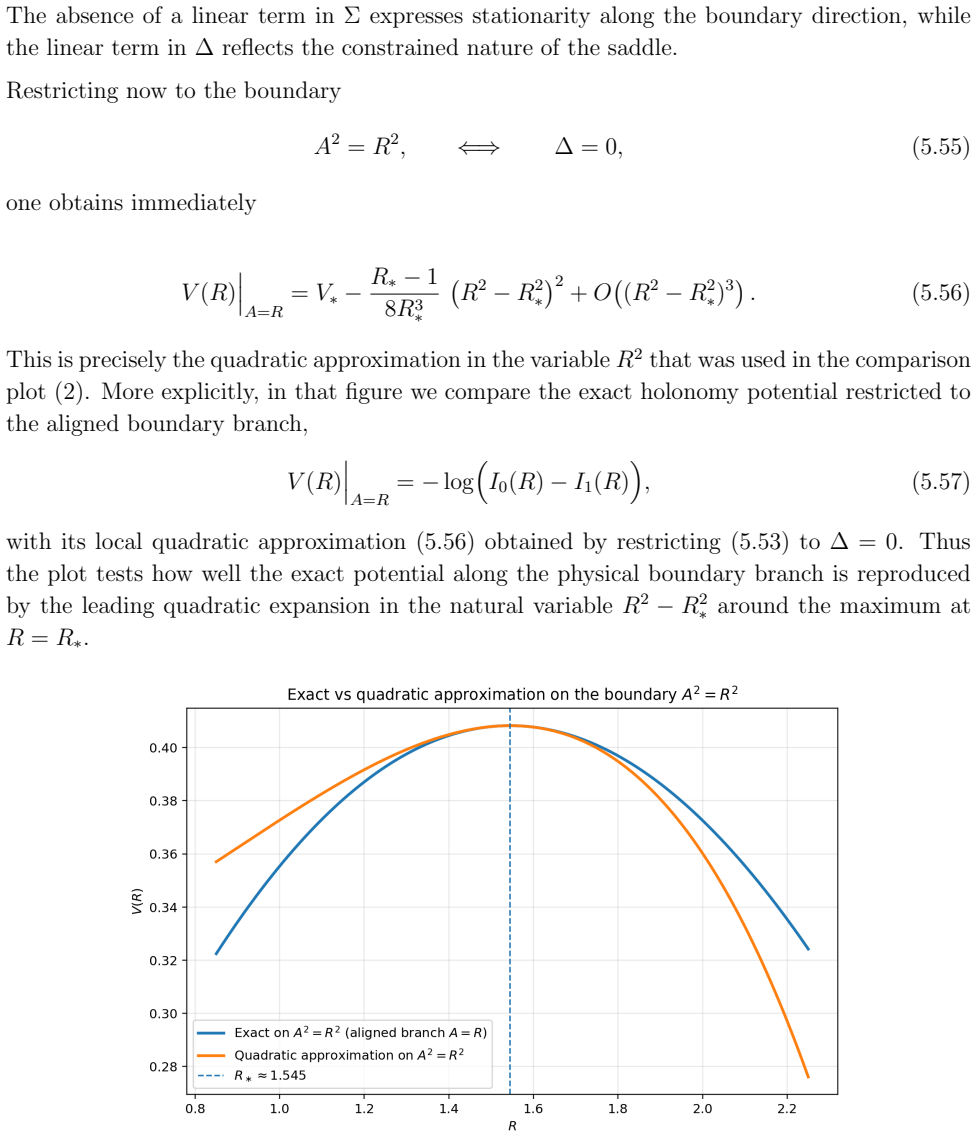
The planar endpoint formulation is equivalent to the angular Molien-Weyl description of the gauge-projected partition function, up to a universal spectator factor. The continuum limit of the quadratic coefficient separates into a trivial Gaussian term plus finite D-channel and beta-channel contributions generated by the singular dependence of the exact holonomy kernel. The relevant saddle is a constrained boundary saddle on the aligned branch, and the toy model V_toy(B) = -log cosh B reproduces the continuum D-channel contribution -2d exactly.
What carries the argument
Radial endpoint formulation obtained by integrating out bulk, gauge, and longitudinal modes, leaving transverse endpoints governed by an effective holonomy potential whose planar version matches the Molien-Weyl angular description.
If this is right
- The low-temperature expansion of the endpoint partition function follows immediately from the Molien-Weyl result.
- The quadratic coefficient d(d+1)/2 counts the number of Gaussian singlet states above the vacuum.
- The continuum quadratic coefficient decomposes into Gaussian, D-channel, and beta-channel pieces with the D-channel equal to -2d.
- The relevant saddle of the holonomy potential is a constrained boundary saddle rather than an unconstrained critical point.
- Any finite polynomial truncation of the transverse expansion has a trivial continuum limit.
Where Pith is reading between the lines
- The D-channel may be reinterpreted as a Wishart-Stiefel entropy arising from an emergent four-dimensional geometry inside R^d.
- The equivalence supplies a route to higher-order terms in the low-temperature series without performing full lattice simulations.
- The boundary-saddle geometry of the holonomy potential may appear in other large-d matrix models that share similar holonomy structures.
- Numerical comparison of the toy model against full lattice data would test whether the Gaussian-regime assumption survives the continuum limit.
Load-bearing premise
The lattice theory remains in the Gaussian regime after the bulk, gauge, and longitudinal modes are integrated out, so the effective holonomy potential on the transverse endpoints alone encodes the full low-temperature and continuum physics.
What would settle it
A direct numerical evaluation of the lattice partition function at low temperature that either confirms or contradicts the predicted quadratic coefficient d(d+1)/2 and the exact -2d shift from the toy model in the continuum limit.
Figures
read the original abstract
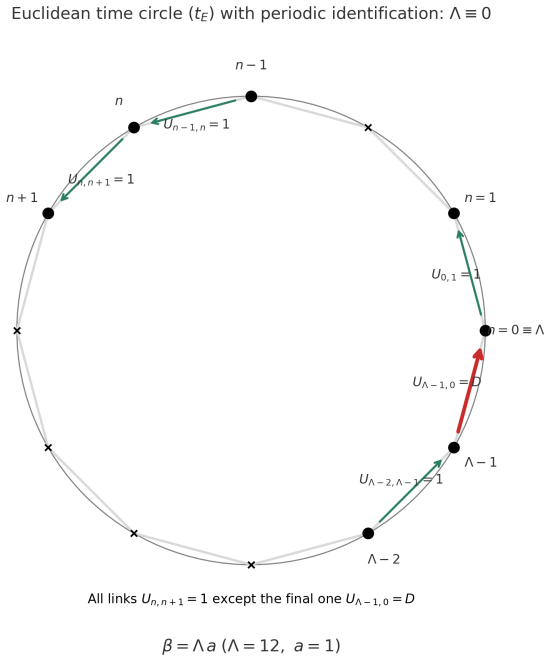
We study the \(N=2\), large--\(d\) sector of BFSS/BMN-type matrix quantum mechanics on the lattice in the Gaussian regime. We develop a radial endpoint formulation in which the bulk, gauge, and longitudinal degrees of freedom are integrated out, leaving transverse endpoint variables governed by an effective holonomy potential. We show that this planar endpoint formulation is equivalent to the angular Molien--Weyl description of the gauge-projected partition function, up to a universal spectator factor. This relation allows the low-temperature expansion of the endpoint partition function to be obtained from the Molien--Weyl result, whose quadratic coefficient \(d(d+1)/2\) counts Gaussian singlet states above the vacuum. We then analyze the continuum limit of the quadratic coefficient and show that it separates into a Gaussian contribution, a \(D\)-channel, and a \(\beta\)-channel. The naive Gaussian term becomes trivial, while the exact holonomy kernel generates finite continuum contributions through singular dependence on the endpoint Gaussian width and anisotropic coupling. We then study the geometry of the holonomy potential and show that its relevant saddle is a constrained boundary saddle on the aligned branch, rather than an unconstrained critical point. The associated transverse expansion captures the local saddle geometry, but any finite polynomial truncation has a trivial continuum limit. Finally, we introduce a non-polynomial toy model based on \(V_{\rm toy}(B)=-\log\cosh B\), which provides a completion of the transverse expansion and reproduces exactly the continuum \(D\)-channel contribution \(-2d\). This prepares the geometric interpretation of the \(D\)-channel as a Wishart--Stiefel entropy associated with an emergent four-dimensional geometry embedded \(\mathbb R^d\) in the endpoint formulation.
Editorial analysis
A structured set of objections, weighed in public.
Referee Report
Summary. The manuscript develops a radial endpoint formulation for the N=2, large-d sector of lattice BFSS/BMN matrix quantum mechanics in the Gaussian regime. It claims that the planar endpoint formulation is equivalent to the angular Molien-Weyl description of the gauge-projected partition function up to a universal spectator factor; this equivalence yields the low-temperature expansion whose quadratic coefficient d(d+1)/2 counts Gaussian singlet states. The continuum limit of this coefficient is shown to separate into Gaussian, D-channel, and β-channel contributions, with the holonomy kernel producing finite non-trivial terms via singular dependence on the endpoint width and anisotropic coupling. The holonomy potential possesses a constrained boundary saddle on the aligned branch; polynomial truncations of the transverse expansion have trivial continuum limits, while the toy model V_toy(B) = -log cosh B exactly reproduces the continuum D-channel contribution -2d and prepares a geometric interpretation of the D-channel as Wishart-Stiefel entropy for an emergent four-dimensional geometry.
Significance. If the central claims hold, the work supplies a concrete bridge between planar endpoint and angular Molien-Weyl descriptions in these matrix models, together with an explicit channel decomposition of the continuum quadratic coefficient and a non-polynomial completion that matches the D-channel exactly. The preparation of a geometric interpretation via Wishart-Stiefel entropy is a potentially useful organizing principle for emergent geometry questions in BFSS/BMN models.
major comments (1)
- [Radial endpoint formulation and Gaussian regime assumption] The radial endpoint construction (abstract and the section developing the effective holonomy potential on transverse endpoints) integrates out bulk, gauge, and longitudinal modes and then assumes the resulting description remains Gaussian, allowing all subsequent steps (Molien-Weyl low-T expansion, channel separation, saddle geometry, and toy-model reproduction of -2d). No explicit verification, error estimates, or checks for surviving non-Gaussian corrections or lattice artifacts at low temperature or in the continuum limit are supplied; this assumption is load-bearing for the claimed equivalences and exact reproductions.
Simulated Author's Rebuttal
We thank the referee for their careful reading of the manuscript and for identifying the load-bearing role of the Gaussian regime assumption. We address the single major comment below.
read point-by-point responses
-
Referee: The radial endpoint construction (abstract and the section developing the effective holonomy potential on transverse endpoints) integrates out bulk, gauge, and longitudinal modes and then assumes the resulting description remains Gaussian, allowing all subsequent steps (Molien-Weyl low-T expansion, channel separation, saddle geometry, and toy-model reproduction of -2d). No explicit verification, error estimates, or checks for surviving non-Gaussian corrections or lattice artifacts at low temperature or in the continuum limit are supplied; this assumption is load-bearing for the claimed equivalences and exact reproductions.
Authors: The radial endpoint formulation is obtained by exactly integrating out bulk, gauge, and longitudinal modes in the large-d limit, after which the effective theory for the transverse endpoints is defined to be Gaussian by construction: the low-temperature expansion is performed on the quadratic term of the resulting holonomy potential. The equivalence to the Molien-Weyl description is shown analytically inside this quadratic regime, and the channel decomposition of the continuum quadratic coefficient follows from the exact holonomy kernel without further approximation. The toy model V_toy(B) = -log cosh B is introduced precisely to complete the transverse expansion while remaining inside the same Gaussian framework. We acknowledge that the manuscript supplies no numerical error estimates or direct checks against non-Gaussian or lattice artifacts. In the revised version we will add a clarifying subsection that (i) states the Gaussian regime as the defining scope of the effective theory and (ii) explains why the analytic continuum limit controls lattice artifacts within that scope. Non-Gaussian corrections lie outside the present analysis. revision: partial
Circularity Check
No significant circularity; Molien-Weyl treated as independent input with explicit equivalence shown
full rationale
The derivation treats the Molien-Weyl result as an external input whose quadratic coefficient is used to obtain the low-temperature expansion of the endpoint partition function. The claimed equivalence between planar endpoint formulation and angular Molien-Weyl description is presented as a shown relation (up to spectator factor), not a definitional identity. The separation of the quadratic coefficient into Gaussian/D/β channels and the toy model V_toy(B)=-log cosh B are explicit constructions that match the D-channel by design rather than reducing the central claims to tautology. No load-bearing step reduces by the paper's own equations to a self-citation chain or fitted input renamed as prediction. The Gaussian regime is an assumption whose validity is separate from circularity.
Axiom & Free-Parameter Ledger
free parameters (2)
- Gaussian width
- anisotropic coupling
axioms (2)
- standard math Molien-Weyl formula correctly describes the gauge-projected partition function for the matrix model
- domain assumption Integration over bulk, gauge, and longitudinal degrees of freedom yields an effective holonomy potential on transverse endpoints without additional corrections
Forward citations
Cited by 1 Pith paper
-
Negative heat capacities in spherically symmetric sectors of $d$-matrix quantum mechanics
SO(d) and O(d) invariant sectors of d-matrix QM show negative microcanonical heat capacity that becomes positive at k_crit ~ N^2/4, forming a caloric fold similar to AdS black holes.
Reference graph
Works this paper leans on
-
[1]
Supersymmetric Yang-Mills Theories,
L. Brink, J. H. Schwarz and J. Scherk, “Supersymmetric Yang-Mills Theories,” Nucl. Phys. B121, 77-92 (1977)
1977
-
[2]
Fierz Identities for Real Clifford Algebras and the Number of Supercharges,
M. Baake, M. Reinicke and V. Rittenberg, “Fierz Identities for Real Clifford Algebras and the Number of Supercharges,” J. Math. Phys.26, 1070 (1985)
1985
-
[3]
’t Hooft,A Planar Diagram Theory for Strong Interactions, Nucl
G. ’t Hooft,A Planar Diagram Theory for Strong Interactions, Nucl. Phys. B72, 461 (1974)
1974
-
[4]
Dimensional Reduction in Quantum Gravity
G. ’t Hooft,Dimensional Reduction in Quantum Gravity, arXiv:gr-qc/9310026
work page internal anchor Pith review Pith/arXiv arXiv
-
[5]
Susskind,The World as a Hologram, J
L. Susskind,The World as a Hologram, J. Math. Phys.36, 6377 (1995)
1995
-
[6]
M Theory As A Matrix Model: A Conjecture
T. Banks, W. Fischler, S. H. Shenker and L. Susskind, “M theory as a matrix model: A conjecture,” Phys. Rev. D55, 5112-5128 (1997) [arXiv:hep-th/9610043 [hep-th]]
work page internal anchor Pith review Pith/arXiv arXiv 1997
-
[7]
Witten,Bound States of Strings andp-Branes, Nucl
E. Witten,Bound States of Strings andp-Branes, Nucl. Phys. B460, 335 (1996)
1996
-
[8]
Itzhaki, J
N. Itzhaki, J. M. Maldacena, J. Sonnenschein and S. Yankielowicz,Supergravity and the LargeNLimit of Theories with Sixteen Supercharges, Phys. Rev. D58, 046004 (1998)
1998
-
[9]
Polchinski,Dirichlet Branes and Ramond–Ramond Charges, Phys
J. Polchinski,Dirichlet Branes and Ramond–Ramond Charges, Phys. Rev. Lett.75, 4724 (1995)
1995
-
[10]
Cremmer, B
E. Cremmer, B. Julia, and J. Scherk,Supergravity Theory in Eleven Dimensions, Phys. Lett. B76, 409 (1978)
1978
-
[11]
String theory dynamics in various dimensions,
E. Witten, “String theory dynamics in various dimensions,”Nucl. Phys. B443, 85 (1995)
1995
-
[12]
Quantum M-wave and Black 0-brane
Y. Hyakutake, “Quantum M-wave and Black 0-brane,” JHEP09, 075 (2014) [arXiv:1407.6023 [hep-th]]
work page internal anchor Pith review Pith/arXiv arXiv 2014
-
[13]
Higher Derivative Corrections to Eleven Dimensional Supergravity via Local Supersymmetry
Y. Hyakutake and S. Ogushi, “Higher derivative corrections to eleven dimensional super- gravity via local supersymmetry,” JHEP02, 068 (2006) [arXiv:hep-th/0601092 [hep-th]]
work page internal anchor Pith review Pith/arXiv arXiv 2006
-
[14]
Hoppe,Quantum Theory of a Massless Relativistic Surface and a Two-Dimensional Bound State Problem, Ph.D
J. Hoppe,Quantum Theory of a Massless Relativistic Surface and a Two-Dimensional Bound State Problem, Ph.D. Thesis, MIT (1982)
1982
-
[15]
Diffeomorphism Groups, Quantization, andSU(∞),
J. Hoppe, “Diffeomorphism Groups, Quantization, andSU(∞),” Int. J. Mod. Phys. A4, 5235 (1989)
1989
-
[16]
de Wit, J
B. de Wit, J. Hoppe and H. Nicolai,On the Quantum Mechanics of Supermembranes, Nucl. Phys. B305, 545 (1988)
1988
-
[17]
Vacuum States in Supersymmetric Kaluza-Klein Theory,
J. Kowalski-Glikman, “Vacuum States in Supersymmetric Kaluza-Klein Theory,” Phys. Lett. B134, 194-196 (1984) 73
1984
-
[18]
A New maximally supersymmetric background of IIB superstring theory,
M. Blau, J. M. Figueroa-O’Farrill, C. Hull and G. Papadopoulos, “A New maximally supersymmetric background of IIB superstring theory,” JHEP01, 047 (2002) [arXiv:hep- th/0110242 [hep-th]]
-
[19]
Azeyanagi, M
T. Azeyanagi, M. Hanada, T. Hirata and H. Shimada,On the Shape of a D-Brane Bound State and Its Topology Change, J. High Energy Phys.0903, 121
-
[20]
Zwiebach,A First Course in String Theory, 2nd ed., Cambridge University Press, Cambridge (2009)
B. Zwiebach,A First Course in String Theory, 2nd ed., Cambridge University Press, Cambridge (2009)
2009
-
[21]
Becker, M
K. Becker, M. Becker and J. H. Schwarz,String Theory and M-Theory: A Modern Intro- duction(Cambridge University Press, Cambridge, 2006)
2006
- [22]
-
[23]
S. S. Gubser, I. R. Klebanov, and A. M. Polyakov,Gauge Theory Correlators from Non- Critical String Theory, Phys. Lett. B428, 105 (1998), arXiv:hep-th/9802109
work page internal anchor Pith review Pith/arXiv arXiv 1998
-
[24]
Anti De Sitter Space And Holography
E. Witten,Anti-de Sitter Space and Holography, Adv. Theor. Math. Phys.2, 253 (1998), arXiv:hep-th/9802150
work page internal anchor Pith review Pith/arXiv arXiv 1998
-
[25]
Confinement of Quarks,
K. G. Wilson, “Confinement of Quarks,” Phys. Rev. D10, 2445-2459 (1974)
1974
-
[26]
Black hole thermodynamics from simulations of lattice Yang–Mills theory,
Catterall, S. and Wiseman, T., “Black hole thermodynamics from simulations of lattice Yang–Mills theory,”Phys. Rev. D78, 041502 (2008)
2008
-
[27]
Monte Carlo stud- ies of supersymmetric matrix quantum mechanics with sixteen supercharges at finite tem- perature,
Anagnostopoulos, K. N., Hanada, M., Nishimura, J. and Takeuchi, S., “Monte Carlo stud- ies of supersymmetric matrix quantum mechanics with sixteen supercharges at finite tem- perature,”Phys. Rev. Lett.100, 021601 (2008)
2008
-
[28]
Holographic description of quantum black hole on a computer,
Hanada, M., Hyakutake, Y., Ishiki, G. and Nishimura, J., “Holographic description of quantum black hole on a computer,”Science344, 882 (2014)
2014
-
[29]
Numerical tests of the gauge/gravity duality conjecture for D0-branes at finite temperature and finiteN,
Hanada, M., Hyakutake, Y., Ishiki, G. and Nishimura, J., “Numerical tests of the gauge/gravity duality conjecture for D0-branes at finite temperature and finiteN,”Phys. Rev. D94, 086010 (2016)
2016
-
[30]
V. G. Filev and D. O’Connor, “The BFSS model on the lattice,” JHEP1605, 167 (2016) [arXiv:1506.01366 [hep-th]]
work page internal anchor Pith review Pith/arXiv arXiv 2016
-
[31]
Black hole thermodynamics from calculations in strongly coupled gauge theory,
Kabat, D. N., Lifschytz, G. and Lowe, D. A., “Black hole thermodynamics from calculations in strongly coupled gauge theory,”Phys. Rev. Lett.86, 1426 (2001). 74
2001
-
[32]
Higher derivative corrections to black hole thermodynamics from supersymmetric matrix quantum mechanics,
Hanada, M., Hyakutake, Y., Nishimura, J. and Takeuchi, S., “Higher derivative corrections to black hole thermodynamics from supersymmetric matrix quantum mechanics,”Phys. Rev. Lett.102, 191602 (2009)
2009
-
[33]
Quantum near-horizon geometry of a black 0-brane,
Y. Hyakutake, “Quantum near-horizon geometry of a black 0-brane,”Progr. Theor. Exp. Phys.2014, 033B04 (2014)
2014
-
[34]
Hanada,What Lattice Theorists Can Do for Superstring/M-Theory, Int
M. Hanada,What Lattice Theorists Can Do for Superstring/M-Theory, Int. J. Mod. Phys. A31, 1643006 (2016)
2016
-
[35]
Strings in flat space and pp waves from ${\cal N}=4$ Super Yang Mills
D. E. Berenstein, J. M. Maldacena and H. S. Nastase, “Strings in flat space and pp waves from N=4 superYang-Mills,” JHEP04, 013 (2002) [arXiv:hep-th/0202021 [hep-th]]
work page internal anchor Pith review Pith/arXiv arXiv 2002
-
[36]
Massive super Yang-Mills quantum mechanics: Classification and the relation to supermembrane,
N. Kim and J. H. Park, “Massive super Yang-Mills quantum mechanics: Classification and the relation to supermembrane,” Nucl. Phys. B759, 249–282 (2006) [arXiv:hep- th/0607005]
-
[37]
Noncriticalosp(1|2,R) M-theory matrix model with an arbitrary time- dependent cosmological constant,
J. H. Park, “Noncriticalosp(1|2,R) M-theory matrix model with an arbitrary time- dependent cosmological constant,” Nucl. Phys. B745, 123–141 (2006) [arXiv:hep- th/0510070]
-
[38]
R. C. Myers, “Dielectric-branes,” JHEP12, 022 (1999) [arXiv:hep-th/9910053 [hep-th]]
work page internal anchor Pith review Pith/arXiv arXiv 1999
-
[39]
Bubbling AdS space and 1/2 BPS geometries
H. Lin, O. Lunin and J. M. Maldacena, “Bubbling AdS space and 1/2 BPS geome- tries,” JHEP10, 025 (2004) doi:10.1088/1126-6708/2004/10/025 [arXiv:hep-th/0409174 [hep-th]]
work page internal anchor Pith review Pith/arXiv arXiv doi:10.1088/1126-6708/2004/10/025 2004
-
[40]
Gauged permutation invariant matrix quantum me- chanics: path integrals,
D. O’Connor and S. Ramgoolam, “Gauged permutation invariant matrix quantum me- chanics: path integrals,” JHEP04, 080 (2024) [arXiv:2312.12397 [hep-th]]
-
[41]
D. O’Connor and S. Ramgoolam, “Permutation invariant matrix quantum thermody- namics and negative specific heat capacities in large N systems,” JHEP12, 161 (2024) [arXiv:2405.13150 [hep-th]]
-
[42]
Phases of one dimensional large N gauge theory in a 1/D expansion
G. Mandal, M. Mahato and T. Morita, “Phases of one dimensional large N gauge theory in a 1/D expansion,” JHEP1002(2010) 034 doi:10.1007/JHEP02(2010)034 [arXiv:0910.4526 [hep-th]]
work page internal anchor Pith review Pith/arXiv arXiv doi:10.1007/jhep02(2010)034 2010
-
[43]
Phases of a two dimensional large N gauge theory on a torus
G. Mandal and T. Morita, “Phases of a two dimensional large N gauge theory on a torus,” Phys. Rev. D84, 085007 (2011) doi:10.1103/PhysRevD.84.085007 [arXiv:1103.1558 [hep- th]]
work page internal anchor Pith review Pith/arXiv arXiv doi:10.1103/physrevd.84.085007 2011
-
[44]
Black Hole Thermodynamics from Calculations in Strongly-Coupled Gauge Theory
D. N. Kabat, G. Lifschytz and D. A. Lowe, “Black hole thermodynamics from calculations in strongly coupled gauge theory,” Int. J. Mod. Phys. A16, 856 (2001) [Phys. Rev. Lett. 86, 1426 (2001)] [hep-th/0007051]. 75
work page internal anchor Pith review Pith/arXiv arXiv 2001
-
[45]
Black hole entropy from non-perturbative gauge theory
D. N. Kabat, G. Lifschytz and D. A. Lowe, “Black hole entropy from nonperturbative gauge theory,” Phys. Rev. D64, 124015 (2001) [hep-th/0105171]
work page internal anchor Pith review Pith/arXiv arXiv 2001
-
[46]
Phase structure of matrix quantum mechanics at finite temperature
N. Kawahara, J. Nishimura and S. Takeuchi, “Phase structure of matrix quantum mechan- ics at finite temperature,” JHEP0710, 097 (2007) [arXiv:0706.3517 [hep-th]]
work page internal anchor Pith review Pith/arXiv arXiv 2007
-
[47]
Possible Third Order Phase Transition in the Large N Lattice Gauge Theory,
D. J. Gross and E. Witten, “Possible Third Order Phase Transition in the Large N Lattice Gauge Theory,” Phys. Rev. D21, 446 (1980)
1980
-
[48]
N = Infinity Phase Transition in a Class of Exactly Soluble Model Lattice Gauge Theories,
S. R. Wadia, “N = Infinity Phase Transition in a Class of Exactly Soluble Model Lattice Gauge Theories,” Phys. Lett.93B, 403 (1980)
1980
-
[49]
O. Aharony, J. Marsano, S. Minwalla and T. Wiseman, “Black hole-black string phase transitions in thermal 1+1 dimensional supersymmetric Yang-Mills theory on a circle,” Class. Quant. Grav.21, 5169-5192 (2004) [arXiv:hep-th/0406210 [hep-th]]
work page internal anchor Pith review Pith/arXiv arXiv 2004
-
[50]
The Hagedorn/Deconfinement Phase Transition in Weakly Coupled Large N Gauge Theories
O. Aharony, J. Marsano, S. Minwalla, K. Papadodimas and M. Van Raamsdonk, “The Hagedorn - deconfinement phase transition in weakly coupled large N gauge theories,” Adv. Theor. Math. Phys.8, 603 (2004) doi:10.4310/ATMP.2004.v8.n4.a1 [hep-th/0310285]
work page internal anchor Pith review Pith/arXiv arXiv doi:10.4310/atmp.2004.v8.n4.a1 2004
-
[51]
Finite temperature effective action, AdS_5 black holes, and 1/N expansion
L. Alvarez-Gaume, C. Gomez, H. Liu and S. Wadia, “Finite temperature effective action, AdS(5) black holes, and 1/N expansion,” Phys. Rev. D71, 124023 (2005) [hep-th/0502227]
work page internal anchor Pith review Pith/arXiv arXiv 2005
-
[52]
D. A. Cox, J. B. Little and D. O’Shea,Using Algebraic Geometry, 2nd ed., Springer, New York (2005), pp. 295–298
2005
-
[53]
The non-perturbative phase diagram of the BMN matrix model
Y. Asano, V. G. Filev, S. Kov´ aˇ cik and D. O’Connor, “The non-perturbative phase diagram of the BMN matrix model,” JHEP07, 152 (2018) [arXiv:1805.05314 [hep-th]]
work page internal anchor Pith review Pith/arXiv arXiv 2018
-
[54]
The Confining Transition in the Bosonic BMN Matrix Model,
Y. Asano, S. Kov´ aˇ cik and D. O’Connor, “The Confining Transition in the Bosonic BMN Matrix Model,” JHEP06, 174 (2020) [arXiv:2001.03749 [hep-th]]
-
[55]
A Large-N Reduced Model as Superstring
N. Ishibashi, H. Kawai, Y. Kitazawa and A. Tsuchiya, “A Large N reduced model as superstring,” Nucl. Phys. B498, 467-491 (1997) [arXiv:hep-th/9612115 [hep-th]]
work page internal anchor Pith review Pith/arXiv arXiv 1997
-
[56]
B. Ydri, “The QM/NCG Correspondence,” doi:10.1142/9789811270437 0027 [arXiv:2211.00339 [hep-th]]
-
[57]
Quantized noncommutative geometry from multitrace matrix models,
B. Ydri, R. Khaled and C. Soudani, “Quantized noncommutative geometry from multitrace matrix models,” Int. J. Mod. Phys. A37, no.10, 2250052 (2022) doi:10.1142/S0217751X2250052X [arXiv:2110.06677 [hep-th]]
-
[58]
Two approaches to quantum gravity and M-(atrix) theory at large number of dimensions,
B. Ydri, “Two approaches to quantum gravity and M-(atrix) theory at large number of dimensions,” Int. J. Mod. Phys. A36, no.31n32, 2150234 (2021) doi:10.1142/S0217751X21502341 [arXiv:2007.04488 [hep-th]]
-
[59]
Ydri,unpublished work/work in progress
B. Ydri,unpublished work/work in progress. 76
discussion (0)
Sign in with ORCID, Apple, or X to comment. Anyone can read and Pith papers without signing in.