An Obscured Tidal Disruption Event Uncovered by Its Mid- and Near-Infrared Dust Echo in a Star-Forming Galaxy
Pith reviewed 2026-06-29 06:44 UTC · model grok-4.3
The pith
An infrared flare in a star-forming galaxy is produced by dust reprocessing a UV flare from an obscured tidal disruption event.
A machine-rendered reading of the paper's core claim, the machinery that carries it, and where it could break.
Core claim
The infrared flare's luminosity evolution, nuclear location, lack of optical counterpart, and energy budget are produced by dust reprocessing of a transient UV flare whose properties match those expected from a tidal disruption event rather than other known transients.
What carries the argument
Dust radiative transfer model that converts the observed mid- and near-infrared photometry into the underlying UV luminosity and total energy release.
If this is right
- Optical TDE surveys miss a population of dust-obscured events in star-forming galaxies.
- Mid-infrared monitoring is required to obtain a complete census of tidal disruption events.
- The inferred energy release of order 10^52 erg is consistent with the expected output of a TDE.
- Dust-obscured TDEs may account for part of the observed preference for TDEs in post-starburst galaxies.
Where Pith is reading between the lines
- TDE rates inferred from optical data alone are likely underestimates.
- Similar mid-infrared flares in other star-forming galaxies could be searched for with existing all-sky infrared surveys.
- The 100-parsec localization precision already achieved suggests that future infrared facilities could test whether every such flare is strictly nuclear.
Load-bearing premise
The observed infrared properties and derived energy are produced by dust reprocessing a TDE UV flare rather than by alternative transients.
What would settle it
Detection of X-ray or UV emission during the flare or optical spectra showing AGN-like broad lines would falsify the obscured TDE interpretation.
Figures
read the original abstract
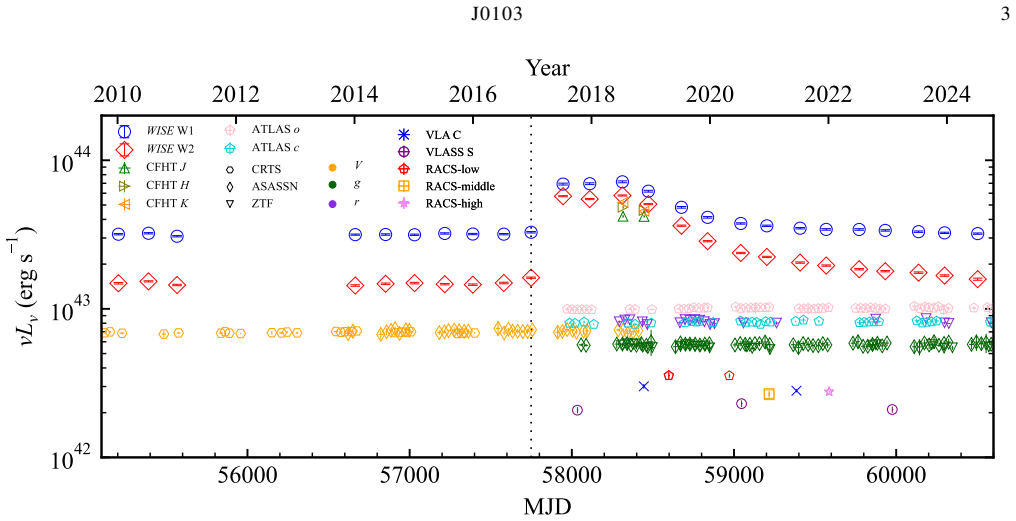
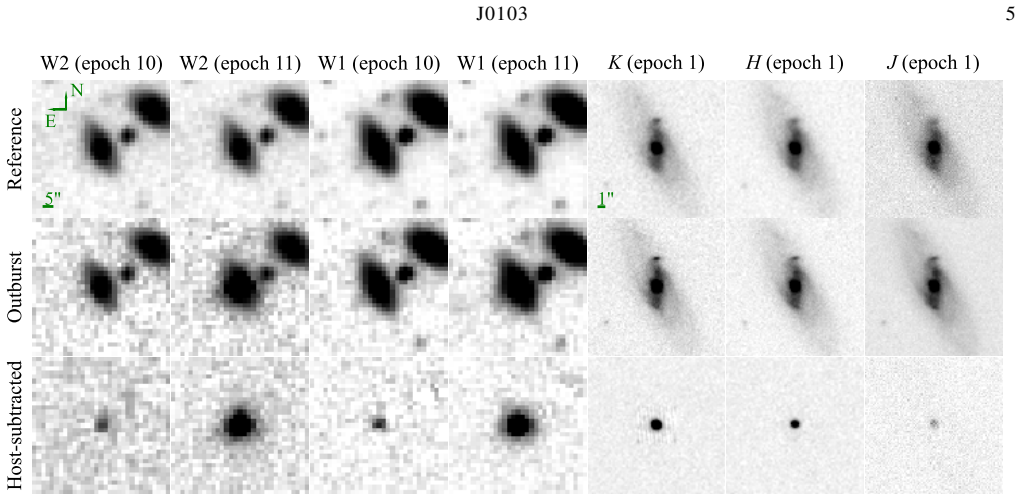
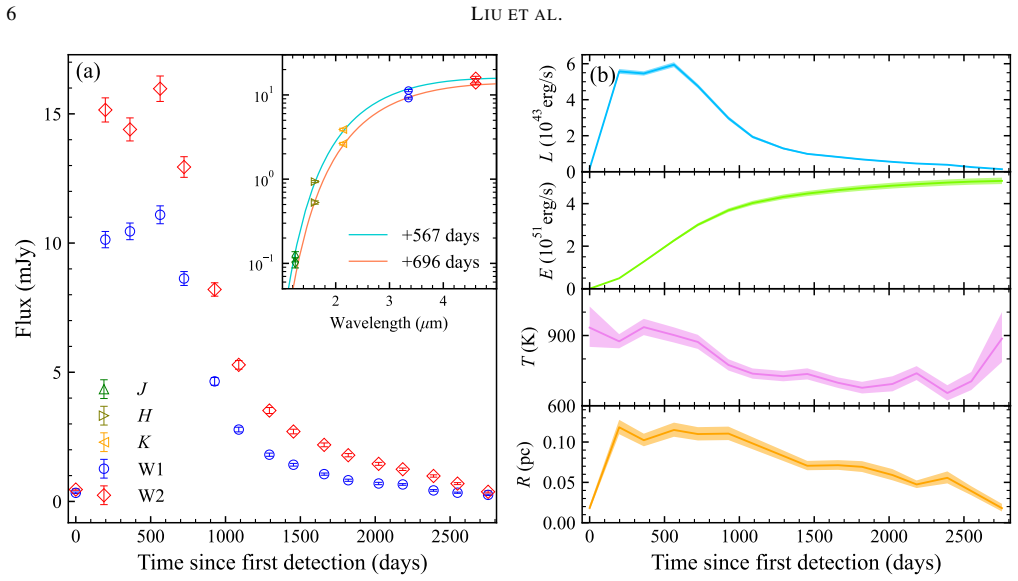
We present a comprehensive study of an infrared (IR) flare in the star-forming galaxy SDSS J010320.39+140152.5, which is selected from the sample of mid-IR (MIR) outbursts in nearby galaxies (MIRONG). Its MIR luminosity rose rapidly to a peak of $\sim5.4\times10^{43}$ \lum, maintained in the high state for about a year, and decreased continuously afterward. No optical variability was detected throughout the IR flare. Near-IR follow-up observations around the peak pinpointed the flare's location to spatially coincide with the galactic nucleus, with a $3\sigma$ upper limit of the offset of $\lesssim100$ pc. The IR spectral energy distribution (SED) of the flare is consistent with thermal emission of dust with temperatures of $\sim900$ K. Using a dust radiative transfer model, we inferred a peak UV luminosity of $\sim(4-10)\times10^{44}$ erg s$^{-1}$ and a total energy of $\sim(0.9-2)\times10^{52}$ ergs released. We ruled out the possibility of a supernova, and prefer that the IR flare originated from an obscured tidal disruption event (TDE) rather than a changing-look active galactic nucleus (AGN). This flare stands as one of the most compelling cases to date for the emerging class of dust-obscured TDEs in recent years. They are missed by optical surveys, partly accounting for the observed bias in TDE host galaxies, and represent a crucial, yet often overlooked, component for a complete understanding of the TDE population.
Editorial analysis
A structured set of objections, weighed in public.
Referee Report
Summary. The manuscript reports an infrared flare in the star-forming galaxy SDSS J010320.39+140152.5 from the MIRONG sample. The flare reached a peak MIR luminosity of ~5.4×10^43 L⊙, stayed elevated for ~1 year, then declined, with no detected optical variability and a nuclear position (offset ≲100 pc). The IR SED is fit by ~900 K dust; a dust radiative transfer model yields an inferred peak UV luminosity of (4-10)×10^44 erg s^{-1} and total energy (0.9-2)×10^52 erg. Supernovae are excluded and an obscured TDE is preferred over a changing-look AGN, positioning the event as one of the strongest examples of dust-obscured TDEs.
Significance. If the classification holds, the result is significant because it supplies a quantitatively modeled example of an obscured TDE in a star-forming host, directly addressing the known bias against such hosts in optically selected TDE samples. The dust-echo modeling that converts observed IR photometry into intrinsic UV energy release constitutes a reproducible, falsifiable step that strengthens the case relative to purely qualitative arguments.
minor comments (2)
- [Abstract] Abstract: peak luminosity, duration, and derived UV quantities are given with approximate symbols but without explicit uncertainties or ranges; the full text should ensure all modeled outputs (e.g., luminosity, energy) are accompanied by the uncertainties propagated from the photometry and model parameters.
- [Abstract] Abstract: the statement that this is 'one of the most compelling cases' is qualitative; a brief, quantitative comparison (e.g., energy release or covering factor) to the handful of previously published obscured TDEs would make the claim more precise.
Simulated Author's Rebuttal
We thank the referee for their positive and accurate summary of our manuscript, as well as for highlighting its significance in addressing biases in TDE host galaxy samples through dust-echo modeling. The recommendation for minor revision is noted. However, the report lists no specific major comments under the MAJOR COMMENTS section. We therefore have no individual points requiring rebuttal or revision at this stage and stand ready to address any minor editorial suggestions.
Circularity Check
No significant circularity
full rationale
The derivation chain begins from observed MIR photometry, nuclear positional coincidence, absence of optical variability, and an IR SED fitted to a standard dust radiative transfer model that yields an inferred UV luminosity and total energy. These quantities are then compared against external literature values for TDE energies, supernova luminosities, and AGN variability to prefer an obscured TDE classification. No step reduces a claimed prediction to a fitted parameter by construction, invokes a self-citation as a uniqueness theorem, or renames an input as an output; the model application and exclusion arguments remain independent of the final preference.
Axiom & Free-Parameter Ledger
free parameters (2)
- Dust temperature =
~900 K
- Inferred UV luminosity =
(4-10) x 10^44 erg s^-1
axioms (2)
- domain assumption The infrared emission arises from thermal dust reprocessing of a central ultraviolet flare.
- ad hoc to paper The transient is neither a supernova nor a changing-look AGN.
Reference graph
Works this paper leans on
-
[1]
Multiple accelerated particle populations in the Cygnus Loop with Fermi-LAT
thebibliography [1] 20pt to REFERENCES 6pt =0pt 10pt plus 3pt =0pt =0pt =1pt plus 1pt =0pt =0pt -12pt =13pt plus 1pt =20pt =13pt plus 1pt \@M =10000 =-1.0em =0pt =0pt 0pt =0pt =1.0em @enumiv\@empty 10000 10000 `\.\@m \@noitemerr \@latex@warning Empty `thebibliography' environment \@ifnextchar \@reference \@latexerr Missing key on reference command Each re...
-
[2]
Anderson, M. M., Mooley, K. P., Hallinan, G., et al.\ 2020, , 903, 116, doi:10.3847/1538-4357/abb94b
-
[3]
Arcavi, I., Gal-Yam, A., Sullivan, M., et al.\ 2014, , 793, 38, doi:10.1088/0004-637X/793/1/38
-
[4]
Bade, N., Komossa, S., & Dahlem, M.\ 1996, , 309, L35
1996
-
[5]
Baldwin, J. A., Phillips, M. M., & Terlevich, R.\ 1981, , 93, 5, doi:10.1086/130766
-
[6]
Becker, A.\ 2015, HOTPANTS: High Order Transform of PSF ANd Template Subtraction, Astrophysics Source Code Library, ascl:1504.004
2015
-
[7]
Bellm, E. C., Kulkarni, S. R., Barlow, T., et al.\ 2019, , 131, 068003, doi:10.1088/1538-3873/ab0c2a
-
[8]
Benetti, S., Nicholl, M., Cappellaro, E., et al.\ 2014, , 441, 289, doi:10.1093/mnras/stu538
-
[9]
2021, extinction: Dust extinction laws, Astrophysics Source Code Library, record ascl:2102.026
Barbary, K. 2021, extinction: Dust extinction laws, Astrophysics Source Code Library, record ascl:2102.026
2021
-
[10]
Bertin, E., Arnouts, S.\ 1996, , 117, 393, doi:10.1051/aas:1996164
-
[11]
Bertin, E., Mellier, Y., Radovich, M., et al.\ 2002, in ASP Conf. Ser. 281, Astronomical Data Analysis Software and Systems XI, ed. D. A. Bohlender, D. Durand, & T. H. Handley (San Francisco, CA: ASP), 228
2002
-
[12]
Bertin, E.\ 2006, in ASP Conf. Ser. 351, Astronomical Data Analysis Software and Systems XV, ed. C. Gabriel, et al. (San Francisco, CA: ASP), 112
2006
-
[13]
Boquien, M., Burgarella, D., Roehlly, Y., et al.\ 2019, , 622, A103, doi:10.1051/0004-6361/201834156
work page internal anchor Pith review doi:10.1051/0004-6361/201834156 2019
-
[14]
Bradley, L., Sip o cz, B., Robitaille, T., et al.\ 2025, astropy/photutils: 2.3.0, doi:10.5281/zenodo.17129028
-
[15]
Bruzual, G., Charlot, S.\ 2003, , 344, 1000, doi:10.1046/j.1365-8711.2003.06897.x
-
[16]
Burgarella, D., Buat, V., & Iglesias-P \'a ramo, J.\ 2005, , 360, 1413, doi:10.1111/j.1365-2966.2005.09131.x
-
[17]
Burrows, D. N., Hill, J. E., Nousek, J., et al.\ 2005, Space science reviews, 120, 165, doi:10.1007/s11214-005-5097-2
work page internal anchor Pith review doi:10.1007/s11214-005-5097-2 2005
-
[18]
The Dust Content and Opacity of Actively Star-Forming Galaxies
Calzetti, D., Armus, L., Bohlin, R. C., et al.\ 2000, , 533, 682, doi:10.1086/308692
work page internal anchor Pith review doi:10.1086/308692 2000
-
[19]
Cappellari, M., Emsellem, E.\ 2004, , 116, 138, doi:10.1086/381875
work page internal anchor Pith review doi:10.1086/381875 2004
-
[20]
Cappellari, M.\ 2017, , 466, 798, doi:10.1093/mnras/stw3020
work page internal anchor Pith review doi:10.1093/mnras/stw3020 2017
-
[21]
Cardelli, J. A., Clayton, G. C., & Mathis, J. S.\ 1989, , 345, 245, doi:10.1086/167900
-
[22]
D., Chornock, R., et al.\ 2024, , 971, 185, doi:10.3847/1538-4357/ad5541
Cendes, Y., Berger, E., Alexander, K. D., Chornock, R., et al.\ 2024, , 971, 185, doi:10.3847/1538-4357/ad5541
-
[23]
C., Vinko, J., et al.\ 2011, , 729, 143, doi:10.1088/0004-637X/729/2/143
Chatzopoulos, E., Wheeler, J. C., Vinko, J., et al.\ 2011, , 729, 143, doi:10.1088/0004-637X/729/2/143
-
[24]
\ 2009, , 697, L149, doi:10.1088/0004-637X/697/2/L149
Chen, X., Madau, P., Sesana, A., et al. \ 2009, , 697, L149, doi:10.1088/0004-637X/697/2/L149
-
[25]
Ciesla, L., Charmandaris, V., Georgakakis, A., et al.\ 2015, , 576, A10, doi:10.1051/0004-6361/201425252
-
[26]
Ciesla, L., Boselli, A., Elbaz, D., et al.\ 2016, , 585, A43, doi:10.1051/0004-6361/201527107
-
[27]
Condon, J. J., Cotton, W. D., Greisen, E. W., et al.\ 1998, , 115, 1693, doi:10.1086/300337
-
[28]
Coughlin, E. R., Armitage, P. J., Lodato, G., et al.\ 2019, , 215, 45, doi:10.1007/s11214-019-0612-z
-
[29]
Dai, B. B., Shu, X. W., Jiang, N., et al.\ 2020, , 896, L27, doi:10.3847/2041-8213/ab97ac
-
[30]
Dale, D. A., Helou, G., Magdis, G. E., et al.\ 2014, , 784, 83, doi:10.1088/0004-637X/784/1/83
work page internal anchor Pith review doi:10.1088/0004-637x/784/1/83 2014
-
[31]
Davies, L. J. M., Huynh, M. T., Seymour, N., et al.\ 2017, , 466, 2312, doi:10.1093/mnras/stw3080
-
[32]
Dou, L., Wang, T.G., Jiang, N., Yang, C., Lyu, J., Zhou, H.\ 2016, , 832, 188, doi:10.3847/0004-637X/832/2/188
-
[33]
Dou, L., Wang, T., Yan, L, et al.\ 2017, , 841, L8, doi:10.3847/2041-8213/aa7130
-
[34]
Draine, B. T., Lee, H. M.\ 1984, , 285, 89, doi:10.1086/162480
-
[35]
T., Malhotra, S.\ 1993, , 414, 632, doi:10.1086/173109
Draine, B. T., Malhotra, S.\ 1993, , 414, 632, doi:10.1086/173109
-
[36]
Drake, A. J., Djorgovski, S. G., Mahabal, A., et al.\ 2009, , 696, 870, doi:10.1088/0004-637X/696/1/870
-
[37]
Drake, A. J., Djorgovski, S. G., Prieto, J. L., et al.\ 2010, , 718, L127, doi:10.1088/2041-8205/718/2/L127
-
[38]
Dressler, A., Gunn, J.E.\ 1983, , 270, 7, doi:10.1086/161093
-
[39]
Dwek, E.\ 1983, , 274, 175, doi:10.1086/161435
-
[40]
D., Ramirez-Ruiz, E., et al.\ 2025, , 983, 28, doi:10.3847/1538-4357/adb974
Earl, N., French, K. D., Ramirez-Ruiz, E., et al.\ 2025, , 983, 28, doi:10.3847/1538-4357/adb974
-
[41]
D., Skrutskie, F., Chevalier, R
Fox, O. D., Skrutskie, F., Chevalier, R. A., et al.\ 2009, , 691, 650, doi:10.1088/0004-637x/691/1/650
-
[42]
Fox, O. D., Chevalier, R. A., Dwek, E., et al.\ 2010, , 725, 1768, doi:10.1088/0004-637x/725/2/1768
-
[43]
Fox, O. D., Chevalier, R. A., Skrutskie, M. F., et al.\ 2011, , 741, 7, doi:10.1088/0004-637X/741/1/7
-
[44]
Fox, O. D., Filippenko, A. V., Skrutskie, M. F., et al.\ 2013, , 146, 2, doi:10.1088/0004-6256/146/1/2
-
[45]
D., Khandrika, H., Rubin, D., et al.\ 2021, , 506, 4199, doi:10.1093/mnras/stab1740
Fox, O. D., Khandrika, H., Rubin, D., et al.\ 2021, , 506, 4199, doi:10.1093/mnras/stab1740
-
[46]
D., Arcavi, I., Zabludoff, A.\ 2016, , 818, L21, doi:10.3847/2041-8205/818/1/L21
French, K. D., Arcavi, I., Zabludoff, A.\ 2016, , 818, L21, doi:10.3847/2041-8205/818/1/L21
-
[47]
D., Wevers, T., Law-Smith, J., et al.\ 2020, , 216, 32, doi:10.1007/s11214-020-00657-y
French, K. D., Wevers, T., Law-Smith, J., et al.\ 2020, , 216, 32, doi:10.1007/s11214-020-00657-y
-
[48]
Fritz, J., Franceschini, A., Hatziminaoglou, E.\ 2006, , 366, 767, doi:10.1111/j.1365-2966.2006.09866.x
-
[49]
R., Vincenzi, M., et al.\ 2021, , 500, 5142, doi:10.1093/mnras/staa3607
Frohmaier, C., Angus, C. R., Vincenzi, M., et al.\ 2021, , 500, 5142, doi:10.1093/mnras/staa3607
-
[50]
Gaia Collaboration, Babusiaux, C., van Leeuwen, F., et al.\ 2018, , 616, A10, doi:10.1051/0004-6361/201832843
-
[51]
Gardner, J. P., Mather, J. C., Clampin, M., et al.\ 2006, , 123, 485, doi:10.1007/s11214-006-8315-7
-
[52]
Gezari, S.\ 2021, , 59, 21, doi:10.1146/annurev-astro-111720-030029
-
[53]
Graham, J. R., Meikle, W. P. S., Selby, M. J., et al.\ 1983, , 304, 709, doi:10.1038/304709a0
-
[54]
Graur, O., French, K. D., Zahid, H. J., et al.\ 2018, , 853, 39, doi:10.3847/1538-4357/aaa3fd
-
[55]
2018, The Journal of Open Source Software, 3, 695, doi: 10.21105/joss.00695
Green, G. M.\ 2018, JOSS, 3, 695, doi:10.21105/joss.00695
-
[56]
Grotova, I., Rau, A., Baldini, P., et al.\ 2025, , 697, 159, doi:10.1051/0004-6361/202553669
-
[57]
Guillochon, J.\ 2017, Nature Astronomy, 1, 0068, doi:10.1038/s41550-017-0068
-
[58]
G\"uver, T., \"Ozel, F.\ 2009, , 400, 2050, doi:10.1111/j.1365-2966.2009.15598.x
-
[59]
Hammerstein, E., Gezari, S., van Velzen, S., et al.\ 2021, , 908, L20, doi:10.3847/2041-8213/abdcb4
-
[60]
Heckman, T. M., Armus, L. & Miley, G. K.\ 1987, , 93, 276, doi:10.1086/114310
-
[61]
G.\ 1975, , 254, 295, doi:10.1038/254295a0
Hills, J. G.\ 1975, , 254, 295, doi:10.1038/254295a0
-
[62]
HI4PI Collaboration, Ben Bekhti, N., Fl \"o er , L., et al.\ 2016, , 594, A116, doi:10.1051/0004-6361/201629178
-
[63]
Inoue, A. K.\ 2011, , 415, 2920, doi:10.1111/j.1365-2966.2011.18906.x
-
[64]
Jencson, J. E., Kasliwal, M. M., Scott M., et al.\ 2019, , 886, 40, doi:10.3847/1538-4357/ab4a01
-
[65]
Jiang, N., Wang, T., Yan, L., et al.\ 2017, , 850, 63, doi:10.3847/1538-4357/aa93f5
-
[66]
et al.\ 2019, , 871, 15, doi:10.3847/1538-4357/aaf6b2
Jiang, N., Wang, T., Mou, G. et al.\ 2019, , 871, 15, doi:10.3847/1538-4357/aaf6b2
-
[67]
Jiang, N., Dou, L., Wang, T., et al.\ 2016, , 828, L14, doi:10.3847/2041-8205/828/1/L14
-
[68]
Jiang, N., Wang, T., Dou, L., et al.\ 2021a, , 252, 32, doi:10.3847/1538-4365/abd1dc
-
[69]
Jiang, N., Wang, T., Hu, X., et al.\ 2021b, , 911, 31, doi:10.3847/1538-4357/abe772
-
[70]
O., Scolnic, D
Jones, D. O., Scolnic, D. M., Rodney, S. A., et al.\ 2015, PythonPhot: Simple DAOPHOT-type photometry in Python, Astrophysics Source Code Library, ascl:1501.010
2015
-
[71]
Kankare, E., Kotak, R., Mattila, S., et al.\ 2017, Nature Astronomy, 1, 865, doi:10.1038/s41550-017-0290-2
-
[72]
M., Tremonti, C., et al.\ 2003, , 346, 1055, doi:10.1111/j.1365-2966.2003.07154.x
Kauffmann, G., Heckman, T. M., Tremonti, C., et al.\ 2003, , 346, 1055, doi:10.1111/j.1365-2966.2003.07154.x
-
[73]
Kennedy, G. F., Meiron, Y., . Shukirgaliyev, B., et al.\ 2016, , 460, 240, doi:10.1093/mnras/stw908
-
[74]
C., Jr.\ 1998, , 36, 189, doi:10.1146/annurev.astro.36.1.189
Kennicutt, R. C., Jr.\ 1998, , 36, 189, doi:10.1146/annurev.astro.36.1.189
work page internal anchor Pith review doi:10.1146/annurev.astro.36.1.189 1998
-
[75]
Kewley, L. J., Dopita, M. A., Sutherland, R. S., et al.\ 2001, , 556, 121, doi:10.1086/321545
work page internal anchor Pith review doi:10.1086/321545 2001
-
[76]
Kewley, L. J., Groves, B., Kauffmann, G., et al.\ 2006, , 372, 961, doi:10.1111/j.1365-2966.2006.10859.x
-
[77]
Klein, U., Lisenfeld, U., & Verley, S.\ 2018, , 611, 55, doi: 10.1051/0004-6361/201731673
-
[78]
Kochanek, C. S., Shappee, B. J., Stanek, K. Z., et al.\ 2017, , doi:10.1088/1538-3873/aa80d9
-
[79]
Komossa, S., Zhou, H., Wang, T., et al.\ 2008, , 678, 13, doi:10.1086/588281
-
[80]
Komossa, S., Zhou, H., Rau, A., et al.\ 2009, , 701, 105, doi:10.1088/0004-637X/701/1/105
discussion (0)
Sign in with ORCID, Apple, or X to comment. Anyone can read and Pith papers without signing in.