Toward a Phenomenologically Acceptable Quantum Cyclic Universe
Pith reviewed 2026-06-29 06:14 UTC · model grok-4.3
The pith
A quantum universe in a finite Hilbert space with commensurable energy differences evolves exactly periodically and can exhibit a distinguished low-entropy excursion if initialized at minimum entropy.
A machine-rendered reading of the paper's core claim, the machinery that carries it, and where it could break.
Core claim
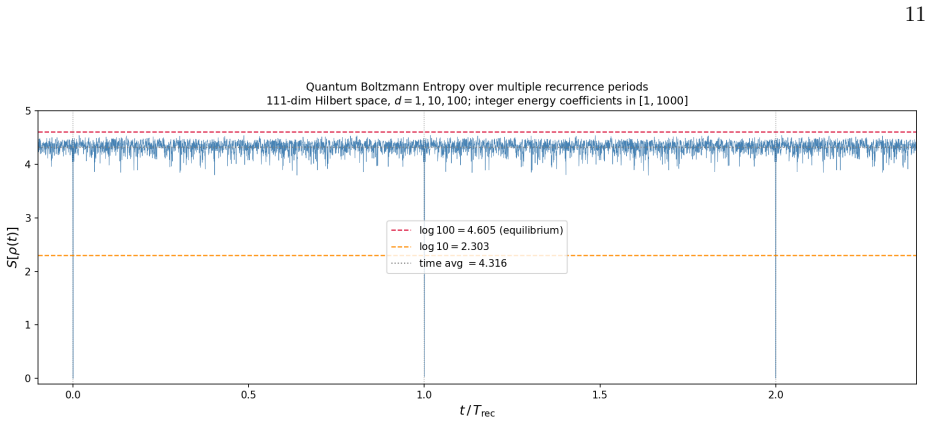
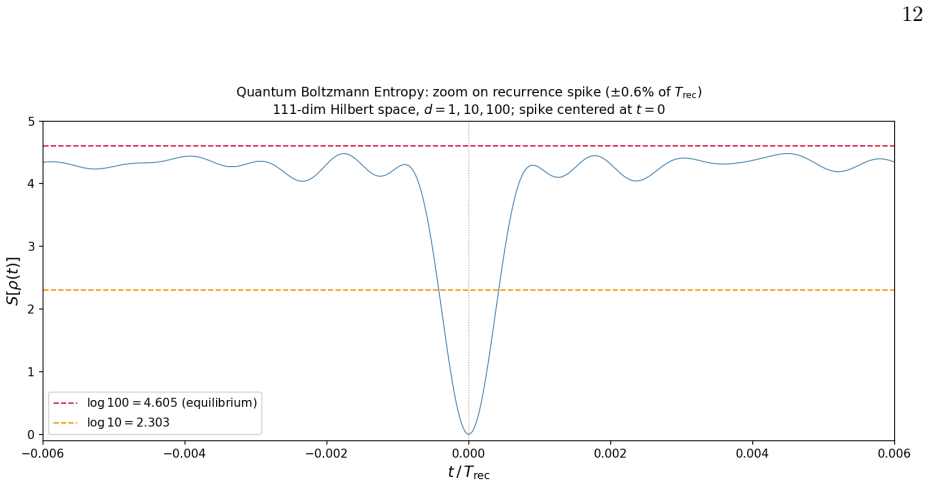
If the universe is described by a quantum state evolving unitarily in a finite-dimensional Hilbert space, its evolution will be recurrent. If the differences in energy eigenvalues are commensurable, the evolution is not simple recurrent, but exactly periodic. Moreover, if the state starts at minimum thermodynamic entropy, its evolution can feature a distinguished entropy excursion that is much more pronounced than one would expect from the conventional expression P(ΔS) ∝ exp(−ΔS). This excursion could represent our Big Bang, with relatively few Boltzmann fluctuations occurring in the subsequent equilibrium phase before a Big Crunch occurs and the cycle begins again.
What carries the argument
Commensurability of energy eigenvalue differences in the finite-dimensional Hilbert space, which enforces exact periodicity instead of quasi-periodic recurrence, combined with initialization at minimum entropy to create a distinguished low-entropy state.
If this is right
- Evolution is exactly periodic rather than quasi-periodic.
- The entropy minimum at the start stands out against the background of equilibrium fluctuations.
- Observers like us arise during the pronounced entropy excursion rather than as typical fluctuations.
- The cycle includes a Big Crunch followed by repetition without dominant Boltzmann brains.
Where Pith is reading between the lines
- The model may tie the thermodynamic arrow of time to a specific phase within the periodic cycle.
- A spacetime interpretation could map the quantum periodicity onto classical expanding and contracting phases.
- The commensurability condition might impose observable constraints on fluctuation statistics in the early universe.
Load-bearing premise
The universe is described by a quantum state in a finite-dimensional Hilbert space whose energy eigenvalue differences are commensurable and which begins at minimum thermodynamic entropy.
What would settle it
Demonstration that the energy eigenvalues of the universe's effective Hilbert space have incommensurable differences, or direct observation of Boltzmann brains dominating over observers in low-entropy regions.
Figures
read the original abstract
We put forward a quantum model of cosmology that is exactly periodic but avoids the Boltzmann Brain problem. If the universe is described by a quantum state evolving unitarily in a finite-dimensional Hilbert space, its evolution will be recurrent: given enough time, the state will return arbitrarily close to its initial state. There is a worry that such a scenario cannot be phenomenologically acceptable, because the state will spend most of its time in a high-entropy equilibrium macrostate, with rare fluctuations downward in entropy, and the vast majority of observers will be minimal fluctuations away from equilibrium, or ``Boltzmann Brains." Here we show that this is not necessarily true. If the differences in energy eigenvalues are commensurable, the evolution is not simple recurrent, but exactly periodic. Moreover, if the state starts at minimum thermodynamic entropy, its evolution can feature a distinguished entropy excursion that is much more pronounced than one would expect from the conventional expression $P(\Delta S) \propto \exp(-\Delta S)$. This excursion could represent our Big Bang, with relatively few Boltzmann fluctuations occurring in the subsequent equilibrium phase before a Big Crunch occurs and the cycle begins again. We speculate on the spacetime interpretation of this kind of quantum universe.
Editorial analysis
A structured set of objections, weighed in public.
Referee Report
Summary. The paper proposes a quantum cosmological model in which a state in a finite-dimensional Hilbert space evolves unitarily. When energy eigenvalue differences are commensurable the evolution is exactly periodic rather than merely recurrent. If the initial state is chosen to have minimum thermodynamic entropy, the entropy function can exhibit one distinguished low-entropy excursion per cycle that is claimed to be far more pronounced than expected from the equilibrium fluctuation formula P(ΔS) ∝ exp(−ΔS); this excursion is suggested to represent the Big Bang, after which the system returns to equilibrium with comparatively few Boltzmann fluctuations before a Big Crunch closes the cycle. The spacetime interpretation is presented as speculative.
Significance. If the central claims are substantiated, the model supplies a concrete, conditional mechanism by which exact periodicity and a minimum-entropy initial condition can suppress the Boltzmann Brain problem in a recurrent quantum cosmology. It illustrates how the standard fluctuation statistics can be altered by commensurability and initial-state choice, and it is explicit about the speculative character of any spacetime reading. These features constitute a modest but clearly stated contribution to the literature on quantum recurrence and the arrow of time.
major comments (2)
- [Abstract] Abstract: the claim that the distinguished entropy excursion 'is much more pronounced than one would expect from the conventional expression P(ΔS) ∝ exp(−ΔS)' is asserted without any supporting equations, derivation, or explicit probability calculation. Because this deviation is the central phenomenological claim, its absence prevents evaluation of whether the model genuinely improves upon standard Boltzmann-brain expectations.
- [Abstract] Abstract: both the commensurability of energy eigenvalue differences and the choice of an initial minimum-entropy state are imposed by hand to obtain exact periodicity and the desired excursion. The text does not derive these conditions from the dynamics; without them the evolution reverts to quasi-periodic recurrence. These modeling choices are therefore load-bearing for the entire argument.
Simulated Author's Rebuttal
We thank the referee for their careful reading and for identifying points that merit clarification. We respond to each major comment below.
read point-by-point responses
-
Referee: [Abstract] Abstract: the claim that the distinguished entropy excursion 'is much more pronounced than one would expect from the conventional expression P(ΔS) ∝ exp(−ΔS)' is asserted without any supporting equations, derivation, or explicit probability calculation. Because this deviation is the central phenomenological claim, its absence prevents evaluation of whether the model genuinely improves upon standard Boltzmann-brain expectations.
Authors: The abstract is a concise summary. The explicit derivation of the entropy evolution, the comparison against the conventional fluctuation formula P(ΔS) ∝ exp(−ΔS), and the probability calculation demonstrating the deviation are given in Section 4 of the manuscript. We will add a brief reference to this section in the abstract to facilitate evaluation. revision: partial
-
Referee: [Abstract] Abstract: both the commensurability of energy eigenvalue differences and the choice of an initial minimum-entropy state are imposed by hand to obtain exact periodicity and the desired excursion. The text does not derive these conditions from the dynamics; without them the evolution reverts to quasi-periodic recurrence. These modeling choices are therefore load-bearing for the entire argument.
Authors: These are modeling assumptions adopted to investigate the consequences of exact periodicity and a distinguished low-entropy state within a finite-dimensional unitary quantum cosmology. Section 2 explains that commensurability converts recurrence into exact periodicity, while the minimum-entropy initial condition is chosen to produce one pronounced excursion per cycle. The manuscript presents the construction as a phenomenological toy model rather than a derivation from more fundamental dynamics; this framing is stated explicitly in the introduction and conclusion. revision: no
Circularity Check
No significant circularity identified
full rationale
The paper advances a conditional model: unitary evolution in a finite-dimensional Hilbert space with commensurable energy differences yields exact periodicity, and an initial minimum-entropy state can produce one distinguished low-entropy excursion per cycle. These are introduced explicitly as 'if' premises whose consequences are then derived; the paper does not claim to derive the commensurability condition or the minimum-entropy initialization from the dynamics, nor does it rename a fitted result as a prediction. No self-citations appear in the supplied text, and the central claim remains the conditional behavior under the stated assumptions rather than an unconditional derivation. The argument is therefore self-contained as a speculative model without reduction of outputs to inputs by construction.
Axiom & Free-Parameter Ledger
free parameters (2)
- commensurability of energy eigenvalue differences
- initial state at minimum thermodynamic entropy
axioms (3)
- domain assumption The universe is described by a quantum state evolving unitarily in a finite-dimensional Hilbert space
- ad hoc to paper Energy eigenvalue differences are commensurable
- ad hoc to paper The initial quantum state is at minimum thermodynamic entropy
Reference graph
Works this paper leans on
-
[1]
Call the bounce phaseB
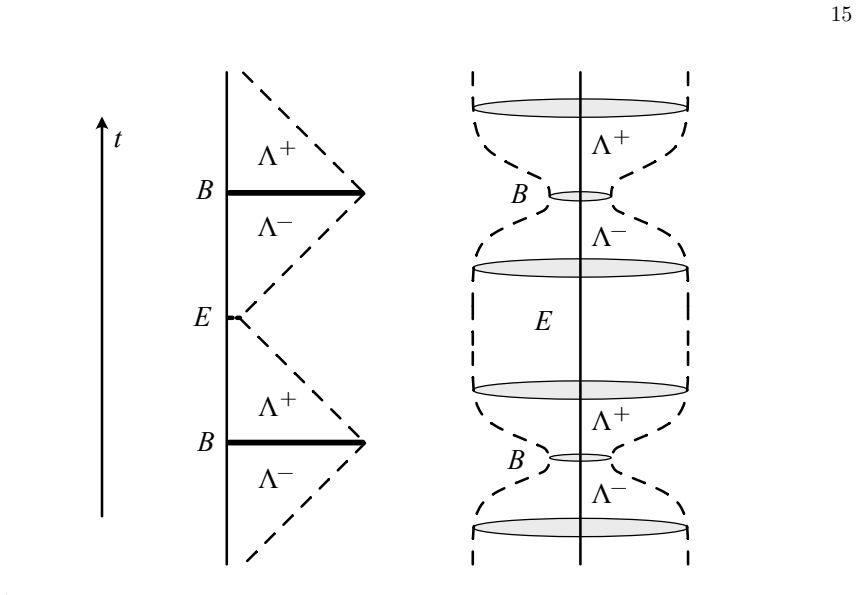
The low-entropy minimum represents a bounce connecting a Big Crunch on one side to a Big Bang on the other. Call the bounce phaseB
-
[2]
Call these phases Λ±, indicating conventional ΛCDM cosmology
On each side of the bounce we have conventional cosmological evolution from the high- temperature/low-entropy phase toward an asymptotically de Sitter phase. Call these phases Λ±, indicating conventional ΛCDM cosmology
-
[3]
expanding
Much of the time is spent in a high-entropy equilibrium phase whose closest spacetime interpretation is empty de Sitter. Call this phaseEfor equilibrium. A possible spacetime diagram implementing these features is shown in Figure 3, first as a conformal diagram and then as a sketch of the horizon volume associated with a chosen geodesic. At the moment it ...
-
[4]
Nietzsche,The gay science: With a prelude in rhymes and an appendix of songs, vol
F. Nietzsche,The gay science: With a prelude in rhymes and an appendix of songs, vol. 985. Vintage, 1974
1974
-
[5]
P. Madau and M. Dickinson, “Cosmic Star Formation History,”Ann. Rev. Astron. Astrophys.52 (2014) 415–486,arXiv:1403.0007 [astro-ph.CO]
work page internal anchor Pith review Pith/arXiv arXiv 2014
-
[6]
Asymptotic behavior of homogeneous cosmological models in the presence of a positive cosmological constant,
R. M. Wald, “Asymptotic behavior of homogeneous cosmological models in the presence of a positive cosmological constant,”Phys. Rev. D28(1983) 2118–2120
1983
-
[7]
The Asymptotic Approach to De Sitter Space-time,
J. D. Barrow and G. Goetz, “The Asymptotic Approach to De Sitter Space-time,”Phys. Lett. B231 (1989) 228–230
1989
-
[8]
Cosmic Equilibration: A Holographic No-Hair Theorem from the Generalized Second Law
S. M. Carroll and A. Chatwin-Davies, “Cosmic Equilibration: A Holographic No-Hair Theorem from the Generalized Second Law,”Phys. Rev. D97no. 4, (2018) 046012,arXiv:1703.09241 [hep-th]. 20
work page internal anchor Pith review Pith/arXiv arXiv 2018
-
[9]
Singularities and time-asymmetry,
R. Penrose, “Singularities and time-asymmetry,” inGeneral Relativity: An Einstein Centenary Survey, S. Hawking and W. Israel, eds. Cambridge University Press, 1979
1979
-
[10]
D. Z. Albert,Time and chance. Harvard University Press, 2003
2003
-
[11]
Carroll,From eternity to here: the quest for the ultimate theory of time
S. Carroll,From eternity to here: the quest for the ultimate theory of time. Dutton, 2010
2010
-
[12]
The arrow of time,
T. Gold, “The arrow of time,”American Journal of Physics30no. 6, (1962) 403–410
1962
-
[13]
Cosmology, Time's Arrow, and That Old Double Standard
H. Price, “Cosmology, time’s arrow, and that old double standard,”arXiv:gr-qc/9310022
work page internal anchor Pith review Pith/arXiv arXiv
-
[14]
Arrow of time in a recollapsing quantum universe,
C. Kiefer and H. Zeh, “Arrow of time in a recollapsing quantum universe,”Physical Review D51 no. 8, (1995) 4145
1995
-
[15]
Arrow of time in cosmology,
S. W. Hawking, “Arrow of time in cosmology,”Physical Review D32no. 10, (1985) 2489
1985
-
[16]
Will entropy decrease if the universe recollapses?,
D. N. Page, “Will entropy decrease if the universe recollapses?,”Physical Review D32no. 10, (1985) 2496
1985
-
[17]
Origin of time asymmetry,
S. W. Hawking, R. Laflamme, and G. W. Lyons, “Origin of time asymmetry,”Physical Review D47 no. 12, (1993) 5342
1993
-
[18]
Inflation without a beginning: A null boundary proposal,
A. Aguirre and S. Gratton, “Inflation without a beginning: A null boundary proposal,”Physical Review D67no. 8, (2003) 083515
2003
-
[19]
Spontaneous Inflation and the Origin of the Arrow of Time
S. M. Carroll and J. Chen, “Spontaneous inflation and the origin of the arrow of time,” arXiv:hep-th/0410270
work page internal anchor Pith review Pith/arXiv arXiv
-
[20]
Arrows of time in the bouncing universes of the no-boundary quantum state,
J. Hartle and T. Hertog, “Arrows of time in the bouncing universes of the no-boundary quantum state,”Physical Review D—Particles, Fields, Gravitation, and Cosmology85no. 10, (2012) 103524
2012
-
[21]
A Gravitational Origin of the Arrows of Time
J. Barbour, T. Koslowski, and F. Mercati, “A Gravitational Origin of the Arrows of Time,” arXiv:1310.5167 [gr-qc]
work page internal anchor Pith review Pith/arXiv arXiv
-
[22]
S. Goldstein, R. Tumulka, and N. Zanghi, “Is the Hypothesis About a Low Entropy Initial State of the Universe Necessary for Explaining the Arrow of Time?,”Phys. Rev. D94(2016) 023520, arXiv:1602.05601 [astro-ph.CO]
work page internal anchor Pith review Pith/arXiv arXiv 2016
-
[23]
L. Boyle, K. Finn, and N. Turok, “CPT-Symmetric Universe,”Phys. Rev. Lett.121no. 25, (2018) 251301,arXiv:1803.08928 [hep-ph]
work page internal anchor Pith review Pith/arXiv arXiv 2018
-
[24]
The Big Bang as a Mirror: a Solution of the Strong CP Problem,
L. Boyle, M. Teuscher, and N. Turok, “The Big Bang as a Mirror: a Solution of the Strong CP Problem,”arXiv:2208.10396 [hep-ph]
-
[25]
On the theoretical requirements for a periodic behaviour of the universe,
R. C. Tolman, “On the theoretical requirements for a periodic behaviour of the universe,”Physical Review38no. 9, (1931) 1758
1931
-
[26]
Cosmic evolution in a cyclic universe,
P. J. Steinhardt and N. Turok, “Cosmic evolution in a cyclic universe,”Physical Review D65no. 12, (2002) 126003
2002
-
[27]
Ekpyrotic and cyclic cosmology,
J.-L. Lehners, “Ekpyrotic and cyclic cosmology,”Physics Reports465no. 6, (2008) 223–263
2008
-
[28]
Loop quantum cosmology,
M. Bojowald, “Loop quantum cosmology,”Living Reviews in Relativity11no. 1, (2008) 4
2008
-
[29]
The basic ideas of conformal cyclic cosmology,
R. Penrose, “The basic ideas of conformal cyclic cosmology,”Eternity between space and time: From consciousness to the cosmos(2012)
2012
-
[30]
Mad-Dog Everettianism: Quantum Mechanics at Its Most Minimal
S. M. Carroll and A. Singh, “Mad-Dog Everettianism: Quantum Mechanics at Its Most Minimal,” in What Is Fundamental?, A. Aguirre, B. Foster, and Z. Merali, eds., pp. 95–104. Springer, 2019. arXiv:1801.08132 [quant-ph]
work page internal anchor Pith review Pith/arXiv arXiv 2019
-
[31]
Reality as a vector in hilbert space,
S. M. Carroll, “Reality as a vector in hilbert space,”arXiv:2103.09780 [quant-ph]
-
[32]
Lorentz symmetry from a random Hamiltonian
A. Albrecht and A. Iglesias, “Lorentz symmetric dispersion relation from a random Hamiltonian,” Phys. Rev. D91no. 4, (2015) 043529,arXiv:1003.2566 [hep-th]
work page internal anchor Pith review Pith/arXiv arXiv 2015
-
[33]
J. S. Cotler, G. R. Penington, and D. H. Ranard, “Locality from the Spectrum,”Commun. Math. Phys.368no. 3, (2019) 1267–1296,arXiv:1702.06142 [quant-ph]
work page internal anchor Pith review Pith/arXiv arXiv 2019
-
[34]
Quantum mereology: Factorizing Hilbert space into subsystems with quasiclassical dynamics,
S. M. Carroll and A. Singh, “Quantum mereology: Factorizing Hilbert space into subsystems with quasiclassical dynamics,”Phys. Rev. A103no. 2, (2021) 022213,arXiv:2005.12938 [quant-ph]
-
[35]
Holographic phenomenology via overlapping degrees of freedom,
O. Friedrich, C. Cao, S. M. Carroll, G. Cheng, and A. Singh, “Holographic phenomenology via overlapping degrees of freedom,”Class. Quant. Grav.41no. 19, (2024) 195003,arXiv:2402.11016 [hep-th]
-
[36]
Operational quantum mereology and minimal scrambling,
P. Zanardi, E. Dallas, F. Andreadakis, and S. Lloyd, “Operational quantum mereology and minimal scrambling,”Quantum8(2024) 1406
2024
-
[37]
A Search for Classical Subsystems in Quantum Worlds
A. Adil, M. S. Rudolph, A. Arrasmith, Z. Holmes, A. Albrecht, and A. Sornborger, “A Search for Classical Subsystems in Quantum Worlds,”arXiv:2403.10895 [quant-ph]
work page internal anchor Pith review Pith/arXiv arXiv
-
[38]
On the emergence of preferred structures in quantum theory,
A. Soulas, G. Franzmann, and A. Di Biagio, “On the emergence of preferred structures in quantum theory,”arXiv:2512.07468 [quant-ph]
-
[39]
Quantum mereology and subsystems from the spectrum,
N. Loizeau and D. Sels, “Quantum mereology and subsystems from the spectrum,”Foundations of Physics55no. 1, (2025) 3. 21
2025
-
[40]
Zurek,Decoherence and Quantum Darwinism: From Quantum Foundations to Classical Reality
W. Zurek,Decoherence and Quantum Darwinism: From Quantum Foundations to Classical Reality. Cambridge University Press, 2025.https://books.google.com/books?id=XA7J0QEACAAJ
2025
-
[41]
Hilbert space structure in quantum gravity: an algebraic perspective
S. B. Giddings, “Hilbert space structure in quantum gravity: an algebraic perspective,”JHEP12 (2015) 099,arXiv:1503.08207 [hep-th]
work page internal anchor Pith review Pith/arXiv arXiv 2015
-
[42]
Observables, gravitational dressing, and obstructions to locality and subsystems
W. Donnelly and S. B. Giddings, “Observables, gravitational dressing, and obstructions to locality and subsystems,”Phys. Rev.D94no. 10, (2016) 104038,arXiv:1607.01025 [hep-th]
work page internal anchor Pith review Pith/arXiv arXiv 2016
-
[43]
Space from Hilbert Space: Recovering Geometry from Bulk Entanglement
C. Cao, S. M. Carroll, and S. Michalakis, “Space from Hilbert Space: Recovering Geometry from Bulk Entanglement,”Phys. Rev.D95no. 2, (2017) 024031,arXiv:1606.08444 [hep-th]
work page internal anchor Pith review Pith/arXiv arXiv 2017
-
[44]
Quantum Circuit Cosmology: The Expansion of the Universe Since the First Qubit
N. Bao, C. Cao, S. M. Carroll, and L. McAllister, “Quantum Circuit Cosmology: The Expansion of the Universe Since the First Qubit,”arXiv:1702.06959 [hep-th]
work page internal anchor Pith review Pith/arXiv arXiv
-
[45]
Bulk Entanglement Gravity without a Boundary: Towards Finding Einstein's Equation in Hilbert Space
C. Cao and S. M. Carroll, “Bulk entanglement gravity without a boundary: Towards finding Einstein’s equation in Hilbert space,”Phys. Rev. D97no. 8, (2018) 086003,arXiv:1712.02803 [hep-th]
work page internal anchor Pith review Pith/arXiv arXiv 2018
-
[46]
State-dependent geometries from magic-enriched quantum codes,
C. Cao, G. Cheng, K. Karthikeyan, C. Li, and J. Preskill, “State-dependent geometries from magic-enriched quantum codes,”arXiv:2603.13475 [hep-th]
-
[47]
Towards a quantum theory of de Sitter space
T. Banks, B. Fiol, and A. Morisse, “Towards a quantum theory of de Sitter space,”JHEP12(2006) 004,arXiv:hep-th/0609062
work page internal anchor Pith review Pith/arXiv arXiv 2006
-
[48]
Causal structure of the entanglement renormalization ansatz
C. Beny, “Causal structure of the entanglement renormalization ansatz,”New J. Phys.15(2013) 023020,arXiv:1110.4872 [quant-ph]
work page internal anchor Pith review Pith/arXiv arXiv 2013
-
[49]
Tensor Networks from Kinematic Space
B. Czech, L. Lamprou, S. McCandlish, and J. Sully, “Tensor Networks from Kinematic Space,” JHEP07(2016) 100,arXiv:1512.01548 [hep-th]
work page internal anchor Pith review Pith/arXiv arXiv 2016
-
[50]
Towards a dS/MERA correspondence
R. Sinai Kunkolienkar and K. Banerjee, “Towards a dS/MERA correspondence,”Int. J. Mod. Phys. D26no. 13, (2017) 1750143,arXiv:1611.08581 [hep-th]
work page internal anchor Pith review Pith/arXiv arXiv 2017
-
[51]
De Sitter Space as a Tensor Network: Cosmic No-Hair, Complementarity, and Complexity
N. Bao, C. Cao, S. M. Carroll, and A. Chatwin-Davies, “De Sitter Space as a Tensor Network: Cosmic No-Hair, Complementarity, and Complexity,”Phys. Rev. D96no. 12, (2017) 123536, arXiv:1709.03513 [hep-th]
work page internal anchor Pith review Pith/arXiv arXiv 2017
-
[52]
Holographic networks for (1+1)-dimensional de Sitter space-time,
L. Niermann and T. J. Osborne, “Holographic networks for (1+1)-dimensional de Sitter space-time,” Phys. Rev. D105no. 12, (2022) 125009,arXiv:2102.09223 [hep-th]
-
[53]
Overlapping qubits from non-isometric maps and de Sitter tensor networks,
C. Cao, W. Chemissany, A. Jahn, and Z. Zimbor´ as, “Overlapping qubits from non-isometric maps and de Sitter tensor networks,”Nature Commun.16no. 1, (2025) 163,arXiv:2304.02673 [hep-th]
-
[54]
Cosmological Correlators Using Tensor Networks
U. Basumatary, A. Sinha, and X. Zhou, “Cosmological Correlators Using Tensor Networks,” arXiv:2603.26090 [hep-th]
work page internal anchor Pith review Pith/arXiv arXiv
-
[55]
Universal upper bound on the entropy-to-energy ratio for bounded systems,
J. D. Bekenstein, “Universal upper bound on the entropy-to-energy ratio for bounded systems,” Phys. Rev. D23(Jan, 1981) 287–298
1981
-
[56]
The Stretched Horizon and Black Hole Complementarity
L. Susskind, L. Thorlacius, and J. Uglum, “The Stretched horizon and black hole complementarity,” Phys. Rev.D48(1993) 3743–3761,arXiv:hep-th/9306069 [hep-th]
work page internal anchor Pith review Pith/arXiv arXiv 1993
-
[57]
A Covariant Entropy Conjecture
R. Bousso, “A Covariant entropy conjecture,”JHEP07(1999) 004,arXiv:hep-th/9905177 [hep-th]
work page internal anchor Pith review Pith/arXiv arXiv 1999
-
[58]
The Hilbert Space of Quantum Gravity Is Locally Finite-Dimensional
N. Bao, S. M. Carroll, and A. Singh, “The Hilbert Space of Quantum Gravity Is Locally Finite-Dimensional,”Int. J. Mod. Phys.D26no. 12, (2017) 1743013,arXiv:1704.00066
work page internal anchor Pith review Pith/arXiv arXiv 2017
-
[59]
Cosmological event horizons, thermodynamics, and particle creation,
G. W. Gibbons and S. W. Hawking, “Cosmological event horizons, thermodynamics, and particle creation,”Physical Review D15no. 10, (1977) 2738
1977
-
[60]
Taking de Sitter Seriously
W. Fischler, “Taking de Sitter Seriously.” Talk given at Role of Scaling Laws in Physics and Biology (Celebrating the 60th Birthday of Geoffrey West), Santa Fe, Dec., 2000
2000
-
[61]
QuantuMechanics and CosMology
T. Banks, “QuantuMechanics and CosMology.” Talk given at the festschrift for L. Susskind, Stanford University, May 2000, 2000
2000
-
[62]
Cosmological Breaking of Supersymmetry?
T. Banks, “Cosmological breaking of supersymmetry?,”Int. J. Mod. Phys.A16(2001) 910–921, arXiv:hep-th/0007146 [hep-th]
work page internal anchor Pith review Pith/arXiv arXiv 2001
-
[63]
Positive vacuum energy and the N-bound
R. Bousso, “Positive vacuum energy and the N-bound,”Journal of High Energy Physics2000 no. 11, (Nov., 2000) 038,arXiv:hep-th/0010252 [hep-th]
work page internal anchor Pith review Pith/arXiv arXiv 2000
-
[64]
Quantum Gravity In De Sitter Space
E. Witten, “Quantum gravity in de Sitter space,” inStrings 2001: International Conference. 6, 2001.arXiv:hep-th/0106109
work page internal anchor Pith review Pith/arXiv arXiv 2001
-
[65]
M-theory observables for cosmological space-times,
T. Banks and W. Fischler, “M-theory observables for cosmological space-times,”arXiv e-prints (Feb., 2001) hep–th/0102077,arXiv:hep-th/0102077 [hep-th]
-
[66]
Disturbing Implications of a Cosmological Constant
L. Dyson, M. Kleban, and L. Susskind, “Disturbing implications of a cosmological constant,”JHEP 10(2002) 011,arXiv:hep-th/0208013. 22
work page internal anchor Pith review Pith/arXiv arXiv 2002
-
[67]
The Trouble with de Sitter Space
N. Goheer, M. Kleban, and L. Susskind, “The trouble with de Sitter space,”Journal of High Energy Physics2003no. 7, (July, 2003) 056,arXiv:hep-th/0212209 [hep-th]
work page internal anchor Pith review Pith/arXiv arXiv 2003
-
[68]
De Sitter Holography with a Finite Number of States
M. K. Parikh and E. P. Verlinde, “De Sitter holography with a finite number of states,”JHEP01 (2005) 054,arXiv:hep-th/0410227
work page internal anchor Pith review Pith/arXiv arXiv 2005
-
[69]
de Sitter equilibrium as a fundamental framework for cosmology
A. Albrecht, “de Sitter equilibrium as a fundamental framework for cosmology,”J. Phys. Conf. Ser. 174(2009) 012006,arXiv:0906.1047 [gr-qc]
work page internal anchor Pith review Pith/arXiv arXiv 2009
-
[70]
My Personal History With the Quantum Theory of de Sitter Space,
T. Banks, “My Personal History With the Quantum Theory of de Sitter Space,”arXiv:2312.10729 [hep-th]
-
[71]
Quantum recurrence theorem,
P. Bocchieri and A. Loinger, “Quantum recurrence theorem,”Physical Review107no. 2, (1957) 337
1957
-
[72]
Note on the quantum recurrence theorem,
L. S. Schulman, “Note on the quantum recurrence theorem,”Physical Review A18no. 5, (1978) 2379
1978
-
[73]
Recurrence theorems: a unified account,
D. Wallace, “Recurrence theorems: a unified account,”Journal of Mathematical Physics56no. 2, (2015)
2015
-
[74]
Conditional cosmological recurrence in finite hilbert spaces and holographic bounds within causal patches,
N. Chronis and N. Sifakis, “Conditional cosmological recurrence in finite hilbert spaces and holographic bounds within causal patches,”Universe12no. 1, (2025) 10
2025
-
[75]
Can the universe afford inflation?,
A. Albrecht and L. Sorbo, “Can the universe afford inflation?,”Physical Review D70no. 6, (Sep,
-
[76]
Return of the Boltzmann Brains
D. N. Page, “Return of the Boltzmann Brains,”Phys.Rev.D78(2008) 063536, arXiv:hep-th/0611158 [hep-th]
work page internal anchor Pith review Pith/arXiv arXiv 2008
-
[77]
Boltzmann brains and the scale-factor cutoff measure of the multiverse
A. De Simone, A. H. Guth, A. D. Linde, M. Noorbala, M. P. Salem,et al., “Boltzmann brains and the scale-factor cutoff measure of the multiverse,”Phys.Rev.D82(2010) 063520,arXiv:0808.3778 [hep-th]
work page internal anchor Pith review Pith/arXiv arXiv 2010
-
[78]
Why boltzmann brains are bad,
S.M. Carroll, “Why boltzmann brains are bad,” inCurrent Controversies in Philosophy of Science, S. Dasgupta, R. Dotan, and B. Weslake, ed., pp. 7–20. Routledge, 2017
2017
-
[79]
S. M. Carroll, “What if Time Really Exists?,”arXiv:0811.3772 [gr-qc]. https://arxiv.org/abs/0811.3772
work page internal anchor Pith review Pith/arXiv arXiv
-
[80]
Recurrent Nightmares?: Measurement Theory in de Sitter Space
T. Banks, W. Fischler, and S. Paban, “Recurrent nightmares? Measurement theory in de Sitter space,”JHEP12(2002) 062,arXiv:hep-th/0210160
work page internal anchor Pith review Pith/arXiv arXiv 2002
discussion (0)
Sign in with ORCID, Apple, or X to comment. Anyone can read and Pith papers without signing in.