Millicharged Particle Constraints from Asymptotic Giant Branch Stars
Pith reviewed 2026-06-29 06:13 UTC · model grok-4.3
The pith
Globular cluster star ratios constrain millicharged particles to charges as low as 5×10^{-13} for 10-100 keV masses.
A machine-rendered reading of the paper's core claim, the machinery that carries it, and where it could break.
Core claim
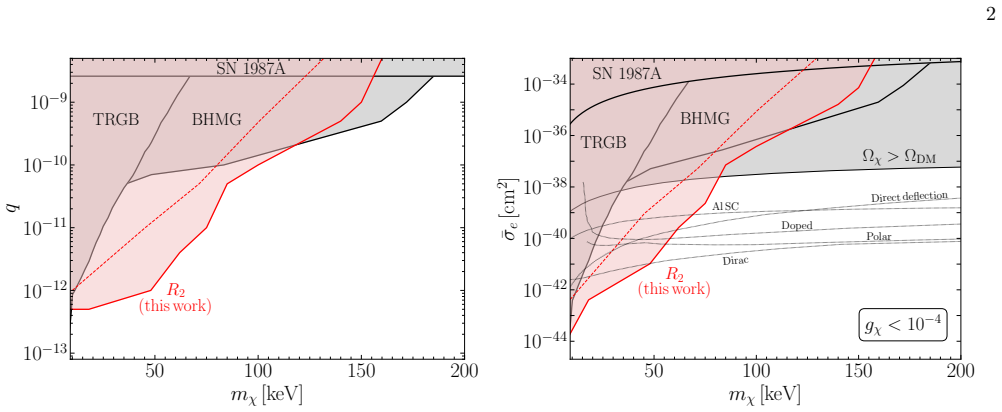
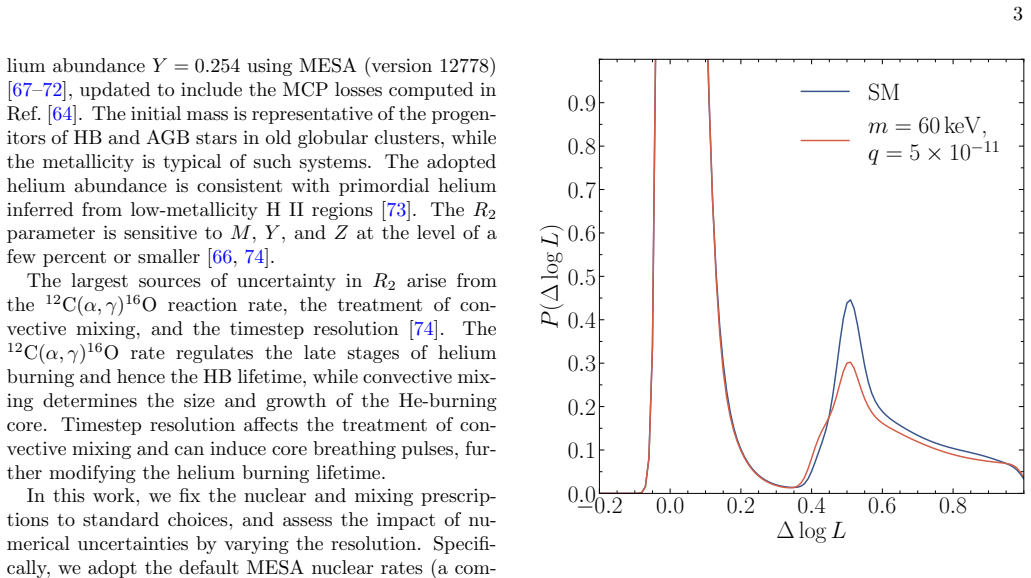
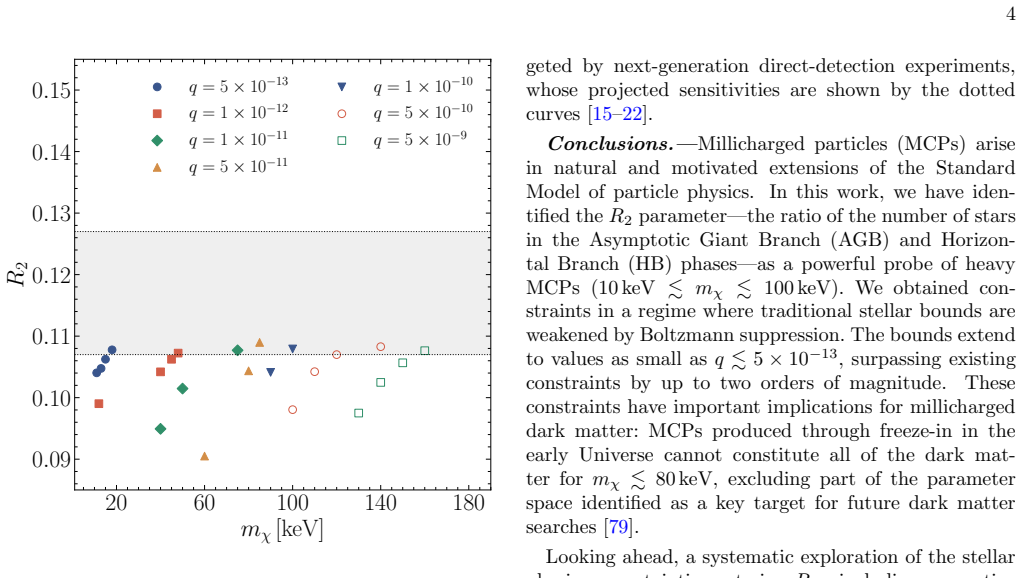
Millicharged particles shorten the lifetimes of horizontal branch and asymptotic giant branch phases in low-mass stars, with a larger effect on the AGB phase due to higher temperatures in the helium-burning shell. This reduces the R2 parameter below standard expectations. Comparison with globular cluster data yields the strongest bounds for masses between 10 keV and 100 keV, with charges down to approximately 5×10^{-13}, improving on prior constraints by up to two orders of magnitude.
What carries the argument
The R2 parameter, the ratio of the number of asymptotic giant branch stars to horizontal branch stars, which is reduced by differential lifetime shortening from millicharged particle emission.
If this is right
- The new bounds apply in the mass range 10 keV to 100 keV.
- These limits surpass previous constraints by up to two orders of magnitude.
- MCP emission reduces AGB lifetimes more than HB lifetimes due to temperature differences.
- Globular cluster observations serve as a sensitive test for exotic particle production in stellar interiors.
Where Pith is reading between the lines
- If the R2 parameter can be measured more precisely in additional clusters, the bounds could be strengthened further.
- This method might be extended to other evolutionary phases or different types of stars to search for millicharged particles in other mass ranges.
- Confirmation of these bounds would imply that millicharged particles could influence energy transport in other high-temperature astrophysical environments.
Load-bearing premise
The assumption that millicharged particle production shortens both the horizontal branch and asymptotic giant branch lifetimes, with a larger reduction in the asymptotic giant branch phase due to higher temperatures in the helium-burning shell.
What would settle it
An observed R2 parameter in globular clusters that is consistent with no additional energy loss from millicharged particles, or a calculation showing that MCP emission does not preferentially shorten the AGB phase, would invalidate the derived bounds.
Figures
read the original abstract
We investigate the effect of millicharged particles (MCPs) with electric charge $qe\ll e$ and mass $m_\chi$ on the late-stage evolution phases of low-mass stars in globular clusters. We predict the $R_2$ parameter -- the ratio of the number of stars in the asymptotic giant branch (AGB) phase to the number of stars in the horizontal branch (HB) phase -- and compare it against globular cluster data. While the production of MCPs shortens both the HB and AGB lifetimes, a larger reduction in the AGB phase arises from the higher temperatures in the helium-burning shell. We find the strongest bounds in the range $10\,\mathrm{keV}\lesssim m_\chi\lesssim 100\,\mathrm{keV}$, reaching charges as small as $q\simeq 5\times10^{-13}$ and surpassing existing constraints by up to two orders of magnitude.
Editorial analysis
A structured set of objections, weighed in public.
Referee Report
Summary. The paper claims that millicharged particles (MCPs) affect late-stage stellar evolution in globular clusters by shortening both horizontal branch (HB) and asymptotic giant branch (AGB) lifetimes, with a larger effect on the AGB phase due to higher temperatures in the helium-burning shell. This differential shortening alters the R2 parameter (ratio of AGB to HB stars), allowing new constraints from globular cluster observations that reach q ≃ 5×10^{-13} for 10 keV ≲ m_χ ≲ 100 keV and improve on existing bounds by up to two orders of magnitude.
Significance. If the predicted differential lifetime reduction holds after full accounting for production rates under realistic stellar conditions, the result would provide substantially stronger limits on MCPs in a mass range where other constraints are weaker, extending the use of globular-cluster R2 data to a new phase. The approach is falsifiable via direct comparison to observed star counts.
major comments (2)
- [sections describing MCP production rates and lifetime calculations] The central claim of improved bounds by ~100 rests on MCP emissivity producing a significantly larger fractional lifetime reduction in the AGB He-shell than in the HB core. The manuscript must explicitly compute and compare the energy-loss rates (Compton, bremsstrahlung, pair processes) for both phases, including density, degeneracy, and kinematic thresholds when m_χ ≈ T; without this quantitative demonstration the factor-of-100 improvement cannot be verified.
- [section on R2 parameter and observational comparison] The bounds are obtained from the change in predicted R2; the paper must report the explicit functional dependence of R2 on q and m_χ, the adopted globular-cluster data set, the observed R2 value with uncertainties, and the error treatment used to translate the R2 shift into the quoted q limits.
minor comments (2)
- The abstract would be clearer if it briefly identified the stellar evolution code or input physics (e.g., opacities, convection treatment) used for the HB and AGB models.
- Notation for the charge q and mass m_χ should be defined at first use and kept consistent with any prior MCP literature cited.
Simulated Author's Rebuttal
We thank the referee for the careful reading and constructive comments on our manuscript. We address each major comment below and will revise the manuscript to incorporate the requested explicit details and comparisons.
read point-by-point responses
-
Referee: The central claim of improved bounds by ~100 rests on MCP emissivity producing a significantly larger fractional lifetime reduction in the AGB He-shell than in the HB core. The manuscript must explicitly compute and compare the energy-loss rates (Compton, bremsstrahlung, pair processes) for both phases, including density, degeneracy, and kinematic thresholds when m_χ ≈ T; without this quantitative demonstration the factor-of-100 improvement cannot be verified.
Authors: We agree that an explicit side-by-side comparison of the energy-loss rates strengthens the presentation. The manuscript computes the MCP emissivities using the standard expressions for Compton scattering, bremsstrahlung, and pair production, evaluated at the characteristic temperature, density, and degeneracy conditions of the HB core and the hotter, lower-density AGB helium-burning shell. The differential lifetime reduction arises because the emissivity is more sensitive to the higher temperature in the AGB shell, particularly for m_χ in the 10–100 keV range where kinematic thresholds become relevant. To address the request directly, we will add a new subsection (or table/figure) in the revised manuscript that tabulates and compares the energy-loss rates and resulting fractional lifetime shortenings for representative m_χ values in both phases, explicitly including degeneracy and threshold effects. This will allow independent verification of the factor-of-~100 improvement in the bounds. revision: yes
-
Referee: The bounds are obtained from the change in predicted R2; the paper must report the explicit functional dependence of R2 on q and m_χ, the adopted globular-cluster data set, the observed R2 value with uncertainties, and the error treatment used to translate the R2 shift into the quoted q limits.
Authors: The R2 parameter is obtained from the ratio of the MCP-modified AGB and HB lifetimes, where the lifetime reduction scales with the emissivity ∝ q² f(m_χ, T, ρ). We will add an explicit statement of this functional dependence in the revised text. The adopted globular-cluster data set, the measured R2 value together with its uncertainty, and the statistical procedure (propagation of the observed R2 uncertainty into an allowed deviation in the lifetime ratio, hence into q) will be reported in a dedicated paragraph or subsection. These additions will make the mapping from R2 shift to the quoted q limits fully transparent without altering the underlying analysis. revision: yes
Circularity Check
No circularity: bounds derived from independent stellar models and observations
full rationale
The paper computes MCP emissivity from standard processes (Compton scattering, bremsstrahlung, pair production) inside HB cores and AGB shells, integrates the resulting energy loss into stellar evolution to obtain shortened lifetimes, forms the observable R2 ratio, and compares the predicted R2(m_χ, q) against globular-cluster star counts. None of the load-bearing steps reduces by definition or by self-citation to the target bound; the temperature dependence that produces a larger AGB effect is an output of the microphysical rates and the stellar-structure equations, not an input. No fitted parameter is relabeled as a prediction, and no uniqueness theorem from the same authors is invoked to close the argument. The derivation is therefore self-contained against external data.
Axiom & Free-Parameter Ledger
Reference graph
Works this paper leans on
-
[1]
Galison and A
P. Galison and A. Manohar,Two Z’s or not two Z’s?, Phys. Lett. B136(1984) 279
1984
-
[2]
Holdom,Searching forϵCharges and a New U(1), Phys
B. Holdom,Searching forϵCharges and a New U(1), Phys. Lett. B178(1986) 65
1986
-
[3]
Holdom,Two U(1)’s and Epsilon Charge Shifts, Phys
B. Holdom,Two U(1)’s and Epsilon Charge Shifts, Phys. Lett. B166(1986) 196
1986
-
[4]
K. R. Dienes, C. F. Kolda and J. March-Russell, 5 Kinetic mixing and the supersymmetric gauge hierarchy, Nucl. Phys. B492(1997) 104 [hep-ph/9610479]
work page internal anchor Pith review Pith/arXiv arXiv 1997
-
[5]
Naturally Light Hidden Photons in LARGE Volume String Compactifications
M. Goodsell, J. Jaeckel, J. Redondo and A. Ringwald, Naturally Light Hidden Photons in LARGE Volume String Compactifications,JHEP11(2009) 027 [0909.0515]
work page internal anchor Pith review Pith/arXiv arXiv 2009
-
[6]
Albertus et al.,WISPedia – the WISPs Encyclopedia,arXiv:2602.09089
C. Albertus et al.,WISPedia – the WISPs Encyclopedia: Cosmic WISPers 2026 – V1.0, 2602.09089
-
[7]
Foot,New Physics From Electric Charge Quantization?,Mod
R. Foot,New Physics From Electric Charge Quantization?,Mod. Phys. Lett. A6(1991) 527
1991
-
[8]
Direct Detection of Sub-GeV Dark Matter
R. Essig, J. Mardon and T. Volansky,Direct Detection of Sub-GeV Dark Matter,Phys. Rev. D85(2012) 076007 [1108.5383]
work page internal anchor Pith review Pith/arXiv arXiv 2012
-
[9]
X. Chu, T. Hambye and M. H. G. Tytgat,The Four Basic Ways of Creating Dark Matter Through a Portal, JCAP05(2012) 034 [1112.0493]
work page internal anchor Pith review Pith/arXiv arXiv 2012
-
[10]
Making dark matter out of light: freeze-in from plasma effects
C. Dvorkin, T. Lin and K. Schutz,Making dark matter out of light: freeze-in from plasma effects,Phys. Rev. D 99(2019) 115009 [1902.08623]. [Erratum: Phys.Rev.D 105, 119901 (2022)]
work page internal anchor Pith review Pith/arXiv arXiv 2019
- [11]
- [12]
-
[13]
D. F. G. Fiorillo, G. Lucente, J. Sakstein, E. Vitagliano and M. Cantiello,The Black Hole Mass Gap as a New Probe of Millicharged Particles,2604.02413
work page internal anchor Pith review Pith/arXiv arXiv
- [14]
- [15]
-
[16]
Detection of Light Dark Matter With Optical Phonons in Polar Materials
S. Knapen, T. Lin, M. Pyle and K. M. Zurek,Detection of Light Dark Matter With Optical Phonons in Polar Materials,Phys. Lett. B785(2018) 386 [1712.06598]
work page internal anchor Pith review Pith/arXiv arXiv 2018
-
[17]
Directional Detection of Light Dark Matter with Polar Materials
S. Griffin, S. Knapen, T. Lin and K. M. Zurek, Directional Detection of Light Dark Matter with Polar Materials,Phys. Rev. D98(2018) 115034 [1807.10291]
work page internal anchor Pith review Pith/arXiv arXiv 2018
-
[18]
Detection of sub-MeV Dark Matter with Three-Dimensional Dirac Materials
Y. Hochberg, Y. Kahn, M. Lisanti, K. M. Zurek, A. G. Grushin, R. Ilan, S. M. Griffin, Z.-F. Liu, S. F. Weber and J. B. Neaton,Detection of sub-MeV Dark Matter with Three-Dimensional Dirac Materials,Phys. Rev. D 97(2018) 015004 [1708.08929]
work page internal anchor Pith review Pith/arXiv arXiv 2018
- [19]
- [20]
-
[21]
Y. Hochberg, Y. Kahn, N. Kurinsky, B. V. Lehmann, T. C. Yu and K. K. Berggren,Determining Dark-Matter–Electron Scattering Rates from the Dielectric Function,Phys. Rev. Lett.127(2021) 151802 [2101.08263]
- [22]
-
[23]
L. W. Jones,A Review of Quark Search Experiments, Rev. Mod. Phys.49(1977) 717
1977
-
[24]
M. I. Dobroliubov and A. Y. Ignatiev,Millicharged Particles,Phys. Rev. Lett.65(1990) 679
1990
-
[25]
R. N. Mohapatra and I. Z. Rothstein,Astrophysical Constraints on Minicharged Particles,Phys. Lett. B 247(1990) 593
1990
-
[26]
Davidson, B
S. Davidson, B. Campbell and D. C. Bailey,Limits on particles of small electric charge,Phys. Rev. D43 (1991) 2314
1991
-
[27]
Mitsui, R
T. Mitsui, R. Fujimoto, Y. Ishisaki, Y. Ueda, Y. Yamazaki, S. Asai and S. Orito,Search for invisible decay of orthopositronium,Phys. Rev. Lett.70(1993) 2265
1993
-
[28]
Astrophysical Bounds on Milli-Charged Particles in Models with a Paraphoton
S. Davidson and M. E. Peskin,Astrophysical bounds on millicharged particles in models with a paraphoton, Phys. Rev. D49(1994) 2114 [hep-ph/9310288]
work page internal anchor Pith review Pith/arXiv arXiv 1994
-
[29]
A. A. Prinz et al.,Search for millicharged particles at SLAC,Phys. Rev. Lett.81(1998) 1175 [hep-ex/9804008]
work page internal anchor Pith review Pith/arXiv arXiv 1998
-
[30]
Updated Bounds on Milli-Charged Particles
S. Davidson, S. Hannestad and G. Raffelt,Updated bounds on millicharged particles,JHEP05(2000) 003 [hep-ph/0001179]
work page internal anchor Pith review Pith/arXiv arXiv 2000
-
[31]
S. L. Dubovsky, D. S. Gorbunov and G. I. Rubtsov, Narrowing the window for millicharged particles by CMB anisotropy,JETP Lett.79(2004) 1 [hep-ph/0311189]
work page internal anchor Pith review Pith/arXiv arXiv 2004
-
[32]
H. Gies, J. Jaeckel and A. Ringwald,Polarized Light Propagating in a Magnetic Field as a Probe of Millicharged Fermions,Phys. Rev. Lett.97(2006) 140402 [hep-ph/0607118]
work page internal anchor Pith review Pith/arXiv arXiv 2006
-
[33]
S. N. Gninenko, N. V. Krasnikov and A. Rubbia,Search for millicharged particles in reactor neutrino experiments: A Probe of the PVLAS anomaly,Phys. Rev. D75(2007) 075014 [hep-ph/0612203]
work page internal anchor Pith review Pith/arXiv arXiv 2007
-
[34]
An Improved Limit on Invisible Decays of Positronium
A. Badertscher, P. Crivelli, W. Fetscher, U. Gendotti, S. Gninenko, V. Postoev, A. Rubbia, V. Samoylenko and D. Sillou,An Improved Limit on Invisible Decays of Positronium,Phys. Rev. D75(2007) 032004 [hep-ex/0609059]
work page internal anchor Pith review Pith/arXiv arXiv 2007
-
[35]
P. C. Kim, E. R. Lee, I. T. Lee, M. L. Perl, V. Halyo and D. Loomba,Search for fractional-charge particles in meteoritic material,Phys. Rev. Lett.99(2007) 161804
2007
-
[36]
Probing Minicharged Particles with Tests of Coulomb's Law
J. Jaeckel,Probing Minicharged Particles with Tests of Coulomb’s Law,Phys. Rev. Lett.103(2009) 080402 [0904.1547]
work page internal anchor Pith review Pith/arXiv arXiv 2009
-
[37]
The Low-Energy Frontier of Particle Physics
J. Jaeckel and A. Ringwald,The Low-Energy Frontier of Particle Physics,Ann. Rev. Nucl. Part. Sci.60 (2010) 405 [1002.0329]
work page internal anchor Pith review Pith/arXiv arXiv 2010
-
[38]
M. D. Diamond and P. Schuster,Searching for Light Dark Matter with the SLAC Millicharge Experiment, Phys. Rev. Lett.111(2013) 221803 [1307.6861]
work page internal anchor Pith review Pith/arXiv arXiv 2013
-
[39]
Dark Radiation constraints on minicharged particles in models with a hidden photon
H. Vogel and J. Redondo,Dark Radiation constraints on minicharged particles in models with a hidden photon,JCAP02(2014) 029 [1311.2600]
work page internal anchor Pith review Pith/arXiv arXiv 2014
-
[40]
D. C. Moore, A. D. Rider and G. Gratta,Search for Millicharged Particles Using Optically Levitated Microspheres,Phys. Rev. Lett.113(2014) 251801 [1408.4396]
work page internal anchor Pith review Pith/arXiv arXiv 2014
-
[41]
A. Haas, C. S. Hill, E. Izaguirre and I. Yavin,Looking for milli-charged particles with a new experiment at the LHC,Phys. Lett. B746(2015) 117 [1410.6816]. 6
work page internal anchor Pith review Pith/arXiv arXiv 2015
-
[42]
Minicharged Particles from the Sun: A Cutting-Edge Bound
N. Vinyoles and H. Vogel,Minicharged Particles from the Sun: A Cutting-Edge Bound,JCAP03(2016) 002 [1511.01122]
work page internal anchor Pith review Pith/arXiv arXiv 2016
-
[43]
J. H. Chang, R. Essig and S. D. McDermott,Supernova 1987A Constraints on Sub-GeV Dark Sectors, Millicharged Particles, the QCD Axion, and an Axion-like Particle,JHEP09(2018) 051 [1803.00993]
work page internal anchor Pith review Pith/arXiv arXiv 2018
- [44]
-
[45]
A. Berlin, N. Blinov, G. Krnjaic, P. Schuster and N. Toro,Dark Matter, Millicharges, Axion and Scalar Particles, Gauge Bosons, and Other New Physics with LDMX,Phys. Rev. D99(2019) 075001 [1807.01730]. [46]ArgoNeuTCollaboration, R. Acciarri et al.,Improved Limits on Millicharged Particles Using the ArgoNeuT Experiment at Fermilab,Phys. Rev. Lett.124(2020) ...
-
[46]
M. Pospelov and H. Ramani,Earth-bound millicharge relics,Phys. Rev. D103(2021) 115031 [2012.03957]
- [47]
- [48]
- [49]
-
[50]
A. Berlin and K. Schutz,Helioscope for gravitationally bound millicharged particles,Phys. Rev. D105(2022) 095012 [2111.01796]. [52]milliQanCollaboration, A. Ball et al.,Sensitivity to millicharged particles in future proton-proton collisions at the LHC with the milliQan detector,Phys. Rev. D 104(2021) 032002 [2104.07151]
-
[51]
X. Gan and Y.-D. Tsai,Cosmic Millicharge Background and Reheating Probes,2308.07951
-
[52]
A. Berlin, S. Rajendran, H. Ramani and E. H. Tanin, Direct deflection of Millicharged radiation,JHEP04 (2025) 198 [2412.03643]. [55]CMSCollaboration, A. Hayrapetyan et al.,Search for Fractionally Charged Particles in Proton-Proton Collisions at s=13 TeV,Phys. Rev. Lett.134(2025) 131802 [2402.09932]
-
[53]
Alcott et al.,Search for Millicharged Particles in Proton-Proton Collisions at s=13.6 TeV,Phys
S. Alcott et al.,Search for Millicharged Particles in Proton-Proton Collisions at s=13.6 TeV,Phys. Rev. Lett.135(2025) 121802 [2506.02251]
- [54]
- [55]
-
[56]
Light Dark Matter: Models and Constraints
S. Knapen, T. Lin and K. M. Zurek,Light Dark Matter: Models and Constraints,Phys. Rev. D96(2017) 115021 [1709.07882]. [60]OscuraCollaboration, A. Aguilar-Arevalo et al.,The Oscura Experiment,2202.10518. [61]SENSEICollaboration, P. Adari et al.,First Direct-Detection Results on Sub-GeV Dark Matter Using the SENSEI Detector at SNOLAB,Phys. Rev. Lett.134(202...
work page internal anchor Pith review Pith/arXiv arXiv 2017
- [57]
-
[58]
D. F. G. Fiorillo, G. Lucente, J. Sakstein and E. Vitagliano,Millicharged Particle Production During Late-Stage Stellar Evolution,2604.02419
work page internal anchor Pith review Pith/arXiv arXiv
-
[59]
R. Kippenhahn, A. Weigert and A. Weiss,Stellar structure and evolution, Astronomy and Astrophysics Library. Springer, 8, 2012, 10.1007/978-3-642-30304-3
-
[60]
M. J. Dolan, F. J. Hiskens and R. R. Volkas,Advancing globular cluster constraints on the axion-photon coupling,JCAP10(2022) 096 [2207.03102]. [67]MESACollaboration, B. Paxton, L. Bildsten, A. Dotter, F. Herwig, P. Lesaffre and F. Timmes, Modules for Experiments in Stellar Astrophysics (MESA),Astrophys. J. Supp. S.192(2011) 3 [1009.1622]
-
[61]
B. Paxton et al.,Modules for Experiments in Stellar Astrophysics (MESA): Planets, Oscillations, Rotation, and Massive Stars,Astrophys. J. Supp. S.208(2013) 4 [1301.0319]
work page internal anchor Pith review Pith/arXiv arXiv 2013
-
[62]
Modules for Experiments in Stellar Astrophysics (MESA): Binaries, Pulsations, and Explosions
B. Paxton et al.,Modules for Experiments in Stellar Astrophysics (MESA): Binaries, Pulsations, and Explosions,Astrophys. J. Supp. S.220(2015) 15 [1506.03146]
work page internal anchor Pith review Pith/arXiv arXiv 2015
-
[63]
B. Paxton et al.,Modules for Experiments in Stellar Astrophysics (MESA): Convective Boundaries, Element Diffusion, and Massive Star Explosions,Astrophys. J. Supp. S.234(2018) 34 [1710.08424]
work page internal anchor Pith review Pith/arXiv arXiv 2018
-
[64]
B. Paxton et al.,Modules for Experiments in Stellar Astrophysics (MESA): Pulsating Variable Stars, Rotation, Convective Boundaries, and Energy Conservation,Astrophys. J. Supp. S.243(2019) 10 [1903.01426]. [72]MESACollaboration, A. S. Jermyn et al.,Modules for Experiments in Stellar Astrophysics (MESA): Time-dependent Convection, Energy Conservation, Autom...
work page internal anchor Pith review Pith/arXiv arXiv 2019
-
[65]
E. Aver, K. A. Olive, R. L. Porter and E. D. Skillman, The primordial helium abundance from updated emissivities,JCAP11(2013) 017 [1309.0047]
work page internal anchor Pith review Pith/arXiv arXiv 2013
-
[66]
The treatment of mixing in core helium burning models -- II. Constraints from cluster star counts
T. Constantino, S. W. Campbell, J. C. Lattanzio and A. van Duijneveldt,The treatment of mixing in core helium burning models - II. Constraints from cluster star counts,Mon. Not. R. Astron. Soc.456(2016) 3866 [1512.04845]
work page internal anchor Pith review Pith/arXiv arXiv 2016
-
[67]
Angulo et al.,A compilation of charged-particle induced thermonuclear reaction rates,Nucl
C. Angulo et al.,A compilation of charged-particle induced thermonuclear reaction rates,Nucl. Phys. A 656(1999) 3
1999
-
[68]
R. H. Cyburt, A. M. Amthor, A. Heger, E. Johnson, L. Keek, Z. Meisel, H. Schatz and K. Smith,Dependence of X-Ray Burst Models on Nuclear Reaction Rates, Astrophys. J.830(2016) 55 [1607.03416]
work page internal anchor Pith review Pith/arXiv arXiv 2016
-
[69]
Henyey, M
L. Henyey, M. S. Vardya and P. Bodenheimer,Studies in Stellar Evolution. III. The Calculation of Model Envelopes.,Astrophys. J.142(1965) 841
1965
- [70]
-
[71]
R. Essig et al.,Snowmass2021 Cosmic Frontier: The landscape of low-threshold dark matter direct detection in the next decade, inSnowmass 2021, 3, 2022, 2203.08297
discussion (0)
Sign in with ORCID, Apple, or X to comment. Anyone can read and Pith papers without signing in.