ComAct: Reframing Professional Software Manipulation via COM-as-Action Paradigm
Pith reviewed 2026-07-01 07:43 UTC · model grok-4.3
The pith
Treating Component Object Model calls as actions lets agents control industrial CAD software through deterministic program synthesis instead of visual clicks.
A machine-rendered reading of the paper's core claim, the machinery that carries it, and where it could break.
Core claim
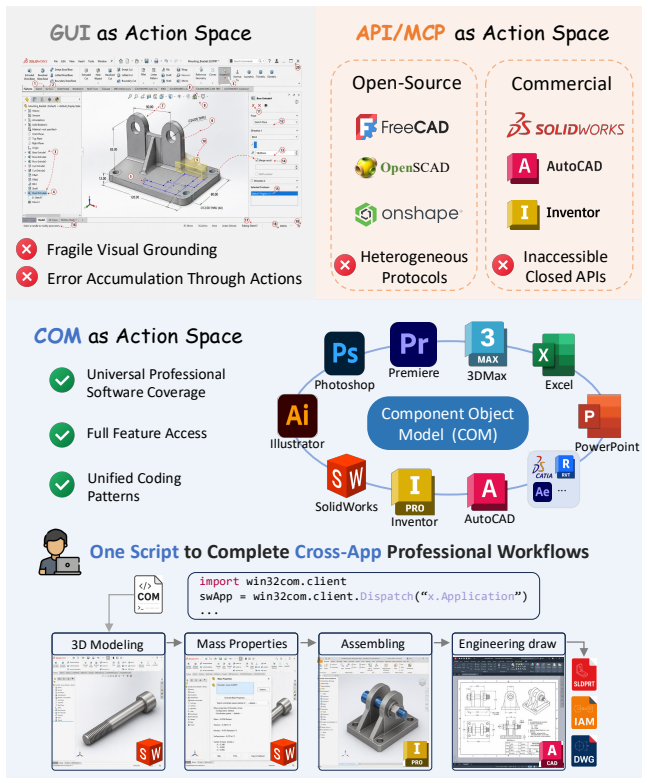
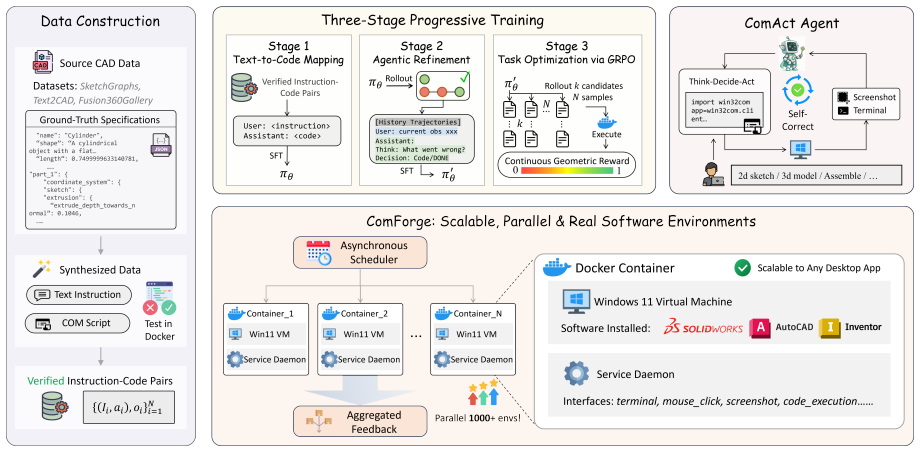
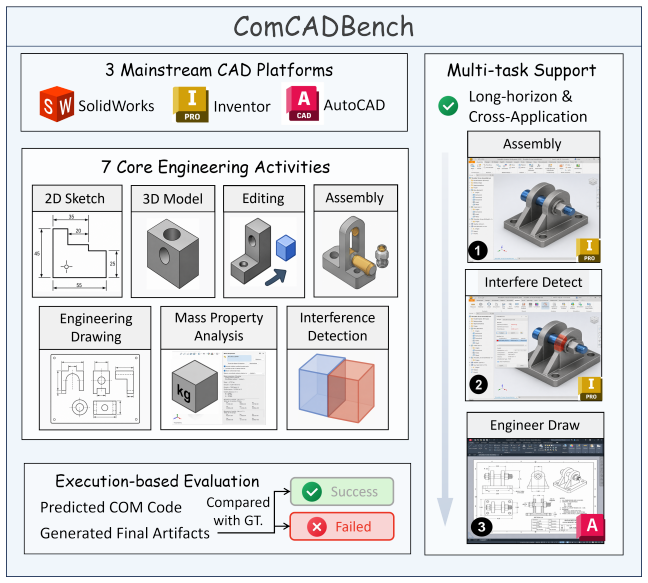
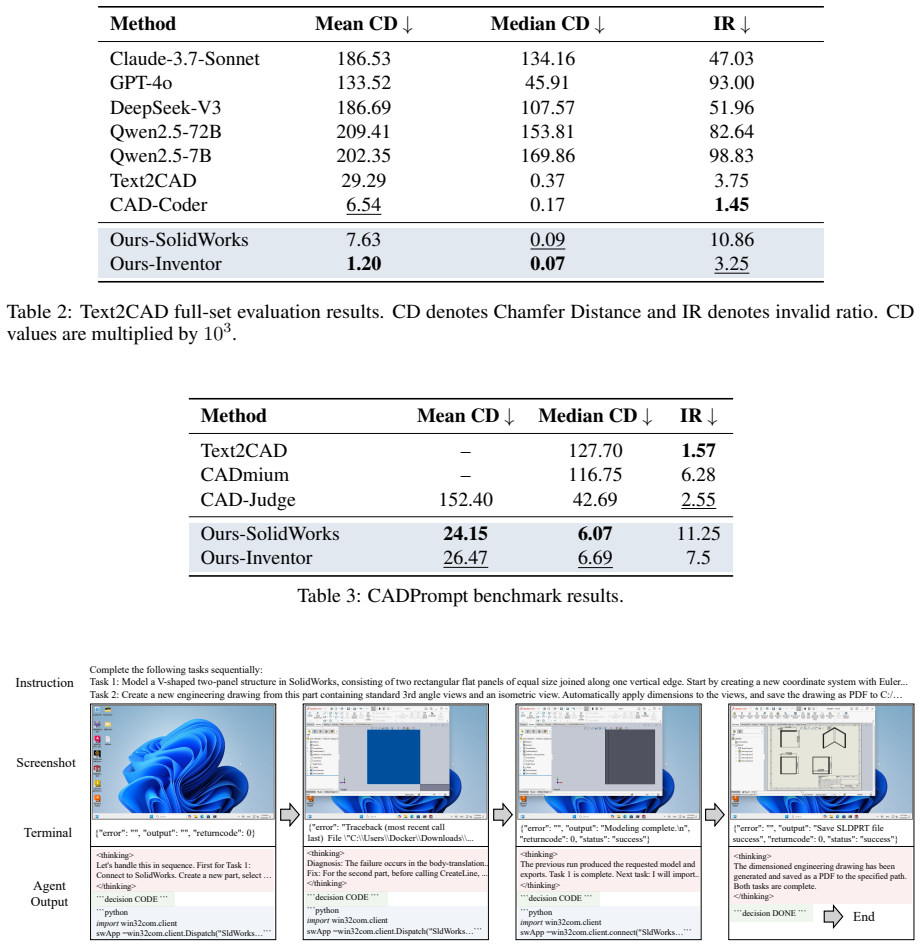
The central claim is that the Component Object Model supplies a unified executable abstraction for professional software, so interaction can be reframed as deterministic program synthesis. Under this COM-as-Action view, the ComActor agent, trained progressively across three stages on ComForge, attains state-of-the-art results on ComCADBench while showing resilience in long-horizon scenarios where GUI baselines fall to near-zero success and also transfers to an external CAD benchmark.
What carries the argument
The COM-as-Action paradigm, which converts professional software manipulation into deterministic program synthesis by issuing Component Object Model calls directly.
If this is right
- Frontier models reach near-zero success with GUI interaction but obtain immediate gains once switched to COM execution.
- ComActor maintains performance across long sequences where baseline agents collapse.
- The trained agent transfers to an external CAD benchmark beyond the training distribution.
- A container platform enables large-scale data collection and training for this style of agent.
Where Pith is reading between the lines
- The same direct-interface approach could be tried on other Windows professional applications that expose COM, such as office or engineering suites.
- Reducing reliance on visual grounding might lower cumulative error rates in any long-running agent workflow that currently uses screen observations.
- Combining COM synthesis with selective API calls could create hybrid agents that handle both open and closed software environments.
Load-bearing premise
The Component Object Model must supply a single, accessible executable interface for real industrial CAD software that supports reliable program synthesis without needing visual interpretation or varied protocols.
What would settle it
Test whether success rates for COM-based agents remain high when applied to a commercial CAD package whose interfaces are not exposed through the Component Object Model.
Figures
read the original abstract
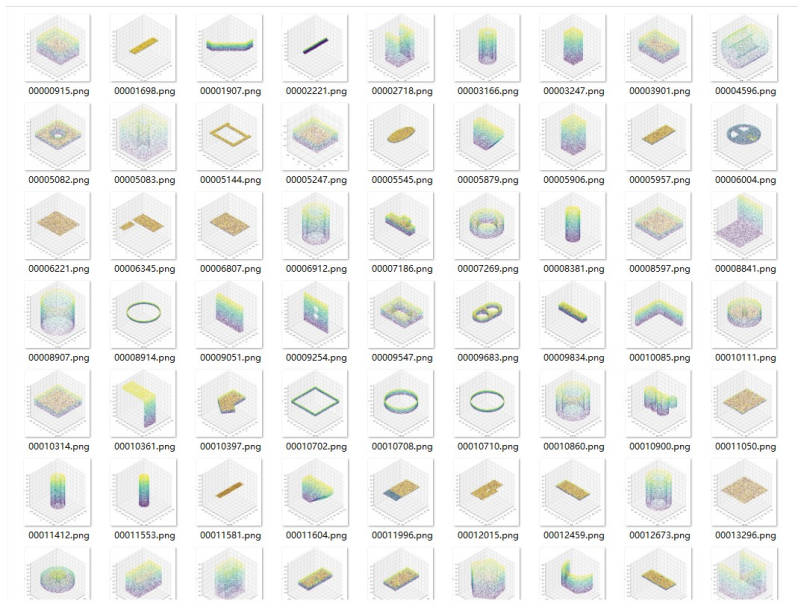
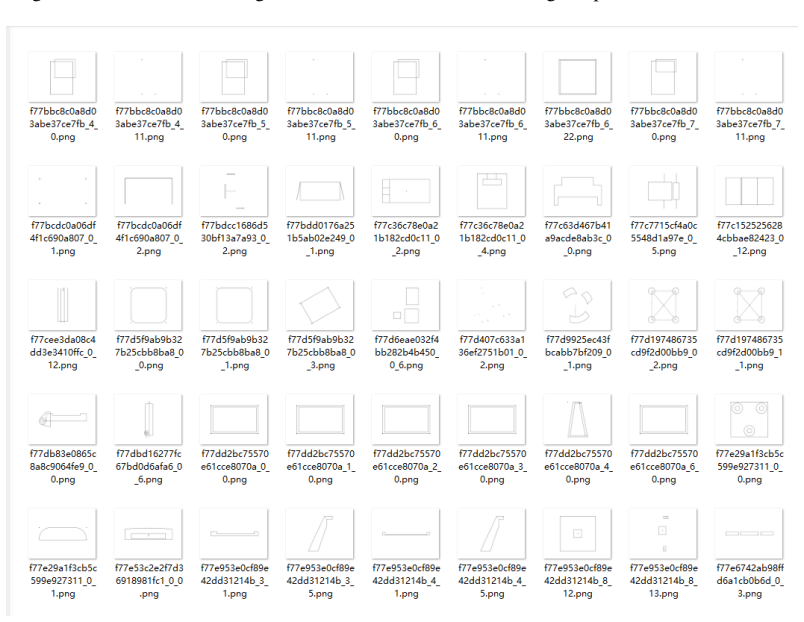
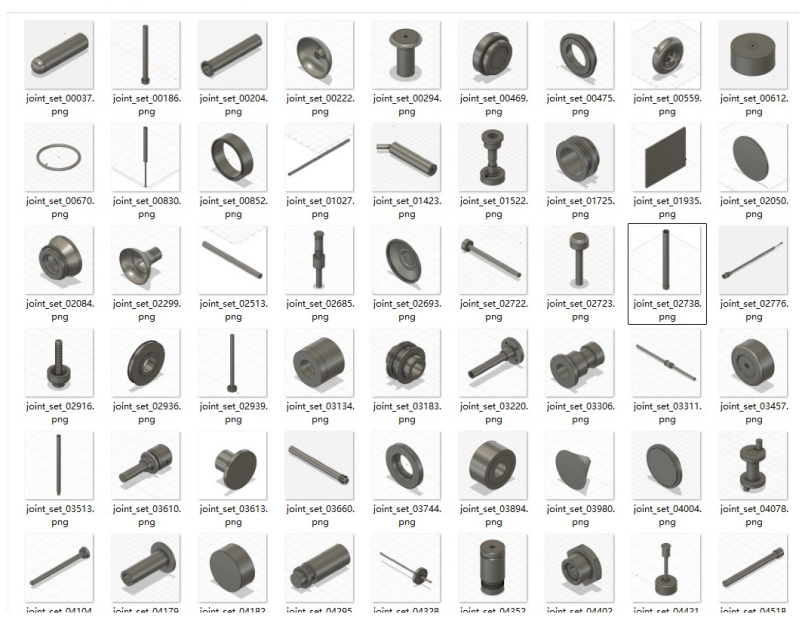
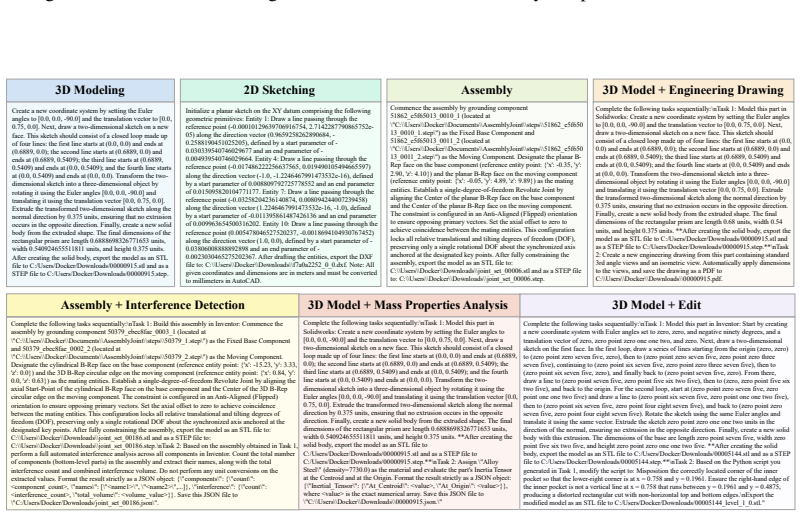
Existing computer-use agents remain fundamentally limited in professional software manipulation: GUI-based agents suffer from fragile visual grounding and long-horizon error accumulation, while API-basedapproaches struggle with heterogeneous protocols and inaccessible commercial interfaces. In this work,we identify the Component Object Model (COM) as a unified executable abstraction, proposing COM-as-Action: a new paradigm that reframes professional software interaction as deterministic program synthesisrather than sequential visual control. To validate this paradigm in the most demanding environments, weintroduce ComCADBench, the first benchmark for agents operating real industrial CAD software. Ourexperiments reveal a substantial paradigm gap: frontier proprietary models achieve near-zero successunder GUI-based interaction, whereas COM-based execution yields substantial immediate gains. Tobridge the remaining gap between syntactic correctness and geometric accuracy, we develop ComActor, aself-correcting agent trained through a progressive three-stage framework, alongside ComForge, a scalableplatform for large-scale training in Windows containers. Extensive experiments show that ComActorachieves state-of-the-art performance on ComCADBench, with strong resilience in long-horizon taskswhere baselines collapse, and generalizes to external CAD benchmark.
Editorial analysis
A structured set of objections, weighed in public.
Referee Report
Summary. The manuscript proposes reframing professional software manipulation (focusing on industrial CAD) as COM-as-Action, treating the Component Object Model as a unified deterministic executable abstraction. It introduces ComCADBench as the first benchmark for agents on real CAD software, claims near-zero GUI success versus substantial COM gains for frontier models, and presents ComActor (a self-correcting agent via three-stage training) plus ComForge (a scalable Windows-container training platform). Experiments reportedly show SOTA performance on ComCADBench with resilience in long-horizon tasks and generalization to an external CAD benchmark.
Significance. If the core accessibility and performance claims hold with reproducible evidence, the work could meaningfully advance reliable agentic control of professional tools by shifting from fragile visual or heterogeneous API methods to programmatic synthesis. The new benchmark and training platform would constitute concrete contributions to the field.
major comments (1)
- [Abstract] Abstract (paragraph 2): The central claim of a 'substantial paradigm gap' (near-zero GUI success vs. substantial COM gains) and the superiority of the COM-as-Action paradigm rests on the unverified assumption that COM supplies a unified, deterministic, and practically accessible executable abstraction for commercial CAD packages. No details are provided on interface discovery, documentation status, or completeness of exposed functionality for the specific CAD software, which is load-bearing; if access relies on undocumented or reverse-engineered entry points, the claimed advantage over API approaches collapses.
minor comments (2)
- [Abstract] Abstract: Typo 'API-basedapproaches' (missing space).
- [Abstract] Abstract: The terms ComActor, ComCADBench, and ComForge are introduced without prior definition or citation to prior work, which may confuse readers unfamiliar with the contributions.
Simulated Author's Rebuttal
We thank the referee for their detailed and constructive feedback, which helps strengthen the clarity and rigor of our claims regarding the COM-as-Action paradigm. We address the single major comment point-by-point below.
read point-by-point responses
-
Referee: [Abstract] Abstract (paragraph 2): The central claim of a 'substantial paradigm gap' (near-zero GUI success vs. substantial COM gains) and the superiority of the COM-as-Action paradigm rests on the unverified assumption that COM supplies a unified, deterministic, and practically accessible executable abstraction for commercial CAD packages. No details are provided on interface discovery, documentation status, or completeness of exposed functionality for the specific CAD software, which is load-bearing; if access relies on undocumented or reverse-engineered entry points, the claimed advantage over API approaches collapses.
Authors: We agree that additional transparency on COM interface access is warranted to support the paradigm claims. In the revised manuscript we will add a dedicated subsection (likely in Section 3 or 4) detailing: (1) the specific CAD packages used in ComCADBench and their official COM exposure via vendor-published type libraries; (2) the standard discovery mechanism using COM's ITypeLib/ITypeInfo interfaces and registry-based ProgID lookup, which does not rely on reverse engineering; (3) references to publicly available vendor documentation (e.g., SolidWorks and AutoCAD API references) confirming that the core geometric and modeling operations exercised by the benchmark are part of the documented, stable COM surface; and (4) a brief completeness analysis showing that the benchmark tasks map to documented methods rather than undocumented internals. This clarification will be reflected in an updated abstract paragraph as well. These additions directly address the load-bearing assumption without altering the experimental results. revision: yes
Circularity Check
No circularity: paradigm proposal and benchmark results are independent of inputs
full rationale
The paper presents a conceptual reframing (COM-as-Action) and an empirical benchmark (ComCADBench) with agent experiments. No equations, fitted parameters, predictions derived from prior fits, or self-citation chains appear in the provided text. The core assumption that COM supplies a unified executable interface is stated as an identification rather than derived from any prior result or self-referential construction. Experimental claims (near-zero GUI success vs. COM gains) rest on reported benchmark outcomes, which are falsifiable externally and do not reduce to the assumption by definition. This is a standard non-circular empirical paper.
Axiom & Free-Parameter Ledger
invented entities (3)
-
ComActor
no independent evidence
-
ComCADBench
no independent evidence
-
ComForge
no independent evidence
Reference graph
Works this paper leans on
-
[1]
Developing a computer use model
Anthropic. Developing a computer use model. https://www.anthropic.com/news/ developing-computer-use, October 2024. Accessed: 2025-03-25
2024
-
[2]
Computer-using agent
OpenAI. Computer-using agent. https://openai.com/index/computer-using-agent/, January 2025. Accessed: 2025-03-25
2025
-
[3]
Toolllm: Facilitating large language models to master 16000+ real-world apis
Yujia Qin, Shihao Liang, Yining Ye, Kunlun Zhu, Lan Yan, Yaxi Lu, Yankai Lin, Xin Cong, Xiangru Tang, Bill Qian, et al. Toolllm: Facilitating large language models to master 16000+ real-world apis. InInternational Conference on Learning Representations, volume 2024, pages 9695–9717, 2024
2024
-
[4]
Screenspot-pro: Gui grounding for professional high-resolution computer use
Kaixin Li, Ziyang Meng, Hongzhan Lin, Ziyang Luo, Yuchen Tian, Jing Ma, Zhiyong Huang, and Tat-Seng Chua. Screenspot-pro: Gui grounding for professional high-resolution computer use. InProceedings of the 33rd ACM International Conference on Multimedia, pages 8778–8786, 2025
2025
-
[5]
Aaditya Singh, Adam Fry, Adam Perelman, Adam Tart, Adi Ganesh, Ahmed El-Kishky, Aidan McLaughlin, Aiden Low, AJ Ostrow, Akhila Ananthram, et al. Openai gpt-5 system card.arXiv preprint arXiv:2601.03267, 2025
work page internal anchor Pith review Pith/arXiv arXiv 2025
-
[6]
Swe-bench: Can language models resolve real-world github issues? InInternational Conference on Learning Representations, volume 2024, pages 54107–54157, 2024
Carlos E Jimenez, John Yang, Alexander Wettig, Shunyu Yao, Kexin Pei, Ofir Press, and Karthik Narasimhan. Swe-bench: Can language models resolve real-world github issues? InInternational Conference on Learning Representations, volume 2024, pages 54107–54157, 2024
2024
-
[7]
Livecodebench: Holistic and contamination free evaluation of large language models for code
Naman Jain, Alex Gu, Wen-Ding Li, Fanjia Yan, Tianjun Zhang, Sida Wang, Armando Solar-Lezama, Koushik Sen, and Ion Stoica. Livecodebench: Holistic and contamination free evaluation of large language models for code. InInternational Conference on Learning Representations, volume 2025, pages 58791–58831, 2025
2025
-
[8]
Component Object Model (COM)
Microsoft. Component Object Model (COM). https://learn.microsoft.com/en-us/windows/win32/ com/component-object-model--com--portal, 2024. Accessed: 2025-05-26
2024
-
[9]
Osworld: Benchmarking multimodal agents for open-ended tasks in real computer environments.Advances in Neural Information Processing Systems, 37:52040–52094, 2024
Tianbao Xie, Danyang Zhang, Jixuan Chen, Xiaochuan Li, Siheng Zhao, Ruisheng Cao, Toh J Hua, Zhoujun Cheng, Dongchan Shin, Fangyu Lei, et al. Osworld: Benchmarking multimodal agents for open-ended tasks in real computer environments.Advances in Neural Information Processing Systems, 37:52040–52094, 2024
2024
-
[10]
Seeclick: Harnessing gui grounding for advanced visual gui agents
Kanzhi Cheng, Qiushi Sun, Yougang Chu, Fangzhi Xu, Li YanTao, Jianbing Zhang, and Zhiyong Wu. Seeclick: Harnessing gui grounding for advanced visual gui agents. InProceedings of the 62nd Annual Meeting of the Association for Computational Linguistics (Volume 1: Long Papers), pages 9313–9332, 2024
2024
-
[11]
arXiv preprint arXiv:2410.08164 (2024)
Saaket Agashe, Jiuzhou Han, Shuyu Gan, Jiachen Yang, Ang Li, and Xin Eric Wang. Agent s: An open agentic framework that uses computers like a human.arXiv preprint arXiv:2410.08164, 2024
-
[12]
UI-TARS: Pioneering Automated GUI Interaction with Native Agents
Yujia Qin, Yining Ye, Junjie Fang, Haoming Wang, Shihao Liang, Shizuo Tian, Junda Zhang, Jiahao Li, Yunxin Li, Shijue Huang, et al. Ui-tars: Pioneering automated gui interaction with native agents.arXiv preprint arXiv:2501.12326, 2025
work page internal anchor Pith review Pith/arXiv arXiv 2025
-
[13]
Ufo3: Weaving the digital agent galaxy.arXiv preprint arXiv:2511.11332, 2025
Chaoyun Zhang, Liqun Li, He Huang, Chiming Ni, Bo Qiao, Si Qin, Yu Kang, Minghua Ma, Qingwei Lin, Saravan Rajmohan, et al. Ufo3: Weaving the digital agent galaxy.arXiv preprint arXiv:2511.11332, 2025
-
[14]
Cogagent: A visual language model for gui agents
Wenyi Hong, Weihan Wang, Qingsong Lv, Jiazheng Xu, Wenmeng Yu, Junhui Ji, Yan Wang, Zihan Wang, Yuxiao Dong, Ming Ding, et al. Cogagent: A visual language model for gui agents. InProceedings of the IEEE/CVF conference on computer vision and pattern recognition, pages 14281–14290, 2024
2024
-
[15]
Appagent: Multimodal agents as smartphone users
Chi Zhang, Zhao Yang, Jiaxuan Liu, Yanda Li, Yucheng Han, Xin Chen, Zebiao Huang, Bin Fu, and Gang Yu. Appagent: Multimodal agents as smartphone users. InProceedings of the 2025 CHI Conference on Human Factors in Computing Systems, pages 1–20, 2025
2025
-
[16]
Aria-ui: Visual grounding for gui instructions
Yuhao Yang, Yue Wang, Dongxu Li, Ziyang Luo, Bei Chen, Chao Huang, and Junnan Li. Aria-ui: Visual grounding for gui instructions. InFindings of the Association for Computational Linguistics: ACL 2025, pages 22418–22433, 2025
2025
-
[17]
GPT-4V(ision) is a Generalist Web Agent, if Grounded
Boyuan Zheng, Boyu Gou, Jihyung Kil, Huan Sun, and Yu Su. Gpt-4v (ision) is a generalist web agent, if grounded.arXiv preprint arXiv:2401.01614, 2024
work page internal anchor Pith review Pith/arXiv arXiv 2024
-
[18]
Large Language Model-Brained GUI Agents: A Survey
Chaoyun Zhang, Shilin He, Jiaxu Qian, Bowen Li, Liqun Li, Si Qin, Yu Kang, Minghua Ma, Guyue Liu, Qingwei Lin, et al. Large language model-brained gui agents: A survey.arXiv preprint arXiv:2411.18279, 2024. 10
work page internal anchor Pith review Pith/arXiv arXiv 2024
-
[19]
Os agents: A survey on mllm-based agents for computer, phone and browser use
Xueyu Hu, Tao Xiong, Biao Yi, Zishu Wei, Ruixuan Xiao, Yurun Chen, Jiasheng Ye, Meiling Tao, Xiangxin Zhou, Ziyu Zhao, et al. Os agents: A survey on mllm-based agents for computer, phone and browser use. In Proceedings of the 63rd Annual Meeting of the Association for Computational Linguistics (Volume 1: Long Papers), pages 7436–7465, 2025
2025
-
[20]
Beyond browsing: Api-based web agents
Yueqi Song, Frank F Xu, Shuyan Zhou, and Graham Neubig. Beyond browsing: Api-based web agents. In Findings of the Association for Computational Linguistics: ACL 2025, pages 11066–11085, 2025
2025
-
[21]
Autowebglm: A large language model-based web navigating agent
Hanyu Lai, Xiao Liu, Iat Long Iong, Shuntian Yao, Yuxuan Chen, Pengbo Shen, Hao Yu, Hanchen Zhang, Xiaohan Zhang, Yuxiao Dong, et al. Autowebglm: A large language model-based web navigating agent. InProceedings of the 30th ACM SIGKDD Conference on Knowledge Discovery and Data Mining, pages 5295–5306, 2024
2024
-
[22]
Os-copilot: Towards generalist computer agents with self-improvement, 2024.URL https://arxiv
Zhiyong Wu, Chengcheng Han, Zichen Ding, Zhenmin Weng, Zhoumianze Liu, Shunyu Yao, Tao Yu, and Lingpeng Kong. Os-copilot: Towards generalist computer agents with self-improvement, 2024.URL https://arxiv. org/abs/2402.07456
-
[23]
Executable code actions elicit better llm agents
Xingyao Wang, Yangyi Chen, Lifan Yuan, Yizhe Zhang, Yunzhu Li, Hao Peng, and Heng Ji. Executable code actions elicit better llm agents. InForty-first International Conference on Machine Learning, 2024
2024
-
[24]
Coact-1: Computer-using agents with coding as actions.arXiv preprint arXiv:2508.03923, 2025
Linxin Song, Yutong Dai, Viraj Prabhu, Jieyu Zhang, Taiwei Shi, Li Li, Junnan Li, Silvio Savarese, Zeyuan Chen, Jieyu Zhao, et al. Coact-1: Computer-using agents with coding as actions.arXiv preprint arXiv:2508.03923, 2025
-
[25]
Ari Seff, Yaniv Ovadia, Wenda Zhou, and Ryan P Adams. Sketchgraphs: A large-scale dataset for modeling relational geometry in computer-aided design.arXiv preprint arXiv:2007.08506, 2020
-
[26]
Fusion 360 gallery: A dataset and environment for programmatic cad construction from human design sequences.ACM Transactions on Graphics (TOG), 40(4):1–24, 2021
Karl DD Willis, Yewen Pu, Jieliang Luo, Hang Chu, Tao Du, Joseph G Lambourne, Armando Solar-Lezama, and Wojciech Matusik. Fusion 360 gallery: A dataset and environment for programmatic cad construction from human design sequences.ACM Transactions on Graphics (TOG), 40(4):1–24, 2021
2021
-
[27]
Transcad: A hierarchical transformer for cad sequence inference from point clouds
Elona Dupont, Kseniya Cherenkova, Dimitrios Mallis, Gleb Gusev, Anis Kacem, and Djamila Aouada. Transcad: A hierarchical transformer for cad sequence inference from point clouds. InEuropean Conference on Computer Vision, pages 19–36. Springer, 2024
2024
-
[28]
Cad-llama: leveraging large language models for computer-aided design parametric 3d model generation
Jiahao Li, Weijian Ma, Xueyang Li, Yunzhong Lou, Guichun Zhou, and Xiangdong Zhou. Cad-llama: leveraging large language models for computer-aided design parametric 3d model generation. InProceedings of the IEEE/CVF Conference on Computer Vision and Pattern Recognition, pages 18563–18573, 2025
2025
-
[29]
Flexcad: Unified and versatile controllable cad generation with fine-tuned large language models
Zhanwei Zhang, Shizhao Sun, Wenxiao Wang, Deng Cai, and Jiang Bian. Flexcad: Unified and versatile controllable cad generation with fine-tuned large language models. InInternational Conference on Learning Representations, volume 2025, pages 3204–3227, 2025
2025
-
[30]
Deepcad: A deep generative network for computer-aided design models
Rundi Wu, Chang Xiao, and Changxi Zheng. Deepcad: A deep generative network for computer-aided design models. InProceedings of the IEEE/CVF international conference on computer vision, pages 6772–6782, 2021
2021
-
[31]
Text2cad: Generating sequential cad designs from beginner-to-expert level text prompts.Advances in Neural Information Processing Systems, 37:7552–7579, 2024
Mohammad S Khan, Sankalp Sinha, Talha U Sheikh, Didier Stricker, Sk A Ali, and Muhammad Z Afzal. Text2cad: Generating sequential cad designs from beginner-to-expert level text prompts.Advances in Neural Information Processing Systems, 37:7552–7579, 2024
2024
-
[32]
Cad-coder: Text-to-cad generation with chain-of-thought and geometric reward.Advances in Neural Information Processing Systems, 38:59765–59789, 2026
Yandong Guan, Xilin Wang, Ximing Xing, Jing Zhang, Dong Xu, and Qian Yu. Cad-coder: Text-to-cad generation with chain-of-thought and geometric reward.Advances in Neural Information Processing Systems, 38:59765–59789, 2026
2026
-
[33]
Cad-recode: Reverse engineering cad code from point clouds
Danila Rukhovich, Elona Dupont, Dimitrios Mallis, Kseniya Cherenkova, Anis Kacem, and Djamila Aouada. Cad-recode: Reverse engineering cad code from point clouds. InProceedings of the IEEE/CVF International Conference on Computer Vision, pages 9801–9811, 2025
2025
-
[34]
DeepSeekMath: Pushing the Limits of Mathematical Reasoning in Open Language Models
Zhihong Shao, Peiyi Wang, Qihao Zhu, Runxin Xu, Junxiao Song, Xiao Bi, Haowei Zhang, Mingchuan Zhang, YK Li, Yang Wu, et al. Deepseekmath: Pushing the limits of mathematical reasoning in open language models. arXiv preprint arXiv:2402.03300, 2024
work page internal anchor Pith review Pith/arXiv arXiv 2024
-
[35]
Prashant Govindarajan, Davide Baldelli, Jay Pathak, Quentin Fournier, and Sarath Chandar. Cadmium: Fine-tuning code language models for text-driven sequential cad design.arXiv preprint arXiv:2507.09792, 2025. 11
-
[36]
Qwen Team. Qwen3.5. https://qwenlm.github.io/blog/qwen3.5/, February 2026. Accessed: 2026- 05-26
2026
-
[37]
Claude Sonnet 4.6 system card
Anthropic. Claude Sonnet 4.6 system card. Technical report, Anthropic, February 2026
2026
-
[38]
GLM-4.5: Agentic, Reasoning, and Coding (ARC) Foundation Models
Aohan Zeng, Xin Lv, Qinkai Zheng, Zhenyu Hou, Bin Chen, Chengxing Xie, Cunxiang Wang, Da Yin, Hao Zeng, Jiajie Zhang, et al. Glm-4.5: Agentic, reasoning, and coding (arc) foundation models.arXiv preprint arXiv:2508.06471, 2025
work page internal anchor Pith review Pith/arXiv arXiv 2025
-
[39]
Cad-judge: Toward efficient morphological grading and verification for text-to-cad generation
Zheyuan Zhou, Jiayi Han, Liang Du, Naiyu Fang, Lemiao Qiu, and Shuyou Zhang. Cad-judge: Toward efficient morphological grading and verification for text-to-cad generation. InICASSP 2026-2026 IEEE International Conference on Acoustics, Speech and Signal Processing (ICASSP), pages 1021–1025. IEEE, 2026
2026
-
[40]
Gpt-4o system card
OpenAI. Gpt-4o system card. https://cdn.openai.com/gpt-4o-system-card.pdf , 2024. Accessed: 2024-09-26. 12 Appendix Contents A Data Construction 13 A.1 Source Data and Textualization . . . . . . . . . . . . . . . . . . . . . . . . . . . . 13 A.2 Ground Truth COM Script Synthesis . . . . . . . . . . . . . . . . . . . . . . . . . 13 A.3 Downstream Multi-Tas...
2024
-
[41]
SFT, we apply Low-Rank Adaptation (LoRA) to all linear layers with a rank of r= 8 and α= 32 . The models are trained using the AdamW optimizer with a learning rate of 1e-5, a cosine learning rate scheduler, and a warmup ratio of 0.05. To accommodate the extensive context required for code generation and error tracebacks, the maximum sequence length is set...
-
[42]
Brief reasoning inside<thinking>...</thinking>
-
[43]
A high-level decision wrapped as:“‘decision CODE (or DONE/FAIL) “‘
-
[44]
‘ RAG Prompt (Appended to Baseline) External Knowledge Context: Here are some COM APIs that might be useful for completing this task. [ {
If and only if the decision is CODE, output a single“‘python ... “‘block. Few-Shot Prompt (Appended to Baseline) Example: 3D Modeling in Solidworks Task Instruction:Model this part in Solidworks: To construct the first part of the cylinder...[Detailed dimensions and constraints omitted for brevity]...export the model as an STL and STEP file. Output: <thin...
discussion (0)
Sign in with ORCID, Apple, or X to comment. Anyone can read and Pith papers without signing in.