Accurate Galaxy Cluster Shear and Mass Calibration for LSST with AnaCal
Pith reviewed 2026-06-26 13:56 UTC · model grok-4.3
The pith
AnaCal recovers input shear with minimal bias at |g|~0.15, producing 0.24% mean cluster mass bias under LSST-like conditions.
A machine-rendered reading of the paper's core claim, the machinery that carries it, and where it could break.
Core claim
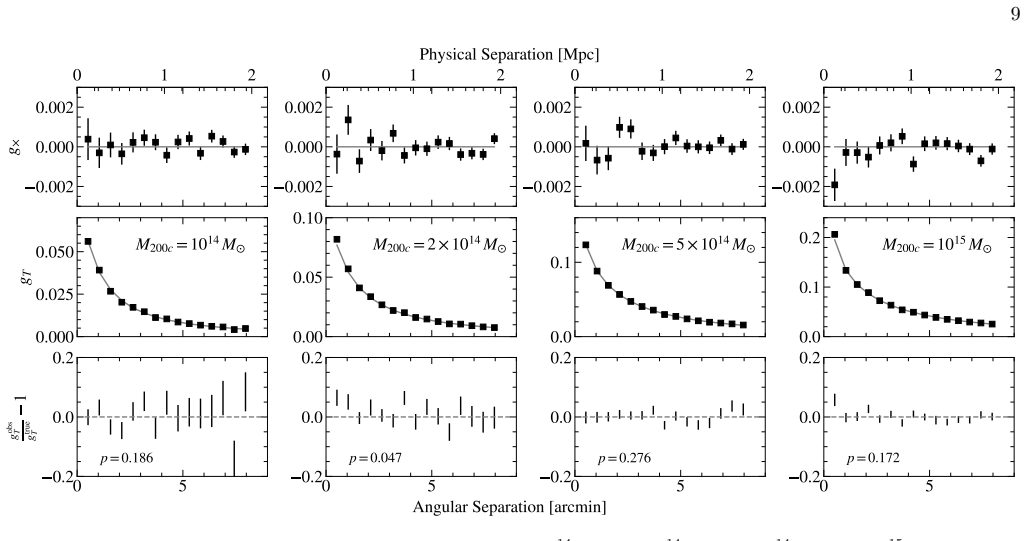
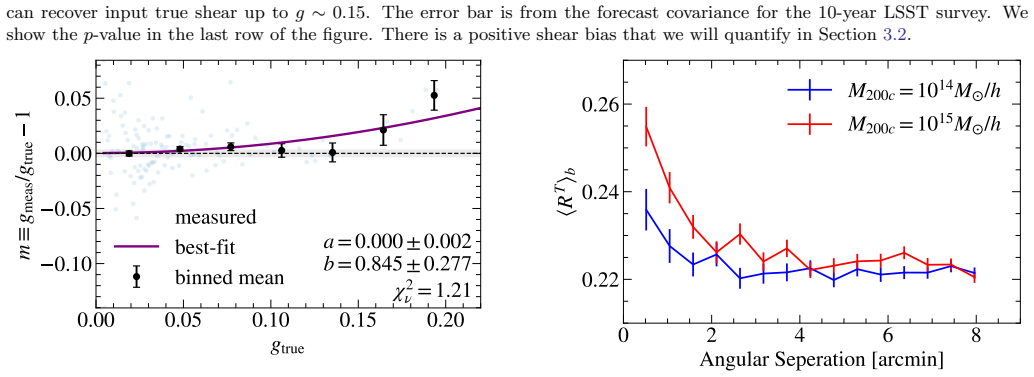
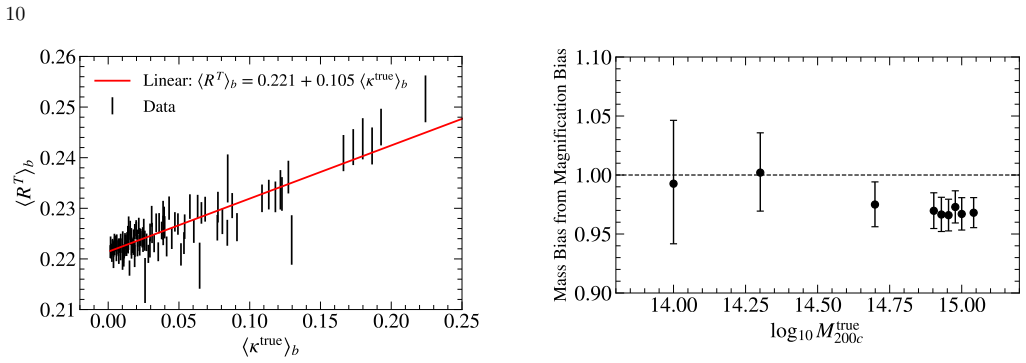
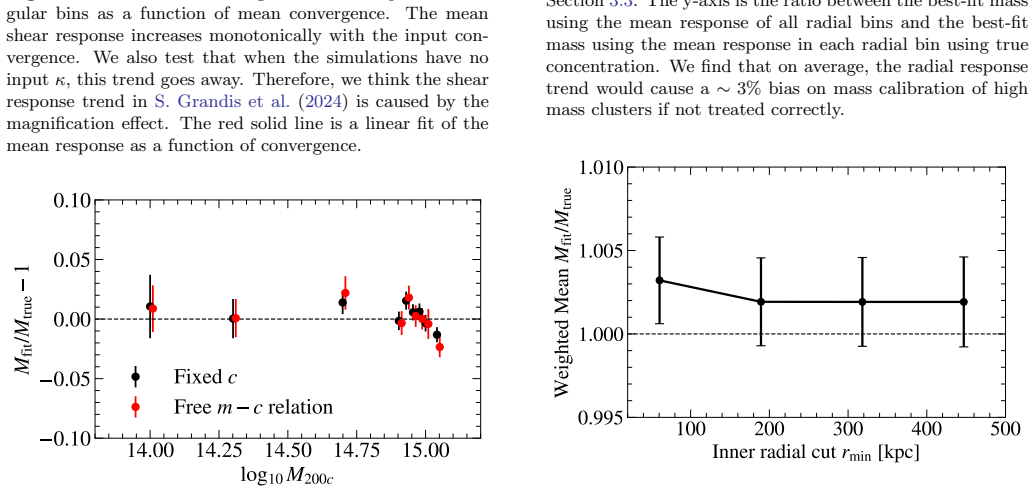
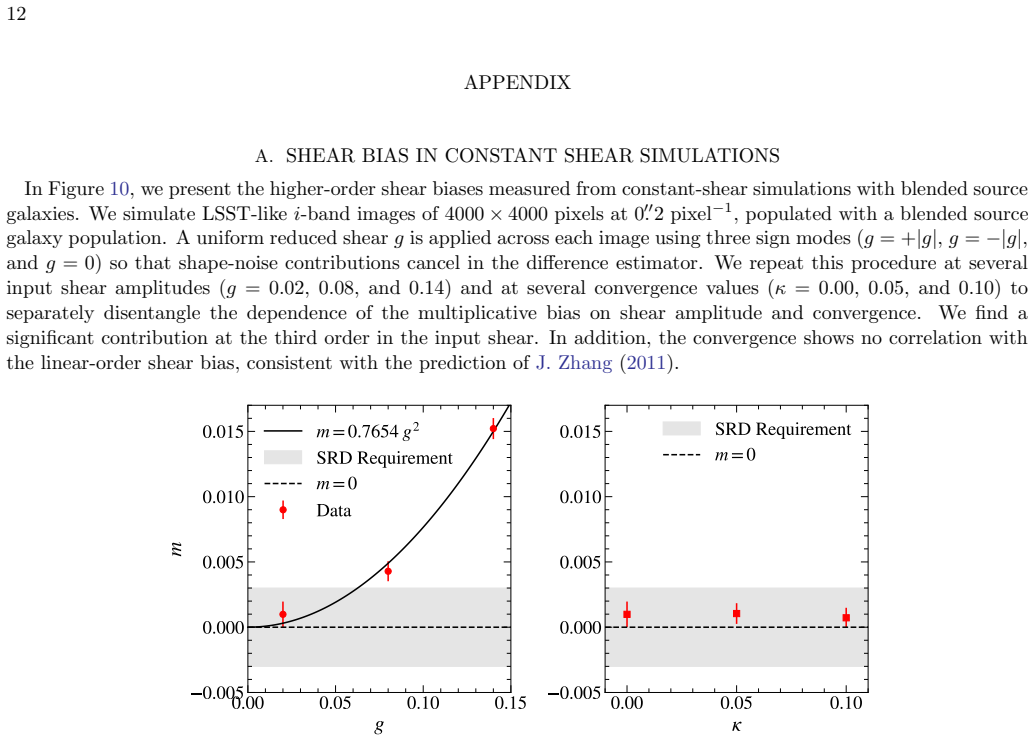
AnaCal recovers the input shear with minimal bias even at mildly high shear |g|~0.15. A radially decreasing mean shear response driven by the radial dependence of the convergence field is discovered; if unmodeled this can bias shear inference. A positive shear-estimation bias at third order in the reduced shear near the cluster center is also found. However, because only a small fraction of galaxies lie in the high-shear regime and those measurements are further downweighted by the covariance matrix, the resulting mean cluster-mass bias for cluster lens masses in [10^14 M_⊙, 10^15 M_⊙] adopting a scale cut of ~0.2 Mpc at z=0.25 is 0.24±0.26% under ideal settings.
What carries the argument
AnaCal shear estimator applied to simulated galaxy images to extract reduced shear signals around clusters.
If this is right
- AnaCal can calibrate cluster masses with sub-percent bias for the tested mass range and scale cut.
- Radial dependence of the shear response must be modeled to avoid systematic error in shear inference.
- Third-order bias terms remain subdominant after covariance weighting in the overall mass estimate.
- The estimator supports cluster weak lensing as a tool for LSST cosmology without large high-shear corrections.
Where Pith is reading between the lines
- If the simulation-to-data match holds, AnaCal could tighten cosmological constraints from cluster number counts.
- Tests with added real-data effects such as blending or variable depth would check whether the reported bias stays this low.
- The same simulation framework could benchmark other shear estimators in the high-shear cluster regime.
Load-bearing premise
The image simulations accurately capture the noise, point-spread function, and galaxy properties of real ten-year LSST observations.
What would settle it
Comparison of AnaCal-derived cluster masses from actual LSST observations against independent mass estimates from X-ray temperature or Sunyaev-Zel'dovich measurements.
Figures
read the original abstract
The observed abundance of galaxy clusters as a function of mass and redshift provides a powerful route to precision cosmology; a key challenge for cluster cosmology is to establish the relation between cluster observables and cluster masses, for which cluster weak gravitational lensing has become the standard tool. A key challenge for cluster lensing is that the shear signal near cluster centers can reach the non-linear regime, where many shear estimators rely on perturbative assumptions that must be explicitly validated. In this work, we use image simulations to test the performance of the shear estimator AnaCal for cluster weak lensing under conditions representative of the 10-year LSST data. We find that AnaCal recovers the input shear with minimal bias even at mildly high shear, $|g|\sim 0.15$. We discover a radially decreasing mean shear response as seen previously in data, driven by the radial dependence of the convergence field; if unmodeled, this effect can bias shear inference. We also find a positive shear-estimation bias at third order in the reduced shear near the cluster center. However, because only a small fraction of galaxies lie in the high-shear regime and those measurements are further downweighted by the covariance matrix, the resulting mean cluster-mass bias for cluster lens masses in $[10^{14} M_\odot, 10^{15} M_\odot]$ -- adopting a scale cut of $\sim 0.2$ Mpc at $z=0.25$ -- is $0.24 \pm 0.26\%$ under ideal settings. These results demonstrate that AnaCal is a robust tool for accurate cluster mass calibration in the LSST era.
Editorial analysis
A structured set of objections, weighed in public.
Referee Report
Summary. The manuscript tests the AnaCal shear estimator on image simulations under conditions stated to be representative of 10-year LSST data. It reports that AnaCal recovers input shear with minimal bias at |g|∼0.15, identifies a radially decreasing mean shear response driven by the convergence field and a positive third-order bias in reduced shear near cluster centers, but concludes that these effects produce only a 0.24±0.26% mean cluster-mass bias for lens masses in [10^14 M_⊙, 10^15 M_⊙] with a ∼0.2 Mpc scale cut at z=0.25 under ideal settings, because high-shear galaxies are few and down-weighted by the covariance matrix.
Significance. If the reported bias levels are preserved under full LSST observing conditions, the work would provide a valuable validation of AnaCal for cluster weak-lensing mass calibration, directly addressing the non-linear shear regime that challenges perturbative estimators. The strength of the approach lies in the direct comparison of recovered shear to known input values in controlled simulations, which supplies a clear, falsifiable test of the estimator's performance.
major comments (2)
- [Abstract] Abstract: the headline mass-bias result (0.24±0.26%) is obtained after modeling the radially decreasing shear response and third-order reduced-shear term, with mitigation attributed to the small fraction of high-shear galaxies and covariance down-weighting; however, both the radial-response modeling and the covariance construction are demonstrated only inside the 'ideal settings' simulations, and no quantitative test is reported of how the bias changes when additional LSST effects (variable focal-plane seeing, chromatic PSF, color gradients, or density-correlated selection) are injected. This is load-bearing for the claim that AnaCal is ready for LSST cluster cosmology.
- [Abstract] Abstract: the simulations are described both as 'representative of the 10-year LSST data' and as 'ideal settings'; the manuscript does not supply a table or section that quantifies the difference between these two descriptions or shows the bias sensitivity to omitted effects, leaving the translation from simulation to real data untested at the precision of the quoted 0.26% uncertainty.
minor comments (1)
- [Abstract] The abstract would benefit from an explicit one-sentence definition of what 'ideal settings' excludes (e.g., no mention of chromatic effects or variable PSF).
Simulated Author's Rebuttal
We thank the referee for their careful and constructive review. The comments correctly identify the scope limitations of our ideal-settings simulations. We respond point-by-point below and revise the manuscript to remove any ambiguity about the applicability of the quoted bias to full LSST conditions.
read point-by-point responses
-
Referee: [Abstract] Abstract: the headline mass-bias result (0.24±0.26%) is obtained after modeling the radially decreasing shear response and third-order reduced-shear term, with mitigation attributed to the small fraction of high-shear galaxies and covariance down-weighting; however, both the radial-response modeling and the covariance construction are demonstrated only inside the 'ideal settings' simulations, and no quantitative test is reported of how the bias changes when additional LSST effects (variable focal-plane seeing, chromatic PSF, color gradients, or density-correlated selection) are injected. This is load-bearing for the claim that AnaCal is ready for LSST cluster cosmology.
Authors: We agree that the simulations are performed exclusively under ideal settings and that no quantitative tests of the listed additional LSST effects are provided. The manuscript already qualifies all numerical results with the phrase 'under ideal settings,' but the abstract conclusion could be read as implying broader readiness. We will revise the abstract to state explicitly that the 0.24±0.26% bias applies only under the ideal conditions tested and that validation under complete LSST observing conditions remains future work. We will also add a paragraph in the discussion section summarizing how each omitted effect could in principle affect the result, drawing on existing literature. This revision directly addresses the load-bearing concern by narrowing the claim. revision: partial
-
Referee: [Abstract] Abstract: the simulations are described both as 'representative of the 10-year LSST data' and as 'ideal settings'; the manuscript does not supply a table or section that quantifies the difference between these two descriptions or shows the bias sensitivity to omitted effects, leaving the translation from simulation to real data untested at the precision of the quoted 0.26% uncertainty.
Authors: We accept that the dual terminology creates ambiguity. The simulations match LSST in galaxy density, redshift distribution, and noise level but are ideal with respect to PSF uniformity and selection. We will insert a new subsection (tentatively 3.4) that defines the ideal-settings approximations, lists the omitted effects, and provides a qualitative assessment of their expected influence on the shear response and mass bias. While a quantitative sensitivity study is not feasible with the current simulation suite, the added section will make the translation limitations explicit and prevent over-interpretation of the 0.26% uncertainty. revision: yes
Circularity Check
No significant circularity; results are direct simulation comparisons.
full rationale
The paper obtains its headline result (0.24±0.26% mean cluster-mass bias) by applying AnaCal to image simulations that supply known input shear values and then measuring the recovered shear and inferred mass bias directly against those inputs. No equation or procedure defines the target bias in terms of itself, fits a parameter to a subset and renames the output as a prediction, or relies on a load-bearing self-citation whose content reduces to the present claim. The radial response and third-order bias are reported as findings from the same simulations rather than inputs that force the final number by construction. The derivation chain is therefore self-contained against the external simulation benchmarks.
Axiom & Free-Parameter Ledger
axioms (1)
- domain assumption Image simulations accurately model the LSST observational conditions including PSF, noise, and galaxy distributions.
Reference graph
Works this paper leans on
-
[1]
Abbott, T. M. C., Aguena, M., Alarcon, A., et al. 2020, Physical Review D, 102, 023509, doi: 10.1103/PhysRevD.102.023509
-
[2]
Abbott, T. M. C., Aguena, M., Alarcon, A., et al. 2025, Physical Review D, 112, 083535, doi: 10.1103/3dzh-d8f5
-
[3]
2021, Monthly Notices of the Royal Astronomical Society, 508, 6092, doi: 10.1093/mnras/stab2764
Aguena, M., Avestruz, C., Combet, C., et al. 2021, Monthly Notices of the Royal Astronomical Society, 508, 6092, doi: 10.1093/mnras/stab2764
-
[4]
2019, Publications of the Astronomical Society of Japan, 71, 114, doi: 10.1093/pasj/psz103
Aihara, H., AlSayyad, Y., Ando, M., et al. 2019, Publications of the Astronomical Society of Japan, 71, 114, doi: 10.1093/pasj/psz103
-
[5]
Allen, S. W., Evrard, A. E., & Mantz, A. B. 2011, Annual Review of Astronomy and Astrophysics, 49, 409, doi: 10.1146/annurev-astro-081710-102514
-
[6]
Ansarinejad, B., Raghunathan, S., Abbott, T. M. C., et al. 2024, Journal of Cosmology and Astroparticle Physics, 2024, 024, doi: 10.1088/1475-7516/2024/07/024
-
[7]
E., von der Linden, A., Kelly, P
Applegate, D. E., von der Linden, A., Kelly, P. L., et al. 2014, Monthly Notices of the Royal Astronomical Society, 439, 48, doi: 10.1093/mnras/stt2129
-
[8]
Applegate, D. E., Mantz, A., Allen, S. W., et al. 2016, Monthly Notices of the Royal Astronomical Society, 457, 1522, doi: 10.1093/mnras/stw005 Astropy Collaboration, Robitaille, T. P., Tollerud, E. J., et al. 2013, A&A, 558, A33, doi: 10.1051/0004-6361/201322068 Astropy Collaboration, Price-Whelan, A. M., Sip˝ ocz, B. M., et al. 2018, AJ, 156, 123, doi: ...
-
[9]
Bacon, D. J., Goldberg, D. M., Rowe, B. T. P., & Taylor, A. N. 2006, Monthly Notices of the Royal Astronomical Society, 365, 414, doi: 10.1111/j.1365-2966.2005.09624.x
-
[10]
Bardeen, J. M., Bond, J. R., Kaiser, N., & Szalay, A. S. 1986, The Astrophysical Journal, 304, 15, doi: 10.1086/164143
-
[11]
2010, Reviews of Modern Physics, 82, 331, doi: 10.1103/RevModPhys.82.331
Bartelmann, M. 2010, Reviews of Modern Physics, 82, 331, doi: 10.1103/RevModPhys.82.331
-
[12]
2001, Physics Reports, 340, 291, doi: 10.1016/S0370-1573(00)00082-X
Bartelmann, M., & Schneider, P. 2001, Physics Reports, 340, 291, doi: 10.1016/S0370-1573(00)00082-X
-
[13]
Becker, M. R., & Kravtsov, A. V. 2011, The Astrophysical Journal, 740, 25, doi: 10.1088/0004-637X/740/1/25
-
[14]
2019, Monthly Notices of the Royal Astronomical Society, 484, 1598, doi: 10.1093/mnras/stz090
Bellagamba, F., Sereno, M., Roncarelli, M., et al. 2019, Monthly Notices of the Royal Astronomical Society, 484, 1598, doi: 10.1093/mnras/stz090
-
[15]
2018, Physics of the Dark Universe, 22, 189, doi: 10.1016/j.dark.2018.11.002
Birrer, S., & Amara, A. 2018, Physics of the Dark Universe, 22, 189, doi: 10.1016/j.dark.2018.11.002
-
[16]
2021, The Journal of Open Source Software, 6, 3283, doi: 10.21105/joss.03283
Birrer, S., Shajib, A., Gilman, D., et al. 2021, The Journal of Open Source Software, 6, 3283, doi: 10.21105/joss.03283
-
[17]
Bocquet, S., Dietrich, J. P., Schrabback, T., et al. 2019, The Astrophysical Journal, 878, 55, doi: 10.3847/1538-4357/ab1f10
-
[18]
Bocquet, S., Grandis, S., Bleem, L. E., et al. 2024a, Physical Review D, 110, 083510, doi: 10.1103/PhysRevD.110.083510
-
[19]
Bocquet, S., Grandis, S., Bleem, L. E., et al. 2024b, Physical Review D, 110, 083509, doi: 10.1103/PhysRevD.110.083509
-
[20]
2025, Physical Review D, 111, 063533, doi: 10.1103/PhysRevD.111.063533
Bocquet, S., Grandis, S., Krause, E., et al. 2025, Physical Review D, 111, 063533, doi: 10.1103/PhysRevD.111.063533
-
[21]
2020, arXiv e-prints, arXiv:2001.11067, doi: 10.48550/arXiv.2001.11067
Brough, S., Collins, C., Demarco, R., et al. 2020, arXiv e-prints, arXiv:2001.11067, doi: 10.48550/arXiv.2001.11067
-
[22]
1998, The Astrophysical Journal, 509, 494, doi: 10.1086/306542
Cen, R. 1998, The Astrophysical Journal, 509, 494, doi: 10.1086/306542
-
[23]
2013, Monthly Notices of the Royal Astronomical Society, 434, 2121, doi: 10.1093/mnras/stt1156
Chang, C., Jarvis, M., Jain, B., et al. 2013, Monthly Notices of the Royal Astronomical Society, 434, 2121, doi: 10.1093/mnras/stt1156
-
[24]
N., Ghirardini, V., Liu, A., et al
Chiu, I. N., Ghirardini, V., Liu, A., et al. 2022, Astronomy and Astrophysics, 661, A11, doi: 10.1051/0004-6361/202141755
-
[25]
2025, Astronomy and Astrophysics, 704, A110, doi: 10.1051/0004-6361/202554942
Chiu, I.-N., Ghirardini, V., Grandis, S., et al. 2025, Astronomy and Astrophysics, 704, A110, doi: 10.1051/0004-6361/202554942
-
[26]
2020, Astronomy and Astrophysics, 641, A6, doi: 10.1051/0004-6361/201833910
Collaboration, P., Aghanim, N., Akrami, Y., et al. 2020, Astronomy and Astrophysics, 641, A6, doi: 10.1051/0004-6361/201833910
-
[27]
J., Peterson, J., Jernigan, J
Connolly, A. J., Peterson, J., Jernigan, J. G., et al. 2010, in
2010
-
[28]
7738, 77381O, doi: 10.1117/12.857819
Modeling, Systems Engineering, and Project Management for Astronomy IV, Vol. 7738, 77381O, doi: 10.1117/12.857819
-
[29]
Connolly, A. J., Angeli, G. Z., Chandrasekharan, S., et al. 2014, in Modeling, Systems Engineering, and Project Management for Astronomy VI, Vol. 9150, 915014, doi: 10.1117/12.2054953
-
[30]
2021, Physical Review D, 103, 043522, doi: 10.1103/PhysRevD.103.043522
Costanzi, M., Saro, A., Bocquet, S., et al. 2021, Physical Review D, 103, 043522, doi: 10.1103/PhysRevD.103.043522
-
[31]
2018, The Astrophysical Journal Supplement Series, 239, 35, doi: 10.3847/1538-4365/aaee8c
Diemer, B. 2018, The Astrophysical Journal Supplement Series, 239, 35, doi: 10.3847/1538-4365/aaee8c
-
[32]
Englert, A. M., Dell’Antonio, I., & Montes, M. 2025, The Astrophysical Journal Letters, 989, L2, doi: 10.3847/2041-8213/ade8f1
-
[33]
Fan, X., Bahcall, N. A., & Cen, R. 1997, The Astrophysical Journal, 490, L123, doi: 10.1086/311031
-
[34]
Foreman-Mackey, D., Hogg, D. W., Lang, D., & Goodman, J. 2013, Publications of the Astronomical Society of the Pacific, 125, 306, doi: 10.1086/670067
-
[35]
2024, The Astrophysical Journal, 974, 69, doi: 10.3847/1538-4357/ad67c6
Fu, S., Dell’Antonio, I., Escalante, Z., et al. 2024, The Astrophysical Journal, 974, 69, doi: 10.3847/1538-4357/ad67c6
-
[36]
Geach, J. E., & Peacock, J. A. 2017, Nature Astronomy, 1, 795, doi: 10.1038/s41550-017-0259-1
-
[37]
2024, The SRG/eROSITA All-Sky Survey: Cosmology Constraints from Cluster Abundances in the Western Galactic
Ghirardini, V., Bulbul, E., Artis, E., et al. 2024, The SRG/eROSITA All-Sky Survey: Cosmology Constraints from Cluster Abundances in the Western Galactic
2024
-
[38]
Gonzalez, A. H., Zabludoff, A. I., & Zaritsky, D. 2005, The Astrophysical Journal, 618, 195, doi: 10.1086/425896
-
[39]
Communications in Applied Mathematics and Computational Science, Vol
Goodman, J., & Weare, J. 2010, Communications in Applied Mathematics and Computational Science, 5, 65, doi: 10.2140/camcos.2010.5.65
-
[40]
Grandis, S., Ghirardini, V., Bocquet, S., et al. 2024, The SRG/eROSITA All-Sky Survey: Dark Energy Survey Year 3 Weak Gravitational Lensing by eRASS1 Selected Galaxy Clusters, doi: 10.48550/arXiv.2402.08455
-
[41]
Harris, C. R., Millman, K. J., van der Walt, S. J., et al. 2020, Nature, 585, 357, doi: 10.1038/s41586-020-2649-2
-
[42]
Hawken, A. J., & Bridle, S. L. 2009, Monthly Notices of the Royal Astronomical Society, 400, 1132, doi: 10.1111/j.1365-2966.2009.15539.x
-
[43]
2013, Space Science Reviews, 177, 75, doi: 10.1007/s11214-013-9978-5 14
Hoekstra, H., Bartelmann, M., Dahle, H., et al. 2013, Space Science Reviews, 177, 75, doi: 10.1007/s11214-013-9978-5 14
-
[44]
Huang, S., Leauthaud, A., Greene, J. E., et al. 2018, Monthly Notices of the Royal Astronomical Society, 475, 3348, doi: 10.1093/mnras/stx3200
-
[45]
Metacalibration: Direct Self-Calibration of Biases in Shear Measurement
Huff, E., & Mandelbaum, R. 2017, Metacalibration: Direct Self-Calibration of Biases in Shear Measurement, arXiv, doi: 10.48550/arXiv.1702.02600
work page internal anchor Pith review Pith/arXiv arXiv doi:10.48550/arxiv.1702.02600 2017
-
[46]
Hunter, J. D. 2007, Computing in Science & Engineering, 9, 90, doi: 10.1109/MCSE.2007.55
-
[47]
Ishiyama, T., Prada, F., Klypin, A. A., et al. 2021, Monthly Notices of the Royal Astronomical Society, 506, 4210, doi: 10.1093/mnras/stab1755 Ivezi´ c,ˇZ., Kahn, S. M., Tyson, J. A., et al. 2019, The Astrophysical Journal, 873, 111, doi: 10.3847/1538-4357/ab042c
-
[48]
Johnston, D. E., Sheldon, E. S., Wechsler, R. H., et al. 2007, Cross-Correlation Weak Lensing of SDSS Galaxy Clusters II: Cluster Density Profiles and the Mass–Richness Relation, arXiv, doi: 10.48550/arXiv.0709.1159
work page internal anchor Pith review Pith/arXiv arXiv doi:10.48550/arxiv.0709.1159 2007
-
[49]
2025, Astronomy and Astrophysics, 695, A216, doi: 10.1051/0004-6361/202449599
Kleinebreil, F., Grandis, S., Schrabback, T., et al. 2025, Astronomy and Astrophysics, 695, A216, doi: 10.1051/0004-6361/202449599
-
[50]
Kluge, M., Bender, R., Riffeser, A., et al. 2021, The Astrophysical Journal Supplement Series, 252, 27, doi: 10.3847/1538-4365/abcda6
-
[51]
Kravtsov, A., & Borgani, S. 2012, Annual Review of Astronomy and Astrophysics, 50, 353, doi: 10.1146/annurev-astro-081811-125502
-
[52]
2010, The Astrophysical Journal, 709, 97, doi: 10.1088/0004-637X/709/1/97
Leauthaud, A., Finoguenov, A., Kneib, J.-P., et al. 2010, The Astrophysical Journal, 709, 97, doi: 10.1088/0004-637X/709/1/97
-
[53]
2022, Monthly Notices of the Royal Astronomical Society, 515, 5335, doi: 10.1093/mnras/stac2121
Li, J., Huang, S., Leauthaud, A., et al. 2022, Monthly Notices of the Royal Astronomical Society, 515, 5335, doi: 10.1093/mnras/stac2121
-
[54]
2025, Astronomy and Astrophysics, 700, A202, doi: 10.1051/0004-6361/202452892
Li, S.-S., Hoekstra, H., Kuijken, K., Schaller, M., & Schaye, J. 2025, Astronomy and Astrophysics, 700, A202, doi: 10.1051/0004-6361/202452892
-
[55]
Li, X. 2025, Analytical Weak-Lensing Shear Response of Galaxy Model Fitting, arXiv, doi: 10.48550/arXiv.2506.16607
-
[56]
2018, Monthly Notices of the Royal Astronomical Society, 481, 4445, doi: 10.1093/mnras/sty2548
Li, X., Katayama, N., Oguri, M., & More, S. 2018, Monthly Notices of the Royal Astronomical Society, 481, 4445, doi: 10.1093/mnras/sty2548
-
[57]
2022, Monthly Notices of the Royal Astronomical Society, 511, 4850, doi: 10.1093/mnras/stac342
Li, X., Li, Y., & Massey, R. 2022, Monthly Notices of the Royal Astronomical Society, 511, 4850, doi: 10.1093/mnras/stac342
-
[58]
2023, Monthly Notices of the Royal Astronomical Society, 521, 4904, doi: 10.1093/mnras/stad890
Li, X., & Mandelbaum, R. 2023, Monthly Notices of the Royal Astronomical Society, 521, 4904, doi: 10.1093/mnras/stad890
-
[59]
2024a, Monthly Notices of the Royal Astronomical Society, 527, 10388, doi: 10.1093/mnras/stad3895
Li, X., Mandelbaum, R., Jarvis, M., et al. 2024a, Monthly Notices of the Royal Astronomical Society, 527, 10388, doi: 10.1093/mnras/stad3895
-
[60]
Li, X., Mandelbaum, R., & The LSST Dark Energy Science Collaboration. 2024b, Analytical Weak Lensing Shear Inference for Precision Cosmology, doi: 10.48550/arXiv.2408.06337
-
[61]
2025, Monthly Notices of the Royal Astronomical Society, 536, 3663, doi: 10.1093/mnras/stae2764
Li, X., Mandelbaum, R., & The LSST Dark Energy Science Collaboration. 2025, Monthly Notices of the Royal Astronomical Society, 536, 3663, doi: 10.1093/mnras/stae2764
-
[62]
Liu, B., Dell’Antonio, I., Chotard, N., & Clowe, D. 2024, Frontiers in Astronomy and Space Sciences, 11, 1411810, doi: 10.3389/fspas.2024.1411810 LSST Dark Energy Science Collaboration (LSST DESC),
-
[63]
2021, The Astrophysical Journal Supplement Series, 253, 31, doi: 10.3847/1538-4365/abd62c
Abolfathi, B., Alonso, D., et al. 2021, The Astrophysical Journal Supplement Series, 253, 31, doi: 10.3847/1538-4365/abd62c
-
[64]
MacCrann, N., Becker, M. R., McCullough, J., et al. 2021, Monthly Notices of the Royal Astronomical Society, 509, 3371, doi: 10.1093/mnras/stab2870
-
[65]
Weak Lensing for Precision Cosmology , volume=
Mandelbaum, R. 2018, Annual Review of Astronomy and Astrophysics, 56, 393, doi: 10.1146/annurev-astro-081817-051928
-
[66]
Mandelbaum, R., Seljak, U., Baldauf, T., & Smith, R. E. 2010, Monthly Notices of the Royal Astronomical Society, 405, 2078, doi: 10.1111/j.1365-2966.2010.16619.x
-
[67]
Mantz, A., Allen, S. W., Rapetti, D., & Ebeling, H. 2010, Monthly Notices of the Royal Astronomical Society, 406, 1759, doi: 10.1111/j.1365-2966.2010.16992.x
-
[68]
B., von der Linden, A., Allen, S
Mantz, A. B., von der Linden, A., Allen, S. W., et al. 2015, Monthly Notices of the Royal Astronomical Society, 446, 2205, doi: 10.1093/mnras/stu2096
-
[69]
Mantz, A. B., Allen, S. W., Morris, R. G., et al. 2016, Monthly Notices of the Royal Astronomical Society, 463, 3582, doi: 10.1093/mnras/stw2250
-
[70]
Massey, R., & Refregier, A. 2005, Monthly Notices of the Royal Astronomical Society, 363, 197, doi: 10.1111/j.1365-2966.2005.09453.x
-
[71]
McClintock, T., Varga, T. N., Gruen, D., et al. 2019, Monthly Notices of the Royal Astronomical Society, 482, 1352, doi: 10.1093/mnras/sty2711
-
[72]
2017, Monthly Notices of the Royal Astronomical Society, 469, 4899, doi: 10.1093/mnras/stx1053
Melchior, P., Gruen, D., McClintock, T., et al. 2017, Monthly Notices of the Royal Astronomical Society, 469, 4899, doi: 10.1093/mnras/stx1053
-
[73]
2019, The Astrophysical Journal, 875, 63, doi: 10.3847/1538-4357/ab0af0
Miyatake, H., Battaglia, N., Hilton, M., et al. 2019, The Astrophysical Journal, 875, 63, doi: 10.3847/1538-4357/ab0af0
-
[74]
Montes, M. 2022, Nature Astronomy, 6, 308, doi: 10.1038/s41550-022-01616-z 15
-
[75]
2018, The Astrophysical Journal, 854, 120, doi: 10.3847/1538-4357/aaaab8
Murata, R., Nishimichi, T., Takada, M., et al. 2018, The Astrophysical Journal, 854, 120, doi: 10.3847/1538-4357/aaaab8
-
[76]
Navarro, J. F., Frenk, C. S., & White, S. D. M. 1997, The Astrophysical Journal, 490, 493, doi: 10.1086/304888
-
[77]
2011, Physical Review D, 83, 023008, doi: 10.1103/PhysRevD.83.023008
Oguri, M., & Takada, M. 2011, Physical Review D, 83, 023008, doi: 10.1103/PhysRevD.83.023008
-
[78]
Okabe, N., & Smith, G. P. 2016, Monthly Notices of the Royal Astronomical Society, 461, 3794, doi: 10.1093/mnras/stw1539
-
[79]
2026, Monthly Notices of the Royal Astronomical Society, 546, stag062, doi: 10.1093/mnras/stag062
Park, A., Li, X., Mandelbaum, R., & Becker, M. 2026, Monthly Notices of the Royal Astronomical Society, 546, stag062, doi: 10.1093/mnras/stag062
-
[80]
2023, Monthly Notices of the Royal Astronomical Society, 518, 5171, doi: 10.1093/mnras/stac3410
Park, Y., Sunayama, T., Takada, M., et al. 2023, Monthly Notices of the Royal Astronomical Society, 518, 5171, doi: 10.1093/mnras/stac3410
discussion (0)
Sign in with ORCID, Apple, or X to comment. Anyone can read and Pith papers without signing in.