Energy Extraction via Magnetic Reconnection from a Rotating Dyonic Black Hole in N = 2, \ U(1)² Gauged Supergravity
Pith reviewed 2026-06-26 07:07 UTC · model grok-4.3
The pith
Energy extraction via magnetic reconnection from dyonic black holes is suppressed by large gauge coupling and near-extremal charges, with efficiency peaking at intermediate spin.
A machine-rendered reading of the paper's core claim, the machinery that carries it, and where it could break.
Core claim
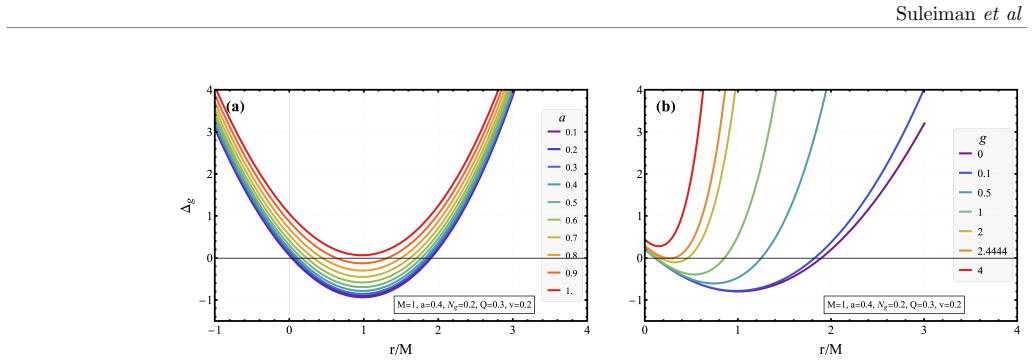
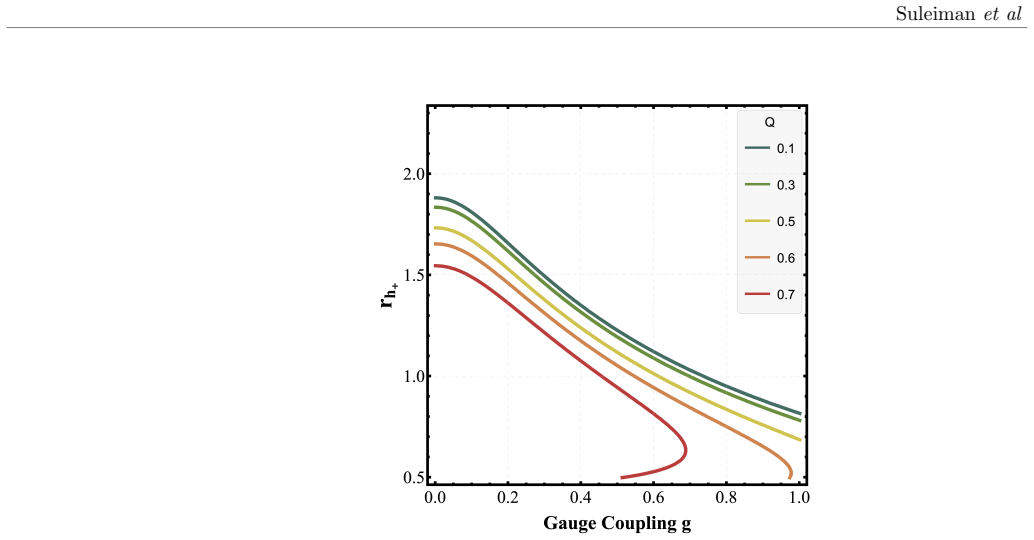
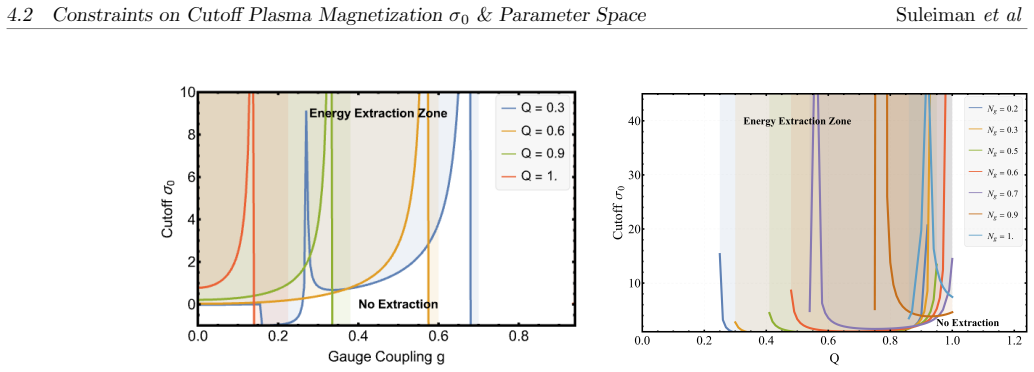
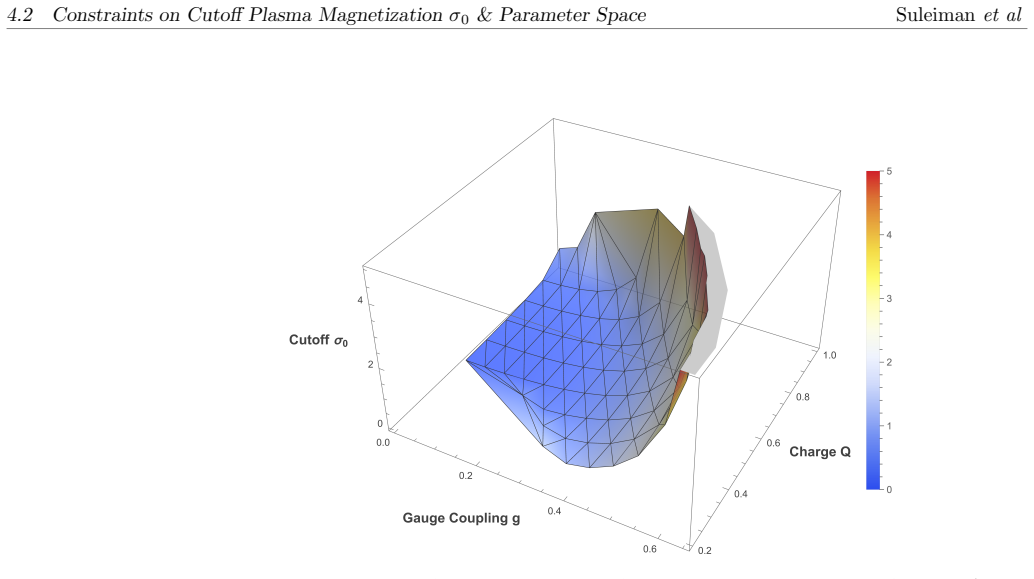
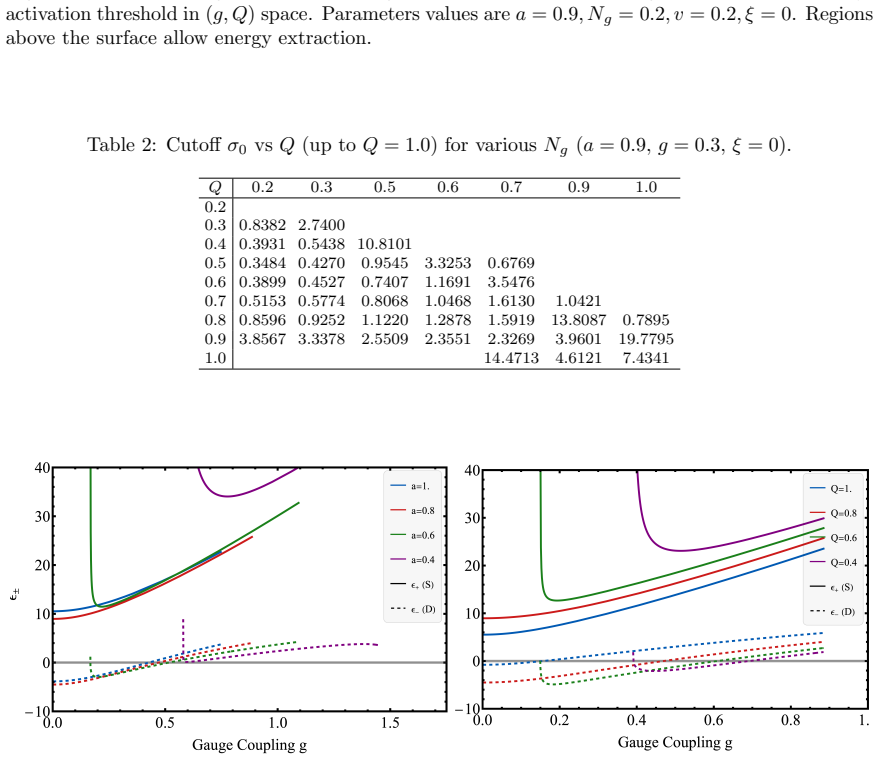
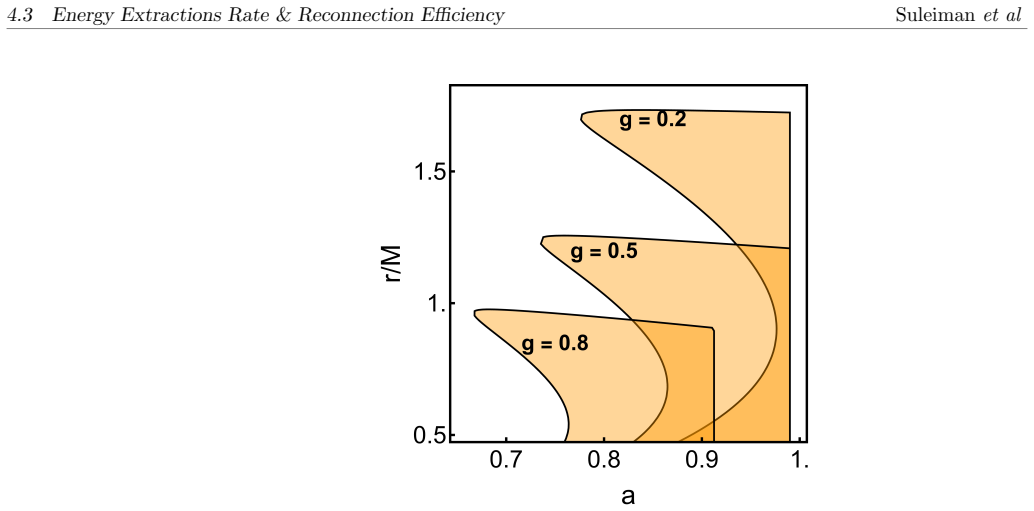
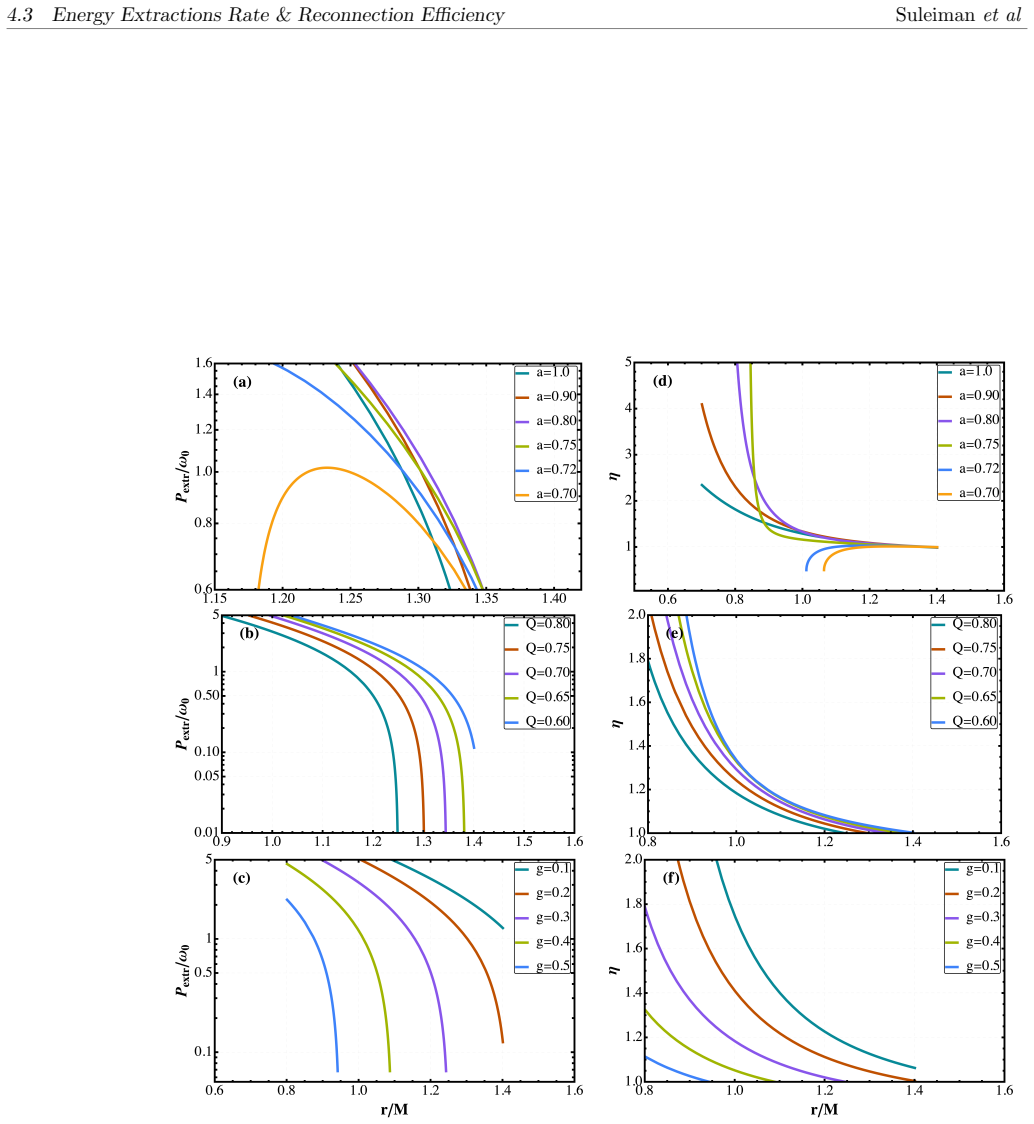
For the rotating dyonic metric in N=2, U(1)^2 gauged supergravity, the condition ε^∞_- < 0 for reconnection outflows is satisfied only above a magnetization cutoff σ0^cutoff that rises with g and with the approach to extremality of the electric and magnetic charges. The spin parameter a enters through Ξ and Δ_g rather than through the usual ergosphere enhancement, making geometric deformations the dominant control. Extracted power and efficiency are therefore non-monotonic in a, reaching maxima near a ≈ 0.8, and require extreme magnetization together with nearly radial outflows confined to a thin shell just outside the horizon.
What carries the argument
The Comisso-Asenjo mechanism for hydrodynamic energy per unit enthalpy evaluated in the ZAMO frame on the dyonic metric whose horizon function is the quartic Δ_g and whose time coordinate is normalized by Ξ.
If this is right
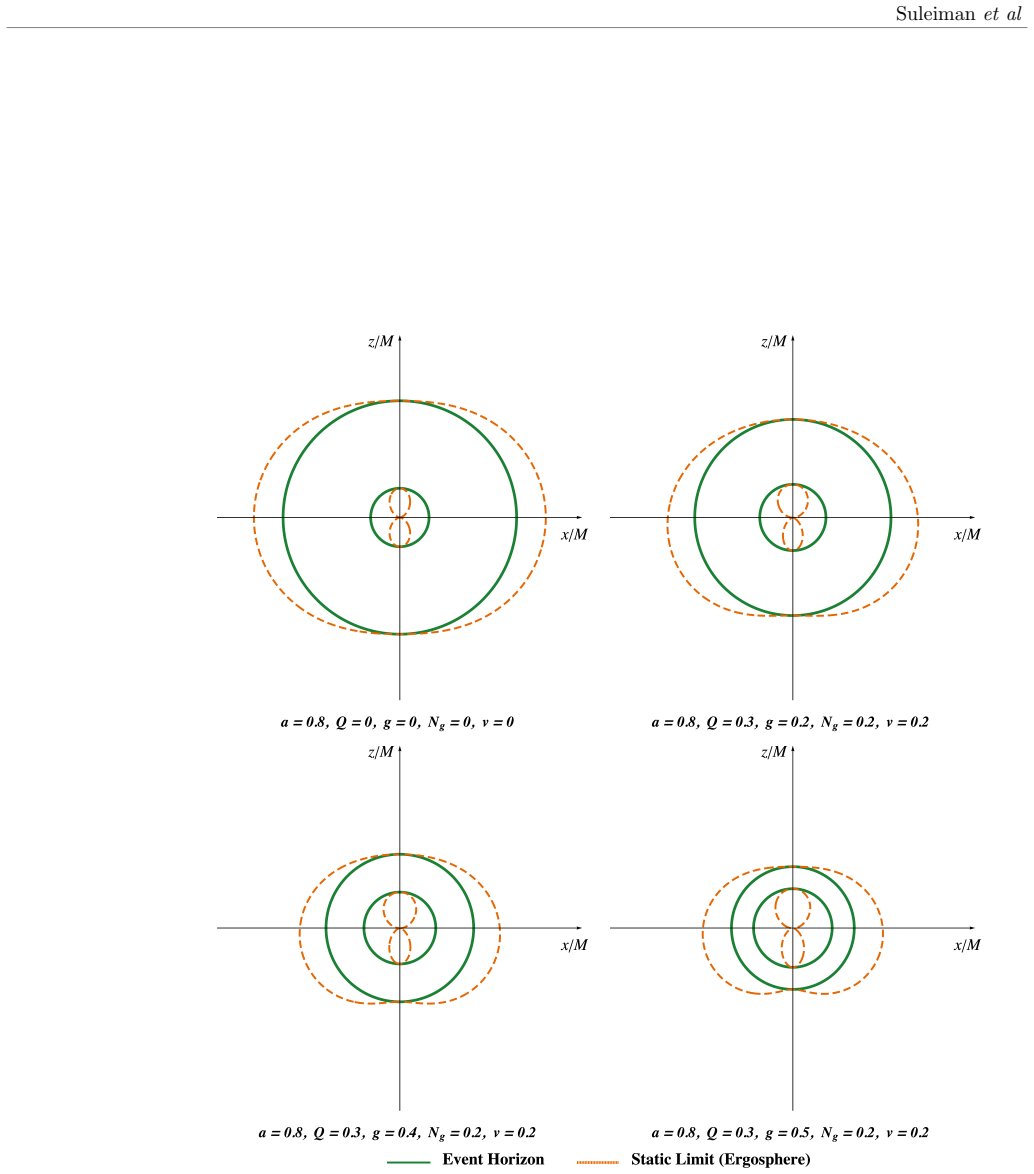
- The active ergoregion for Comisso-Asenjo extraction shrinks when g is increased or the dyonic charges are driven toward extremality.
- Extracted power and efficiency are non-monotonic in spin a and attain their highest values at intermediate rotation rather than near extremality.
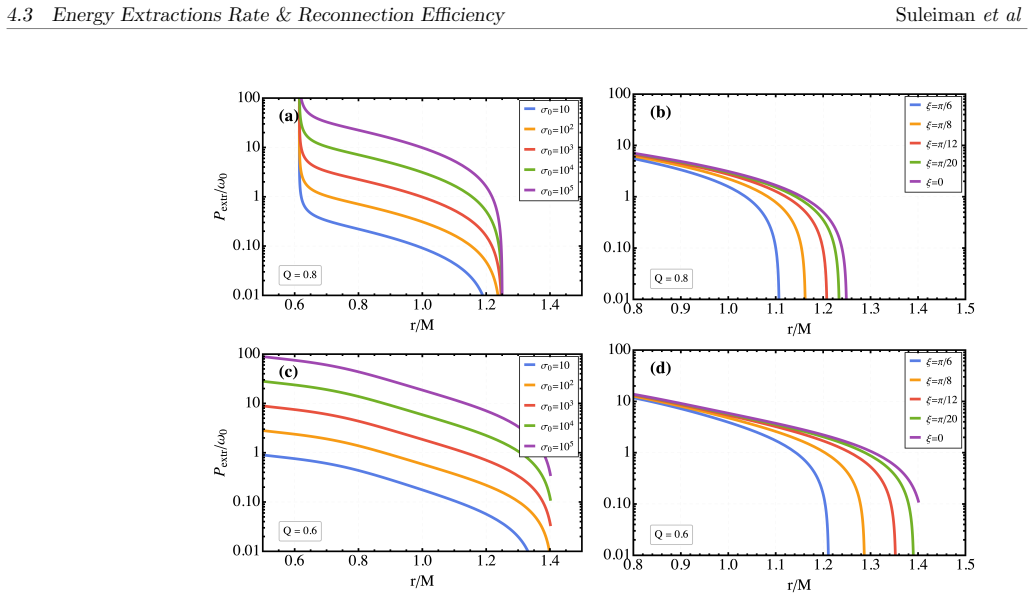
- Efficient extraction requires extreme magnetization and nearly radial outflows restricted to a thin shell outside the horizon.
- Geometric factors from the AdS and NUT sectors dominate the usual frame-dragging contribution to the energy budget.
Where Pith is reading between the lines
- If the mechanism survives in more general supergravity solutions, then bounds on observed extraction efficiency could indirectly constrain the effective gauge coupling.
- The same non-monotonic dependence on spin may appear in other asymptotically AdS black-hole families once their horizon functions are inserted into the same ZAMO expressions.
- Numerical magnetohydrodynamic simulations that vary g and the charges independently could map the precise boundary of the σ0^cutoff surface.
Load-bearing premise
The Comisso-Asenjo energy-per-unit-enthalpy formulas derived in the ZAMO frame remain valid without adjustment when inserted into the specific rotating dyonic metric of N=2, U(1)^2 gauged supergravity.
What would settle it
An explicit calculation of the reconnection outflow four-velocity showing that ε^∞_- stays positive for every value of g and every dyonic charge in this metric would falsify the reported existence of a controllable extraction window.
Figures
read the original abstract
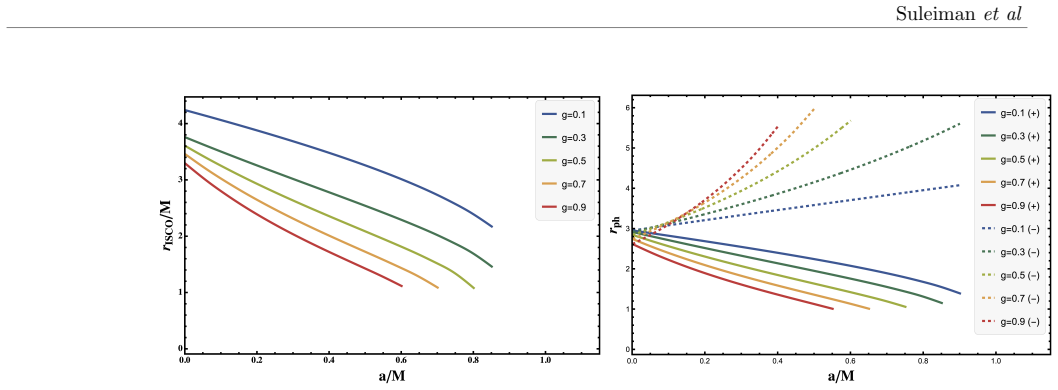
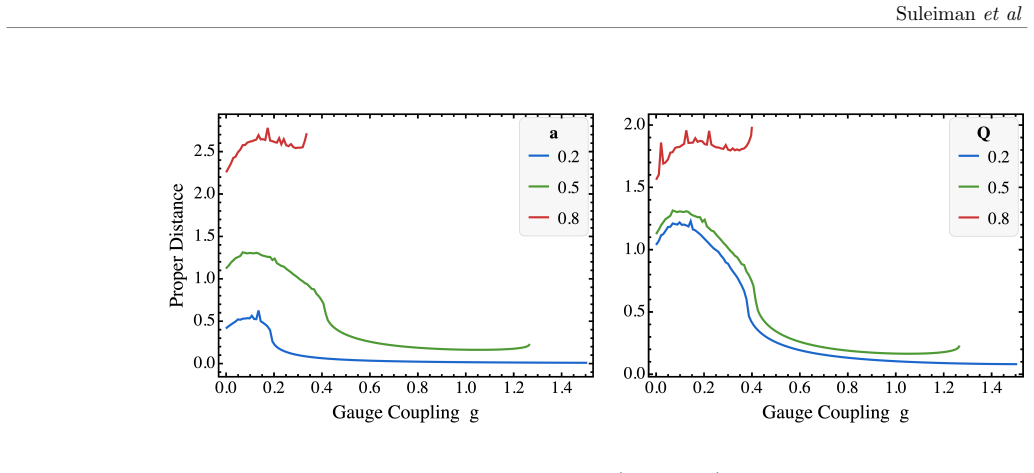
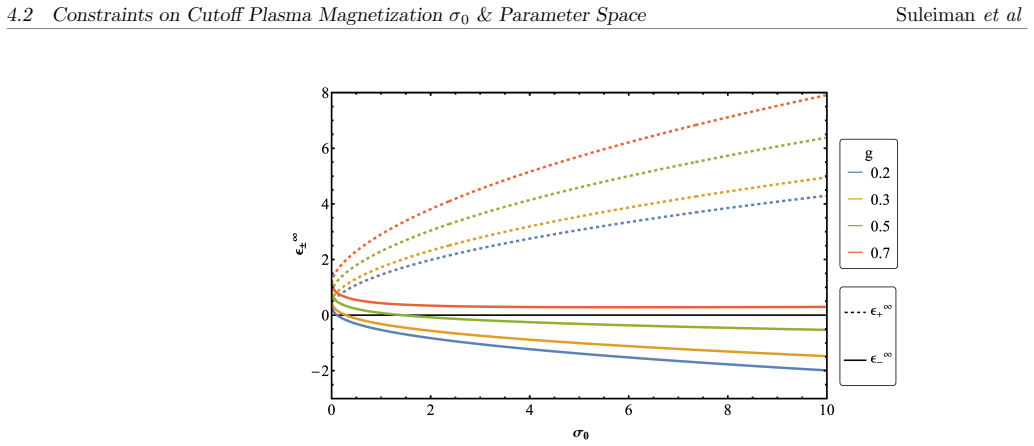
We study energy extraction via magnetic reconnection from a rotating dyonic black hole in four-dimensional $N=2$, $U(1)^2$ gauged supergravity. Using the Comisso-Asenjo mechanism in the ZAMO frame, we derive the asymptotic hydrodynamic energy per unit enthalpy $\epsilon^{\infty}_\pm$ and determine when reconnection outflows attained negative energy at infinity. By varying the spin $a$, electric and magnetic charges, NUT parameter $N_g$, and gauge coupling $g$, we compute the cutoff magnetization $\sigma_0^{\rm cutoff}$ and map the region of parameter space that admits $\epsilon^{\infty}_-<0$. We find that $\sigma_0^{\rm cutoff}$ and the very existence of Comisso-Asenjo extraction are tightly controlled by $g$ and the dyonic charges: increasing $g$ or pushing the charges toward extremality raises $\sigma_0^{\rm cutoff}$ and shrinks the CA-active part of the ergoregion. Unlike Kerr, the spin enters through the normalization factor $\Xi$, and the quartic horizon function $\Delta_g$, so geometric effects from the AdS/NUT deformation dominate the usual frame-dragging enhancement. As a result, the extracted power and efficiency are non-monotonic in $a$ and peak at intermediate spin ($a\sim0.8$); near-extremal rotation is not required for high efficiency, provided $g$ is small and $Q$ is moderate. Efficient extraction further demands extreme magnetization and nearly radial outflows, confining the active reconnection layer to a thin shell, just outside the horizon.
Editorial analysis
A structured set of objections, weighed in public.
Referee Report
Summary. The manuscript studies energy extraction via magnetic reconnection from a rotating dyonic black hole in four-dimensional N=2, U(1)^2 gauged supergravity. Using the Comisso-Asenjo mechanism in the ZAMO frame, it derives the asymptotic hydrodynamic energy per unit enthalpy ε^∞_±, computes the cutoff magnetization σ₀^cutoff, and maps parameter space (a, electric/magnetic charges, N_g, g) where ε^∞_- < 0 is possible. The central claims are that σ₀^cutoff and the existence of extraction are controlled by g and the dyonic charges, that AdS/NUT geometric effects (via Ξ and quartic Δ_g) dominate frame-dragging, and that efficiency is non-monotonic in a, peaking at intermediate spin.
Significance. If the application of the mechanism is valid, the work extends the Comisso-Asenjo process beyond Kerr to a family of supergravity black holes, demonstrating how the gauge coupling and NUT parameter alter the active ergoregion and efficiency in ways not captured by spin alone. This provides concrete, falsifiable predictions for how AdS deformations suppress or enhance extraction.
major comments (1)
- [Sections applying the Comisso-Asenjo mechanism (likely §3–4)] The central claims rest on substituting the new metric functions (quartic Δ_g and normalization Ξ) directly into the existing Comisso-Asenjo ZAMO-frame expressions for ε^∞_± and the negative-energy condition without re-deriving the relevant conservation laws or ergoregion boundary from the Killing vectors of this specific metric. No section verifies that the quartic horizon function and gauged-supergravity Maxwell fields do not generate additional cross terms that would alter the reported σ₀^cutoff values or the statement that geometric effects dominate frame-dragging.
minor comments (2)
- [Abstract and results presentation] The abstract and results sections mention parameter scans but report no explicit checks against limiting cases (e.g., g → 0 recovering Kerr, or N_g = 0), no error bars on the computed cutoffs, and no discussion of numerical resolution for the thin reconnection layer.
- [Metric and parameter definitions] Notation for the dyonic charges and the precise definition of the active reconnection region inside the ergoregion could be clarified with an additional equation or table summarizing the boundary conditions.
Simulated Author's Rebuttal
We thank the referee for the careful review and constructive feedback. We address the major comment below, providing justification for the application of the mechanism while agreeing to strengthen the manuscript with explicit verification.
read point-by-point responses
-
Referee: [Sections applying the Comisso-Asenjo mechanism (likely §3–4)] The central claims rest on substituting the new metric functions (quartic Δ_g and normalization Ξ) directly into the existing Comisso-Asenjo ZAMO-frame expressions for ε^∞_± and the negative-energy condition without re-deriving the relevant conservation laws or ergoregion boundary from the Killing vectors of this specific metric. No section verifies that the quartic horizon function and gauged-supergravity Maxwell fields do not generate additional cross terms that would alter the reported σ₀^cutoff values or the statement that geometric effects dominate frame-dragging.
Authors: The Comisso-Asenjo mechanism is formulated for any stationary, axisymmetric spacetime with the standard timelike (∂_t) and azimuthal (∂_φ) Killing vectors, both of which are present and unchanged in our metric. The ZAMO frame and the derived expressions for ε^∞_± follow directly from the Killing conserved quantities and the four-velocity normalization u^μ u_μ = −1; these steps depend only on the metric components g_tt, g_tφ, g_φφ and carry over without modification when the functional forms of Δ_g and Ξ are substituted. The ergoregion boundary is likewise defined by g_tt < 0, which we compute explicitly from the given metric. The gauged-supergravity Maxwell fields determine the metric coefficients via the Einstein equations but do not enter the hydrodynamic energy expressions as additional cross terms, because the plasma is modeled as a neutral test fluid in the fixed background geometry. We acknowledge that the manuscript does not contain a dedicated verification paragraph and agree this would improve rigor. We will revise Section 3 to include a concise justification confirming that no such cross terms arise and that the geometric dominance of AdS/NUT effects follows from the explicit dependence on Ξ and Δ_g. revision: yes
Circularity Check
No circularity: direct substitution of new metric functions into external Comisso-Asenjo expressions
full rationale
The derivation substitutes the quartic Δ_g, Ξ normalization, and dyonic parameters of the N=2 U(1)^2 gauged supergravity metric into the pre-existing Comisso-Asenjo ZAMO-frame formulas for ε^∞_± and the negative-energy condition. No step reduces a claimed prediction to a fitted parameter by construction, renames a known result, or relies on a load-bearing self-citation whose content is itself unverified. The central results (σ_0^cutoff dependence on g, charges, and non-monotonicity in a) are explicit evaluations of those external expressions at the new metric functions; the paper does not define the target quantities in terms of themselves or smuggle an ansatz via its own prior work. This is a standard application of an external mechanism and therefore self-contained against the listed circularity patterns.
Axiom & Free-Parameter Ledger
Reference graph
Works this paper leans on
-
[1]
Schwarzschild K 1916 ¨Uber das Gravitationsfeld einer Kugel aus inkompressibler Fl¨ ussigkeit Sitzungsber. Preuss. Akad. Wiss. Berlin (Math. Phys.)1424
1916
-
[2]
Kerr R P 1963 Gravitational field of a spinning mass as an example of algebraically special metricsPhys. Rev. Lett.11237–238, doi:10.1103/PhysRevLett.11.237
-
[3]
Abbott B Pet al(LIGO Scientific and Virgo Collaborations) 2016 Observation of gravitational waves from a binary black hole mergerPhys. Rev. Lett.116061102, doi:10.1103/PhysRevLett.116.061102, arXiv:1602.03837 [gr-qc]
work page internal anchor Pith review Pith/arXiv arXiv doi:10.1103/physrevlett.116.061102 2016
-
[4]
Abbott B Pet al(LIGO Scientific and Virgo Collaborations) 2017 GW170817: Observa- tion of gravitational waves from a binary neutron star inspiralPhys. Rev. Lett.119161101, doi:10.1103/PhysRevLett.119.161101, arXiv:1710.05832 [gr-qc]
work page internal anchor Pith review Pith/arXiv arXiv doi:10.1103/physrevlett.119.161101 2017
-
[5]
Akiyama Ket al(Event Horizon Telescope Collaboration) 2019 First M87 Event Horizon Tele- scope results. IV. Imaging the central supermassive black holeAstrophys. J. Lett.875L4, doi:10.3847/2041-8213/ab0e85, arXiv:1906.11241 [astro-ph.GA]
work page internal anchor Pith review Pith/arXiv arXiv doi:10.3847/2041-8213/ab0e85 2019
-
[6]
Akiyama Ket al(Event Horizon Telescope Collaboration) 2022 First Sagittarius A* Event Horizon Telescope results. VI. Testing the black hole metricAstrophys. J. Lett.930L17, doi:10.3847/2041-8213/ac6756, arXiv:2311.09484 [astro-ph.HE]
-
[7]
Remillard R A and McClintock J E 2006 X-ray properties of black-hole binariesAnnu. Rev. Astron. Astrophys.4449–92, doi:10.1146/annurev.astro.44.051905.092532 21 REFERENCES Suleimanet al
work page internal anchor Pith review Pith/arXiv arXiv doi:10.1146/annurev.astro.44.051905.092532 2006
-
[8]
Rev.183295–322, doi:10.1007/s11214-013-0003- 9
McClintock J E, Narayan R and Steiner J F 2014 Black hole spin via continuum fitting and the role of spin in powering transient jetsSpace Sci. Rev.183295–322, doi:10.1007/s11214-013-0003- 9
-
[9]
M., Casares, J., Mu˜ noz-Darias, T., et al
Corral-Santana J M, Casares J, Mu˜ noz-Darias T, Bauer F E, Mart´ ınez-Pais I G and Russell D M 2016 BlackCAT: A catalogue of stellar-mass black holes in X-ray transientsAstron. Astrophys. 587A61, doi:10.1051/0004-6361/201527130
-
[10]
Woosley S E and Bloom J S 2006 The supernova–gamma-ray burst connectionAnnu. Rev. Astron. Astrophys.44507–556, doi:10.1146/annurev.astro.43.072103.150558
-
[11]
The Observer's Guide to the Gamma-Ray Burst-Supernova Connection
Cano Z, Wang S-Q, Dai Z-G and Wu X-F 2017 The observer’s guide to the gamma-ray burst supernova connectionAdv. Astron.20178929054, doi:10.1155/2017/8929054, arXiv:1604.03549 [astro-ph.HE]
work page internal anchor Pith review Pith/arXiv arXiv doi:10.1155/2017/8929054 2017
-
[12]
Reynolds C S 2021 Observational constraints on black hole spinAnnu. Rev. Astron. Astrophys. 59117–154, doi:10.1146/annurev-astro-112420-035022
-
[13]
Kormendy J and Ho L C 2013 Coevolution (or not) of supermassive black holes and host galaxies Annu. Rev. Astron. Astrophys.51511–653, doi:10.1146/annurev-astro-082708-101811
work page internal anchor Pith review doi:10.1146/annurev-astro-082708-101811 2013
-
[14]
Heckman T M and Best P N 2014 The coevolution of galaxies and supermassive black holes: insights from surveys of the contemporary universeAnnu. Rev. Astron. Astrophys.52589–660, doi:10.1146/annurev-astro-081913-035722
work page internal anchor Pith review doi:10.1146/annurev-astro-081913-035722 2014
-
[15]
Netzer H 2015 Revisiting the unified model of active galactic nucleiAnnu. Rev. Astron. Astro- phys.53365–408, doi:10.1146/annurev-astro-082214-122302
work page internal anchor Pith review doi:10.1146/annurev-astro-082214-122302 2015
-
[16]
Penrose R and Floyd R M 1971 Extraction of rotational energy from a black holeNature229 177–179, doi:10.1038/physci229177a0
-
[17]
J.191231–234, doi:10.1086/152959
Wald R M 1974 Energy limits on the Penrose processAstrophys. J.191231–234, doi:10.1086/152959
-
[18]
Blandford R D and Znajek R L 1977 Electromagnetic extraction of energy from Kerr black holes Mon. Not. R. Astron. Soc.179433–456, doi:10.1093/mnras/179.3.433
-
[19]
Meringolo C, Camilloni F and Rezzolla L 2025 Electromagnetic energy extraction from Kerr black holes:ab initiocalculationsAstrophys. J. Lett.992L8, doi:10.3847/2041-8213/ae06a6
-
[20]
J.363206–217, doi:10.1086/169331
Takahashi M, Nitta S, Tatematsu Y and Tomimatsu A 1990 Magnetohydrodynamic flows in Kerr geometry: energy extraction from black holesAstrophys. J.363206–217, doi:10.1086/169331
-
[21]
Ruffini R and Wilson J R 1975 Relativistic magnetohydrodynamics over a Kerr black holePhys. Rev. D122959–2975, doi:10.1103/PhysRevD.12.2959
-
[22]
Energy Extraction from a Rotating Black Hole by Magnetic Reconnection in Ergosphere
Koide S and Arai K 2008 Energy extraction from a rotating black hole by magnetic reconnection in ergosphereAstrophys. J.6821124, doi:10.1086/589497, arXiv:0805.0044 [astro-ph]
work page internal anchor Pith review Pith/arXiv arXiv doi:10.1086/589497 2008
-
[23]
Comisso L and Asenjo F A 2021 Magnetic reconnection as a mechanism for energy extrac- tion from rotating black holesPhys. Rev. D103023014, doi:10.1103/PhysRevD.103.023014, arXiv:2012.00879 [astro-ph.HE]
-
[24]
Shaymatov S, Alloqulov M, Ahmedov B and Wang A 2024 Kerr–Newman-modified- gravity black hole’s impact on the magnetic reconnectionPhys. Rev. D110044005, doi:10.1103/PhysRevD.110.044005, arXiv:2307.03012 [gr-qc]
-
[25]
Dark Univ.48101961, doi:10.1016/j.dark.2025.101961, arXiv:2407.15347 [gr-qc]
Rodriguez S, Sidler A, Rodriguez L and Ram-Mohan L R 2025 Energy extraction through magnetic reconnection from a Kerr–Newman black hole in perfect fluid dark matterPhys. Dark Univ.48101961, doi:10.1016/j.dark.2025.101961, arXiv:2407.15347 [gr-qc]
-
[26]
Wang C H, Pang C Q and Wei S W 2022 Extracting energy via magnetic reconnection from Kerr–de Sitter black holesPhys. Rev. D106124050, doi:10.1103/PhysRevD.106.124050, arXiv:2209.08837 [gr-qc]
-
[27]
Shaymatov S 2024 Efficiency of magnetic Penrose process in higher dimensional My- ers–Perry black hole spacetimesPhys. Rev. D110044042, doi:10.1103/PhysRevD.110.044042, arXiv:2402.02471 [gr-qc] 22 REFERENCES Suleimanet al
-
[28]
Zeng X-X and Wang K 2025 Energy extraction via magnetic reconnection in Kerr–Sen–AdS 4 black hole: circular plasma and plunging plasmaPhys. Rev. D112064080, doi:10.1103/mnpg- xbc4, arXiv:2507.10520 [gr-qc]
-
[29]
Wei S W, Wang H M, Zhang Y P and Liu Y X 2022 Effects of tidal charge on magnetic reconnection and energy extraction from spinning braneworld black holeJ. Cosmol. Astropart. Phys.202204 050, doi:10.1088/1475-7516/2022/04/050, arXiv:2201.12729 [gr-qc]
-
[30]
Khodadi M, Mota D F and Sheykhi A 2023 Harvesting energy driven by Comisso–Asenjo pro- cess from Kerr–MOG black holesJ. Cosmol. Astropart. Phys.202310 034, doi:10.1088/1475- 7516/2023/10/034, arXiv:2307.00478 [astro-ph.HE]
-
[31]
Carleo A, Lambiase G and Mastrototaro L 2022 Energy extraction via magnetic recon- nection in Lorentz breaking Kerr–Sen and Kiselev black holesEur. Phys. J. C82776, doi:10.1140/epjc/s10052-022-10751-w, arXiv:2206.12988 [gr-qc]
-
[32]
J.925149, doi:10.3847/1538-4357/ac3de3, arXiv:2204.07338 [astro-ph.HE]
Liu W 2022 Energy extraction via magnetic reconnection in the ergosphere of a rotating non-Kerr black holeAstrophys. J.925149, doi:10.3847/1538-4357/ac3de3, arXiv:2204.07338 [astro-ph.HE]
-
[33]
Li Z, Guo X K and Yuan F 2023 Energy extraction from rotating regular black hole via Comisso–Asenjo mechanismPhys. Rev. D108044067, doi:10.1103/PhysRevD.108.044067, arXiv:2304.08831 [gr-qc]
-
[34]
Li Z and Yuan F 2023 Energy extraction via Comisso–Asenjo mechanism from rotating hairy black holePhys. Rev. D108024039, doi:10.1103/PhysRevD.108.024039, arXiv:2304.12553 [gr- qc]
-
[35]
Zhang S J 2024 Energy extraction via magnetic reconnection in Konoplya–Rezzolla–Zhidenko parametrized black holesPhys. Rev. D109084066, doi:10.1103/PhysRevD.109.084066, arXiv:2402.15050 [gr-qc]
-
[36]
Long F, Chen S, Wang S and Jing J 2025 Magnetic reconnection and energy extrac- tion from a Konoplya–Zhidenko rotating non-Kerr black holeEur. Phys. J. C8526, doi:10.1140/epjc/s10052-025-13746-5, arXiv:2409.11942 [gr-qc]
-
[37]
Ye X, Wang C H and Wei S W 2023 Extracting spinning wormhole energy via Comisso–Asenjo processJ. Cosmol. Astropart. Phys.202312 030, doi:10.1088/1475-7516/2023/12/030, arXiv:2306.12097 [gr-qc]
-
[38]
Cheng Z, Chen S and Jing J 2025 Extracting energy from plunging region of a Kerr–Taub–NUT black hole by magnetic reconnectionEur. Phys. J. C851130, doi:10.1140/epjc/s10052-025- 14894-4, arXiv:2507.11859 [gr-qc]
-
[39]
Zeng X X and Wang K 2025 Energy extraction from the Kerr–Bertotti–Robinson black hole via magnetic reconnection under circular plasma and plunging plasmaPhys. Rev. D(to appear), doi:10.1103/vc96-snjm, arXiv:2507.21777 [gr-qc]
-
[40]
Wang K and Zeng X X 2025 Energy extraction from the accelerating Kerr black hole via magnetic reconnection in the plunging region and circular orbit regionJ. Cosmol. Astropart. Phys.2025 11 026, doi:10.1088/1475-7516/2025/11/026, arXiv:2508.11934 [gr-qc]
-
[41]
Chen B, Hou Y, Li J and Shen Y 2024 Energy extraction from a Kerr black hole via magnetic reconnection within the plunging regionPhys. Rev. D110063003, doi:10.1103/PhysRevD.110.063003, arXiv:2405.11488 [gr-qc]
-
[42]
Shen Y, YuChih H Y and Chen B 2024 Energy extraction from a rotating black hole via magnetic reconnection: the plunging bulk plasma and orientation anglePhys. Rev. D110123010, doi:10.1103/PhysRevD.110.123010, arXiv:2409.07345 [gr-qc]
-
[43]
Zhang S J 2024 Energy extraction via magnetic reconnection in magnetized black holesJ. Cosmol. Astropart. Phys.202407 042, doi:10.1088/1475-7516/2024/07/042, arXiv:2405.16941 [gr-qc]
-
[44]
Shen Y and YuChih H Y 2025 Energy extraction from a rotating black hole via magnetic reconnection: parameters in reconnection modelsPhys. Rev. D111023003, doi:10.1103/PhysRevD.111.023003, arXiv:2412.03010 [astro-ph.HE] 23 REFERENCES Suleimanet al
-
[45]
Chong Z W, Cvetiˇ c M, L¨ u H and Pope C N 2005 Charged rotating black holes in four-dimensional gauged and ungauged supergravitiesNucl. Phys. B717246–271, doi:10.1016/j.nuclphysb.2005.03.034, arXiv:hep-th/0411045
work page internal anchor Pith review Pith/arXiv arXiv doi:10.1016/j.nuclphysb.2005.03.034 2005
-
[46]
Shaymatov S, Sheoran P and Siwach S 2022 Motion of charged and spinning particles influ- enced by dark matter field surrounding a charged dyonic black holePhys. Rev. D105104059, doi:10.1103/PhysRevD.105.104059, arXiv:2110.10610 [gr-qc]
-
[47]
Cvetiˇ c M, Gibbons G W, L¨ u H and Pope C N 2005 Rotating black holes in gauged supergrav- ities: thermodynamics, supersymmetric limits, topological solitons and time machinesPreprint arXiv:hep-th/0504080
Pith/arXiv arXiv 2005
-
[48]
AdS Dyonic Black Hole and its Thermodynamics
L¨ u H, Pang Y and Pope C N 2013 AdS dyonic black hole and its thermodynamicsJ. High Energy Phys.201311 033, doi:10.1007/JHEP11(2013)033, arXiv:1307.6243 [hep-th]
work page internal anchor Pith review Pith/arXiv arXiv doi:10.1007/jhep11(2013)033 2013
-
[49]
Aliev A N and Delice O 2009 Superradiant instability of five-dimensional rotating charged AdS black holesPhys. Rev. D79024013, doi:10.1103/PhysRevD.79.024013, arXiv:0808.0280 [hep-th]
work page internal anchor Pith review Pith/arXiv arXiv doi:10.1103/physrevd.79.024013 2009
-
[50]
Cvetiˇ c M, Gibbons G W, Pope C N and Whiting B F 2020 Positive energy functional for massless scalars in rotating black hole backgrounds of maximal ungauged supergravityPhys. Rev. Lett. 124231102, doi:10.1103/PhysRevLett.124.231102, arXiv:1912.08988 [hep-th]
-
[51]
Mukherjee S, Chakraborty S and Dadhich N 2016 Penrose process in a charged axion–dilaton coupled black holeEur. Phys. J. C76210, doi:10.1140/epjc/s10052-016-4058-0, arXiv:1401.6826 [gr-qc]
work page internal anchor Pith review Pith/arXiv arXiv doi:10.1140/epjc/s10052-016-4058-0 2016
-
[52]
Rotating black holes in 4d gauged supergravity
Gnecchi A, Hristov K, Klemm D, Toldo C and Vaughan O 2014 Rotating black holes in 4d gauged supergravityJ. High Energy Phys.201401 127, doi:10.1007/JHEP01(2014)127, arXiv:1311.1795 [hep-th]
work page internal anchor Pith review Pith/arXiv arXiv doi:10.1007/jhep01(2014)127 2014
-
[53]
Sharma P, Nandan H and Papnoi U 2021 Optical and thermodynamic properties of a rotating dyonic black hole spacetime inN= 2, U(1) 2 gauged supergravityEur. Phys. J. C81429, doi:10.1140/epjc/s10052-021-09178-6, arXiv:2105.12629
-
[54]
Cvetiˇ c M, Gibbons G W, L¨ u H and Pope C N 2018 Killing horizons: negative tempera- tures and entropy super-additivityPhys. Rev. D98106015, doi:10.1103/PhysRevD.98.106015, arXiv:1806.11134 [hep-th]
work page internal anchor Pith review Pith/arXiv arXiv doi:10.1103/physrevd.98.106015 2018
-
[55]
Quantum Grav.37225010, doi:10.1088/1361-6382/abb73b
Rudra A, Nandan H, Gannouji R, Chakraborty S and Chatterjee A K 2020 Rotating dyonic black hole inN= 2,U(1) 2 gauged supergravity as natural laboratory for high energy particle collisionsClass. Quantum Grav.37225010, doi:10.1088/1361-6382/abb73b
-
[56]
Chow D D K and Comp` ere G 2014 Black holes inN= 8 supergravity fromSO(8,8) non-linear sigma modelsPhys. Rev. D89065003, doi:10.1103/PhysRevD.89.065003, arXiv:1311.1204
work page internal anchor Pith review Pith/arXiv arXiv doi:10.1103/physrevd.89.065003 2014
-
[57]
Flathmann K and Grunau S 2016 Analytic solutions of the geodesic equa- tion for Einstein–Maxwell–dilaton–axion black holesPhys. Rev. D94124013, doi:10.1103/PhysRevD.94.124013
-
[58]
Cvetiˇ c M, Duff M J, Hoxha P, Liu J T, L¨ u H, Lu J X, Martinez-Acosta R, Pope C N, Sati H and Tran T A 1999 Embedding AdS black holes in ten and eleven dimensionsNucl. Phys. B558 96–126, doi:10.1016/S0550-3213(99)00419-8, arXiv:hep-th/9903214
work page internal anchor Pith review Pith/arXiv arXiv doi:10.1016/s0550-3213(99)00419-8 1999
-
[59]
Newman E T, Couch E, Chinnapared K, Exton A, Prakash A and Torrence R 1965 Metric of a rotating, charged massJ. Math. Phys.6918, doi:10.1063/1.1704351
-
[60]
Abbott L F and Deser S 1982 Stability of gravity with a cosmological constantNucl. Phys. B 19576–96, doi:10.1016/0550-3213(82)90049-9
-
[61]
Enthalpy and the Mechanics of AdS Black Holes
Kastor D, Ray S and Traschen J 2009 Enthalpy and the mechanics of AdS black holesClass. Quantum Grav.26195011, doi:10.1088/0264-9381/26/19/195011, arXiv:0904.2765 [hep-th]
work page internal anchor Pith review Pith/arXiv arXiv doi:10.1088/0264-9381/26/19/195011 2009
-
[62]
Hawking S W and Page D N 1983 Thermodynamics of black holes in anti-de Sitter space Commun. Math. Phys.87577, doi:10.1007/BF01208266
-
[63]
The cosmological constant and the black hole equation of state
Dolan B P 2011 The cosmological constant and the black hole equation of stateClass. Quantum Grav.28125020, doi:10.1088/0264-9381/28/12/125020, arXiv:1008.5023 24 REFERENCES Suleimanet al
work page internal anchor Pith review Pith/arXiv arXiv doi:10.1088/0264-9381/28/12/125020 2011
-
[64]
Black hole chemistry: thermodynamics with Lambda
Kubizˇ n´ ak D, Mann R B and Teo M 2017 Black hole chemistry: thermodynamics with ΛClass. Quantum Grav.34063001, doi:10.1088/1361-6382/aa5c69, arXiv:1608.06147
work page internal anchor Pith review Pith/arXiv arXiv doi:10.1088/1361-6382/aa5c69 2017
-
[65]
Carter B 1968 Global structure of the Kerr family of gravitational fieldsCommun. Math. Phys. 10280
1968
-
[66]
Hackmann E and Xu H 2013 Charged particle motion in Kerr–Newman space-timesPhys. Rev. D87124030
2013
-
[67]
Bambi C and Freese K 2009 Apparent shape of super-spinning black holesPhys. Rev. D79 043002
2009
-
[68]
Hawking S W, Hunter C J and Taylor-Robinson M M 1999 Rotation and the AdS/CFT corre- spondencePhys. Rev. D59064005, doi:10.1103/PhysRevD.59.064005, arXiv:hep-th/9811056
work page internal anchor Pith review Pith/arXiv arXiv doi:10.1103/physrevd.59.064005 1999
-
[69]
Kosteleck´ y V A and Perry M J 1996 Solitonic black holes in gaugedN= 2 supergravityPhys. Lett. B371191–198, doi:10.1016/0370-2693(95)01607-4, arXiv:hep-th/9512222
work page internal anchor Pith review Pith/arXiv arXiv doi:10.1016/0370-2693(95)01607-4 1996
-
[70]
doi:10.1086/151796 , journal =
Bardeen J M, Press W H and Teukolsky S A 1972 Rotating black holes: locally nonrotat- ing frames, energy extraction, and scalar synchrotron radiationAstrophys. J.178347–369, doi:10.1086/151796
-
[71]
Plasma Phys.82 595820601 25
Comisso L and Bhattacharjee A 2016 On the value of the reconnection rateJ. Plasma Phys.82 595820601 25
2016
discussion (0)
Sign in with ORCID, Apple, or X to comment. Anyone can read and Pith papers without signing in.