pop-cosmos: Galaxy size evolution across structural and star-formation classifications in COSMOS-Web
Pith reviewed 2026-06-30 01:00 UTC · model grok-4.3
The pith
Quiescent and bulge-dominated galaxies exhibit size-mass relation breaks at different stellar masses, indicating separate timescales for quenching and structural transformation.
A machine-rendered reading of the paper's core claim, the machinery that carries it, and where it could break.
Core claim
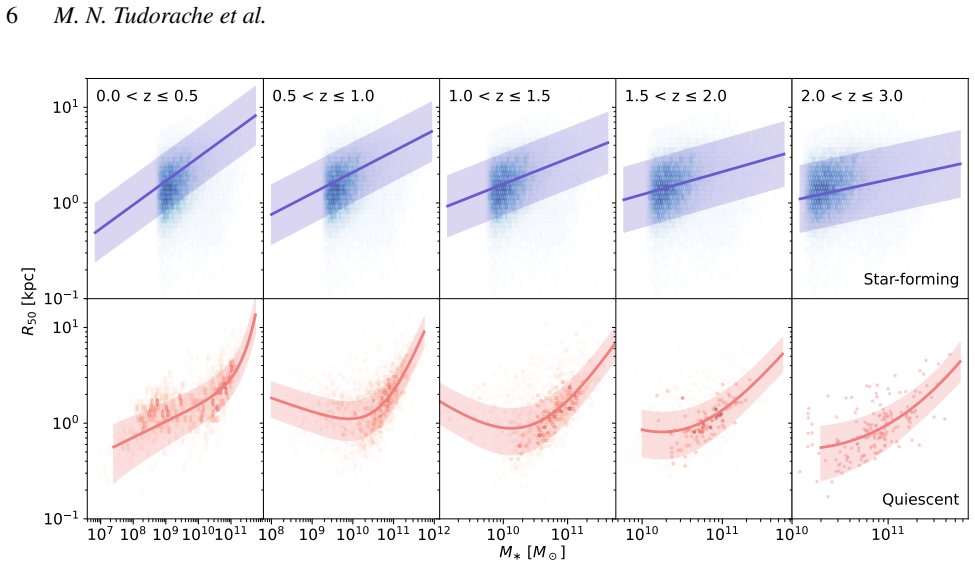
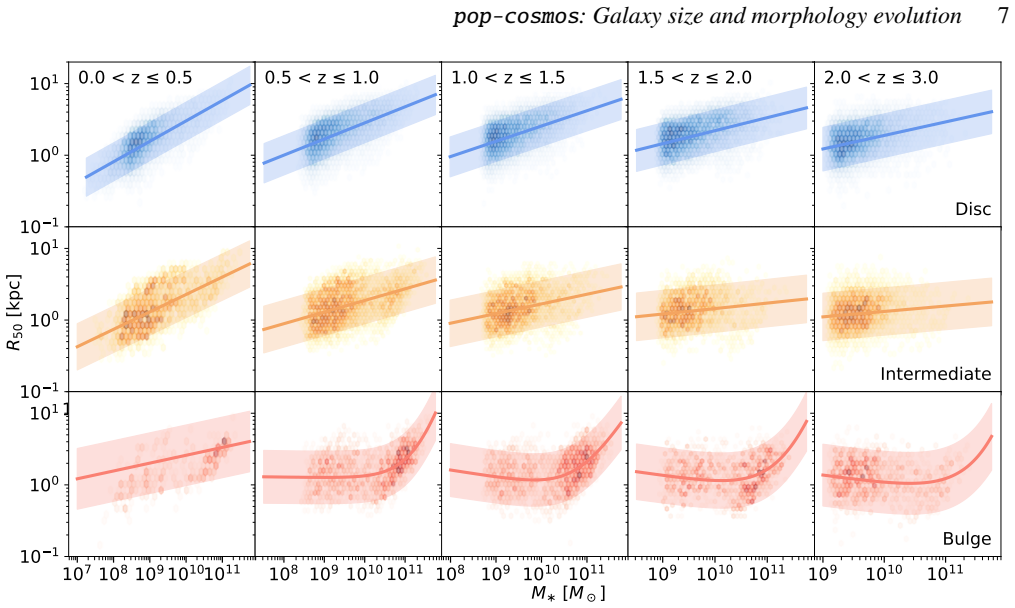
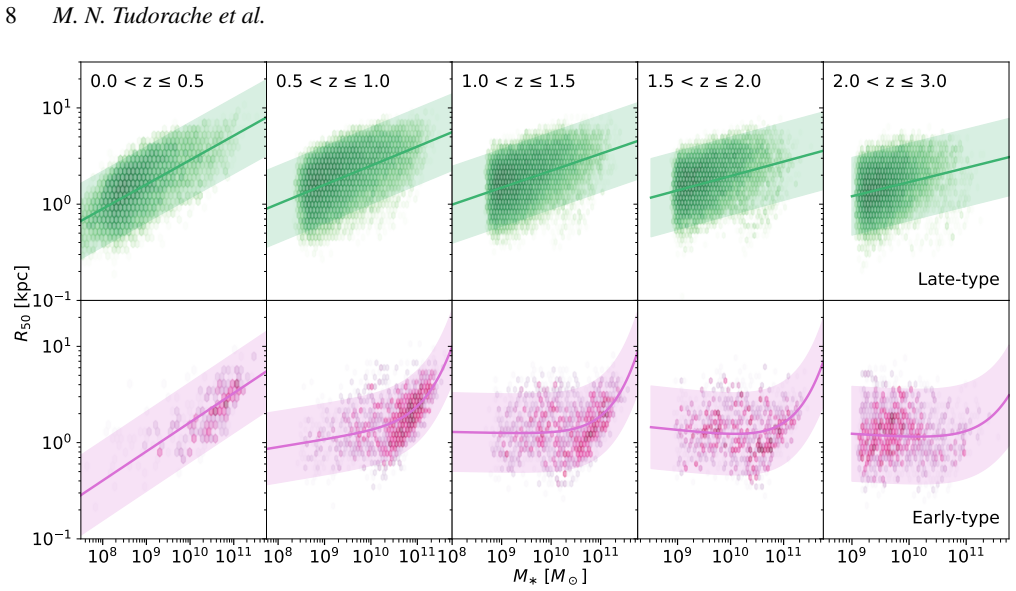
By combining pop-cosmos estimates with COSMOS-Web measurements for nearly 100,000 galaxies, the analysis reveals that the quiescent size-mass relation breaks at approximately 10^10.7 solar masses, matching the mass where AGN infrared torus luminosity fraction peaks in transitioning galaxies. The bulge-dominated relation breaks at 10^11.1 solar masses, aligning with the halo mass for peak AGN-driven baryonic redistribution. These offset pivots demonstrate that quenching and structural transformation proceed on distinct timescales.
What carries the argument
Double-power law breaks in the size-mass relations, with the quiescent break at lower mass than the bulge-dominated break.
If this is right
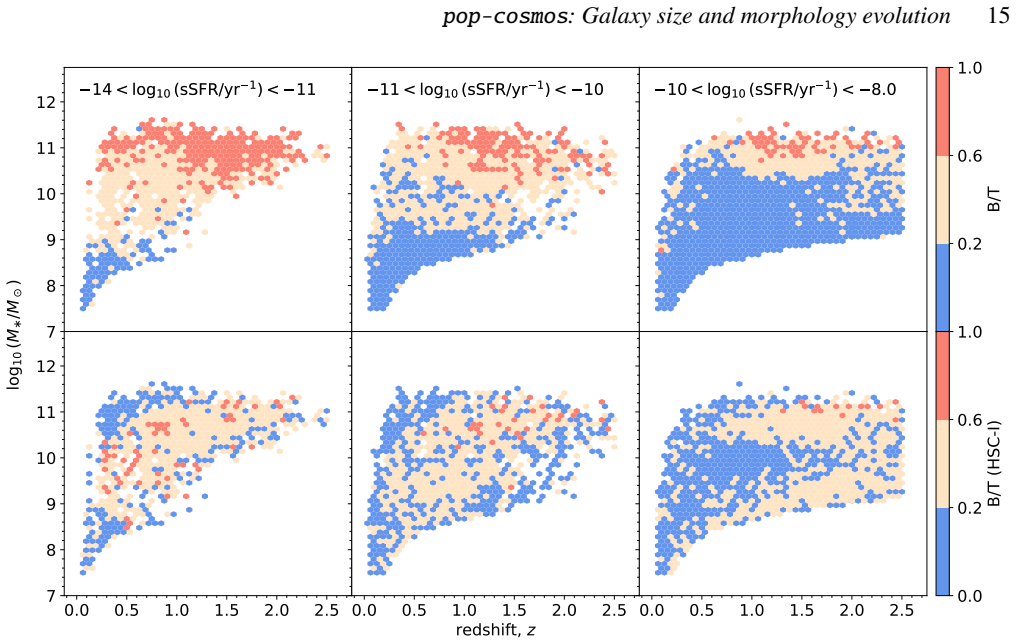
- The sSFR-based and morphology-based classifications yield different slopes, intercepts, and scatter in the size relations.
- Intrinsic scatter in galaxy sizes depends on structural morphology but not on specific star-formation rate.
- Morphology-dependent trends in size evolution are only recoverable from space-based imaging.
- The alignment of pivot masses with AGN features traces the progression of AGN feedback from quenching to structural change.
Where Pith is reading between the lines
- If the different pivot masses hold, it suggests AGN feedback operates in stages, first suppressing star formation and later driving structural changes at higher masses.
- This separation could help refine models of how galaxies connect to their dark matter halos through morphology.
- Similar mass-dependent breaks might be testable in hydrodynamical simulations that include detailed AGN feedback prescriptions.
Load-bearing premise
The pop-cosmos generative model trained on COSMOS2020 delivers unbiased stellar mass and specific star-formation rate estimates that permit clean splits by star-formation activity and morphology.
What would settle it
Observing that the break masses for the quiescent and bulge-dominated size-mass relations are identical, or that they fail to coincide with the reported AGN luminosity and halo mass scales, would undermine the conclusion of distinct timescales.
Figures
read the original abstract
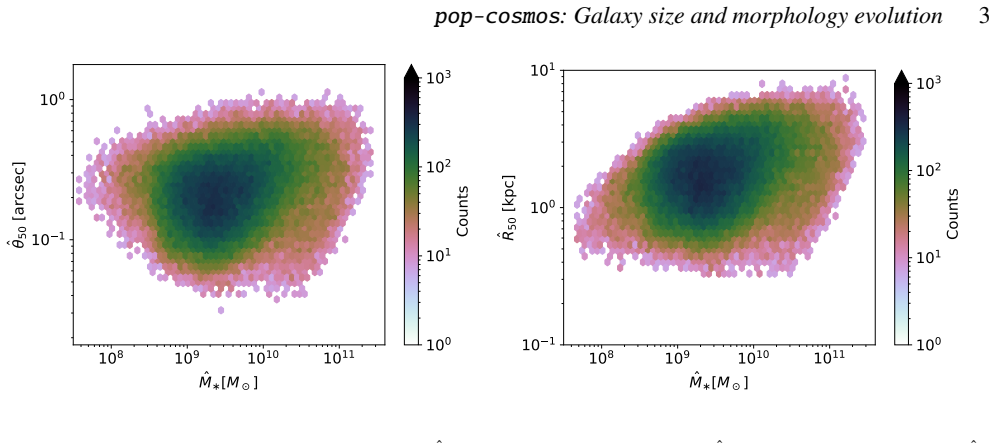
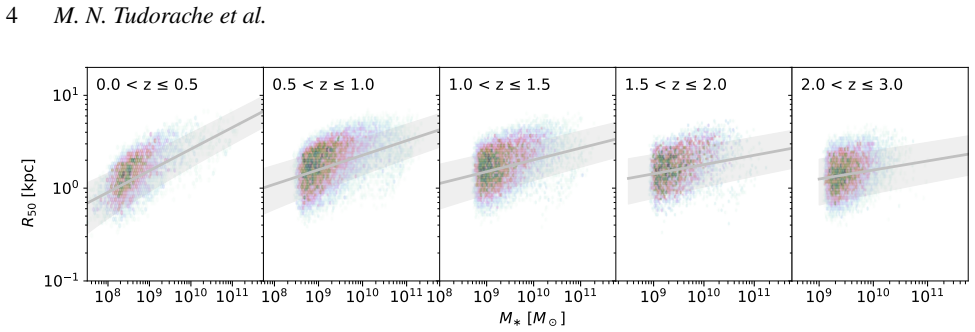
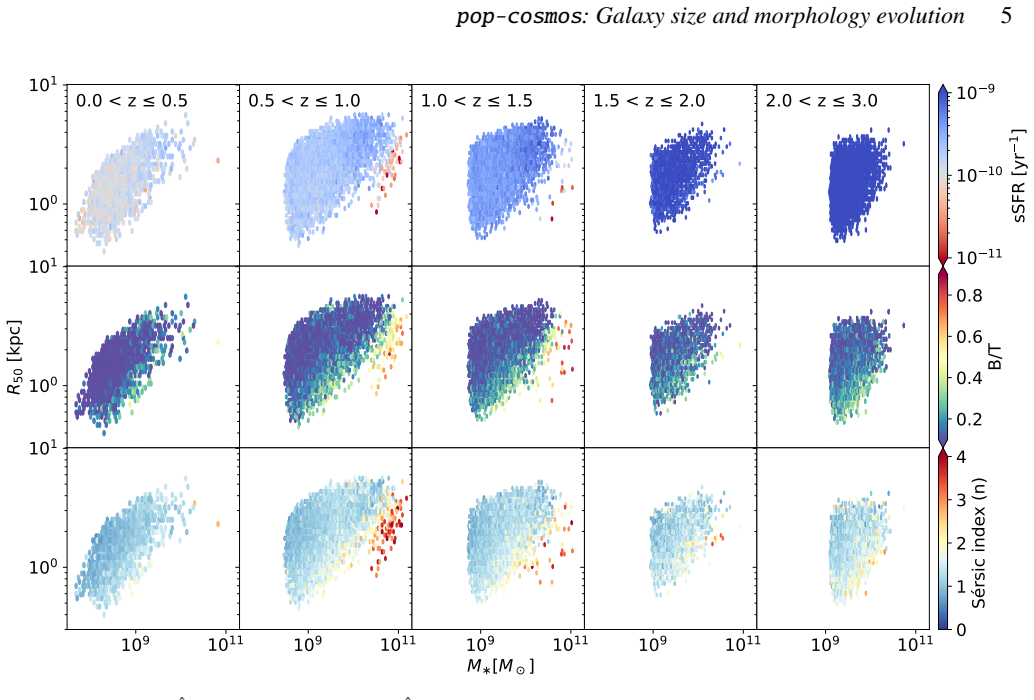
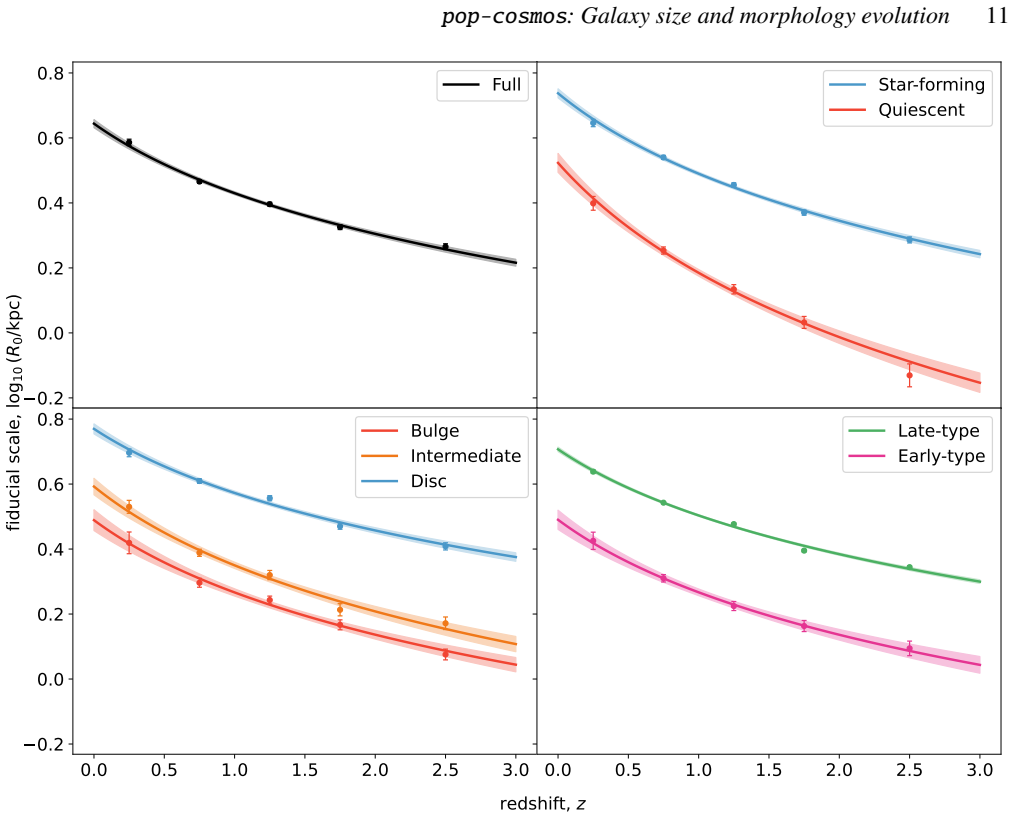
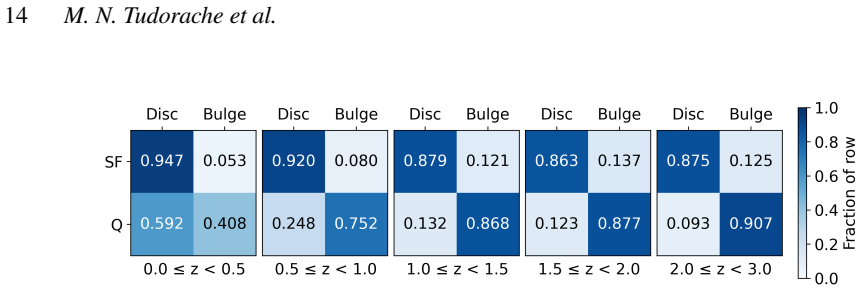
Galaxy sizes are correlated with stellar mass and redshift, as characterised by size scaling relations. The inferred forms of these scaling relations are sensitive to how galaxies are classified -- either by their star formation activity (e.g. specific star-formation rate, sSFR) or by their morphology markers (e.g. bulge-to-total ratio, S\'{e}rsic index). We combine stellar mass and sSFR estimates from pop-cosmos (a generative model trained on COSMOS2020 Spitzer IRAC $\textit{Ch.1} <26$) with size and morphology measurements from COSMOS-Web, obtaining $99,369$ galaxies. By investigating the size-mass and the size-redshift relations, we show that: (i) the sSFR/morphology splits give quantitatively different slopes, intercepts, and intrinsic scatter behaviour; (ii) intrinsic scatter depends on structural morphology but not on sSFR, which constrains the galaxy-halo connection; (iii) the quiescent and bulge-dominated size-mass relations both show double-power law breaks, but at different pivot masses, indicating that quenching and structural transformation occur on different time-scales; (iv) the morphology-dependent trends are only recoverable from space-based imaging. Further, the quiescent pivot mass $M_{\ast} \sim 10^{10.7}~\mathrm{M}_{\odot}$ coincides with the mass scale at which AGN (infrared torus) bolometric luminosity fraction peaks in transitioning galaxies, while the bulge-dominated pivot mass $M_{\ast} \sim 10^{11.1}~\mathrm{M}_{\odot}$ coincides with the halo mass at which AGN-driven baryonic redistribution peaks, tracing the interval over which AGN feedback ramps from quenching onset to structural transformation.
Editorial analysis
A structured set of objections, weighed in public.
Referee Report
Summary. The manuscript analyzes size-mass and size-redshift relations for 99,369 galaxies in COSMOS-Web, combining stellar masses and sSFR from the pop-cosmos generative model (trained on COSMOS2020 IRAC Ch.1 < 26) with size and Sérsic index measurements. It reports that sSFR-based and morphology-based classifications produce quantitatively different scaling relations, that intrinsic scatter depends on structural morphology but not sSFR, and that both the quiescent (sSFR-selected) and bulge-dominated (morphology-selected) size-mass relations exhibit double-power-law breaks, but at distinct pivot masses (~10^10.7 M⊙ vs ~10^11.1 M⊙). These are interpreted as indicating that quenching and structural transformation occur on different timescales, with the quiescent pivot coinciding with the AGN infrared torus luminosity fraction peak and the bulge pivot with the halo mass scale of AGN-driven baryonic redistribution.
Significance. If the pop-cosmos classifications prove robust against mass-dependent bias, the separation of pivot masses would provide a useful empirical constraint on the relative timing of quenching and morphological transformation, and on the mass scales where AGN feedback transitions from onset to structural impact. The large sample size, the explicit comparison of sSFR versus morphology splits, and the demonstration that morphology-dependent trends require space-based imaging are strengths. The data-driven approach avoids internal circularity in the reported trends.
major comments (3)
- [Methods (pop-cosmos application and sample construction)] The central claim that the quiescent and bulge-dominated populations exhibit double-power-law breaks at different pivot masses (and therefore on different timescales) is load-bearing on the assumption that pop-cosmos stellar-mass and sSFR posteriors produce uncontaminated classifications when intersected with COSMOS-Web sizes and Sérsic indices. The manuscript does not report mass-dependent validation tests (e.g., purity/completeness as a function of M* or comparison against independent mass/sSFR catalogs) that would rule out correlated scatter shifting the apparent break locations.
- [Results (size-mass relations and double-power-law fits)] The reported pivot masses (M* ~ 10^10.7 M⊙ for quiescent, M* ~ 10^11.1 M⊙ for bulge-dominated) and the post-hoc AGN-coincidence arguments rest on the double-power-law functional form and the fitting procedure, yet no details are provided on the likelihood, error treatment, or robustness checks against redshift cuts, magnitude limits, or alternative functional forms.
- [Results (intrinsic scatter analysis)] The claim that intrinsic scatter depends on structural morphology but not on sSFR (constraining the galaxy-halo connection) requires that the morphology and sSFR classifications are orthogonal; any mass-dependent contamination between the two would induce spurious differences in scatter trends.
minor comments (2)
- [Abstract] The abstract would be strengthened by a one-sentence statement of the sample selection cuts (redshift range, magnitude limits) and the precise functional form adopted for the double-power-law size-mass relation.
- [Figures (size-mass panels)] Figure captions for the size-mass relations should explicitly state the number of galaxies in each classification bin and whether the plotted points are medians or individual measurements.
Simulated Author's Rebuttal
We thank the referee for their constructive comments, which highlight important areas for strengthening the robustness of our conclusions. We address each major comment below and will incorporate revisions to provide the requested validations, methodological details, and checks.
read point-by-point responses
-
Referee: [Methods (pop-cosmos application and sample construction)] The central claim that the quiescent and bulge-dominated populations exhibit double-power-law breaks at different pivot masses (and therefore on different timescales) is load-bearing on the assumption that pop-cosmos stellar-mass and sSFR posteriors produce uncontaminated classifications when intersected with COSMOS-Web sizes and Sérsic indices. The manuscript does not report mass-dependent validation tests (e.g., purity/completeness as a function of M* or comparison against independent mass/sSFR catalogs) that would rule out correlated scatter shifting the apparent break locations.
Authors: We agree that mass-dependent validation is necessary to support the pivot-mass separation. Although pop-cosmos was validated in its original work, the current manuscript lacks explicit tests against mass. In revision we will add purity/completeness versus M*, cross-comparisons to independent catalogs, and a quantitative assessment of how classification contamination could shift the fitted breaks. revision: yes
-
Referee: [Results (size-mass relations and double-power-law fits)] The reported pivot masses (M* ~ 10^10.7 M⊙ for quiescent, M* ~ 10^11.1 M⊙ for bulge-dominated) and the post-hoc AGN-coincidence arguments rest on the double-power-law functional form and the fitting procedure, yet no details are provided on the likelihood, error treatment, or robustness checks against redshift cuts, magnitude limits, or alternative functional forms.
Authors: The manuscript indeed omits these fitting details. We will expand the methods section to specify the likelihood, error propagation, and robustness tests (redshift/magnitude cuts, alternative functional forms). These additions will directly support the reported pivot locations and AGN-coincidence discussion. revision: yes
-
Referee: [Results (intrinsic scatter analysis)] The claim that intrinsic scatter depends on structural morphology but not on sSFR (constraining the galaxy-halo connection) requires that the morphology and sSFR classifications are orthogonal; any mass-dependent contamination between the two would induce spurious differences in scatter trends.
Authors: We acknowledge that non-orthogonality could affect the scatter comparison. In revision we will quantify the mass-dependent overlap between the two classifications and test whether the morphology-dependent scatter trend remains after accounting for cross-contamination, thereby clarifying the constraint on the galaxy-halo connection. revision: partial
Circularity Check
Minor self-citation to pop-cosmos model; central size-mass fits remain independent
full rationale
The paper applies a pre-trained generative model (pop-cosmos, trained on COSMOS2020) to obtain stellar masses and sSFRs, then fits size-mass relations to independent COSMOS-Web size and Sérsic data. The double-power-law breaks and distinct pivot masses (~10^10.7 and ~10^11.1 M⊙) are obtained by direct fitting to the classified samples; no equation or step reduces these fitted quantities to the model inputs by construction. The citation to pop-cosmos is a single self-citation that is not load-bearing for the reported trends, which are falsifiable against the external imaging data.
Axiom & Free-Parameter Ledger
axioms (2)
- domain assumption pop-cosmos provides unbiased stellar mass and sSFR estimates for the COSMOS-Web sample
- domain assumption COSMOS-Web imaging yields accurate size and morphology measurements suitable for structural classification
Reference graph
Works this paper leans on
-
[1]
Correlations between Nebular Emission and the Continuum Spectral Shape in SDSS Galaxies
Correlations between Nebular Emission and the Continuum Spectral Shape in SDSS Galaxies. , keywords =. doi:10.1088/0004-6256/141/4/133 , archivePrefix =. 1110.1877 , primaryClass =
work page internal anchor Pith review Pith/arXiv arXiv doi:10.1088/0004-6256/141/4/133
-
[2]
arXiv e-prints , keywords =
pop-cosmos: Disentangling galaxy properties from observables using data-driven approaches. arXiv e-prints , keywords =
-
[3]
and Ralchenko,
Kramida, A. and Ralchenko,. 2024 , month = nov, doi =
2024
-
[4]
Discovering the building blocks of dark matter halo density profiles with neural networks. , keywords =. doi:10.1103/PhysRevD.105.103533 , archivePrefix =. 2203.08827 , primaryClass =
-
[5]
Representation learning approach to probe for dynamical dark energy in matter power spectra. , keywords =. doi:10.1103/PhysRevD.110.023514 , archivePrefix =. 2310.10717 , primaryClass =
-
[6]
CDM and early dark energy in latent space: A data-driven parametrization of the CMB temperature power spectrum. , keywords =. doi:10.1103/PhysRevD.111.083537 , archivePrefix =. 2502.09810 , primaryClass =
-
[7]
Proceedings of the 9th Python in Science Conference , title =
McKinney, Wes , doi =. Proceedings of the 9th Python in Science Conference , title =. 2010 , publisher =
2010
-
[8]
doi:10.1111/j.1365-2966.2012.21124.x , adsurl=
Eliminating error in the chemical abundance scale for extragalactic H II regions. , keywords =. doi:10.1111/j.1365-2966.2012.21145.x , archivePrefix =. 1203.5021 , primaryClass =
-
[9]
Monthly Notices of the Royal Astronomical Society , author=
Inferring physical properties of galaxies from their emission-line spectra , volume=. Monthly Notices of the Royal Astronomical Society , author=. 2017 , month=feb, pages=. doi:10.1093/mnras/stw2836 , number=
-
[10]
Color and Stellar Population Gradients in Passively Evolving Galaxies at z -0.5ex 2 from HST/WFC3 Deep Imaging in the Hubble Ultra Deep Field. , keywords =. doi:10.1088/0004-637X/735/1/18 , archivePrefix =. 1101.0843 , primaryClass =
work page internal anchor Pith review Pith/arXiv arXiv doi:10.1088/0004-637x/735/1/18
-
[11]
The Effects of Dust on Broadband Color Gradients in Elliptical Galaxies. , keywords =. doi:10.1086/177044 , adsurl =
-
[12]
Galaxy masses. Rev.\ Modern Phys. , keywords =. doi:10.1103/RevModPhys.86.47 , archivePrefix =. 1309.3276 , primaryClass =
work page internal anchor Pith review Pith/arXiv arXiv doi:10.1103/revmodphys.86.47
-
[13]
Spectral Classification of Emission-Line Galaxies. , keywords =. doi:10.1086/191166 , adsurl =
-
[14]
Theoretical Evolution of Optical Strong Lines across Cosmic Time
Theoretical Evolution of Optical Strong Lines across Cosmic Time. , keywords =. doi:10.1088/0004-637X/774/2/100 , archivePrefix =. 1307.0508 , primaryClass =
work page internal anchor Pith review Pith/arXiv arXiv doi:10.1088/0004-637x/774/2/100
-
[15]
[OIII]/[NII] as an abundance indicator at high redshift. , keywords =. doi:10.1111/j.1365-2966.2004.07591.x , archivePrefix =. astro-ph/0401128 , primaryClass =
-
[16]
De-noising of galaxy optical spectra with autoencoders. , keywords =. doi:10.1093/mnras/stad2709 , archivePrefix =. 2309.02315 , primaryClass =
-
[17]
Measuring the Physical Conditions in High-Redshift Star-Forming Galaxies: Insights from KBSS-MOSFIRE
Measuring the Physical Conditions in High-redshift Star-forming Galaxies: Insights from KBSS-MOSFIRE. , keywords =. doi:10.3847/1538-4357/aae1a5 , archivePrefix =. 1711.08820 , primaryClass =
work page internal anchor Pith review Pith/arXiv arXiv doi:10.3847/1538-4357/aae1a5
-
[18]
Characterizing Extreme Emission-line Galaxies. I. A Four-zone Ionization Model for Very High-ionization Emission. , keywords =. doi:10.3847/1538-4357/ac141b , archivePrefix =. 2105.12765 , primaryClass =
-
[19]
Starbursts in barred spiral galaxies. IV. On young bars and the formation of abundance gradients. , keywords =. doi:10.48550/arXiv.astro-ph/0001286 , archivePrefix =. astro-ph/0001286 , primaryClass =
work page internal anchor Pith review Pith/arXiv arXiv doi:10.48550/arxiv.astro-ph/0001286
-
[20]
The impact of the nitrogen-to-oxygen ratio on ionized nebula diagnostics based on [NII] emission lines. , keywords =. doi:10.1111/j.1365-2966.2009.15145.x , archivePrefix =. 0905.4621 , primaryClass =
-
[21]
Mapping the Diversity of Galaxy Spectra with Deep Unsupervised Machine Learning. , keywords =. doi:10.3847/1538-3881/ac4039 , archivePrefix =. 2112.03425 , primaryClass =
-
[22]
Interpreting the detection of anomalies in SDSS spectra. , keywords =. doi:10.1051/0004-6361/202556339 , archivePrefix =. 2510.05235 , primaryClass =
-
[23]
Identifying Anomalous DESI Galaxy Spectra with a Variational Autoencoder. , keywords =. doi:10.1093/mnras/stag010 , archivePrefix =. 2506.17376 , primaryClass =
-
[24]
Very Strong Emission-Line Galaxies in the WISP Survey and Implications for High-Redshift Galaxies
Very Strong Emission-line Galaxies in the WFC3 Infrared Spectroscopic Parallel Survey and Implications for High-redshift Galaxies. , keywords =. doi:10.1088/0004-637X/743/2/121 , archivePrefix =. 1109.0639 , primaryClass =
work page internal anchor Pith review Pith/arXiv arXiv doi:10.1088/0004-637x/743/2/121
-
[25]
The Stellar Populations and Evolution of Lyman Break Galaxies
The Stellar Populations and Evolution of Lyman Break Galaxies. , keywords =. doi:10.1086/322412 , archivePrefix =. astro-ph/0105087 , primaryClass =
work page internal anchor Pith review Pith/arXiv arXiv doi:10.1086/322412
-
[26]
Improving the full spectrum fitting method: accurate convolution with Gauss-Hermite functions
Improving the full spectrum fitting method: accurate convolution with Gauss-Hermite functions. , keywords =. doi:10.1093/mnras/stw3020 , archivePrefix =. 1607.08538 , primaryClass =
work page internal anchor Pith review Pith/arXiv arXiv doi:10.1093/mnras/stw3020
-
[27]
Optical-IR Spectral Energy Distributions of z>2 Lyman Break Galaxies
Optical-Infrared Spectral Energy Distributions of Z > 2 Lyman Break Galaxies. , keywords =. doi:10.1086/300291 , archivePrefix =. astro-ph/9712216 , primaryClass =
work page internal anchor Pith review Pith/arXiv arXiv doi:10.1086/300291
-
[28]
The BPT Diagram in Cosmological Galaxy Formation Simulations: Understanding the Physics Driving Offsets at High Redshift. , keywords =. doi:10.3847/1538-4357/ac43b8 , archivePrefix =. 2201.03564 , primaryClass =
-
[29]
Quantifying correlations between galaxy emission lines and stellar continua
Quantifying correlations between galaxy emission lines and stellar continua. , keywords =. doi:10.1093/mnras/stv2986 , archivePrefix =. 1601.02417 , primaryClass =
work page internal anchor Pith review Pith/arXiv arXiv doi:10.1093/mnras/stv2986
-
[30]
J.\ Open Source Software , keywords =
pysersic: A Python package for determining galaxy structural properties via Bayesian inference, accelerated with jax. J.\ Open Source Software , keywords =. doi:10.21105/joss.05703 , archivePrefix =. 2306.05454 , primaryClass =
-
[31]
An ultra-deep near-infrared spectrum of a compact quiescent galaxy at z=2.2
An Ultra-Deep Near-Infrared Spectrum of a Compact Quiescent Galaxy at z = 2.2. , keywords =. doi:10.1088/0004-637X/700/1/221 , archivePrefix =. 0905.1692 , primaryClass =
work page internal anchor Pith review Pith/arXiv arXiv doi:10.1088/0004-637x/700/1/221
-
[32]
MegaMorph - multiwavelength measurement of galaxy structure. S \'e rsic profile fits to galaxies near and far. , keywords =. doi:10.1093/mnras/stt1320 , archivePrefix =. 1307.4996 , primaryClass =
work page internal anchor Pith review Pith/arXiv arXiv doi:10.1093/mnras/stt1320
-
[33]
MegaMorph - multiwavelength measurement of galaxy structure: complete S \'e rsic profile information from modern surveys. , keywords =. doi:10.1093/mnras/sts633 , archivePrefix =. 1212.3332 , primaryClass =
work page internal anchor Pith review Pith/arXiv arXiv doi:10.1093/mnras/sts633
-
[34]
GALAPAGOS-2/GALFITM/GAMA - Multi-wavelength measurement of galaxy structure: Separating the properties of spheroid and disk components in modern surveys. , keywords =. doi:10.1051/0004-6361/202142935 , archivePrefix =. 2204.05907 , primaryClass =
-
[35]
Detailed Structural Decomposition of Galaxy Images
Detailed Structural Decomposition of Galaxy Images. , keywords =. doi:10.1086/340952 , archivePrefix =. astro-ph/0204182 , primaryClass =
work page internal anchor Pith review Pith/arXiv arXiv doi:10.1086/340952
-
[36]
J.\ Open Source Software , keywords =
PyAutoGalaxy: Open-Source Multiwavelength Galaxy Structure & Morphology. J.\ Open Source Software , keywords =. doi:10.21105/joss.04475 , adsurl =
-
[37]
Distributions of Galaxy Spectral Types in the Sloan Digital Sky Survey
Distributions of Galaxy Spectral Types in the Sloan Digital Sky Survey. , keywords =. doi:10.1086/422429 , archivePrefix =. astro-ph/0407061 , primaryClass =
work page internal anchor Pith review Pith/arXiv arXiv doi:10.1086/422429
-
[38]
Optical spectra of IRAS ``warm'' galaxies. , keywords =. doi:10.1086/131676 , adsurl =
-
[39]
Using Strong Lines to Estimate Abundances in Extragalactic HII Regions and Starburst Galaxies
Using Strong Lines to Estimate Abundances in Extragalactic H II Regions and Starburst Galaxies. , keywords =. doi:10.1086/341326 , archivePrefix =. astro-ph/0206495 , primaryClass =
work page internal anchor Pith review Pith/arXiv arXiv doi:10.1086/341326
-
[40]
The host galaxies and classification of active galactic nuclei. , keywords =. doi:10.1111/j.1365-2966.2006.10859.x , archivePrefix =. astro-ph/0605681 , primaryClass =
-
[41]
Theoretical Modeling of Starburst Galaxies
Theoretical Modeling of Starburst Galaxies. , keywords =. doi:10.1086/321545 , archivePrefix =. astro-ph/0106324 , primaryClass =
work page internal anchor Pith review Pith/arXiv arXiv doi:10.1086/321545
-
[42]
Classification parameters for the emission-line spectra of extragalactic objects. , keywords =. doi:10.1086/130766 , adsurl =
-
[43]
Galaxy morphology in rich clusters: implications for the formation and evolution of galaxies. , journal =. doi:10.1086/157753 , adsurl =
-
[44]
Dust Absorption and the Ultraviolet Luminosity Density at z -0.5ex 3 as Calibrated by Local Starburst Galaxies. , keywords =. doi:10.1086/307523 , archivePrefix =. astro-ph/9903054 , primaryClass =
work page internal anchor Pith review Pith/arXiv arXiv doi:10.1086/307523
-
[45]
Distribution of mutual information from complete and incomplete data , url =
Marcus Hutter and Marco Zaffalon , doi =. Distribution of mutual information from complete and incomplete data , url =. Comput.\ Statistics Data Analysis , keywords =
-
[46]
Classification of radio sources through self-supervised learning. , keywords =. doi:10.1051/0004-6361/202554735 , archivePrefix =. 2503.19111 , primaryClass =
-
[47]
Kingma, Diederik P. and Welling, Max , title =. 2019 , volume =. doi:10.1561/2200000056 , journal =
-
[48]
Bengio, Yoshua and Courville, Aaron and Vincent, Pascal , title =. 2013 , issue_date =. doi:10.1109/TPAMI.2013.50 , journal =
-
[49]
doi:10.1038/323533a0 , adsurl =
Learning representations by back-propagating errors , journal =. doi:10.1038/323533a0 , adsurl =
-
[50]
Dimensionality Reduction of SDSS Spectra with Variational Autoencoders. , keywords =. doi:10.3847/1538-3881/ab9644 , archivePrefix =. 2002.10464 , primaryClass =
-
[51]
A Physics-Informed Variational Autoencoder for Rapid Galaxy Inference and Anomaly Detection. ArXiv e-prints , keywords =. doi:10.48550/arXiv.2312.16687 , archivePrefix =. 2312.16687 , primaryClass =
-
[52]
Autoencoding Galaxy Spectra. II. Redshift Invariance and Outlier Detection. , keywords =. doi:10.3847/1538-3881/ace100 , archivePrefix =. 2302.02496 , primaryClass =
-
[53]
Machine-assisted discovery of relationships in astronomy
Machine-assisted discovery of relationships in astronomy. , keywords =. doi:10.1093/mnras/stt329 , archivePrefix =. 1302.5129 , primaryClass =
work page internal anchor Pith review Pith/arXiv arXiv doi:10.1093/mnras/stt329
-
[54]
Differential Galaxy Evolution in Cluster and Field Galaxies at z=0.3
Differential Galaxy Evolution in Cluster and Field Galaxies at z -0.5ex 0.3. , keywords =. doi:10.1086/308056 , archivePrefix =. astro-ph/9906470 , primaryClass =
work page internal anchor Pith review Pith/arXiv arXiv doi:10.1086/308056
-
[55]
Wilk, M. B. and Gnanadesikan, R. , title = ". Biometrika , volume =. 1968 , month =. doi:10.1093/biomet/55.1.1 , url =
-
[56]
Analysis of a complex of statistical variables into principal components , volume =
Harold Hotelling , journal =. Analysis of a complex of statistical variables into principal components , volume =. 1933 , doi =
1933
-
[57]
Relations Between Two Sets of Variates , urldate =
Harold Hotelling , journal =. Relations Between Two Sets of Variates , urldate =. 1936 , doi =
1936
-
[58]
, journal =
Kolmogorov, A.N. , journal =
-
[59]
Smirnov , title =
N. Smirnov , title =. Ann.\ Math.\ Statistics , number =. 1948 , doi =
1948
-
[60]
Scandinavian Actuarial J
Harald Cram\'er , title =. Scandinavian Actuarial J. , volume =. 1928 , publisher =
1928
-
[61]
Practical Guidance for Bayesian Inference in Astronomy. arXiv e-prints , keywords =. doi:10.48550/arXiv.2302.04703 , archivePrefix =. 2302.04703 , primaryClass =
-
[62]
Testing the consistency of dust laws in SN Ia host galaxies: a BAYESN examination of Foundation DR1. , keywords =. doi:10.1093/mnras/stab2849 , archivePrefix =. 2102.05678 , primaryClass =
-
[63]
A hierarchical Bayesian SED model for Type Ia supernovae in the optical to near-infrared. , keywords =. doi:10.1093/mnras/stab3496 , archivePrefix =. 2008.07538 , primaryClass =
-
[64]
Type Ia Supernova Light Curve Inference: Hierarchical Bayesian Analysis in the Near Infrared
Type Ia Supernova Light-Curve Inference: Hierarchical Bayesian Analysis in the Near-Infrared. , keywords =. doi:10.1088/0004-637X/704/1/629 , archivePrefix =. 0908.0536 , primaryClass =
work page internal anchor Pith review Pith/arXiv arXiv doi:10.1088/0004-637x/704/1/629
-
[65]
Type Ia Supernova Light Curve Inference: Hierarchical Models in the Optical and Near Infrared
Type Ia Supernova Light Curve Inference: Hierarchical Models in the Optical and Near-infrared. , keywords =. doi:10.1088/0004-637X/731/2/120 , archivePrefix =. 1011.5910 , primaryClass =
work page internal anchor Pith review Pith/arXiv arXiv doi:10.1088/0004-637x/731/2/120
-
[66]
Do spectra improve distance measurements of Type Ia supernovae?
Do spectra improve distance measurements of Type Ia supernovae?. , keywords =. doi:10.1051/0004-6361/201015792 , archivePrefix =. 1012.0005 , primaryClass =
work page internal anchor Pith review Pith/arXiv arXiv doi:10.1051/0004-6361/201015792
-
[67]
On the Application of Bayesian Leave-one-out Cross-validation to Exoplanet Atmospheric Analysis. , keywords =. doi:10.3847/1538-3881/acab67 , archivePrefix =. 2212.03872 , primaryClass =
-
[68]
First semi-empirical test of the white dwarf mass-radius relationship using a single white dwarf via astrometric microlensing. , keywords =. doi:10.1093/mnras/stac3532 , archivePrefix =. 2206.01814 , primaryClass =
-
[69]
Methods for Incorporating Model Uncertainty into Exoplanet Atmospheric Analysis. arXiv e-prints , keywords =. doi:10.48550/arXiv.2310.03713 , archivePrefix =. 2310.03713 , primaryClass =
-
[70]
Bringing 2D Eclipse Mapping out of the Shadows with Leave-one-out Cross-validation. arXiv e-prints , keywords =. doi:10.48550/arXiv.2310.03733 , archivePrefix =. 2310.03733 , primaryClass =
-
[71]
Pareto Smoothed Importance Sampling. arXiv e-prints , keywords =. doi:10.48550/arXiv.1507.02646 , archivePrefix =. 1507.02646 , primaryClass =
-
[72]
Practical Bayesian model evaluation using leave-one-out cross-validation and WAIC
Practical Bayesian model evaluation using leave-one-out cross-validation and WAIC. Statistics & Computing , keywords =. doi:10.1007/s11222-016-9696-4 , archivePrefix =. 1507.04544 , primaryClass =
work page internal anchor Pith review Pith/arXiv arXiv doi:10.1007/s11222-016-9696-4
-
[73]
Prospects for resolving the Hubble constant tension with standard sirens
Prospects for Resolving the Hubble Constant Tension with Standard Sirens. , keywords =. doi:10.1103/PhysRevLett.122.061105 , archivePrefix =. 1802.03404 , primaryClass =
work page internal anchor Pith review Pith/arXiv arXiv doi:10.1103/physrevlett.122.061105
-
[74]
Dark Energy Survey year 1 results: Joint analysis of galaxy clustering, galaxy lensing, and CMB lensing two-point functions. , keywords =. doi:10.1103/PhysRevD.100.023541 , archivePrefix =. 1810.02322 , primaryClass =
-
[75]
General framework for cosmological dark matter bounds using N -body simulations. , keywords =. doi:10.1103/PhysRevD.103.043526 , archivePrefix =. 2007.13751 , primaryClass =
-
[76]
Forward Modeling of Galaxy Populations for Cosmological Redshift Distribution Inference. , keywords =. doi:10.3847/1538-4365/ac9583 , archivePrefix =. 2207.05819 , primaryClass =
-
[77]
Hierarchical Bayesian Inference of Photometric Redshifts with Stellar Population Synthesis Models. , keywords =. doi:10.3847/1538-4365/ac9d99 , archivePrefix =. 2207.07673 , primaryClass =
-
[78]
PopSED: Population-level Inference for Galaxy Properties from Broadband Photometry with Neural Density Estimation. , keywords =. doi:10.3847/1538-3881/ad0be4 , archivePrefix =. 2309.16958 , primaryClass =
-
[79]
Charles R. Harris and K. Jarrod Millman and St. Array programming with. 2020 , month = sep, journal =. doi:10.1038/s41586-020-2649-2 , publisher =
-
[80]
and Haberland, Matt and Reddy, Tyler and Cournapeau, David and Burovski, Evgeni and Peterson, Pearu and Weckesser, Warren and Bright, Jonathan and
Virtanen, Pauli and Gommers, Ralf and Oliphant, Travis E. and Haberland, Matt and Reddy, Tyler and Cournapeau, David and Burovski, Evgeni and Peterson, Pearu and Weckesser, Warren and Bright, Jonathan and. Nature Methods , year =
discussion (0)
Sign in with ORCID, Apple, or X to comment. Anyone can read and Pith papers without signing in.