Galaxy Power Spectrum at Two-Loop Order: Implications for Weak Lensing Surveys and New Physics
Pith reviewed 2026-07-01 01:58 UTC · model grok-4.3
The pith
Two-loop galaxy power spectrum in EFT yields unbiased σ8 with three times narrower error bars than linear theory.
A machine-rendered reading of the paper's core claim, the machinery that carries it, and where it could break.
Core claim
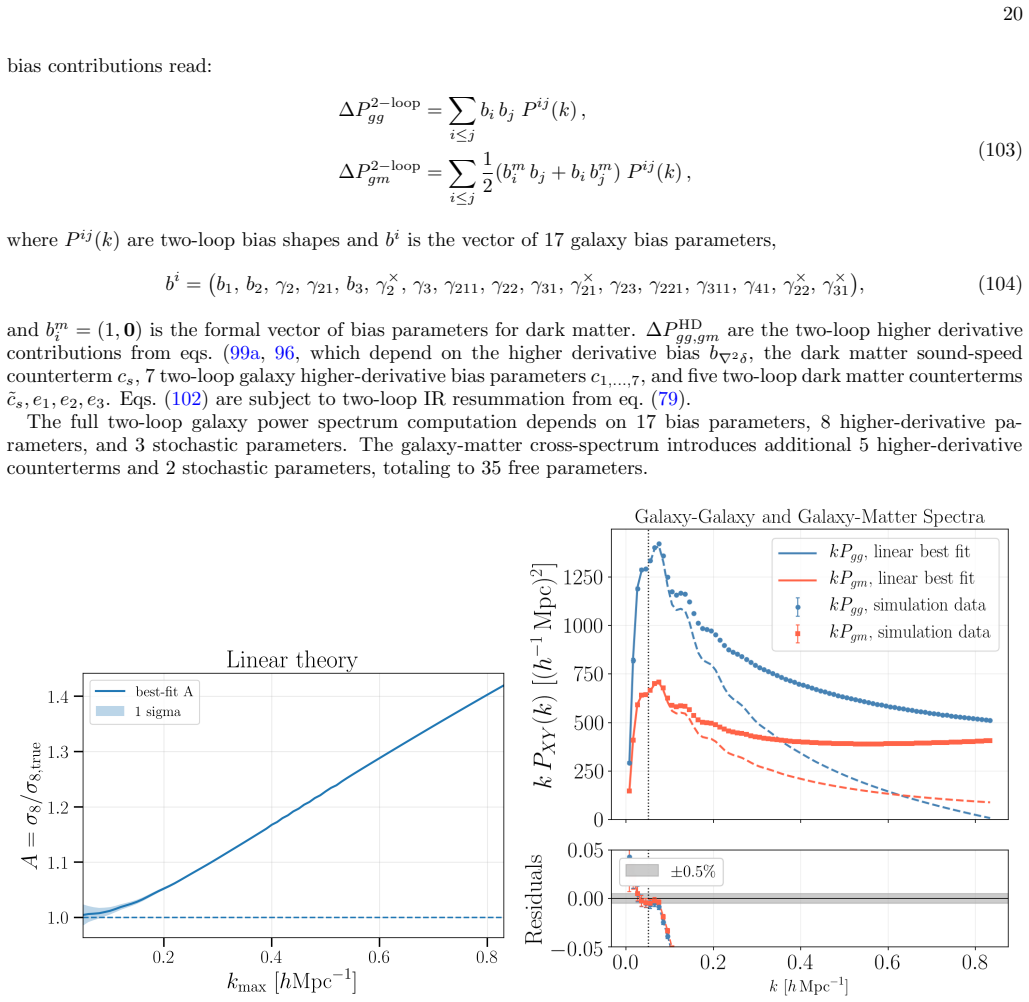
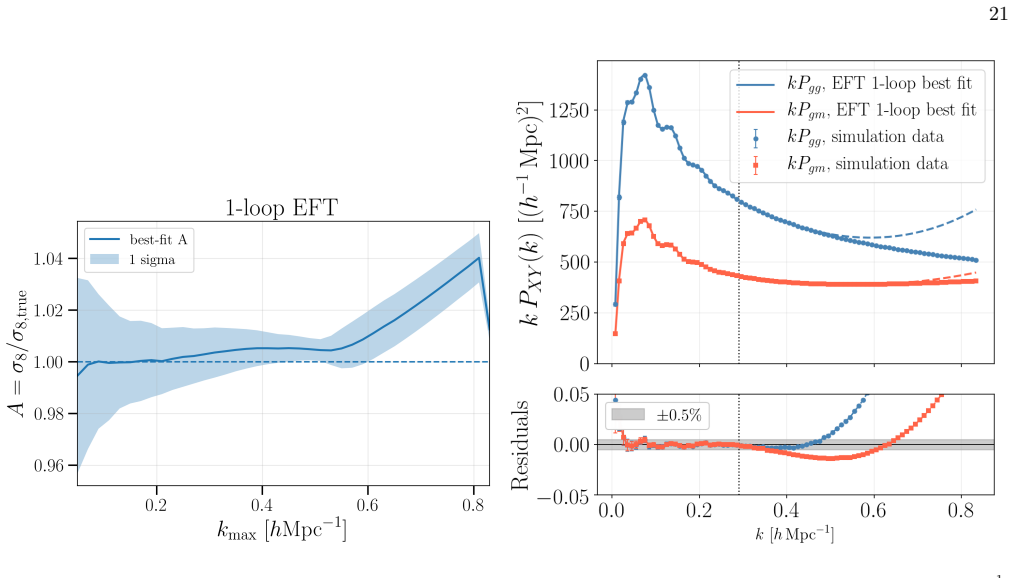
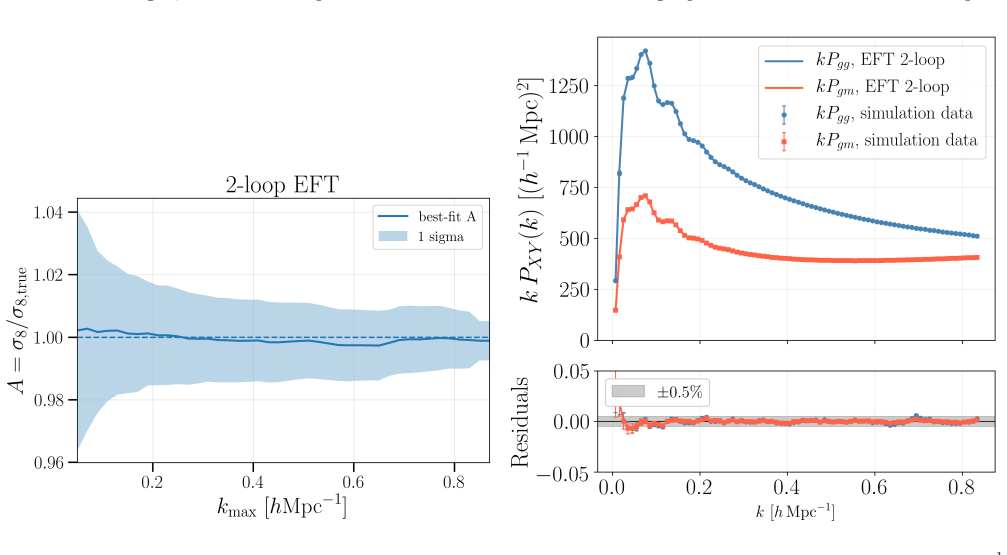
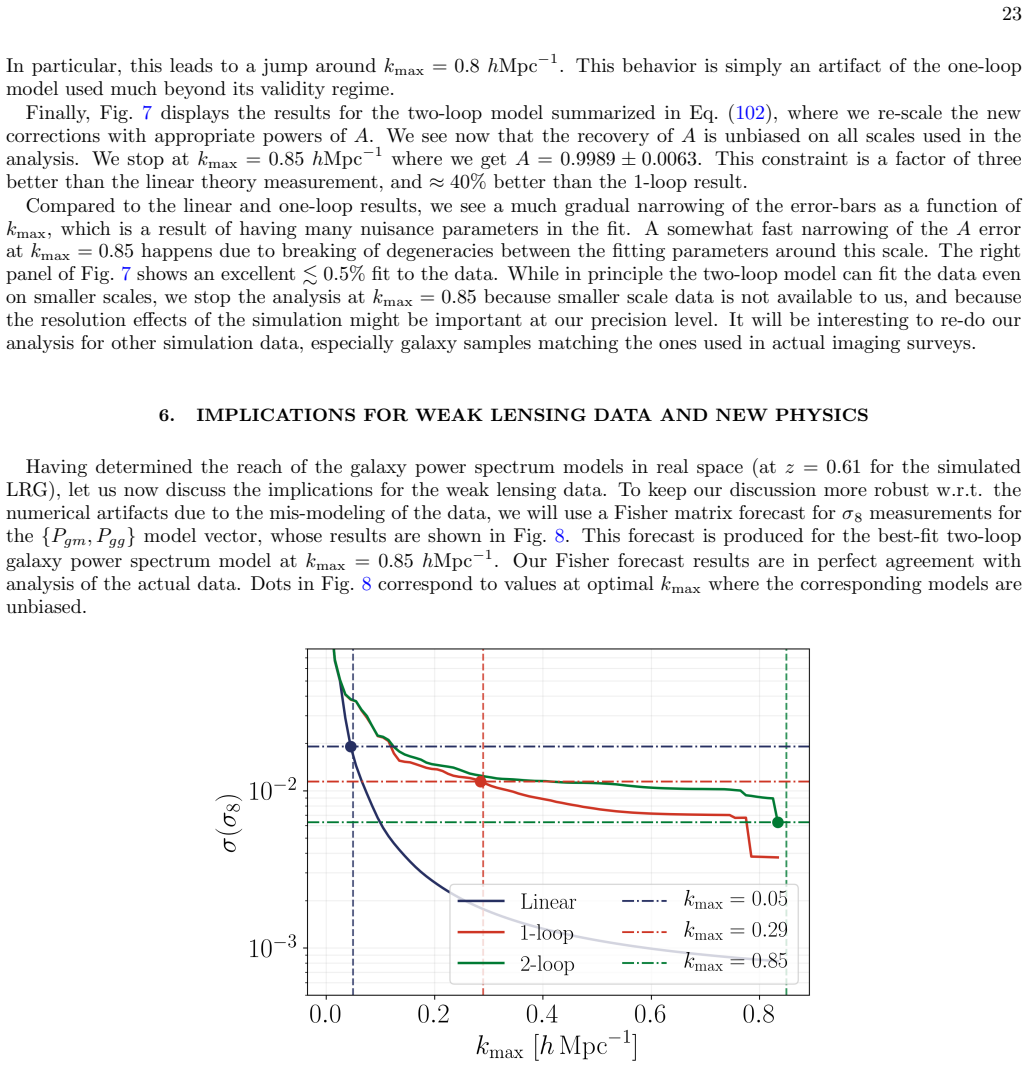
We compute the galaxy power spectrum at two-loop order in cosmological perturbation theory using the effective field theory. After deriving the bias operators through fifth order and obtaining two-loop renormalization conditions, we find that the model requires 21 additional EFT parameters per galaxy sample. The computation agrees with PT Challenge simulations at per mille level up to k=0.85 h Mpc^{-1}. With conservative priors on all EFT parameters, the two-loop model produces an unbiased measurement of σ8 with three times narrower error-bars than the linear theory model, and 40% improvement over one-loop.
What carries the argument
Two-loop renormalization conditions for fifth-order galaxy bias operators in the effective field theory, including higher-derivative, stochastic terms, and IR resummation.
If this is right
- Significant gains in precision for galaxy clustering and galaxy-lensing two-point function analyses from surveys like Euclid, LSST, and Roman.
- Ability to probe new physics scenarios that alter the matter power spectrum shape at wavenumbers 0.4-0.8 h Mpc^{-1}, such as ultra-light axion dark matter.
- The computation interfaces easily with tools like CLASS-PT for one-loop analyses.
- Per mille-level accuracy up to k=0.85 h Mpc^{-1} enables reliable use in weak lensing surveys.
Where Pith is reading between the lines
- Extending this two-loop framework to the bispectrum could yield even tighter cosmological constraints.
- The reduced error bars on σ8 may help resolve tensions in current cosmological data when applied to real survey observations.
- Testing the model at different redshifts would confirm its robustness for multi-redshift analyses.
Load-bearing premise
The 21 additional two-loop EFT parameters per galaxy sample do not absorb or bias the cosmological signal when marginalized over with conservative priors.
What would settle it
If applying the two-loop model to simulated or observed data produces a biased value of σ8 compared to the true input or independent measurements from higher-resolution simulations, the unbiased measurement claim would be falsified.
Figures
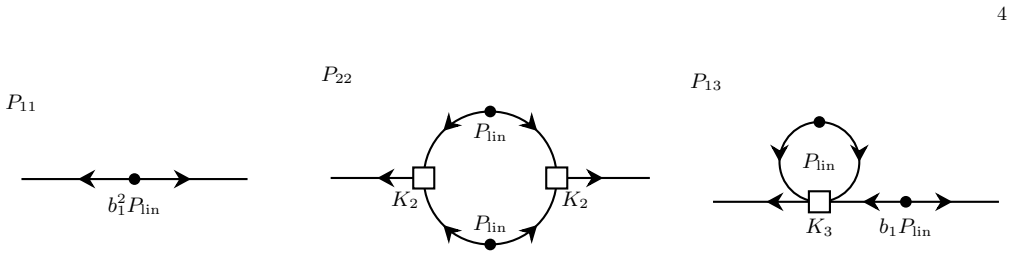
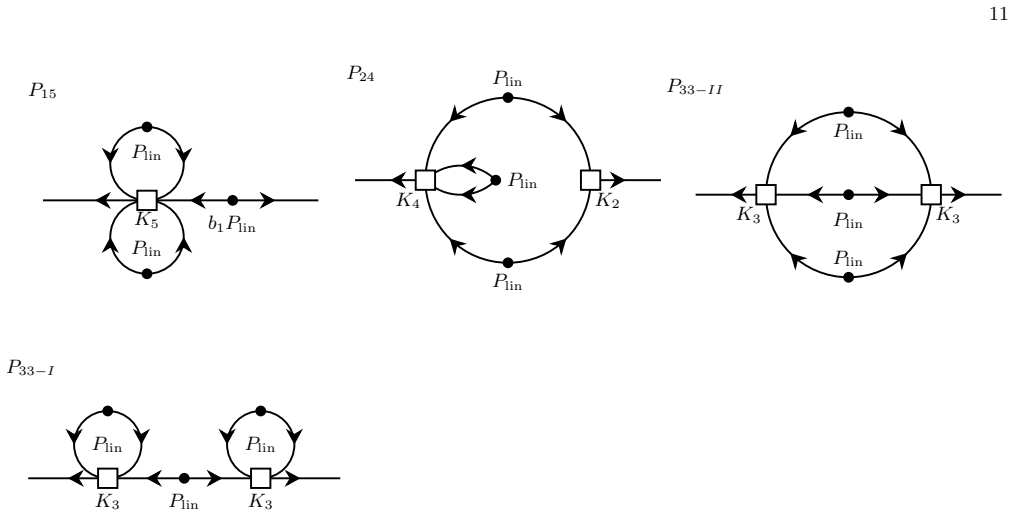
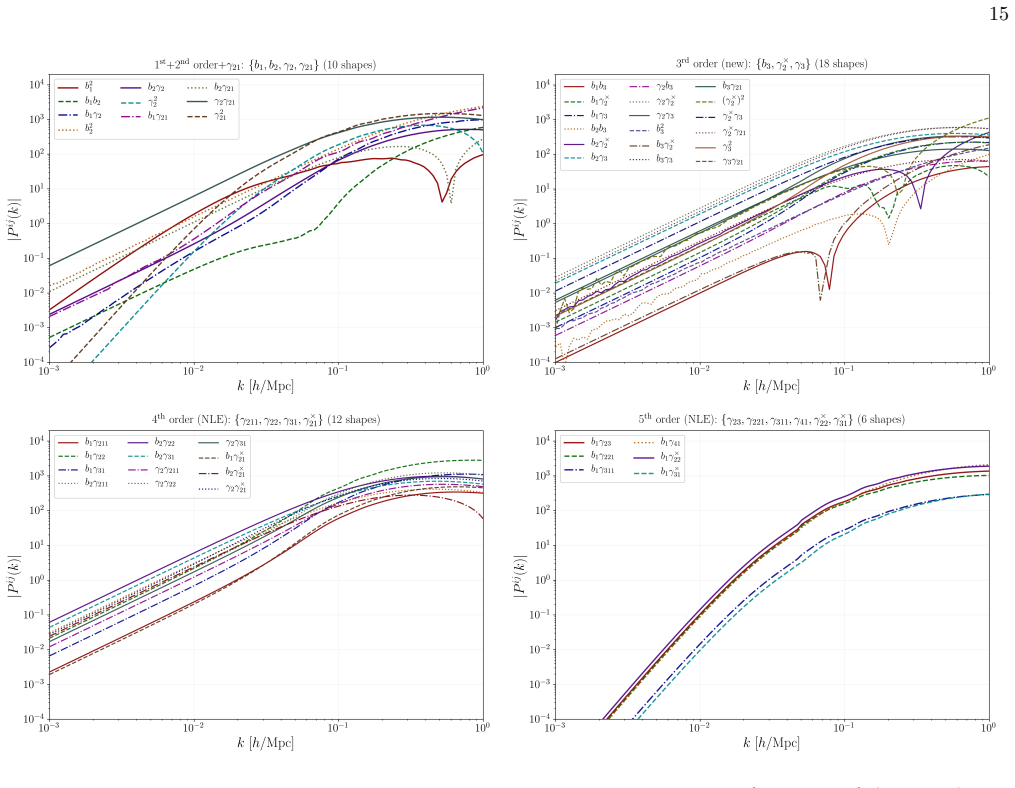
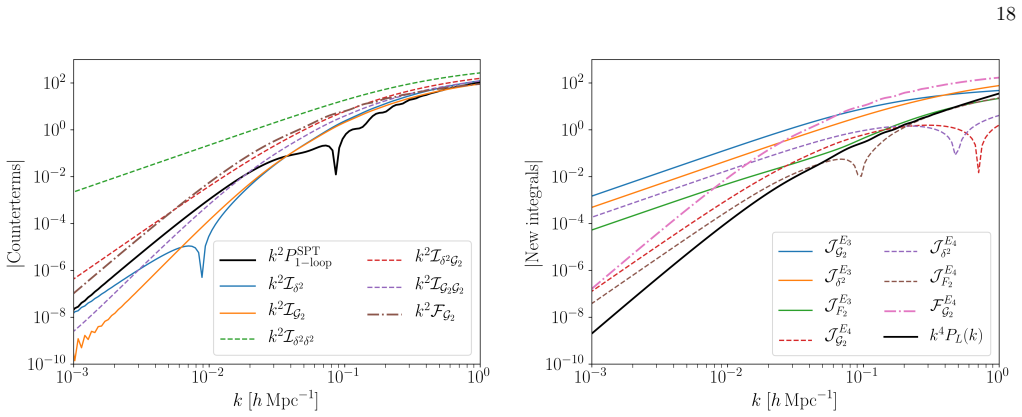
read the original abstract
We compute the galaxy power spectrum at two-loop order in cosmological perturbation theory (effective field theory, EFT). We derive galaxy bias operators through the fifth order and obtain two-loop renormalization conditions for the their bias coefficients. We compute the two-loop integrals using a renormalization scheme consistent with the CLASS-PT code, allowing for an easy interface of our new computations with standard tools used in the one-loop galaxy power spectrum and bispectrum analyses. We also derive the relevant higher-derivative and stochastic contributions, and implement IR resummation using time-sliced perturbation theory. Having identified the redundant operators, we find that the two-loop galaxy power spectrum requires 21 additional EFT parameters per galaxy sample. We compare our computation with the galaxy-galaxy and galaxy-matter power spectra from the PT Challenge N-body simulation at $z=0.61$ and find a per mille-level agreement up to $k=0.85~h$Mpc$^{-1}$. We show that even with conservative priors on all EFT parameters, the two-loop model produces an unbiased measurement of the mass fluctuation amplitude $\sigma_8$ with three times narrower error-bars than the linear theory model. The improvement over the one-loop model is $\simeq 40\%$. This suggests significant gains in the two-loop EFT analyses of galaxy clustering and galaxy--lensing two-point functions ($2\times2$ pt) from CMB lensing maps and imaging surveys like Euclid, LSST, and Roman. In addition, our two-loop computation offers a probe of new physics scenarios that modify the shape of the matter power spectrum at wavenumbers $(0.4-0.8)~h$Mpc$^{-1}$ such as the presence of ultra-light axion dark matter sub-components with masses $m_a\sim 10^{-24}$ eV.
Editorial analysis
A structured set of objections, weighed in public.
Referee Report
Summary. The manuscript computes the galaxy power spectrum at two-loop order in the EFTofLSS, deriving bias operators through fifth order, obtaining two-loop renormalization conditions, and implementing IR resummation with a scheme consistent with CLASS-PT. It identifies 21 additional EFT parameters per galaxy sample after removing redundancies, validates the computation against PT Challenge N-body simulations at z=0.61 with per-mille agreement in P_gg and P_gm up to k=0.85 h/Mpc, and claims that marginalization over these parameters with conservative priors yields an unbiased σ8 measurement with error bars three times narrower than linear theory and ~40% narrower than one-loop, with implications for weak-lensing surveys and new-physics searches.
Significance. If the unbiased-σ8 claim holds under the stated priors, the work would enable meaningfully tighter cosmological constraints from galaxy clustering and 2×2pt analyses in Euclid, LSST, and Roman, while also providing a tool for testing new physics that alters the matter power spectrum at 0.4–0.8 h/Mpc. The CLASS-PT interface and simulation agreement are concrete strengths that facilitate adoption.
major comments (2)
- [Abstract] Abstract: the headline claim that marginalizing 21 additional EFT parameters with conservative priors leaves σ8 unbiased is load-bearing for the central result, yet the PT Challenge comparison is performed at fixed cosmology; this test does not directly demonstrate that the same operators remain decoupled from σ8 when cosmology is varied in a joint fit.
- [Abstract] Abstract (cosmological-inference paragraph): no explicit posterior contours, prior-volume diagnostics, or degeneracy tests are referenced to confirm that the 21 parameters do not absorb cosmological signal; the per-mille agreement at fixed cosmology therefore leaves the unbiasedness assertion under-supported relative to its importance.
minor comments (1)
- The renormalization conditions and the list of redundant operators should be tabulated with explicit equation references to aid reproducibility with CLASS-PT.
Simulated Author's Rebuttal
We thank the referee for their careful reading and constructive comments on the manuscript. We address the major comments point by point below.
read point-by-point responses
-
Referee: [Abstract] Abstract: the headline claim that marginalizing 21 additional EFT parameters with conservative priors leaves σ8 unbiased is load-bearing for the central result, yet the PT Challenge comparison is performed at fixed cosmology; this test does not directly demonstrate that the same operators remain decoupled from σ8 when cosmology is varied in a joint fit.
Authors: We agree that the PT Challenge comparison validates the two-loop computation at fixed cosmology and does not itself demonstrate decoupling under cosmological variation. The unbiased-σ8 result is obtained from a separate cosmological-parameter inference in which both σ8 and the full set of EFT parameters are varied jointly on the simulation data, using the stated conservative priors; the resulting posterior for σ8 remains centered on the true value. We will revise the abstract to distinguish these two analyses more clearly and add an explicit reference to the joint-fit procedure. revision: yes
-
Referee: [Abstract] Abstract (cosmological-inference paragraph): no explicit posterior contours, prior-volume diagnostics, or degeneracy tests are referenced to confirm that the 21 parameters do not absorb cosmological signal; the per-mille agreement at fixed cosmology therefore leaves the unbiasedness assertion under-supported relative to its importance.
Authors: The main text presents the results of the joint cosmological fit, including the σ8 posterior and the absence of strong degeneracies with the EFT parameters. However, the abstract paragraph does not reference these diagnostics. We will update the abstract to include a brief reference to the posterior contours and degeneracy checks that support the claim that the 21 parameters do not absorb cosmological signal under the adopted priors. revision: yes
Circularity Check
No circularity: derivation is self-contained perturbation theory validated externally
full rationale
The paper derives the two-loop galaxy power spectrum, bias operators to fifth order, renormalization conditions, higher-derivative/stochastic terms, and IR resummation directly from EFT of large-scale structure and time-sliced perturbation theory. It identifies 21 additional parameters after removing redundancies and validates the resulting model against independent PT Challenge N-body simulations (fixed cosmology) at per-mille agreement up to k=0.85 h/Mpc. The σ8 claim is a numerical demonstration obtained by applying the model with stated conservative priors to (presumably mock) data; this is not a self-referential reduction of the spectrum computation itself. No quoted step equates a prediction to its own fit or imports uniqueness via self-citation chain. The central computation remains independent of the final cosmological inference step.
Axiom & Free-Parameter Ledger
free parameters (1)
- 21 additional EFT parameters per galaxy sample
axioms (1)
- domain assumption Standard assumptions of cosmological perturbation theory and the validity of the EFT expansion at the quoted wavenumbers
Reference graph
Works this paper leans on
-
[1]
rules to estimate the size of various corrections
POWER COUNTING An important aspect of EFT is power counting, i.e. rules to estimate the size of various corrections. These rules allow one to identify all terms relevant at a given specified precision of the calculation. The EFT power counting is the simplest for a power-law Universe [7, 59, 60], whoselinearmatter power spectrum is Plin(k) = 2π2 k3 NL k k...
-
[2]
local evolution
TWO-LOOP GALAXY BIAS EXP ANSION In this Section we handle the bias expansion for the galaxy power spectrum at the two-loop order. In EFT the galaxy overdensity is expanded as δg(k) = X a ba Oa(k),(8) where each operatorO a is build from the underlying degrees of freedom. At lowest orders these are the density and velocity scalar potentials. A standard pra...
-
[3]
contribution we implement IR-safe integrands following [47]. For the remaining terms the spurious IR enhancements are much milder, so their computation with high precision is enough to resolve the physical remainders left after the cancellation of the IR-enhanced terms. We implement numerical integration using the Cuba library in Julia, employing the VEGA...
-
[4]
two-loop counterterm,
COUNTER TERMS AND STOCHASTICITY In this Section we work out the new higher-derivative and stochastic contributions. 4.1. Higher-derivative bias We start with the higher-derivative operators. The two-loop order power counting suggests that we need to consider terms of the orderO(k 4δ),O(k 2δ2) andO(k 2δ3). Let us consider them one-by-one. In what follows, ...
-
[5]
theoretical error
COMP ARISON WITH SIMULA TION DA T A In this section we compare our two-loop computation with the galaxy-galaxy power spectrum and galaxy-matter cross-spectrum of the PT Challenge simulation data [58] at a fixed redshiftz= 0.61. We focus on theP gg −P gm combination in order to understand the implications of the two-loop galaxy power spectrum model for the...
-
[6]
To keep our discussion more robust w.r.t
IMPLICA TIONS FOR WEAK LENSING DA T A AND NEW PHYSICS Having determined the reach of the galaxy power spectrum models in real space (atz= 0.61 for the simulated LRG), let us now discuss the implications for the weak lensing data. To keep our discussion more robust w.r.t. the numerical artifacts due to the mis-modeling of the data, we will use a Fisher mat...
-
[7]
CONCLUSIONS We have computed the real space galaxy power spectrum in cosmological perturbation theory (effective field theory) at two-loop order. We have derived fifth order bias operators using a hybrid scheme which classifies all operators into Eulerian local evolution operators and the Lagrangian non-local evolution operators. We have shows that there ...
-
[8]
The DESI Experiment Part I: Science,Targeting, and Survey Design
A. Aghamousaet al.(DESI), (2016), arXiv:1611.00036 [astro-ph.IM]
work page internal anchor Pith review Pith/arXiv arXiv 2016
-
[9]
Euclid Definition Study Report
R. Laureijset al.(EUCLID), (2011), arXiv:1110.3193 [astro-ph.CO]
work page internal anchor Pith review Pith/arXiv arXiv 2011
-
[10]
LSST: from Science Drivers to Reference Design and Anticipated Data Products
v. Ivezi´ cet al.(LSST), Astrophys. J.873, 111 (2019), arXiv:0805.2366 [astro-ph]
work page internal anchor Pith review Pith/arXiv arXiv 2019
-
[11]
The Wide Field Infrared Survey Telescope: 100 Hubbles for the 2020s
R. Akesonet al., (2019), arXiv:1902.05569 [astro-ph.IM]
work page internal anchor Pith review Pith/arXiv arXiv 2019
-
[12]
Cosmological Non-Linearities as an Effective Fluid
D. Baumann, A. Nicolis, L. Senatore, and M. Zaldarriaga, JCAP1207, 051 (2012), arXiv:1004.2488 [astro-ph.CO]
work page internal anchor Pith review Pith/arXiv arXiv 2012
-
[13]
J. J. M. Carrasco, M. P. Hertzberg, and L. Senatore, JHEP09, 082 (2012), arXiv:1206.2926 [astro-ph.CO]
work page internal anchor Pith review Pith/arXiv arXiv 2012
- [14]
-
[15]
S. Alamet al.(BOSS), Mon. Not. Roy. Astron. Soc.470, 2617 (2017), arXiv:1607.03155 [astro-ph.CO]
work page internal anchor Pith review Pith/arXiv arXiv 2017
-
[16]
S. Alamet al.(eBOSS), Phys. Rev. D103, 083533 (2021), arXiv:2007.08991 [astro-ph.CO]
work page internal anchor Pith review Pith/arXiv arXiv 2021
-
[17]
A. G. Adameet al.(DESI), (2024), arXiv:2411.12021 [astro-ph.CO]
work page internal anchor Pith review Pith/arXiv arXiv 2024
-
[18]
G. D’Amico, J. Gleyzes, N. Kokron, D. Markovic, L. Senatore, P. Zhang, F. Beutler, and H. Gil-Mar´ ın, (2019), arXiv:1909.05271 [astro-ph.CO]
- [19]
- [20]
- [21]
- [22]
- [23]
-
[24]
A. Chudaykin and M. M. Ivanov, (2022), arXiv:2210.17044 [astro-ph.CO]
- [25]
- [26]
- [27]
-
[28]
A. Chudaykin, K. Dolgikh, and M. M. Ivanov, Phys. Rev. D103, 023507 (2021), arXiv:2009.10106 [astro-ph.CO]
- [29]
- [30]
- [31]
- [32]
- [33]
- [34]
-
[35]
A. Chudaykin, M. M. Ivanov, and O. H. E. Philcox, (2025), arXiv:2507.13433 [astro-ph.CO]
-
[36]
Reanalyzing DESI DR1: 2. Constraints on Dark Energy, Spatial Curvature, and Neutrino Masses
A. Chudaykin, M. M. Ivanov, and O. H. E. Philcox, (2025), arXiv:2511.20757 [astro-ph.CO]
work page internal anchor Pith review Pith/arXiv arXiv 2025
-
[37]
A. Chudaykin, M. M. Ivanov, and O. H. E. Philcox, Phys. Rev. D113, 063552 (2026), arXiv:2512.04266 [astro-ph.CO]
-
[38]
A. Chudaykin, M. M. Ivanov, and O. H. E. Philcox, (2026), arXiv:2602.18554 [astro-ph.CO]
- [39]
-
[40]
A. Krolewski, S. Ferraro, and M. White, JCAP12, 028 (2021), arXiv:2105.03421 [astro-ph.CO]
-
[41]
Saileret al., JCAP06, 008 (2025), arXiv:2407.04607 [astro-ph.CO]
N. Saileret al., JCAP06, 008 (2025), arXiv:2407.04607 [astro-ph.CO]
- [42]
- [43]
-
[44]
Cosmology from Planck CMB Lensing and DESI DR1 Quasar Tomography
R. de Belsunceet al., JCAP10, 077 (2025), arXiv:2506.22416 [astro-ph.CO]
work page internal anchor Pith review Pith/arXiv arXiv 2025
-
[45]
Mauset al., JCAP11, 077 (2025), arXiv:2505.20656 [astro-ph.CO]
M. Mauset al., JCAP11, 077 (2025), arXiv:2505.20656 [astro-ph.CO]
-
[46]
S. Pandeyet al.(DES), Phys. Rev. D102, 123522 (2020), arXiv:2008.05991 [astro-ph.CO]
-
[47]
S. Pandeyet al.(DES), Phys. Rev. D106, 043520 (2022), arXiv:2105.13545 [astro-ph.CO]
- [48]
-
[49]
Chenet al., (2024), arXiv:2407.04795 [astro-ph.CO]
S. Chenet al., (2024), arXiv:2407.04795 [astro-ph.CO]
- [50]
-
[51]
G. D’Amico, A. Refregier, L. Senatore, and P. Zhang, JCAP03, 062 (2026), arXiv:2510.24878 [astro-ph.CO]
-
[52]
A. Chudaykin, M. M. Ivanov, O. H. E. Philcox, and M. Simonovi´ c, Phys. Rev. D102, 063533 (2020), arXiv:2004.10607 [astro-ph.CO]
-
[53]
E. Saraivanov, H. Rubira, V. Miranda, and T. Eifler, (2026), arXiv:2603.13031 [astro-ph.CO]
-
[54]
J. J. M. Carrasco, S. Foreman, D. Green, and L. Senatore, JCAP07, 056 (2014), arXiv:1304.4946 [astro-ph.CO]
work page internal anchor Pith review Pith/arXiv arXiv 2014
-
[55]
D. Blas, M. Garny, and T. Konstandin, JCAP09, 024 (2013), arXiv:1304.1546 [astro-ph.CO]
work page internal anchor Pith review Pith/arXiv arXiv 2013
-
[56]
D. Blas, M. Garny, and T. Konstandin, JCAP1401, 010 (2014), arXiv:1309.3308 [astro-ph.CO]
work page internal anchor Pith review Pith/arXiv arXiv 2014
- [57]
-
[58]
T. Bakx, H. Rubira, N. E. Chisari, and Z. Vlah, (2025), 10.33232/001c.157501, arXiv:2508.00611 [astro-ph.CO]
-
[59]
C. Anastasiou, A. Favorito, M. Lewandowski, L. Senatore, and H. Zheng, (2025), arXiv:2509.05187 [astro-ph.CO]
-
[60]
V. Assassi, D. Baumann, D. Green, and M. Zaldarriaga, JCAP1408, 056 (2014), arXiv:1402.5916 [astro-ph.CO]
work page internal anchor Pith review Pith/arXiv arXiv 2014
-
[61]
Bias Loop Corrections to the Galaxy Bispectrum
A. Eggemeier, R. Scoccimarro, and R. E. Smith, (2018), arXiv:1812.03208 [astro-ph.CO]
work page internal anchor Pith review Pith/arXiv arXiv 2018
-
[62]
A. Eggemeier, R. Scoccimarro, M. Crocce, A. Pezzotta, and A. G. S´ anchez, Phys. Rev. D102, 103530 (2020), arXiv:2006.09729 [astro-ph.CO]
- [63]
- [64]
-
[65]
T. Nishimichi, G. D’Amico, M. M. Ivanov, L. Senatore, M. Simonovi´ c, M. Takada, M. Zaldarriaga, and P. Zhang, Phys. Rev. D102, 123541 (2020), arXiv:2003.08277 [astro-ph.CO]
-
[66]
On the Renormalization of the Effective Field Theory of Large Scale Structures
E. Pajer and M. Zaldarriaga, JCAP08, 037 (2013), arXiv:1301.7182 [astro-ph.CO]
work page internal anchor Pith review Pith/arXiv arXiv 2013
-
[67]
J. J. M. Carrasco, S. Foreman, D. Green, and L. Senatore, JCAP07, 057 (2014), arXiv:1310.0464 [astro-ph.CO]
work page internal anchor Pith review Pith/arXiv arXiv 2014
-
[68]
Cosmological Perturbations: Entering the Non-Linear Regime
R. Scoccimarro, Astrophys. J.487, 1 (1997), arXiv:astro-ph/9612207 [astro-ph]
work page internal anchor Pith review Pith/arXiv arXiv 1997
-
[69]
Power Spectrum Correlations Induced by Non-Linear Clustering
R. Scoccimarro, M. Zaldarriaga, and L. Hui, Astrophys. J.527, 1 (1999), arXiv:astro-ph/9901099 [astro-ph]
work page internal anchor Pith review Pith/arXiv arXiv 1999
-
[70]
Large-Scale Structure of the Universe and Cosmological Perturbation Theory
F. Bernardeau, S. Colombi, E. Gaztanaga, and R. Scoccimarro, Phys. Rept.367, 1 (2002), arXiv:astro-ph/0112551 [astro-ph]
work page internal anchor Pith review Pith/arXiv arXiv 2002
-
[71]
V. Desjacques, D. Jeong, and F. Schmidt, Phys. Rept.733, 1 (2018), arXiv:1611.09787 [astro-ph.CO]
work page internal anchor Pith review Pith/arXiv arXiv 2018
-
[72]
Biased Tracers and Time Evolution
M. Mirbabayi, F. Schmidt, and M. Zaldarriaga, JCAP1507, 030 (2015), arXiv:1412.5169 [astro-ph.CO]
work page internal anchor Pith review Pith/arXiv arXiv 2015
-
[73]
M. M. Ivanov and S. Sibiryakov, JCAP1807, 053 (2018), arXiv:1804.05080 [astro-ph.CO]
work page internal anchor Pith review Pith/arXiv arXiv 2018
-
[74]
Loop Corrections in Non-Linear Cosmological Perturbation Theory
R. Scoccimarro and J. Frieman, Astrophys. J. Suppl.105, 37 (1996), arXiv:astro-ph/9509047. 27
work page internal anchor Pith review Pith/arXiv arXiv 1996
-
[75]
T. Matsubara, Phys. Rev.D77, 063530 (2008), arXiv:0711.2521 [astro-ph]
work page internal anchor Pith review Pith/arXiv arXiv 2008
-
[76]
Recursive Solutions of Lagrangian Perturbation Theory
T. Matsubara, Phys. Rev. D92, 023534 (2015), arXiv:1505.01481 [astro-ph.CO]
work page internal anchor Pith review Pith/arXiv arXiv 2015
-
[77]
N. N. Bogoliubov and O. S. Parasiuk, Acta Math.97, 227 (1957)
1957
-
[78]
Hepp, Commun
K. Hepp, Commun. Math. Phys.2, 301 (1966)
1966
-
[79]
Renormalized Cosmological Perturbation Theory
M. Crocce and R. Scoccimarro, Phys. Rev. D73, 063519 (2006), arXiv:astro-ph/0509418
work page internal anchor Pith review Pith/arXiv arXiv 2006
-
[80]
Nonlinear Evolution of Baryon Acoustic Oscillations
M. Crocce and R. Scoccimarro, Phys. Rev.D77, 023533 (2008), arXiv:0704.2783 [astro-ph]
work page internal anchor Pith review Pith/arXiv arXiv 2008
discussion (0)
Sign in with ORCID, Apple, or X to comment. Anyone can read and Pith papers without signing in.