Numerical polology: towards next-generation model-building for cosmology
Pith reviewed 2026-07-01 01:51 UTC · model grok-4.3
The pith
Numerical sampling of coupling spaces identifies ghost-free tensor models for cosmology.
A machine-rendered reading of the paper's core claim, the machinery that carries it, and where it could break.
Core claim
Numerical polology discovers perturbative, ghost-free models with consistent interactions by sampling the coupling space in tensor field theories of ranks up to three, thereby generating model priors that feed into subsequent observational constraints on black hole superradiance, dark energy, and gravitational waves.
What carries the argument
Numerical polology framework that examines propagator poles corresponding to particle states and samples coupling space to enforce ghost-free spectra and interaction consistency.
If this is right
- Models found by the sampling can be constrained with black hole superradiance observations from M33 X-7.
- Dynamical dark energy parameters in the models can be tested against DESI DR2, Pantheon, and SH0ES data.
- Gravitational wave signals from GWTC-3 can further restrict the allowed interactions.
Where Pith is reading between the lines
- The same sampling procedure could be applied to tensor theories of rank higher than three or to mixed field contents.
- Pairing the numerical scan with targeted analytic checks on borderline cases might reduce false positives from the sampling.
Load-bearing premise
Numerical sampling of the coupling space will reliably locate models that have consistent interactions and ghost-free spectra without requiring extra analytic constraints or overlooking non-perturbative effects.
What would settle it
Analytic verification of a model selected by the sampling procedure that reveals either ghosts in the spectrum or inconsistent interactions would show the method fails to identify valid models.
Figures
read the original abstract
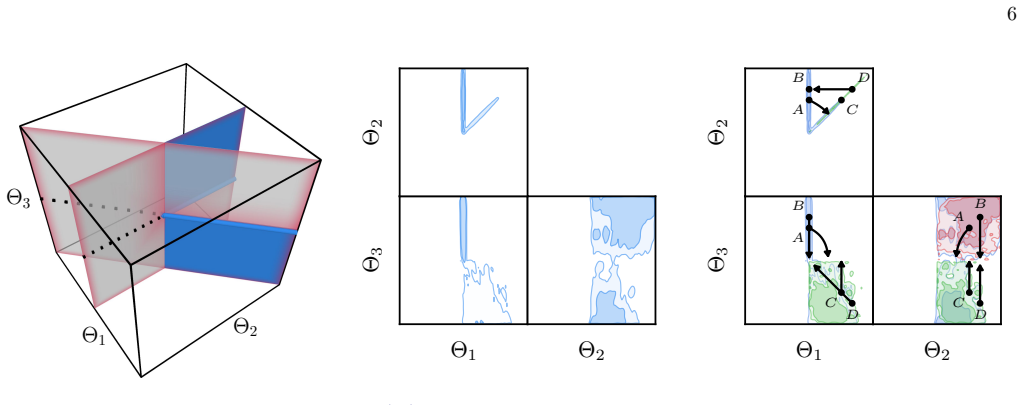
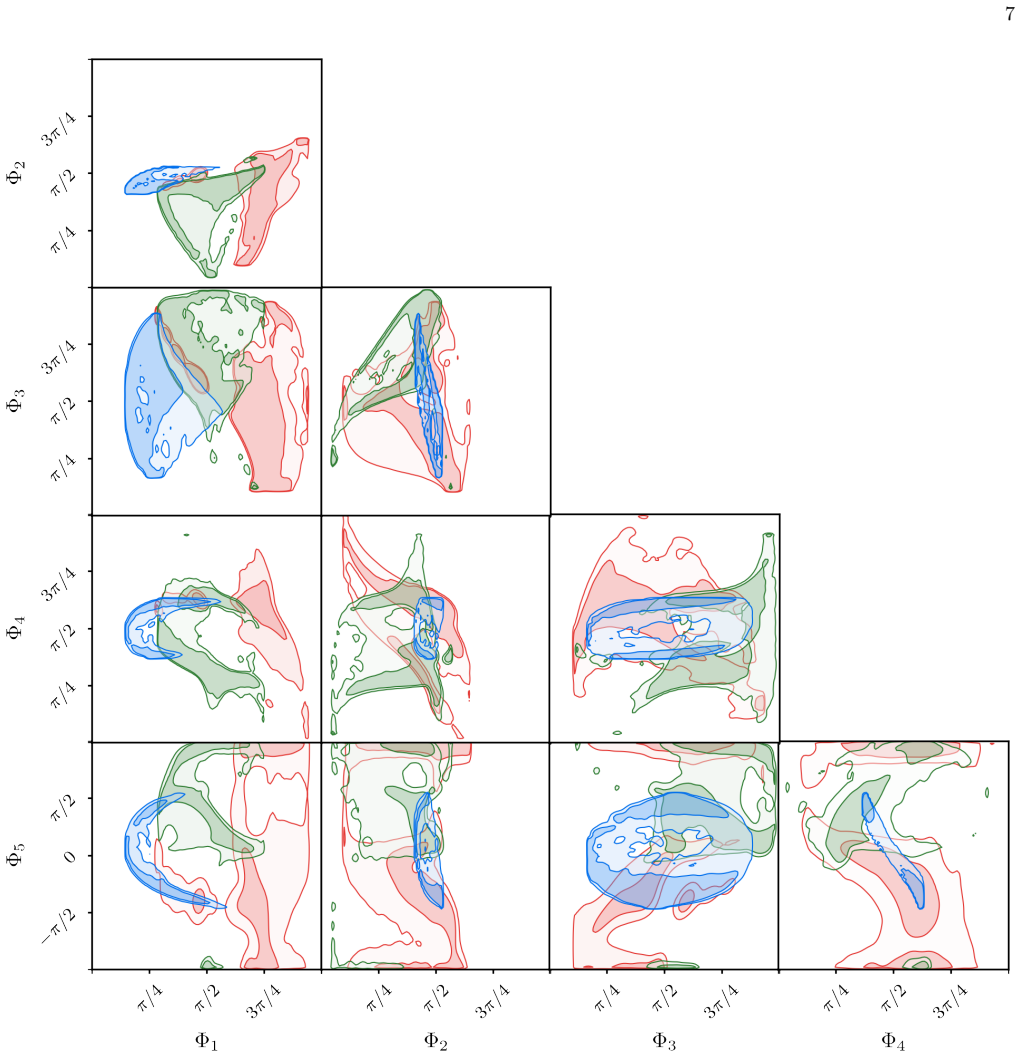
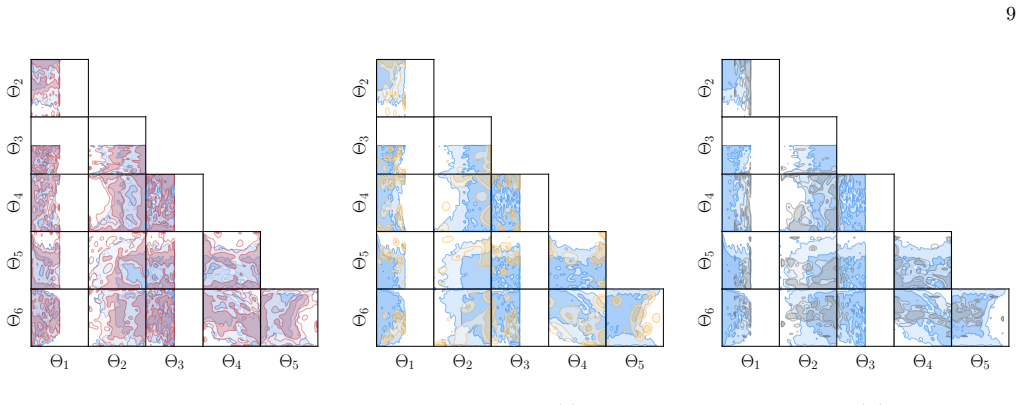
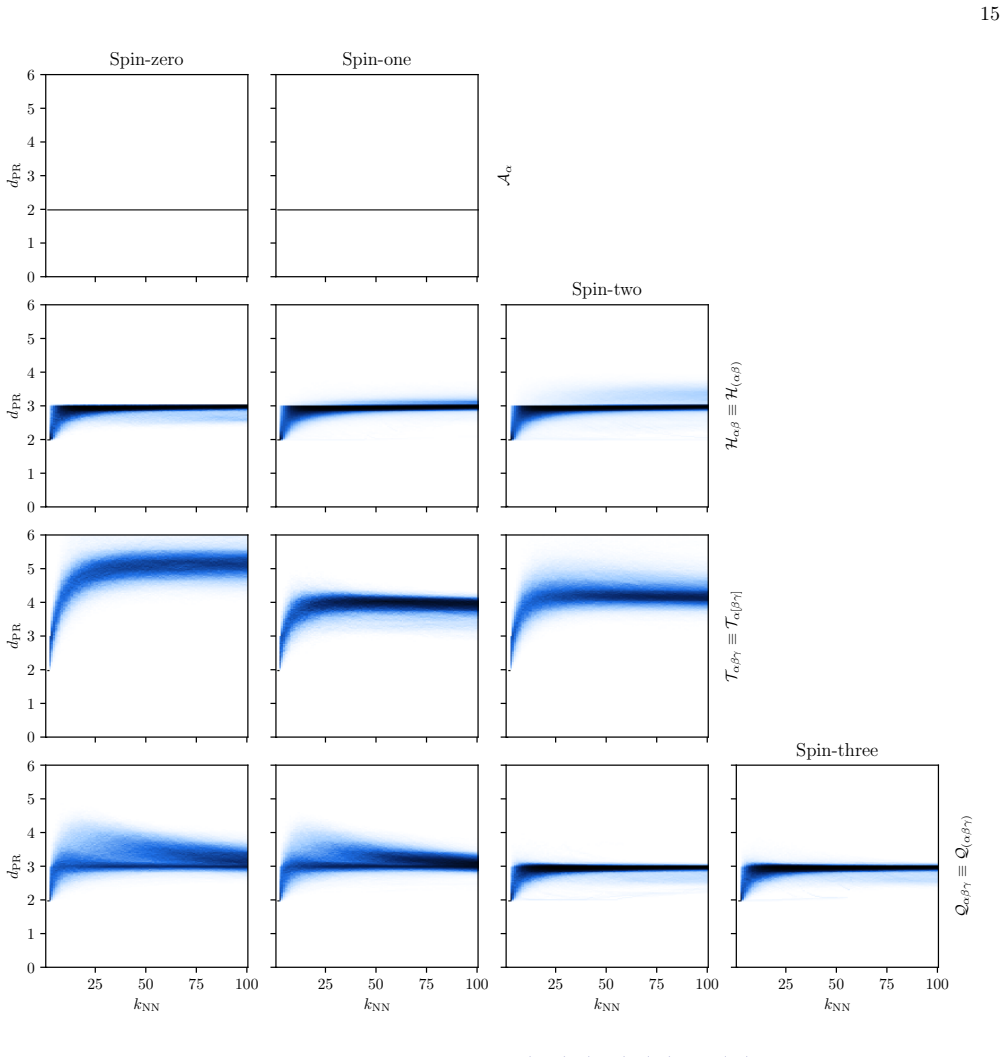
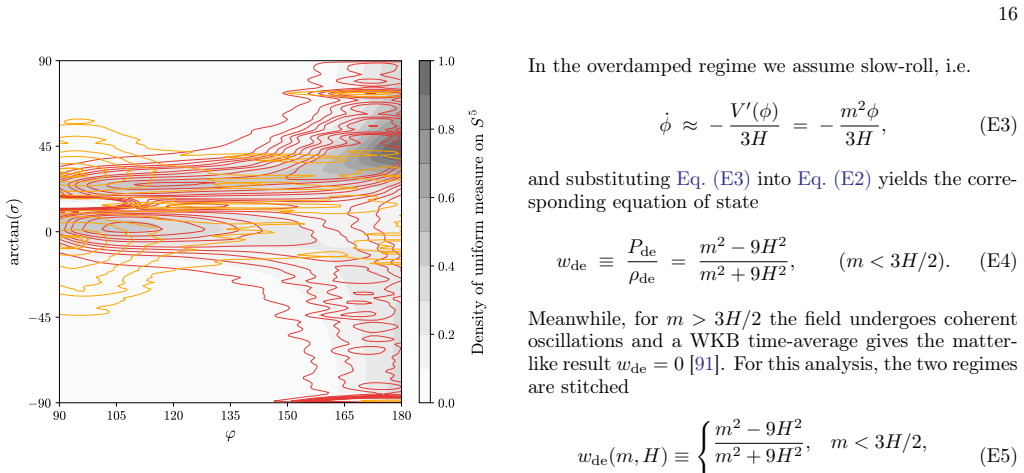
The dark sector need not be restricted to simple field content. Indeed, simple bosonic configurations, such as scalar-tensor or dark photon models, contrast with the much richer picture painted by many ultraviolet scenarios. Polology is the study of propagator poles, which correspond to particle states in any given theory. We outline a numerical polology framework for discovering perturbative, ghost-free models with consistent interactions, which produces theoretical model priors by sampling the coupling space. The method is tested on tensor field theories of up to rank three. Subsequent observational constraint pipelines are illustrated for black hole superradiance (M33 X-7), dynamical dark energy (DESI DR2, Pantheon and SH0ES) and gravitational waves (GWTC-3).
Editorial analysis
A structured set of objections, weighed in public.
Referee Report
Summary. The paper outlines a numerical polology framework that samples the coupling space of tensor field theories (up to rank three) to generate perturbative, ghost-free models with consistent interactions; these models then supply theoretical priors that are fed into observational constraint pipelines for black hole superradiance (M33 X-7), dynamical dark energy (DESI DR2, Pantheon, SH0ES), and gravitational waves (GWTC-3).
Significance. If the sampling procedure demonstrably produces only ghost-free spectra and consistent interactions without hidden analytic constraints or overlooked non-perturbative effects, the method would supply a reproducible route from UV-inspired field content to cosmology-ready priors, a capability that is currently absent from most model-building pipelines.
major comments (3)
- [§3.2] §3.2 (numerical polology algorithm): the claim that the Monte-Carlo sampling of couplings automatically enforces ghost-free spectra rests on the numerical identification of propagator poles; no explicit test is shown that the chosen root-finding tolerance or discretization grid excludes spurious poles or misses narrow resonances, which directly affects the reliability of the generated priors.
- [§4.1] §4.1 (rank-3 tensor example): the reported interaction consistency is verified only at tree level for a subset of sampled points; it is unclear whether the same sampling procedure continues to yield consistent vertices once loop corrections or higher-rank operators are included, which is load-bearing for the claim that the framework scales beyond the tested cases.
- [§5] §5 (observational pipelines): the mapping from sampled models to likelihoods for DESI DR2 + Pantheon + SH0ES assumes that the effective dark-energy equation-of-state parameters extracted from the polology output are free of additional theoretical uncertainties; no propagation of the sampling variance into the final posteriors is presented.
minor comments (3)
- [Abstract, §2] The abstract and §2 use “polology” without a concise one-sentence definition; a short parenthetical gloss would aid readers unfamiliar with the term.
- [Figure 2] Figure 2 (sampling distribution) lacks axis labels on the coupling-plane projection and does not indicate the total number of accepted samples.
- [References] Reference list omits the original polology literature that the numerical extension builds upon.
Simulated Author's Rebuttal
We thank the referee for their thorough review and valuable comments on our manuscript. We address each of the major comments point by point below, and indicate where revisions will be made.
read point-by-point responses
-
Referee: [§3.2] §3.2 (numerical polology algorithm): the claim that the Monte-Carlo sampling of couplings automatically enforces ghost-free spectra rests on the numerical identification of propagator poles; no explicit test is shown that the chosen root-finding tolerance or discretization grid excludes spurious poles or misses narrow resonances, which directly affects the reliability of the generated priors.
Authors: We agree that demonstrating the robustness of the pole-finding procedure is essential. In the revised manuscript, we will add a dedicated subsection or appendix presenting convergence tests with respect to root-finding tolerance and grid discretization. These tests will show that the identified ghost-free spectra remain stable under reasonable variations in these parameters. revision: yes
-
Referee: [§4.1] §4.1 (rank-3 tensor example): the reported interaction consistency is verified only at tree level for a subset of sampled points; it is unclear whether the same sampling procedure continues to yield consistent vertices once loop corrections or higher-rank operators are included, which is load-bearing for the claim that the framework scales beyond the tested cases.
Authors: The manuscript presents the framework and demonstrates it for tree-level interactions up to rank three. We will revise the text to explicitly state the scope of the current implementation and note that extending to loop corrections would require additional computational developments not covered here. The sampling procedure is modular and can be adapted for higher-order calculations in future work. revision: partial
-
Referee: [§5] §5 (observational pipelines): the mapping from sampled models to likelihoods for DESI DR2 + Pantheon + SH0ES assumes that the effective dark-energy equation-of-state parameters extracted from the polology output are free of additional theoretical uncertainties; no propagation of the sampling variance into the final posteriors is presented.
Authors: We acknowledge the importance of including sampling uncertainties in the observational analysis. We will update the manuscript to propagate the variance from the Monte-Carlo sampling into the likelihoods where feasible, or provide a discussion of why the effect is negligible for the current precision of the data. revision: yes
Circularity Check
No significant circularity detected
full rationale
The paper outlines a numerical polology framework that samples coupling space in tensor field theories (up to rank 3) to generate theoretical model priors for perturbative ghost-free models with consistent interactions. No equations, derivations, or self-citations are provided in the abstract or described content that reduce any central claim to a self-definitional loop, fitted input renamed as prediction, or load-bearing self-citation chain. The sampling produces priors that are then subjected to external observational constraints (e.g., DESI, Pantheon, GWTC-3), keeping the method self-contained and independent of the target results.
Axiom & Free-Parameter Ledger
axioms (1)
- domain assumption Tensor field theories of rank up to three provide a sufficient testbed for the numerical polology method
Reference graph
Works this paper leans on
-
[1]
P. Athronet al.(GAMBIT), Thermal WIMPs and the scale of new physics: global fits of Dirac dark matter 11 The use ofJAXthroughout opens the door, in principle, to an eventual GPU acceleration of the algorithm. Note that, for all the models considered in this work, the sampling procedure has a walltime of minutes on a single CPU core at double precision. ef...
-
[2]
C. Balázset al., Cosmological constraints on decaying axion-like particles: a global analysis, JCAP12, 027, arXiv:2205.13549 [astro-ph.CO]
-
[3]
P. Stöckeret al.(GAMBIT Cosmology Workgroup), Strengthening the bound on the mass of the lightest neutrino with terrestrial and cosmological experiments, Phys. Rev. D103, 123508 (2021), arXiv:2009.03287 [astro-ph.CO]. 20
-
[4]
N. Arkani-Hamed and J. Maldacena, Cosmological Col- lider Physics, arXiv preprint (2015), arXiv:1503.08043 [hep-th]
work page internal anchor Pith review Pith/arXiv arXiv 2015
-
[5]
Quasi-Single Field Inflation and Non-Gaussianities
X. Chen and Y. Wang, Quasi-Single Field Inflation and Non-Gaussianities, JCAP04, 027, arXiv:0911.3380 [hep-th]
work page internal anchor Pith review Pith/arXiv arXiv
-
[6]
The Effective Field Theory of Inflation
C. Cheung, P. Creminelli, A. L. Fitzpatrick, J. Kaplan, and L. Senatore, The Effective Field Theory of Inflation, JHEP03, 014, arXiv:0709.0293 [hep-th]
work page internal anchor Pith review Pith/arXiv arXiv
-
[7]
Effective Field Theory for Inflation
S. Weinberg, Effective Field Theory for Inflation, Phys. Rev. D77, 123541 (2008), arXiv:0804.4291 [hep-th]
work page internal anchor Pith review Pith/arXiv arXiv 2008
-
[8]
The Effective Theory of Quintessence: the w<-1 Side Unveiled
P. Creminelli, G. D’Amico, J. Norena, and F. Vernizzi, The Effective Theory of Quintessence: the w<-1 Side Unveiled, JCAP02, 018, arXiv:0811.0827 [astro-ph]
work page internal anchor Pith review Pith/arXiv arXiv
-
[9]
The Effective Field Theory of Dark Energy
G. Gubitosi, F. Piazza, and F. Vernizzi, The Effec- tive Field Theory of Dark Energy, JCAP02, 032, arXiv:1210.0201 [hep-th]
work page internal anchor Pith review Pith/arXiv arXiv
-
[10]
Essential Building Blocks of Dark Energy
J. Gleyzes, D. Langlois, F. Piazza, and F. Vernizzi, Es- sential Building Blocks of Dark Energy, JCAP08, 025, arXiv:1304.4840 [hep-th]
work page internal anchor Pith review Pith/arXiv arXiv
-
[11]
Weinberg, Phenomenological Lagrangians, Physica A 96, 327 (1979)
S. Weinberg, Phenomenological Lagrangians, Physica A 96, 327 (1979)
1979
-
[12]
S. R. Coleman, J. Wess, and B. Zumino, Structure of phenomenologicalLagrangians.1.,Phys.Rev.177,2239 (1969)
1969
-
[13]
C. G. Callan, Jr., S. R. Coleman, J. Wess, and B. Zu- mino, Structure of phenomenological Lagrangians. 2., Phys. Rev.177, 2247 (1969)
1969
- [14]
- [15]
-
[16]
C. Chang, P. Scott, T. E. Gonzalo, F. Kahlhoefer, and M. White, Global fits of simplified models for dark matter with GAMBIT: II. Vector dark matter with an s-channel vector mediator, Eur. Phys. J. C83, 692 (2023), [Erratum: Eur.Phys.J.C 83, 768 (2023)], arXiv:2303.08351 [hep-ph]
-
[17]
F. A. Berends, G. J. H. Burgers, and H. van Dam, On the Theoretical Problems in Constructing Interactions Involving Higher Spin Massless Particles, Nucl. Phys. B 260, 295 (1985)
1985
-
[18]
Cubic interactions of Maxwell-like higher spins
D. Francia, G. L. Monaco, and K. Mkrtchyan, Cubic interactions of Maxwell-like higher spins, JHEP04, 068, arXiv:1611.00292 [hep-th]
work page internal anchor Pith review Pith/arXiv arXiv
-
[19]
Marzo, Radiatively stable ghost and tachyon free- dom in metric affine gravity, Phys
C. Marzo, Radiatively stable ghost and tachyon free- dom in metric affine gravity, Phys. Rev. D106, 024045 (2022), arXiv:2110.14788 [hep-th]
-
[20]
C. Marzo, Can MAG be a predictive EFT? Radia- tive stability and ghost resurgence in massive vec- tor models, Class. Quant. Grav.42, 095007 (2025), arXiv:2403.15003 [hep-th]
-
[21]
’t Hooft, Naturalness, chiral symmetry, and sponta- neous chiral symmetry breaking, NATO Sci
G. ’t Hooft, Naturalness, chiral symmetry, and sponta- neous chiral symmetry breaking, NATO Sci. Ser. B59, 135 (1980)
1980
-
[22]
Deser, Gravity From Selfinteraction in a Curved Background, Class
S. Deser, Gravity From Selfinteraction in a Curved Background, Class. Quant. Grav.4, L99 (1987)
1987
-
[23]
L. M. Butcher, M. Hobson, and A. Lasenby, Boot- strapping gravity: A Consistent approach to energy- momentum self-coupling, Phys. Rev. D80, 084014 (2009), arXiv:0906.0926 [gr-qc]
work page internal anchor Pith review Pith/arXiv arXiv 2009
-
[24]
J. F. Donoghue, General relativity as an effective field theory: The leading quantum corrections, Phys. Rev. D 50, 3874 (1994), arXiv:gr-qc/9405057
work page internal anchor Pith review Pith/arXiv arXiv 1994
-
[25]
Donoghue, Quantum gravity as a low energy effective field theory, Scholarpedia12, 32997 (2017)
J. Donoghue, Quantum gravity as a low energy effective field theory, Scholarpedia12, 32997 (2017)
2017
-
[26]
A. E. Nelson and J. Scholtz, Dark Light, Dark Matter and the Misalignment Mechanism, Phys. Rev. D84, 103501 (2011), arXiv:1105.2812 [hep-ph]
work page internal anchor Pith review Pith/arXiv arXiv 2011
-
[27]
P. W. Graham, J. Mardon, and S. Rajendran, Vector Dark Matter from Inflationary Fluctuations, Phys. Rev. D93, 103520 (2016), arXiv:1504.02102 [hep-ph]
work page internal anchor Pith review Pith/arXiv arXiv 2016
- [28]
-
[29]
P. Pani, V. Cardoso, L. Gualtieri, E. Berti, and A. Ishibashi, Black hole bombs and photon mass bounds, Phys. Rev. Lett.109, 131102 (2012), arXiv:1209.0465 [gr-qc]
work page internal anchor Pith review Pith/arXiv arXiv 2012
-
[30]
P. Pani, V. Cardoso, L. Gualtieri, E. Berti, and A. Ishibashi, Perturbations of slowly rotating black holes: massive vector fields in the Kerr metric, Phys. Rev. D86, 104017 (2012), arXiv:1209.0773 [gr-qc]
work page internal anchor Pith review Pith/arXiv arXiv 2012
-
[31]
Black Hole Superradiance Signatures of Ultralight Vectors
M. Baryakhtar, R. Lasenby, and M. Teo, Black Hole Superradiance Signatures of Ultralight Vectors, Phys. Rev. D96, 035019 (2017), arXiv:1704.05081 [hep-ph]
work page internal anchor Pith review Pith/arXiv arXiv 2017
-
[32]
Constraining the mass of dark photons and axion-like particles through black-hole superradiance
V. Cardoso, Ó. J. C. Dias, G. S. Hartnett, M. Middle- ton, P. Pani, and J. E. Santos, Constraining the mass of darkphotonsandaxion-likeparticlesthroughblack-hole superradiance, JCAP03, 043, arXiv:1801.01420 [gr-qc]
work page internal anchor Pith review Pith/arXiv arXiv
-
[33]
R. Brito, V. Cardoso, and P. Pani, Massive spin- 2 fields on black hole spacetimes: Instability of the Schwarzschild and Kerr solutions and bounds on the graviton mass, Phys. Rev. D88, 023514 (2013), arXiv:1304.6725 [gr-qc]
work page internal anchor Pith review Pith/arXiv arXiv 2013
- [34]
-
[35]
S. Alexander, L. Jenks, and E. McDonough, Higher spin dark matter, Phys. Lett. B819, 136436 (2021), arXiv:2010.15125 [hep-ph]
-
[36]
A. Falkowski, G. Isabella, and C. S. Machado, On-shell effective theory for higher-spin dark matter, SciPost Phys.10, 101 (2021), arXiv:2011.05339 [hep-ph]
-
[37]
M. Jain and M. A. Amin, Polarized solitons in higher- spin wave dark matter, Phys. Rev. D105, 056019 (2022), arXiv:2109.04892 [hep-th]
-
[38]
Klein, Quantum Theory and Five-Dimensional The- ory of Relativity
O. Klein, Quantum Theory and Five-Dimensional The- ory of Relativity. (In German and English), Z. Phys.37, 895 (1926)
1926
-
[39]
Gordon, Der Comptoneffekt nach der Schrödinger- schen Theorie, Z
W. Gordon, Der Comptoneffekt nach der Schrödinger- schen Theorie, Z. Phys.40, 117 (1926)
1926
-
[40]
Proca, Sur la theorie ondulatoire des electrons posi- tifs et negatifs, J
A. Proca, Sur la theorie ondulatoire des electrons posi- tifs et negatifs, J. Phys. Radium7, 347 (1936)
1936
-
[41]
Fierz, Force-free particles with any spin, Helv
M. Fierz, Force-free particles with any spin, Helv. Phys. Acta12, 3 (1939)
1939
-
[42]
Fierz and W
M. Fierz and W. Pauli, On relativistic wave equations forparticlesofarbitraryspininanelectromagneticfield, Proc. Roy. Soc. Lond. A173, 211 (1939)
1939
-
[43]
L. P. S. Singh and C. R. Hagen, Lagrangian formulation for arbitrary spin. 1. The boson case, Phys. Rev. D9, 898 (1974)
1974
-
[44]
de Wit and D
B. de Wit and D. Z. Freedman, Systematics of Higher Spin Gauge Fields, Phys. Rev. D21, 358 (1980). 21
1980
-
[45]
S. M. Klishevich and Y. M. Zinovev, On electromagnetic interactionofmassivespin-2particle,Phys.Atom.Nucl. 61, 1527 (1998), arXiv:hep-th/9708150
work page internal anchor Pith review Pith/arXiv arXiv 1998
-
[46]
Y. M. Zinoviev, On spin 3 interacting with gravity, Class. Quant. Grav.26, 035022 (2009), arXiv:0805.2226 [hep-th]
work page internal anchor Pith review Pith/arXiv arXiv 2009
- [47]
-
[48]
B. C. Allanach, SOFTSUSY: a program for calculating supersymmetric spectra, Comput. Phys. Commun.143, 305 (2002), arXiv:hep-ph/0104145
work page internal anchor Pith review Pith/arXiv arXiv 2002
-
[49]
F. Staub, SARAH, arXiv preprint (2008), arXiv:0806.0538 [hep-ph]
work page internal anchor Pith review Pith/arXiv arXiv 2008
-
[50]
SARAH 4: A tool for (not only SUSY) model builders
F. Staub, SARAH 4 : A tool for (not only SUSY) model builders, Comput. Phys. Commun.185, 1773 (2014), arXiv:1309.7223 [hep-ph]
work page internal anchor Pith review Pith/arXiv arXiv 2014
-
[51]
W. Porod, SPheno, a program for calculating supersym- metricspectra, SUSYparticledecaysandSUSYparticle production at e+ e- colliders, Comput. Phys. Commun. 153, 275 (2003), arXiv:hep-ph/0301101
work page internal anchor Pith review Pith/arXiv arXiv 2003
-
[52]
SPheno 3.1: extensions including flavour, CP-phases and models beyond the MSSM
W. Porod and F. Staub, SPheno 3.1: Extensions in- cluding flavour, CP-phases and models beyond the MSSM, Comput. Phys. Commun.183, 2458 (2012), arXiv:1104.1573 [hep-ph]
work page internal anchor Pith review Pith/arXiv arXiv 2012
-
[53]
Weinberg,The Quantum theory of fields
S. Weinberg,The Quantum theory of fields. Vol. 1: Foundations(Cambridge University Press, 2005)
2005
-
[54]
Van Nieuwenhuizen, On ghost-free tensor lagrangians andlinearizedgravitation,Nucl.Phys.B60,478(1973)
P. Van Nieuwenhuizen, On ghost-free tensor lagrangians andlinearizedgravitation,Nucl.Phys.B60,478(1973)
1973
-
[55]
D. E. Neville, A Gravity Lagrangian With Ghost Free Curvature**2 Terms, Phys. Rev. D18, 3535 (1978)
1978
-
[56]
D. E. Neville, Gravity Theories With Propagating Tor- sion, Phys. Rev. D21, 867 (1980)
1980
-
[57]
Sezgin, Class of Ghost Free Gravity Lagrangians With Massive or Massless Propagating Torsion, Phys
E. Sezgin, Class of Ghost Free Gravity Lagrangians With Massive or Massless Propagating Torsion, Phys. Rev. D24, 1677 (1981)
1981
-
[58]
Sezgin and P
E. Sezgin and P. van Nieuwenhuizen, New Ghost Free Gravity Lagrangians with Propagating Torsion, Phys. Rev. D21, 3269 (1980)
1980
-
[59]
Kuhfuss and J
R. Kuhfuss and J. Nitsch, Propagating Modes in Gauge Field Theories of Gravity, Gen. Rel. Grav.18, 1207 (1986)
1986
-
[60]
G. K. Karananas, The particle spectrum of parity- violating Poincaré gravitational theory, Class. Quant. Grav.32, 055012 (2015), arXiv:1411.5613 [gr-qc]
work page internal anchor Pith review Pith/arXiv arXiv 2015
-
[61]
G. K. Karananas,Poincaré, Scale and Conformal Sym- metries Gauge Perspective and Cosmological Ramifi- cations, Ph.D. thesis, Ecole Polytechnique, Lausanne (2016), arXiv:1608.08451 [hep-th]
work page internal anchor Pith review Pith/arXiv arXiv 2016
- [62]
-
[63]
R. Percacci and E. Sezgin, New class of ghost- and tachyon-free metric affine gravities, Phys. Rev. D101, 084040 (2020), [Erratum: Phys.Rev.D 111, 109902 (2025)], arXiv:1912.01023 [hep-th]
-
[64]
Marzo, Ghost and tachyon free propagation up to spin 3 in Lorentz invariant field theories, Phys
C. Marzo, Ghost and tachyon free propagation up to spin 3 in Lorentz invariant field theories, Phys. Rev. D 105, 065017 (2022), arXiv:2108.11982 [hep-ph]
- [65]
-
[66]
Y. Mikura and R. Percacci, Some simple theories of gravity with propagating nonmetricity, Eur. Phys. J. C 85, 377 (2025), arXiv:2401.10097 [gr-qc]
- [67]
- [68]
-
[69]
C. Marzo, Kummitus: a light-weight toolbox for count- ing DOF in perturbative QFT, arXiv preprint (2026), arXiv:2603.22451 [hep-th]
-
[70]
Y.-C. Lin, M. P. Hobson, and A. N. Lasenby, Ghost and tachyon free Poincaré gauge theories: A sys- tematic approach, Phys. Rev. D99, 064001 (2019), arXiv:1812.02675 [gr-qc]
work page internal anchor Pith review Pith/arXiv arXiv 2019
- [71]
- [72]
-
[73]
Lin,Ghost and tachyon free gauge theories of gravity: A systematic approach, Ph.D
Y.-C. Lin,Ghost and tachyon free gauge theories of gravity: A systematic approach, Ph.D. thesis, Cam- bridge U. (2020)
2020
-
[74]
F. Feroz and M. P. Hobson, Multimodal nested sam- pling: an efficient and robust alternative to MCMC methods for astronomical data analysis, Mon. Not. Roy. Astron. Soc.384, 449 (2008), arXiv:0704.3704 [astro- ph]
work page internal anchor Pith review Pith/arXiv arXiv 2008
-
[75]
Bayesian Selection of sign(mu) within mSUGRA in Global Fits Including WMAP5 Results
F. Feroz, B. C. Allanach, M. Hobson, S. S. Abdus- Salam, R. Trotta, and A. M. Weber, Bayesian Selection of sign(mu) within mSUGRA in Global Fits Including WMAP5 Results, JHEP10, 064, arXiv:0807.4512 [hep- ph]
work page internal anchor Pith review Pith/arXiv arXiv
-
[76]
anesthetic: nested sampling visualisation
W. Handley, anesthetic: nested sampling visualisation, J. Open Source Softw.4, 1414 (2019), arXiv:1905.04768 [astro-ph.IM]
work page internal anchor Pith review Pith/arXiv arXiv 2019
-
[77]
Theoretical Aspects of Massive Gravity
K. Hinterbichler, Theoretical Aspects of Massive Grav- ity, Rev. Mod. Phys.84, 671 (2012), arXiv:1105.3735 [hep-th]
work page internal anchor Pith review Pith/arXiv arXiv 2012
-
[78]
N. Arkani-Hamed, H. Georgi, and M. D. Schwartz, Ef- fective field theory for massive gravitons and gravity in theory space, Annals Phys.305, 96 (2003), arXiv:hep- th/0210184
-
[79]
C. de Rham, Massive Gravity, Living Rev. Rel.17, 7 (2014), arXiv:1401.4173 [hep-th]
work page internal anchor Pith review Pith/arXiv arXiv 2014
-
[80]
J.Bonifacio, P.G.Ferreira,andK.Hinterbichler,Trans- verse diffeomorphism and Weyl invariant massive spin 2: Linear theory, Phys. Rev. D91, 125008 (2015), arXiv:1501.03159 [hep-th]
work page internal anchor Pith review Pith/arXiv arXiv 2015
discussion (0)
Sign in with ORCID, Apple, or X to comment. Anyone can read and Pith papers without signing in.