Interpretation of the binned SNe Ia Master Sample data via a scalar quintessence component: phantom transition?
Pith reviewed 2026-07-02 06:15 UTC · model grok-4.3
The pith
Best-fit viscous quintessence model to binned SNe Ia data keeps effective equation of state below -1 at all redshifts with no transition.
A machine-rendered reading of the paper's core claim, the machinery that carries it, and where it could break.
Core claim
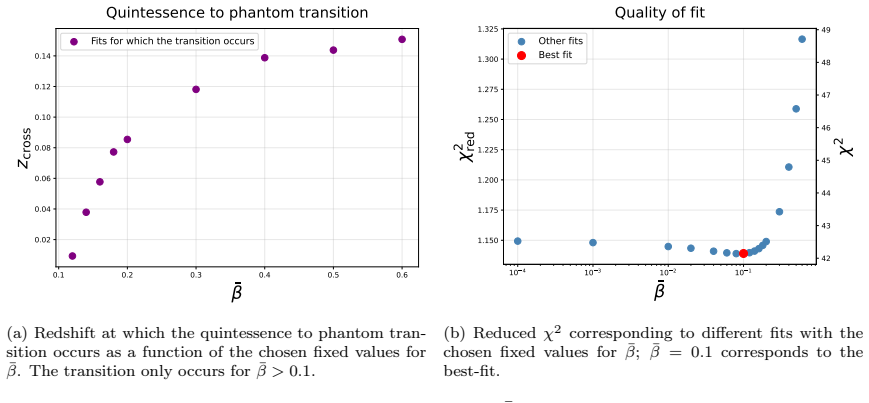
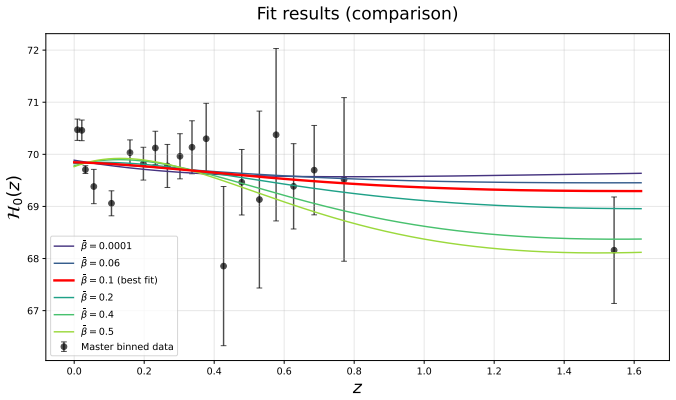
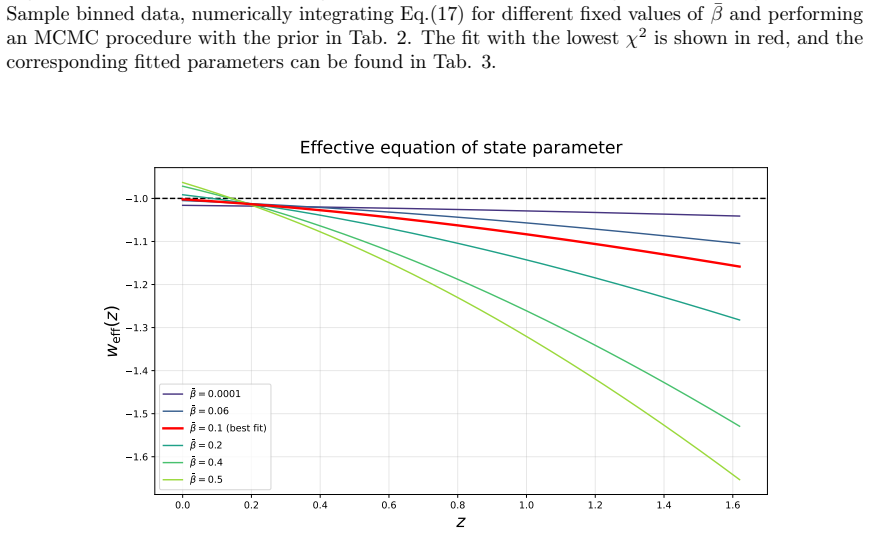
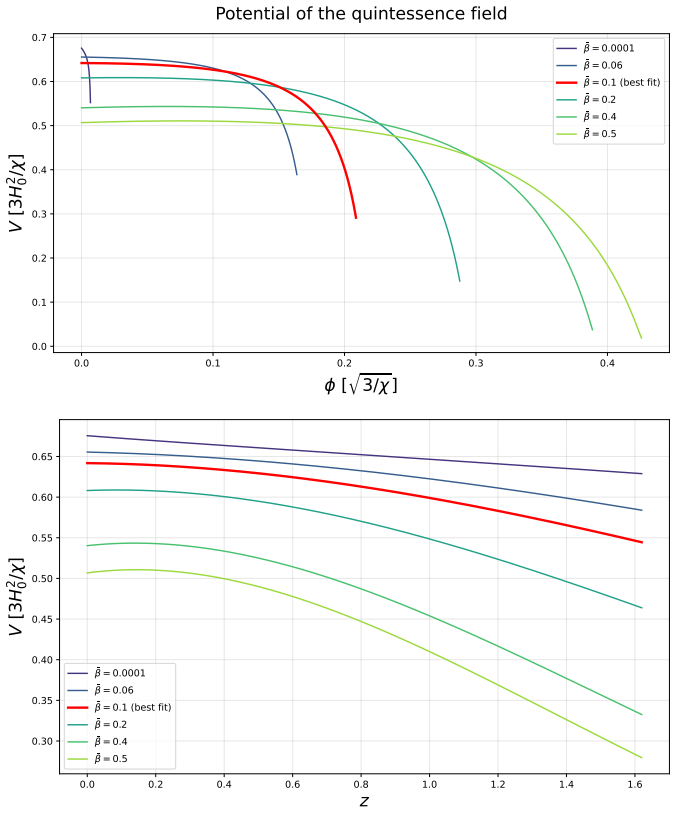
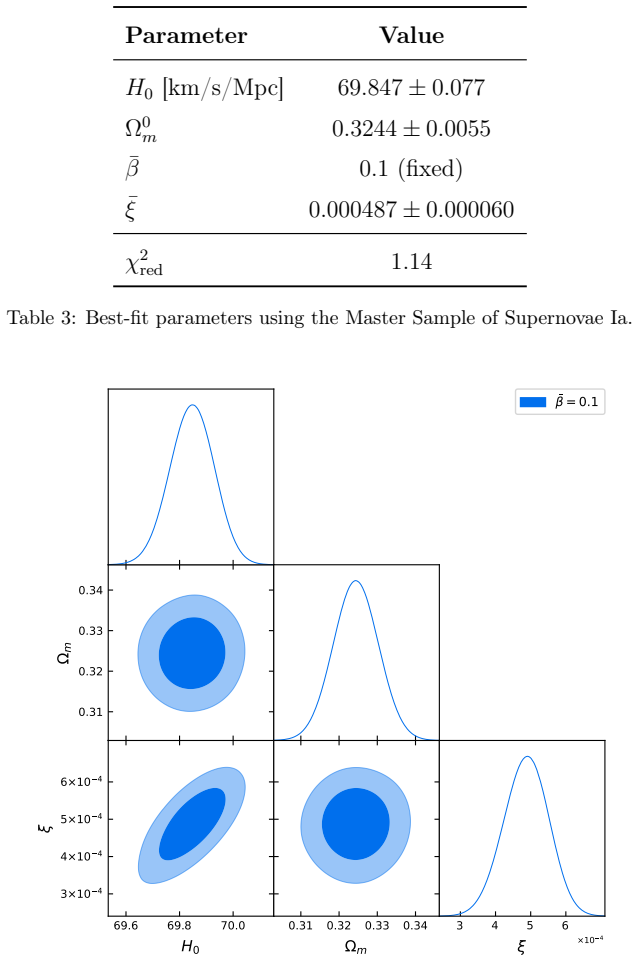
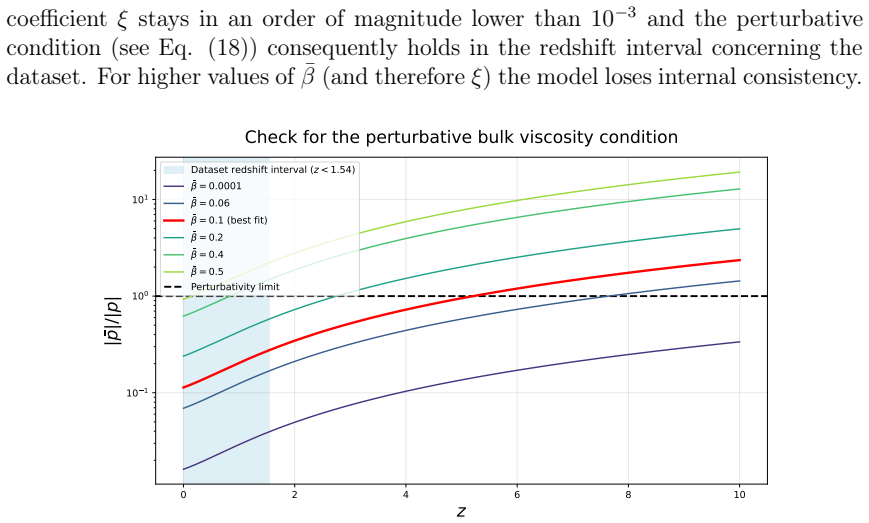
Within the viscous scalar-field framework the effective running Hubble constant is fitted to the binned SNe Ia Master Sample. The best-fit solution satisfies the slow-rolling condition because kinetic energy remains small compared with the potential throughout the redshift interval. For those same parameter values the effective equation of state parameter remains below -1 at every redshift, so no quintessence-to-phantom transition occurs. Supernovae data alone therefore supply no indication of a change in the nature of dark energy.
What carries the argument
Viscous contribution added to the scalar-field energy-momentum tensor, allowing an effective equation-of-state parameter that can lie below -1 while the underlying field remains quintessence-like.
If this is right
- The slow-rolling condition holds because kinetic energy stays small relative to potential energy over the full redshift interval.
- Any transition that might appear is pushed to redshifts significantly lower than the value reported by the DESI Collaboration.
- When the model is restricted to the parameter region that best matches the data, the effective equation of state never crosses -1.
Where Pith is reading between the lines
- The result applies only to supernova data; joint analyses with BAO or CMB measurements could still permit a transition at higher redshift.
- If future supernova surveys reach higher redshifts with smaller errors, they could directly test whether the effective w remains below -1.
- The viscosity term itself is an effective description; a microscopic derivation of the bulk-viscosity coefficient would be needed before the model can be extrapolated to early times.
Load-bearing premise
The binned Master Sample data are constructed by performing an MCMC fit that assumes a LambdaCDM model inside each redshift bin.
What would settle it
An independent re-binning or re-fitting of the same SNe Ia catalog performed without assuming LambdaCDM inside each bin that yields a best-fit transition at redshift greater than zero would falsify the no-transition result.
Figures
read the original abstract
We study a modified cosmological scenario for the late Universe, involving an evolutionary dark energy model associated with the dynamics of a self-interacting scalar field in a potential-dominated regime. Through the analogy with a fluid energy-momentum tensor, we introduce a viscous contribution to the scalar dynamics, accounting for effective non-equilibrium behaviour of the self-interacting scalar cluster. The resulting picture is that of an intrinsic quintessence contribution which, due to the bulk viscosity, admits an effective equation of state parameter that can also take values below -1. Within this framework, we set up the diagnostic tool of the so-called "effective running Hubble constant", which allows us to trace possible deviations from a standard LambdaCDM model. We then compare this theoretical function with binned data from the Master Sample of Supernovae Ia, constructed assuming a LambdaCDM model in the MCMC procedure performed in each bin. We show that the self-interacting scalar field corresponding to the best fit satisfies a slow-rolling condition, since the kinetic energy remains small compared to the potential contribution throughout the redshift interval. The key finding is that, when limiting the model to specific regions of the parameter space and fitting it to the data, the transition only occurs at redshifts significantly lower than the redshift value identified by the DESI Collaboration. Furthermore, for the parameter values ensuring the best fit, no quintessence-to-phantom transition occurs (i.e., the effective equation of state parameter remains below -1 across the whole redshift domain). In other words, Supernovae data alone provide no indication of a change in the nature of the dark energy.
Editorial analysis
A structured set of objections, weighed in public.
Referee Report
Summary. The manuscript introduces a viscous quintessence model for late-universe dark energy, where bulk viscosity allows an effective equation-of-state parameter w_eff that can fall below -1. An effective running Hubble constant is used as a diagnostic to fit the model to binned SNe Ia Master Sample data (constructed via per-bin LambdaCDM MCMC). The central result is that the best-fit parameters satisfy a slow-roll condition and yield w_eff < -1 at all redshifts, implying no quintessence-to-phantom transition and that SNe Ia data alone show no evidence for a change in the nature of dark energy.
Significance. If the no-transition result is robust, the work supplies a concrete counter-example to claims of evolving dark energy from other probes (e.g., DESI) by demonstrating consistency of SNe Ia with a non-transitioning viscous quintessence scenario. The explicit acknowledgment of the LambdaCDM-based binning procedure is a point of transparency, though it does not resolve the dependence of the conclusion on that preprocessing.
major comments (2)
- [Abstract] Abstract: The claim that 'Supernovae data alone provide no indication of a change in the nature of the dark energy' rests on fits to binned Master Sample data whose construction explicitly assumes a LambdaCDM cosmology in each bin's MCMC. Because this preprocessing embeds the constant-w = -1 hypothesis, any signature of a w_eff transition could be attenuated before the viscous-quintessence fit is performed; the no-transition conclusion is therefore not an independent test of the data but a consequence of the binning step. This is load-bearing for the central claim.
- [Abstract] Abstract (key-finding paragraph): The statement that 'for the parameter values ensuring the best fit, no quintessence-to-phantom transition occurs' follows after restricting the model to 'specific regions of the parameter space.' No explicit justification, prior ranges, or post-fit robustness checks against these restrictions are referenced, leaving open whether the w_eff < -1 result is selected by the data or imposed by the chosen parameter domain.
minor comments (1)
- [Abstract] The abstract supplies no derivation outline or explicit expression for the effective equation-of-state parameter that incorporates the viscous term, nor any mention of error bars or covariance on the reported best-fit values; these omissions hinder immediate assessment of the quantitative support for the no-transition statement.
Simulated Author's Rebuttal
We thank the referee for the careful reading and constructive comments on our manuscript. Below we respond point-by-point to the major comments, indicating where revisions will strengthen the presentation while preserving the core analysis.
read point-by-point responses
-
Referee: [Abstract] Abstract: The claim that 'Supernovae data alone provide no indication of a change in the nature of the dark energy' rests on fits to binned Master Sample data whose construction explicitly assumes a LambdaCDM cosmology in each bin's MCMC. Because this preprocessing embeds the constant-w = -1 hypothesis, any signature of a w_eff transition could be attenuated before the viscous-quintessence fit is performed; the no-transition conclusion is therefore not an independent test of the data but a consequence of the binning step. This is load-bearing for the central claim.
Authors: We acknowledge that the binned Master Sample is constructed via per-bin LambdaCDM MCMC fits, as already stated in the manuscript. This is the published form of the data set and the standard preprocessing used in the literature for such binned analyses. While the referee is correct that this step can limit sensitivity to transitions, our result remains that the viscous quintessence model provides a good fit to these data without requiring a transition at the redshifts suggested by DESI. We will revise the abstract to qualify the central claim explicitly as applying to the binned SNe Ia Master Sample constructed under LambdaCDM assumptions, thereby making the dependence transparent rather than overstating independence. revision: partial
-
Referee: [Abstract] Abstract (key-finding paragraph): The statement that 'for the parameter values ensuring the best fit, no quintessence-to-phantom transition occurs' follows after restricting the model to 'specific regions of the parameter space.' No explicit justification, prior ranges, or post-fit robustness checks against these restrictions are referenced, leaving open whether the w_eff < -1 result is selected by the data or imposed by the chosen parameter domain.
Authors: The phrase 'specific regions of the parameter space' refers to the slow-roll regime in which the kinetic energy remains negligible compared with the potential energy, a condition we verify explicitly for the best-fit parameters in the main text. The MCMC fit was performed over the full physically allowed ranges consistent with this regime; the best-fit point lies inside it. In revision we will (i) state the explicit prior ranges employed, (ii) add a short robustness paragraph confirming that the w_eff < -1 result is stable under modest excursions around the best-fit values, and (iii) clarify that the slow-roll restriction is theoretically motivated rather than arbitrarily imposed. revision: yes
Circularity Check
No circularity: standard model fit to externally provided binned data
full rationale
The paper constructs a viscous quintessence model with an effective running Hubble constant diagnostic, then performs a fit to the binned Master Sample data (explicitly noting the per-bin LambdaCDM MCMC construction). The reported outcome—that best-fit parameters yield w_eff < -1 with no transition—is the direct numerical result of that fit rather than a quantity defined to equal the input by construction. No self-definitional loop, fitted-input-renamed-as-prediction, load-bearing self-citation, uniqueness theorem, or ansatz smuggling appears in the derivation chain. The analysis is therefore self-contained against the supplied data.
Axiom & Free-Parameter Ledger
free parameters (1)
- viscosity coefficient and scalar potential parameters
axioms (2)
- domain assumption Scalar field remains in potential-dominated slow-roll regime throughout the redshift range.
- standard math Standard FLRW background cosmology.
invented entities (1)
-
viscous contribution to scalar dynamics
no independent evidence
Reference graph
Works this paper leans on
-
[1]
M. G.Dainotti, etal., A NewMaster Supernovae Iasample andthe investigation of the Hubble tension, JHEAp 48 (2025) 100405.arXiv:2501.11772,doi: 10.1016/j.jheap.2025.100405
-
[2]
DESI DR2 Results II: Measurements of Baryon Acoustic Oscillations and Cosmological Constraints
M. Abdul Karim, et al., DESI DR2 Results II: Measurements of Baryon Acoustic Oscillations and Cosmological Constraints (3 2025).arXiv:2503.14738
work page internal anchor Pith review Pith/arXiv arXiv 2025
-
[3]
A. G. Adame, et al., DESI 2024 VI: cosmological constraints from the measure- ments of baryon acoustic oscillations, JCAP 02 (2025) 021.arXiv:2404.03002, doi:10.1088/1475-7516/2025/02/021. 17
work page internal anchor Pith review Pith/arXiv arXiv doi:10.1088/1475-7516/2025/02/021 2024
-
[4]
A. G. Riess, W. Yuan, L. M. Macri, et al., A comprehensive measurement of the local value of the Hubble constant with 1 km s−1 Mpc−1uncertainty from the Hubble Space Telescope and the SH0ES team, The Astrophysical journal letters 934 (1) (2022) L7.doi:10.3847/2041-8213/ac5c5b
-
[5]
Aghanim, Y
N. Aghanim, Y. Akrami, M. Ashdown, et al., Planck 2018 results-VI. Cosmo- logical parameters, Astronomy & Astrophysics 641 (2020) A6
2018
-
[6]
M. Dainotti, B. De Simone, G. Montani, et al., The hubble constant ten- sion: current status and future perspectives through new cosmological probes, arXiv e-prints (2023) arXiv:2301.10572arXiv:2301.10572,doi:10.48550/ arXiv.2301.10572. URLhttps://ui.adsabs.harvard.edu/abs/2023arXiv230110572D
-
[7]
M. G. Dainotti, G. Bargiacchi, A. Ł. Lenart, et al., Quasar standardization: Overcoming selection biases and redshift evolution, The Astrophysical Jour- nal931 (2) (2022) 106.arXiv:2203.12914,doi:10.3847/1538-4357/ac6593. URLhttps://ui.adsabs.harvard.edu/abs/2022ApJ...931..106D
-
[8]
M. G. Dainotti, A. Ł. Lenart, M. G. Yengejeh, et al., A new binning method to choose a standard set of Quasars, Physics of the Dark Universe 44 (2024) 101428.arXiv:2401.12847,doi:10.1016/j.dark.2024.101428
-
[9]
URLhttps://ui.adsabs.harvard.edu/abs/2025PhRvD.112f3520M
S.Mukherjee, S.S.Pandey, A.S.Majumdar, Constrainingthehubbleparameter withthe21-cmbrightnesstemperaturesignalinauniversewithinhomogeneities, Physical Review D112 (6) (2025) 063520.arXiv:2505.22219,doi:10.1103/ w1wp-tqz2. URLhttps://ui.adsabs.harvard.edu/abs/2025PhRvD.112f3520M
-
[10]
M. G. Dainotti, G. Bargiacchi, A. Ł. Lenart, et al., The Scavenger Hunt for Quasar Samples to Be Used as Cosmological Tools, Galaxies 12 (1) (2024) 4. arXiv:2401.11998,doi:10.3390/galaxies12010004
-
[11]
M. G. Dainotti, A. Ł. Lenart, A. Chraya, et al., The gamma-ray bursts fun- damental plane correlation as a cosmological tool, Monthly Notices of the Royal Astronomical Society518 (2) (2023) 2201–2240.arXiv:2209.08675, doi:10.1093/mnras/stac2752. URLhttps://ui.adsabs.harvard.edu/abs/2023MNRAS.518.2201D
-
[12]
M. G. Dainotti, G. Sarracino, S. Capozziello, Gamma-ray bursts, supernovae ia, andbaryonacousticoscillations: Abinnedcosmologicalanalysis, Publicationsof 18 the Astronomical Society of Japan74 (5) (2022) 1095–1113.arXiv:2206.07479, doi:10.1093/pasj/psac057. URLhttps://ui.adsabs.harvard.edu/abs/2022PASJ...74.1095D
-
[13]
G. Bargiacchi, M. G. Dainotti, S. Capozziello, High-redshift cosmology by gamma-ray bursts: An overview, New Astronomy Reviews100 (2025) 101712. arXiv:2408.10707,doi:10.1016/j.newar.2024.101712. URLhttps://ui.adsabs.harvard.edu/abs/2025NewAR.10001712B
-
[14]
S. A. Adil, M. G. Dainotti, A. A. Sen, Revisiting the concordanceΛcdm model using gamma-ray bursts together with supernovae ia and planck data, Journal of Cosmology and Astroparticle Physics2024 (8) (2024) 015.arXiv:2405.01452, doi:10.1088/1475-7516/2024/08/015. URLhttps://ui.adsabs.harvard.edu/abs/2024JCAP...08..015A
-
[15]
B. P. Abbott, R. Abbott, T. D. Abbott, et al., Gw170817: Observation of gravitational waves from a binary neutron star inspiral, Physical Review Let- ters119 (16) (2017) 161101.arXiv:1710.05832,doi:10.1103/PhysRevLett. 119.161101. URLhttps://ui.adsabs.harvard.edu/abs/2017PhRvL.119p1101A
work page internal anchor Pith review Pith/arXiv arXiv doi:10.1103/physrevlett 2017
-
[16]
S. Kalita, A. Uniyal, T. Bulik, et al., Revealing limitation in the standard cosmological model: A redshift-dependent hubble constant from fast radio bursts, The Astrophysical Journal996 (1) (2026) 50.arXiv:2506.14947,doi: 10.3847/1538-4357/ae261b. URLhttps://ui.adsabs.harvard.edu/abs/2026ApJ...996...50K
-
[17]
A. Faucher, D. Benisty, D. F. Mota, Hubble-constant and -mass determination of centaurus a and m83 from tip-of-red-giant-branch distances, Astronomy & Astrophysics705 (2026) A112.arXiv:2510.09190,doi:10.1051/0004-6361/ 202556283. URLhttps://ui.adsabs.harvard.edu/abs/2026A&A...705A.112F
-
[18]
G. N. Gadbail, K. Bamba, A model-independent measurement of the hub- ble constant from gravitational-wave standard sirens and electromagnetic ob- servations, arXiv e-prints (2026) arXiv:2602.04497arXiv:2602.04497,doi: 10.48550/arXiv.2602.04497. URLhttps://ui.adsabs.harvard.edu/abs/2026arXiv260204497G
work page internal anchor Pith review Pith/arXiv arXiv doi:10.48550/arxiv.2602.04497 2026
-
[19]
Y. Zhan, D. Wang, S.-X. Yi, et al., Hubble constant measurement from quasiperiodic eruptions as electromagnetic counterparts to extreme mass ra- 19 tio inspirals, The Astrophysical Journal997 (2) (2026) 134.arXiv:2506.14150, doi:10.3847/1538-4357/ae2600. URLhttps://ui.adsabs.harvard.edu/abs/2026ApJ...997..134Z
-
[20]
Chevallier, D
M. Chevallier, D. Polarski, Accelerating universes with scaling dark matter, International Journal of Modern Physics D 10 (02) (2001) 213–223
2001
-
[21]
E. V. Linder, Exploring the expansion history of the universe, Physical review letters 90 (9) (2003) 091301
2003
-
[22]
Extended Dark Energy analysis using DESI DR2 BAO measurements
K. Lodha, et al., Extended Dark Energy analysis using DESI DR2 BAO mea- surements (3 2025).arXiv:2503.14743
work page internal anchor Pith review Pith/arXiv arXiv 2025
-
[23]
D. D. Y. Ong, D. Yallup, W. Handley, The bayesian view of desi dr2 with unim- peded: Evidence and tension in a combined analysis with cmb and supernovae across cosmological models (2026).arXiv:2603.05472. URLhttps://arxiv.org/abs/2603.05472
work page internal anchor Pith review Pith/arXiv arXiv 2026
-
[24]
G. Efstathiou, Evolving dark energy or supernovae systematics? (2025).arXiv: 2408.07175. URLhttps://arxiv.org/abs/2408.07175
-
[25]
S. Capozziello, H. Chaudhary, G. Mustafa, et al., Evidence of dynamical dark energy found via the desi dr2 lymanÎś forest, Astronomy & Astrophysics (Apr. 2026).doi:10.1051/0004-6361/202557820. URLhttp://dx.doi.org/10.1051/0004-6361/202557820
-
[26]
H. Chaudhary, S. Capozziello, S. Praharaj, et al., Is the ÎŻcdm model in crisis?, Journal of High Energy Astrophysics 50 (2026) 100507.doi:10.1016/j.jheap. 2025.100507. URLhttp://dx.doi.org/10.1016/j.jheap.2025.100507
-
[27]
H. Chaudhary, V. K. Sharma, S. Capozziello, et al., Probing departures from ÎŻcdm by late-time datasets, The Astrophysical Journal Supplement Series 283 (2) (2026) 73.doi:10.3847/1538-4365/ae4b3f. URLhttp://dx.doi.org/10.3847/1538-4365/ae4b3f
-
[28]
Evidence for evolving dark energy from DESI DR2 BAO and Pantheon$^+$, DES-Dovekie, and Union3
H. Chaudhary, S. Capozziello, V. K. Sharma, et al., Evidence for evolving dark energy from desi dr2 bao and pantheon+, des-dovekie, and union3 (2026). arXiv:2508.10514. URLhttps://arxiv.org/abs/2508.10514 20
work page internal anchor Pith review Pith/arXiv arXiv 2026
-
[29]
H. Chaudhary, S. Capozziello, V. K. Sharma, et al., Does desi dr2 challenge ÎŻcdm paradigm?, The Astrophysical Journal 992 (2) (2025) 194.doi:10. 3847/1538-4357/ae0458. URLhttp://dx.doi.org/10.3847/1538-4357/ae0458
-
[30]
Modeling nonlinear scales for dynamical dark energy cosmologies with COLA
J. RebouÃğas, V. Lloyd, J. Gordon, et al., Modeling nonlinear scales for dy- namical dark energy cosmologies with cola (2026).arXiv:2510.14888. URLhttps://arxiv.org/abs/2510.14888
work page internal anchor Pith review Pith/arXiv arXiv 2026
-
[31]
M.Ishak, L.Medina-Varela, Persistentandseriouschallengetotheλcdmthrone: Evidence for dynamical dark energy rising from combinations of different types of datasets (2025).arXiv:2507.22856. URLhttps://arxiv.org/abs/2507.22856
-
[32]
C.-G. Park, B. Ratra, Updated observational constraints onϕcdm dynamical dark energy cosmological models (2025).arXiv:2509.25812. URLhttps://arxiv.org/abs/2509.25812
work page internal anchor Pith review Pith/arXiv arXiv 2025
- [33]
-
[35]
M. CortÃłs, A. R. Liddle, Interpreting desiâĂŹs evidence for evolving dark energy, Journal of Cosmology and Astroparticle Physics 2024 (12) (2024) 007. doi:10.1088/1475-7516/2024/12/007. URLhttp://dx.doi.org/10.1088/1475-7516/2024/12/007
-
[36]
R. Calderon, K. Lodha, A. Shafieloo, et al., DESI 2024: reconstructing dark energyusingcrossingstatisticswithDESIDR1BAOdata, JournalofCosmology and Astroparticle Physics2024 (10) (2024) 048.arXiv:2405.04216,doi:10. 1088/1475-7516/2024/10/048
-
[37]
S. Tsujikawa, Quintessence: a review, Classical and Quantum Gravity 30 (21) (2013) 214003.doi:10.1088/0264-9381/30/21/214003. URLhttp://dx.doi.org/10.1088/0264-9381/30/21/214003 21
-
[38]
R. Caldwell, A phantom menace? cosmological consequences of a dark energy component with super-negative equation of state, Physics Letters B 545 (1âĂŞ2) (2002) 23âĂŞ29.doi:10.1016/s0370-2693(02)02589-3. URLhttp://dx.doi.org/10.1016/S0370-2693(02)02589-3
-
[39]
S. M. Carroll, M. Hoffman, M. Trodden, Can the dark energy equation-of-state parameter w be less than−1?, Phys. Rev. D 68 (2003) 023509.doi:10.1103/ PhysRevD.68.023509. URLhttps://link.aps.org/doi/10.1103/PhysRevD.68.023509
-
[40]
T. Schiavone, G. Montani, Evolution of an effective Hubble constant in f (R) modified gravity, Nuovo Cim. C 48 (3) (2025) 105.arXiv:2408.01410,doi: 10.1393/ncc/i2025-25105-3
-
[41]
M. G. Dainotti, B. De Simone, T. Schiavone, et al., On the Hubble constant tension in the SNe Ia Pantheon sample, The Astrophysical Journal 912 (2) (2021) 150
2021
-
[42]
E. Fazzari, M. G. Dainotti, G. Montani, et al., The effective running Hubble constant in SNe Ia as a marker for the dark energy nature, JHEAp 49 (2026) 100459.arXiv:2506.04162,doi:10.1016/j.jheap.2025.100459
-
[43]
M. G. Dainotti, B. De Simone, T. Schiavone, et al., On the evolution of the Hubble constant with the SNe Ia pantheon sample and baryon acoustic oscil- lations: a feasibility study for GRB-cosmology in 2030, Galaxies 10 (1) (2022) 24
2030
-
[44]
Physical Review D , keywords =
C. Krishnan, E. Ó. Colgáin, M. M. Sheikh-Jabbari, et al., Running Hubble Tension and a H0 Diagnostic, Phys. Rev. D 103 (10) (2021) 103509.arXiv: 2011.02858,doi:10.1103/PhysRevD.103.103509
- [45]
-
[46]
E. Di Valentino, O. Mena, S. Pan, et al., In the realm of the Hubble tensionâĂŤa review of solutions, Classical and Quantum Gravity 38 (15) (2021) 153001.doi: 10.1088/1361-6382/ac086d
-
[48]
G. Montani, E. Fazzari, N. Carlevaro, et al., Two Dynamical Scenarios for Binned Master Sample Interpretation, Entropy 27 (2025) 895.arXiv:2507. 14048,doi:10.3390/e27090895
-
[49]
G. Montani, N. Carlevaro, M. G. Dainotti, Running Hubble constant: Evolu- tionary Dark Energy, Phys. Dark Univ. 48 (2025) 101847.arXiv:2411.07060, doi:10.1016/j.dark.2025.101847
-
[51]
G. Montani, N. Carlevaro, L. A. Escamilla, et al., Kinetic model for dark en- ergy—dark matter interaction: Scenario for the hubble tension, Phys. Dark Univ. 48 (2025) 101848.arXiv:2404.15977,doi:10.1016/j.dark.2025. 101848
-
[52]
Efstathiou, ToH0 or not toH0?, Monthly Notices of the Royal Astronomical Society 505 (3) (2021) 3866–3872
G. Efstathiou, ToH0 or not toH0?, Monthly Notices of the Royal Astronomical Society 505 (3) (2021) 3866–3872
2021
-
[53]
Elizalde, M
E. Elizalde, M. Khurshudyan, S. D. Odintsov, Can we learn from matter creation to solve theH 0 tension problem?, The European Physical Journal C 84 (8) (2024) 782
2024
-
[54]
M. G. Dainotti, V. Petrosian, J. Singal, et al., Determination of the intrinsic luminosity time correlation in the x-ray afterglows of gamma-ray bursts, The AstrophysicalJournal774(2)(2013)157.doi:10.1088/0004-637X/774/2/157. URLhttps://doi.org/10.1088/0004-637X/774/2/157
- [55]
-
[56]
T. Schiavone, G. Montani, F. Bombacigno, f(R) gravity in the Jordan frame as a paradigm for the Hubble tension, Monthly Notices of the Royal Astronomical Society: Letters 522 (1) (2023) L72âĂŞL77.doi:10.1093/mnrasl/slad041
- [57]
-
[58]
LeClair, Quantum vacuum energy as the origin of gravity (2025).arXiv: 2509.02636
A. LeClair, Quantum vacuum energy as the origin of gravity (2025).arXiv: 2509.02636. URLhttps://arxiv.org/abs/2509.02636
-
[59]
Weinberg, Gravitation and Cosmology: Principles and Applications of the General Theory of Relativity, John Wiley and Sons, New York, 1972
S. Weinberg, Gravitation and Cosmology: Principles and Applications of the General Theory of Relativity, John Wiley and Sons, New York, 1972
1972
-
[60]
Montani, M
G. Montani, M. V. Battisti, R. Benini, et al., Primordial cosmology, World Scientific, Singapore, 2009
2009
-
[61]
V. A. Belinskii, I. M. Khalatnikov, Influence of viscosity on the character of cosmological evolution, Soviet JETT 42 (1975) 205
1975
-
[62]
V. A. Belinskii, I. M. Khalatnikov, Viscosity effects in isotropic cosmologies, Soviet JETT 45 (1977) 19
1977
-
[63]
V. A. Belinskii, E. S. Nikomarov, I. M. Khalatnikov, Investigation of the cos- mological evolution of viscoelastic matter with causal thermodynamics, Soviet JETT 50 (2) (1979) 21
1979
-
[65]
G. Montani, M. Venanzi, Bianchi i cosmology in the presence of a causally regularized viscous fluid, The European Physical Journal C 77 (7) (Jul. 2017). doi:10.1140/epjc/s10052-017-5042-z. URLhttp://dx.doi.org/10.1140/epjc/s10052-017-5042-z
-
[66]
N. Carlevaro, G. Montani, Bulk viscosity effects on the early Universe stability, Mod. Phys. Lett. A 20 (2005) 1729–1739.doi:10.1142/S0217732305017998
-
[67]
Weinberg, Cosmology, 2008
S. Weinberg, Cosmology, 2008
2008
-
[68]
E. W. Kolb, M. S. Turner, The Early Universe, Vol. 69, 1990
1990
-
[69]
J. A. Peacock, Cosmological Physics, Cambridge University Press, 1999
1999
-
[70]
M. E. Peskin, D. V. Schroeder, An Introduction to Quantum Field Theory, Addison-Wesley, 1995. 24
1995
-
[71]
Efstathiou, S
G. Efstathiou, S. Gratton, The evidence for a spatially flat universe, Monthly Notices of the Royal Astronomical Society: Letters 496 (1) (2020) L91–L95
2020
- [72]
-
[73]
C.Krishnan, E.ÓColgáin, M.M.Sheikh-Jabbari, etal., Runninghubbletension and a h0 diagnostic, Phys. Rev. D 103 (2021) 103509.doi:10.1103/PhysRevD. 103.103509. URLhttps://link.aps.org/doi/10.1103/PhysRevD.103.103509
-
[74]
C. Krishnan, R. Mondol,h0 as a universal flrw diagnostic (2022).arXiv:2201. 13384. URLhttps://arxiv.org/abs/2201.13384
-
[75]
D. C. T. M. C. Abbott, M. Acevedo, M. Aguena, et al., The dark energy survey: Cosmology results with 1500 new high-redshift type ia supernovae using the full 5-year dataset (2025).arXiv:2401.02929. URLhttps://arxiv.org/abs/2401.02929
work page internal anchor Pith review Pith/arXiv arXiv 2025
-
[76]
D. Scolnic, D. Brout, A. Carr, et al., The Pantheon+ Analysis: The Full Data Set and Light-curve Release, The Astrophysical Journal 938 (2) (2022) 113. doi:10.3847/1538-4357/ac8b7a
-
[77]
D. Brout, D. Scolnic, B. Popovic, et al., The Pantheon+ Analysis: Cos- mological Constraints, The Astrophysical Journal 938 (2) (2022) 110.doi: 10.3847/1538-4357/ac8e04
-
[78]
D. M. Scolnic, D. Jones, A. Rest, et al., The complete light-curve sample of spectroscopically confirmed SNe Ia from Pan-STARRS1 and cosmological con- straints from the combined pantheon sample, The Astrophysical Journal 859 (2) (2018) 101
2018
-
[79]
Betoule, R
M. Betoule, R. Kessler, J. Guy, et al., Improved cosmological constraints from a joint analysis of the SDSS-II and SNLS supernova samples, Astronomy & Astrophysics 568 (2014) A22
2014
-
[80]
M. Dainotti, G. Bargiacchi, M. Bogdan, et al., On the statistical assumption on the distance moduli of supernovae ia and its impact on the determination 25 of cosmological parameters, Journal of High Energy Astrophysics 41 (2024) 30–41.doi:https://doi.org/10.1016/j.jheap.2024.01.001. URLhttps://www.sciencedirect.com/science/article/pii/ S2214404824000016
-
[81]
M. G. Dainotti, G. Bargiacchi, M. Bogdan, et al., Reducing the uncertainty on the hubble constant up to 35% with an improved statistical analysis: Different best-fit likelihoods for type ia supernovae, baryon acoustic oscillations, quasars, and gamma-ray bursts, The Astrophysical Journal 951 (1) (2023) 63.doi: 10.3847/1538-4357/acd63f. URLhttp://dx.doi.or...
-
[82]
G. Bargiacchi, M. G. Dainotti, S. Nagataki, et al., Gamma-ray bursts, quasars, baryonic acoustic oscillations, and supernovae ia: new statistical insights and cosmological constraints, Monthly Notices of the Royal Astronomical Society 521 (3) (2023) 3909–3924.doi:10.1093/mnras/stad763. URLhttp://dx.doi.org/10.1093/mnras/stad763
-
[83]
Gelman, D
A. Gelman, D. B. Rubin, Inference from iterative simulation using multiple sequences, Statistical science 7 (4) (1992) 457–472
1992
-
[84]
GetDist: a Python package for analysing Monte Carlo samples
A. Lewis, GetDist: a Python package for analysing Monte Carlo samples, JCAP 08 (2025) 025.arXiv:1910.13970,doi:10.1088/1475-7516/2025/08/025
work page internal anchor Pith review Pith/arXiv arXiv doi:10.1088/1475-7516/2025/08/025 2025
discussion (0)
Sign in with ORCID, Apple, or X to comment. Anyone can read and Pith papers without signing in.