REVIEW 1 major objections 6 minor 44 references
Reviewed by Pith at T0; open to challenge.
T0 means a machine referee read the full paper against a public rubric. The mark states how deep the mechanical check went, never who wrote it. the ladder, T0–T4 →
T0 review · glm-5.2
Simulation Grows Breakable Apple Trees on a Laptop GPU
2026-07-08 09:18 UTC pith:2P5CXORO
load-bearing objection OrchardBench is a well-engineered simulation benchmark that fills a real gap, but its physical fidelity is asserted through parameter provenance rather than demonstrated against real trees. the 1 major comments →
OrchardBench: A Physically-Grounded, GPU-Parallel Apple-Orchard Simulation Benchmark for Agricultural Robotics
The pith
A machine-rendered reading of the paper's core claim, the machinery that carries it, and where it could break.
Core claim
The core technical discovery is that a compliant, breakable, fruit-bearing tree can be represented as a large sparse articulation (hundreds of compliant joints plus dozens of free fruit bodies) that remains stable and fast under a GPU-batched physics solver, provided three key engineering conditions are met: branch stiffness follows from beam theory and pipe-model taper so no per-joint tuning is needed, rupture is implemented as an in-place gain-zeroing operation that avoids model recompilation, and the mass-ratio problem of gram-scale twigs against a 130 kg robot is handled by added joint armature and a contact margin rather than dropping the contact. The paper shows that shared-dimension (
What carries the argument
Euler-Bernoulli torsional spring-damper branches with pipe-model taper; in-place rupture via gain zeroing; reduced-DOF (3-DOF translational) fruit on spring-damper tethers with branch reaction forces; per-environment domain randomization with fixed topology for GPU batching; matrix-free conjugate-gradient constraint solve; instanced massless foliage rigidly attached to branch bodies.
Load-bearing premise
The Euler-Bernoulli torsional-spring model with literature-derived (not directly measured) wood parameters accurately enough captures how a living apple tree bends, transmits forces, and breaks under robot contact that results in the simulator will correspond meaningfully to real-world behavior.
What would settle it
Compare branch bending angles, rupture moments, and fruit detachment forces measured on live apple trees under controlled robot contact against the simulator's predictions under identical loading conditions. If the simulator's bending deflection, rupture threshold, or detachment force differs substantially from live-tree measurements, the physical grounding is insufficient for the benchmark's metrics to predict field performance.
If this is right
- Learned harvesting policies can be trained at GPU scale on thousands of randomized trees with damage as a first-class cost, potentially producing controllers that are safer to deploy on real orchards than those trained only on rigid-object benchmarks.
- The variable-foliage dial with perfect ground-truth fruit poses provides a controlled testbed for fruit detection under occlusion, isolating a problem that real orchard datasets cannot vary systematically.
- The canopy-zone breakdown metric (success by vertical and radial position) gives a diagnostic tool for identifying whether a controller's failures come from perception, reach, or contact, guiding targeted improvements.
- The generation and physics pipeline is not apple-specific; trellised vines, stone fruit, and other trained crop systems are natural extensions, making this a template for a family of physically-grounded agricultural benchmarks.
Where Pith is reading between the lines
- If the Euler-Bernoulli lumping does not accurately capture real branch compliance under robot contact, then all damage and success metrics are relative to a fictional plant, and any policy trained in this simulator may learn behaviors that exploit the discrepancy rather than transfer to real orchards. The paper explicitly acknowledges this as unvalidated.
- The finding that per-branch size variation across batched worlds breaks the parallel solve (a 15x slowdown) suggests a structural limit on how much geometric diversity can be achieved within a single GPU batch, which may constrain the sim-to-real transfer gap for policies trained on a single batch.
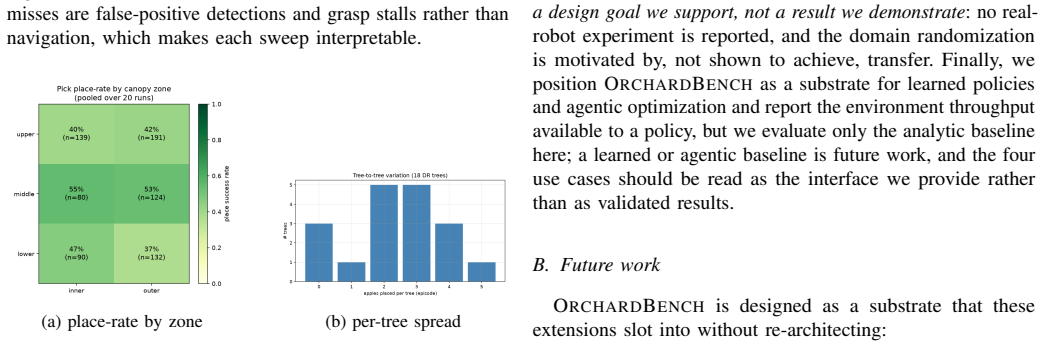
- The baseline's dominant failure mode being false-positive detections (committing to fruit that is not there) suggests that the perception bottleneck, rather than manipulation skill, is the highest-leverage area for improvement, and that learned detectors evaluated against this benchmark's ground truth could yield disproportionate gains.
- The damage-throughput tension exposed by the baseline (dropping six fruit per tree while harvesting only 12%) implies that unconstrained throughput optimization would be actively harmful in a real orchard, making the constrained Pareto formulation the practically relevant one.
Editorial analysis
A structured set of objections, weighed in public.
Referee Report
Summary. This paper presents OrchardBench, a GPU-parallel simulation benchmark for apple-orchard harvesting robotics built on the Newton/MuJoCo-Warp engine. The core contribution is a physically grounded tree model: branches are compliant torsional spring-dampers with Euler-Bernoulli beam-theoretic stiffness, rupture at a wood modulus of rupture with free-fall dynamics, and apples are independent rigid bodies on stem tethers that detach at literature-grounded pull forces. Around this plant model, the paper builds a complete benchmark: a stochastic L-system tree generator with per-environment domain randomization, a mobile manipulator (Ridgeback + Franka) with wrist depth sensing, a geometric (learning-free) fruit detector, an autonomous harvesting baseline, and a metric suite covering harvest completeness, throughput, plant damage, and per-canopy-zone success. The system runs hundreds of parallel environments on a single 8 GB laptop GPU. Baseline results show the analytic controller harvests ~12% of reachable fruit with ~0.2 branches snapped and ~6 fruit dropped per tree, leaving clear headroom for learned methods.
Significance. The paper addresses a genuine gap: existing GPU-parallel robot-learning simulators contain no compliant, breakable, fruit-bearing plants, while functional-structural plant models are geometrically detailed but physically inert. The engineering contributions are substantial and well-executed: the in-place rupture mechanism (zeroing joint gains without model recompile) is a clever solver-level innovation; the reduced-DOF fruit model and instanced foliage keep physics costs low; the domain randomization design that preserves GPU-batchable homogeneity while varying continuous parameters per-world is well reasoned. Every physical parameter in Table III is tied to a published source, and the parameter provenance appendix is exemplary in its transparency. The paper ships reproducible code, fixed evaluation seeds, and a versioned protocol. The honest scoping in Section VIII-A (grounded, not validated) is appropriate and strengthens the contribution. The benchmark fills a real need for the agricultural robotics community.
major comments (1)
- Section IV-A, Eq. (4) and Table III: the stiffness-proportional damping coefficient cd = 0.1 s is explicitly chosen for numerical stability rather than physical fidelity, and Table III notes physical branch damping ratios ζ ≈ 0.01–0.075 from [35] but does not use them. Since damage metrics (branches snapped, fruit dropped) are first-class outputs of the benchmark and depend directly on the damping regime — an over-damped tree absorbs impulsive contact too readily while an under-damped one whips and chain-snaps — the absence of any sensitivity analysis is a gap. The paper should either (a) compute the distribution of effective ζ_eff = cd·sqrt(Kp)/(2·sqrt(J)) across the joint population of a typical tree and show it falls within or near the cited physical range, or (b) run a brief sweep of cd and report how branches-snapped and fruit-dropped metrics respond. This would establish whether 's
minor comments (6)
- Table II: the headline baseline table reports point estimates only (e.g., ~0.2 branches snapped, ~6 fruit dropped), while the figures include 95% bootstrap CIs. Given the high tree-to-tree variance reported in Section VII-E (2.4 ± 1.5 fruit deposited), adding CIs to Table II would strengthen the baseline characterization.
- Section IV-E: foliage is massless and non-colliding, so the robot passes through leaves without physical resistance. This is a reasonable modeling choice for the stated purpose (controllable occlusion for perception), but the paper could briefly note that real foliage also provides mechanical resistance during canopy penetration, which is out of scope for the current model.
- Section VI, evaluation protocol: the paper references 'ORCHARDBENCH-V1: K held-out seeds' but does not specify the value of K. Stating K explicitly would aid reproducibility.
- Section IV-B, Eq. (5): the quasi-static rupture test omits the transient damper term Kd·ω. The paper notes this and adds N-frame hysteresis to suppress rate spikes. A one-sentence justification that dynamic rupture thresholds (where impact velocity lowers the failure deflection) are intentionally excluded as a modeling choice would clarify the scope.
- Abstract: 'Every physical parameter is tied to a published source' is technically accurate (cd is marked as a solver value in Table III), but a reader of the abstract alone may infer that the damping is also physically grounded. A brief qualifier (e.g., 'every physical material parameter') would prevent this misreading.
- Figure 6: the y-axis label on the left panel ('Physics step rate') could specify units (fps) in the axis label rather than only in the caption.
Simulated Author's Rebuttal
We thank the referee for a careful and constructive review. The single major comment concerns the absence of a sensitivity analysis for the stiffness-proportional damping coefficient cd, which is acknowledged as a solver-stability choice rather than a physically tuned value. The referee correctly identifies that damage metrics (branches snapped, fruit dropped) depend on the damping regime and that the paper cites physical damping ratios ζ ≈ 0.01–0.075 from [35] without using them directly. We agree this is a genuine gap and will address it in revision by computing the distribution of effective ζ_eff across the joint population of a typical tree and running a brief cd sweep, reporting the impact on branches-snapped and fruit-dropped metrics.
read point-by-point responses
-
Referee: Section IV-A, Eq. (4) and Table III: the stiffness-proportional damping coefficient cd = 0.1 s is explicitly chosen for numerical stability rather than physical fidelity, and Table III notes physical branch damping ratios ζ ≈ 0.01–0.075 from [35] but does not use them. Since damage metrics (branches snapped, fruit dropped) are first-class outputs of the benchmark and depend directly on the damping regime — an over-damped tree absorbs impulsive contact too readily while an under-damped one whips and chain-snaps — the absence of any sensitivity analysis is a gap. The paper should either (a) compute the distribution of effective ζ_eff = cd·sqrt(Kp)/(2·sqrt(J)) across the joint population of a typical tree and show it falls within or near the cited physical range, or (b) run a brief sweep of cd and report how branches-snapped and fruit-dropped metrics respond.
Authors: The referee is correct on all points. The paper explicitly states that cd = 0.1 s is chosen for numerical stability rather than physical fidelity, and Table III cites the physical damping ratio range ζ ≈ 0.01–0.075 from [35] without demonstrating that the effective per-joint ζ_eff falls within or near that range. Since damage metrics are first-class benchmark outputs and the referee rightly notes that the damping regime directly affects them — over-damping absorbs impulsive contact, under-damping causes whipping and chain-snapping — the absence of any sensitivity analysis is a genuine gap that weakens the benchmark's credibility on exactly the metrics it is designed to measure. We will address this in revision by implementing both of the referee's suggested analyses. First, we will compute the distribution of effective ζ_eff = cd·sqrt(Kp)/(2·sqrt(J)) across all joints of a typical generated tree and report it (as a figure or table), showing where it falls relative to the cited physical range. Because Kp ∝ r^4 and J depends on link geometry, ζ_eff varies substantially across the joint population, and this distribution will make clear whether the default cd places the tree within, above, or below the physical band. Second, we will run a brief sweep of cd over a range bracketing the default (e.g., cd ∈ {0.02, 0.05, 0.1, 0.2, 0.4} s) on the fixed evaluation seed set and report branches-snapped and fruit-dropped metrics at each setting, so that benchmark users can see how sensitive the damage metrics are to the damping choice. We will add these results to Section VII (Experiments) and update the discussion in Section IV-A and Table III accordingly. If the ζ_eff distribution falls outside the physical range for some joints, we will say so honestly and discuss the trade-off (e revision: yes
Circularity Check
No circularity found; the derivation chain is self-contained and externally grounded.
full rationale
I walked the paper's load-bearing derivation chain and found no step that reduces to its own inputs by construction. The branch stiffness formula Kp = (π/4)Er⁴/ℓ (Eq. 4) is standard Euler-Bernoulli beam theory, not a definition that presupposes its output. The rupture criterion |M| = Kp‖θ‖ > Mmax = σr·πr³/4 (Eq. 5) is standard solid mechanics with externally sourced σr. Fruit detachment forces (14–23 N) come from external literature [38–40]. Every physical parameter in Table III is tied to an external citation (Forest Products Laboratory, Wood Database, Niklas & Spatz, etc.). The damping coefficient cd = 0.1 s is explicitly flagged as a solver choice rather than a physical prediction or a fitted-then-predicted quantity. The baseline results in Table II are generated by the simulator itself, but this is appropriate for a benchmark paper: the paper does not claim these results validate physical accuracy, and Section VIII-A explicitly states 'results should be read as relative comparisons within the simulator rather than absolute predictions of field performance.' The citation of Jacob et al. [12] for the branch-compliance formulation is not self-citation (different author group). No uniqueness theorem is invoked. No ansatz is smuggled through citation. No known result is renamed and presented as novel derivation. The paper is self-contained against external benchmarks and its claims are proportionate to what it establishes.
Axiom & Free-Parameter Ledger
free parameters (6)
- cd (stiffness-proportional damping) =
0.1 s
- sigma_r (modulus of rupture) =
50 MPa
- E (Young's modulus) =
7 GPa
- fdetach (stem detachment force) =
14-23 N
- Tree height =
2.4 m
- Apple diameter =
4.8-7 cm
axioms (4)
- domain assumption Euler-Bernoulli beam theory accurately captures branch bending dynamics.
- domain assumption Green-wood mechanical properties can be estimated from dried-wood references with a reduction factor.
- ad hoc to paper The quasi-static elastic moment is the correct test for rupture (omitting transient damper term).
- domain assumption Torsional spring-dampers at branch junctions capture the essential dynamics of a tree.
invented entities (3)
-
OrchardBench benchmark
independent evidence
-
In-place rupture mechanism
independent evidence
-
Reduced-DOF fruit model
independent evidence
read the original abstract
Robotic tree-fruit harvesting is a flagship problem for agricultural automation, but progress is bottlenecked by the cost and irreproducibility of field experiments: an orchard is available only weeks a year, every tree is different, and a control error can permanently damage the crop or the plant. The tree models used in graphics and agronomy are geometrically detailed but physically inert, while the GPU-parallel simulators used in robot learning contain no plausible trees. We present OrchardBench, a physically-grounded, GPU-parallel simulation of apple-orchard trees on the Newton engine. Each tree is grown by a stochastic L-system and instantiated as a fully articulated body: branches are compliant torsional spring-dampers whose stiffness follows Euler-Bernoulli beam theory, they break at a wood modulus of rupture and fall as free hinges, and apples are independent bodies on stem tethers that detach at literature-grounded pull forces and load the branch when pulled. A moving, density-controllable foliage layer occludes the canopy as real leaves do. Every physical parameter is tied to a published source. Per-environment domain randomization makes each batched world a distinct tree, and a mobile manipulator with a wrist depth camera closes the loop with geometric fruit perception and an autonomous harvesting baseline. Careful engineering of the solver and the model lets OrchardBench run many parallel environments at interactive rates on a laptop GPU. We define the tasks and a metric suite spanning harvest completeness, throughput, and plant damage (with a per-canopy-zone breakdown), and report baseline results across foliage, fruit load, terrain, canopy zone, and parallelism. The analytic baseline succeeds on about 40% of the fruit it detects and harvests only about an eighth of the reachable fruit on a tree, leaving clear headroom for novel autonomy approaches.
Figures


Reference graph
Works this paper leans on
-
[1]
C. Wouter Bac, Eldert J. van Henten, Jochen Hemming, and Yael Edan. Harvesting robots for high-value crops: State-of-the-art review and challenges ahead.Journal of Field Robotics, 31(6):888–911, 2014
work page 2014
-
[2]
Davidson, Manoj Karkee, Changki Mo, Qin Zhang, and Karen Lewis
Abhisesh Silwal, Joseph R. Davidson, Manoj Karkee, Changki Mo, Qin Zhang, and Karen Lewis. Design, inte- gration, and field evaluation of a robotic apple harvester. Journal of Field Robotics, 34(6):1140–1159, 2017
work page 2017
-
[3]
Blok, Jochen Hem- ming, and Eldert van Henten
Gert Kootstra, Xin Wang, Pieter M. Blok, Jochen Hem- ming, and Eldert van Henten. Selective harvesting robotics: Current research, trends, and future directions. Current Robotics Reports, 2:95–104, 2021
work page 2021
-
[4]
Isaac Gym: High Performance GPU-Based Physics Simulation For Robot Learning
Viktor Makoviychuk, Lukasz Wawrzyniak, Yunrong Guo, et al. Isaac gym: High performance GPU-based physics simulation for robot learning.arXiv preprint arXiv:2108.10470, 2021
work page internal anchor Pith review Pith/arXiv arXiv 2021
-
[5]
MuJoCo: A physics engine for model-based control
Emanuel Todorov, Tom Erez, and Yuval Tassa. MuJoCo: A physics engine for model-based control. InIEEE/RSJ International Conference on Intelligent Robots and Sys- tems (IROS), pages 5026–5033, 2012
work page 2012
-
[6]
Springer-Verlag, New York, 1990
Przemyslaw Prusinkiewicz and Aristid Lindenmayer.The Algorithmic Beauty of Plants. Springer-Verlag, New York, 1990
work page 1990
-
[7]
Hisao Honda. Description of the form of trees by the parameters of the tree-like body.Journal of Theoretical Biology, 31(2):331–338, 1971
work page 1971
-
[8]
Evelyne Costes, Colin Smith, Michael Renton, Yann Gué- don, Przemyslaw Prusinkiewicz, and Christophe Godın. MAppleT: simulation of apple tree development using mixed stochastic and biomechanical models.Functional Plant Biology, 35(10):936–950, 2008
work page 2008
-
[9]
Stephen James, Zicong Ma, David Rovick Arrojo, and Andrew J. Davison. RLBench: The robot learning benchmark & learning environment.IEEE Robotics and Automation Letters (RA-L), 5(2):3019–3026, 2020
work page 2020
-
[10]
Meta- world: A benchmark and evaluation for multi-task and meta reinforcement learning
Tianhe Yu, Deirdre Quillen, Zhanpeng He, Ryan Julian, Karol Hausman, Chelsea Finn, and Sergey Levine. Meta- world: A benchmark and evaluation for multi-task and meta reinforcement learning. InProceedings of the 3rd Conference on Robot Learning (CoRL), volume 100 of Proceedings of Machine Learning Research. PMLR, 2019
work page 2019
-
[11]
Man- iSkill: Generalizable manipulation skill benchmark with large-scale demonstrations
Tongzhou Mu, Zhan Ling, Fanbo Xiang, et al. Man- iSkill: Generalizable manipulation skill benchmark with large-scale demonstrations. InNeurIPS Datasets and Benchmarks Track, 2021
work page 2021
-
[12]
Gentle manipulation of tree branches: A contact-aware policy learning approach
Jayadeep Jacob, Shizhe Cai, Paulo Vinicius Koerich Borges, Tirthankar Bandyopadhyay, and Fabio Ramos. Gentle manipulation of tree branches: A contact-aware policy learning approach. InProceedings of the 8th Conference on Robot Learning (CoRL), volume 270 ofProceedings of Machine Learning Research. PMLR,
-
[13]
URL https://proceedings.mlr.press/v270/jacob25a. html. PCAP: Proprioceptive Contact-Aware Policy
-
[14]
A quantitative analysis of plant form – the pipe model theory: I
Kichiro Shinozaki, Kyoji Yoda, Kazuo Hozumi, and Tatuo Kira. A quantitative analysis of plant form – the pipe model theory: I. basic analyses.Japanese Journal of Ecology, 14(3):97–105, 1964
work page 1964
-
[15]
The pipe model theory half a century on: a review.Annals of Botany, 121(5):773–795, 2018
Romain Lehnebach, Robert Beyer, Véronique Letort, and Patrick Heuret. The pipe model theory half a century on: a review.Annals of Botany, 121(5):773–795, 2018
work page 2018
-
[16]
Katherine A. McCulloh, John S. Sperry, and Frederick R. Adler. Water transport in plants obeys murray’s law. Nature, 421(6926):939–942, 2003
work page 2003
-
[17]
Biophysical optimality of the golden angle in phyllotaxis.Scientific Reports, 5:15358, 2015
Takuya Okabe. Biophysical optimality of the golden angle in phyllotaxis.Scientific Reports, 5:15358, 2015
work page 2015
-
[18]
Mayank Mittal, Calvin Yu, Qinxi Yu, Jingzhou Liu, Nikita Rudin, David Hoeller, Jia Lin Yuan, Ritvik Singh, Yunrong Guo, Hammad Mazhar, Ajay Mandlekar, Buck Babich, Gavriel State, Marco Hutter, and Animesh Garg. Orbit: A unified simulation framework for interactive robot learning environments.IEEE Robotics and Automa- tion Letters, 8(6):3740–3747, 2023. do...
work page doi:10.1109/lra 2023
-
[19]
Warp: A high-performance python framework for GPU simulation and graphics
Miles Macklin. Warp: A high-performance python framework for GPU simulation and graphics. InNVIDIA GTC / GitHub (NVIDIA/warp), 2022
work page 2022
-
[20]
Daniel Freeman, Erik Frey, Anton Raichuk, Sertan Girgin, Igor Mordatch, and Olivier Bachem
C. Daniel Freeman, Erik Frey, Anton Raichuk, Sertan Girgin, Igor Mordatch, and Olivier Bachem. Brax – a differentiable physics engine for large scale rigid body simulation. InAdvances in Neural Information Processing Systems (NeurIPS) Datasets and Benchmarks Track, 2021
work page 2021
-
[21]
Kevin Zakka, Baruch Tabanpour, Qiayuan Liao, Mustafa Haiderbhai, Samuel Holt, Jing Yuan Luo, Arthur Allshire, Erik Frey, Koushil Sreenath, Lueder A. Kahrs, Carmelo Sferrazza, Yuval Tassa, and Pieter Abbeel. MuJoCo play- ground: An open-source framework for GPU-accelerated robot learning and sim-to-real transfer.arXiv preprint arXiv:2502.08844, 2025
work page internal anchor Pith review Pith/arXiv arXiv 2025
-
[22]
Fanbo Xiang, Yuzhe Qin, Kaichun Mo, Yikuan Xia, Hao Zhu, Fangchen Liu, Minghua Liu, Hanxiao Jiang, Yifu Yuan, He Wang, Li Yi, Angel X. Chang, Leonidas J. Guibas, and Hao Su. SAPIEN: A simulated part-based interactive environment. InProceedings of the IEEE/CVF Conference on Computer Vision and Pattern Recognition (CVPR), pages 11097–11107, 2020
work page 2020
-
[23]
Genesis: A universal and generative physics engine for robotics and beyond
Genesis Authors. Genesis: A universal and generative physics engine for robotics and beyond. https://github. com/Genesis-Embodied-AI/Genesis, 2024. Open-source project (accessed 2026)
work page 2024
-
[24]
New- ton: An open-source GPU-accelerated physics engine for robotics simulation
NVIDIA, Google DeepMind, and Disney Research. New- ton: An open-source GPU-accelerated physics engine for robotics simulation. https://github.com/newton-physics/ newton, 2025. Built on NVIDIA Warp and OpenUSD; contributed to the Linux Foundation. Newton 1.3, docs https://newton-physics.github.io/newton/ (accessed 2026)
work page 2025
-
[25]
Igathinathane, Jieqing Li, Haiyan Cen, Yu Lu, and Paulo Flores
Zhao Zhang, C. Igathinathane, Jieqing Li, Haiyan Cen, Yu Lu, and Paulo Flores. Technology progress in mechanical harvest of fresh market apples.Computers and Electronics in Agriculture, 175:105606, 2020
work page 2020
-
[26]
Amol Gongal, Suraj Amatya, Manoj Karkee, Qin Zhang, and Karen Lewis. Sensors and systems for fruit detection and localization: A review.Computers and Electronics in Agriculture, 116:8–19, 2015
work page 2015
-
[27]
Walsh, Zhenglin Wang, and Cheryl McCarthy
Anand Koirala, Kerry B. Walsh, Zhenglin Wang, and Cheryl McCarthy. Deep learning – method overview and review of use for fruit detection and yield estimation. Computers and Electronics in Agriculture, 162:219–234, 2019
work page 2019
-
[28]
Min- neApple: A benchmark dataset for apple detection and segmentation
Nicolai Häni, Pravakar Roy, and V olkan Isler. Min- neApple: A benchmark dataset for apple detection and segmentation. InIEEE Robotics and Automation Letters (RA-L), 2020
work page 2020
-
[29]
Sercan Ozden and A. Roland Ennos. Why don’t branches snap? the mechanics of bending failure in three temperate tree species.Trees, 28:1657–1667, 2014
work page 2014
-
[30]
Domain randomization for transferring deep neural networks from simulation to the real world
Josh Tobin, Rachel Fong, Alex Ray, Jonas Schneider, Woj- ciech Zaremba, and Pieter Abbeel. Domain randomization for transferring deep neural networks from simulation to the real world. InIEEE/RSJ International Conference on Intelligent Robots and Systems (IROS), 2017
work page 2017
-
[31]
Sim-to-real transfer of robotic control with dynamics randomization
Xue Bin Peng, Marcin Andrychowicz, Wojciech Zaremba, and Pieter Abbeel. Sim-to-real transfer of robotic control with dynamics randomization. InIEEE International Conference on Robotics and Automation (ICRA), 2018
work page 2018
-
[32]
Wood handbook—wood as an engineering material
Forest Products Laboratory. Wood handbook—wood as an engineering material. Technical Report FPL-GTR-190, U.S. Department of Agriculture, Forest Service, 2010
work page 2010
-
[33]
Apple (Malus spp.) — the wood database
Eric Meier. Apple (Malus spp.) — the wood database. https://www.wood-database.com/apple/, 2020. Reports: specific gravity 0.61 (basic)/0.83 (12% MC), MOR 88.3 MPa, elastic modulus 8.76 GPa, crushing strength 41.6 MPa, Janka hardness 7700 N. Accessed 2026
work page 2020
-
[34]
Niklas and Hanns-Christof Spatz
Karl J. Niklas and Hanns-Christof Spatz. Worldwide correlations of mechanical properties and green wood density.American Journal of Botany, 97(10):1587–1594, 2010
work page 2010
-
[35]
David E. Kretschmann. Mechanical properties of wood. InWood Handbook—Wood as an Engineering Material, General Technical Report FPL-GTR-190, chapter 5, pages 5–1–5–46. U.S. Forest Products Laboratory, Madison, WI, 2010
work page 2010
-
[36]
Kenneth R. James. A study of branch dynamics on an open-grown tree.Arboriculture & Urban Forestry, 40(3): 125–134, 2014
work page 2014
-
[37]
Richard S. Smith, Soazig Guyomarc’h, Therese Mandel, Didier Reinhardt, Cris Kuhlemeier, and Przemyslaw Prusinkiewicz. A plausible model of phyllotaxis.Pro- ceedings of the National Academy of Sciences, 103(5): 1301–1306, 2006. doi: 10.1073/pnas.0510457103
- [38]
-
[39]
Experimental and simulation analysis of the detachment force of apple fruit
Lingxin Bu, Chengkun Chen, Guangrui Hu, Jianguang Zhou, Adilet Sugirbay, and Jun Chen. Experimental and simulation analysis of the detachment force of apple fruit. Scientia Horticulturae, 261:108937, 2020
work page 2020
-
[40]
Jianfeng Li, Manoj Karkee, Qin Zhang, Kanghong Xiao, and Tao Feng. Characterizing apple picking patterns for robotic harvesting.Computers and Electronics in Agriculture, 127:633–640, 2016. doi: 10.1016/j.compag. 2016.07.024
-
[41]
M. Parameswarakumar and C. P. Gupta. Design parame- ters for vibratory mango harvesting system.Transactions of the ASAE, 34(1):14–20, 1991. doi: 10.13031/2013. 31615
-
[42]
Ridgeback omnidirectional indoor robot platform (datasheet)
Clearpath Robotics. Ridgeback omnidirectional indoor robot platform (datasheet). https://clearpathrobotics.com/ ridgeback-indoor-robot-platform/, 2024. Nominal max speed 1.1 m s−1,∼135 kg payload class; accessed 2026
work page 2024
-
[43]
Intel realsense depth camera D435i (product datasheet)
Intel Corporation. Intel realsense depth camera D435i (product datasheet). https://www.intelrealsense.com/ depth-camera-d435i/, 2024. Depth FOV ∼87°×58°, range ∼0.3–3 m; accessed 2026
work page 2024
-
[44]
a hand cannot keep pushing something flying away
Niko E. C. Verhoest, Hans Lievens, Wolfgang Wagner, Jesús Álvarez Mozos, M. Susan Moran, and Francesco Mattia. On the soil roughness parameterization problem in soil moisture retrieval of bare surfaces from synthetic aperture radar.Sensors, 8(7):4213–4248, 2008. doi: 10. 3390/s8074213. APPENDIXA PARAMETERPROVENANCE A central design principle of ORCHARDBEN...
work page 2008
discussion (0)
Sign in with ORCID, Apple, or X to comment. Anyone can read and Pith papers without signing in.