REVIEW 2 major objections 4 minor 42 references
Jointly sparsifying structure while distilling few-step video diffusion yields a step-specific Mixture-of-Models that removes 24% of per-step FLOPs and reaches 30× speedup on Wan-14B with competitive quality.
Reviewed by Pith at T0; open to challenge. T0 means a machine referee read the full paper against a public rubric. the ladder, T0–T4 →
T0 review · grok-4.5
2026-07-11 00:58 UTC pith:7GIAVSUB
load-bearing objection Solid joint recipe that finally makes step-aware pruning work with 4-step distillation; the 24% FLOPs cut is real, the 1.2× wall-clock is thinner evidence. the 2 major comments →
Dynamic-in-Few-Step: Unifying Dynamic Computation and Few-Step Distillation for Efficient Video Generation
The pith
A machine-rendered reading of the paper's core claim, the machinery that carries it, and where it could break.
Core claim
Few-step distillation and dynamic structural sparsification can be solved as one joint optimization. Continuous structural masks are learned for blocks, attention heads and FFN channels at each of the four discrete timesteps; hard gates derived from those masks turn a pre-trained video DiT into a step-specific Mixture-of-Models. Stabilized by reverse-order progressive sparsification and by rolling the student all the way to the final clean frame for the fake-score loss, the co-optimization discovers genuine temporal redundancy and yields a practical further acceleration without quality collapse.
What carries the argument
The step-aware Mixture-of-Models produced by jointly optimizing a modified distribution-matching distillation loss with a sparsity penalty on learnable structural masks, kept stable by a reverse-order progressive curriculum and an output-rollout fake-score objective.
Load-bearing premise
That applying the sparsity penalty only to the newly introduced step in reverse order, together with rolling the student forward under detached gradients to the final clean frame, is enough to stop the joint search from collapsing into arbitrary over-pruning.
What would settle it
Train the same joint objective on Wan-14B without the progressive schedule or the output-rollout, push average FLOPs to the reported 76% retention, and check whether VBench Imaging Quality and Dynamic Degree still match the dense 4-step distill baseline under the paper’s own evaluation protocol; a collapse would falsify the claim that those two devices make the co-optimization stable.
If this is right
- Per-step parametric redundancy is an orthogonal acceleration axis that can be stacked with sparse attention, quantization and system-level engines.
- The learned U-shaped capacity pattern (high at first and last steps, low in the middle) can guide the design of future hand-crafted few-step architectures.
- Decoupled prune-then-distill or distill-then-prune pipelines are strictly weaker than joint optimization for this setting.
- Once masks are fixed, a single super-model plus lightweight index tables is sufficient for dense inference without reloading separate models.
Where Pith is reading between the lines
- The same reverse-order curriculum may stabilize other joint architecture-search + distillation problems beyond video diffusion.
- Semantic freezing of deep layers after the first step suggests later few-step stages could be replaced by lighter texture-only modules without full retraining.
- If the U-shape is universal across DiT video models, FLOPs budgets could be pre-allocated per step before any joint training begins.
- Exporting dense step-specific sub-networks makes the method immediately compatible with existing static-model deployment stacks on mobile or edge hardware.
Editorial analysis
A structured set of objections, weighed in public.
Referee Report
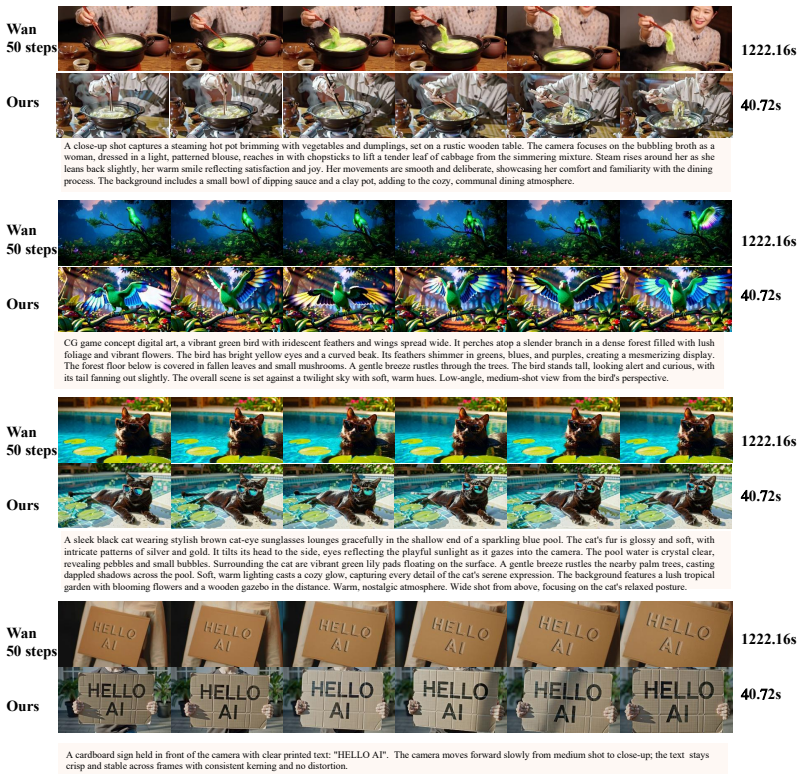
Summary. The paper proposes a post-training framework that jointly optimizes few-step distribution-matching distillation (modified D-DMD + GAN) and step-aware tri-level structural pruning (block / head / FFN-channel gates) for video diffusion models. Continuous masks are optimized via STE under a sparsity penalty, producing a step-specific Mixture-of-Models that is exported as dense per-step sub-networks. Training instability is addressed by a reverse-order progressive curriculum (sparsity applied only to the newly introduced step, advanced when that step’s FLOPs drop 5 %) plus an output-rollout mechanism that trains the fake score network on multi-step final outputs rather than single-step clean predictions. A specialized inference engine gathers active parameters from a super-model via index tables. On Wan-14B the method reports 24 % per-step FLOPs reduction on top of 4-step distillation, 1.2× additional wall-clock speedup (40.72 s vs. 1222 s teacher), and competitive VBench scores; ablations and decoupled prune/distill baselines support the necessity of joint optimization and the progressive+rollout recipe.
Significance. If the joint-optimization claim holds, the work supplies a cleanly orthogonal acceleration axis—per-step parametric redundancy along the hidden-channel dimension—that is complementary to sparse attention, quantization and system-level kernels already used by frameworks such as LightX2V and TurboDiffusion. The architectural findings (U-shaped capacity allocation, deeper-layer semantic freezing) are interpretable and potentially reusable. Strengths include a full set of controlled two-stage baselines, quantitative ablations that demonstrate a hard sparsity wall without the proposed curriculum, and an explicit specialized engine that converts theoretical sparsity into measured latency. The contribution is therefore of practical interest for efficient video generation, provided the wall-clock numbers generalize beyond the proprietary XPU and engine.
major comments (2)
- Table 1 (Wan-14B row) and §5.4 package the central claim as 24 % FLOPs + 1.2× wall-clock + 30× end-to-end. The FLOPs figure is architectural and consistent with the reported retention; the wall-clock figure (40.72 s) is a single measurement on one Kunlun P800 under the unreproduced specialized engine of §4.3. No multi-run variance, no FLOPs-to-latency scaling curve, and no head-to-head comparison of the identical dense 4-step model under the same engine are supplied. On Wan-1.3B the same method yields only +1.09×, already suggesting gather/index or bandwidth overhead can erode theoretical sparsity. Without these controls the practical acceleration claim remains under-supported even while the FLOPs claim stands.
- §4.2 and the ablation in §5.5 / Table 3 establish that the reverse-order curriculum and output-rollout are necessary to avoid collapse, yet both mechanisms introduce free parameters (5 % FLOPs stage-transition threshold, adaptive λ_t via gradient-norm EMA, FFN chunk size C=8, L2 reordering). The manuscript does not report sensitivity of the final masks or VBench scores to these choices, nor does it show that the learned U-shaped policy (Fig. 4) is stable across random seeds or modest hyper-parameter perturbations. Given that the reader’s weakest assumption is precisely the sufficiency of this recipe for genuine step-adaptivity, a modest sensitivity study is load-bearing for the claim that the masks are not training-set artifacts.
minor comments (4)
- Fig. 1(c) and §4.3 describe the super-model + index-table engine but give no memory-footprint numbers or comparison against naïve storage of T separate dense models; a short table would clarify the claimed memory advantage.
- The Dynamic Degree of 80.56 on Wan-1.3B exceeds the teacher (65.19). Appendix D attributes this to GAN + real-video data and mask stochasticity, yet the main text should briefly flag the high variance of this metric and the supporting Motion Smoothness score so readers do not misread it as artifact-driven motion.
- Eq. (4) uses a ReLU on the average retention across all steps; the interaction of this global term with the progressive schedule (sparsity applied only to t_new) is not immediately transparent and would benefit from a one-sentence clarification.
- Several related-work citations (DyDiT, PhasedDMD, LightX2V) appear only as arXiv preprints; once camera-ready versions exist they should be updated.
Circularity Check
No circularity: empirical joint-optimization recipe whose FLOPs/latency/quality claims are measured externally on VBench and wall-clock, not derived by construction from fitted inputs.
full rationale
The paper presents a post-training engineering method (joint few-step DMD + step-aware tri-level gating, progressive reverse-order curriculum, output-rollout fake-score training, and a specialized gather-based MoM engine). All load-bearing quantities—24% per-step FLOPs reduction, 1.2× wall-clock over the dense 4-step baseline, 30× end-to-end vs. the 50-step teacher, and VBench scores—are obtained by training the masks under the stated losses and then measuring the exported dense-per-step models on held-out prompts and a single hardware platform. There is no equation that defines a quantity in terms of a fitted parameter and then re-presents that quantity as a prediction; the sparsity ratios are free parameters controlled by the progressive schedule and λ, not forced by construction to equal any reported metric. Citations (DMD, DyDiT, structural pruning) are to external literature; no uniqueness theorem or ansatz is imported from overlapping authors to forbid alternatives. The U-shaped allocation and semantic-freezing observations in §6 are post-hoc visualizations of the learned gates, not circular derivations. The method is therefore self-contained against external benchmarks; any remaining concerns (single-run latency, proprietary XPU, engine overhead) are validation/reproducibility issues, not circularity.
Axiom & Free-Parameter Ledger
free parameters (5)
- target sparsity ratios η_k (block/head/FFN)
- FLOPs-driven stage transition threshold (5%)
- adaptive sparsity weight λ_t via gradient-norm EMA
- FFN chunk size C=8 and L2-norm reordering
- learning rates and mask warm-up (1e-3 → 1e-2)
axioms (4)
- domain assumption Diffusion generation is coarse-to-fine, so different noise levels possess different structural redundancy that can be exploited by step-specific masks.
- domain assumption Straight-Through Estimator (STE) supplies usable gradients for discrete structural gates inside the distillation loss.
- ad hoc to paper Output-rollout final-video samples give a more reliable training signal for the fake score network than single-step clean predictions when masks are dynamic.
- ad hoc to paper A reverse-order curriculum (stabilize low-noise steps first) prevents gradient imbalance from causing arbitrary over-pruning of high-noise steps.
invented entities (3)
-
step-aware Mixture-of-Models (MoM) obtained by exporting per-step hard gates
no independent evidence
-
Progressive Training Strategy with Output Rollout
no independent evidence
-
specialized inference engine with super-model + index tables
no independent evidence
read the original abstract
Video Diffusion Models (VDMs) have demonstrated superior generation quality but suffer from prohibitive computational costs. While recent few-step distillation techniques significantly accelerate inference, they typically enforce a static model architecture across all denoising stages, ignoring the varying computational demands inherent to different noise levels. In this work, we propose a novel post-training acceleration framework that exploits this redundancy by integrating dynamic structural sparsification directly into the distillation process. Unlike conventional post-hoc compression applied to a fixed diffusion pipeline, our approach jointly optimizes the denoising steps and structured model sparsity, transforming a pre-trained VDM into a compact, step-specific Mixture-of-Models (MoM). To address the training instability arising from this joint optimization, we introduce a Progressive Training Strategy coupled with an Output Rollout Mechanism, which ensures the coherent learning of structural decisions across timesteps. Furthermore, we develop a specialized inference engine to deploy the resulting MoM efficiently. Our method is orthogonal to existing acceleration techniques and highly effective: On Wan-14B, it removes 24% of the per-step FLOPs on top of 4-step distillation, adding a 1.2x wall-clock gain and reaching a 30x speedup over the 50-step teacher while preserving competitive generation quality.
Figures



Reference graph
Works this paper leans on
-
[1]
Flash diffusion: Accel- erating any conditional diffusion model for few steps image generation
Clement Chadebec, Onur Tasar, Eyal Benaroche, and Benjamin Aubin. Flash diffusion: Accel- erating any conditional diffusion model for few steps image generation. InProceedings of the AAAI Conference on Artificial Intelligence, volume 39, pages 15686–15695, 2025
work page 2025
-
[2]
Junyu Chen, Wenkun He, Yuchao Gu, Yuyang Zhao, Jincheng Yu, Junsong Chen, Dongyun Zou, Yujun Lin, Zhekai Zhang, Muyang Li, et al. Dc-videogen: Efficient video generation with deep compression video autoencoder.arXiv preprint arXiv:2509.25182, 2025. 11
-
[3]
Lightx2v: Light video generation inference framework
LightX2V Contributors. Lightx2v: Light video generation inference framework. https: //github.com/ModelTC/lightx2v, 2025
work page 2025
-
[4]
Deepseekmoe: Towards ultimate expert specializa- tion in mixture-of-experts language models
Damai Dai, Chengqi Deng, Chenggang Zhao, RX Xu, Huazuo Gao, Deli Chen, Jiashi Li, Wangding Zeng, Xingkai Yu, Yu Wu, et al. Deepseekmoe: Towards ultimate expert specializa- tion in mixture-of-experts language models. InProceedings of the 62nd Annual Meeting of the Association for Computational Linguistics (Volume 1: Long Papers), pages 1280–1297, 2024
work page 2024
-
[5]
Fu, Stefano Ermon, Atri Rudra, and Christopher Ré
Tri Dao, Daniel Y . Fu, Stefano Ermon, Atri Rudra, and Christopher Ré. FlashAttention: Fast and memory-efficient exact attention with IO-awareness. InAdvances in Neural Information Processing Systems (NeurIPS), 2022
work page 2022
-
[6]
Xiangyu Fan, Zesong Qiu, Zhuguanyu Wu, Fanzhou Wang, Zhiqian Lin, Tianxiang Ren, Dahua Lin, Ruihao Gong, and Lei Yang. Phased dmd: Few-step distribution matching distillation via score matching within subintervals.arXiv preprint arXiv:2510.27684, 2025
-
[7]
William Fedus, Barret Zoph, and Noam Shazeer. Switch transformers: Scaling to trillion parameter models with simple and efficient sparsity.Journal of Machine Learning Research, 23 (120):1–39, 2022
work page 2022
-
[8]
Zhida Feng, Zhenyu Zhang, Xintong Yu, Yewei Fang, Lanxin Li, Xuyi Chen, Yuxiang Lu, Jiaxiang Liu, Weichong Yin, Shikun Feng, et al. Ernie-vilg 2.0: Improving text-to-image diffusion model with knowledge-enhanced mixture-of-denoising-experts. InProceedings of the IEEE/CVF Conference on Computer Vision and Pattern Recognition, pages 10135–10145, 2023
work page 2023
-
[9]
Pruning Filters for Efficient ConvNets
Determine Filters’Importance. Pruning filters for efficient convnets.arXiv preprint arXiv:1608.08710, 3, 2016
work page internal anchor Pith review Pith/arXiv arXiv 2016
-
[10]
Seedance 1.0: Exploring the Boundaries of Video Generation Models
Yu Gao, Haoyuan Guo, Tuyen Hoang, Weilin Huang, Lu Jiang, Fangyuan Kong, Huixia Li, Jiashi Li, Liang Li, Xiaojie Li, et al. Seedance 1.0: Exploring the boundaries of video generation models.arXiv preprint arXiv:2506.09113, 2025
work page internal anchor Pith review Pith/arXiv arXiv 2025
-
[11]
Yizeng Han, Zeyu Liu, Zhihang Yuan, Yifan Pu, Chaofei Wang, Shiji Song, and Gao Huang. Latency-aware unified dynamic networks for efficient image recognition.IEEE Transactions on Pattern Analysis and Machine Intelligence, 46(12):7760–7774, 2024
work page 2024
-
[12]
Channel pruning for accelerating very deep neural networks
Yihui He, Xiangyu Zhang, and Jian Sun. Channel pruning for accelerating very deep neural networks. InProceedings of the IEEE international conference on computer vision, pages 1389–1397, 2017
work page 2017
-
[13]
Self Forcing: Bridging the Train-Test Gap in Autoregressive Video Diffusion
Xun Huang, Zhengqi Li, Guande He, Mingyuan Zhou, and Eli Shechtman. Self forcing: Bridging the train-test gap in autoregressive video diffusion.arXiv preprint arXiv:2506.08009, 2025
work page internal anchor Pith review Pith/arXiv arXiv 2025
-
[14]
Yushi Huang, Xingtong Ge, Ruihao Gong, Chengtao Lv, and Jun Zhang. Linvideo: A post- training framework towards o (n) attention in efficient video generation.arXiv preprint arXiv:2510.08318, 2025
-
[15]
Yushi Huang, Ruihao Gong, Jing Liu, Yifu Ding, Chengtao Lv, Haotong Qin, and Jun Zhang. Qv- gen: Pushing the limit of quantized video generative models.arXiv preprint arXiv:2505.11497, 2025
-
[16]
Vbench: Comprehensive benchmark suite for video generative models
Ziqi Huang, Yinan He, Jiashuo Yu, Fan Zhang, Chenyang Si, Yuming Jiang, Yuanhan Zhang, Tianxing Wu, Qingyang Jin, Nattapol Chanpaisit, et al. Vbench: Comprehensive benchmark suite for video generative models. InProceedings of the IEEE/CVF Conference on Computer Vision and Pattern Recognition, pages 21807–21818, 2024
work page 2024
-
[17]
HunyuanVideo: A Systematic Framework For Large Video Generative Models
Weijie Kong, Qi Tian, Zijian Zhang, Rox Min, Zuozhuo Dai, Jin Zhou, Jiangfeng Xiong, Xin Li, Bo Wu, Jianwei Zhang, et al. Hunyuanvideo: A systematic framework for large video generative models.arXiv preprint arXiv:2412.03603, 2024
work page internal anchor Pith review Pith/arXiv arXiv 2024
-
[18]
Learning to Skip the Middle Layers of Transformers
Tim Lawson and Laurence Aitchison. Learning to skip the middle layers of transformers.arXiv preprint arXiv:2506.21103, 2025. 12
work page internal anchor Pith review Pith/arXiv arXiv 2025
-
[19]
Shanchuan Lin, Xin Xia, Yuxi Ren, Ceyuan Yang, Xuefeng Xiao, and Lu Jiang. Diffusion adversarial post-training for one-step video generation.arXiv preprint arXiv:2501.08316, 2025
-
[20]
Dongyang Liu, Peng Gao, David Liu, Ruoyi Du, Zhen Li, Qilong Wu, Xin Jin, Sihan Cao, Shifeng Zhang, Hongsheng Li, et al. Decoupled dmd: Cfg augmentation as the spear, distribution matching as the shield.arXiv preprint arXiv:2511.22677, 2025
-
[21]
Timestep Embedding Tells: It's Time to Cache for Video Diffusion Model
Feng Liu, Shiwei Zhang, Xiaofeng Wang, Yujie Wei, Haonan Qiu, Yuzhong Zhao, Yingya Zhang, Qixiang Ye, and Fang Wan. Timestep embedding tells: It’s time to cache for video diffusion model.arXiv preprint arXiv:2411.19108, 2024
work page internal anchor Pith review Pith/arXiv arXiv 2024
-
[22]
Cheng Lu, Yuhao Zhou, Fan Bao, Jianfei Chen, Chongxuan Li, and Jun Zhu. Dpm-solver: A fast ode solver for diffusion probabilistic model sampling in around 10 steps.Advances in Neural Information Processing Systems, 35:5775–5787, 2022
work page 2022
-
[23]
Pruning Convolutional Neural Networks for Resource Efficient Inference
Pavlo Molchanov, Stephen Tyree, Tero Karras, Timo Aila, and Jan Kautz. Pruning convolutional neural networks for resource efficient inference.arXiv preprint arXiv:1611.06440, 2016
work page internal anchor Pith review Pith/arXiv arXiv 2016
-
[24]
Transition matching distillation for fast video generation.arXiv preprint arXiv:2601.09881, 2026
Weili Nie, Julius Berner, Nanye Ma, Chao Liu, Saining Xie, and Arash Vahdat. Transition matching distillation for fast video generation.arXiv preprint arXiv:2601.09881, 2026
- [25]
-
[26]
Outrageously Large Neural Networks: The Sparsely-Gated Mixture-of-Experts Layer
Noam Shazeer, Azalia Mirhoseini, Krzysztof Maziarz, Andy Davis, Quoc Le, Geoffrey Hinton, and Jeff Dean. Outrageously large neural networks: The sparsely-gated mixture-of-experts layer.arXiv preprint arXiv:1701.06538, 2017
work page internal anchor Pith review Pith/arXiv arXiv 2017
-
[27]
Yanxiao Sun, Jiafu Wu, Yun Cao, Chengming Xu, Yabiao Wang, Weijian Cao, Donghao Luo, Chengjie Wang, and Yanwei Fu. Swiftvideo: A unified framework for few-step video generation through trajectory-distribution alignment.arXiv preprint arXiv:2508.06082, 2025
-
[28]
Faster gaze prediction with dense networks and Fisher pruning
Lucas Theis, Iryna Korshunova, Alykhan Tejani, and Ferenc Huszár. Faster gaze prediction with dense networks and fisher pruning.arXiv preprint arXiv:1801.05787, 2018
work page internal anchor Pith review Pith/arXiv arXiv 2018
-
[30]
Wan: Open and Advanced Large-Scale Video Generative Models
Team Wan, Ang Wang, Baole Ai, Bin Wen, Chaojie Mao, Chen-Wei Xie, Di Chen, Feiwu Yu, Haiming Zhao, Jianxiao Yang, et al. Wan: Open and advanced large-scale video generative models.arXiv preprint arXiv:2503.20314, 2025
work page internal anchor Pith review Pith/arXiv arXiv 2025
-
[31]
Qiuheng Wang, Yukai Shi, Jiarong Ou, Rui Chen, Ke Lin, Jiahao Wang, Boyuan Jiang, Haotian Yang, Mingwu Zheng, Xin Tao, et al. Koala-36m: A large-scale video dataset improving consistency between fine-grained conditions and video content. InProceedings of the Computer Vision and Pattern Recognition Conference, pages 8428–8437, 2025
work page 2025
-
[32]
Zhengyi Wang, Cheng Lu, Yikai Wang, Fan Bao, Chongxuan Li, Hang Su, and Jun Zhu. Pro- lificdreamer: High-fidelity and diverse text-to-3d generation with variational score distillation. Advances in neural information processing systems, 36:8406–8441, 2023
work page 2023
-
[33]
Yushu Wu, Yanyu Li, Anil Kag, Ivan Skorokhodov, Willi Menapace, Ke Ma, Arpit Sahni, Ju Hu, Aliaksandr Siarohin, Dhritiman Sagar, et al. Taming diffusion transformer for efficient mobile video generation in seconds.arXiv preprint arXiv:2507.13343, 2025. 13
-
[34]
One-step Diffusion with Distribution Matching Distillation
Tianwei Yin, Michaël Gharbi, Richard Zhang, Eli Shechtman, Fredo Durand, William T Freeman, and Taesung Park. One-step diffusion with distribution matching distillation.arXiv preprint arXiv:2311.18828, 2023
work page internal anchor Pith review Pith/arXiv arXiv 2023
-
[35]
Improved Distribution Matching Distillation for Fast Image Synthesis
Tianwei Yin, Michaël Gharbi, Taesung Park, Richard Zhang, Eli Shechtman, Fredo Durand, and William T Freeman. Improved distribution matching distillation for fast image synthesis. arXiv preprint arXiv:2405.14867, 2024
work page internal anchor Pith review Pith/arXiv arXiv 2024
-
[36]
From slow bidirectional to fast autoregressive video diffusion models
Tianwei Yin, Qiang Zhang, Richard Zhang, William T Freeman, Fredo Durand, Eli Shechtman, and Xun Huang. From slow bidirectional to fast autoregressive video diffusion models. In Proceedings of the IEEE/CVF Conference on Computer Vision and Pattern Recognition, pages 22963–22974, 2025
work page 2025
-
[37]
Jintao Zhang, Haoxu Wang, Kai Jiang, Shuo Yang, Kaiwen Zheng, Haocheng Xi, Ziteng Wang, Hongzhou Zhu, Min Zhao, Ion Stoica, et al. Sla: Beyond sparsity in diffusion transformers via fine-tunable sparse-linear attention.arXiv preprint arXiv:2509.24006, 2025
-
[38]
Turbodiffusion: Accelerating video diffusion models by 100-200 times
Jintao Zhang, Kaiwen Zheng, Kai Jiang, Haoxu Wang, Ion Stoica, Joseph E Gonzalez, Jianfei Chen, and Jun Zhu. Turbodiffusion: Accelerating video diffusion models by 100-200 times. arXiv preprint arXiv:2512.16093, 2025
-
[39]
Vsa: Faster video diffusion with trainable sparse attention.arXiv preprint arXiv:2505.13389, 2025
Peiyuan Zhang, Yongqi Chen, Haofeng Huang, Will Lin, Zhengzhong Liu, Ion Stoica, Eric Xing, and Hao Zhang. Vsa: Faster video diffusion with trainable sparse attention.arXiv preprint arXiv:2505.13389, 2025
-
[40]
Fast Video Generation with Sliding Tile Attention
Peiyuan Zhang, Yongqi Chen, Runlong Su, Hangliang Ding, Ion Stoica, Zhengzhong Liu, and Hao Zhang. Fast video generation with sliding tile attention.arXiv preprint arXiv:2502.04507, 2025
work page internal anchor Pith review Pith/arXiv arXiv 2025
-
[41]
Wangbo Zhao, Yizeng Han, Jiasheng Tang, Kai Wang, Yibing Song, Gao Huang, Fan Wang, and Yang You. Dynamic diffusion transformer.arXiv preprint arXiv:2410.03456, 2024
work page internal anchor Pith review Pith/arXiv arXiv 2024
-
[42]
Wangbo Zhao, Yizeng Han, Jiasheng Tang, Kai Wang, Hao Luo, Yibing Song, Gao Huang, Fan Wang, and Yang You. Dydit++: Diffusion transformers with timestep and spatial dynamics for efficient visual generation.IEEE Transactions on Pattern Analysis and Machine Intelligence, 2026
work page 2026
-
[43]
Large Scale Diffusion Distillation via Score-Regularized Continuous-Time Consistency
Kaiwen Zheng, Yuji Wang, Qianli Ma, Huayu Chen, Jintao Zhang, Yogesh Balaji, Jianfei Chen, Ming-Yu Liu, Jun Zhu, and Qinsheng Zhang. Large scale diffusion distillation via score-regularized continuous-time consistency.arXiv preprint arXiv:2510.08431, 2025. 14 Appendix This supplementary material provides further details and comprehensive results to suppor...
work page internal anchor Pith review Pith/arXiv arXiv 2025
discussion (0)
Sign in with ORCID, Apple, or X to comment. Anyone can read and Pith papers without signing in.