REVIEW 1 major objections 8 minor 93 references
Reviewed by Pith at T0; open to challenge.
T0 means a machine referee read the full paper against a public rubric. The mark states how deep the mechanical check went, never who wrote it. the ladder, T0–T4 →
T0 review · glm-5.2
CMB amplitude fixes Higgs mass and predicts 3 TeV wino dark matter
2026-07-09 17:35 UTC pith:DTNO522M
load-bearing objection Starobinsky supergravity + MSSM links CMB amplitude to Higgs mass and 3 TeV thermal wino DM, but the chain rests on two acknowledged fine-tunings and the wino mass is set externally. the 1 major comments →
Higgs boson mass and thermal wino dark matter from Starobinsky supergravity with the MSSM
The pith
A machine-rendered reading of the paper's core claim, the machinery that carries it, and where it could break.
Core claim
The central mechanism is a chain of scale-fixing: the CMB scalar amplitude determines the Starobinsky mass parameter m, which (through the goldstino VEV s0, fixed by demanding a light Higgs doublet) determines the gravitino mass m_{3/2}, which determines all MSSM soft parameters, which determine the Higgs quartic coupling boundary condition, whose three-loop running yields the physical Higgs mass. The chain has no free intermediate parameters once the CMB amplitude and the light-Higgs condition are imposed. A parallel chain selects dark matter: the same soft spectrum makes higgsinos and scalars heavy, anomaly mediation makes the wino the lightest supersymmetric particle, and the thermal-reli
What carries the argument
Starobinsky supergravity in the old-minimal formulation, dualised to an Einstein-frame theory with Kähler potential K = -3 M_P^2 ln[1 + T + T_bar + gamma(S + S_bar) - 2 S S_bar + ...] and superpotential W = 6 m T S. The goldstino VEV s0 is fixed by the determinant condition det(M_H^2) = 0, which yields s0 = sqrt(5/17) for a bare mu-term or s0 approx 0.746 for a dynamically generated mu-term from the operator S^2 H_u H_d. Universal soft scalar masses m_0 = m_{3/2}, trilinear A = -m_{3/2}, and tan(beta) = 1 follow. Anomaly-mediated gaugino masses M_a^{AMSB} = (b_a alpha_a / 4pi) m_{3/2} create a hierarchy where the wino is lightest. Three-loop RG evolution of the Higgs quartic lambda from m_0~
Load-bearing premise
The framework requires that the determinant of the Higgs mass-squared matrix vanish at the high scale, which is an acknowledged fine-tuning: without it, the goldstino VEV and hence the gravitino mass remain undetermined, and the Higgs mass prediction loses its anchor. Separately, the gauge kinetic function is not derived from the supergravity framework, and achieving a TeV-scale wino requires a precise cancellation between tree-level and anomaly-mediated gaugino masses that
What would settle it
A 100 TeV collider failing to observe disappearing tracks at the 3 TeV wino mass would exclude the thermal wino branch. A next-generation xenon detector measuring a spin-independent cross section significantly below 2.3 x 10^-47 cm^2 would rule out the pure-wino prediction. On the inflation side, a tensor-to-scalar ratio r inconsistent with the Starobinsky prediction (r ~ 0.003-0.004) at future CMB experiments would undermine the supergravity embedding.
If this is right
- A future 100 TeV proton collider could discover the disappearing-track signal from a 3 TeV wino or fully exclude the thermal wino dark matter scenario predicted by this framework.
- Next-generation multi-ton liquid-xenon detectors (DARWIN/XLZD) can probe the predicted wino-nucleon scattering cross section of ~2.3 x 10^-47 cm^2, which lies below current LUX-ZEPLIN sensitivity but above the irreducible neutrino background.
- Improved measurements of the top-quark mass and the strong coupling at the HL-LHC would tighten the Higgs mass prediction, reducing the allowed parameter space and providing an indirect test of the high-scale SUSY breaking scenario.
- The framework can be extended to include SO(10) grand unification with right-handed neutrinos, light neutrino masses via the seesaw mechanism, and leptogenesis, all within the same supergravitational hidden sector.
- Non-thermal wino production from gravitationally produced scalar decays remains an unexplored branch that could yield a different dark matter mass and detection phenomenology.
Where Pith is reading between the lines
- If the determinant condition det(M_H^2) = 0 is interpreted not as fine-tuning but as a selection rule from an underlying symmetry or dynamics not yet identified, then the entire parameter-fixing chain would become a genuine prediction rather than a postdiction, and the 3 TeV wino mass would acquire theoretical rather than purely phenomenological status.
- The framework's structure suggests that any viable inflationary model with a supersymmetric completion and gravitational mediation could, in principle, link its CMB-normalised mass scale to the Higgs mass and dark matter spectrum through an analogous chain, making the Starobinsky choice one instance of a broader class.
- The high-precision cancellation required between tree-level and anomaly-mediated contributions to the wino mass may point to a deeper connection between the gauge kinetic function and the R-symmetry breaking sector that is not captured by the current ansatz.
Editorial analysis
A structured set of objections, weighed in public.
Referee Report
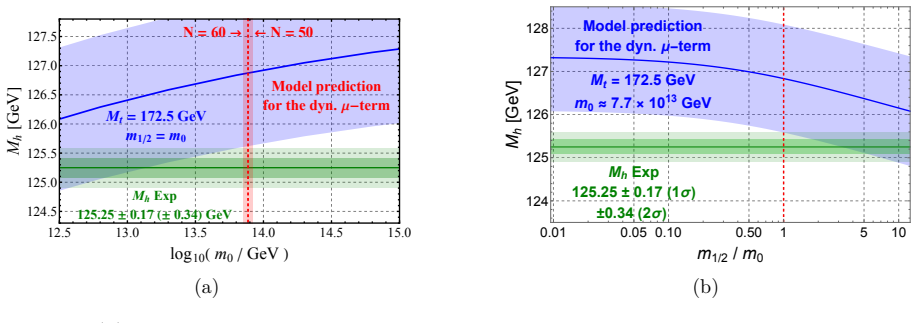
Summary. This paper constructs a framework in which Starobinsky supergravity, formulated in the Jordan frame and dualized to the Einstein frame, provides a hidden sector that drives both inflation and SUSY breaking. When coupled to the MSSM in the Einstein frame, the inflationary scale (fixed by the CMB scalar amplitude) determines the gravitino mass and, through gravitational mediation, the MSSM soft terms. The authors impose the standard high-scale SUSY condition det(M_H^2)=0 to ensure a light SM Higgs doublet, which fixes the goldstino VEV s0 and thereby the gravitino mass. Two scenarios for the mu-term are considered: a bare mu-term and a dynamically generated one via the goldstino superfield S. Three-loop RG evolution of the Higgs quartic coupling, using both SusyHD and HSSUSY, yields Mh in the range 126.6--127.6 GeV, consistent with the measured 125.25 GeV within uncertainties. With conserved R-parity, the LSP is stable; the thermal relic abundance selects a nearly pure wino at ~3 TeV, testable via disappearing tracks at a future 100 TeV collider and via loop-induced direct detection at next-generation xenon experiments. The framework is internally consistent and provides clear falsifiable predictions.
Significance. The paper makes a genuine attempt to connect CMB observables to particle physics observables through a single supergravity framework, which is a worthwhile goal. The use of two independent EFT codes (SusyHD and HSSUSY) for the Higgs mass calculation, including the discovery and correction of a bug in SusyHD's interpolation table, is commendable and strengthens the reliability of the numerical results. The falsifiable predictions for disappearing-track searches at 100 TeV colliders and direct detection at multi-ton xenon experiments are concrete and well-motivated. The dynamical generation of the mu-term from the goldstino superfield, without introducing an ad hoc singlet, is an elegant feature. However, the significance of the CMB-to-Higgs-mass link is tempered by the fact that it is conditional on the externally imposed det(M_H^2)=0 fine-tuning and on the unspecified gauge kinetic function, as discussed below.
major comments (1)
- Sec. 5, Eqs. (44)--(51) and Sec. 5, Eqs. (54)--(58): The goldstino VEV s0, which fixes the gravitino mass m3/2 and all soft parameters, is determined by imposing det(M_H^2)=0 (Eq. 44). The authors acknowledge this as 'the usual EW fine-tuning in high-scale SUSY.' This condition is not derived from the Starobinsky supergravity framework but is imposed externally to ensure a light Higgs doublet. Consequently, the claim in the abstract that the framework links 'the amplitude of primordial scalar perturbations to the Higgs boson mass' is conditional on this additional assumption. The authors should explicitly state in the abstract and conclusion that the CMB-to-Higgs-mass connection requires the det(M_H^2)=0 boundary condition, and clarify that without it, s0 remains a free parameter in the interval (0.438, 0.886) and m3/2 is not uniquely determined by CMB data alone. This is a presentation/
minor comments (8)
- Sec. 6, Eqs. (70)--(73): The wino mass M2 ≈ 3 TeV is not predicted by the framework but is set by the external thermal relic abundance condition. The gauge kinetic function coefficients cT, cS are adjusted to achieve the required cancellation between the tree-level and AMSB contributions. The authors are transparent about this ('significantly fine-tuned'), but the abstract's phrasing 'the observed relic abundance selects a nearly pure thermal wino' could be read as a framework prediction. A brief clarification that the wino mass is an input from cosmology rather than a derived quantity would improve precision.
- Eq. (74): All four Higgs mass central values (126.58--127.61 GeV) lie above the measured 125.25 GeV. The HSSUSY bare-mu case (126.58 ± 0.48_th ± 0.65_αs) is the closest, with the central value ~1.3 GeV high, roughly 1.2σ in combined uncertainty. The SusyHD central values are ~1.8--2.4 GeV high. While the authors note the ~0.5 GeV agreement between the two codes, they do not discuss the systematic upward offset of all central values relative to the measured mass. A brief comment on whether this offset might indicate missing higher-order corrections or a preference for one mu-term scenario over the other would strengthen the analysis.
- Sec. 6, discussion of non-thermal wino DM (Eqs. 65--67): The non-thermal branch is mentioned but its calculation is deferred to future work. Given that the MSSM scalars are lighter than the inflaton (minf/m0 ≈ 1.1 for the bare mu-term case) and can be gravitationally produced, the non-thermal branch is a natural consequence of the framework. The authors should at least comment on whether the non-thermal branch could dominate over the thermal branch for their parameter space, or whether the thermal branch is robustly selected.
- Figure 4(a) and Figure 5(a): The red dashed lines marking the model predictions for m0 are described in the captions, but the stability bound (solid red line in Fig. 4a) is mentioned only in the caption of Fig. 4(a) and not in the main text. A brief reference in the text would help the reader.
- Sec. 4, Eq. (31): The coupling constant tilde-lambda is stated to be 'suppressed' and potentially generated by instantons, but no quantitative estimate or reference to a specific instanton calculation is provided. While the authors cite string theory compactification references [55--57], a more specific pointer to how such a suppression arises would be helpful.
- Appendix A: The bug discovery and correction in SusyHD v1.0.2 is documented thoroughly. The authors should consider submitting the corrected table upstream to the SusyHD repository so that the broader community benefits, if they have not already done so.
- Sec. 3, Eq. (17): The gravitino mass formula involves the parameter s0, but the notation switches between s0 (dimensionless VEV of S/MP) and ⟨S⟩ = s0·MP (dimensionful) in different places (e.g., Eq. 32 vs. Eq. 17). A consistent notation would improve readability.
- The paper uses both 'bare mu-term' and 'dynamically generated mu-term' scenarios but does not clearly state which is the preferred or default scenario. In the conclusion, both are discussed on equal footing. If there is a theoretical preference (e.g., the dynamical mechanism is more motivated), this should be stated.
Circularity Check
No significant circularity found; the fine-tuning conditions are acknowledged assumptions, not circular derivations.
full rationale
The paper's derivation chain is: CMB scalar amplitude A_s fixes the mass parameter m (Eq. 23); m together with the goldstino VEV s_0 fixes the gravitino mass m_{3/2} (Eq. 17); m_{3/2} fixes all soft MSSM parameters (Eqs. 33-38); these set the boundary condition for RG evolution of the Higgs quartic coupling; three-loop RG running yields the Higgs pole mass. The key question is whether the condition det(M²_H) = 0 (Eq. 44), which fixes s_0 and hence m_{3/2}, is circular with the Higgs mass prediction. It is not: det(M²_H) = 0 is a structural requirement that a light Higgs doublet exists at all (i.e., much lighter than m_{3/2}), but it does not determine the numerical value of the Higgs mass. The actual prediction M_h ≈ 125-127 GeV comes from independent RG evolution of λ and threshold corrections, which depend on the SUSY scale and soft parameters but not on the measured Higgs mass. The authors transparently acknowledge this as 'the usual EW fine-tuning in high-scale SUSY' — it is an assumption, not a circularity. Similarly, the wino mass ~3 TeV is explicitly stated as an input from the external relic abundance condition ('We therefore adopt M_2 ≃ 3 TeV as the thermal target and do not recalculate the freeze-out abundance'), not a prediction from the framework. The gauge kinetic function is acknowledged as unspecified by Starobinsky supergravity, and the required cancellation is called 'significantly fine-tuned.' These are honest disclosures of assumptions and fine-tunings, not instances where outputs reduce to inputs by construction. Self-citations (e.g., Ref. [31] by Addazi and Ketov) provide framework setup but are not load-bearing for the central Higgs mass prediction, which relies on standard RG tools (SusyHD, HSSUSY) and boundary conditions derived within the paper. The derivation is self-contained against external benchmarks.
Axiom & Free-Parameter Ledger
free parameters (7)
- m (Starobinsky mass) =
~1.78×10^13 GeV (for N=55)
- s0 (goldstino VEV) =
√(5/17)≈0.542 (bare μ) or ≈0.746 (dynamical μ)
- N (e-folds) =
50-60 (pivot N=55)
- cT, cS (gauge kinetic function coefficients) =
Chosen to cancel AMSB and yield M2≈3 TeV
- n (power in μ-term coupling) =
2
- ˜λ (μ-term coupling) =
~2.26×10^-5
- Xt (stop mixing) =
0
axioms (6)
- domain assumption Starobinsky supergravity with the f-function in Eq. (11) correctly describes the gravitational effective action at inflationary scales
- domain assumption The MSSM is the correct visible sector below the Planck scale
- domain assumption R-parity is conserved, making the LSP stable
- domain assumption The thermal wino relic abundance calculation from literature (2.7-3.0 TeV) applies to this framework
- ad hoc to paper The det(M²_H)=0 condition (Eq. 44) is a valid high-scale boundary condition
- domain assumption Standard supergravity soft term derivation (flat limit MP→∞ with m3/2 fixed) applies to this higher-derivative supergravity
invented entities (2)
-
Goldstino superfield S
independent evidence
-
Inflaton superfield T
independent evidence
read the original abstract
We propose a framework connecting cosmic microwave background (CMB) observables with high-energy particle phenomenology, based on Starobinsky supergravity coupled to the Minimal Supersymmetric Standard Model (MSSM). Cosmic inflation and supersymmetry (SUSY) breaking occur within the hidden sector emerging from Starobinsky supergravity. The inflationary scale fixes the characteristic mass scale of the hidden sector, which determines the MSSM soft terms through gravitational mediation of SUSY breaking. The same hidden sector can also dynamically generate a high-scale $\mu$ term. The resulting MSSM spectrum fixes the high-scale threshold corrections and the boundary conditions for the renormalisation-group (RG) evolution of the Higgs quartic coupling. Three-loop RG evolution of the Higgs quartic coupling gives a Higgs boson mass consistent with the measured value within the theoretical and experimental uncertainties, thereby linking the amplitude of primordial scalar perturbations to the Higgs boson mass. With conserved R-parity, the lightest supersymmetric particle is stable, making it a compelling dark matter candidate. The observed relic abundance selects a nearly pure thermal wino with a physical mass of about 3 TeV. Its loop-induced spin-independent wino-nucleon scattering cross section lies below the current sensitivity of the LUX-ZEPLIN experiment, but within the projected reach of next-generation multi-ton liquid-xenon detectors. Electroweak radiative corrections generate a small mass splitting between the charged and neutral wino states, leading to a long-lived charged wino and the characteristic disappearing-track signature. A future 100 TeV proton collider can discover the disappearing-track signal from a 3 TeV wino or fully exclude this thermal wino dark matter scenario.
Figures



Reference graph
Works this paper leans on
-
[1]
J. Martin, C. Ringeval, and V. Vennin, “Encyclopædia Inflationaris: Opiparous Edition,” Phys. Dark Univ.5-6(2014) 75–235,arXiv:1303.3787 [astro-ph.CO]
work page internal anchor Pith review Pith/arXiv arXiv 2014
-
[2]
Lectures on Reheating after Inflation
K. D. Lozanov, “Lectures on Reheating after Inflation,”arXiv:1907.04402 [astro-ph.CO]
work page internal anchor Pith review Pith/arXiv arXiv 1907
-
[3]
Cosmic Inflation at the Crossroads
J. Martin, C. Ringeval, and V. Vennin, “Cosmic Inflation at the crossroads,”JCAP07 (2024) 087,arXiv:2404.10647 [astro-ph.CO]
work page internal anchor Pith review Pith/arXiv arXiv 2024
-
[4]
On the Present Status of Inflationary Cosmology,
R. Kallosh and A. Linde, “On the Present Status of Inflationary Cosmology,” arXiv:2505.13646 [hep-th]
-
[5]
The Standard Model Higgs boson as the inflaton
F. L. Bezrukov and M. Shaposhnikov, “The Standard Model Higgs boson as the inflaton,” Phys. Lett. B659(2008) 703–706,arXiv:0710.3755 [hep-th]
work page internal anchor Pith review Pith/arXiv arXiv 2008
-
[6]
Running Inflation in the Standard Model
A. De Simone, M. P. Hertzberg, and F. Wilczek, “Running Inflation in the Standard Model,”Phys. Lett. B678(2009) 1–8,arXiv:0812.4946 [hep-ph]
work page internal anchor Pith review Pith/arXiv arXiv 2009
-
[7]
Higgs inflation: consistency and generalisations
F. Bezrukov, A. Magnin, M. Shaposhnikov, and S. Sibiryakov, “Higgs inflation: consistency and generalisations,”JHEP01(2011) 016,arXiv:1008.5157 [hep-ph]
work page internal anchor Pith review Pith/arXiv arXiv 2011
-
[8]
Can Inflation be Connected to Low Energy Particle Physics?
M. P. Hertzberg, “Can Inflation be Connected to Low Energy Particle Physics?,”JCAP 08(2012) 008,arXiv:1110.5650 [hep-ph]
work page internal anchor Pith review Pith/arXiv arXiv 2012
-
[9]
A new type of isotropic cosmological models without singularity,
A. A. Starobinsky, “A new type of isotropic cosmological models without singularity,” Phys. Lett. B91no. 1, (1980) 99 – 102
work page 1980
-
[10]
On the equivalence between Starobinsky and Higgs inflationary models in gravity and supergravity
S. V. Ketov, “On the equivalence of Starobinsky and Higgs inflationary models in gravity and supergravity,”J. Phys. A53no. 8, (2020) 084001,arXiv:1911.01008 [hep-th]
work page internal anchor Pith review Pith/arXiv arXiv 2020
-
[11]
On Legacy of Starobinsky Inflation
S. V. Ketov, “On Legacy of Starobinsky Inflation,” 1, 2025.arXiv:2501.06451 [gr-qc]
work page internal anchor Pith review Pith/arXiv arXiv 2025
-
[12]
S. J. Gates, M. T. Grisaru, M. Rocek, and W. Siegel,Superspace Or One Thousand and One Lessons in Supersymmetry, vol. 58 ofFrontiers in Physics. 1983. arXiv:hep-th/0108200
work page internal anchor Pith review Pith/arXiv arXiv 1983
-
[13]
J. Wess and J. Bagger,Supersymmetry and supergravity. Princeton University Press, Princeton, NJ, USA, 1992
work page 1992
-
[14]
I. L. Buchbinder and S. M. Kuzenko,Ideas and Methods of Supersymmetry and Supergravity or A Walk Through Superspace: A Walk Through Superspace. Taylor & Francis, 1998. [15]BICEP, KeckCollaboration, P. A. R. Adeet al., “Improved Constraints on Primordial Gravitational Waves using Planck, WMAP, and BICEP/Keck Observations through the 2018 Observing Season,”...
-
[15]
Curvature corrections to Starobinsky inflation can explain the ACT results,
A. Addazi, Y. Aldabergenov, and S. V. Ketov, “Curvature corrections to Starobinsky inflation can explain the ACT results,”Phys. Lett. B869(2025) 139883, arXiv:2505.10305 [gr-qc]. [17]ACTCollaboration, T. Louiset al., “The Atacama Cosmology Telescope: DR6 Power Spectra, Likelihoods andΛCDM Parameters,”arXiv:2503.14452 [astro-ph.CO]. 28 [18]ACTCollaboration...
-
[16]
J. Ellis, D. V. Nanopoulos, K. A. Olive, and S. Verner, “A general classification of Starobinsky-like inflationary avatars of SU(2,1)/SU(2)×U(1) no-scale supergravity,” JHEP03(2019) 099,arXiv:1812.02192 [hep-th]
work page internal anchor Pith review Pith/arXiv arXiv 2019
-
[17]
Inflaton decay in No-Scale Supergravity and Starobinsky-like models
Y. Ema, M. A. G. Garcia, W. Ke, K. A. Olive, and S. Verner, “Inflaton Decay in No-Scale Supergravity and Starobinsky-like Models,”Universe10no. 6, (2024) 239, arXiv:2404.14545 [hep-ph]
work page internal anchor Pith review Pith/arXiv arXiv 2024
-
[18]
I. Antoniadis, D. V. Nanopoulos, and K. A. Olive, “R2-inflation derived from 4d strings, the role of the dilaton, and turning the Swampland into a mirage,”JHEP06(2025) 155, arXiv:2410.16541 [hep-th]
work page internal anchor Pith review Pith/arXiv arXiv 2025
-
[19]
Effects of radiative corrections on Starobinsky inflation,
J. Ellis, T. Gherghetta, K. Kaneta, W. Ke, and K. A. Olive, “Effects of radiative corrections on Starobinsky inflation,”Phys. Rev. D112no. 12, (2025) 123530, arXiv:2510.15137 [hep-ph]
-
[20]
Radiative Corrections in Supergravity Models of Inflation,
J. Ellis, T. Gherghetta, K. Kaneta, W. Ke, and K. A. Olive, “Radiative Corrections in Supergravity Models of Inflation,”arXiv:2603.02389 [hep-ph]
-
[21]
Higher derivative supergravity is equivalent to standard supergravity coupled to matter. 1.,
S. Cecotti, “Higher derivative supergravity is equivalent to standard supergravity coupled to matter. 1.,”Phys. Lett.B190(1987) 86–92
work page 1987
-
[22]
Superstring-inspired supergravity as the universal source of inflation and quintessence
J. Gates, S.James and S. V. Ketov, “Superstring-inspired supergravity as the universal source of inflation and quintessence,”Phys. Lett. B674(2009) 59–63,arXiv:0901.2467 [hep-th]
work page internal anchor Pith review Pith/arXiv arXiv 2009
-
[23]
Embedding (R+R^2)-Inflation into Supergravity
S. V. Ketov and A. A. Starobinsky, “Embedding(R+R2)-Inflation into Supergravity,” Phys. Rev. D83(2011) 063512,arXiv:1011.0240 [hep-th]
work page internal anchor Pith review Pith/arXiv arXiv 2011
-
[24]
On the Starobinsky Model of Inflation from Supergravity
F. Farakos, A. Kehagias, and A. Riotto, “On the Starobinsky Model of Inflation from Supergravity,”Nucl. Phys. B876(2013) 187–200,arXiv:1307.1137 [hep-th]
work page internal anchor Pith review Pith/arXiv arXiv 2013
-
[25]
Old-minimal supergravity models of inflation
S. V. Ketov and T. Terada, “Old-minimal supergravity models of inflation,”JHEP12 (2013) 040,arXiv:1309.7494 [hep-th]
work page internal anchor Pith review Pith/arXiv arXiv 2013
-
[26]
Comments on the Starobinsky Model of Inflation and its Descendants
A. Kehagias, A. Moradinezhad Dizgah, and A. Riotto, “Remarks on the Starobinsky model of inflation and its descendants,”Phys. Rev. D89no. 4, (2014) 043527, arXiv:1312.1155 [hep-th]
work page internal anchor Pith review Pith/arXiv arXiv 2014
-
[27]
Energy conditions in Starobinsky supergravity
A. Addazi and S. V. Ketov, “Energy conditions in Starobinsky supergravity,”JCAP03 (2017) 061,arXiv:1701.02450 [hep-th]
work page internal anchor Pith review Pith/arXiv arXiv 2017
-
[28]
Four-Dimensional Higher-Derivative Supergravity and Spontaneous Supersymmetry Breaking
A. Hindawi, B. A. Ovrut, and D. Waldram, “Four-dimensional higher derivative supergravity and spontaneous supersymmetry breaking,”Nucl. Phys. B476(1996) 175–199,arXiv:hep-th/9511223
work page internal anchor Pith review Pith/arXiv arXiv 1996
-
[29]
Supersymmetry Breaking and Inflation from Higher Curvature Supergravity
I. Dalianis, F. Farakos, A. Kehagias, A. Riotto, and R. von Unge, “Supersymmetry Breaking and Inflation from Higher Curvature Supergravity,”JHEP01(2015) 043, arXiv:1409.8299 [hep-th]. 29
work page internal anchor Pith review Pith/arXiv arXiv 2015
-
[30]
Inflation with Non-minimal Gravitational Couplings and Supergravity
M. B. Einhorn and D. R. T. Jones, “Inflation with Non-minimal Gravitational Couplings in Supergravity,”JHEP03(2010) 026,arXiv:0912.2718 [hep-ph]
work page internal anchor Pith review Pith/arXiv arXiv 2010
-
[31]
Complexified Starobinsky Inflation in Supergravity in the Light of Recent BICEP2 Result
K. Hamaguchi, T. Moroi, and T. Terada, “Complexified Starobinsky Inflation in Supergravity in the Light of Recent BICEP2 Result,”Phys. Lett. B733(2014) 305–308, arXiv:1403.7521 [hep-ph]
work page internal anchor Pith review Pith/arXiv arXiv 2014
-
[32]
Starobinsky Inflation: From Non-SUSY To SUGRA Realizations
C. Pallis and N. Toumbas, “Starobinsky Inflation: From Non-SUSY To SUGRA Realizations,”Adv. High Energy Phys.2017(2017) 6759267,arXiv:1612.09202 [hep-ph]
work page internal anchor Pith review Pith/arXiv arXiv 2017
-
[33]
E. Dudas, Y. Mambrini, and K. Olive, “Case for an EeV Gravitino,”Phys. Rev. Lett.119 no. 5, (2017) 051801,arXiv:1704.03008 [hep-ph]
work page internal anchor Pith review Pith/arXiv arXiv 2017
-
[34]
Inflation and High-Scale Supersymmetry with an EeV Gravitino
E. Dudas, T. Gherghetta, Y. Mambrini, and K. A. Olive, “Inflation and High-Scale Supersymmetry with an EeV Gravitino,”Phys. Rev. D96no. 11, (2017) 115032, arXiv:1710.07341 [hep-ph]
work page internal anchor Pith review Pith/arXiv arXiv 2017
-
[35]
Gravity-Mediated SUSY Breaking, R Symmetry and Hyperbolic Kaehler Geometry
C. Pallis, “Gravity-mediated SUSY breaking,Rsymmetry, and hyperbolic Kähler geometry,”Phys. Rev. D100no. 5, (2019) 055013,arXiv:1812.10284 [hep-ph]
work page internal anchor Pith review Pith/arXiv arXiv 2019
-
[36]
Inflection-Point Sgoldstino Inflation in no-Scale Supergravity
C. Pallis, “Inflection-point sgoldstino inflation in no-scale supergravity,”Phys. Lett. B843 (2023) 138018,arXiv:2302.12214 [hep-ph]
work page internal anchor Pith review Pith/arXiv arXiv 2023
-
[37]
Scalaron the mighty: producing dark matter and baryon asymmetry at reheating
D. S. Gorbunov and A. G. Panin, “Scalaron the mighty: producing dark matter and baryon asymmetry at reheating,”Phys. Lett. B700(2011) 157–162,arXiv:1009.2448 [hep-ph]
work page internal anchor Pith review Pith/arXiv arXiv 2011
-
[38]
Jordan Frame Supergravity and Inflation in NMSSM
S. Ferrara, R. Kallosh, A. Linde, A. Marrani, and A. Van Proeyen, “Jordan Frame Supergravity and Inflation in NMSSM,”Phys. Rev. D82(2010) 045003, arXiv:1004.0712 [hep-th]
work page internal anchor Pith review Pith/arXiv arXiv 2010
-
[39]
Reheating process in the $R^2$ inflationary model with the baryogenesis scenario
H. Jeong, K. Kamada, A. A. Starobinsky, and J. Yokoyama, “Reheating process in the R2 inflationary model with the baryogenesis scenario,”JCAP11(2023) 023, arXiv:2305.14273 [hep-ph]
work page internal anchor Pith review Pith/arXiv arXiv 2023
-
[40]
Inflationary cosmology from supergravity,
S. V. Ketov, “Inflationary cosmology from supergravity,” inHandbook of Quantum Gravity, C. Bambi, L. Modesto, and I. Shapiro, eds. Springer, Singapore, 2023. https://doi.org/10.1007/978-981-19-3079-9_51-1
-
[41]
Cosmological properties of a generic (\cal R)^2-supergravity
S. V. Ketov and N. Watanabe, “Cosmological properties of a genericR2-supergravity,” JCAP03(2011) 011,arXiv:1101.0450 [hep-th]
work page internal anchor Pith review Pith/arXiv arXiv 2011
-
[42]
Modified Supergravity and Early Universe: the Meeting Point of Cosmology and High-Energy Physics
S. V. Ketov, “Supergravity and Early Universe: the Meeting Point of Cosmology and High-Energy Physics,”Int. J. Mod. Phys. A28(2013) 1330021,arXiv:1201.2239 [hep-th]
work page internal anchor Pith review Pith/arXiv arXiv 2013
-
[43]
Consistency of inflation and preheating in F(R) supergravity
S. V. Ketov and S. Tsujikawa, “Consistency of inflation and preheating in F(R) supergravity,”Phys. Rev. D86(2012) 023529,arXiv:1205.2918 [hep-th]
work page internal anchor Pith review Pith/arXiv arXiv 2012
-
[44]
Inflation in F(R) gravity models revisited after ACT,
S. V. Ketov, E. O. Pozdeeva, and S. Y. Vernov, “Inflation in F(R) gravity models revisited after ACT,”JCAP12(2025) 040,arXiv:2508.08927 [gr-qc]
-
[45]
F-term multi-field inflation in supergravity without stabiliser superfields,
J.-O. Gong, S. V. Ketov, and T. Terada, “F-term multi-field inflation in supergravity without stabiliser superfields,”JHEP12(2025) 059,arXiv:2508.20194 [hep-th]
-
[46]
Starobinsky inflation beyond the leading order
S. Toyama and S. V. Ketov, “Starobinsky inflation beyond the leading order,”Phys. Rev. D110no. 6, (2024) 063552,arXiv:2407.21349 [gr-qc]. 30
work page internal anchor Pith review Pith/arXiv arXiv 2024
-
[47]
ACT observations, reheating, and Starobinsky and Higgs inflation,
D. S. Zharov, O. O. Sobol, and S. I. Vilchinskii, “ACT observations, reheating, and Starobinsky and Higgs inflation,”Phys. Rev. D112no. 2, (2025) 023544, arXiv:2505.01129 [astro-ph.CO]
-
[48]
Planck 2018 results. X. Constraints on inflation
PlanckCollaboration, Y. Akramiet al., “Planck 2018 results. X. Constraints on inflation,” Astron. Astrophys.641(2020) A10,arXiv:1807.06211 [astro-ph.CO]
work page internal anchor Pith review Pith/arXiv arXiv 2018
-
[49]
The BAO-CMB Tension and Implications for Inflation
E. G. M. Ferreira, E. McDonough, L. Balkenhol, R. Kallosh, L. Knox, and A. Linde, “BAO-CMB tension and implications for inflation,”Phys. Rev. D113no. 4, (2026) 043524, arXiv:2507.12459 [astro-ph.CO]
work page internal anchor Pith review Pith/arXiv arXiv 2026
-
[50]
Are single-field models of inflation and PBHs production ruled out by ACT observations?,
D. Frolovsky and S. V. Ketov, “Are single-field models of inflation and PBHs production ruled out by ACT observations?,”Mod. Phys. Lett. A40no. 40, (2025) 2550182, arXiv:2505.17514 [astro-ph.CO]
-
[51]
Yukawa Couplings for a Three Generation Superstring Compactification,
P. Candelas and S. Kalara, “Yukawa Couplings for a Three Generation Superstring Compactification,”Nucl. Phys. B298(1988) 357–368
work page 1988
-
[52]
Yukawa Couplings in Degenerate Orbifolds: Towards a Realistic SU(3) x SU(2) x U(1) Superstring,
A. Font, L. E. Ibanez, H. P. Nilles, and F. Quevedo, “Yukawa Couplings in Degenerate Orbifolds: Towards a Realistic SU(3) x SU(2) x U(1) Superstring,”Phys. Lett. B210 (1988) 101. [Erratum: Phys.Lett.B 213, 564 (1988)]
work page 1988
-
[53]
A. Cheshel and S. V. Ketov, “IIA string instanton corrections to the four fermion correlator in the intersection of Del Pezzo surfaces,”Phys. Rev. D67(2003) 026007, arXiv:hep-th/0209063
work page internal anchor Pith review Pith/arXiv arXiv 2003
-
[54]
Supersymmetry and the MSSM: An Elementary Introduction
I. J. R. Aitchison, “Supersymmetry and the MSSM: An Elementary introduction,” arXiv:hep-ph/0505105
work page internal anchor Pith review Pith/arXiv arXiv
-
[55]
The mu Problem and the Strong CP Problem,
J. E. Kim and H. P. Nilles, “The mu Problem and the Strong CP Problem,”Phys. Lett. B 138(1984) 150–154
work page 1984
-
[56]
The Next-to-Minimal Supersymmetric Standard Model
U. Ellwanger, C. Hugonie, and A. M. Teixeira, “The Next-to-Minimal Supersymmetric Standard Model,”Phys. Rept.496(2010) 1–77,arXiv:0910.1785 [hep-ph]
work page internal anchor Pith review Pith/arXiv arXiv 2010
-
[57]
A Natural Solution to the mu Problem in Supergravity Theories,
G. F. Giudice and A. Masiero, “A Natural Solution to the mu Problem in Supergravity Theories,”Phys. Lett. B206(1988) 480–484
work page 1988
-
[58]
A Natural Solution to the MU Problem
J. A. Casas and C. Munoz, “A Natural solution to the mu problem,”Phys. Lett. B306 (1993) 288–294,arXiv:hep-ph/9302227
work page internal anchor Pith review Pith/arXiv arXiv 1993
-
[59]
Revisiting the SUSY mu problem and its solutions in the LHC era
K. J. Bae, H. Baer, V. Barger, and D. Sengupta, “Revisiting the SUSYµproblem and its solutions in the LHC era,”Phys. Rev. D99no. 11, (2019) 115027,arXiv:1902.10748 [hep-ph]
work page internal anchor Pith review Pith/arXiv arXiv 2019
-
[60]
Soft supersymmetry-breaking terms from supergravity and superstring models
A. Brignole, L. E. Ibanez, and C. Munoz, “Soft supersymmetry breaking terms from supergravity and superstring models,”Adv. Ser. Direct. High Energy Phys.18(1998) 125–148,arXiv:hep-ph/9707209
work page internal anchor Pith review Pith/arXiv arXiv 1998
-
[61]
Soft supersymmetry breaking terms from supergravity and superstring models,
A. Brignole, L. E. Ibanez, and C. Munoz, “Soft supersymmetry breaking terms from supergravity and superstring models,”Adv. Ser. Direct. High Energy Phys.21(2010) 244–268
work page 2010
-
[62]
SusyHD: Higgs mass Determination in Supersymmetry
J. Pardo Vega and G. Villadoro, “SusyHD: Higgs mass Determination in Supersymmetry,” JHEP07(2015) 159,arXiv:1504.05200 [hep-ph]. 31
work page internal anchor Pith review Pith/arXiv arXiv 2015
-
[63]
Precise Higgs mass calculations in (non-)minimal supersymmetry at both high and low scales
P. Athron, J.-h. Park, T. Steudtner, D. Stockinger, and A. Voigt, “Precise Higgs mass calculations in (non-)minimal supersymmetry at both high and low scales,”JHEP01 (2017) 079,arXiv:1609.00371 [hep-ph]
work page internal anchor Pith review Pith/arXiv arXiv 2017
-
[64]
FlexibleSUSY 2.0: Extensions to investigate the phenomenology of SUSY and non-SUSY models
P. Athronet al., “FlexibleSUSY 2.0: Extensions to investigate the phenomenology of SUSY and non-SUSY models,”Comput. Phys. Commun.230(2018) 145–217, arXiv:1710.03760 [hep-ph]
work page internal anchor Pith review Pith/arXiv arXiv 2018
-
[65]
B. C. Allanach and A. Voigt, “Uncertainties in the LightestCPEven Higgs Boson Mass Prediction in the Minimal Supersymmetric Standard Model: Fixed Order Versus Effective Field Theory Prediction,”Eur. Phys. J. C78no. 7, (2018) 573,arXiv:1804.09410 [hep-ph]
work page internal anchor Pith review Pith/arXiv arXiv 2018
-
[66]
Higgs Mass and Unnatural Supersymmetry
E. Bagnaschi, G. F. Giudice, P. Slavich, and A. Strumia, “Higgs Mass and Unnatural Supersymmetry,”JHEP09(2014) 092,arXiv:1407.4081 [hep-ph]. [71]ATLASCollaboration, “Search for long-lived charginos based on a disappearing-track signature using 136 fb−1of pp collisions at√s = 13TeV with the ATLAS detector,”Eur. Phys. J. C82no. 7, (2022) 606,arXiv:2201.0247...
work page internal anchor Pith review Pith/arXiv arXiv 2014
-
[67]
G. F. Giudice, M. A. Luty, H. Murayama, and R. Rattazzi, “Gaugino mass without singlets,”JHEP12(1998) 027,arXiv:hep-ph/9810442
work page internal anchor Pith review Pith/arXiv arXiv 1998
-
[68]
Wino Cold Dark Matter from Anomaly-Mediated SUSY Breaking
T. Moroi and L. Randall, “Wino cold dark matter from anomaly mediated SUSY breaking,”Nucl. Phys. B570(2000) 455–472,arXiv:hep-ph/9906527
work page internal anchor Pith review Pith/arXiv arXiv 2000
-
[69]
Viable Supersymmetry and Leptogenesis with Anomaly Mediation
M. Ibe, R. Kitano, H. Murayama, and T. Yanagida, “Viable supersymmetry and leptogenesis with anomaly mediation,”Phys. Rev. D70(2004) 075012, arXiv:hep-ph/0403198
work page internal anchor Pith review Pith/arXiv arXiv 2004
-
[70]
Cosmological gravitational particle production and its implications for cosmological relics
E. W. Kolb and A. J. Long, “Cosmological gravitational particle production and its implications for cosmological relics,”Rev. Mod. Phys.96no. 4, (2024) 045005, arXiv:2312.09042 [astro-ph.CO]
work page internal anchor Pith review Pith/arXiv arXiv 2024
-
[71]
Production of Purely Gravitational Dark Matter
Y. Ema, K. Nakayama, and Y. Tang, “Production of Purely Gravitational Dark Matter,” JHEP09(2018) 135,arXiv:1804.07471 [hep-ph]
work page internal anchor Pith review Pith/arXiv arXiv 2018
-
[72]
Non-perturbative Effect on Thermal Relic Abundance of Dark Matter
J. Hisano, S. Matsumoto, M. Nagai, O. Saito, and M. Senami, “Non-perturbative effect on thermal relic abundance of dark matter,”Phys. Lett. B646(2007) 34–38, arXiv:hep-ph/0610249
work page internal anchor Pith review Pith/arXiv arXiv 2007
-
[73]
Relic densities including Sommerfeld enhancements in the MSSM
A. Hryczuk, R. Iengo, and P. Ullio, “Relic densities including Sommerfeld enhancements in the MSSM,”JHEP03(2011) 069,arXiv:1010.2172 [hep-ph]
work page internal anchor Pith review Pith/arXiv arXiv 2011
-
[74]
Heavy neutralino relic abundance with Sommerfeld enhancements - a study of pMSSM scenarios
M. Beneke, C. Hellmann, and P. Ruiz-Femenia, “Heavy neutralino relic abundance with Sommerfeld enhancements - a study of pMSSM scenarios,”JHEP03(2015) 162, arXiv:1411.6930 [hep-ph]
work page internal anchor Pith review Pith/arXiv arXiv 2015
-
[75]
Relic density of wino-like dark matter in the MSSM
M. Beneke, A. Bharucha, F. Dighera, C. Hellmann, A. Hryczuk, S. Recksiegel, and P. Ruiz-Femenia, “Relic density of wino-like dark matter in the MSSM,”JHEP03(2016) 119,arXiv:1601.04718 [hep-ph]
work page internal anchor Pith review Pith/arXiv arXiv 2016
-
[76]
Sommerfeld-corrected relic abundance of wino dark matter with NLO electroweak potentials
M. Beneke, R. Szafron, and K. Urban, “Sommerfeld-corrected relic abundance of wino dark matter with NLO electroweak potentials,”JHEP02(2021) 020,arXiv:2009.00640 [hep-ph]. 32
work page internal anchor Pith review Pith/arXiv arXiv 2021
-
[77]
Direct Detection of the Wino- and Higgsino-like Neutralino Dark Matters at One-Loop Level
J. Hisano, S. Matsumoto, M. M. Nojiri, and O. Saito, “Direct Detection of the Wino- and Higgsino-like Neutralino Dark Matters at One-Loop Level,”Phys. Rev. D71(2005) 015007,arXiv:hep-ph/0407168
work page internal anchor Pith review Pith/arXiv arXiv 2005
-
[78]
Gluon contribution to the dark matter direct detection
J. Hisano, K. Ishiwata, and N. Nagata, “Gluon contribution to the dark matter direct detection,”Phys. Rev. D82(2010) 115007,arXiv:1007.2601 [hep-ph]
work page internal anchor Pith review Pith/arXiv arXiv 2010
-
[79]
QCD Effects on Direct Detection of Wino Dark Matter
J. Hisano, K. Ishiwata, and N. Nagata, “QCD effects on direct detection of wino dark matter,”JHEP06(2015) 097,arXiv:1504.00915 [hep-ph]. [85]LUX-ZEPLINCollaboration, J. Aalberset al., “Dark Matter Search Results from 4.2 Tonne-Years of Exposure of the LUX-ZEPLIN (LZ) Experiment,”arXiv:2410.17036 [hep-ex]
work page internal anchor Pith review Pith/arXiv arXiv 2015
-
[80]
D. S. Akeribet al., “The XLZD Design Book: Towards the Next-Generation Liquid Xenon Observatory for Dark Matter and Neutrino Physics,”arXiv:2410.17137 [physics.ins-det]
discussion (0)
Sign in with ORCID, Apple, or X to comment. Anyone can read and Pith papers without signing in.