REVIEW 3 major objections 6 minor 43 references
Instruction-tuned 3B open-weight models can beat larger 7B base models on zero-shot intent classification, while SNIPS no longer ranks them.
Reviewed by Pith at T0; open to challenge. T0 means a machine referee read the full paper against a public rubric. the ladder, T0–T4 →
Across eight zero-shot intent datasets, instruction-tuned ~3B open-weight models can match or beat larger base models, top systems are statistically tied on MASSIVE, and SNIPS is saturated.
T0 review reviewed 2026-07-31 challenge →
load-bearing objection Useful practitioner bake-off of 41 sub-9B open-weight models on zero-shot IC; the IT-over-scale headline is real under their free-text protocol but partly confounded with format compliance. the 3 major comments →
Selecting Open-Weight Language Models for Zero-Shot Intent Classification: A Systematic Evaluation of 41 Models
The pith
A machine-rendered reading of the paper's core claim, the machinery that carries it, and where it could break.
The reading
Core claim
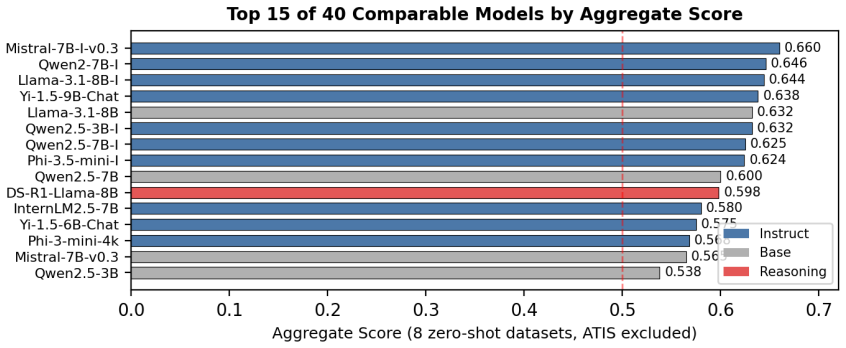
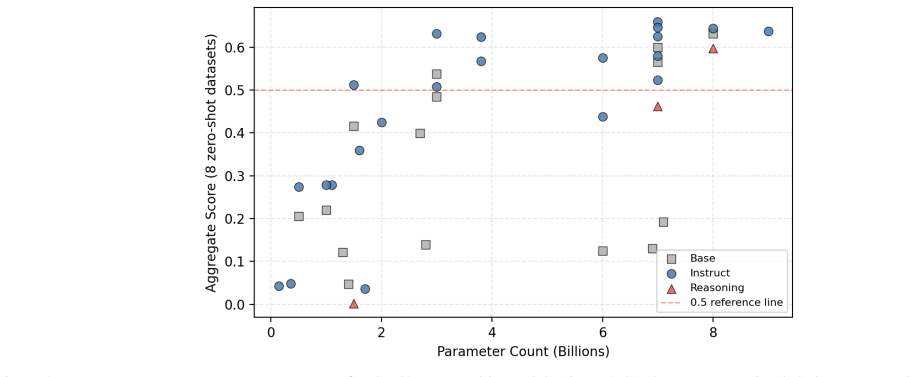
Within the evaluated open-weight sub-9B population, instruction tuning is a stronger signal than moderate parameter scale for zero-shot single-label intent classification: Qwen2.5-3B-Instruct reaches the same reported aggregate as a top-five 8B model and outperforms multiple 7B base models, all six cleanly matched base–instruct pairs improve with instruction tuning, differences among the top five on MASSIVE are pairwise non-significant under McNemar tests, and SNIPS is saturated (most models exceed 80% accuracy) while production-style sets still discriminate.
What carries the argument
A group-balanced eight-dataset zero-shot aggregate (standard IC composite of CLINC150/Banking77/SNIPS, plus MASSIVE, MTOP, and three HINT3 sets), scored by free-text exact-match accuracy under fixed greedy decoding, then extended with McNemar ranking tests, MASSIVE-scoped ECE/Brier calibration, single-seed input perturbations, and a Pareto front over accuracy, latency, and parameters.
Load-bearing premise
The paper treats sequence-level free-text log-probabilities on MASSIVE’s short labels as a usable stand-in for true label confidence, which is the basis for saying instruction tuning’s calibration effect is inconsistent rather than uniformly harmful.
What would settle it
Re-run the same 41 models with constrained decoding or full-test-set sampling and multi-seed typo perturbations: if matched base–instruct pairs no longer show consistent aggregate gains, top-five MASSIVE differences become significant, or SNIPS stops looking saturated relative to production sets, the selection guidance collapses.
If this is right
- For maximum zero-shot accuracy in this range, prefer a strong 7B instruct model such as Mistral-7B-Instruct-v0.3 over larger base models alone.
- Under tight memory or latency budgets, a 3B instruct model can be Pareto-rational and still competitive with much larger bases.
- SNIPS should be demoted in modern IC leaderboards; MASSIVE, MTOP, Banking77, and HINT3-style production sets carry more ranking signal.
- Single-benchmark rankings of leading open-weight models are unreliable without multi-dataset aggregates and significance tests.
- Typo robustness and calibration must be checked per model; clean accuracy and instruction-tuning status do not reliably predict either.
Where Pith is reading between the lines
- Label-space design may matter as much as model choice: the cross-model play-music/music-query confusion suggests many “model errors” are actually ambiguous taxonomies that few-shot definitions or merged-label metrics could fix.
- Reasoning-distilled models need deployment protocols with larger output budgets; fixed short-generation limits can zero out otherwise capable systems and skew comparative tables.
- A natural next test is whether the same instruct-over-scale pattern holds for multi-label or multilingual intent under the same efficiency and robustness axes.
Editorial analysis
A structured set of objections, weighed in public.
Referee Report
Summary. The paper presents a systematic zero-shot evaluation of 41 open-weight LLMs (15 families, 135M–9B) on eight English single-label intent-classification datasets, with ATIS reported separately as a five-shot auxiliary result. Beyond exact-match accuracy it reports confidence calibration (scoped to MASSIVE), robustness to input perturbations, McNemar tests and CIs on MASSIVE rankings, Pareto deployment efficiency, and benchmark saturation. Main claims are that instruction-tuned 3B models can outperform several 7B base models under the stated protocol, that top models on MASSIVE are pairwise statistically indistinguishable, that SNIPS is saturated (32/41 models >80%), and that instruction tuning’s effect on calibration is inconsistent rather than uniformly harmful. The work is framed as practical selection guidance for compute- and latency-constrained deployment.
Significance. If the reported rankings and tradeoffs hold under the stated free-text deployment protocol, the paper fills a genuine gap: prior intent benchmarks either target frontier proprietary models, use multiple-choice reformulations, or omit calibration, robustness, efficiency, and ranking reliability for the sub-9B open-weight range practitioners actually deploy. Strengths include breadth (41 models, production HINT3 sets), explicit statistical tests on MASSIVE, Pareto filtering with measured latency/VRAM, saturation counts that justify de-emphasizing SNIPS, and transparent limitations (ATIS subset skew, single perturbation seed, free-text calibration proxy). These make the resource useful as a menu of protocol-conditioned ranks even where causal claims about instruction tuning need tighter qualification.
major comments (3)
- [Results: Instruction Tuning vs. Parameter Scale; Finding-2; Evaluation Framework] Finding-2 (Instruction Tuning vs. Parameter Scale) and the abstract claim that instruction-tuned 3B models outperform 7B bases are measured only under free-text greedy generation, max 20 tokens, exact-match after normalization, with invalid outputs scored wrong (Evaluation Framework; Supplementary Answer-parsing logic). Instruct models are trained to obey “Reply with the label only”; base models are not. The paper’s own DeepSeek-R1-Distill-Qwen-1.5B near-zero score is attributed to reasoning tokens exhausting the budget, showing the protocol can zero models for non-IC reasons. Without per-model invalid/EMPTY_PRED rates (or a constrained-decoding / forced-choice control), a material share of the IT advantage may be format- and budget-compliance rather than intent separation. Please report invalid/empty rates by model (base vs instruct) and either (a) qualify Finding-2 as protocol-conditio
- [Confidence Calibration; Finding-8; Why Calibration is Restricted to MASSIVE] Calibration (RQ-8 / Finding-8) rests on sequence-level free-text logprobabilities on MASSIVE as a proxy for label-level confidence (Why Calibration is Restricted to MASSIVE; Limitations). The authors correctly flag length sensitivity and that low ECE can arise from consistent underconfidence. Given that the abstract and Finding-8 still state that instruction tuning’s calibration effect is “inconsistent rather than uniformly harmful,” the claim should be explicitly scoped in the abstract and finding box to “under approximate free-text sequence logprob confidence on MASSIVE,” and any base–instruct ECE comparison should note whether instruct models also change output-length distributions (which mechanically affect sequence logprobs).
- [Datasets; Limitations; Overall Model Rankings] Main accuracy uses deterministic first-500 index slices (complete HINT3 tests). Limitations documents a real ATIS majority-class skew (+3.8 pp for flight) that likely inflates ATIS figures, and states representativeness was not checked for the other five non-HINT3 sets. Because aggregate ranks and Finding-1 rest on these slices, either (i) report full-test-set scores for at least the top-10 models on CLINC150/Banking77/MASSIVE/MTOP, or (ii) quantify subset-vs-full agreement (e.g., rank correlation / accuracy delta) so readers can bound how much the 40-model ordering could move.
minor comments (6)
- [Robustness to Input Perturbations; Finding-7] Robustness (Finding-7) uses a single perturbation seed (seed 0). The text already cautions against over-generalizing Qwen2.5-7B-Instruct’s 1.3 pp typo drop; please also report at least 3 seeds or bootstrap CIs for the typo condition on the competitive subset so the “lowest observed degradation” claim is not a one-draw artifact.
- [Benchmark Saturation Analysis; Finding-3] Saturation is defined as “>50% of models exceed 80% accuracy.” The threshold is reasonable but free; a one-sentence sensitivity note (e.g., 70%/90% cutoffs) would show SNIPS remains saturated under nearby definitions.
- [Overall Model Rankings; Figure 1; Supplementary Table 2] Figure 1 and Table 2 report three-decimal aggregates; Qwen2.5-3B-Instruct and Llama-3.1-8B both show 0.632. State how ties are broken in rank order, or mark them as tied.
- [Supplementary Prompt Templates; Scoring] Prompt templates differ slightly across datasets (spaces vs underscores; Utterance/Intent vs Query/Label; uppercase for HINT3). A short note on whether normalization fully absorbs these surface differences would help reproducibility.
- [Related Work; Extended Related Work] Related Work cites IntentGrasp and Park et al. appropriately; when discussing saturation, a brief pointer to Larson & Leach (2022) already in the text is good—ensure the survey’s specific saturation observations are not overstated beyond what they claimed.
- [Figure 1 caption] Minor clarity: “group-balanced aggregate” is defined clearly in Evaluation Framework; consider repeating the six-group definition once in the Figure 1 caption so the figure is self-contained.
Circularity Check
No circularity: empirical bake-off reads rankings off held-out predictions under pre-specified prompts and metrics.
full rationale
This paper is a systematic zero-shot evaluation of 41 open-weight models on eight IC datasets (plus auxiliary 5-shot ATIS). Load-bearing claims—instruction tuning outweighing moderate scale within matched pairs, SNIPS saturation (32/41 >80%), non-significant top-5 McNemar tests on MASSIVE, Pareto efficiency, typo robustness, and inconsistent calibration effects—are empirical readouts from free-text greedy exact-match accuracy, ECE/Brier on MASSIVE logprobs, and single-seed perturbations. No parameter is fitted to a subset and then re-presented as a prediction of a closely related quantity; the group-balanced aggregate and the saturation threshold (>50% of models >80%) are explicit reporting definitions, not circular proofs, and a sensitivity check (Spearman ρ=0.995 vs simple mean) is reported. Citations are to external benchmarks and prior work (IntentGrasp, HINT3, etc.), not self-authored uniqueness theorems or ansatzes that force the results. There is no derivation chain that reduces by construction to its inputs. Protocol confounds (format compliance under free-text exact-match) are validity concerns, not circularity.
Axiom & Free-Parameter Ledger
free parameters (6)
- saturation_threshold =
>50% of models >80% accuracy
- group_balanced_aggregate_weights =
equal weight on 6 groups (IC composite, MASSIVE, MTOP, 3×HINT3)
- eval_subset_size =
500 (HINT3: full test sets)
- max_output_tokens =
20
- ECE_bins_and_confidence_proxy =
n_bins=10; sequence-level logprob
- perturbation_seed =
seed 0
axioms (6)
- domain assumption Exact-match accuracy after lowercase/article/punctuation normalization is the primary quality metric for single-label IC.
- domain assumption Zero-shot free-text generation with a fixed label list in the prompt is a valid deployment-relevant protocol (no constrained decoding, no fine-tuning).
- ad hoc to paper MASSIVE short-label generations align closely enough with the label vocabulary that sequence logprobabilities approximate answer confidence.
- standard math McNemar tests on n=500 MASSIVE items and Wald 95% CIs suffice to assess whether top-model ranking gaps are reliable on that benchmark.
- ad hoc to paper Index-ordered first-500 slices are adequate for cross-model comparison even if not random samples of the full test distribution.
- domain assumption Pareto optimality over aggregate accuracy, latency, and parameter count identifies practically undominated deployment choices under the measured V100/vLLM regime.
Cite this review
Pith. "Pith review of Selecting Open-Weight Language Models for Zero-Shot Intent Classification: A Systematic Evaluation of 41 Models." pith.science (2026). https://pith.science/paper/Y2NTYWIE
@misc{pith2026260727421,
  author       = {Pith},
  title        = {Pith review of: Selecting Open-Weight Language Models for Zero-Shot Intent Classification: A Systematic Evaluation of 41 Models},
  year         = {2026},
  howpublished = {\url{https://pith.science/paper/Y2NTYWIE}},
  note         = {Machine review of arXiv:2607.27421}
}
read the original abstract
Intent classification is a core component of task-oriented dialogue systems, yet practitioners have limited systematic guidance for selecting deployable open-weight language models under compute, latency, and robustness constraints. We present a systematic zero-shot evaluation of 41 open-weight language models spanning 15 families and the 135M--9B parameter range across eight English single-label intent-classification datasets. A ninth dataset, ATIS, uses five labeled demonstrations and is reported as an auxiliary five-shot result. The evaluation includes standard benchmarks, a large-scale voice-assistant corpus, and production-derived e-commerce datasets. Beyond exact-match accuracy, we analyze confidence calibration, robustness to realistic input perturbations, statistical reliability of model rankings, deployment efficiency, and benchmark saturation. Our results show that instruction-tuned 3B models can outperform several evaluated 7B base models, that differences among leading models on MASSIVE are statistically indistinguishable under pairwise McNemar tests, and that widely used benchmarks such as SNIPS have become saturated and no longer meaningfully discriminate among current open-weight models. Instruction tuning's effect on confidence calibration is inconsistent rather than uniformly harmful. These findings provide practical guidance for selecting and evaluating open-weight language models for intent classification.
Figures


Reference graph
Works this paper leans on
-
[1]
Abdin, M.; Jacobs, S. A.; Awan, A. A.; Aneja, J.; Awadallah, A.; Awadalla, H.; Bach, N.; Bahree, A.; Bakhtiari, A.; Behl, H.; et al. 2024. Phi-3 Technical Report: A Highly Capable Language Model Locally on Your Phone.arXiv preprint arXiv:2404.14219
Pith/arXiv arXiv 2024
-
[2]
Allal,L.B.;Lozhkov,A.;Bakouch,E.;Blazquez,G.M.; Penedo, G.; Tunstall, L.; Marafioti, A.; Kydlicek, H.; Lajarin, A. P.; Srivastav, V.; et al. 2025. SmolLM2: WhenSmolGoesBig–Data-CentricTrainingofaSmall Language Model.arXiv preprint arXiv:2502.02737
Pith/arXiv arXiv 2025
-
[3]
Bellagente, M.; Tow, J.; Mahan, D.; Phung, D.; Zhu- ravinskyi, M.; Adithyan, R.; Baicoianu, J.; Brooks, B.; Cooper, N.; Datta, A.; et al. 2024. Stable LM 2 1.6B Technical Report.arXiv preprint arXiv:2402.17834
Pith/arXiv arXiv 2024
-
[4]
G.; Bradley, H.; O’Brien, K.; Hallahan, E.; Khan, M
Biderman, S.; Schoelkopf, H.; Anthony, Q. G.; Bradley, H.; O’Brien, K.; Hallahan, E.; Khan, M. A.; Purohit, S.; Prashanth, U. S.; Raff, E.; Skowron, A.; Sutawika, L.; and van der Wal, O. 2023. Pythia: A Suite for Analyzing Large Language Models Across Training and Scaling. InInternational Conference on Machine Learning, 2397–2430. PMLR
2023
-
[5]
BigScience Workshop; Le Scao, T.; Fan, A.; Akiki, C.; Pavlick, E.; Ilić, S.; Hesslow, D.; Castagné, R.; Luccioni, A. S.; Yvon, F.; et al. 2022. BLOOM: A 176B-Parameter Open-Access Multilingual Language Model.arXiv preprint arXiv:2211.05100
Pith/arXiv arXiv 2022
-
[6]
D.; Dhariwal, P.; Neelakantan, A.; Shyam, P.; Sastry, G.; Askell, A.; et al
Brown, T.; Mann, B.; Ryder, N.; Subbiah, M.; Kaplan, J. D.; Dhariwal, P.; Neelakantan, A.; Shyam, P.; Sastry, G.; Askell, A.; et al. 2020. Language models are few-shot learners. InAdvances in Neural Information Processing Systems, volume 33, 1877–1901
2020
-
[7]
Cai, Z.; Cao, M.; Chen, H.; Chen, K.; Chen, K.; Chen, X.; Chen, X.; Chen, Z.; Chen, Z.; Chu, P.; et al
-
[8]
Casanueva, I.; Teˇmčinas, T.; Gerz, D.; Henderson, M.; and Vulić, I. 2020. Efficient intent detection with dual sentenceencoders. InProceedingsofthe2ndWorkshop on NLP for Conversational AI
2020
-
[9]
Coucke, A.; Saade, A.; Ball, A.; Bluche, T.; Caulier, A.; Leroy, D.; Doumouro, C.; Gisselbrecht, T.; Calta- girone, F.; Lavril, T.; et al. 2018. Snips voice platform: an embedded spoken language understanding system for private-by-design voice interfaces.arXiv preprint arXiv:1805.10190
Pith/arXiv arXiv 2018
-
[10]
DeepSeek-AI; Guo, D.; Yang, D.; Zhang, H.; Song, J.; Zhang, R.; Xu, R.; Zhu, Q.; Ma, S.; Wang, P.; et al. 2025. DeepSeek-R1: Incentivizing Reasoning Capability in LLMs via Reinforcement Learning.arXiv preprint arXiv:2501.12948
Pith/arXiv arXiv 2025
-
[11]
FitzGerald, J.; Hench, C.; Peris, C.; Mackie, S.; Rottmann, K.; Sanchez, A.; Nash, A.; Urbach, L.; Kakarala, V.; Singh, R.; et al. 2022. MASSIVE: A 1M- example multilingual natural language understanding dataset with 51 typologically-diverse languages.arXiv preprint arXiv:2204.08582
Pith/arXiv arXiv 2022
-
[12]
Grattafiori, A.; Dubey, A.; Jauhri, A.; Pandey, A.; Kadian, A.; Al-Dahle, A.; Letman, A.; Mathur, A.; Schelten, A.; Vaughan, A.; et al. 2024. The Llama 3 Herd of Models.arXiv preprint arXiv:2407.21783
Pith/arXiv arXiv 2024
-
[13]
Guo, C.; Pleiss, G.; Sun, Y.; and Weinberger, K. Q
-
[14]
T.; Godfrey, J
Hemphill, C. T.; Godfrey, J. J.; and Doddington, G. R
-
[15]
Hu, S.; Tu, Y.; Han, X.; He, C.; Cui, G.; Long, X.; Zheng, Z.; Fang, Y.; Huang, Y.; Zhao, W.; et al. 2024. MiniCPM: Unveiling the Potential of Small Language ModelswithScalableTrainingStrategies.arXivpreprint arXiv:2404.06395
Pith/arXiv arXiv 2024
-
[16]
S.; de las Casas, D.; Bressand, F.; Lengyel, G.; Lample, G.; Saulnier, L.; et al
Jiang,A.Q.;Sablayrolles,A.;Mensch,A.;Bamford,C.; Chaplot, D. S.; de las Casas, D.; Bressand, F.; Lengyel, G.; Lample, G.; Saulnier, L.; et al. 2023. Mistral 7B. arXiv preprint arXiv:2310.06825
Pith/arXiv arXiv 2023
-
[17]
H.; Gonzalez, J
Kwon, W.; Li, Z.; Zhuang, S.; Sheng, Y.; Zheng, L.; Yu, C. H.; Gonzalez, J. E.; Zhang, H.; and Stoica, I
-
[18]
Larson, S.; and Leach, K. 2022. A survey of intent classification and slot-filling datasets for task-oriented dialog.arXiv preprint arXiv:2207.13211
Pith/arXiv arXiv 2022
-
[19]
J.; Clarke, C.; Lee, A.; Hill, P.; Kummerfeld, J
Larson, S.; Mahendran, A.; Peper, J. J.; Clarke, C.; Lee, A.; Hill, P.; Kummerfeld, J. K.; Leach, K.; Laurenzano, M. A.; Tang, L.; et al. 2019. An evaluation dataset for intent classification and out-of-scope prediction. In Proceedings of EMNLP-IJCNLP
2019
-
[20]
Li, X.; Lyu, T.; Yang, S.; et al. 2025. Consintbench: Evaluating language models on real-world consumer intent understanding.arXiv preprint arXiv:2510.13499
arXiv 2025
-
[21]
Mehri, S.; and Eric, M. 2021. Example-driven intent prediction with observers. InProceedings of NAACL
2021
-
[22]
HINT3: Raising the bar for intent detection in the wild
Mehta,G.; Jain,C.;Chaturvedi,M.; andModi,K.2020. HINT3: Raising the bar for intent detection in the wild. InProceedings of the First Workshop on Insights from Negative Results in NLP
2020
-
[23]
Park, G.; Baek, I.; Kim, B.; Shin, J.; and Lee, H
-
[24]
Qin, L.; Xu, X.; Che, W.; and Liu, T. 2020. AGIF: An adaptive graph-interactive framework for joint multiple intent detection and slot filling. InFindings of EMNLP
2020
-
[25]
Schick, T.; and Schütze, H. 2021. Exploiting cloze- questions for few-shot text classification and natural language inference. InProceedings of EACL
2021
-
[26]
Team GLM; Zeng, A.; Xu, B.; Wang, B.; Zhang, C.; Yin, D.; Zhang, D.; Rojas, D.; Feng, G.; Zhao, H.; et al
-
[27]
Wang, B.; and Komatsuzaki, A. 2021. GPT-J-6B: A 6 Billion Parameter Autoregressive Language Model. https://github.com/kingoflolz/mesh-transformer-jax
2021
-
[28]
Dynamic Label Name Refinement for Few- Shot Dialogue Intent Classification.arXiv preprint arXiv:2412.15603
-
[29]
Qwen2 Technical Report.arXiv preprint arXiv:2407.10671
Yang, A.; Yang, B.; Hui, B.; Zheng, B.; Yu, B.; Zhou, C.;Li,C.;Li,C.;Liu,D.;Huang,F.;etal.2024. Qwen2 Technical Report.arXiv preprint arXiv:2407.10671
Pith/arXiv arXiv 2024
-
[30]
Yang, A.; Yang, B.; Zhang, B.; Hui, B.; Zheng, B.; Yu, B.; Li, C.; Liu, D.; Huang, F.; et al. 2024. Qwen2.5 Technical Report.arXiv preprint arXiv:2412.15115
Pith/arXiv arXiv 2024
-
[31]
Yang, Y.; Wang, W.; Xu, B.; et al. 2025. SessionIn- tentBench: A multi-task inter-session intention-shift modelingbenchmark.arXivpreprintarXiv:2507.20185
Pith/arXiv arXiv 2025
-
[32]
ChatGLM: A Family of Large Language Models from GLM-130B to GLM-4 All Tools.arXiv preprint arXiv:2406.12793
-
[33]
Young, A.; Chen, B.; Li, C.; Huang, C.; Zhang, G.; Zhang, G.; Li, H.; Zhu, J.; Chen, J.; Chang, J.; et al
-
[34]
Y.; Guu, K.; Yu, A
Wei, J.; Bosma, M.; Zhao, V. Y.; Guu, K.; Yu, A. W.; Lester, B.; Du, N.; Dai, A. M.; and Le, Q. V. 2022. Finetuned language models are zero-shot learners. In Proceedings of ICLR
2022
-
[35]
Z.; Wallace, E.; Feng, S.; Klein, D.; and Singh, S
Zhao, T. Z.; Wallace, E.; Feng, S.; Klein, D.; and Singh, S. 2021. Calibrate before use: Improving few-shot performance of language models.arXiv preprint. Supplementary Material This supplementary material provides complete model rank- ings, extended experimental results, prompt templates, cal- ibration results, robustness analyses, statistical tests, and...
2021
-
[38]
Yin, Y.; Li, C.; and Carenini, G. 2026. Intentgrasp: A comprehensive benchmark for intent understanding. arXiv preprint arXiv:2605.06832
Pith/arXiv arXiv 2026
-
[40]
Yi: Open Foundation Models by 01.AI.arXiv preprint arXiv:2403.04652
-
[41]
Zhang, P.; Zeng, G.; Wang, T.; and Lu, W. 2024. TinyLlama: An Open-Source Small Language Model. arXiv preprint arXiv:2401.02385
Pith/arXiv arXiv 2024
-
[1990]
InSpeech and Natural Language: Proceedings of a Workshop
The ATIS spoken language systems pilot corpus. InSpeech and Natural Language: Proceedings of a Workshop
-
[2017]
In Proceedings of the 34th International Conference on Machine Learning
On calibration of modern neural networks. In Proceedings of the 34th International Conference on Machine Learning
-
[2021]
\n", "</s>
(117 intents, hierarchical). HINT3 (Mehta et al. 2020) introducedthreerealIndiane-commerceproductiondatasets— Curekart, Powerplay11, Sofmattress—to expose the gap be- tween academic benchmarks and deployment reality. Larson and Leach (2022) surveyed IC datasets and noted growing saturation concerns, which our analysis confirms and extends. Zero-Shot IC wi...
2020
-
[2023]
InProceedings of the 29th Symposium on Operating Systems Principles
Efficientmemorymanagementforlargelanguage model serving with pagedattention. InProceedings of the 29th Symposium on Operating Systems Principles
-
[2024]
InternLM2 Technical Report.arXiv preprint arXiv:2403.17297
This paper was first reviewed by grok-4.5 on July 31, 2026.
discussion (0)
Sign in with ORCID, Apple, or X to comment. Anyone can read and Pith papers without signing in.