Artificial Intelligence · arXiv:2608.09248 v2 · submitted 10 Aug 2026 · 36 references
Emotion2Skill: Model-Internal Emotion Signals for Adaptive Skill Selection and Evolution
The paper says
“Skill-based LLM agents select reusable procedures from an external library to solve complex tasks, yet their routing decisions rely entirely on text-level signals such as task descriptions, verbal reflections, and experience-derived rules, while the model's own internal representational state remains unobserved.”
more of the abstract
Recent interpretability work has shown that LLMs maintain linear emotion representations that causally influence behavior; however, these representations have been exploited only for post-hoc analysis or direct output steering, and have not been used to inform agent-level decision-making. We propose Emotion2Skill, a framework that extracts LLM-internal emotion vectors and incorporates them into both skill selection and skill evolution. At each decision step, a 27-dimensional emotion state is extracted from the residual stream and mapped to a confidence-gated summary injected into the routing prompt. Beyond online selection, emotion trajectories are analyzed for abrupt internal-state shifts to pinpoint problematic skill invocations, guiding targeted SOP rewriting that replaces the coarse binary outcome signal of prior methods. On WebShop and ALFWorld, Emotion2Skill with Qwen3-8B improves over the Zero-Shot baseline by +26.9% success rate and +25.5% average success respectively, outperforming all baselines on both benchmarks with consistent gains on Qwen3-14B. Co-activation analysis further reveals semantically coherent emotion–skill pairings, confirming that the routing improvements reflect meaningful internal-state signals rather than opaque statistical correlations. These results establish LLM-internal emotion representations as an effective decision-level signal for orchestrating agent skill systems, extending their utility beyond interpretability and output steering. The code is available at https://github.com/BoHan-LIN04/Emotion2Skill.
from the abstract
Pith says
Machine review · deepseek-v4-flash · 14 Aug 2026 · what was read was not recorded · not checked by a person
It can be wrong. Challenge this review or reply to it.
The passes disagreed. Reader: holds up, with conditions. Skeptic: gave no verdict. Referee: major revision.
Interesting idea with clear empirical promise, but the headline gains rest on an unstated warm-up/evolution/test split that must be documented before the numbers can be trusted. This line is wrong
3 major objections · 4 minor
How often objections from reviews like this one are right: not yet measured
Not checked: figures, code, what the 36 references say.
The paper says, at §4.1, Appendix B.2
The review did not quote this passage.
Pith says: Objection 1 of 3 · major
The evaluation split's provenance is underspecified in a way that directly bears on Table 1. The main results use the WebShop test set and the ALFWorld json_2.1.1 split (134 test episodes), while Appendix B.2 says the emotion encoder is trained on 500 warm-up episodes (250 WebShop + 250 ALFWorld) and skill evolution uses 100 episodes per round for R=3 rounds (50 WebShop + 50 ALFWorld per round).
more of objection 1
The paper never states that these episodes are disjoint from the evaluation episodes, and for ALFWorld the 250 warm-up episodes alone exceed the 134-episode test split. If the warm-up or evolution batches are drawn from the same splits that produce the numbers in Table 1, then Emotion2Skill receives outcome labels from the test distribution before the final evaluation, and the comparison against baselines that do not see those outcomes is invalid. Please provide the exact source split (training, validation, test), episode identifiers, and a statement of disjointness for the warm-up, evolution, and evaluation episode sets; if overlap exists, rerun with a strictly disjoint held-out evaluation set.
The paper says, at Section 3.2, Appendix C.3
The review did not quote this passage.
Pith says: Objection 2 of 3 · major
The paper's central interpretation is that the routing gain comes from model-internal emotion, but the 'emotion' summary is not a raw affective readout. The encoder fθ is trained with a supervised-contrastive loss on tuples (e_t, s_sel_t, y_t), using baseline skill choices and episode outcomes, and Appendix C.3 states that the confidence score c_t is trained by binary cross-entropy against episode success labels, although this loss term is absent from the training objective in Section 3.2.
more of objection 2
As a result, the injected summary can be understood as a learned success predictor conditioned on emotion-derived features rather than as an emotion measurement. To support the stated claim, the authors should either explicitly reframe the signal as outcome-supervised features derived from emotion vectors or add an ablation in which the encoder is trained without outcome labels (or with shuffled outcome labels), and they should specify the actual loss used for the confidence head.
The paper says, at Table 2 vs. Table 1
The review did not quote this passage.
Pith says: Objection 3 of 3 · major
Table 2's Full row reports WebShop Succ. 28.1 and ALFWorld Avg. 46.9 on Qwen3-8B, while Table 1 reports 29.7 ±1.6 and 47.4 ±1.6 for the same configuration. The table does not state whether it uses one run, a different episode ordering, or a different subset.
more of objection 3
Since the ablation deltas are computed against this Full value, the inconsistency makes the ablation magnitudes hard to interpret. Report the run count and standard deviations for Table 2, and align its Full row with the same evaluation protocol as Table 1.
4 minor objections
The paper says, at Appendix A.1
Pith says: minor objection 1 of 4
The appendix states that subtracting the global mean gives contrastive directions v_k via 'Eq. 1', but in the main text the direction formula appears as Eq. (2); the equation numbering should be made consistent across the paper.
The paper says, at Appendix B.2
Pith says: minor objection 2 of 4
The sentence 'Warm-up data: 500 episodes under ReAct+skill baseline (250 WebShop, 250 ALFWorld)' is ambiguous about whether these episodes are sampled with replacement and from which split; please specify the episode sampling procedure explicitly.
show 2 more
The paper says, at Section 3.2
Pith says: minor objection 3 of 4
The k-means pseudo-label step for the template-classification loss is described only briefly; please specify the number of k-means restarts, the initialization of the prototype vectors q_j, and how the pseudo-labels are assigned during encoder training.
The paper says, at Appendix C.3
Pith says: minor objection 4 of 4
Proposition 3 assumes that c_t is a consistent estimator of Pr[ΔU_t > 0 | r_t], but no evidence or derivation is given that episode-outcome supervision makes c_t a consistent estimator of stepwise utility gain; either prove this connection or state it as an assumption.
What would settle it
Inspect the public repository's experiment harness and identify the exact episode IDs and splits used for: (1) the 500 warm-up episodes described in Appendix B.2; (2) each evolution round's 100 episodes described in Appendix B.2; and (3) the final evaluation behind Table 1 and Table F.1. Verify that none of the warm-up or evolution episodes, and none of their outcome labels, belong to the WebShop test set or the ALFWorld json_2.1.1 evaluation split. Then rerun Qwen3-8B on WebShop with skill evolution disabled entirely, meaning no SOP rewriting at all, and also with evolution performed only on a disjoint training split, and compare the resulting Succ. to the reported 29.7%. If either variant drops materially below 29.7%, the headline gains are partly attributable to test-set adaptation rather than to emotion-conditioned skill selection.
from the skeptic's reading
How the review went
4 readings by deepseek-v4-flash · 14 Aug 2026
- Reader holds up, with conditions
- Skeptic partly agrees
- Editor wrote the verdict above
- Referee major revision: 3 major objections, 4 minor
Not run on this paper: the simulated authors' defence.
Pith did not check this review's objections against the paper.
The review in full
The review in brief, machine-written
What you should know first: the paper is the first to use LLM-internal emotion vectors as an active routing and evolution signal for skill-based agents, and it reports consistent gains over five baselines on WebShop and ALFWorld with two Qwen3 backbones. The components are sensible: contrastive extraction from Sofroniew et al., a small MLP encoder producing confidence-gated text templates, and transition-point diagnostics that guide SOP rewriting. The ablations isolate each piece and the code is public. That is real work and worth engaging with.
The soft spot is not the idea; it is the evaluation protocol. The emotion encoder is trained on 500 warm-up episodes and the skill-evolution stage runs three rounds of 100 episodes each, where the agent receives episode outcomes and rewrites SOPs before the final Table 1 numbers are computed. The paper nowhere states that those warm-up and evolution episodes are disjoint from the WebShop test set and ALFWorld json_2.1.1 test episodes used for evaluation. If they are sampled from the same test splits, the reported gains partly reflect in-test adaptation that the baselines never get, and the comparison is unfair. This is a load-bearing condition for the central claim, and it should have been stated explicitly in Appendix B.2. The stress-test note is right on this point; I checked the paper and found no split documentation.
A couple of smaller caveats: the co-activation coherence analysis uses a GPT-4o proxy with a 76.5% consistency rate, which is weak confirmatory evidence, and the phrase "causal proxy" in the introduction overreaches since the method only observes the emotion vectors and never intervenes on them. The Appendix's theoretical section is mostly re-derivations with loose assumptions; it does not add much, but it is not harmful.
Citation pattern looks fine: Sofroniew et al. is properly credited for the extraction method, and the related work is broad. No invented entities or obvious missing references.
Bottom line: this paper deserves a serious referee, but only after the split question is resolved. If the authors confirm disjointness, the result is a solid within-subfield contribution. As written, the headline empirical claim is unverified. My recommendation: send to peer review, but make the split disclosure a required condition; I would not accept as-is.
The strongest objection
To support the central claim that internal emotion signals improve skill selection and evolution, Table 1 must compare methods on episodes whose outcomes never influence the method. The paper does not establish this. Appendix B.2 says the emotion encoder is trained on 500 warm-up episodes (250 WebShop, 250 ALFWorld) under a ReAct+skill baseline, and that skill evolution runs R=3 rounds with 100 episodes per round (50 WebShop + 50 ALFWorld). The main evaluation uses the WebShop test set and the ALFWorld json_2.1.1 split, which contains only 134 test episodes. Nowhere do the authors state that the warm-up episodes or the 300 evolution episodes are disjoint from the evaluation episodes. If the evolution batches are sampled from the same test splits, then during evolution the agent receives episode outcomes, since Eq. 13 includes r_ep in the rewrite prompt, and rewrites SOPs before the final Table 1 numbers are computed. The reported 29.7% WebShop Succ. and 52.3% ALFWorld Avg. would then reflect in-test adaptation unavailable to Zero-Shot, ReAct, Reflexion, ExpeL, and MASA. The w/o Emotion Evolution ablation in Table 2 does not remove evolution, only the emotion diagnostics, so it cannot isolate this effect. This is the load-bearing condition for the headline empirical comparison, and without a documented split it remains unverified.
The paper's central claim is that LLM-internal emotion representations improve skill selection and evolution. The empirical core is Table 1, which requires a clean separation between episodes used to fit or adapt the system and episodes used for evaluation. The paper specifies warm-up data of 500 episodes and evolution data of 3 by 100 episodes, but it never states the split provenance of these episodes. ALFWorld's evaluation split is only 134 episodes, and the paper does not document that the 250 warm-up and 150 evolution ALFWorld episodes are drawn from a disjoint training split. If the evolution batches come from the test split, the method adapts SOPs using test outcomes, so the comparison to static baselines is not apples-to-apples. This concern is more decisive than the reader's warm-up-only concern, but it belongs to the same data-split family, so agreement is partial. Other weaknesses, such as the GPT-4o coherence rating and the emotion labels acting partly as outcome predictors, affect interpretation of the mechanism but not the validity of the comparison. The proposed code inspection and the no-evolution rerun would settle the matter, so the appropriate status is unverdictable until that check is performed.
The referee's report
If the empirical result holds, Emotion2Skill would be a useful demonstration that internal-state readouts can serve as a routing signal for skill-based LLM agents, moving internal emotion representations beyond post-hoc interpretability and output steering. The paper is empirically ambitious: it evaluates on two interactive benchmarks with two backbones, includes ablations, tests out-of-domain transfer, and releases code. The significance is conditional on experiment hygiene: the reported gains are meaningful only if no warm-up episode, evolution episode, or validation split overlaps the evaluation episodes. At present the paper does not establish this, and the inconsistency between the stated training objective and the confidence-head description also needs to be resolved before the claims can be fully assessed.
Pith's reading of the paper (a machine's summary, not the authors')
Emotion2Skill tries to show that the internal emotional state of an LLM is a usable decision signal for agent skill systems, not just a curiosity for interpretability. At each routing step it reads a 27-dimensional emotion vector from the residual stream (the hidden activations between transformer layers), compresses it into a natural-language template with a confidence score, and injects that template into the skill-selection prompt only when confidence is high. It also uses sharp shifts in the emotion trajectory to locate which steps of an episode went wrong and to guide rewriting of underperforming skill procedures. On WebShop and ALFWorld, the method outperforms all tested baselines on both Qwen3-8B and Qwen3-14B, improving over zero-shot by roughly 21 to 29 percentage points depending on benchmark and backbone. If the claim holds, skill-based agents can condition their routing on model-internal state without any weight updates, using information that text-based reflection and retrieval do not expose.
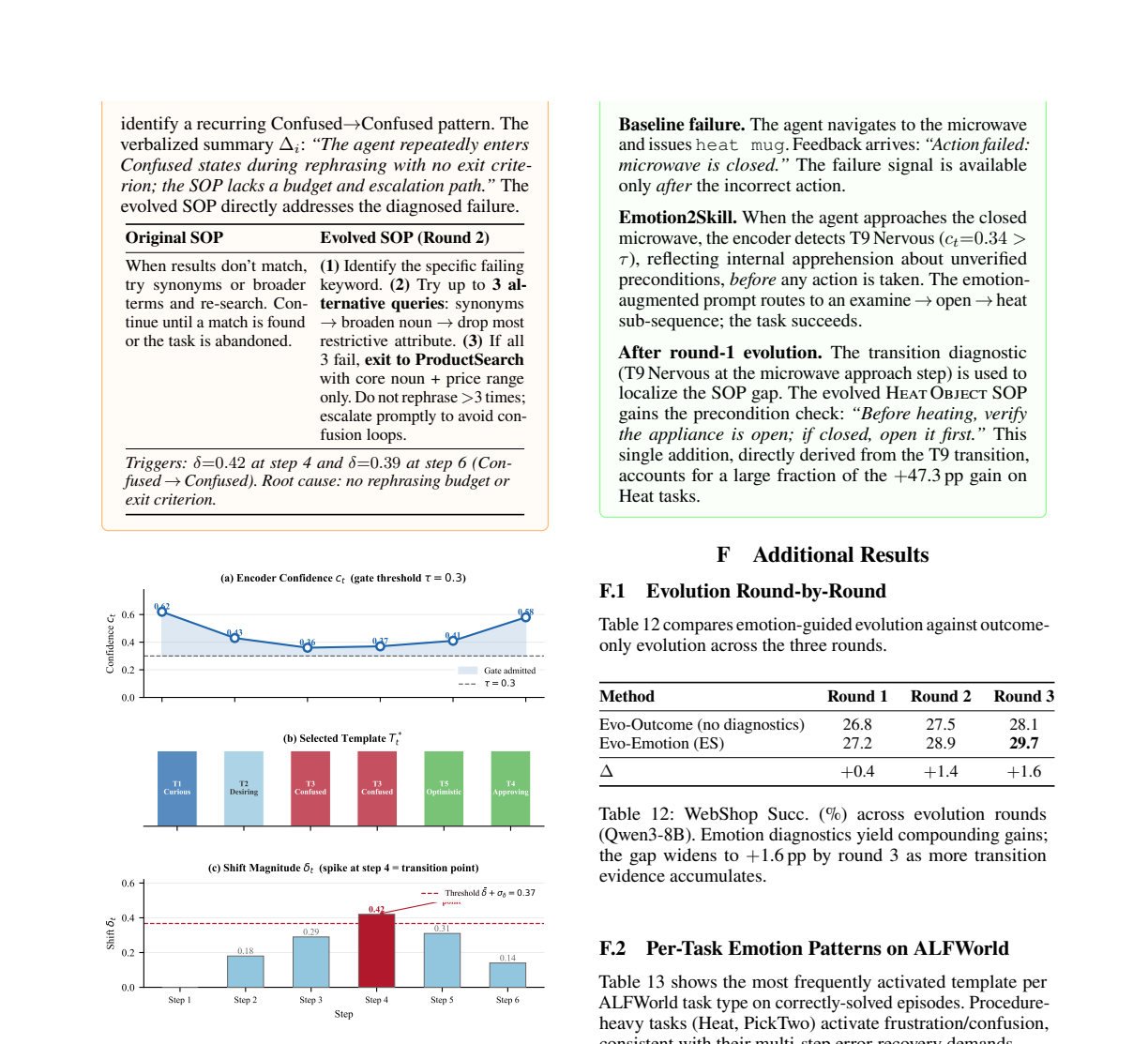
What carries the argument. The central machinery is a four-part loop built around the residual stream, the sequence of hidden activations the transformer carries between layers. Contrastive averaging over 100 generated stories per emotion yields 27 denoised emotion directions from the GoEmotions taxonomy; at each decision step the activation at the Assistant delimiter token is projected onto these directions and normalized into a 27-dimensional emotion state. A 3-layer MLP, trained with supervised contrastive loss on 500 warm-up episodes, maps that state to one of 12 language templates and a confidence score, and the gate admits the template only when confidence is at least 0.3. Offline, the cosine distance between consecutive emotion states flags transition points, and 3-step windows around them are fed to the LLM rewriter to revise underperforming skill SOPs. This loop is what carries the claim: the emotion readout is the only new information the routing prompt receives beyond text.
Core claim. The paper's central claim is that an LLM's internal emotion representation—not the text it generates—carries decision-relevant state that skill-based agents can exploit. Concretely, residual-stream activations at a chosen layer, projected onto 27 contrastive emotion directions from GoEmotions and normalized, form an emotion vector at each step; a small trained encoder turns that vector into a natural-language emotion template plus a confidence score, and only when confidence passes a threshold is the template appended to the skill-selection prompt. The same emotion trajectory, viewed as cosine shifts between consecutive vectors, identifies transition points that guide targeted SOP rewriting. On WebShop and ALFWorld with Qwen3-8B, this configuration improves zero-shot success by +26.9 and +25.5 percentage points respectively and beats ReAct, Reflexion, ExpeL, and MASA on both benchmarks; Qwen3-14B shows consistent gains, and a co-activation analysis finds semantically coherent emotion–skill pairings at a 76.5% agreement rate.
The premise it rests on. The load-bearing premise is that the 27-dimensional emotion readout, encoded by a network trained on 500 warm-up episodes, supplies routing information that the textual context alone does not already contain, and that those warm-up episodes do not overlap the evaluation episodes.
If the paper is right (Pith's inferences, not the authors')
Skill-based agents can be made to condition on their own internal state at decision time without weight updates, by changing only the prompt.
The routing benefit transfers across domains: emotion vectors extracted once at layer 24 for Qwen3-8B improve MATH accuracy by +14.4 points and MBPP pass@1 by +11.8 points without re-extraction.
Confidence gating makes the method robust: performance stays within about 1 point for thresholds tau in [0.1, 0.6], and 72% of steps are admitted by the gate.
Temporally localized emotion-transition diagnostics improve SOP rewriting more than binary outcome feedback, with the gap widening across evolution rounds to +1.6 points on WebShop.
Because gains are larger on Qwen3-14B than Qwen3-8B and scale with GoEmotions classification accuracy, the benefit is tied to the fidelity of the emotion representation.
The framework is compatible with external reward- or similarity-based skill-evolution methods, which the paper explicitly identifies as operating on a different, complementary signal dimension.
If the emotion readout is partly a learned success predictor because the encoder is trained on outcome labels, a fair comparison would test a text-based uncertainty signal of equal information; this would clarify whether residual-stream access is essential or merely a convenience.
The transition-point detector could be lifted out of skill evolution and used as a generic episode-level curriculum signal, for example to decide where to insert reflection calls or reward shaping, since it needs only the emotion trajectory.
The requirement of white-box residual-stream access limits deployment to locally served models; a testable extension is whether a black-box model can mimic the gated summary from text alone, which would shrink the practical advantage.
The 76.5% coherence rate of emotion–skill pairings, with low-intensity activations explaining most disagreements, suggests that thresholding on activation magnitude could further sharpen routing.
Check this review
Pith stored no record of this review's passes and took no fingerprint of it. Reviews made by code from 13 Nov 2026 on carry both.
How often reviews like this one are right
Reviews like this one: written by deepseek-v4-flash, where what was read was not recorded.
How often objections from reviews like this one are right: not yet measured
Reviews by people
This review was written by a machine. No person has reviewed this paper on Pith yet. A scientist listed on Pith can review it for a fee, and their review is published here whatever it concludes.
The paper
Abstract
Skill-based LLM agents select reusable procedures from an external library to solve complex tasks, yet their routing decisions rely entirely on text-level signals such as task descriptions, verbal reflections, and experience-derived rules, while the model's own internal representational state remains unobserved. Recent interpretability work has shown that LLMs maintain linear emotion representations that causally influence behavior; however, these representations have been exploited only for post-hoc analysis or direct output steering, and have not been used to inform agent-level decision-making. We propose Emotion2Skill, a framework that extracts LLM-internal emotion vectors and incorporates them into both skill selection and skill evolution. At each decision step, a 27-dimensional emotion state is extracted from the residual stream and mapped to a confidence-gated summary injected into the routing prompt. Beyond online selection, emotion trajectories are analyzed for abrupt internal-state shifts to pinpoint problematic skill invocations, guiding targeted SOP rewriting that replaces the coarse binary outcome signal of prior methods. On WebShop and ALFWorld, Emotion2Skill with Qwen3-8B improves over the Zero-Shot baseline by +26.9% success rate and +25.5% average success respectively, outperforming all baselines on both benchmarks with consistent gains on Qwen3-14B. Co-activation analysis further reveals semantically coherent emotion–skill pairings, confirming that the routing improvements reflect meaningful internal-state signals rather than opaque statistical correlations. These results establish LLM-internal emotion representations as an effective decision-level signal for orchestrating agent skill systems, extending their utility beyond interpretability and output steering. The code is available at https://github.com/BoHan-LIN04/Emotion2Skill.
The paper's own sentences, arranged, kept beside the review and separate from it. Each label is drawn from a closed vocabulary; the number beside it is the probability the classifier gave that label. No sentence in this record was written by a model.
abstract compiled · 2026-09-23
The authors' main claim, as the classifier picked it out 1.00
“These results establish LLM-internal emotion representations as an effective decision-level signal for orchestrating agent skill systems, extending their utility beyond interpretability and output steering.”
How the main claim is stated: asserted 1.00
What the abstract itself states, as probabilities: claims first 0.25 · states limitation 0.11 · human participants 0.03 · controlled comparison 0.97 · randomized assignment 0.02 · states quantitative result 0.99 · compares with prior results 0.98 · mentions code or data availability 0.99
The abstract, sentence by sentence
This table labels the abstract only (arXiv listing abstract v2). The number is the probability the classifier gave the label.
| Sentence | Role | The authors' own work | States the main conclusion | Strength |
|---|---|---|---|---|
| Skill-based LLM agents select reusable procedures from an external library to solve complex tasks, yet their routing decisions rely entirely on text-level signals such as task descriptions, verbal reflections, and experience-derived rules, while the model's own internal representational state remains unobserved. | gap 0.65 | 0.06 | 0.02 | asserted 1.00 |
| Recent interpretability work has shown that LLMs maintain linear emotion representations that causally influence behavior; however, these representations have been exploited only for post-hoc analysis or direct output steering, and have not been used to inform agent-level decision-making. | gap 0.79 | 0.04 | 0.03 | asserted 1.00 |
| We propose Emotion2Skill, a framework that extracts LLM-internal emotion vectors and incorporates them into both skill selection and skill evolution. | contribution 0.99 | 0.84 | 0.08 | asserted 0.99 |
| At each decision step, a 27-dimensional emotion state is extracted from the residual stream and mapped to a confidence-gated summary injected into the routing prompt. | method 1.00 | 0.93 | 0.03 | asserted 1.00 |
| Beyond online selection, emotion trajectories are analyzed for abrupt internal-state shifts to pinpoint problematic skill invocations, guiding targeted SOP rewriting that replaces the coarse binary outcome signal of prior methods. | method 0.90 | 0.92 | 0.05 | asserted 0.99 |
| On WebShop and ALFWorld, Emotion2Skill with Qwen3-8B improves over the Zero-Shot baseline by +26.9% success rate and +25.5% average success respectively, outperforming all baselines on both benchmarks with consistent gains on Qwen3-14B. | result 1.00 | 0.96 | 0.13 | asserted 1.00 |
| Co-activation analysis further reveals semantically coherent emotion--skill pairings, confirming that the routing improvements reflect meaningful internal-state signals rather than opaque statistical correlations. | interpretation 0.68 | 0.93 | 0.08 | asserted 0.99 |
| These results establish LLM-internal emotion representations as an effective decision-level signal for orchestrating agent skill systems, extending their utility beyond interpretability and output steering. | interpretation 1.00 | 0.85 | 0.93 | asserted 1.00 |
| The code is available at https://github.com/BoHan-LIN04/Emotion2Skill. | contribution 0.67 | 0.41 | 0.02 | asserted 0.90 |
What kind of paper the classifier reports this is: method or tool 1.00 · evidence from observation or experiment 0.96
What was examined, and what was not
Sources read
- arXiv listing abstract v2
Not examined
- full text
- figures and tables
- references and citing sentences
- relations to other papers
Levels run
- P abstract
Not run
- S sections
- T body sentences
- C citations
- R cross-paper relations
How the labels were made
Compiled by classifier-1.13.0 via TypeSafe API, question bank abstract-p1-20260923, 2026-09-23: 1 request, 7,202 input tokens.
Every quoted sentence on this record is the authors'. Every label is from Pith's closed vocabulary, with the probability shown beside it. This record as JSON
Figures (7)



Showing 6 of the paper's 7 figures. Figures are the authors', reproduced from the paper.
References (36)
- [1] Appraisal Considered as a Process of Multilevel Sequential Checking , author =. Appraisal Processes in Emotion: Theory, Methods, Research , editor =. 2001 , publisher = on Pith
- [2] Li, Yu and Miao, Rui and Qi, Zhengling and Lan, Tian , year =. 2603.16060 , archivePrefix = on PitharXiv
- [3] Yang, Shuo and Wu, Jinyang and Lu, Zhengxi and Shen, Yuhao and others , year =. 2606.26790 , archivePrefix = on PithPith's reviewarXiv
- [4] Vishe, Yash and Surana, Rohan and Jiang, Xunyi and Huang, Zihan and others , year =. 2605.09359 , archivePrefix = on PithPith's reviewarXiv
- [5] Yang, Ruiyi and Li, Zechen and Xue, Hao and Razzak, Imran and others , year =. 2605.10064 , archivePrefix = on PithPith's reviewarXiv
- [6] Descartes' Error: Emotion, Reason, and the Human Brain , author =. 1994 , publisher = on Pith
- [7] Emotion and Decision Making , author =. Annual Review of Psychology , volume = on Pith
- [8] Emotion Concepts and their Function in a Large Language Model , author =. 2026 , eprint = on Pith
- [9] Yang, Yifan and Gong, Ziyang and Huang, Weiquan and Yang, Qihao and Zhou, Ziwei and Huang, Zisu and Li, Yan and Gao, Xuemei and Dai, Qi and Liu, Bei and others , year =. 2605.23904 , archivePrefix = on PithPith's reviewarXiv
- [10] Yu, Xinyi and others , year =. Skill is Not One-Size-Fits-All: Model-Aware Skill Alignment for. 2605.30723 , archivePrefix = on PithPith's reviewarXiv
- [11] Ni, Jingwei and Liu, Yihao and Liu, Xinpeng and Sun, Yutao and Zhou, Mengyu and Cheng, Pengyu and Wang, Dexin and Zhao, Erchao and Jiang, Xiaoxi and Jiang, Guanjun , year =. 2603.25158 , archivePrefix = on PithPith's reviewarXiv
- [12] Voyager: An Open-Ended Embodied Agent with Large Language Models , author =. Transactions on Machine Learning Research , year = on Pith
- [13] Reflexion: Language Agents with Verbal Reinforcement Learning , author =. Advances in Neural Information Processing Systems , volume = on Pith
- [14] Yao, Shunyu and Zhao, Jeffrey and Yu, Dian and Du, Nan and Shafran, Izhak and Narasimhan, Karthik and Cao, Yuan , booktitle = on Pith
- [15] Zou, Andy and Phan, Long and Chen, Sarah and Campbell, James and Guo, Phillip and Ren, Richard and Pan, Alexander and Yin, Xuwang and Mazeika, Mantas and Dombrowski, Ann-Kathrin and others , year =. Representation Engineering: A Top-Down Approach to. 2310.01405 , archivePrefix = on PithPith's reviewarXiv
- [16] Panickssery, Nina and Gabrieli, Nick and Schulz, Julian and Tong, Meg and Hubinger, Evan and Turner, Alexander M. , booktitle =. Steering on Pith
- [17] Steering Language Models With Activation Engineering , author =. 2023 , eprint = on Pith
- [18] Discovering Latent Knowledge in Language Models Without Supervision , author =. International Conference on Learning Representations , year = on Pith
- [19] The Linear Representation Hypothesis and the Geometry of Large Language Models , author =. Proceedings of the 41st International Conference on Machine Learning , volume = on Pith
- [20] Demszky, Dorottya and Movshovitz-Attias, Dana and Ko, Jeongwoo and Cowen, Alan and Nemade, Gaurav and Ravi, Sujith , booktitle = on Pith
show 16 more
- [21] Shridhar, Mohit and Yuan, Xingdi and C\^. International Conference on Learning Representations , year = on Pith
- [22] Yao, Shunyu and Chen, Howard and Yang, John and Narasimhan, Karthik , booktitle = on Pith
- [23] Shi, Yaorui and Chen, Yuxin and Lu, Zhengxi and Miao, Yuchun and Liu, Shugui and Gu, Qi and Cai, Xunliang and Wang, Xiang and Zhang, An , year =. 2605.06130 , archivePrefix = on PithPith's reviewarXiv
- [24] Qwen3 Technical Report , author =. 2025 , eprint = on Pith
- [25] Zhao, Andrew and Huang, Daniel and Xu, Quentin and Lin, Matthieu and Liu, Yong-Jin and Huang, Gao , booktitle = on Pith
- [26] Inference-Time Intervention: Eliciting Truthful Answers from a Language Model , author =. Advances in Neural Information Processing Systems , volume = on Pith
- [27] Emergent Linear Representations in World Models of Self-Supervised Sequence Models , author =. Proceedings of the 6th BlackboxNLP Workshop: Analyzing and Interpreting Neural Networks for NLP , pages = on Pith
- [28] Supervised Contrastive Learning , author =. Advances in Neural Information Processing Systems , volume = on Pith
- [29] Hendrycks, Dan and Burns, Collin and Kadavath, Saurav and Arora, Akul and Basart, Steven and Tang, Eric and Song, Dawn and Steinhardt, Jacob , booktitle =. Measuring Mathematical Problem Solving with the on Pith
- [30] Program Synthesis with Large Language Models , author =. 2021 , eprint = on Pith
- [31] Sun, Moran and Li, Tianlin and Zheng, Yuwei and Zhou, Zhenhong and Liu, Aishan and Liu, Xianglong and Liu, Yang , year =. How Emotion Shapes the Behavior of. 2604.00005 , archivePrefix = on PitharXiv
- [32] Mechanistic Decoding of Cognitive Constructs in Large Language Models , author =. 2026 , eprint = on Pith
- [33] Wang, Dingzirui and Zhang, Xuanliang and Xu, Keyan and Zhu, Qingfu and Che, Wanxiang and Deng, Yang , year =. 2506.23149 , archivePrefix = on PithPith's reviewarXiv
- [34] Yang, Min and Piao, Jinghua and Xia, Xu and Lan, Xiaochong and Chen, Jiaju and Gong, Yongshun and Li, Yong , year =. 2605.08693 , archivePrefix = on PithPith's reviewarXiv
- [35] Agent Evolving Learning for Open-Ended Environments , author =. 2026 , eprint = on Pith
- [36] He, Zelin and Lin, Haotian and Han, Boran and Zhu, Wei and Fang, Haoyang and Wang, Bernie and Zhu, Xuan and Li, Runze and Reimherr, Matthew , year =. 2606.01619 , archivePrefix = on PithPith's reviewarXiv
Cited by 1 Pith paper
Reviewed papers on Pith that cite this one. The full citation record
How the literature uses it
What this paper does with the arXiv papers it cites
What it cites · 8 sentences without a confident label
Uses the method or tool of 1 paper
-
We extract emotion directions from the agent model following the contrastive-averaging procedure of [ref] , replicated on Qwen3.
Emotion Concepts and their Function in a Large Language Model · Emotion Vector Extraction and Encoding · 0.99
Uses data or values from 1 paper
-
Figure [ref] reports out-of-domain generalization on MATH [ref] (500 problems, accuracy) and MBPP [ref] (374 tasks, pass@1).
Program Synthesis with Large Language Models · Ablation Studies and Analysis · 0.94
Compares with 7 papers
-
We compare against Zero-Shot, ReAct [ref] , Reflexion [ref] , ExpeL [ref] , and MASA [ref] ; all methods are reproduced on both Qwen3-8B and Qwen3-14B [ref] .All experiments are conducted on 8$×$H800 GPUs.Detailed dataset statistics, baseline reproduction protocols, and hyperparameter configurations are provided in the Technical Supplement.
Qwen3 Technical Report · Setup · 0.95
-
We compare against Zero-Shot, ReAct [ref] , Reflexion [ref] , ExpeL [ref] , and MASA [ref] ; all methods are reproduced on both Qwen3-8B and Qwen3-14B [ref] .All experiments are conducted on 8$×$H800 GPUs.Detailed dataset statistics, baseline reproduction protocols, and hyperparameter configurations are provided in the Technical Supplement.
Skill is Not One-Size-Fits-All: Model-Aware Skill Alignment for LLM Agents · Setup · 0.95
-
The peak at $24/36=0.67$ depth is broadly consistent with [ref] 's ( [ref] ) observation that emotion representations concentrate near two-thirds depth, though the non-monotonic profile suggests additional layer-specific specialization.
Emotion Concepts and their Function in a Large Language Model · Emotion Vector Quality and Layer Selection · 0.87
Cites as background 14 papers
-
A growing body of work shows that LLM internal representations encode high-level semantic concepts as linear directions in activation space [ref] that can be read out at inference time [ref] and causally steered to alter model behavior [ref] .
Steering Language Models With Activation Engineering · Related Work · 0.80
-
A growing body of work shows that LLM internal representations encode high-level semantic concepts as linear directions in activation space [ref] that can be read out at inference time [ref] and causally steered to alter model behavior [ref] .
Representation Engineering: A Top-Down Approach to AI Transparency · Related Work · 0.80
-
Text-embedding retrieval [ref] matches task descriptions against skill descriptions in a shared semantic space, verbal self-reflection [ref] produces textual critiques of prior actions to inform subsequent choices, experience-based learning [ref] distills trajectory-level lessons into natural-language rules, and model-aware alignment [ref] refines skill content through text-space search.
Skill is Not One-Size-Fits-All: Model-Aware Skill Alignment for LLM Agents · Introduction · 0.84
Challenges and discussion
Disagree with the review, or know something it missed? Leave a comment, or challenge this review formally: a challenge becomes a permanent entry in this paper's record, and its decision is published here.
Come back by email
A short list of the week's newly reviewed papers. Nothing is sent until you confirm from your inbox, and every email has a link that stops it. No account.
No comments yet.
Sign in to comment