Computer Vision and Pattern Recognition · arXiv:2609.18690 v1 · submitted 16 Sep 2026 · 33 references
RankGround: Efficient High-Resolution GUI Grounding via Lightweight Reranker-Guided Crop Selection
The paper says
“Graphical User Interface (GUI) grounding is a fundamental perception task for multimodal agents, enabling them to interpret natural language instructions and interact with digital interfaces.”
more of the abstract
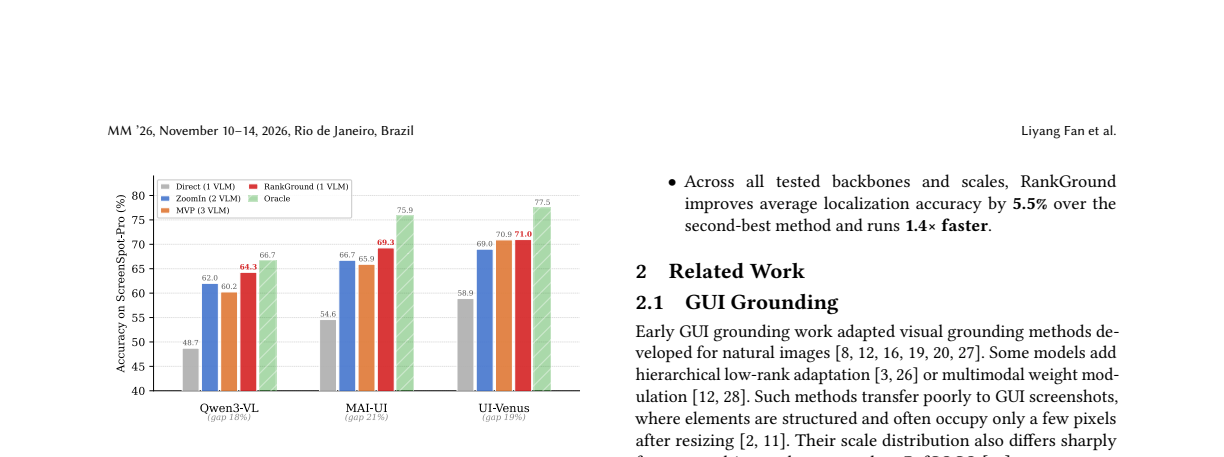
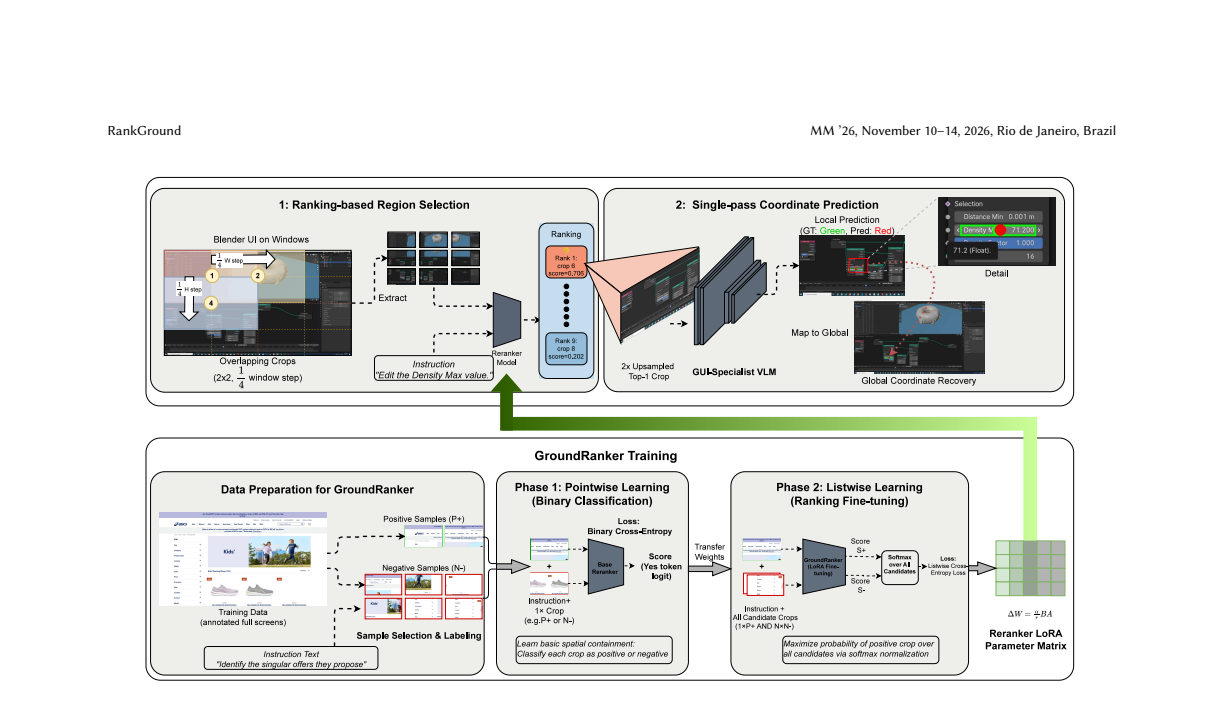
Existing methods face a fundamental trade-off between accuracy and efficiency: direct full-image inference often fails to capture small or visually similar UI elements, while multi-crop strategies improve localization at the cost of multiple expensive Vision-Language Model (VLM) calls per query. To address this challenge, we propose RankGround, a two-stage framework that achieves accurate GUI grounding with a single VLM call per query. Central to our approach is GroundRanker, a lightweight multimodal reranker that identifies the most promising crop from a dense candidate set. Because no off-the-shelf ranking dataset is available, we construct ranking supervision data from existing grounding datasets. A strict containment criterion and boundary-aware positive augmentation improve alignment and spatial coverage in cluttered layouts. GroundRanker is then trained with a two-stage curriculum: a pointwise objective first learns coarse containment, and a listwise objective refines subtle semantic and spatial distinctions among visually similar crops. Experimental results show that RankGround consistently outperforms strong baselines while reducing computational cost. It achieves 1.4 times faster inference and improves localization accuracy by 5.5% on average over the second-best method across all backbones and screen scales, establishing a new state of the art in both efficiency and precision for GUI grounding.
from the abstract
Pith says
Machine review · deepseek-v4-flash · 17 Sep 2026 · what was read was not recorded · not checked by a person
It can be wrong. Challenge this review or reply to it.
Holds up. Well-engineered reranker approach to GUI grounding that delivers real efficiency gains; the claims are supported by thorough experiments and honest limitations. This line is wrong
7 minor
How often objections from reviews like this one are right: not yet measured
Not checked: figures, code, what the 33 references say.
7 minor objections
The paper says, at Abstract / Section 1 / Section 7
Pith says: minor objection 1 of 7
The claim of “5.5% improvement on average over the second-best method” is ambiguous. From Table 2, the absolute improvement over the best multi-crop baseline averages approximately 3.5 percentage points, while the relative improvement averages about 6.2%. Please clarify whether the reported 5.5% is absolute or relative, and specify the baseline and averaging procedure (e.g., across backbones, scales, or all six settings).
The paper says, at Section 3.2.2
Pith says: minor objection 2 of 7
The text says “Data construction yields about 295K pairwise, 124K pointwise, and 78K listwise samples.” The term “pairwise” is not defined; the training uses only pointwise and listwise losses. Explain what the “pairwise” samples represent (e.g., positive-negative pairs extracted from listwise samples).
show 5 more
The paper says, at Table 2, Table 3
Pith says: minor objection 3 of 7
The main results (Table 2) and reranker ablations (Table 3) use different prompts (default vs. optimized). State explicitly which prompt was used for the final RankGround evaluation in Table 2, and whether the reranker was LoRA-fine-tuned with that prompt from the start.
The paper says, at Abstract / Section 5.1
Pith says: minor objection 4 of 7
The speedup claim “1.4× faster” is an average over the six settings, but the per-setting speedup over ZoomIn ranges from 1.32× to 1.61×. Specify the comparison baseline (ZoomIn or both multi-crop methods) and whether this is a mean or median. A note that speedup depends on the backbone capacity would help readers calibrate expectations.
The paper says, at Section 3.2.2
Pith says: minor objection 5 of 7
The description of boundary-aware positive augmentation says “each positive crop yields up to 12 variants.” Give the exact set of offsets used (e.g., four corners, four edge midpoints, four near-boundary positions) to make the augmentation reproducible.
The paper says, at Table 11
Pith says: minor objection 6 of 7
The column header “Errors” is ambiguous; it appears to be the error count. Rename to “Error Count” or “Errors (n)” to clarify. Also, does “Err. (%)” reflect the error rate relative to the total samples for that application? If so, the 41.9% for Origin is correctly computed (26/62), but please confirm the denominator for each row.
The paper says, at Section 5.6 / Figure 5
Pith says: minor objection 7 of 7
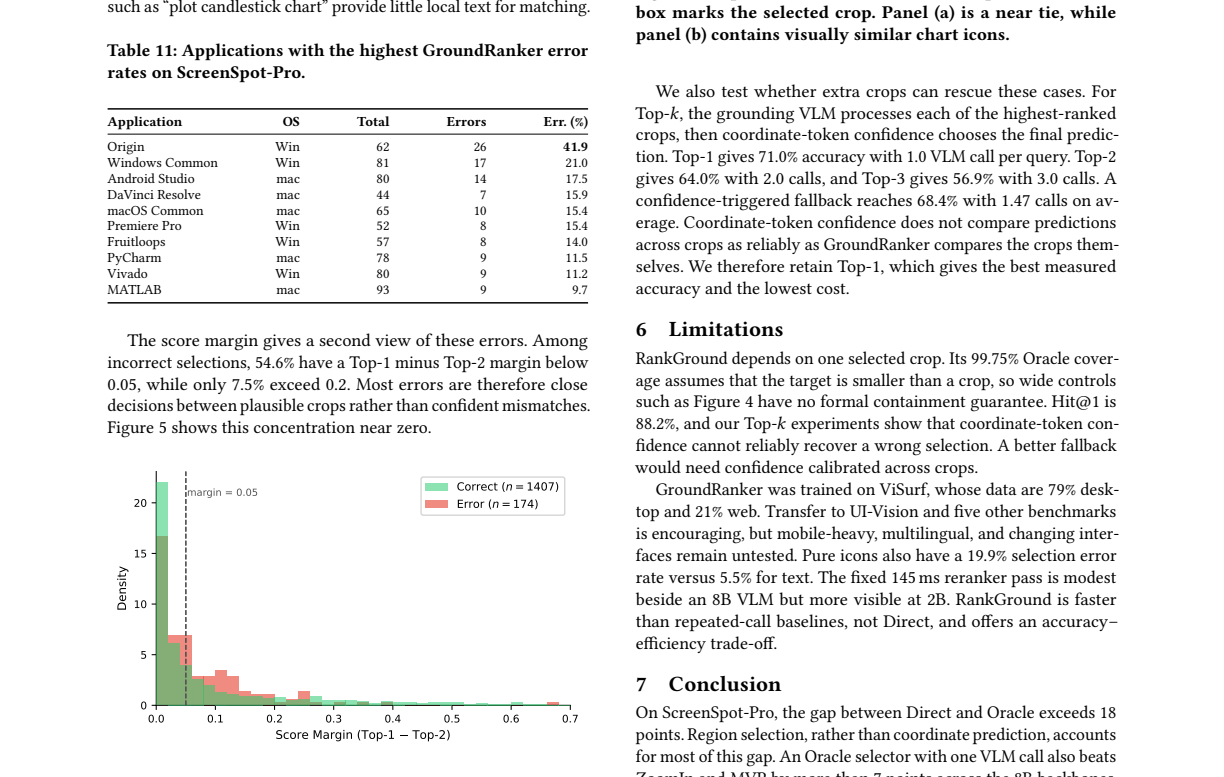
The score-margin distribution shows that 54.6% of errors have a margin below 0.05. This suggests a simple rejection rule based on the margin could reduce errors. The paper tests coordinate-token confidence but not margin-based rejection. A brief explanation of why this was not pursued (e.g., risk of rejecting a correct but low-margin selection) would strengthen the failure analysis.
What would settle it
Re-train GroundRanker using the inference crop generation parameters (G=2, overlap ratio 0.5) instead of the pixel-budget sliding window, and compare Hit@1 on ScreenSpot-Pro. If the difference is within 1 point, the training procedure is robust; a larger drop would indicate sensitivity to crop size distribution.
from the skeptic's reading
How the review went
4 readings by deepseek-v4-flash · 17 Sep 2026
- Reader holds up
- Skeptic partly agrees
- Editor wrote the verdict above
- Referee minor revision: 7 minor
Not run on this paper: the simulated authors' defence.
Pith did not check this review's objections against the paper.
The review in full
The review in brief, machine-written
Hey,
This paper is worth a referee. It's a solid empirical piece that does what it says on the tin: a lightweight reranker selects a crop, then one VLM call grounds the target. That design is the core novelty, and it works. Across three backbones at two scales, RankGround consistently outperforms multi-crop methods (ZoomIn, MVP) while cutting latency by 1.4x on average. The 5.5% accuracy gain over the second-best method is real, backed by error bars and ablation studies.
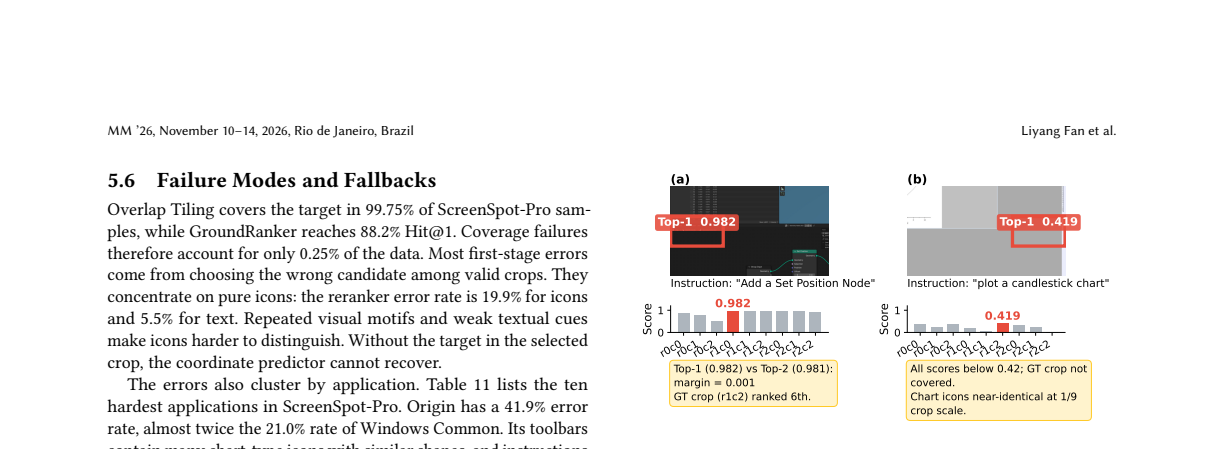
What I like most is the honesty. The authors report a 88.2% Hit@1 on the reranker and an 11.8% miss rate, and they dissect where those misses happen—icons are the main culprit (19.9% error vs 5.5% for text). The limitations section is upfront about wide targets not being formally guaranteed, though coverage failures are only 0.25%. The failure analysis with score margins and per-application error rates is above average for this subfield.
The paper's main weakness is that the reranker is still the bottleneck: 12% of queries are doomed before the VLM sees anything. The authors try a confidence-based fallback but find it doesn't help, and they stick with Top-1. That's the right call, but it means the ceiling is the reranker's accuracy. Icon errors remain high, and the training data (ViSurf) are desktop and web only, so mobile or multilingual interfaces haven't been tested.
The claims about efficiency are well supported. The 1.4x speedup is measured correctly against multi-crop baselines. The method is not faster than Direct (single full-image inference), but that's not the point; they explicitly frame it as an accracy-efficiency trade-off.
Overall, this is a well-written, well-executed paper that makes a clear incremental contribution to GUI grounding. It doesn't rewrite the rules, but it delivers a practical improvement with honest evaluation. I'd recommend sending it to peer review—it will pass.
The strongest objection
The paper's main claim—that RankGround outperforms multi-crop baselines in both accuracy and efficiency—is supported by controlled experiments with standard deviations, thorough ablations, and honest limitations reporting. The most frequently cited concern is the strict containment assumption for wide targets, but the paper quantifies its impact (0.25% coverage failures) and provides examples of successful handling. The 11.8% Hit@1 miss rate is acknowledged and analyzed. No fundamental flaw undermines the central conclusion.
The paper conducts a systematic empirical study. The main results are consistent across backbones and benchmarks. The assumptions about containment are explicit and the failure rate is quantified. The efficiency and accuracy gains are computed fairly with controlled baselines. The reader's weakest assumption (strict containment) is acknowledged but not load-bearing given the 0.25% coverage failure rate. Therefore the existing verdict stands.
The referee's report
If the reported results hold, the paper makes a practical contribution to GUI grounding by demonstrating that a lightweight reranker can replace multiple costly VLM calls without sacrificing accuracy. The decoupled design is novel for this task, and the empirical evaluation is extensive (six backbone-scale combinations, multiple benchmarks, error analysis, and OOD generalization). The work is relevant for deploying GUI agents on consumer hardware, as it stays within 24 GB memory and reduces latency. The honest limitation discussion (88.2% Hit@1, 19.9% icon error rate, wide-target coverage edge cases) increases confidence in the claims.
Pith's reading of the paper (a machine's summary, not the authors')
GUI grounding maps a text instruction to a screen coordinate. Prior work either processes the full screenshot (fast but misses small elements) or examines multiple crops (accurate but costly). RankGround splits the task: a lightweight multimodal reranker selects the most promising crop from an overlapping grid, then a single VLM call predicts coordinates on that crop. The reranker is trained with a novel pointwise-to-listwise curriculum on automatically generated containment labels. On ScreenSpot-Pro, RankGround improves localization accuracy by 5.5% over the best multi-crop baseline while running 1.4× faster.
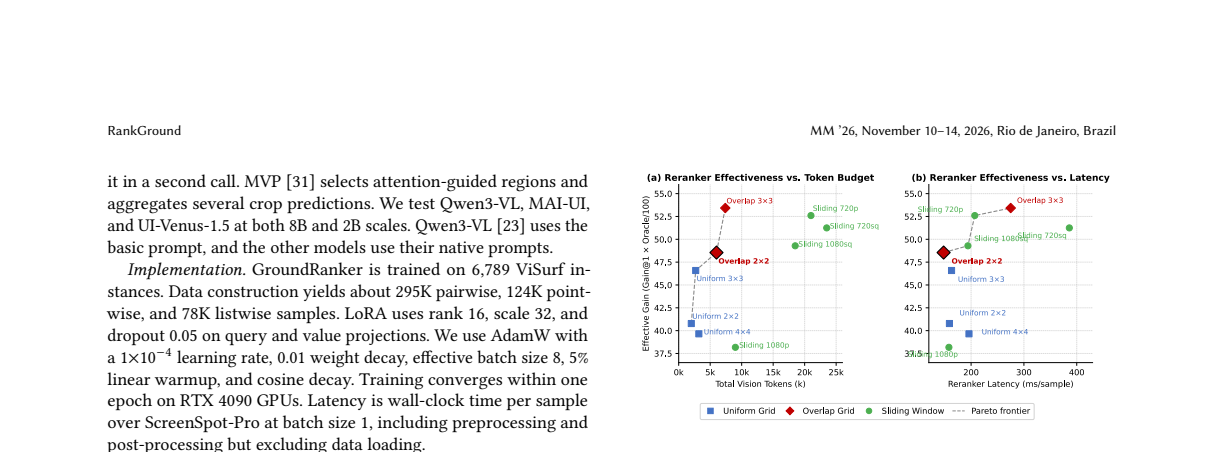
What carries the argument. GroundRanker, a fine-tuned Qwen3-VL-Reranker-2B, scores crops using the logit of the 'yes' token. It is trained in two stages: pointwise binary cross-entropy for coarse containment, then listwise cross-entropy that contrasts the positive crop against near-miss crops that overlap but do not fully contain the target. A 2×2 overlap tiling guarantees 99.75% oracle coverage with 9 crops.
Core claim. The paper establishes that the accuracy gap in GUI grounding is primarily due to region selection, not coordinate prediction. By replacing repeated VLM-based crop evaluation with a lightweight reranker trained on strict containment labels and boundary-aware augmentation, RankGround achieves the highest reported accuracy on ScreenSpot-Pro while requiring only one GUI-specialist VLM call per query.
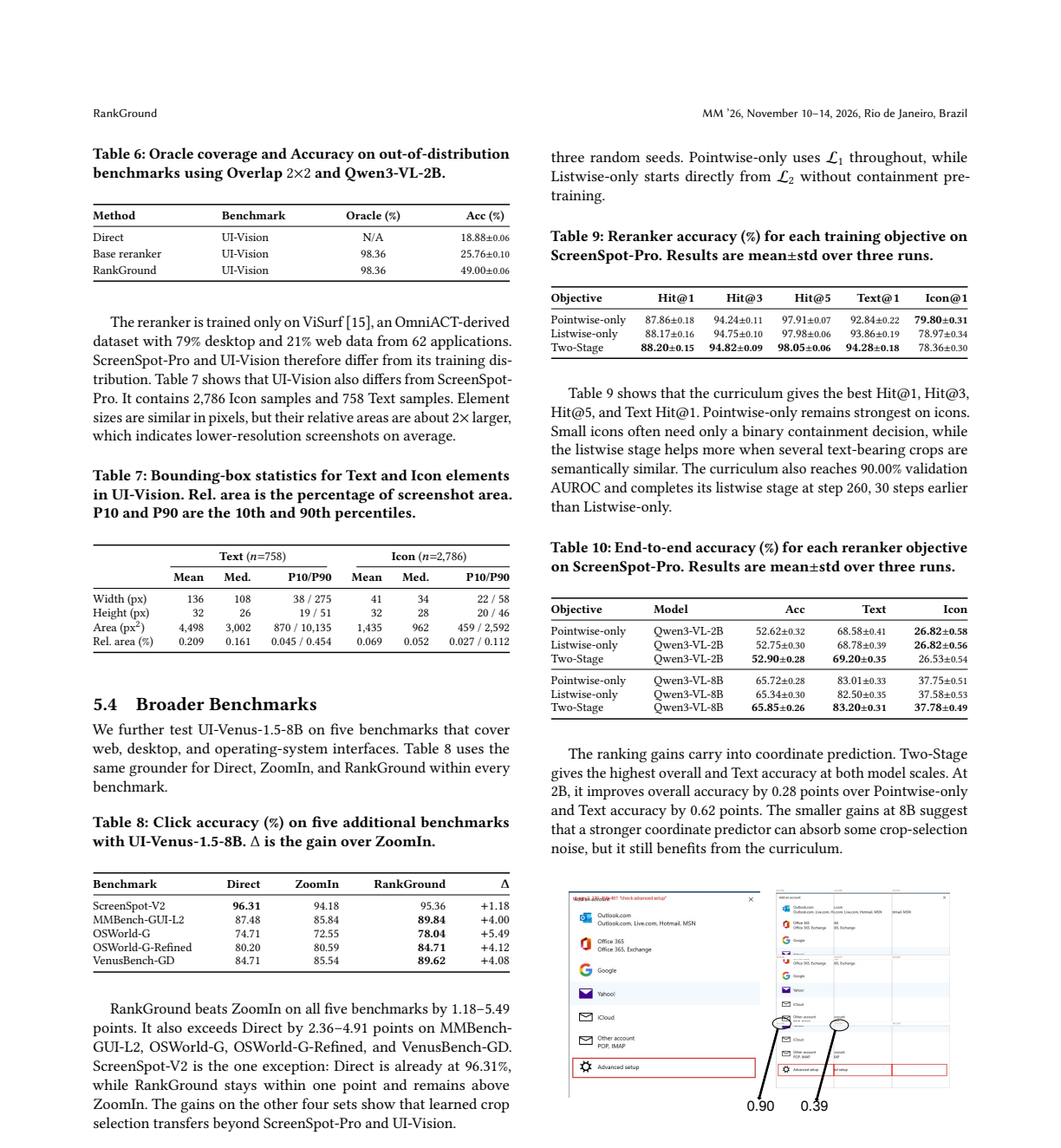
The premise it rests on. The strict containment condition (Eq. 5) assumes that every target element fits entirely within at least one crop. Wide UI controls that cross all crop boundaries have no formal guarantee of full containment, and the reranker must rely on partial views, which works empirically but is not proven reliable for all layouts.
If the paper is right (Pith's inferences, not the authors')
Multi-crop grounding baselines (ZoomIn, MVP) become unnecessary; a single VLM call augmented by a 145ms reranker pass matches or exceeds their accuracy.
The reranker generalizes to unseen benchmarks (UI-Vision) without per-dataset fine-tuning, achieving 78.7% hit rate on crop selection.
Text elements are handled reliably (5.5% selection error), while icons remain the main bottleneck (19.9% error), suggesting a focused direction for future improvement.
A confidence-triggered fallback that inspects additional crops does not improve over Top-1 selection, because coordinate-token confidence is not calibrated across crops.
The same decoupled design could benefit other high-resolution perception tasks such as document layout analysis or medical image region-of-interest selection, where a cheap first-stage router identifies the subregion for expensive fine-grained analysis.
The data construction pipeline (strict containment labels from bounding boxes, boundary-aware augmentation) provides a template for creating ranking supervision in any domain with spatial annotations.
To reduce icon errors, one could augment the reranker with visual-semantic embeddings that capture fine-grained icon appearance, rather than relying solely on the VLM cross-encoder features.
Check this review
Pith stored no record of this review's passes and took no fingerprint of it. Reviews made by code from 13 Nov 2026 on carry both.
How often reviews like this one are right
Reviews like this one: written by deepseek-v4-flash, where what was read was not recorded.
How often objections from reviews like this one are right: not yet measured
Reviews by people
This review was written by a machine. No person has reviewed this paper on Pith yet. A scientist listed on Pith can review it for a fee, and their review is published here whatever it concludes.
The paper
Abstract
Graphical User Interface (GUI) grounding is a fundamental perception task for multimodal agents, enabling them to interpret natural language instructions and interact with digital interfaces. Existing methods face a fundamental trade-off between accuracy and efficiency: direct full-image inference often fails to capture small or visually similar UI elements, while multi-crop strategies improve localization at the cost of multiple expensive Vision-Language Model (VLM) calls per query. To address this challenge, we propose RankGround, a two-stage framework that achieves accurate GUI grounding with a single VLM call per query. Central to our approach is GroundRanker, a lightweight multimodal reranker that identifies the most promising crop from a dense candidate set. Because no off-the-shelf ranking dataset is available, we construct ranking supervision data from existing grounding datasets. A strict containment criterion and boundary-aware positive augmentation improve alignment and spatial coverage in cluttered layouts. GroundRanker is then trained with a two-stage curriculum: a pointwise objective first learns coarse containment, and a listwise objective refines subtle semantic and spatial distinctions among visually similar crops. Experimental results show that RankGround consistently outperforms strong baselines while reducing computational cost. It achieves 1.4 times faster inference and improves localization accuracy by 5.5% on average over the second-best method across all backbones and screen scales, establishing a new state of the art in both efficiency and precision for GUI grounding.
The paper's own sentences, arranged, kept beside the review and separate from it. Each label is drawn from a closed vocabulary; the number beside it is the probability the classifier gave that label. No sentence in this record was written by a model.
abstract compiled · 2026-09-23
The authors' main claim, as the classifier picked it out 0.86
“It achieves 1.4 times faster inference and improves localization accuracy by 5.5% on average over the second-best method across all backbones and screen scales, establishing a new state of the art in both efficiency and precision for GUI grounding.”
How the main claim is stated: asserted 1.00
What the abstract itself states, as probabilities: claims first 0.09 · states limitation 0.18 · human participants 0.03 · controlled comparison 0.91 · randomized assignment 0.01 · states quantitative result 0.99 · compares with prior results 0.98 · mentions code or data availability 0.03
The abstract, sentence by sentence
This table labels the abstract only (arXiv listing abstract v1). The number is the probability the classifier gave the label.
| Sentence | Role | The authors' own work | States the main conclusion | Strength |
|---|---|---|---|---|
| Graphical User Interface (GUI) grounding is a fundamental perception task for multimodal agents, enabling them to interpret natural language instructions and interact with digital interfaces. | background 1.00 | 0.04 | 0.02 | asserted 1.00 |
| Existing methods face a fundamental trade-off between accuracy and efficiency: direct full-image inference often fails to capture small or visually similar UI elements, while multi-crop strategies improve localization at the cost of multiple expensive Vision-Language Model (VLM) calls per query. | background 0.67 | 0.06 | 0.03 | asserted 1.00 |
| To address this challenge, we propose RankGround, a two-stage framework that achieves accurate GUI grounding with a single VLM call per query. | contribution 1.00 | 0.85 | 0.31 | asserted 1.00 |
| Central to our approach is GroundRanker, a lightweight multimodal reranker that identifies the most promising crop from a dense candidate set. | method 0.84 | 0.86 | 0.04 | asserted 1.00 |
| Because no off-the-shelf ranking dataset is available, we construct ranking supervision data from existing grounding datasets. | method 0.83 | 0.94 | 0.02 | asserted 1.00 |
| A strict containment criterion and boundary-aware positive augmentation improve alignment and spatial coverage in cluttered layouts. | method 0.96 | 0.86 | 0.02 | asserted 0.98 |
| GroundRanker is then trained with a two-stage curriculum: a pointwise objective first learns coarse containment, and a listwise objective refines subtle semantic and spatial distinctions among visually similar crops. | method 0.99 | 0.94 | 0.03 | asserted 1.00 |
| Experimental results show that RankGround consistently outperforms strong baselines while reducing computational cost. | result 0.98 | 0.95 | 0.58 | asserted 1.00 |
| It achieves 1.4 times faster inference and improves localization accuracy by 5.5% on average over the second-best method across all backbones and screen scales, establishing a new state of the art in both efficiency and precision for GUI grounding. | result 1.00 | 0.96 | 0.72 | asserted 1.00 |
What kind of paper the classifier reports this is: method or tool 1.00 · evidence from observation or experiment 0.99
What was examined, and what was not
Sources read
- arXiv listing abstract v1
Not examined
- full text
- figures and tables
- references and citing sentences
- relations to other papers
Levels run
- P abstract
Not run
- S sections
- T body sentences
- C citations
- R cross-paper relations
How the labels were made
Compiled by classifier-1.13.0 via TypeSafe API, question bank abstract-p1-20260923, 2026-09-23: 1 request, 7,014 input tokens.
Every quoted sentence on this record is the authors'. Every label is from Pith's closed vocabulary, with the probability shown beside it. This record as JSON
Figures (6)
Figures are the authors', reproduced from the paper.
References (33)
- [1] Zhe Cao, Tao Qin, Tie-Yan Liu, Ming-Feng Tsai, and Hang Li. 2007. Learning to rank: from pairwise approach to listwise approach. InMachine Learning, Proceedings of the Twenty-Fourth International Conference (ICML 2007), Corvallis, Oregon, USA, June 20-24, 2007 (ACM Internation... on PitharXiv
- [2] Kanzhi Cheng, Qiushi Sun, Yougang Chu, Fangzhi Xu, Yantao Li, Jianbing Zhang, and Zhiyong Wu. 2024. SeeClick: Harnessing GUI Grounding for Advanced Visual GUI Agents. InProceedings of the 62nd Annual Meeting of the Association for Computational Linguistics (Volume 1: Long Pape... on Pithdoi:10.18653/v1/2024
- [4] Manuel Faysse, Hugues Sibille, Tony Wu, Bilel Omrani, Gautier Viaud, Céline Hudelot, and Pierre Colombo. 2025. ColPali: Efficient Document Retrieval with Vision Language Models. InThe Thirteenth International Conference on Learning Representations, ICLR 2025, Singapore, April ... on Pith
- [5] Boyu Gou, Ruohan Wang, Boyuan Zheng, Yanan Xie, Cheng Chang, Yiheng Shu, Huan Sun, and Yu Su. 2025. Navigating the Digital World as Humans Do: Universal Visual Grounding for GUI Agents. InThe Thirteenth International Conference on Learning Representations, ICLR 2025, Singapore... on Pith
- [6] Edward J. Hu, Yelong Shen, Phillip Wallis, Zeyuan Allen-Zhu, Yuanzhi Li, Shean Wang, Lu Wang, and Weizhu Chen. 2022. LoRA: Low-Rank Adaptation of Large Language Models. InThe Tenth International Conference on Learning Representations, ICLR 2022, Virtual Event, April 25-29, 202... on Pith
- [7] Zhiyuan Jiang, Shenghao Xie, Wenyi Li, Wenqiang Zu, Peihang Li, Jiahao Qiu, Siqi Pei, Lei Ma, Tiejun Huang, Mengdi Wang, and Shilong Liu. 2025. Zoom in, Click out: Unlocking and Evaluating the Potential of Zooming for GUI Grounding. CoRRabs/2512.05941 (2025). arXiv:2512.05941 ... on Pithdoi:10.48550/arxiv.2512.05941
- [8] Aishwarya Kamath, Mannat Singh, Yann LeCun, Gabriel Synnaeve, Ishan Misra, and Nicolas Carion. 2021. MDETR - Modulated Detection for End-to-End Multi- Modal Understanding. In2021 IEEE/CVF International Conference on Computer Vision, ICCV 2021, Montreal, QC, Canada, October 10-... on PitharXiv
- [9] Mingyu Kim, Jeonghoon Park, Hojun Lee, and Taesik Gong. 2026. GOLD: Global Overview to Local Detail in Efficient Visual Grounding for GUI Agents. https: //openreview.net/forum?id=PVwSDvUWtr on Pith
- [10] Aiden Yiliu Li, Bizhi Yu, Daoan Lei, Tianhe Ren, and Shilong Liu. 2025. Chain- of-Ground: Improving GUI Grounding via Iterative Reasoning and Reference Feedback.CoRRabs/2512.01979 (2025). arXiv:2512.01979 doi:10.48550/ARXIV. 2512.01979 on Pithdoi:10.48550/arxiv.2512.01979
- [11] Kaixin Li, Ziyang Meng, Hongzhan Lin, Ziyang Luo, Yuchen Tian, Jing Ma, Zhiyong Huang, and Tat-Seng Chua. 2025. ScreenSpot-Pro: GUI Grounding for Professional High-Resolution Computer Use. InProceedings of the 33rd ACM International Conference on Multimedia, MM 2025, Dublin, I... on PitharXiv
- [12] Liunian Harold Li, Pengchuan Zhang, Haotian Zhang, Jianwei Yang, Chunyuan Li, Yiwu Zhong, Lijuan Wang, Lu Yuan, Lei Zhang, Jenq-Neng Hwang, Kai-Wei Chang, and Jianfeng Gao. 2022. Grounded Language-Image Pre-training. In IEEE/CVF Conference on Computer Vision and Pattern Recogn... on PitharXiv
- [13] Mingxin Li, Yanzhao Zhang, Dingkun Long, Keqin Chen, Sibo Song, Shuai Bai, Zhibo Yang, Pengjun Xie, An Yang, Dayiheng Liu, Jingren Zhou, and Junyang Lin on Pith
- [14] Sheng-Chieh Lin, Chankyu Lee, Mohammad Shoeybi, Jimmy Lin, Bryan Catan- zaro, and Wei Ping. 2025. Mm-Embed: Universal Multimodal Retrieval with Multimodal LLMS. InThe Thirteenth International Conference on Learning Rep- resentations, ICLR 2025, Singapore, April 24-28, 2025. Op... on Pith
- [15] Yuqi Liu, Liangyu Chen, Jiazhen Liu, Mingkang Zhu, Zhisheng Zhong, Bei Yu, and Jiaya Jia. 2025. ViSurf: Visual Supervised-and-Reinforcement Fine- Tuning for Large Vision-and-Language Models.CoRRabs/2510.10606 (2025). arXiv:2510.10606 doi:10.48550/ARXIV.2510.10606 on PithPith's reviewarXivdoi:10.48550/arxiv.2510.10606
- [16] Junhua Mao, Jonathan Huang, Alexander Toshev, Oana Camburu, Alan L. Yuille, and Kevin Murphy. 2016. Generation and Comprehension of Unambiguous Object Descriptions. In2016 IEEE Conference on Computer Vision and Pattern Recognition, CVPR 2016, Las Vegas, NV, USA, June 27-30, 20... on Pithdoi:10.1109/cvpr.2016.9
- [17] Shravan Nayak, Xiangru Jian, Kevin Qinghong Lin, Juan A. Rodríguez, Montek Kalsi, Nicolas Chapados, M. Tamer Özsu, Aishwarya Agrawal, David Vázquez, Christopher Pal, Perouz Taslakian, Spandana Gella, and Sai Rajeswar. 2025. UI-Vision: A Desktop-centric GUI Benchmark for Visual... on Pith
- [18] Rodrigo Nogueira and Kyunghyun Cho. 2019. Passage Re-ranking with BERT. CoRRabs/1901.04085 (2019). arXiv:1901.04085 doi:10.48550/arXiv.1901.04085 on PithPith's reviewarXivdoi:10.48550/arxiv.1901.04085
- [19] Bryan A. Plummer, Liwei Wang, Chris M. Cervantes, Juan C. Caicedo, Julia Hockenmaier, and Svetlana Lazebnik. 2015. Flickr30k Entities: Collecting Region- to-Phrase Correspondences for Richer Image-to-Sentence Models. In2015 IEEE International Conference on Computer Vision, ICC... on Pithdoi:10.1109/iccv.2015.303
- [20] Yanyuan Qiao, Chaorui Deng, and Qi Wu. 2021. Referring Expression Com- prehension: A Survey of Methods and Datasets.IEEE Trans. Multim.23 (2021), 4426–4440. doi:10.1109/TMM.2020.3042066 on PitharXiv
- [21] Yujia Qin, Yining Ye, Junjie Fang, Haoming Wang, Shihao Liang, Shizuo Tian, Junda Zhang, Jiahao Li, Yunxin Li, Shijue Huang, Wanjun Zhong, Kuanye Li, Jiale Yang, Yu Miao, Woyu Lin, Longxiang Liu, Xu Jiang, Qianli Ma, Jingyu Li, Xiaojun Xiao, Kai Cai, Chuang Li, Yaowei Zheng, C... on PithPith's reviewarXivdoi:10.48550/arxiv.2501.12326
show 13 more
- [22] Fei Tang, Yongliang Shen, Hang Zhang, Siqi Chen, Guiyang Hou, Wenqi Zhang, Wenqiao Zhang, Kaitao Song, Weiming Lu, and Yueting Zhuang. 2025. Think Twice, Click Once: Enhancing GUI Grounding via Fast and Slow Systems.CoRR abs/2503.06470 (2025). arXiv:2503.06470 doi:10.48550/ARX... on PithPith's reviewarXivdoi:10.48550/arxiv.2503.06470
- [23] Qwen Team. 2025. Qwen3-VL Technical Report.CoRRabs/2511.21631 (2025). arXiv:2511.21631 doi:10.48550/ARXIV.2511.21631 on PithPith's reviewarXivdoi:10.48550/arxiv.2511.21631
- [24] Venus Team, Changlong Gao, Zhangxuan Gu, Yulin Liu, Xinyu Qiu, Shuheng Shen, Yue Wen, Tianyu Xia, Zhenyu Xu, Zhengwen Zeng, Beitong Zhou, Xingran Zhou, Weizhi Chen, Sunhao Dai, Jingya Dou, Yichen Gong, Yuan Guo, Zhenlin Guo, Feng Li, Qian Li, Jinzhen Lin, Yuqi Zhou, Linchao Zh... on Pithdoi:10.48550/arxiv.2602.09082
- [25] Cong Wei, Yang Chen, Haonan Chen, Hexiang Hu, Ge Zhang, Jie Fu, Alan Ritter, and Wenhu Chen. 2024. UniIR: Training and Benchmarking Universal Multimodal Information Retrievers. InComputer Vision - ECCV 2024 - 18th European Confer- ence, Milan, Italy, September 29-October 4, 20... on Pithdoi:10.1007/978-3-031-73021-4_23
- [26] Linhui Xiao, Xiaoshan Yang, Fang Peng, Yaowei Wang, and Changsheng Xu. 2024. HiVG: Hierarchical Multimodal Fine-grained Modulation for Visual Grounding. InProceedings of the 32nd ACM International Conference on Multimedia, MM 2024, Melbourne, VIC, Australia, 28 October 2024 - ... on PitharXiv
- [27] Zhengyuan Yang, Zhe Gan, Jianfeng Wang, Xiaowei Hu, Faisal Ahmed, Zicheng Liu, Yumao Lu, and Lijuan Wang. 2022. UniTAB: Unifying Text and Box Outputs for Grounded Vision-Language Modeling. InComputer Vision - ECCV 2022 - 17th European Conference, Tel A viv, Israel, October 23-... on Pithdoi:10.1007/978-3-031-
- [28] Ruilin Yao, Shengwu Xiong, Yichen Zhao, and Yi Rong. 2024. Visual Ground- ing with Multi-modal Conditional Adaptation. InProceedings of the 32nd ACM International Conference on Multimedia, MM 2024, Melbourne, VIC, Australia, 28 October 2024 - 1 November 2024, Jianfei Cai, Moha... on PitharXiv
- [29] Xianhang Ye, Yiqing Li, Wei Dai, Miancan Liu, Ziyuan Chen, Zhangye Han, Hongbo Min, Jinkui Ren, Xiantao Zhang, Wen Yang, and Zhi Jin. 2026. GUI- ARP: Enhancing Grounding with Adaptive Region Perception for GUI Agents. In ICASSP 2026 - 2026 IEEE International Conference on Acou... on PitharXiv
- [30] Licheng Yu, Patrick Poirson, Shan Yang, Alexander C. Berg, and Tamara L. Berg on Pith
- [31] Yunzhu Zhang, Zeyu Pan, Zhengwen Zeng, Shuheng Shen, Changhua Meng, and Linchao Zhu. 2025. MVP: Multiple View Prediction Improves GUI Grounding. CoRRabs/2512.08529 (2025). arXiv:2512.08529 doi:10.48550/ARXIV.2512.08529 on Pithdoi:10.48550/arxiv.2512.08529
- [32] Hanzhang Zhou, Xu Zhang, Panrong Tong, Jianan Zhang, Liangyu Chen, Quyu Kong, Chenglin Cai, Chen Liu, Yue Wang, Jingren Zhou, and Steven Hoi. 2025. MAI-UI Technical Report: Real-World Centric Foundation GUI Agents.CoRR abs/2512.22047 (2025). arXiv:2512.22047 doi:10.48550/ARXIV... on Pithdoi:10.48550/arxiv.2512.22047
- [2016] Modeling Context in Referring Expressions. InComputer Vision - ECCV 2016 - 14th European Conference, Amsterdam, The Netherlands, October 11-14, 2016, Proceedings, Part II (Lecture Notes in Computer Science). Springer, 69–85. doi:10.1007/978-3-319-46475-6_5 on Pithdoi:10.1007/978-3-319-46475-6_5
- [2026] Qwen3-VL-Embedding and Qwen3-VL-Reranker: A Unified Framework for State-of-the-Art Multimodal Retrieval and Ranking.CoRRabs/2601.04720 (2026). arXiv:2601.04720 doi:10.48550/ARXIV.2601.04720 on PithPith's reviewarXivdoi:10.48550/arxiv.2601.04720
Cited by 1 Pith paper
Reviewed papers on Pith that cite this one. The full citation record
- GroundCascade: Selective Second Opinions for GUI Grounding cs.CV · Nov 2026
Challenges and discussion
Disagree with the review, or know something it missed? Leave a comment, or challenge this review formally: a challenge becomes a permanent entry in this paper's record, and its decision is published here.
Come back by email
A short list of the week's newly reviewed papers. Nothing is sent until you confirm from your inbox, and every email has a link that stops it. No account.
No comments yet.
Sign in to comment