Computer Vision and Pattern Recognition · arXiv:2611.13177 v1 · submitted 9 Nov 2026 · 44 references
GroundCascade: Selective Second Opinions for GUI Grounding
The paper says
“Graphical user interface (GUI) grounding maps a screenshot and a natural-language instruction to the screen location where an agent should act. Zoomed views can reveal small targets but may lose the context needed to identify them.”
more of the abstract
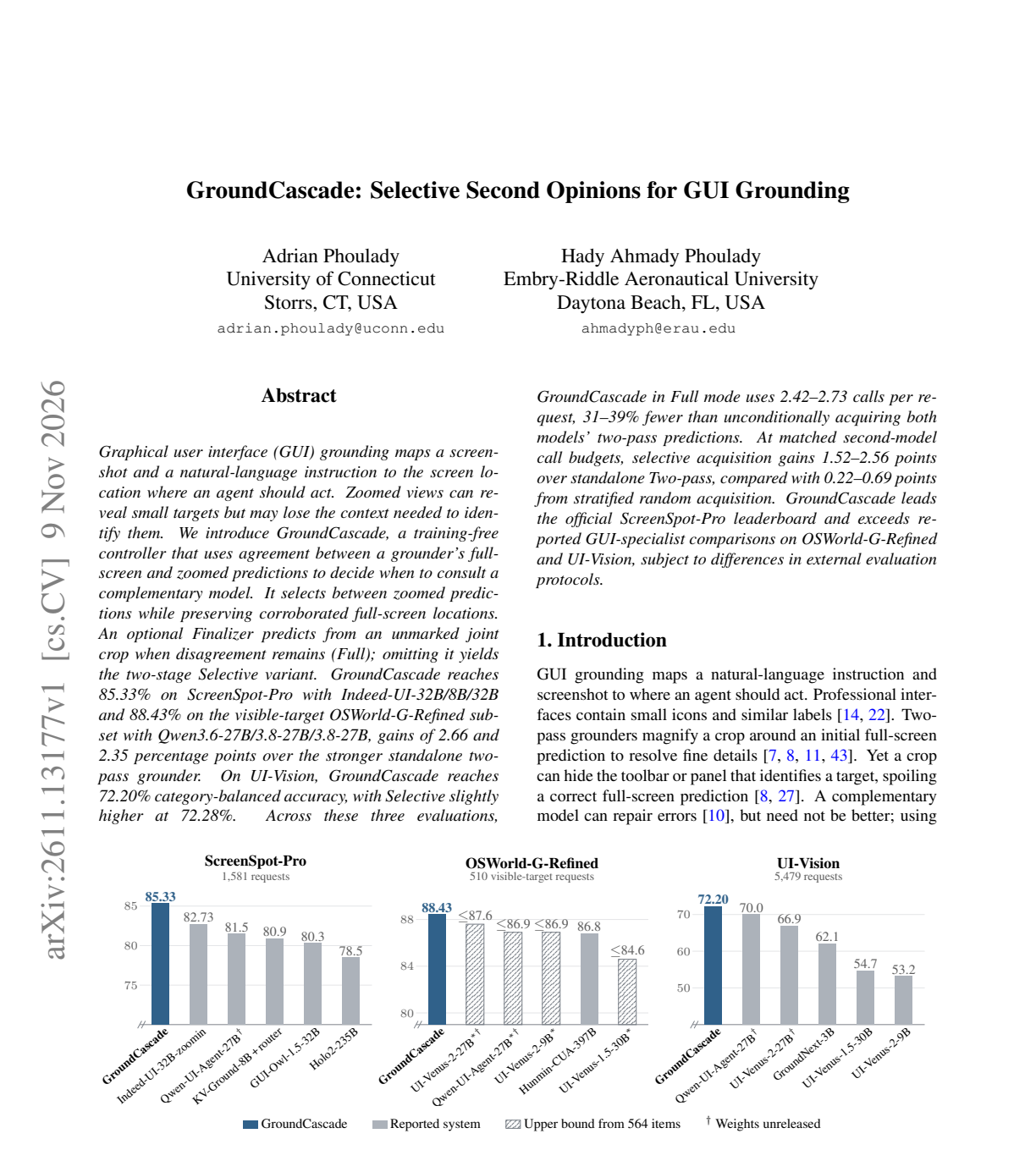
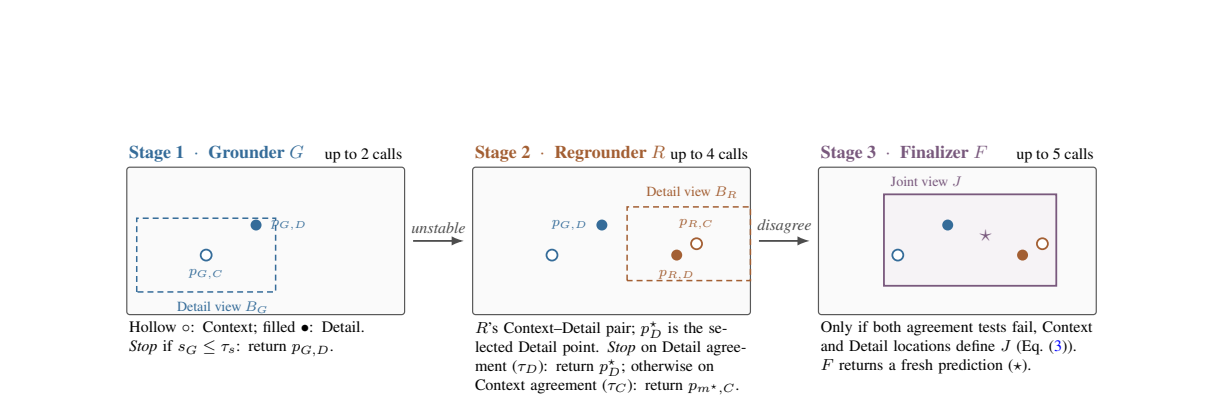
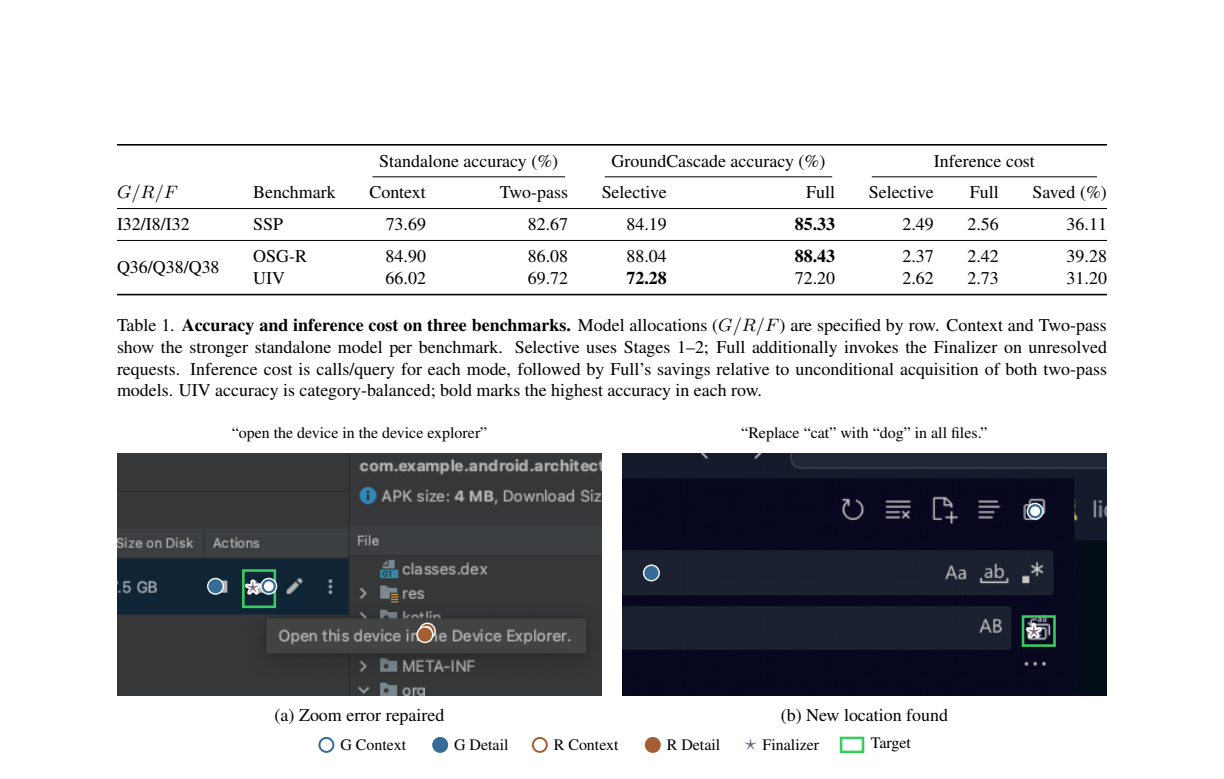
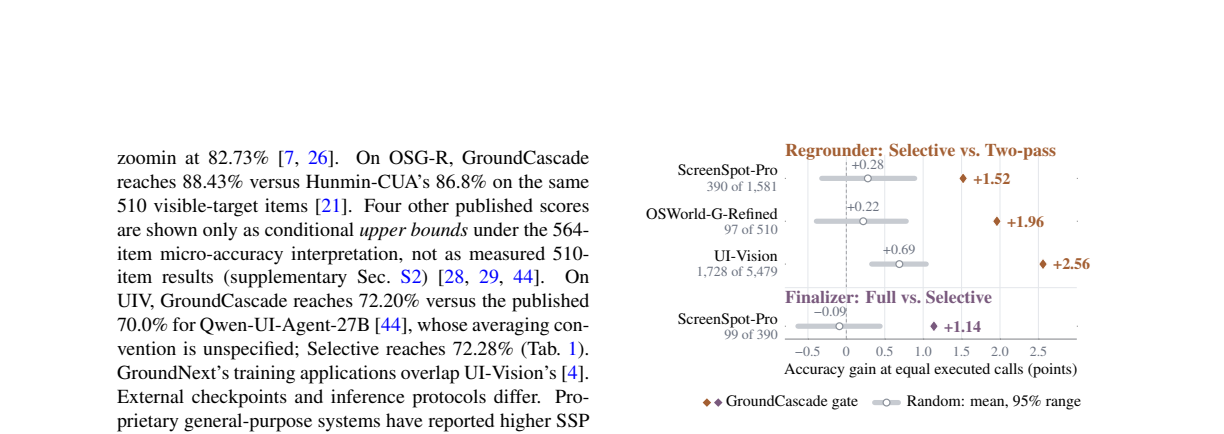
We introduce GroundCascade, a training-free controller that uses agreement between a grounder's full-screen and zoomed predictions to decide when to consult a complementary model. It selects between zoomed predictions while preserving corroborated full-screen locations. An optional Finalizer predicts from an unmarked joint crop when disagreement remains (Full); omitting it yields the two-stage Selective variant. GroundCascade reaches 85.33% on ScreenSpot-Pro with Indeed-UI-32B/8B/32B and 88.43% on the visible-target OSWorld-G-Refined subset with Qwen3.6-27B/3.8-27B/3.8-27B, gains of 2.66 and 2.35 percentage points over the stronger standalone two-pass grounder. On UI-Vision, GroundCascade reaches 72.20% category-balanced accuracy, with Selective slightly higher at 72.28%. Across these three evaluations, GroundCascade in Full mode uses 2.42-2.73 calls per request, 31-39% fewer than unconditionally acquiring both models' two-pass predictions. At matched second-model call budgets, selective acquisition gains 1.52-2.56 points over standalone Two-pass, compared with 0.22-0.69 points from stratified random acquisition. GroundCascade leads the official ScreenSpot-Pro leaderboard and exceeds reported GUI-specialist comparisons on OSWorld-G-Refined and UI-Vision, subject to differences in external evaluation protocols.
from the abstract
Pith says
Machine review · deepseek-v4-flash · 11 Nov 2026 · what was read was not recorded · not checked by a person
It can be wrong. Challenge this review or reply to it.
Holds up, with conditions. A clean, well-controlled empirical paper on a training-free routing policy for GUI grounding. The gains are real but small, and the threshold-selection question is the main unresolved issue. This line is wrong
4 major objections · 7 minor
How often objections from reviews like this one are right: not yet measured
Not checked: figures, code, what the 44 references say.
The paper says, at Section 3, Budget and parameters; Section 4.1
The review did not quote this passage.
Pith says: Objection 1 of 4 · major
The three routing thresholds tau_s=0.01, tau_D=0.04, tau_C=0.005 are load-bearing for all reported results, yet the paper provides no sensitivity analysis and no statement that they were fixed before seeing test outcomes. The authors acknowledge in sentence b100 that the CIs are conditional on the reported configurations and do not account for configuration-selection uncertainty, but this does not address the risk that the thresholds were selected on the evaluated benchmarks.
more of objection 1
A sensitivity analysis (e.g., varying each threshold over a plausible range and reporting the resulting accuracy and call savings) is needed to establish robustness. Without it, the reader cannot assess whether the reported gains are a selected operating point.
The paper says, at Section 4.2, Table 1; Section 4.3
The review did not quote this passage.
Pith says: Objection 2 of 4 · major
The model allocations (G/R/F) differ across benchmarks: I32/I8/I32 on SSP, Q36/Q38/Q38 on OSG-R and UIV. The paper tests alternative orders on SSP (Section 4.3) but does not test whether the Qwen allocations are optimal or whether the thresholds transfer. The claim that the Regrounder 'need not be stronger in isolation' is supported, but the choice of which model is Grounder vs.
more of objection 2
Regrounder is itself a configuration choice. The paper should either justify the allocation choices a priori or provide a sensitivity analysis on OSG-R and UIV similar to the SSP order analysis.
The paper says, at Section 4.4, Figure 4
The review did not quote this passage.
Pith says: Objection 3 of 4 · major
The random-acquisition control is a strength, but it is retrospective and uses recorded predictions. The paper states that random allocations are 'stratified by recorded call cost (and UIV category)' but does not specify how call-cost strata are defined. Since the gate's decisions depend on the Grounder's self-displacement, which correlates with call cost (invalid Context skips Detail), the stratification may not fully capture the selection mechanism.
more of objection 3
The paper should clarify the stratification procedure and discuss whether the random control could be biased by the fact that requests with higher call cost (e.g., those requiring both Context and Detail) are also those where the gate is more likely to escalate.
The paper says, at Section 5.3, Figure 6
The review did not quote this passage.
Pith says: Objection 4 of 4 · major
The error analysis is informative, but the claim that 'stable errors therefore include mistakes within an available crop' (line after Figure 6) is based on 72 stable errors where the target lies entirely inside the Detail crop. However, the paper does not report how many of these 72 errors are actually corrected by the cascade (i.e., how many are escalated and then fixed).
more of objection 4
The stage decomposition in Figure 5 shows net gains, but a more detailed breakdown of stable errors that are later recovered would strengthen the analysis of the gate's limitations.
7 minor objections
The paper says, at Abstract
Pith says: minor objection 1 of 7
The abstract states 'GroundCascade leads the official ScreenSpot-Pro leaderboard and exceeds reported GUI-specialist comparisons on OSWorld-G-Refined and UI-Vision, subject to differences in external evaluation protocols.' The phrase 'subject to differences' is vague; the paper later clarifies these differences (supplementary Sec. S2), but the abstract could briefly note that the OSG-R comparisons are conditional bounds.
The paper says, at Section 3, Eq. (3)
Pith says: minor objection 2 of 7
The joint crop definition uses rho = min{1, max{0.5, delta + 0.1}}. The rationale for the offset 0.1 is not explained. Is this a heuristic or derived from some property? A brief justification would help.
show 5 more
The paper says, at Section 4.1, Evaluation protocol
Pith says: minor objection 3 of 7
The paper states 'Calls count executed model invocations, not tokens, runtime, or FLOPs.' This is clear, but the comparison with MVP (Section 4.2) notes that MVP uses only I32 whereas GroundCascade also uses I8, and 'image and generation budgets differ, so the comparison concerns executed calls rather than equal compute.' This is a fair caveat, but it would be helpful to also report the total pixel budget or FLOPs for a more complete comparison.
The paper says, at Section 4.2, Figure 1
Pith says: minor objection 4 of 7
Figure 1 shows hatched <= bars for OSG-R conditional bounds. The caption explains this, but the figure itself could include a note that these are upper bounds, not measured scores, to avoid misinterpretation by readers who skip the caption.
The paper says, at Section 5.1, AUROC values
Pith says: minor objection 5 of 7
The AUROC values for cross-model displacement (0.807 on SSP) are reported without confidence intervals. Given that the paper uses bootstrap for accuracy differences, it would be consistent to provide bootstrap CIs for AUROC as well.
The paper says, at Supplementary S2, Published OSG-R bounds
Pith says: minor objection 6 of 7
The derivation of conditional bounds is careful, but the sentence 'This supports, without proving, the 564-item micro-accuracy interpretation' could be misinterpreted. Consider rephrasing to clarify that the bounds are conditional on that interpretation, not that the interpretation is proven.
The paper says, at General
Pith says: minor objection 7 of 7
The paper uses the term 'GroundCascade' to refer to both the Full and Selective variants, which can be confusing. In several places (e.g., Table 1 caption), it is clear which variant is meant, but in the abstract and introduction, the reader must infer from context. Consider consistently specifying 'GroundCascade (Full)' and 'GroundCascade (Selective)' when the distinction matters.
What would settle it
Perform a development-split selection check using the paper's recorded predictions: split each benchmark into development and test portions (preserving UIV category budgets and OSG-R image clustering), select tau_s, tau_D, tau_C and the G/R/F allocation on the development portion, then evaluate once on the untouched test portion, reporting accuracy, calls/query, and gains over standalone Two-pass. Additionally plot accuracy and calls over a factor-of-two grid around the stated constants, e.g., tau_s in {0.005, 0.01, 0.02, 0.04}, tau_D in {0.01, 0.02, 0.04, 0.08}, tau_C in {0.0025, 0.005, 0.01, 0.02}. The concern is settled if the held-out gain remains in the reported 2–3 point range and the grid shows a plateau; it lands if the held-out gain falls below roughly one point or moves inside the matched random-acquisition range.
from the skeptic's reading
How the review went
4 readings by deepseek-v4-flash · 11 Nov 2026
- Reader holds up, with conditions
- Skeptic agrees
- Editor wrote the verdict above
- Referee major revision: 4 major objections, 7 minor
Not run on this paper: the simulated authors' defence.
Pith did not check this review's objections against the paper.
The review in full
The review in brief, machine-written
The paper is a careful empirical evaluation of a simple, training-free controller that uses agreement between a grounder's full-screen and zoomed predictions to decide when to call a second model. The core idea—using the first model's Context–Detail displacement as a gate, then checking cross-model Detail and Context agreement before falling back to a joint crop—is not present in the cited Zoom Consistency or earlier cascade work. The evaluation is thorough: three benchmarks, paired bootstrap CIs, matched random-acquisition controls, stage decompositions, and honest disclosure of protocol differences and conditional bounds. The headline numbers (2–3 point gains, 31–39% call savings) are internally consistent and the controls make the mechanism plausible.
The main soft spot is the provenance of the three routing thresholds (tau_s=0.01, tau_D=0.04, tau_C=0.005). The paper gives the values but no sensitivity analysis and no statement that they were fixed before seeing test outcomes. The authors acknowledge in sentence b100 that the CIs are conditional on the reported configurations and do not account for configuration-selection uncertainty, but they do not address how much the results depend on these particular constants. If the thresholds were chosen on the evaluated benchmarks, the reported gains and savings are a selected operating point and the bootstrap intervals understate the true uncertainty. This is a load-bearing weakness because the thresholds determine which requests get the second model and which branch returns, directly affecting both the accuracy numerator and the call-count denominator.
Other concerns are minor. No code is released, so the exact gains may depend on implementation details. The comparison with MVP is apples-to-oranges (different model allocations, image budgets). The UIV gain is small and the Finalizer actually hurts there, which the paper discloses. The Context-preservation branch contributes little, which the paper also acknowledges.
Who this is for: researchers working on cost-sensitive GUI agents or training-free routing for vision-language models. The paper is worth a serious referee: the experiments are well-designed, the controls are appropriate, and the claims are stated with reasonable precision. The threshold-selection issue should be addressed in revision (sensitivity analysis or a hold-out validation set), but it does not invalidate the paper.
Recommendation: accept with moderate revision. The authors should add a sensitivity analysis for the thresholds or show that they were fixed before seeing test outcomes. If they can do that, the paper is solid.
The strongest objection
The central quantitative claim is that agreement-gated selective acquisition beats the stronger standalone two-pass grounder by 2.35–2.66 points while using 31–39% fewer calls than unconditional two-model acquisition. The internal evidence is strong in places: the matched random-acquisition controls, the bootstrap paired intervals, and the stage decompositions make the mechanism plausible. The load-bearing weakness is the provenance and robustness of the three routing constants tau_s=0.01, tau_D=0.04, and tau_C=0.005, given in Section 3, Budget and parameters. These constants set the operating point of the whole controller: they determine which 390/1,581 SSP requests, 97/510 OSG-R requests, and 1,728/5,479 UIV requests receive the second model, which branch returns, and hence both the accuracy numerator and the call-count denominator of every headline result. The paper gives no sensitivity analysis and no statement that the values were fixed before seeing test outcomes. The authors do acknowledge, in sentence b100, that the paired CIs are conditional on the reported configurations and do not account for configuration-selection uncertainty, and Section 4.3 shows that model order was selected on SSP. The concern is not internal inconsistency: the protocol is fully specified and the controls are appropriate. The concern is selection risk: if the thresholds or the G/R/F allocations were chosen on the evaluated benchmarks, the reported gains and savings are a selected operating point, and the bootstrap intervals understate the true uncertainty.
Good-faith reading: the paper's aim is to show that a training-free, agreement-gated controller can get more accuracy than a standalone two-pass grounder while calling a second model less often. The experimental design is generally careful: external benchmarks, paired bootstrap intervals, matched random-budget controls, stage decompositions, and explicit caveats about leaderboard protocol differences and conditional bounds. I find no circularity and no internal inconsistency in the main reported numbers. The single load-bearing soft spot is the one the reader identified: the three thresholds tau_s, tau_D, and tau_C are fixed constants that determine every operating characteristic of the cascade, yet their values are asserted without sensitivity analysis or a statement that they were chosen before seeing test outcomes. The authors' own b100 concedes that the confidence intervals are conditional on the reported configurations and do not cover configuration-selection uncertainty, and Section 4.3 shows at least one model-order choice was made on SSP. This makes the exact magnitudes of the headline gains conditional on an unexamined selection process. The matched random control shows the gate itself is better than random acquisition, which is an important and independent result, but it does not test whether the specific thresholds were overfit. A development-split selection check and a threshold-neighborhood sweep would settle the question. Because the concern is real but does not overturn the direction of the evaluation, I would keep the reader's CONDITIONAL verdict unchanged.
The referee's report
If the results hold, GroundCascade offers a practical, training-free approach to improving GUI grounding accuracy while reducing computational cost. The selective acquisition mechanism is well-motivated and the controlled experiments (matched random-acquisition baselines, bootstrap intervals) provide reasonable evidence that the gate concentrates useful corrections. The method achieves state-of-the-art results on the ScreenSpot-Pro leaderboard and exceeds published GUI-specialist comparisons on the other two benchmarks, subject to protocol differences. The paper's strengths include the reproducibility-oriented design (recorded predictions, matched controls) and the honest disclosure of limitations (conditional CIs, configuration-selection uncertainty, protocol differences).
Pith's reading of the paper (a machine's summary, not the authors')
The paper introduces GroundCascade, a training-free controller that uses the spatial agreement between a GUI grounder’s full-screen and zoomed predictions to decide whether a second grounder is needed. If the first model’s two views agree closely, its zoomed prediction is returned immediately; otherwise a complementary model is consulted, and the cascade may preserve corroborated full-screen predictions or, in Full mode, make a fresh prediction from a joint crop when both models disagree. Across three benchmarks (ScreenSpot-Pro, OSWorld-G-Refined, UI-Vision), GroundCascade improves accuracy by roughly two to three percentage points over the stronger standalone two-pass grounder while using 31–39% fewer model invocations than unconditionally calling both models. The core claim is that selective, agreement-gated acquisition concentrates complementary predictions on the requests that benefit most, outperforming random allocation at the same call budget.
What carries the argument. The central mechanism is the three-stage routing cascade based on screen-space L∞ distances between Context (full-screen) and Detail (zoomed) predictions. Stage 1 (Grounder) computes self-displacement s_G = d(p_{G,C}, p_{G,D}); if s_G ≤ τ_s, the zoomed prediction is returned immediately. Stage 2 (Regrounder) acquires a second model’s Context–Detail pair, selects the more self-consistent Detail candidate, then tests Detail agreement (d(p_{G,D}, p_{R,D}) ≤ τ_D) and, failing that, Context agreement (d(p_{G,C}, p_{R,C}) ≤ τ_C) to decide whether to return a Detail point or a preserved full-screen point. Stage 3 (Finalizer, optional) makes a fresh prediction from an unmarked joint crop covering all four prior points when both agreement tests fail. All decisions use only spatial coordinates, no model confidences or training.
Core claim. GroundCascade demonstrates that a simple, training-free controller based on screen-space distances between a grounder’s full-screen (Context) and zoomed (Detail) predictions can reliably decide when to escalate to a second grounder. The controller uses three fixed thresholds: self-displacement τ_s = 0.01 (to detect unstable first-model predictions), Detail agreement τ_D = 0.04 (to select between the two models’ zoomed predictions when they agree), and Context agreement τ_C = 0.005 (to preserve a full-screen prediction when both models’ Context points agree closely). This routing outperforms both unconditional two-model acquisition (saving 31–39% of calls) and stratified random acquisition at matched call budgets, establishing that which requests receive a second opinion matters more than how many calls are made. The paper further shows that the weaker model can serve as the second grounder (e.g., 8B vs 32B, or Q38 vs Q36) and still improve overall accuracy through selective routing.
The premise it rests on. The three fixed thresholds (τ_s=0.01, τ_D=0.04, τ_C=0.005) were chosen without reported sensitivity analysis or evidence that they were fixed before seeing test outcomes, so the reported gains and call savings may depend on these specific values and may not transfer to other model pairs or benchmarks without retuning.
If the paper is right (Pith's inferences, not the authors')
GUI agents can deploy GroundCascade with off-the-shelf models and no additional training, reducing API costs by roughly a third while improving grounding accuracy by 2–3 points.
The routing thresholds (τ_s=0.01, τ_D=0.04, τ_C=0.005) may transfer to other grounding model pairs and screen resolutions, potentially serving as default hyperparameters for selective cascade systems.
The finding that a weaker model (8B vs 32B, Q38 vs Q36) can serve as the second grounder and still improve accuracy suggests that model diversity in failure modes is more important than raw standalone accuracy for complementary routing.
The Context-agreement branch can recover correct full-screen predictions that zooming would have discarded, addressing a known failure mode of two-pass grounders.
The paper’s matched-budget comparison against stratified random acquisition provides a strong causal argument: the gate itself, not just the extra calls, drives the gain. This methodology could serve as a template for evaluating selective computation in other vision-language tasks.
Because the controller uses only spatial distances, it could be extended to model cascades with more than two models or to tasks beyond GUI grounding (e.g., object detection, document layout analysis) where coarse-to-fine predictions are available.
The fixed thresholds, while effective here, may need recalibration for domains with different target sizes or screen aspect ratios; a sensitivity analysis or adaptive threshold scheme would strengthen the generality claim.
The Finalizer’s mixed results (helpful on SSP, neutral on OSG-R, slightly harmful on UIV) suggest that the joint-view prediction is useful primarily when the four prior points are spatially clustered around the target, a condition that may be more common in professional interfaces (SSP) than in general desktop screens (UIV).
Check this review
Pith stored no record of this review's passes and took no fingerprint of it. Reviews made by code from 13 Nov 2026 on carry both.
How often reviews like this one are right
Reviews like this one: written by deepseek-v4-flash, where what was read was not recorded.
How often objections from reviews like this one are right: not yet measured
Reviews by people
This review was written by a machine. No person has reviewed this paper on Pith yet. A scientist listed on Pith can review it for a fee, and their review is published here whatever it concludes.
The paper
Abstract
Graphical user interface (GUI) grounding maps a screenshot and a natural-language instruction to the screen location where an agent should act. Zoomed views can reveal small targets but may lose the context needed to identify them. We introduce GroundCascade, a training-free controller that uses agreement between a grounder's full-screen and zoomed predictions to decide when to consult a complementary model. It selects between zoomed predictions while preserving corroborated full-screen locations. An optional Finalizer predicts from an unmarked joint crop when disagreement remains (Full); omitting it yields the two-stage Selective variant. GroundCascade reaches 85.33% on ScreenSpot-Pro with Indeed-UI-32B/8B/32B and 88.43% on the visible-target OSWorld-G-Refined subset with Qwen3.6-27B/3.8-27B/3.8-27B, gains of 2.66 and 2.35 percentage points over the stronger standalone two-pass grounder. On UI-Vision, GroundCascade reaches 72.20% category-balanced accuracy, with Selective slightly higher at 72.28%. Across these three evaluations, GroundCascade in Full mode uses 2.42-2.73 calls per request, 31-39% fewer than unconditionally acquiring both models' two-pass predictions. At matched second-model call budgets, selective acquisition gains 1.52-2.56 points over standalone Two-pass, compared with 0.22-0.69 points from stratified random acquisition. GroundCascade leads the official ScreenSpot-Pro leaderboard and exceeds reported GUI-specialist comparisons on OSWorld-G-Refined and UI-Vision, subject to differences in external evaluation protocols.
The paper's own sentences, arranged, kept beside the review and separate from it. Each label is drawn from a closed vocabulary; the number beside it is the probability the classifier gave that label. No sentence in this record was written by a model.
abstract compiled · 2026-11-11
The authors' main claim, as the classifier picked it out 0.86
“GroundCascade leads the official ScreenSpot-Pro leaderboard and exceeds reported GUI-specialist comparisons on OSWorld-G-Refined and UI-Vision, subject to differences in external evaluation protocols.”
How the main claim is stated: asserted 0.99
What the abstract itself states, as probabilities: claims first 0.06 · states limitation 0.85 · human participants 0.03 · controlled comparison 0.96 · randomized assignment 0.03 · states quantitative result 0.99 · compares with prior results 0.98 · mentions code or data availability 0.03
The abstract, sentence by sentence
This table labels the abstract only (arXiv listing abstract v1). The number is the probability the classifier gave the label.
| Sentence | Role | The authors' own work | States the main conclusion | Strength |
|---|---|---|---|---|
| Graphical user interface (GUI) grounding maps a screenshot and a natural-language instruction to the screen location where an agent should act. | background 1.00 | 0.05 | 0.02 | asserted 1.00 |
| Zoomed views can reveal small targets but may lose the context needed to identify them. | background 0.94 | 0.08 | 0.02 | hedged possibility 0.98 |
| We introduce GroundCascade, a training-free controller that uses agreement between a grounder's full-screen and zoomed predictions to decide when to consult a complementary model. | contribution 0.84 | 0.90 | 0.15 | asserted 1.00 |
| It selects between zoomed predictions while preserving corroborated full-screen locations. | method 0.97 | 0.77 | 0.08 | asserted 1.00 |
| An optional Finalizer predicts from an unmarked joint crop when disagreement remains (Full); omitting it yields the two-stage Selective variant. | method 0.99 | 0.80 | 0.05 | asserted 0.96 |
| GroundCascade reaches 85.33% on ScreenSpot-Pro with Indeed-UI-32B/8B/32B and 88.43% on the visible-target OSWorld-G-Refined subset with Qwen3.6-27B/3.8-27B/3.8-27B, gains of 2.66 and 2.35 percentage points over the stronger standalone two-pass grounder. | result 1.00 | 0.96 | 0.40 | asserted 1.00 |
| On UI-Vision, GroundCascade reaches 72.20% category-balanced accuracy, with Selective slightly higher at 72.28%. | result 1.00 | 0.95 | 0.06 | asserted 1.00 |
| Across these three evaluations, GroundCascade in Full mode uses 2.42-2.73 calls per request, 31-39% fewer than unconditionally acquiring both models' two-pass predictions. | result 1.00 | 0.95 | 0.13 | asserted 1.00 |
| At matched second-model call budgets, selective acquisition gains 1.52-2.56 points over standalone Two-pass, compared with 0.22-0.69 points from stratified random acquisition. | result 0.99 | 0.93 | 0.16 | asserted 1.00 |
| GroundCascade leads the official ScreenSpot-Pro leaderboard and exceeds reported GUI-specialist comparisons on OSWorld-G-Refined and UI-Vision, subject to differences in external evaluation protocols. | result 0.91 | 0.84 | 0.39 | asserted 0.99 |
What kind of paper the classifier reports this is: method or tool 1.00 · evidence from observation or experiment 0.95
What was examined, and what was not
Sources read
- arXiv listing abstract v1
Not examined
- full text
- figures and tables
- references and citing sentences
- relations to other papers
Levels run
- P abstract
Not run
- S sections
- T body sentences
- C citations
- R cross-paper relations
How the labels were made
Compiled by classifier-1.13.0 via TypeSafe API, question bank abstract-p1-20260923, 2026-11-11: 1 request, 7,912 input tokens.
Every quoted sentence on this record is the authors'. Every label is from Pith's closed vocabulary, with the probability shown beside it. This record as JSON
Figures (5)
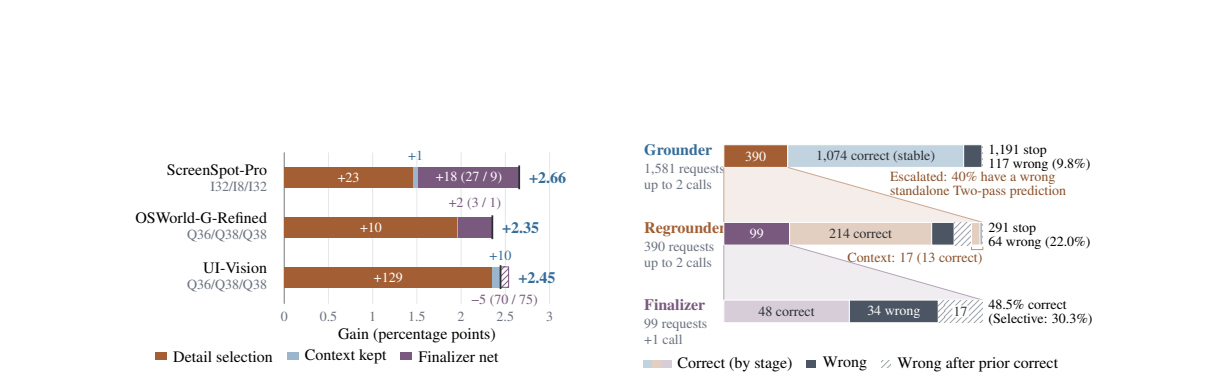
Figures are the authors', reproduced from the paper.
References (44)
- [1] Lingjiao Chen, Matei Zaharia, and James Zou. FrugalGPT: How to use large language models while reducing cost and improving performance.Transactions on Machine Learning Research, 2024. 3 on Pith
- [2] Minghua Chen, Xingming Liao, Weiqiang Zhong, and Zhuowei Wang. MHVF: Training-free GUI ground- ing via verification-guided multi-hypothesis search. arXiv:2610.17792, 2026. 2 on PithPith's reviewarXiv
- [3] Liyang Fan, Xinping Bi, Yitai Li, Shuaimin Li, Hui Li, and Min Yang. RankGround: Efficient high-resolution GUI grounding via lightweight reranker-guided crop selection. arXiv:2609.18690, 2026. 2 on PithPith's reviewarXiv
- [4] Aarash Feizi, Shravan Nayak, Xiangru Jian, Kevin Qinghong Lin, Kaixin Li, Rabiul Awal, Xing Han Lù, Johan Obando- Ceron, Juan A. Rodriguez, Nicolas Chapados, David Vazquez, Adriana Romero-Soriano, Reihaneh Rabbany, Per- ouz Taslakian, Christopher Pal, Spandana Gella, and Sai R... on Pith
- [5] Zichuan Fu, Shirong Wang, Wenlin Zhang, Guojing Li, Yimin Deng, Jingtong Gao, Junjia Qi, Hanyu Yan, Yefeng Zheng, Xiaopeng Li, Wanyu Wang, Xian Wu, and Xiangyu Zhao. GUI-Lens: Coarse-to-fine cropping for GUI ground- ing with general-purpose VLMs.arXiv:2608.03270, 2026. 2, 5 on PithPith's reviewarXiv
- [6] H Company. H Company’s new Holo2 model takes the lead in UI localization.https://huggingface.co/ blog / Hcompany / introducing - holo2 - 235b - a22b, 2026. 3 February 2026. 1 on Pith
- [7] Intelligence Indeed. Indeed-UI: High-resolution GUI grounding model.https : / / github . com / intelligence - indeed / Indeed - UI, 2026. 1, 4, 5 on Pith
- [8] Zhiyuan Jiang, Shenghao Xie, Wenyi Li, Wenqiang Zu, Pei- hang Li, Jiahao Qiu, Siqi Pei, Lei Ma, Tiejun Huang, Mengdi Wang, and Shilong Liu. Zoom in, click out: Unlocking and evaluating the potential of zooming for GUI grounding. arXiv:2512.05941, 2025. 1, 2, 6 on PitharXiv
- [9] Wittawat Jitkrittum, Neha Gupta, Aditya K. Menon, Harikr- ishna Narasimhan, Ankit Rawat, and Sanjiv Kumar. When does confidence-based cascade deferral suffice? InAdvances in Neural Information Processing Systems, 2023. 3 on Pith
- [10] Keon Kim and Krish Chelikavada. Zoom consistency: A free confidence signal in multi-step visual grounding pipelines. arXiv:2604.15376, 2026. 1, 2, 3 on PithPith's reviewarXiv
- [11] Kingsware and V ocaela AI. KV-Ground: Small GUI grounding models for high-resolution images.https: //github.com/vocaela/kv-ground, 2026. 1, 4 on Pith
- [12] Divake Kumar, Sina Tayebati, Devashri Naik, Amanda Sofie Rios, Nilesh Ahuja, Omesh Tickoo, Ranganath Krishnan, and Amit Ranjan Trivedi. Argus: A cross-regime bench- mark for the transferability of uncertainty quantification in computer-use agents. InNeurIPS Evaluations and Dat... on Pith
- [13] Aiden Yiliu Li, Bizhi Yu, Daoan Lei, Tianhe Ren, and Shilong Liu. Chain-of-Ground: Improving GUI grounding via iterative reasoning and reference feedback. arXiv:2512.01979, 2025. 2 on PitharXiv
- [14] Kaixin Li, Ziyang Meng, Hongzhan Lin, Ziyang Luo, Yuchen Tian, Jing Ma, Zhiyong Huang, and Tat-Seng Chua. ScreenSpot-Pro: GUI grounding for professional high-resolution computer use. InACM Multimedia, 2025. 1, 3 on Pith
- [15] Yunxiang Li, Xixin Wu, and Helen M. Meng. How many pixels is a digit worth? place-aware coordinate entropy for GUI agent confidence estimation.arXiv:2609.24277, 2026. Accepted to EMNLP 2026. 2 on PithPith's reviewarXiv
- [16] Zhecheng Li, Guoxian Song, Yiwei Wang, Zhen Xiong, Jun- song Yuan, and Yujun Cai. Generalist scanner meets special- ist locator: A synergistic coarse-to-fine framework for robust GUI grounding.arXiv:2509.24133, 2025. 2 on PitharXiv
- [17] Jiaping Lin, Fei Shen, Junzhe Li, Ping Nie, Fei Yu, Ming Li, and Haizhou Li. What happens before decoding? Prefill de- termines GUI grounding in VLMs.arXiv:2605.12549, 2026. 2 on PithPith's reviewarXiv
- [18] Xunzhuo Liu, Bowei He, Xue Liu, Andy Luo, Haichen Zhang, and Huamin Chen. Adaptive vision-language model routing for computer use agents.arXiv:2603.12823, 2026. 3 on PitharXiv
- [19] Yichao Liu, Huawen Shen, Liu Yu, Shiyu Liu, Zeyu Chen, and Yu Zhou. DRS-GUI: Dynamic region search for training-free GUI grounding. InCVPR, 2026. 2 on Pith
- [20] Tiange Luo, Lajanugen Logeswaran, Justin Johnson, and Honglak Lee. Visual test-time scaling for GUI agent ground- ing. InICCV, 2025. 2 on Pith
show 24 more
- [21] MNC AI. Hunmin-CUA: Post-training a 397b MoE for computer use.https://huggingface.co/blog/ mncai/hunmin- cua- post- training- a- 397b- moe-for-computer-u, 2026. 1, 5 on Pith
- [22] Shravan Nayak, Xiangru Jian, Kevin Qinghong Lin, Juan A. Rodriguez, Montek Kalsi, Nicolas Chapados, M. Tamer Özsu, Aishwarya Agrawal, David Vazquez, Christopher Pal, Perouz Taslakian, Spandana Gella, and Sai Rajeswar. UI- Vision: A desktop-centric GUI benchmark for visual perc... on Pith
- [23] OpenAI. GPT-6 Astra: A new generation of intelligence. https : / / openai . com / index / gpt - 6 - astra/, on Pith
- [24] Qwen Team. Qwen3.6-27B: Model card.https:// huggingface.co/Qwen/Qwen3.6-27B, 2026. 4 on Pith
- [25] Qwen Team. Qwen3.8-27B: Model card.https:// huggingface.co/Qwen/Qwen3.8-27B, 2026. 4 7 on Pith
- [26] ScreenSpot-Pro Benchmark Maintainers. ScreenSpot-Pro Leaderboard.https://gui- agent.github.io/ grounding-leaderboard/, 2026. Accessed 5 Novem- ber 2026. 2, 5 on Pith
- [27] Fei Tang, Bofan Chen, Zhengxi Lu, Tongbo Chen, Songqin Nong, Tao Jiang, Wenhao Xu, Weiming Lu, Jun Xiao, Yueting Zhuang, and Yongliang Shen. UI-Zoomer: Uncertainty-driven adaptive zoom-in for GUI grounding. arXiv:2604.14113, 2026. 1, 2, 6 on PithPith's reviewarXiv
- [28] Venus Team, Zhuohan Cai, Haoxing Chen, Jiaxuan Chen, Weizhi Chen, Changlong Gao, Zhangxuan Gu, Yuan Guo, Yusong Hu, Jianrong Jiang, Jianguo Li, Runze Li, Jinzhen Lin, Zhenyu Ma, Changhua Meng, Han Peng, Xinyu Qiu, Shuheng Shen, Zhongyi Shui, Weiqiang Wang, Ming Wen, Zhuoer Xu,... on PithPith's reviewarXiv
- [29] Venus Team, Changlong Gao, Zhangxuan Gu, Yulin Liu, Xinyu Qiu, Shuheng Shen, Yue Wen, Tianyu Xia, Zhenyu Xu, Zhengwen Zeng, Beitong Zhou, Xingran Zhou, Weizhi Chen, Sunhao Dai, Jingya Dou, Yichen Gong, Yuan Guo, Zhenlin Guo, Feng Li, Qian Li, Jinzhen Lin, Yuqi Zhou, Linchao Zh... on PitharXiv
- [30] Paul Viola and Michael Jones. Rapid object detection using a boosted cascade of simple features. InCVPR, 2001. 3 on Pith
- [31] Qingni Wang, Yue Fan, and Xin Eric Wang. SafeGround: Know when to trust GUI grounding models via uncertainty calibration.arXiv:2602.02419, 2026. 2 on PitharXiv
- [32] Qingni Wang, Changdae Oh, Yuzhe Yang, Sharon Li, Ji- achen Yang, Ang Li, and Xin Eric Wang. LEASH: Uncertainty-aware weak-to-strong escalation and oversight for computer-use agents.arXiv:2610.22280, 2026. 3 on PithPith's reviewarXiv
- [33] Wenkai Wang, Xiyun Li, Hongcan Guo, Wenhao Yu, Tian- qing Fang, Haitao Mi, Dong Yu, and Shengyu Zhang. Mea- sure twice, click once: Co-evolving proposer and visual critic via reinforcement learning for GUI grounding. InACL, on Pith
- [34] Xiaofang Wang, Dan Kondratyuk, Eric Christiansen, Kris M. Kitani, Yair Alon, and Elad Eban. Wisdom of committees: An overlooked approach to faster and more accurate models. InICLR, 2022. 3 on Pith
- [35] Tianbao Xie, Jiaqi Deng, Xiaochuan Li, Junlin Yang, Haoyuan Wu, Jixuan Chen, Wenjing Hu, Xinyuan Wang, Yuhui Xu, Zekun Wang, Yiheng Xu, Junli Wang, Doyen Sahoo, Tao Yu, and Caiming Xiong. Scaling computer-use grounding via user interface decomposition and synthesis. In NeurIPS... on Pith
- [36] Haiyang Xu, Xi Zhang, Haowei Liu, Junyang Wang, Zhaozai Zhu, Shengjie Zhou, Xuhao Hu, Feiyu Gao, Junjie Cao, Zi- hua Wang, Zhiyuan Chen, Jitong Liao, Qi Zheng, Jiahui Zeng, Ze Xu, Shuai Bai, Junyang Lin, Jingren Zhou, and Ming Yan. Mobile-Agent-v3.5: Multi-platform fundamental... on PitharXiv
- [37] Zhenhua Yang, Xiachong Feng, Weihong Zhong, Lunjun Liu, Xiaocheng Feng, and Bing Qin. Focus like a human: Ef- ficient GUI grounding via coarse-to-fine visual attention and parallel verification. InProceedings of the Thirty-Fifth In- ternational Joint Conference on Artificial I... on Pith
- [38] Ruilin Yao, Shegnwu Xiong, Tianyu Zou, Shili Xiong, and Yi Rong. AutoFocus: Uncertainty-aware active visual search for GUI grounding.arXiv:2605.02630, 2026. 2 on PithPith's reviewarXiv
- [39] Murong Yue, Jie Zhao, Min Zhang, Liang Du, and Ziyu Yao. Large language model cascades with mixture of thought rep- resentations for cost-efficient reasoning. InICLR, 2024. 3 on Pith
- [40] Borui Zhang, Bo Zhang, Bo Wang, Wenzhao Zheng, Yuhao Cheng, Liang Tang, Yiqiang Yan, Jie Zhou, and Jiwen Lu. BAMI: Training-free bias mitigation in GUI grounding. In Proceedings of the IEEE/CVF Conference on Computer Vi- sion and Pattern Recognition, pages 34596–34605, 2026. 2 on Pith
- [41] Renshan Zhang, Haoyang Meng, Yixiao He, Rui Shao, April Hua Liu, and Liqiang Nie. LookAgain: Closed- loop GUI grounding with visually grounded reflection. arXiv:2608.09723, 2026. 2 on PithPith's reviewarXiv
- [42] Yunzhu Zhang, Zeyu Pan, Zhengwen Zeng, Shuheng Shen, Changhua Meng, and Linchao Zhu. MVP: Multiple view prediction improves GUI grounding. InCVPR, 2026. 2, 4, 5 on Pith
- [43] Hanzhang Zhou, Xu Zhang, Panrong Tong, Jianan Zhang, Liangyu Chen, Quyu Kong, Chenglin Cai, Chen Liu, Yue Wang, Jingren Zhou, and Steven Hoi. MAI-UI tech- nical report: Real-world centric foundation GUI agents. arXiv:2512.22047, 2025. 1 on PitharXiv
- [44] Hanzhang Zhou, Panrong Tong, Xu Zhang, Quyu Kong, Chenglin Cai, Tianyu Xia, Gongjie Zhang, Jianan Zhang, Long Li, Long Chen, Lei Wang, Gaole Dai, Pengxiang Li, Liangyu Chen, Yue Wang, and Steven Hoi. Qwen-UI-Agent technical report: Toward next-generation real-world centric fou... on PithPith's reviewarXiv
Challenges and discussion
Disagree with the review, or know something it missed? Leave a comment, or challenge this review formally: a challenge becomes a permanent entry in this paper's record, and its decision is published here.
Come back by email
A short list of the week's newly reviewed papers. Nothing is sent until you confirm from your inbox, and every email has a link that stops it. No account.
No comments yet.
Sign in to comment