Computer Vision and Pattern Recognition · arXiv:2610.17792 v1 · submitted 13 Oct 2026 · 46 references
MHVF: Training-Free GUI Grounding via Verification-Guided Multi-Hypothesis Search
The paper says
“GUI grounding enables web agents to translate natural-language instructions into actionable interface locations. However, dense layouts and small, visually similar controls can lead models toward plausible but incorrect elements, while refinement around a single prediction may leave alternative targets unexplored.”
more of the abstract
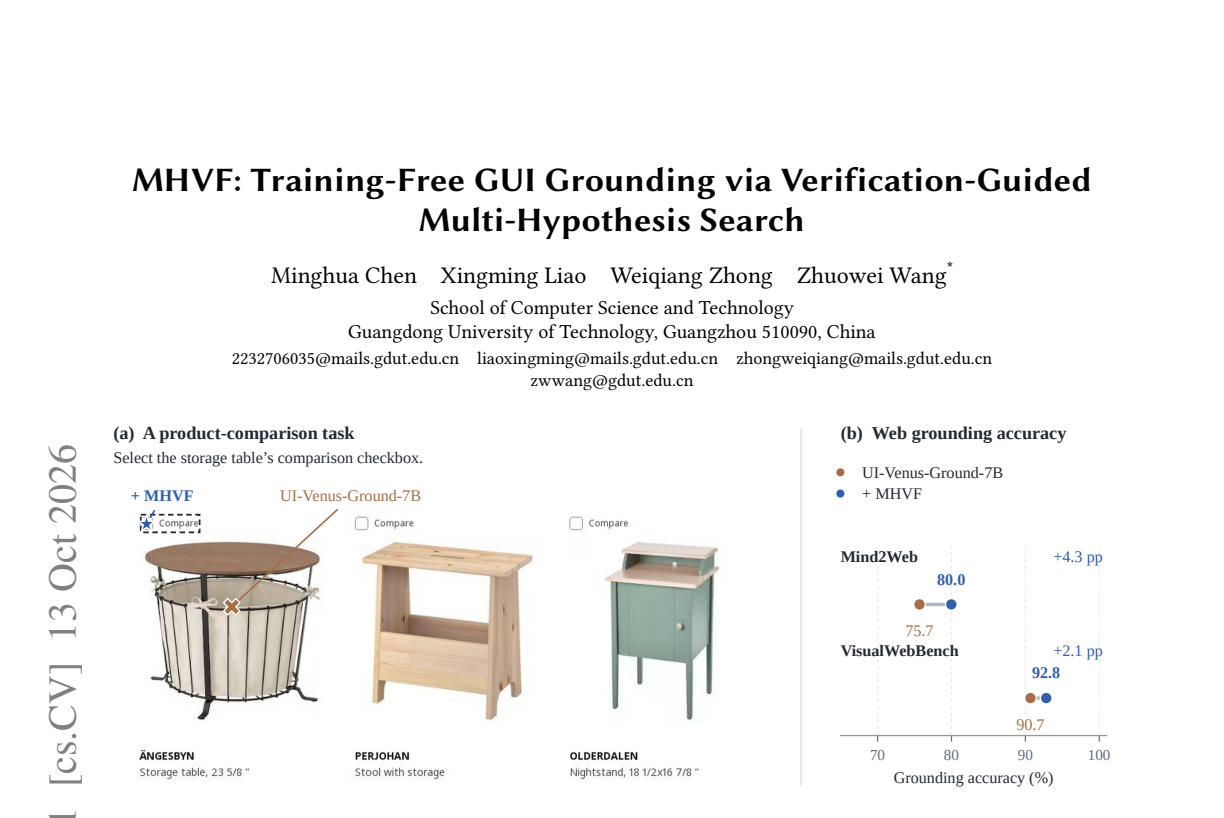
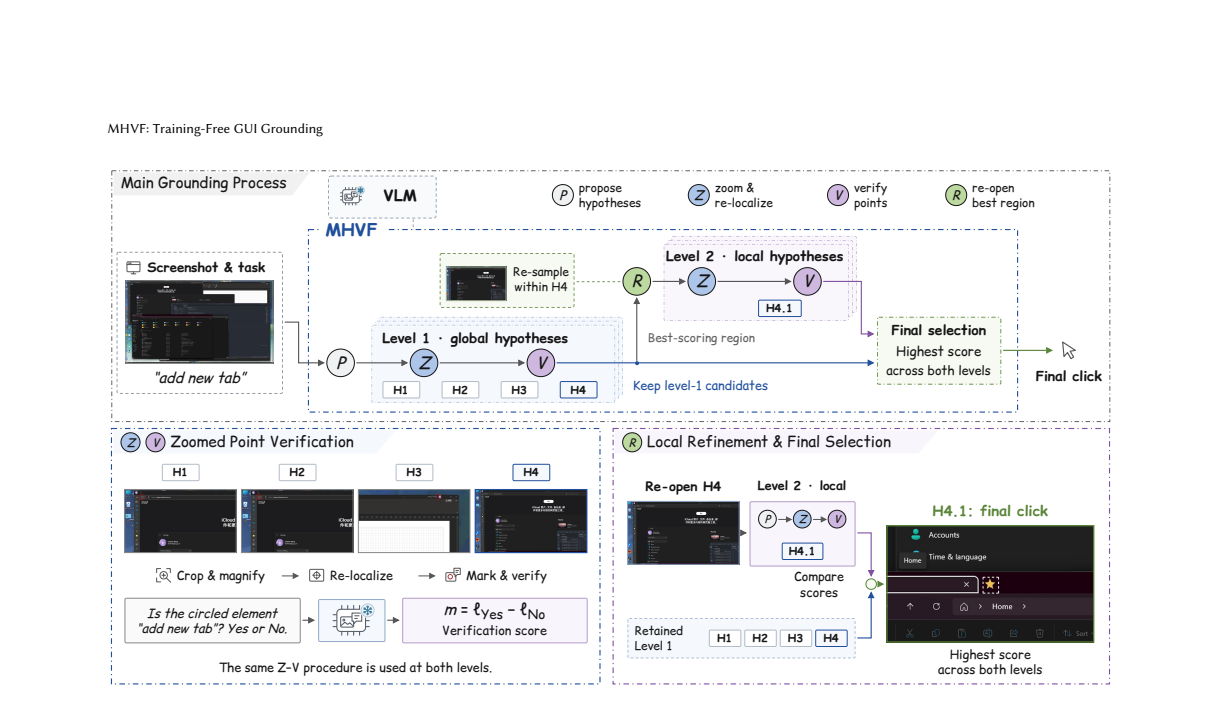
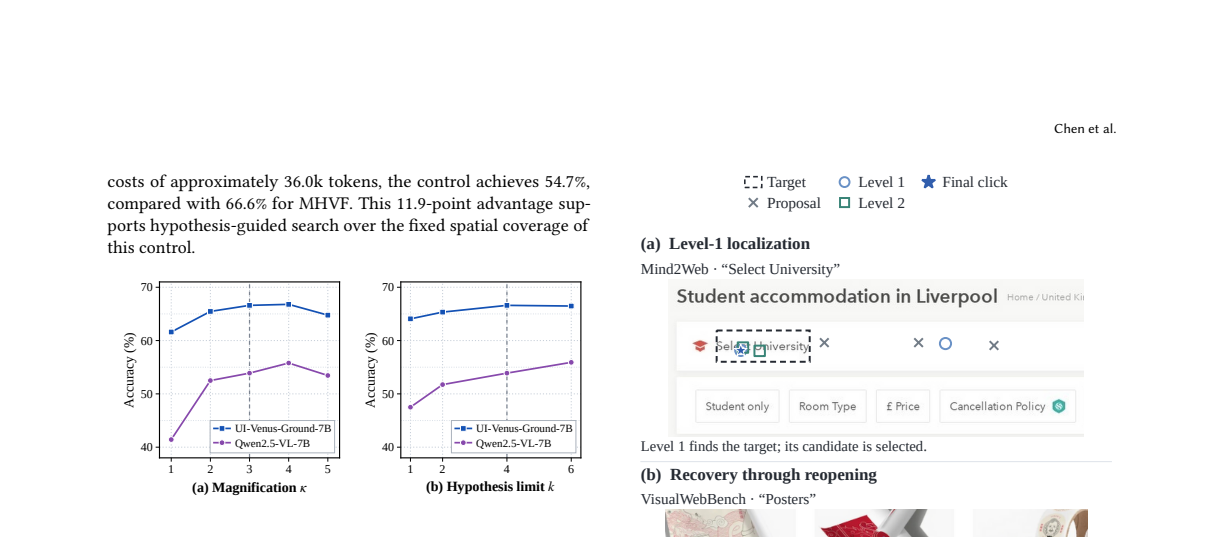
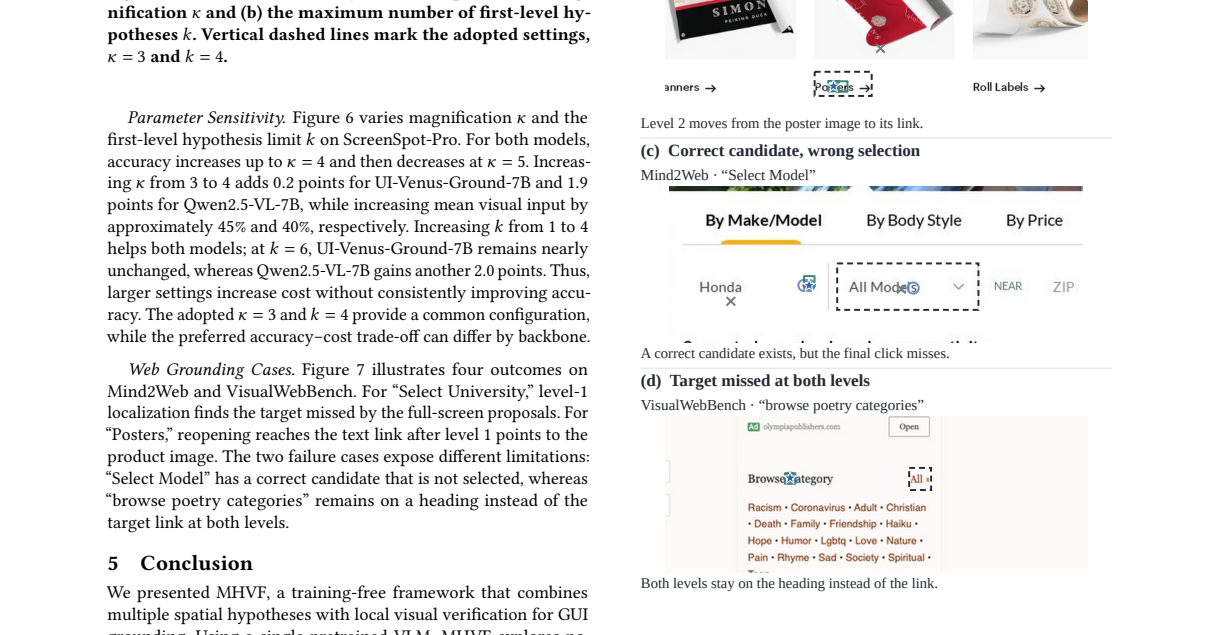
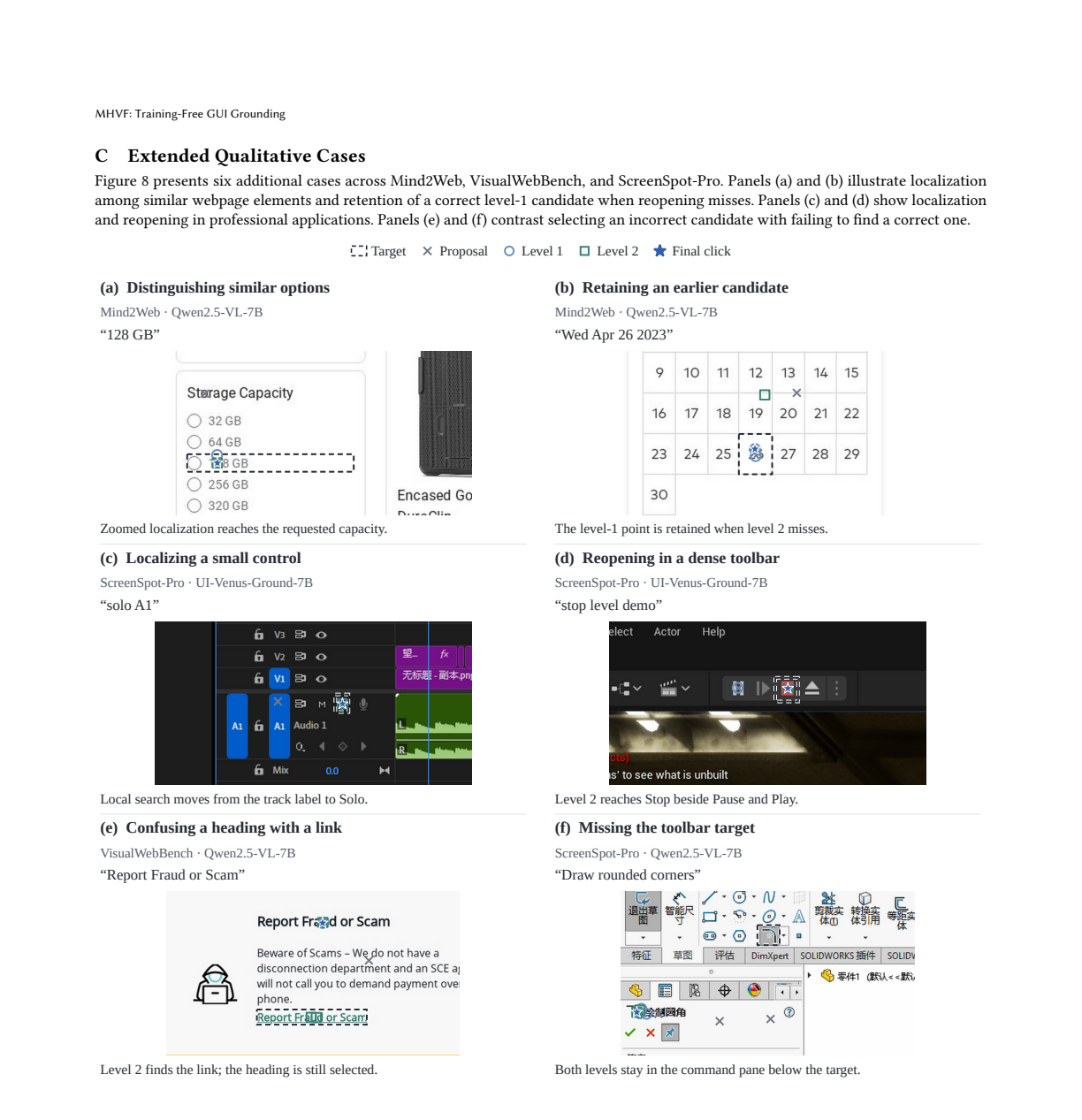
We propose the Multi-Hypothesis Verification Framework (MHVF) for training-free GUI grounding. It combines multi-hypothesis exploration with local visual verification using a single pretrained vision-language model. To explore alternative targets, MHVF constructs spatial hypotheses from multiple full-screen predictions and examines the corresponding regions through zoomed re-localization. To resolve ambiguity among the resulting candidates, it verifies their agreement with the instruction in marked local views. Verification scores then guide a second round of local search and rank candidates retained from both search levels for final selection. Experiments with five general-purpose and GUI-specific models across eight benchmark settings demonstrate improvements in grounding accuracy in most settings. MHVF improves UI-Venus-Ground-7B by 4.3 and 2.1 percentage points on Mind2Web and VisualWebBench, respectively, and raises Qwen2.5-VL-7B's accuracy on ScreenSpot-Pro from 23.6% to 53.6%.
from the abstract
Pith says
Machine review · deepseek-v4-flash · 14 Oct 2026 · what was read was not recorded · not checked by a person
It can be wrong. Challenge this review or reply to it.
Holds up. Solid engineering contribution with broad experiments; the verification score's discriminative power is the main unresolved question. This line is wrong
2 major objections · 5 minor
How often objections from reviews like this one are right: not yet measured
Not checked: figures, code, what the 46 references say.
The paper says, at §3.4, Eq. (7); §4.3, Table 4
The review did not quote this passage.
Pith says: Objection 1 of 2 · major
The verification score m_h is central to guiding reopening and final selection, but the paper does not directly evaluate its discriminative power (e.g., area under ROC curve or precision/recall at different thresholds) for distinguishing correct from incorrect candidates. The ablation shows a modest benefit (verification adds 0.4–4.2 pp over a no-verification variant), but without a direct measure it remains unclear whether the score is well-calibrated or may sometimes disfavor correct candidates.
more of objection 1
Adding such an analysis would substantially strengthen the claim that verification 'guides search and selection'.
The paper says, at §4.1–4.2, Tables 1–2
The review did not quote this passage.
Pith says: Objection 2 of 2 · major
No confidence intervals or statistical significance tests are reported for the main accuracy numbers. Given the per-instance variability and small gains in some settings (e.g., +0.2 pp on VisualWebBench for Qwen2.5-VL-3B), confidence intervals (e.g., via bootstrap) would help the reader assess whether the improvements are reliable. The claim 'improvements in most settings' would be better supported if the uncertainty of each gain were characterized.
5 minor objections
The paper says, at Figure 1
Pith says: minor objection 1 of 5
The bar chart shows absolute accuracy percentages, but the caption says 'gains are in percentage points.' The label inside the figure (e.g., '+4.3 pp') makes the message clear, but the caption could be more precise to avoid confusion.
The paper says, at Table 1, GTA1-7B row
Pith says: minor objection 2 of 5
GTA1-7B + MHVF shows a decrease on Mind2Web (-0.8), VisualWebBench (-0.2), and MMBench-GUI L2 (-3.0 pp). A brief comment in the text or a footnote explaining possible reasons (e.g., model-specific behaviors, over-reliance on verification) would be informative.
show 3 more
The paper says, at Appendix A, verification prompt
Pith says: minor objection 3 of 5
The verification prompt is given inline. Displaying it as a verbatim code block would improve readability and ensure that the exact prompt (including the placeholder 'instruction') is unambiguous.
The paper says, at References [14] and [7]
Pith says: minor objection 4 of 5
References [14] (DART) is a GitHub repository and [7] (UI-Venus technical report) is an arXiv preprint. While both are acceptable, ensure that the status (to appear, preprint, etc.) is clearly stated where needed; for [14] there is no indication of publication, which may affect citability.
The paper says, at Figure 3
Pith says: minor objection 5 of 5
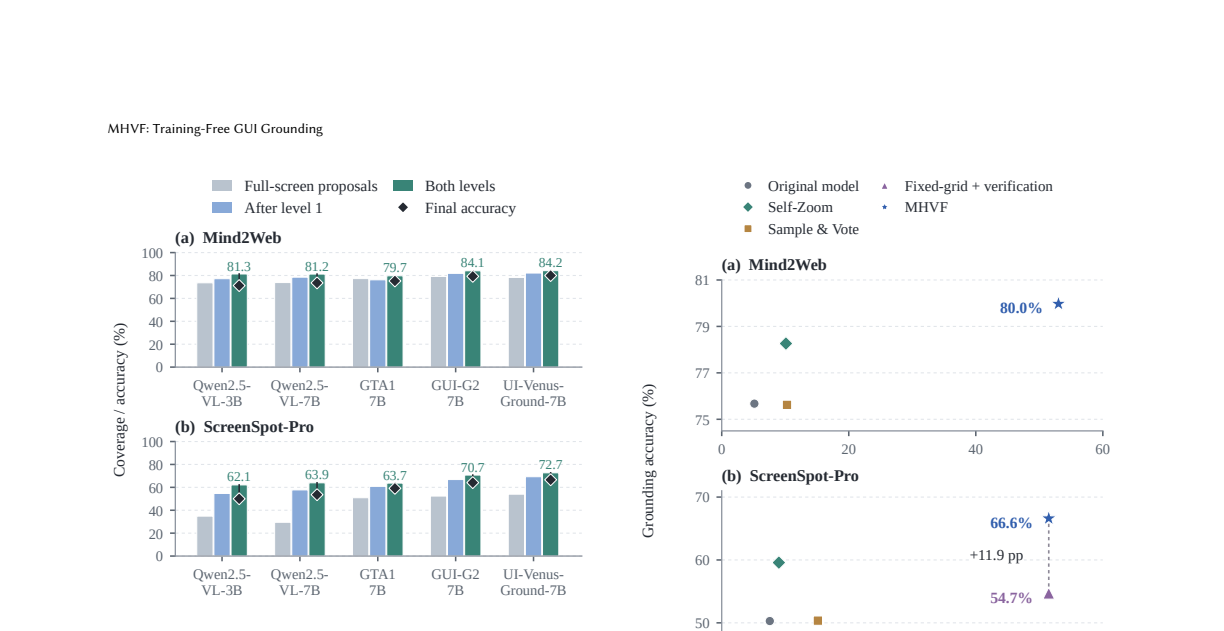
The 'selection gap' is clearly shown, and the paper acknowledges it. It would be helpful if the text explicitly stated the average gap (e.g., '4–12 pp across settings') in a single place to reinforce the point.
What would settle it
On a held-out subset (e.g., 500 samples from ScreenSpot-Pro), compute verification scores for all predicted candidates—not just the one selected. Record whether each candidate is correct (inside target box). Compute the area under the ROC curve (AUC) for m_h as a binary classifier of correctness. Also compute the fraction of cases where the correct candidate gets the highest score. If AUC ≤ 0.6 or the correct candidate is top-scored in < 70% of cases, the verification signal is weak and the method's reliance on it is unjustified.
from the skeptic's reading
How the review went
4 readings by deepseek-v4-flash · 14 Oct 2026
- Reader holds up
- Skeptic agrees
- Editor wrote the verdict above
- Referee minor revision: 2 major objections, 5 minor
Not run on this paper: the simulated authors' defence.
Pith did not check this review's objections against the paper.
The review in full
The review in brief, machine-written
This paper proposes MHVF, a training-free framework that improves GUI grounding by combining multi-hypothesis spatial search with zoomed re-localization and self-verification. The core idea is sensible: you sample multiple predictions, cluster them, inspect each region at higher magnification, and then use the same frozen VLM to score a candidate in a marked local view. A second level repeats the process on the best-scoring region. The experiments are the paper's strongest asset: five models, eight benchmarks, careful ablations, candidate-coverage analysis, and parameter sensitivity—all with consistent gains across most settings. The improvement on high-resolution interfaces (ScreenSpot-Pro) is striking, e.g., Qwen2.5-VL-7B jumps from 23.6% to 53.6%. The ablation study (Table 4) credibly separates the contributions of magnification, multiple hypotheses, verification, and reopening.
What gives me pause is the verification score itself. The stress-test note flags this: the score mh = l_Yes − l_No is computed from the same VLM that generated the candidates, and there is no direct evidence that it reliably separates correct from incorrect candidates. The paper's own Figure 3 shows that many correct candidates exist after search but are not selected—the selection gap remains 4–12 percentage points. And in Table 4, removing verification (but keeping both search levels) only reduces accuracy by 0.3–3.0 pp. That suggests the principal benefit comes from coverage and magnification, not from verification-guided ranking. The authors acknowledge the selection gap in the conclusion (b192), but they still rely on verification for reopening and final choice. Absent a calibration study or a head-to-head comparison with a simpler selection rule (e.g., nearest-first or voting), it is hard to know how much lift verification actually provides.
Other soft spots: the method degrades GTA1-7B on two benchmarks with no deep analysis of why. The inference cost is high (visual tokens increase by 3–10× depending on the benchmark). Parameter search is only shown on one benchmark (ScreenSpot-Pro) with two variables. No code or data are released.
This paper is for readers working on GUI grounding, web agents, or test-time scaling for VLMs. It deserves a serious referee because the experiments are thorough and the method is practical. The core claim—that MHVF improves grounding in most settings—holds up, but the contribution of verification needs stronger justification. I would recommend acceptance conditional on a direct evaluation of verifier accuracy or a simplified ablation that matches the selection rule to the claimed mechanism.
The strongest objection
The method relies on the verification score m_h = l_Yes - l_No to rank candidates and guide reopening. The paper does not evaluate how well this score distinguishes correct from incorrect candidates. Because the same VLM performs both localization and verification, and the marked view shows its own prediction, the score may be inflated for plausible-looking but wrong candidates (confirmation bias). The selection gap in Figure 3 shows that correct candidates are often present but not selected, which is consistent with a noisy or biased verifier. If the verification signal is systematically unreliable, the two-level selection may add noise rather than signal, and the method's gains might come primarily from increased coverage and magnification rather than from verification-guided ranking. The paper's ablations show that removing verification reduces accuracy only modestly (0.3–3.0 pp), suggesting verification's contribution is secondary—but it is still used for reopening and final selection in the full method. Without a direct measure of verification accuracy, the central claim that verification 'guides search and selection' rests on an untested assumption.
The reader identified the verification score as the weakest assumption. I agree: the paper does not provide evidence that m_h reliably distinguishes correct from incorrect candidates. However, the paper's overall claim (accuracy improvements in most settings) is supported by extensive experiments and ablations. The verification component, while questionable, is not the sole source of gains; magnification and multi-hypothesis search also contribute. Therefore, no adjustment to the ACCEPT verdict is necessary. The concrete test would settle whether the verification assumption is actually violated, and if so, suggest that the method's benefits stem from other components rather than verification.
The referee's report
If the reported gains hold, MHVF offers a practical training-free enhancement for GUI grounding that can be applied to any pretrained VLM. The combination of spatial multi-hypothesis search with local verification is a sensible test-time scaling approach, and the extensive evaluation (five backbones, eight benchmark settings) provides broad evidence of effectiveness. The method's training-free nature and reliance on a single model make it easy to adopt.
Pith's reading of the paper (a machine's summary, not the authors')
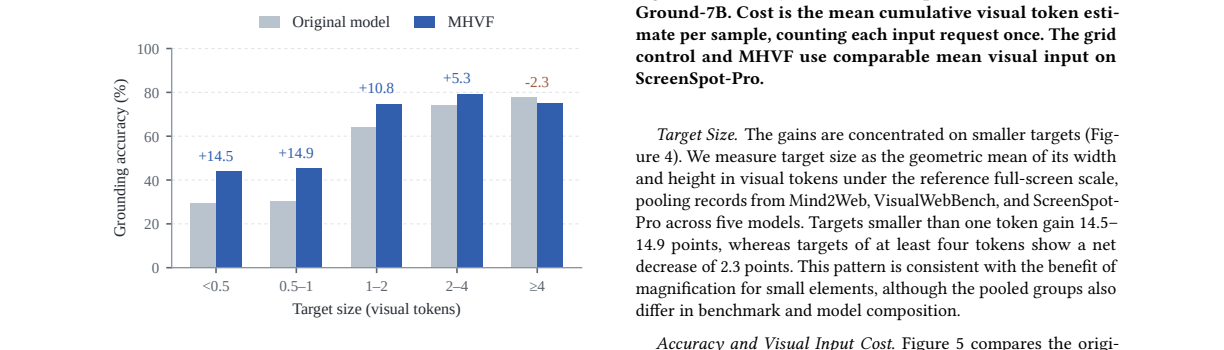
GUI grounding is the task of translating a natural-language instruction (e.g., "click the comparison checkbox") into a pixel coordinate on a screenshot. Current vision-language models often miss small or visually ambiguous elements because they process the entire screen at once. MHVF works with a single frozen model and no extra training. First, the model makes several full-screen predictions by sampling with temperature; these points are clustered into spatial hypotheses. Each hypothesis defines a region to crop and magnify, so the model can re-localize the target with finer detail. The resulting candidate is then marked with a red circle in its zoomed view, and the same VLM is asked whether that circled element matches the instruction. The log-probability difference between "Yes" and "No" becomes a verification score. The best-scoring region is reopened for a second round of finer-grain search. Candidates from both rounds are pooled, and the highest-scoring click is returned. The key insight is that the model can serve as its own verifier if given magnified, marked views of its own predictions. Experiments across web, desktop, and professional interfaces show that MHVF improves five different models in almost all settings, especially on small targets.
Core claim. MHVF, a training-free framework combining multi-hypothesis search with local visual verification using a single pretrained VLM, improves GUI grounding accuracy in most of the 40 evaluated model–benchmark settings, with gains such as +30.0 pp on ScreenSpot-Pro for Qwen2.5-VL-7B and +4.3 pp on Mind2Web for UI-Venus-Ground-7B.
The premise it rests on. The verification score m_h = l_Yes - l_No (computed from the frozen VLM's output log-probabilities on a marked local view) is a reliable signal for ranking candidates and guiding search; if the model's self-verification is poorly calibrated or systematically biased toward familiar patterns, the whole two-level selection procedure may degrade rather than improve accuracy.
Check this review
Pith stored no record of this review's passes and took no fingerprint of it. Reviews made by code from 13 Nov 2026 on carry both.
How often reviews like this one are right
Reviews like this one: written by deepseek-v4-flash, where what was read was not recorded.
How often objections from reviews like this one are right: not yet measured
Reviews by people
This review was written by a machine. No person has reviewed this paper on Pith yet. A scientist listed on Pith can review it for a fee, and their review is published here whatever it concludes.
The paper
Abstract
GUI grounding enables web agents to translate natural-language instructions into actionable interface locations. However, dense layouts and small, visually similar controls can lead models toward plausible but incorrect elements, while refinement around a single prediction may leave alternative targets unexplored. We propose the Multi-Hypothesis Verification Framework (MHVF) for training-free GUI grounding. It combines multi-hypothesis exploration with local visual verification using a single pretrained vision-language model. To explore alternative targets, MHVF constructs spatial hypotheses from multiple full-screen predictions and examines the corresponding regions through zoomed re-localization. To resolve ambiguity among the resulting candidates, it verifies their agreement with the instruction in marked local views. Verification scores then guide a second round of local search and rank candidates retained from both search levels for final selection. Experiments with five general-purpose and GUI-specific models across eight benchmark settings demonstrate improvements in grounding accuracy in most settings. MHVF improves UI-Venus-Ground-7B by 4.3 and 2.1 percentage points on Mind2Web and VisualWebBench, respectively, and raises Qwen2.5-VL-7B's accuracy on ScreenSpot-Pro from 23.6% to 53.6%.
The paper's own sentences, arranged, kept beside the review and separate from it. Each label is drawn from a closed vocabulary; the number beside it is the probability the classifier gave that label. No sentence in this record was written by a model.
abstract compiled · 2026-10-14
The authors' main claim, as the classifier picked it out 0.98
“Experiments with five general-purpose and GUI-specific models across eight benchmark settings demonstrate improvements in grounding accuracy in most settings.”
How the main claim is stated: asserted 1.00
What the abstract itself states, as probabilities: claims first 0.04 · states limitation 0.22 · human participants 0.03 · controlled comparison 0.53 · randomized assignment 0.01 · states quantitative result 0.99 · compares with prior results 0.91 · mentions code or data availability 0.03
The abstract, sentence by sentence
This table labels the abstract only (arXiv listing abstract v1). The number is the probability the classifier gave the label.
| Sentence | Role | The authors' own work | States the main conclusion | Strength |
|---|---|---|---|---|
| GUI grounding enables web agents to translate natural-language instructions into actionable interface locations. | background 1.00 | 0.04 | 0.02 | asserted 1.00 |
| However, dense layouts and small, visually similar controls can lead models toward plausible but incorrect elements, while refinement around a single prediction may leave alternative targets unexplored. | background 0.67 | 0.07 | 0.02 | hedged possibility 0.63 |
| We propose the Multi-Hypothesis Verification Framework (MHVF) for training-free GUI grounding. | contribution 0.99 | 0.87 | 0.11 | asserted 0.99 |
| It combines multi-hypothesis exploration with local visual verification using a single pretrained vision-language model. | method 0.86 | 0.82 | 0.05 | asserted 1.00 |
| To explore alternative targets, MHVF constructs spatial hypotheses from multiple full-screen predictions and examines the corresponding regions through zoomed re-localization. | method 1.00 | 0.84 | 0.03 | asserted 1.00 |
| To resolve ambiguity among the resulting candidates, it verifies their agreement with the instruction in marked local views. | method 1.00 | 0.80 | 0.03 | asserted 0.99 |
| Verification scores then guide a second round of local search and rank candidates retained from both search levels for final selection. | method 1.00 | 0.86 | 0.07 | asserted 1.00 |
| Experiments with five general-purpose and GUI-specific models across eight benchmark settings demonstrate improvements in grounding accuracy in most settings. | result 0.96 | 0.95 | 0.46 | asserted 1.00 |
| MHVF improves UI-Venus-Ground-7B by 4.3 and 2.1 percentage points on Mind2Web and VisualWebBench, respectively, and raises Qwen2.5-VL-7B's accuracy on ScreenSpot-Pro from 23.6% to 53.6%. | result 1.00 | 0.95 | 0.35 | asserted 1.00 |
What kind of paper the classifier reports this is: method or tool 1.00 · evidence from observation or experiment 1.00
What was examined, and what was not
Sources read
- arXiv listing abstract v1
Not examined
- full text
- figures and tables
- references and citing sentences
- relations to other papers
Levels run
- P abstract
Not run
- S sections
- T body sentences
- C citations
- R cross-paper relations
How the labels were made
Compiled by classifier-1.13.0 via TypeSafe API, question bank abstract-p1-20260923, 2026-10-14: 1 request, 6,866 input tokens.
Every quoted sentence on this record is the authors'. Every label is from Pith's closed vocabulary, with the probability shown beside it. This record as JSON
Figures (8)
Showing 7 of the paper's 8 figures. Figures are the authors', reproduced from the paper.
References (46)
- [1] Shuai Bai, Keqin Chen, Xuejing Liu, Jialin Wang, Wenbin Ge, Sibo Song, Kai Dang, Peng Wang, Shijie Wang, Jun Tang, Humen Zhong, Yuanzhi Zhu, Mingkun Yang, Zhaohai Li, Jianqiang Wan, Pengfei Wang, Wei Ding, Zheren Fu, Yiheng Xu, Jiabo Ye, Xi Zhang, Tianbao Xie, Zesen Cheng, Han... on PithPith's reviewarXiv
- [2] Kanzhi Cheng, Qiushi Sun, Yougang Chu, Fangzhi Xu, Yantao Li, Jianbing Zhang, and Zhiyong Wu. 2024. SeeClick: Harnessing GUI Grounding for Advanced Visual GUI Agents. InProceedings of the 62nd Annual Meeting of the Association for Computational Linguistics (Volume 1: Long Pape... on Pithdoi:10.18653/v1/2024.acl-long.505
- [3] Xiang Deng, Yu Gu, Boyuan Zheng, Shijie Chen, Sam Stevens, Boshi Wang, Huan Sun, and Yu Su. 2023. Mind2Web: Towards a Generalist Agent for the Web. InAdvances in Neural Information Processing Systems, Vol. 36. 28091–28114. doi:10.52202/075280-1220 on Pithdoi:10.52202/075280-1220
- [4] Yong Du, Yuchen Yan, Fei Tang, Zhengxi Lu, Chang Zong, Weiming Lu, Shengpei Jiang, and Yongliang Shen. 2026. Test-Time Reinforcement Learning for GUI Grounding via Region Consistency.Proceedings of the AAAI Conference on Artificial Intelligence40, 36 (2026), 30593–30601. doi:1... on Pithdoi:10.1609/aaai.v40i36.40314
- [5] Zichuan Fu, Shirong Wang, Wenlin Zhang, Guojing Li, Yimin Deng, Jingtong Gao, Junjia Qi, Hanyu Yan, Yefeng Zheng, Xiaopeng Li, Wanyu Wang, Xian Wu, and Xiangyu Zhao. 2026. GUI-Lens: Coarse-to-Fine Cropping for GUI Grounding with General-Purpose VLMs. arXiv:2608.03270 on PithPith's reviewarXiv
- [6] Boyu Gou, Ruohan Wang, Boyuan Zheng, Yanan Xie, Cheng Chang, Yiheng Shu, Huan Sun, and Yu Su. 2025. Navigating the Digital World as Humans Do: Universal Visual Grounding for GUI Agents. InInternational Conference on Learning Representations. https://arxiv.org/abs/2410.05243 on PithPith's reviewarXiv
- [7] Zhangxuan Gu, Zhengwen Zeng, Zhenyu Xu, Xingran Zhou, Shuheng Shen, Yunfei Liu, Beitong Zhou, Changhua Meng, Tianyu Xia, Weizhi Chen, Yue Wen, Jingya Dou, Fei Tang, Jinzhen Lin, Yulin Liu, Zhenlin Guo, Yichen Gong, Heng Jia, Changlong Gao, Yuan Guo, Yong Deng, Zhenyu Guo, Lian... on PithPith's reviewarXiv
- [8] Zhiyuan Jiang, Shenghao Xie, Wenyi Li, Wenqiang Zu, Peihang Li, Jiahao Qiu, Siqi Pei, Lei Ma, Tiejun Huang, Mengdi Wang, and Shilong Liu. 2025. Zoom in, Click out: Unlocking and Evaluating the Potential of Zooming for GUI Grounding. arXiv:2512.05941 on PitharXiv
- [9] SeokJoo Kwak, Jihoon Kim, Boyoun Kim, Jung Jae Yoon, Wooseok Jang, Jeonghoon Hong, Jaeho Yang, and Yeong-Dae Kwon. 2025. MEGA-GUI: Multi- stage Enhanced Grounding Agents for GUI Elements. arXiv:2511.13087 on PitharXiv
- [10] Woosuk Kwon, Zhuohan Li, Siyuan Zhuang, Ying Sheng, Lianmin Zheng, Cody Hao Yu, Joseph E. Gonzalez, Hao Zhang, and Ion Stoica. 2023. Efficient Memory Management for Large Language Model Serving with PagedAttention. InProceedings of the 29th Symposium on Operating Systems Princ... on Pithdoi:10.1145/3600006.3613165
- [11] Hyunseok Lee, Jeonghoon Kim, Beomjun Kim, Jihoon Tack, Chansong Jo, Jae- hong Lee, Cheonbok Park, Sookyo In, Jinwoo Shin, and Kang Min Yoo. 2025. ReGUIDE: Data Efficient GUI Grounding via Spatial Reasoning and Search. arXiv:2505.15259v2 on PithPith's reviewarXiv
- [12] Jaeseong Lee, Yeeun Choi, Heechan Choi, Hanjung Kim, and Seonjoo Kim. 2025. A Training-Free, Task-Agnostic Framework for Enhancing MLLM Performance on High-Resolution Images. arXiv:2507.10202 on PithPith's reviewarXiv
- [13] Bin Lei, Nuo Xu, Ali Payani, Mingyi Hong, Chunhua Liao, Yu Cao, and Caiwen Ding. 2025. GUI-Spotlight: Adaptive Iterative Focus Refinement for Enhanced GUI Visual Grounding. arXiv:2510.04039 on PitharXiv
- [14] lexuanhoang120. 2026. DART: Density-Aware Adaptive Refinement Technique for GUI Grounding. GitHub repository. Retrieved October 11, 2026 from https:// github.com/lexuanhoang120/Density-Aware-Adaptive-Refinement-Technique on Pith
- [15] Aiden Yiliu Li, Bizhi Yu, Daoan Lei, Tianhe Ren, and Shilong Liu. 2025. Chain- of-Ground: Improving GUI Grounding via Iterative Reasoning and Reference Feedback. arXiv:2512.01979 on PitharXiv
- [16] Kaixin Li, Ziyang Meng, Hongzhan Lin, Ziyang Luo, Yuchen Tian, Jing Ma, Zhiyong Huang, and Tat-Seng Chua. 2025. ScreenSpot-Pro: GUI Grounding for Professional High-Resolution Computer Use. InProceedings of the 33rd ACM International Conference on Multimedia. Association for Co... on Pithdoi:10.1145/3746027.3755688
- [17] Zhecheng Li, Guoxian Song, Yiwei Wang, Zhen Xiong, Junsong Yuan, and Yujun Cai. 2025. Generalist Scanner Meets Specialist Locator: A Synergistic Coarse-to- Fine Framework for Robust GUI Grounding. arXiv:2509.24133 on PitharXiv
- [18] Jiaping Lin, Fei Shen, Junzhe Li, Ping Nie, Fei Yu, Ming Li, and Haizhou Li. 2026. What Happens Before Decoding? Prefill Determines GUI Grounding in VLMs. arXiv:2605.12549 on PithPith's reviewarXiv
- [19] Chen Liu, Ling Chen, Hanzhang Zhou, Liangyu Chen, Chenglin Cai, Xin Yu, Steven Hoi, and Yue Wang. 2026. One Forward Beats Two: InnerZoom for Accurate and Efficient GUI Grounding. arXiv:2606.30084 on PithPith's reviewarXiv
- [20] Junpeng Liu, Yifan Song, Bill Yuchen Lin, Wai Lam, Graham Neubig, Yuanzhi Li, and Xiang Yue. 2024. VisualWebBench: How Far Have Multimodal LLMs Evolved in Web Page Understanding and Grounding?. InConference on Language Modeling. https://openreview.net/forum?id=egVSgtJJAx on Pith
show 26 more
- [21] Yichao Liu, Huawen Shen, Liu Yu, Shiyu Liu, Zeyu Chen, and Yu Zhou. 2026. DRS-GUI: Dynamic Region Search for Training-Free GUI Grounding. InPro- ceedings of the IEEE/CVF Conference on Computer Vision and Pattern Recognition. 34606–34616. https://openaccess.thecvf.com/content/C... on Pith
- [22] Yizhou Liu, Fei Tang, Yuchen Yan, Zhengxi Lu, Songqin Nong, Tao Jiang, Wenhao Xu, Wenqi Zhang, Weiming Lu, Jun Xiao, and Yongliang Shen. 2026. Learning from Reliable Negatives: Confidence-Anchored Test-Time Adaptation for GUI Grounding. arXiv:2609.15307 on PithPith's reviewarXiv
- [23] Ziwei Liu, Tao Feng, Borui Kang, Yanbing Yang, and Jun Luo. 2026. Zoom to Essence: Trainless GUI Grounding by Inferring upon Interface Elements. arXiv:2603.14448 on PitharXiv
- [24] Tiange Luo, Lajanugen Logeswaran, Justin Johnson, and Honglak Lee on Pith
- [25] Longhui Ma, Di Zhao, Siwei Wang, Zhao Lv, and Miao Wang. 2026. Tri- fuse: Enhancing Attention-Based GUI Grounding via Multimodal Fusion. arXiv:2602.06351 on PitharXiv
- [26] Shravan Nayak, Xiangru Jian, Kevin Qinghong Lin, Juan A. Rodriguez, Montek Kalsi, Nicolas Chapados, M. Tamer Özsu, Aishwarya Agrawal, David Vazquez, Christopher Pal, Perouz Taslakian, Spandana Gella, and Sai Rajeswar. 2025. UI-Vision: A Desktop-centric GUI Benchmark for Visual... on Pith
- [27] Siqi Pei, Liang Tang, Tiaonan Duan, Long Chen, Shuxian Li, Kaer Huang, Yanzhe Jing, Yiqiang Yan, Bo Zhang, Chenghao Jiang, Borui Zhang, and Jiwen Lu. 2026. AdaZoom-GUI: Adaptive Zoom-based GUI Grounding with Instruction Refine- ment. arXiv:2603.17441 on PitharXiv
- [28] Fei Tang, Bofan Chen, Zhengxi Lu, Tongbo Chen, Songqin Nong, Tao Jiang, Wenhao Xu, Weiming Lu, Jun Xiao, Yueting Zhuang, and Yongliang Shen on Pith
- [29] Fei Tang, Zhangxuan Gu, Zhengxi Lu, Xuyang Liu, Shuheng Shen, Changhua Meng, Wen Wang, Wenqi Zhang, Yongliang Shen, Weiming Lu, Jun Xiao, and Yueting Zhuang. 2026. GUI-G 2: Gaussian Reward Modeling for GUI Grounding. Proceedings of the AAAI Conference on Artificial Intelligenc... on Pithdoi:10.1609/aaai.v40i39.40606
- [30] Xingjian Tao, Yiwei Wang, Yujun Cai, Yihong Luo, Kai Han, and Jing Tang on Pith
- [31] Xuehui Wang, Zhenyu Wu, JingJing Xie, Zichen Ding, Bowen Yang, Zehao Li, Zhaoyang Liu, Qingyun Li, Xuan Dong, Zhe Chen, Weiyun Wang, Xiangyu Zhao, Jixuan Chen, Haodong Duan, Tianbao Xie, Chenyu Yang, Shiqian Su, Yue Yu, Yanting Zhang, Xiangyu Yue, Weijie Su, Xizhou Zhu, Wei Sh... on Pith
- [32] Hang Wu, Hongkai Chen, Yujun Cai, Chang Liu, Qingwen Ye, Ming-Hsuan Yang, and Yiwei Wang. 2025. DiMo-GUI: Advancing Test-time Scaling in GUI Grounding via Modality-Aware Visual Reasoning. InProceedings of the 2025 Conference on Empirical Methods in Natural Language Processing.... on Pithdoi:10.18653/v1/2025.emnlp-main.1334
- [33] Mitigating Coordinate Prediction Bias from Positional Encoding Failures. arXiv:2510.22102 on PithPith's reviewarXiv
- [34] Tianbao Xie, Jiaqi Deng, Xiaochuan Li, Junlin Yang, Haoyuan Wu, Jixuan Chen, Wenjing Hu, Xinyuan Wang, Yuhui Xu, Zekun Wang, Yiheng Xu, Junli Wang, Doyen Sahoo, Tao Yu, and Caiming Xiong. 2025. Scaling Computer-Use Ground- ing via User Interface Decomposition and Synthesis. In... on Pithdoi:10.52202/085713-0817
- [35] Shiyu Xuan and Zechao Li. 2026. Test-Time Self-Evolving GUI Visual Grounding via Reflection-Guided On-Policy Self-Distillation. arXiv:2608.11191 on PithPith's reviewarXiv
- [36] Zhiyong Wu, Zhenyu Wu, Fangzhi Xu, Yian Wang, Qiushi Sun, Chengyou Jia, Kanzhi Cheng, Zichen Ding, Liheng Chen, Paul Pu Liang, and Yu Qiao. 2025. OS-ATLAS: Foundation Action Model for Generalist GUI Agents. InInterna- tional Conference on Learning Representations. https://open... on Pith
- [37] Yan Yang, Dongxu Li, Yutong Dai, Yuhao Yang, Ziyang Luo, Zirui Zhao, Zhiyuan Hu, Junzhe Huang, Amrita Saha, Zeyuan Chen, Ran Xu, Liyuan Pan, Caiming Xiong, and Junnan Li. 2026. GTA1: GUI Test-Time Scaling Agent. InInterna- tional Conference on Learning Representations. https:/... on Pith
- [38] Ruilin Yao, Shegnwu Xiong, Tianyu Zou, Shili Xiong, and Yi Rong. 2026. AutoFocus: Uncertainty-Aware Active Visual Search for GUI Grounding. arXiv:2605.02630 on PithPith's reviewarXiv
- [39] Jianwei Yang, Hao Zhang, Feng Li, Xueyan Zou, Chunyuan Li, and Jianfeng Gao on Pith
- [40] Yunzhu Zhang, Zeyu Pan, Zhengwen Zeng, Shuheng Shen, Changhua Meng, and Linchao Zhu. 2025. MVP: Multiple View Prediction Improves GUI Grounding. arXiv:2512.08529 on PitharXiv
- [41] Haoren Zhao, Tianyi Chen, and Zhen Wang. 2026. WinDeskGround: A Bench- mark for Robust GUI Grounding in Complex Multi-Window Desktop Environ- ments. InProceedings of the 43rd International Conference on Machine Learn- ing (Proceedings of Machine Learning Research, Vol. 306). P... on Pith
- [42] Boyuan Zheng, Boyu Gou, Jihyung Kil, Huan Sun, and Yu Su. 2024. GPT-4V(ision) is a Generalist Web Agent, if Grounded. InProceedings of the 41st International Conference on Machine Learning (Proceedings of Machine Learning Research, Vol. 235). PMLR, 61349–61385. https://proceed... on Pith
- [43] Borui Zhang, Bo Zhang, Bo Wang, Wenzhao Zheng, Yuhao Cheng, Liang Tang, Yiqiang Yan, Jie Zhou, and Jiwen Lu. 2026. BAMI: Training-Free Bias Mitigation in GUI Grounding. InProceedings of the IEEE/CVF Conference on Computer Vision and Pattern Recognition. 34596– 34605. https://o... on Pith
- [2023] Set-of-Mark Prompting Unleashes Extraordinary Visual Grounding in GPT-4V. arXiv:2310.11441 9 Chen et al on PithPith's reviewarXiv
- [2025] Visual Test-time Scaling for GUI Agent Grounding. InProceed- ings of the IEEE/CVF International Conference on Computer Vision. 19989– 19998. https://openaccess.thecvf.com/content/ICCV2025/html/Luo_Visual_Test- time_Scaling_for_GUI_Agent_Grounding_ICCV_2025_paper.html on Pith
- [2026] UI-Zoomer: Uncertainty-Driven Adaptive Zoom-In for GUI Grounding. arXiv:2604.14113 on PithPith's reviewarXiv
Cited by 1 Pith paper
Reviewed papers on Pith that cite this one. The full citation record
- GroundCascade: Selective Second Opinions for GUI Grounding cs.CV · Nov 2026
Challenges and discussion
Disagree with the review, or know something it missed? Leave a comment, or challenge this review formally: a challenge becomes a permanent entry in this paper's record, and its decision is published here.
Come back by email
A short list of the week's newly reviewed papers. Nothing is sent until you confirm from your inbox, and every email has a link that stops it. No account.
No comments yet.
Sign in to comment