Computer Vision and Pattern Recognition · arXiv:2609.15307 v1 · submitted 14 Sep 2026 · 63 references
Learning from Reliable Negatives: Confidence-Anchored Test-Time Adaptation for GUI Grounding
The paper says
“Graphical User Interface (GUI) grounding is essential for autonomous agents to map natural language instructions to precise screen coordinates. However, existing supervised fine-tuning and reinforcement learning methods are constrained by the high cost of annotation, creating a scalability bottleneck.”
more of the abstract
In this paper, we introduce a label-free test-time training paradigm driven by two key insights: (1) confidence patterns in coordinate tokens are a better indicator than full-sequence confidence, and (2) in sparse GUI coordinate spaces, negative samples offer more reliable learning signals than potentially noisy positive ones. We first propose Confidence-Anchored Learning (CAL), which utilizes coordinate-token confidence to filter pseudo-labels and assign distance-based binary rewards. Building on this, we develop Confidence-Anchored Negative Learning (CANL), which exclusively optimizes the model using negative samples to bypass the risks of incorrect positive samples. Experimental results demonstrate that CANL-7B achieves 92.1% on ScreenSpot-V2. On more challenging ScreenSpot-Pro, CANL-7B reaches 33.8%, an 8.9% absolute improvement over the base model. Our findings establish coordinate-token confidence as a powerful alternative to manual annotations for scalable GUI agent development.
from the abstract
Pith says
Machine review · deepseek-v4-flash · 15 Sep 2026 · what was read was not recorded · not checked by a person
It can be wrong. Challenge this review or reply to it.
Holds up, with conditions. A solid label-free GUI grounding method with good results, but the central confidence claim is not fully validated on hard benchmarks. This line is wrong
3 major objections · 9 minor
How often objections from reviews like this one are right: not yet measured
Not checked: figures, code, what the 63 references say.
The paper says, at Section 3.1 and Fig. 1 (right), Fig. 3.
The review did not quote this passage.
Pith says: Objection 1 of 3 · major
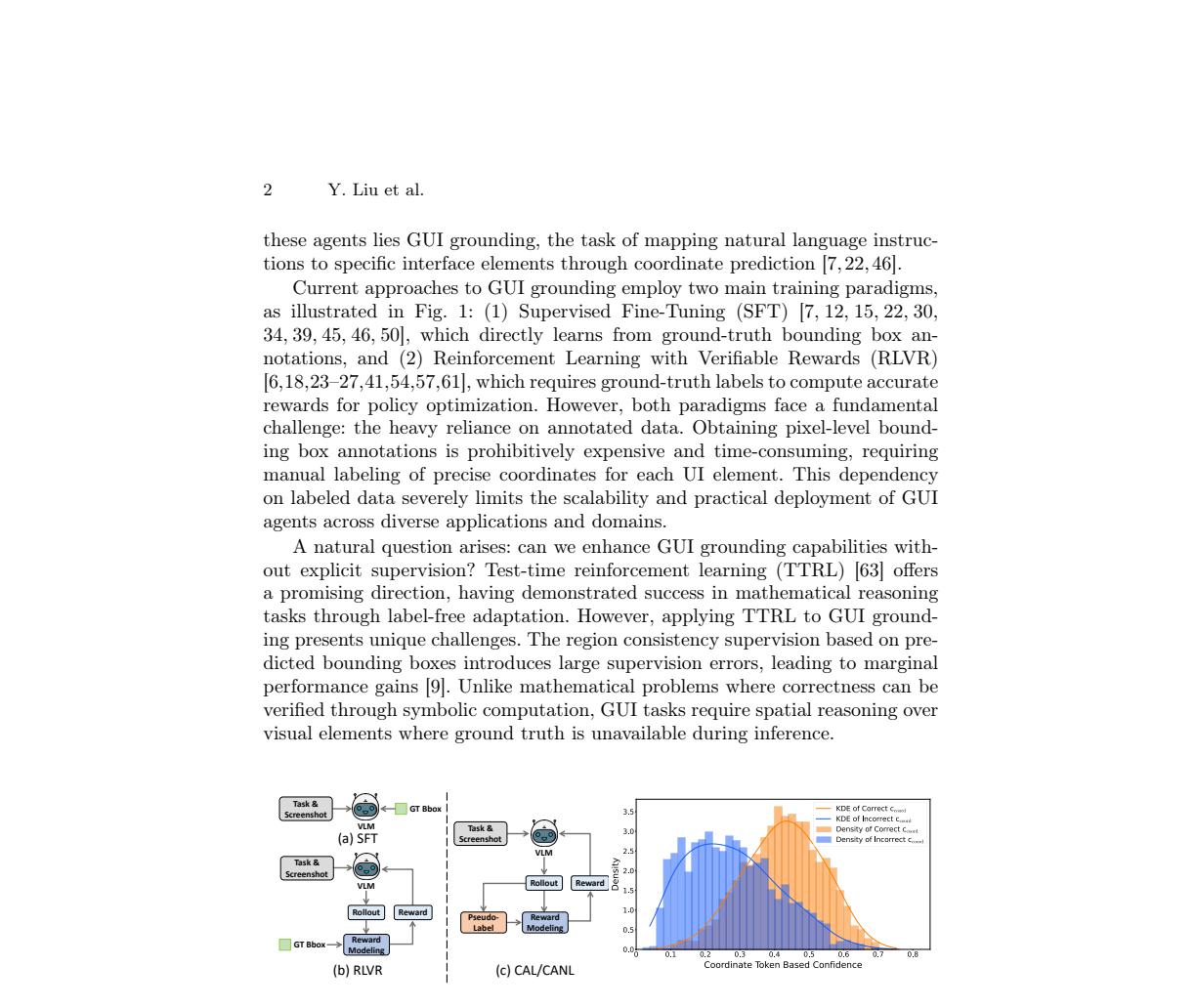
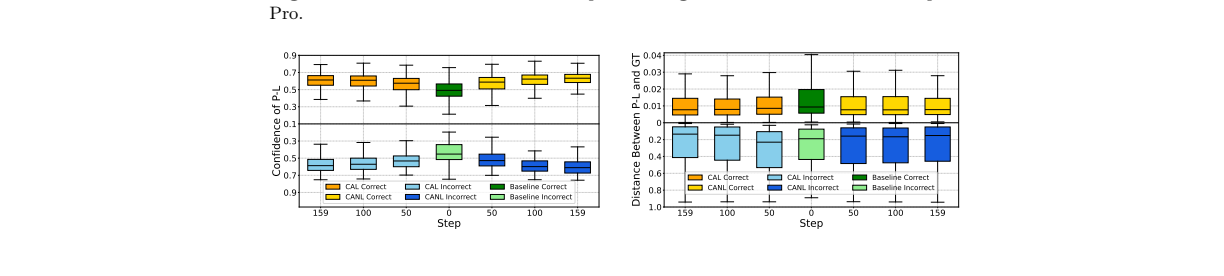
The load-bearing assumption of the paper—that coordinate-token confidence separates correct from incorrect predictions and thereby selects reliable pseudo-labels—is validated directly only on ScreenSpot-V2: the distribution analysis in Fig. 1 (right), the pseudo-label-quality comparison in Fig. 3, and Tables 10-12 all concern ScreenSpot-V2.
more of objection 1
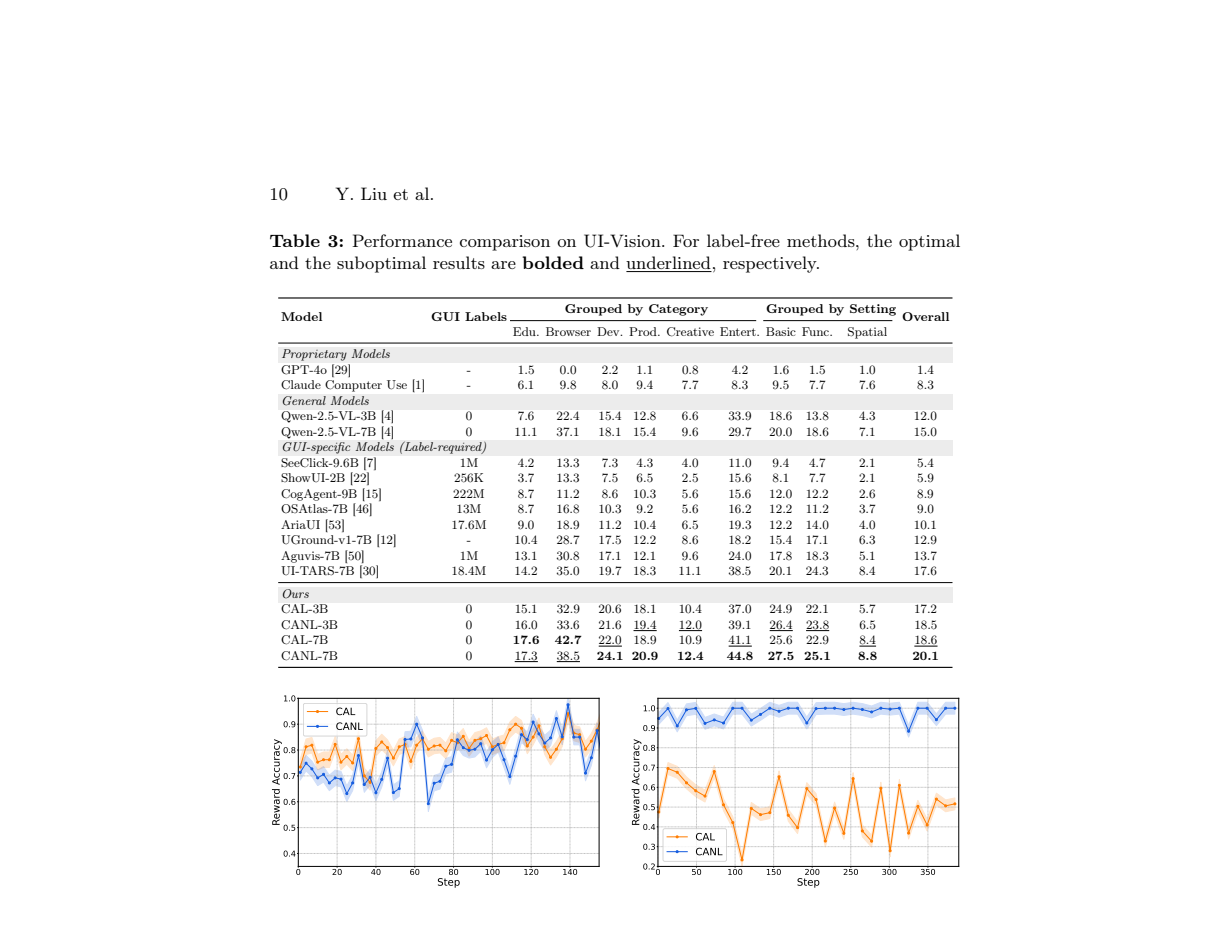
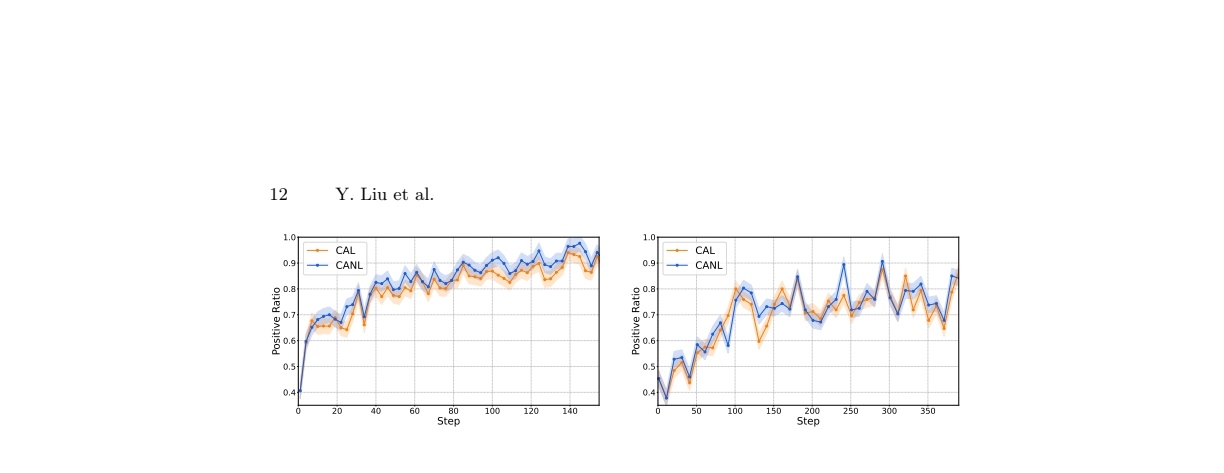
The headline improvements, however, are on ScreenSpot-Pro and UI-Vision, where targets are smaller and backgrounds are cluttered. Fig. 4's reward-accuracy curves on ScreenSpot-Pro partially answer the related question of whether negative rewards are reliable there, and the final accuracies suggest the signal does survive, but the quality of the selected pseudo-label itself on the harder benchmarks is never measured. Please add (a) the confidence distributions of correct versus incorrect predictions and (b) pseudo-label accuracy as a function of sampling budget for ScreenSpot-Pro and UI-Vision; without this evidence the anchoring mechanism on the difficult benchmarks rests on indirect inference.
The paper says, at Sections 4.1 and A.1.
The review did not quote this passage.
Pith says: Objection 2 of 3 · major
The evaluation protocol is underspecified for the 7B models. The 7B prompt asks the model to 'Locate the UI element(s)' and permits a JSON list of multiple points, yet the paper never states how a multi-element output is matched to the single ground-truth box used by these benchmarks, nor whether the rule 'predictions are correct if they fall within ground truth bounding boxes' is applied to any emitted point or to a designated element.
more of objection 2
Because all headline numbers (92.1% on ScreenSpot-V2, 33.8% on ScreenSpot-Pro) use the 7B model, this matching rule must be stated explicitly. Relatedly, the main results adapt the model on the full set of each benchmark (A.1) and evaluate on the same set; this test-time-adaptation protocol is legitimate and is also used by GUI-RCPO, but comparisons with supervised models trained on separate data should be described as such, and the paper should state explicitly that the adapted model has seen the evaluation inputs during adaptation.
The paper says, at Section 4.2, Tables 2-3.
The review did not quote this passage.
Pith says: Objection 3 of 3 · major
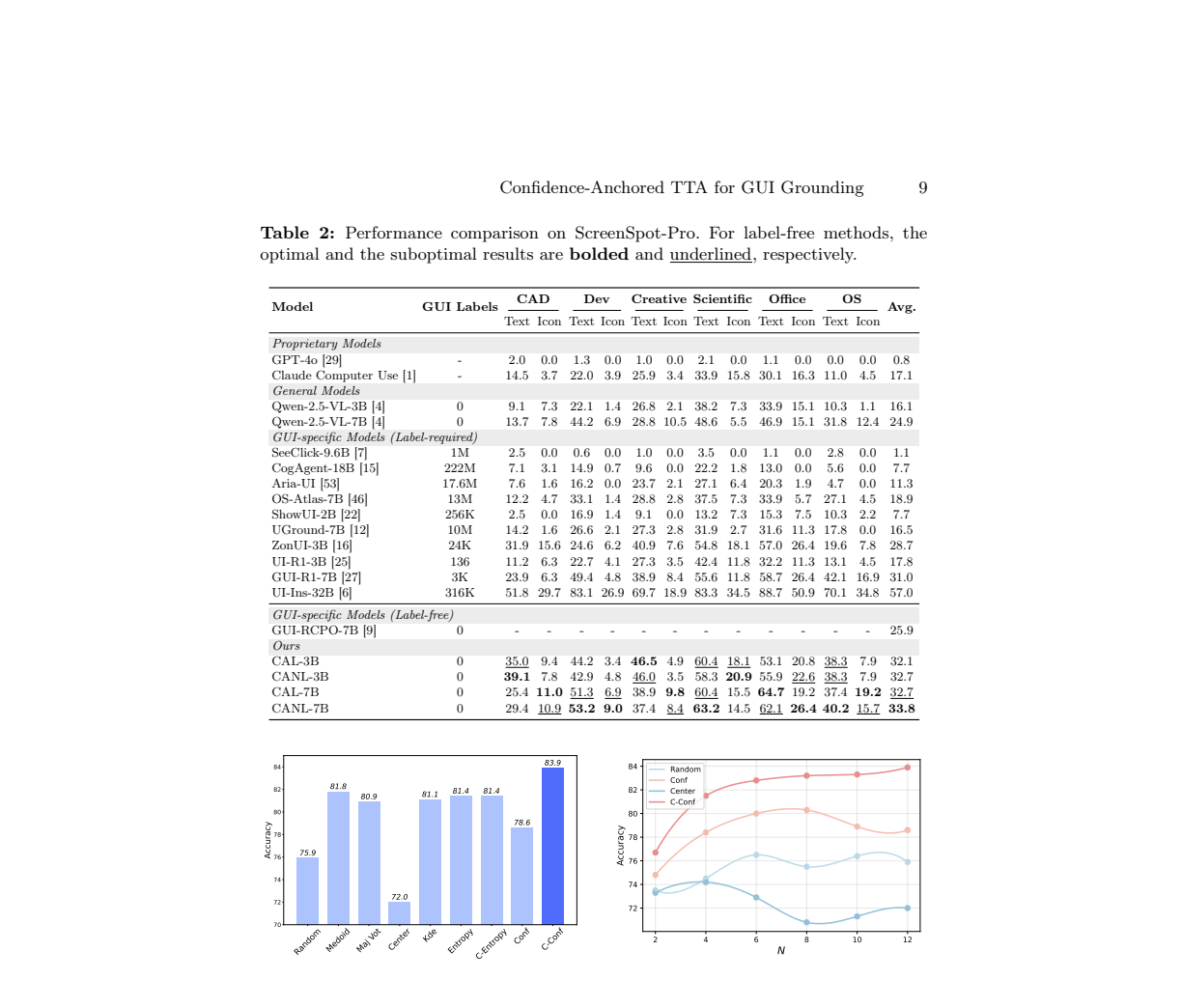
The central comparative claim that negative-only CANL beats mixed CAL on challenging benchmarks rests on small differences: 1.1% on ScreenSpot-Pro and 1.5% on UI-Vision at the 7B scale, and 0.3-1.3% at the 3B scale. No standard deviations, confidence intervals, or run counts are reported anywhere, although the Reproducibility Statement asserts that results are 'averaged over multiple runs'—no table in the paper carries variance information.
more of objection 3
Some per-category cells even move against the claim (ScreenSpot-Pro Creative icon, Table 2: base Qwen-2.5-VL-7B 10.5 → CANL-7B 8.4). Please report multi-seed variance for the headline numbers and for the CAL-versus-CANL gap; without it, the primary claim favoring negative learning is not statistically grounded.
9 minor objections
The paper says, at Section 4.3, Fig. 8.
Pith says: minor objection 1 of 9
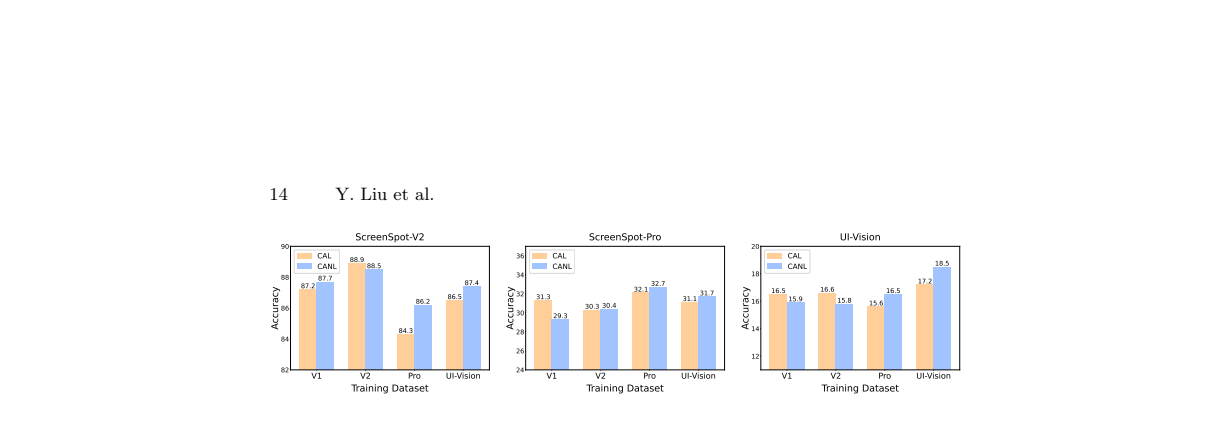
The text states that ScreenSpot-V1 is excluded from cross-dataset training due to documented annotation errors, yet Fig. 8 displays a 'V1' training column; the figure labels and the protocol description should be reconciled.
The paper says, at Table 1 and Fig. 3.
Pith says: minor objection 2 of 9
Several table entries are concatenated in the typeset version (e.g., '96.4 66.4' appearing as '96.466.4' for CANL-3B and '97.1 87.3 86.1' appearing as '097.1 87.386.1' for CAL-7B), and the Fig. 3 horizontal-axis labels run together; the final version must render these legibly since the paper asks readers to verify specific numbers.
show 7 more
The paper says, at Equations (5)-(7).
Pith says: minor objection 3 of 9
The advantage computations divide by std({R_j}), which is zero for a group whose rewards are all equal; the paper should state the degenerate-group handling (e.g., an epsilon), given that Fig. 5 shows positive ratios approaching 0.9.
The paper says, at Table 4.
Pith says: minor objection 4 of 9
The claim that CANL 'maintains remarkable stability' across τ should be qualified for ScreenSpot-Pro, where CANL ranges from 30.2 to 33.7 across the five thresholds.
The paper says, at Table 6 (AndroidWorld).
Pith says: minor objection 5 of 9
The table's structure is ambiguous (the GPT-4o row has no value), and with only 116 tasks a 4.3-5.2 point success-rate difference is roughly 5-6 tasks; a confidence interval or an explicit small-sample caveat is needed.
The paper says, at Reproducibility Statement.
Pith says: minor objection 6 of 9
The statement that results are 'averaged over multiple runs' is not substantiated by any table or appendix; please either report the per-run values or revise the statement.
The paper says, at Appendix A.8.
Pith says: minor objection 7 of 9
τ=0.05 is said to be selected 'based on preliminary experiments,' but no such experiments are shown; please report the preliminary sweep, since τ interacts with the pixel scale of each benchmark.
The paper says, at Abstract and Section 1.
Pith says: minor objection 8 of 9
The general statement that coordinate-token confidence offers 'a powerful alternative to manual annotations' should be qualified per benchmark: on ScreenSpot-Pro, CANL-7B at 33.8% remains well below the label-required UI-Ins-32B at 57.0%, so the claim holds only on a dataset-by-dataset basis.
The paper says, at Section 2.2 and Fig. 2.
Pith says: minor objection 9 of 9
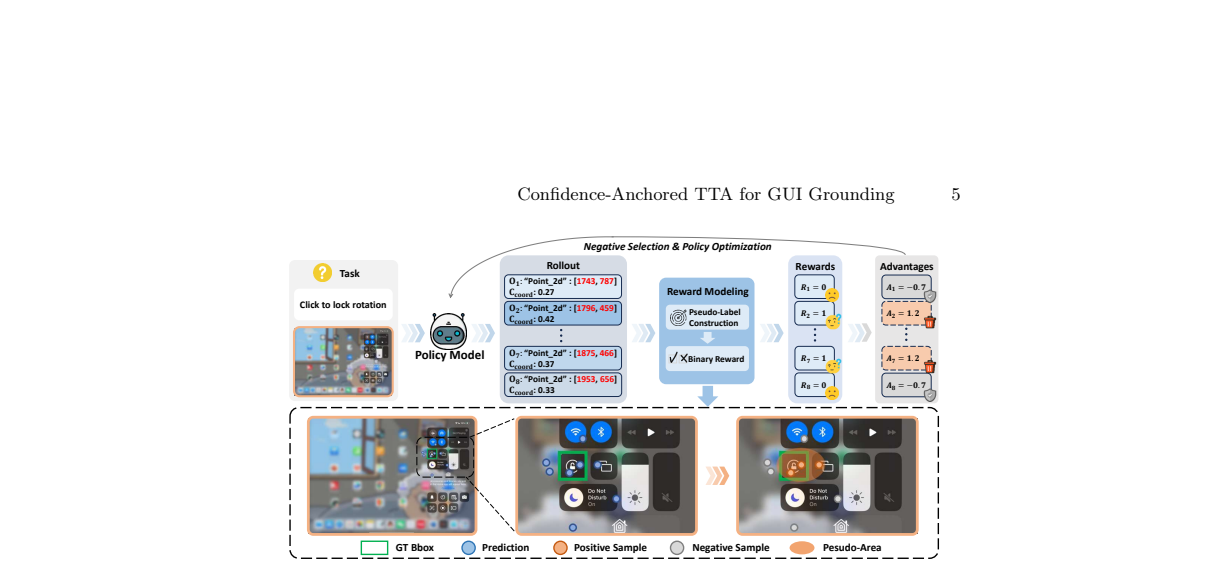
Minor typos: 'Our work explore' should read 'Our work explores,' and Fig. 2's 'Pesudo-Area' should read 'Pseudo-Area.'
What would settle it
Reproduce Fig. 1 (right) for ScreenSpot-Pro: sample 12 rollouts per input from Qwen-2.5-VL-7B, compute coordinate-token confidence for each prediction, and separate by correctness against the ground truth bounding box. Report the overlap coefficient of the two distributions (area of intersection / area of union). If overlap > 0.3, the pseudo-label selection basis is substantially weaker than on ScreenSpot-V2, and the headline results may rely on other factors (e.g., negative learning robustness) rather than the claimed confidence signal.
from the skeptic's reading
How the review went
4 readings by deepseek-v4-flash · 15 Sep 2026
- Reader holds up, with conditions
- Skeptic partly agrees
- Editor wrote the verdict above
- Referee major revision: 3 major objections, 9 minor
Not run on this paper: the simulated authors' defence.
Pith did not check this review's objections against the paper.
The review in full
The review in brief, machine-written
You should know that this paper does something genuinely useful—it shows that coordinate-token confidence can be a reliable pseudo-label signal for GUI grounding, and that learning exclusively from negative samples works better than including noisy positives. The experimental evaluation is thorough and the results are credible.
What's new: The specific combination of coordinate-token confidence for pseudo-label selection and exclusive negative learning (CANL) in this context. The experiments are well-designed: four benchmarks, multiple ablations (pseudo-label methods, threshold sensitivity, reward types), cross-dataset generalization, and an AndroidWorld end-to-end task. On ScreenSpot-V2, CANL-7B matches or exceeds supervised methods that use millions of labels. On ScreenSpot-Pro, the 8.9% absolute improvement over the base model is notable.
However, there are soft spots. The biggest is that the core assumption—coordinate-token confidence separates correct from incorrect predictions—is only empirically shown on ScreenSpot-V2 (Fig 1 right). On harder benchmarks like ScreenSpot-Pro, the authors do not provide the same distribution analysis. The method works on average on those benchmarks, but we do not know if the confidence signal itself is well-separated there. This is the weakest link, and the stress-test concern is valid. Another caveat is the test-time training setting: the method fine-tunes separately on each benchmark, which limits claims of generalization. The cross-dataset experiments help, but they still train on one full benchmark and test on another, not zero-shot to novel environments. Also, the method requires 16 forward passes per input during training, which is computationally heavy—though the authors acknowledge this and use downsampling.
Despite these concerns, the paper is honest about its limitations (see the conclusion paragraph). The central idea is reasonable and the experiments support the claims when viewed in context. The method is not a silver bullet but it is a clear step forward for label-free GUI grounding.
This paper is for the GUI grounding and agent communities. A reader interested in test-time adaptation or label-free training will get value. It deserves a serious referee—the method is novel, the experiments are thorough, and the claims are mostly well-supported. I would accept it for peer review.
The strongest objection
The central claim that coordinate-token confidence provides a reliable pseudo-label signal rests on the empirical separation shown in Fig. 1 (right), which is computed on ScreenSpot-V2—a low-resolution benchmark with large targets. The paper does not provide the same distribution analysis for ScreenSpot-Pro or UI-Vision, where bounding boxes are smaller and backgrounds are cluttered. If the confidence distributions for correct and incorrect predictions overlap significantly on these harder benchmarks, then selecting the highest-confidence prediction as pseudo-label would be unreliable, and the subsequent reinforcement learning (both CAL and CANL) would propagate errors. The method's success on ScreenSpot-Pro (Table 2) does not prove that the confidence signal is well-separated there; it only shows the overall method works on average. Without direct evidence of separation, the core assumption remains unvalidated in the most demanding setting, making it the weakest link in the argument.
The reader correctly identified the reliance on coordinate-token confidence as the weakest assumption. My concern sharpens this: the paper demonstrates the key empirical support (Fig. 1) only on ScreenSpot-V2, the easiest benchmark. For the method to be generally applicable, the confidence separation must hold on harder datasets as well. This is testable and would directly validate or weaken the central claim. Since the reader's verdict is already CONDITIONAL and the paper's results are otherwise convincing, I recommend no change to the verdict. The condition should include an explicit verification step on the hardest benchmark.
The referee's report
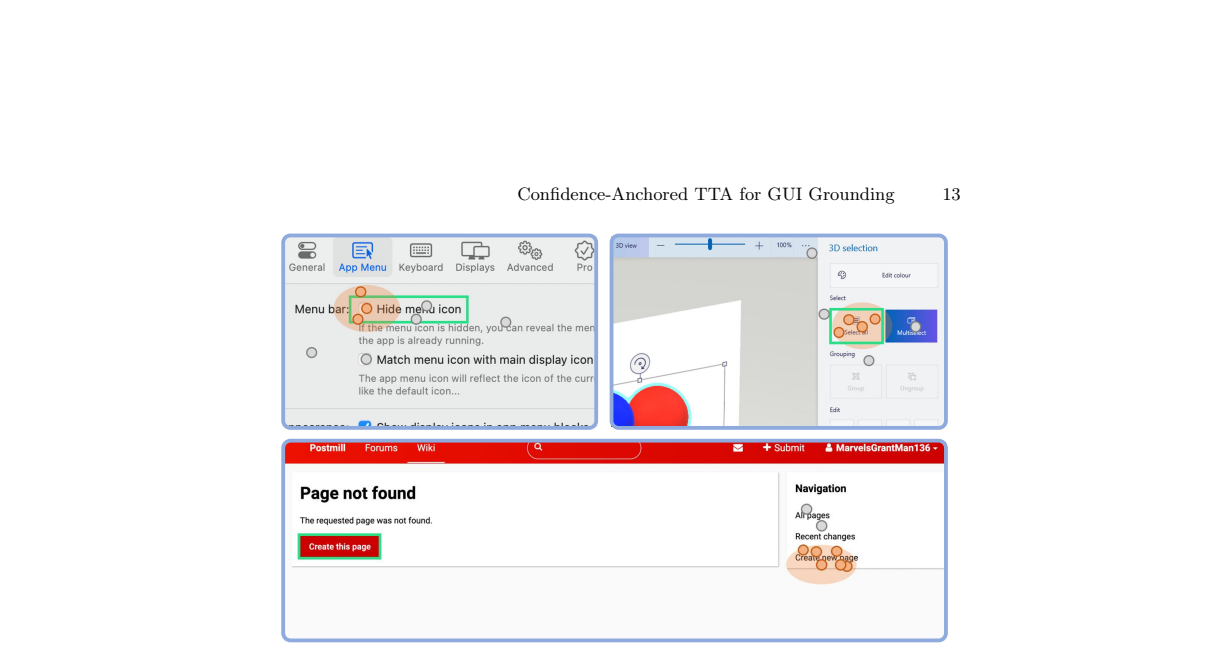
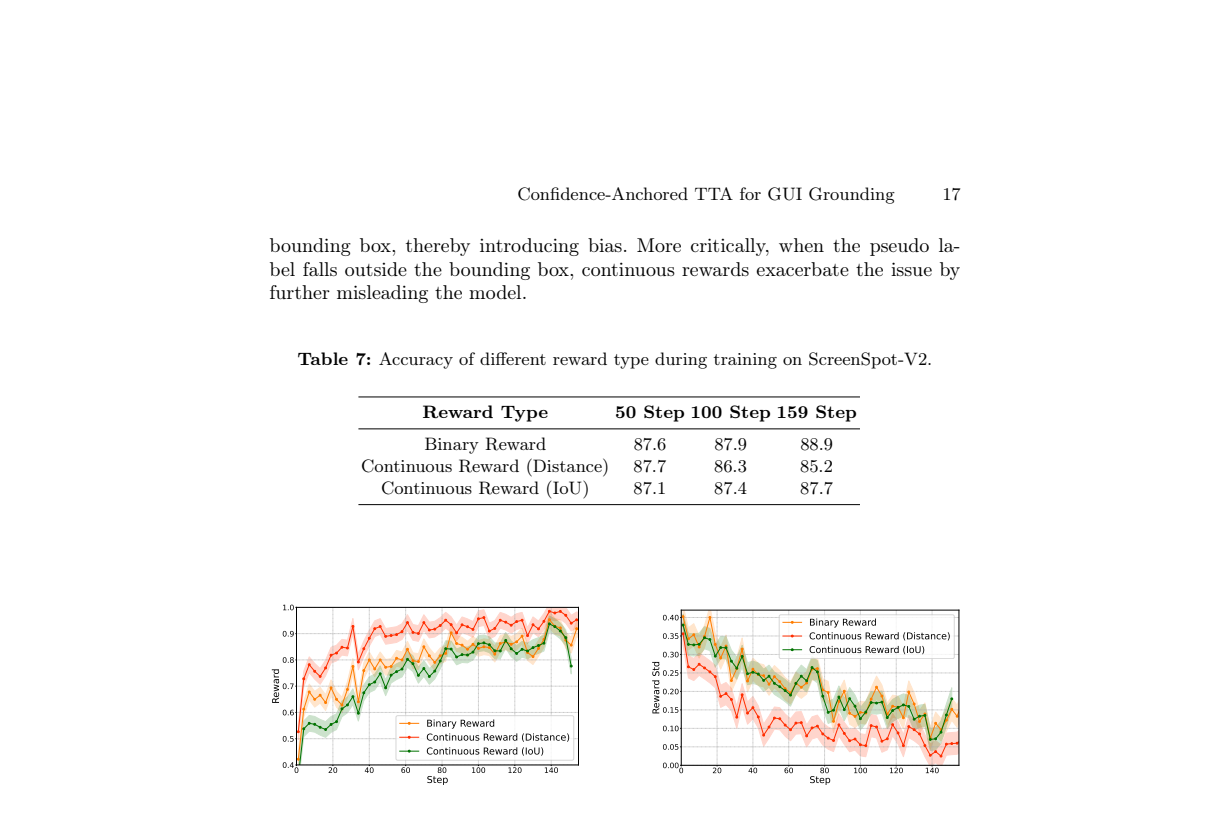
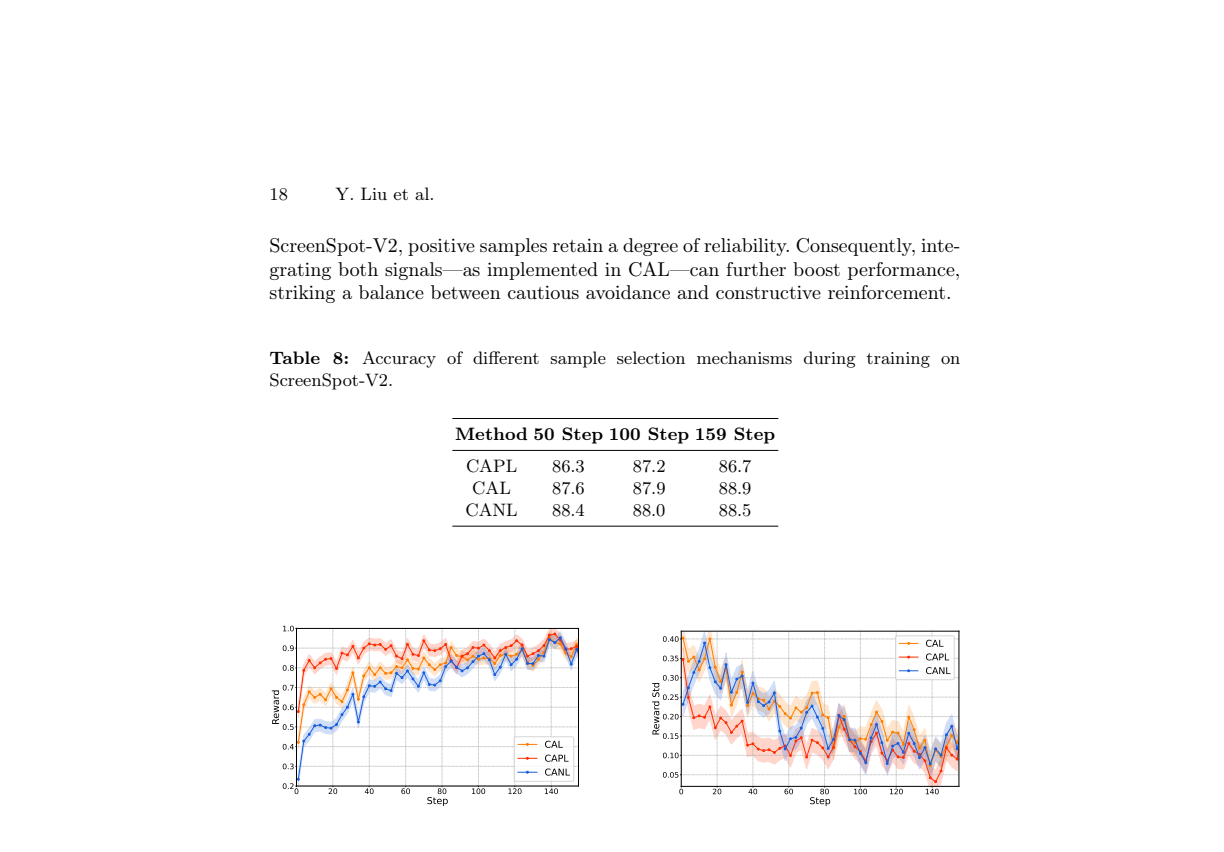
If the claims hold, the paper demonstrates a meaningful step toward scalable GUI agents: substantial grounding gains with no manual labels, including on ScreenSpot-Pro and UI-Vision, where the label-free method surpasses several label-required RL baselines (e.g., GUI-R1-7B and GUI-RCPO-7B). The empirical package is a genuine strength: four benchmarks; systematic comparisons of pseudo-label construction methods (Fig. 3, Tables 10-12); threshold sensitivity (Table 4); reward-type and positive/negative-only ablations (Tables 7-8); direct reward-accuracy measurement against ground truth (Fig. 4); and transfer evidence (Fig. 8, Tables 5-6) that mitigates the otherwise legitimate circularity concern of training and evaluating on the same benchmark. The authors also report failure cases honestly (Fig. 6 and Fig. 7). The main gap is that the core confidence-separation assumption is validated only on the easiest benchmark, with indirect evidence on the harder ones.
Pith's reading of the paper (a machine's summary, not the authors')
This paper introduces a label-free test-time training paradigm for graphical user interface (GUI) grounding, the task of mapping natural language instructions to screen coordinates. The key insight is that the confidence scores of the tokens representing spatial coordinates are more informative than overall sequence confidence for distinguishing correct from incorrect predictions. Based on this, the authors propose Confidence-Anchored Learning (CAL), which uses the highest-confidence prediction among multiple samples as a pseudo-label and assigns binary rewards based on distance. To avoid errors from noisy pseudo-labels, they further develop Confidence-Anchored Negative Learning (CANL), which only uses negative samples (predictions far from the pseudo-label) for policy optimization. Without any manual annotations, CANL achieves 92.1% on ScreenSpot-V2 and 33.8% on ScreenSpot-Pro, matching or exceeding supervised methods that require thousands to millions of labels.
What carries the argument. The central mechanism is coordinate-token confidence, defined as the mean predicted probability over only the coordinate tokens (e.g., x and y pixel values). This is used to select a pseudo-label from multiple sampled outputs. Then, a binary reward is assigned based on normalized Euclidean distance to the pseudo-label with threshold τ. In CANL, the advantage for policy optimization is set to zero for positive rewards (samples within the threshold) and kept only for negative samples, effectively learning what to avoid rather than what to produce.
Core claim. The paper establishes that coordinate-token confidence—the average probability of the output tokens corresponding to pixel coordinates—provides a reliable self-supervision signal for GUI grounding. Multiple predictions are sampled; the one with highest coordinate-token confidence serves as a pseudo-label. Because GUI coordinates are sparse, predictions far from this pseudo-label are almost certainly wrong, making negative samples a trustworthy learning signal. CANL modifies the advantage computation in GRPO to zero out positive rewards and only update the policy on negative samples, yielding consistent improvements over methods that also use potentially incorrect positive pseudo-labels.
The premise it rests on. The method assumes that the model's coordinate-token confidence reliably identifies correct predictions, and that the highest-confidence prediction among a set of samples is an accurate pseudo-label.
If the paper is right (Pith's inferences, not the authors')
GUI grounding can be performed without any manual labels, drastically reducing the cost of building GUI agents.
The coordinate-token confidence metric may generalize to other spatial prediction tasks (e.g., object detection, keypoint estimation) as a self-supervisory signal.
Learning exclusively from negative samples proves robust to pseudo-label noise, suggesting a paradigm for label-free RL in sparse output spaces.
Test-time adaptation allows the model to quickly adjust to new GUI environments without retraining on large datasets.
The method can be integrated with existing GUI navigation systems to improve grounding accuracy in real-world deployments.
The success of focusing on coordinate tokens suggests that many sequence-level confidence measures are dominated by uninformative tokens; this insight could improve confidence calibration in other structured prediction tasks.
By relying on negative samples, the method implicitly assumes that the target distribution is sparse; for dense prediction tasks (e.g., full-image segmentation), the same strategy may fail because negative samples become harder to define.
The distance threshold τ requires tuning; an adaptive threshold based on the spread of predictions could improve robustness across different GUI scales.
Combining CANL with occasional ground-truth labels (few-shot) might yield even stronger performance, bridging the gap to fully supervised methods.
Check this review
Pith stored no record of this review's passes and took no fingerprint of it. Reviews made by code from 13 Nov 2026 on carry both.
How often reviews like this one are right
Reviews like this one: written by deepseek-v4-flash, where what was read was not recorded.
How often objections from reviews like this one are right: not yet measured
Reviews by people
This review was written by a machine. No person has reviewed this paper on Pith yet. A scientist listed on Pith can review it for a fee, and their review is published here whatever it concludes.
The paper
Abstract
Graphical User Interface (GUI) grounding is essential for autonomous agents to map natural language instructions to precise screen coordinates. However, existing supervised fine-tuning and reinforcement learning methods are constrained by the high cost of annotation, creating a scalability bottleneck. In this paper, we introduce a label-free test-time training paradigm driven by two key insights: (1) confidence patterns in coordinate tokens are a better indicator than full-sequence confidence, and (2) in sparse GUI coordinate spaces, negative samples offer more reliable learning signals than potentially noisy positive ones. We first propose Confidence-Anchored Learning (CAL), which utilizes coordinate-token confidence to filter pseudo-labels and assign distance-based binary rewards. Building on this, we develop Confidence-Anchored Negative Learning (CANL), which exclusively optimizes the model using negative samples to bypass the risks of incorrect positive samples. Experimental results demonstrate that CANL-7B achieves 92.1% on ScreenSpot-V2. On more challenging ScreenSpot-Pro, CANL-7B reaches 33.8%, an 8.9% absolute improvement over the base model. Our findings establish coordinate-token confidence as a powerful alternative to manual annotations for scalable GUI agent development.
The paper's own sentences, arranged, kept beside the review and separate from it. Each label is drawn from a closed vocabulary; the number beside it is the probability the classifier gave that label. No sentence in this record was written by a model.
abstract compiled · 2026-09-23
The authors' main claim, as the classifier picked it out 1.00
“Our findings establish coordinate-token confidence as a powerful alternative to manual annotations for scalable GUI agent development.”
How the main claim is stated: asserted 1.00
What the abstract itself states, as probabilities: claims first 0.08 · states limitation 0.16 · human participants 0.03 · controlled comparison 0.86 · randomized assignment 0.02 · states quantitative result 0.99 · compares with prior results 0.88 · mentions code or data availability 0.03
The abstract, sentence by sentence
This table labels the abstract only (arXiv listing abstract v1). The number is the probability the classifier gave the label.
| Sentence | Role | The authors' own work | States the main conclusion | Strength |
|---|---|---|---|---|
| Graphical User Interface (GUI) grounding is essential for autonomous agents to map natural language instructions to precise screen coordinates. | background 1.00 | 0.04 | 0.02 | asserted 1.00 |
| However, existing supervised fine-tuning and reinforcement learning methods are constrained by the high cost of annotation, creating a scalability bottleneck. | gap 0.61 | 0.04 | 0.02 | asserted 1.00 |
| In this paper, we introduce a label-free test-time training paradigm driven by two key insights: (1) confidence patterns in coordinate tokens are a better indicator than full-sequence confidence, and (2) in sparse GUI coordinate spaces, negative samples offer more reliable learning signals than potentially noisy positive ones. | contribution 0.93 | 0.41 | 0.13 | asserted 0.98 |
| We first propose Confidence-Anchored Learning (CAL), which utilizes coordinate-token confidence to filter pseudo-labels and assign distance-based binary rewards. | method 0.86 | 0.93 | 0.05 | asserted 0.99 |
| Building on this, we develop Confidence-Anchored Negative Learning (CANL), which exclusively optimizes the model using negative samples to bypass the risks of incorrect positive samples. | method 0.84 | 0.92 | 0.07 | asserted 1.00 |
| Experimental results demonstrate that CANL-7B achieves 92.1% on ScreenSpot-V2. | result 1.00 | 0.95 | 0.10 | asserted 1.00 |
| On more challenging ScreenSpot-Pro, CANL-7B reaches 33.8%, an 8.9% absolute improvement over the base model. | result 1.00 | 0.96 | 0.07 | asserted 1.00 |
| Our findings establish coordinate-token confidence as a powerful alternative to manual annotations for scalable GUI agent development. | interpretation 1.00 | 0.91 | 0.89 | asserted 1.00 |
What kind of paper the classifier reports this is: method or tool 1.00 · evidence from observation or experiment 0.99
What was examined, and what was not
Sources read
- arXiv listing abstract v1
Not examined
- full text
- figures and tables
- references and citing sentences
- relations to other papers
Levels run
- P abstract
Not run
- S sections
- T body sentences
- C citations
- R cross-paper relations
How the labels were made
Compiled by classifier-1.13.0 via TypeSafe API, question bank abstract-p1-20260923, 2026-09-23: 1 request, 6,276 input tokens.
Every quoted sentence on this record is the authors'. Every label is from Pith's closed vocabulary, with the probability shown beside it. This record as JSON
Figures (10)
Figures are the authors', reproduced from the paper.
References (63)
- [1] Anthropic: Claude computer use. Available at: https://www.anthropic.com/news/developing-computer-use (2024), accessed 27 June 2026 on Pith
- [2] Bai, J., Bai, S., Yang, S., Wang, S., Tan, S., Wang, P., Lin, J., Zhou, C., Zhou, J.: Qwen-vl: A versatile vision-language model for understanding, localization, text reading, and beyond. arXiv preprint arXiv:2308.12966 (2023) on PithPith's reviewarXiv
- [3] Bai, S., Cai, Y., Chen, R., Chen, K., Chen, X., Cheng, Z., Deng, L., Ding, W., Gao, C., Ge, C., et al.: Qwen3-vl technical report. arXiv preprint arXiv:2511.21631 (2025) on PithPith's reviewarXiv
- [4] Bai, S., Chen, K., Liu, X., Wang, J., Ge, W., Song, S., Dang, K., Wang, P., Wang, S., Tang, J., et al.: Qwen2. 5-vl technical report. arXiv preprint arXiv:2502.13923 (2025) on PithPith's reviewarXiv
- [5] Chen, H., Zheng, K., Zhang, Q., Cui, G., Cui, Y., Ye, H., Lin, T.Y., Liu, M.Y., Zhu,J.,Wang,H.:Bridgingsupervisedlearningandreinforcementlearninginmath reasoning. arXiv preprint arXiv:2505.18116 (2025) on PitharXiv
- [6] Chen, L., Zhou, H., Cai, C., Zhang, J., Tong, P., Kong, Q., Zhang, X., Liu, C., Liu, Y., Wang, W., et al.: Ui-ins: Enhancing gui grounding with multi-perspective instruction-as-reasoning. arXiv preprint arXiv:2510.20286 (2025) on PitharXiv
- [7] Cheng, K., Sun, Q., Chu, Y., Xu, F., Li, Y., Zhang, J., Wu, Z.: Seeclick: Harnessing gui grounding for advanced visual gui agents. arXiv preprint arXiv:2401.10935 (2024) on PithPith's reviewarXiv
- [8] Dao, T.: Flashattention-2: Faster attention with better parallelism and work par- titioning. arXiv preprint arXiv:2307.08691 (2023) on PithPith's reviewarXiv
- [9] Du, Y., Yan, Y., Tang, F., Lu, Z., Zong, C., Lu, W., Jiang, S., Shen, Y.: Test-time reinforcement learning for gui grounding via region consistency (2025) on Pith
- [10] Feizi, A., Nayak, S., Jian, X., Lin, K.Q., Li, K., Awal, R., Lù, X.H., Obando-Ceron, J.,Rodriguez,J.A.,Chapados,N.,etal.:Groundingcomputeruseagentsonhuman demonstrations. arXiv preprint arXiv:2511.07332 (2025) on PithPith's reviewarXiv
- [11] Gao, L., Zhang, L., Gao, P., Liu, W., Luan, J., Xu, M.: Gui-shift: Enhancing vlm- based gui agents through self-supervised reinforcement learning. arXiv preprint arXiv:2505.12493 (2025) on PitharXiv
- [12] Gou, B., Wang, R., Zheng, B., Xie, Y., Chang, C., Shu, Y., Sun, H., Su, Y.: Navigating the digital world as humans do: Universal visual grounding for gui agents. arXiv preprint arXiv:2410.05243 (2024) Confidence-Anchored TTA for GUI Grounding 23 on PithPith's reviewarXiv
- [13] Gu, Z., Zeng, Z., Xu, Z., Zhou, X., Shen, S., Liu, Y., Zhou, B., Meng, C., Xia, T., Chen, W., et al.: Ui-venus technical report: Building high-performance ui agents with rft. arXiv preprint arXiv:2508.10833 (2025) on PithPith's reviewarXiv
- [14] Guo, D., Yang, D., Zhang, H., Song, J., Zhang, R., Xu, R., Zhu, Q., Ma, S., Wang, P., Bi, X., et al.: Deepseek-r1: Incentivizing reasoning capability in llms via reinforcement learning. arXiv preprint arXiv:2501.12948 (2025) on PithPith's reviewarXiv
- [15] Hong, W., Wang, W., Lv, Q., Xu, J., Yu, W., Ji, J., Wang, Y., Wang, Z., Dong, Y., Ding, M., et al.: Cogagent: A visual language model for gui agents. In: Proceedings of the IEEE/CVF Conference on Computer Vision and Pattern Recognition. pp. 14281–14290 (2024) on Pith
- [16] Hsieh, Z., Wei, T.J., Yang, S.: Zonui-3b: A lightweight vision-language model for cross-resolution gui grounding. arXiv e-prints pp. arXiv–2506 (2025) on Pith
- [17] Hu, X., Xiong, T., Yi, B., Wei, Z., Xiao, R., Chen, Y., Ye, J., Tao, M., Zhou, X., Zhao, Z., et al.: Os agents: A survey on mllm-based agents for computer, phone and browser use. In: Proceedings of the 63rd Annual Meeting of the Association for Computational Linguistics (Volum... on Pith
- [18] Kang, W., Lei, B., Liu, G., Ding, C., Yan, Y.: Guirlvg: Incentivize gui visual grounding via empirical exploration on reinforcement learning. arXiv preprint arXiv:2508.04389 (2025) on PithPith's reviewarXiv
- [19] Kim, Y., Yim, J., Yun, J., Kim, J.: Nlnl: Negative learning for noisy labels. In: Proceedings of the IEEE/CVF international conference on computer vision. pp. 101–110 (2019) on Pith
- [20] Lee, H., Kim, J., Kim, B., Tack, J., Jo, C., Lee, J., Park, C., In, S., Shin, J., Yoo, K.M.: Reguide: Data efficient gui grounding via spatial reasoning and search. arXiv preprint arXiv:2505.15259 (2025) on PithPith's reviewarXiv
show 43 more
- [21] Li, K., Meng, Z., Lin, H., Luo, Z., Tian, Y., Ma, J., Huang, Z., Chua, T.S.: Screenspot-pro: Gui grounding for professional high-resolution computer use. arXiv preprint arXiv:2504.07981 (2025) on PithPith's reviewarXiv
- [22] Lin, K.Q., Li, L., Gao, D., Yang, Z., Wu, S., Bai, Z., Lei, S.W., Wang, L., Shou, M.Z.: Showui: One vision-language-action model for gui visual agent. In: Proceed- ings of the Computer Vision and Pattern Recognition Conference. pp. 19498–19508 (2025) on Pith
- [23] Liu, Y., Li, P., Xie, C., Hu, X., Han, X., Zhang, S., Yang, H., Wu, F.: Infigui-r1: Advancing multimodal gui agents from reactive actors to deliberative reasoners. arXiv preprint arXiv:2504.14239 (2025) on PithPith's reviewarXiv
- [24] Liu, Y., Liu, Z., Zhu, S., Li, P., Xie, C., Wang, J., Hu, X., Han, X., Yuan, J., Wang, X., et al.: Infigui-g1: Advancing gui grounding with adaptive exploration policy optimization. arXiv preprint arXiv:2508.05731 (2025) on PitharXiv
- [25] Lu, Z., Chai, Y., Guo, Y., Yin, X., Liu, L., Wang, H., Xiao, H., Ren, S., Xiong, G., Li, H.: Ui-r1: Enhancing efficient action prediction of gui agents by reinforcement learning. arXiv preprint arXiv:2503.21620 (2025) on PithPith's reviewarXiv
- [26] Lu, Z., Ye, J., Tang, F., Shen, Y., Xu, H., Zheng, Z., Lu, W., Yan, M., Huang, F., Xiao, J., et al.: Ui-s1: Advancing gui automation via semi-online reinforcement learning. arXiv preprint arXiv:2509.11543 (2025) on PitharXiv
- [27] Luo, R., Wang, L., He, W., Xia, X.: Gui-r1: A generalist r1-style vision-language action model for gui agents. arXiv preprint arXiv:2504.10458 (2025) on PithPith's reviewarXiv
- [28] Nayak, S., Jian, X., Lin, K.Q., Rodriguez, J.A., Kalsi, M., Awal, R., Chapados, N., Özsu, M.T., Agrawal, A., Vazquez, D., et al.: Ui-vision: A desktop-centric gui benchmark for visual perception and interaction. arXiv preprint arXiv:2503.15661 (2025) 24 Y. Liu et al on PithPith's reviewarXiv
- [29] OpenAI: Introducing gpt-4o. Available at: https://openai.com/index/hello-gpt-4o (2024), accessed 27 June 2026 on Pith
- [30] Qin, Y., Ye, Y., Fang, J., Wang, H., Liang, S., Tian, S., Zhang, J., Li, J., Li, Y., Huang, S., et al.: Ui-tars: Pioneering automated gui interaction with native agents. arXiv preprint arXiv:2501.12326 (2025) on PithPith's reviewarXiv
- [31] Rawles, C., Clinckemaillie, S., Chang, Y., Waltz, J., Lau, G., Fair, M., Li, A., Bishop, W., Li, W., Campbell-Ajala, F., et al.: Androidworld: A dynamic bench- marking environment for autonomous agents. arXiv preprint arXiv:2405.14573 (2024) on PithPith's reviewarXiv
- [32] Shao, Z., Wang, P., Zhu, Q., Xu, R., Song, J., Bi, X., Zhang, H., Zhang, M., Li, Y., Wu, Y., et al.: Deepseekmath: Pushing the limits of mathematical reasoning in open language models. arXiv preprint arXiv:2402.03300 (2024) on PithPith's reviewarXiv
- [33] Shen, H., Liu, P., Li, J., Fang, C., Ma, Y., Liao, J., Shen, Q., Zhang, Z., Zhao, K., Zhang, Q., et al.: Vlm-r1: A stable and generalizable r1-style large vision-language model. arXiv preprint arXiv:2504.07615 (2025) on PithPith's reviewarXiv
- [34] Sun, Q., Cheng, K., Ding, Z., Jin, C., Wang, Y., Xu, F., Wu, Z., Jia, C., Chen, L., Liu, Z., Kao, B., Li, G., He, J., Qiao, Y., Wu, Z.: Os-genesis: Automating gui agent trajectory construction via reverse task synthesis. In: Proceedings of the 63rd Annual Meeting of the Associ... on Pith
- [35] Tang, F., Chen, B., Lu, Z., Chen, T., Nong, S., Jiang, T., Xu, W., Lu, W., Xiao, J., Zhuang, Y., et al.: Ui-zoomer: Uncertainty-driven adaptive zoom-in for gui grounding. arXiv preprint arXiv:2604.14113 (2026) on PithPith's reviewarXiv
- [36] Tang, F., Gu, Z., Lu, Z., Liu, X., Shen, S., Meng, C., Wang, W., Zhang, W., Shen, Y., Lu, W., et al.: Gui-g2: Gaussian reward modeling for gui grounding. arXiv preprint arXiv:2507.15846 (2025) on PithPith's reviewarXiv
- [37] Tang, F., Gu, Z., Lu, Z., Zhang, S., Zeng, Z., Shen, S., Meng, C., Yan, Y., Zhang, W., Shen, Y., et al.: Gui-sage: Enhancing gui automation with self-explanatory learning. In: Proceedings of the IEEE/CVF Conference on Computer Vision and Pattern Recognition. pp. 13007–13016 (2026) on Pith
- [38] Tang, F., Lu, Z., Zhang, B., Lu, W., Xiao, J., Zhuang, Y., Shen, Y.: Clawgui: A unified framework for training, evaluating, and deploying gui agents. arXiv preprint arXiv:2604.11784 (2026) on PithPith's reviewarXiv
- [39] Tang, F., Shen, Y., Zhang, H., Chen, S., Hou, G., Zhang, W., Zhang, W., Song, K., Lu, W., Zhuang, Y.: Think twice, click once: Enhancing gui grounding via fast and slow systems. arXiv preprint arXiv:2503.06470 (2025) on PithPith's reviewarXiv
- [40] Tang, F., Xu, H., Zhang, H., Chen, S., Wu, X., Shen, Y., Zhang, W., Hou, G., Tan, Z., Yan, Y., et al.: A survey on (m) llm-based gui agents. arXiv preprint arXiv:2504.13865 (2025) on PithPith's reviewarXiv
- [41] Tang, J., Xia, Y., Wu, Y.F., Hu, Y., Chen, Y., Chen, Q.G., Xu, X., Wu, X., Lu, H., Ma, Y., et al.: Lpo: Towards accurate gui agent interaction via location preference optimization. arXiv preprint arXiv:2506.09373 (2025) on PithPith's reviewarXiv
- [42] Wang, J., Xu, H., Ye, J., Yan, M., Shen, W., Zhang, J., Huang, F., Sang, J.: Mobile- agent: Autonomous multi-modal mobile device agent with visual perception. arXiv preprint arXiv:2401.16158 (2024) on PithPith's reviewarXiv
- [43] Wang, R., Li, H., Han, X., Zhang, Y., Baldwin, T.: Learning from failure: Inte- grating negative examples when fine-tuning large language models as agents. arXiv preprint arXiv:2402.11651 (2024) on PithPith's reviewarXiv
- [44] Wei, X.S., Xu, H.Y., Zhang, F., Peng, Y., Zhou, W.: An embarrassingly simple approach to semi-supervised few-shot learning. Advances in Neural Information Processing Systems35, 14489–14500 (2022) Confidence-Anchored TTA for GUI Grounding 25 on Pith
- [45] Wu, Q., Cheng, K., Yang, R., Zhang, C., Yang, J., Jiang, H., Mu, J., Peng, B., Qiao, B., Tan, R., et al.: Gui-actor: Coordinate-free visual grounding for gui agents. arXiv preprint arXiv:2506.03143 (2025) on PithPith's reviewarXiv
- [46] Wu, Z., Wu, Z., Xu, F., Wang, Y., Sun, Q., Jia, C., Cheng, K., Ding, Z., Chen, L., Liang, P.P., et al.: Os-atlas: A foundation action model for generalist gui agents. arXiv preprint arXiv:2410.23218 (2024) on PithPith's reviewarXiv
- [47] Xie, T., Deng, J., Li, X., Yang, J., Wu, H., Chen, J., Hu, W., Wang, X., Xu, Y., Wang, Z., et al.: Scaling computer-use grounding via user interface decomposition and synthesis. arXiv preprint arXiv:2505.13227 (2025) on PitharXiv
- [48] Xu, H., Zhang, X., Liu, H., Wang, J., Zhu, Z., Zhou, S., Hu, X., Gao, F., Cao, J., Wang, Z., et al.: Mobile-agent-v3. 5: Multi-platform fundamental gui agents. arXiv preprint arXiv:2602.16855 (2026) on PitharXiv
- [49] Xu, Y., Liu, X., Liu, X., Fu, J., Zhang, H., Jing, B., Zhang, S., Wang, Y., Zhao, W., Dong, Y.: Mobilerl: Online agentic reinforcement learning for mobile gui agents. arXiv preprint arXiv:2509.18119 (2025) on PitharXiv
- [50] Xu, Y., Wang, Z., Wang, J., Lu, D., Xie, T., Saha, A., Sahoo, D., Yu, T., Xiong, C.: Aguvis: Unified pure vision agents for autonomous gui interaction. arXiv preprint arXiv:2412.04454 (2024) on PithPith's reviewarXiv
- [51] Yan, H., Wang, J., Huang, X., Shen, Y., Meng, Z., Fan, Z., Tan, K., Gao, J., Shi, L., Yang, M., et al.: Step-gui technical report. arXiv preprint arXiv:2512.15431 (2025) on PitharXiv
- [52] Yang, Y., Li, D., Dai, Y., Yang, Y., Luo, Z., Zhao, Z., Hu, Z., Huang, J., Saha, A., Chen, Z., et al.: Gta1: Gui test-time scaling agent. arXiv preprint arXiv:2507.05791 (2025) on PithPith's reviewarXiv
- [53] Yang, Y., Wang, Y., Li, D., Luo, Z., Chen, B., Huang, C., Li, J.: Aria-ui: Visual grounding for gui instructions. arXiv preprint arXiv:2412.16256 (2024) on PithPith's reviewarXiv
- [54] Yuan, X., Zhang, J., Li, K., Cai, Z., Yao, L., Chen, J., Wang, E., Hou, Q., Chen, J., Jiang, P.T., et al.: Enhancing visual grounding for gui agents via self-evolutionary reinforcement learning. arXiv preprint arXiv:2505.12370 (2025) on PithPith's reviewarXiv
- [55] Zhang, M., Xu, Z., Zhu, J., Dai, Q., Qiu, K., Yang, Y., Luo, C., Chen, T., Wagle, J., Franklin, T., et al.: Phi-ground tech report: Advancing perception in gui grounding. arXiv preprint arXiv:2507.23779 (2025) on PithPith's reviewarXiv
- [56] Zhang, Y., Ni, B., Chen, X.S., Zhang, H.R., Rao, Y., Peng, H., Lu, Q., Hu, H., Guo, M.H., Hu, S.M.: Bee: A high-quality corpus and full-stack suite to unlock advanced fully open mllms. arXiv preprint arXiv:2510.13795 (2025) on PitharXiv
- [57] Zhao, Z., Liu, Y., Liu, Y., Wang, H., Tian, L., Zhou, X., You, Y., Yu, Z., Yu, Y., Zhou, J.: Points-gui-g: Gui-grounding journey. arXiv preprint arXiv:2602.06391 (2026) on PitharXiv
- [58] Zhou, H., Zhang, X., Tong, P., Zhang, J., Chen, L., Kong, Q., Cai, C., Liu, C., Wang, Y., Zhou, J., Hoi, S.: Mai-ui technical report: Real-world centric foundation gui agents (2025) on Pith
- [59] Zhou, S., Xu, F.F., Zhu, H., Zhou, X., Lo, R., Sridhar, A., Cheng, X., Bisk, Y., Fried, D., Alon, U., et al.: Webarena: A realistic web environment for building autonomous agents. arXiv preprint arXiv:2307.13854 (2023) on PithPith's reviewarXiv
- [60] Zhou, Y., Liu, L., Gou, C.: Learning from observer gaze:zero-shot attention pre- diction oriented by human-object interaction recognition. In: CVPR (2024) on Pith
- [61] Zhou, Y., Dai, S., Wang, S., Zhou, K., Jia, Q., Xu, J.: Gui-g1: Understand- ing r1-zero-like training for visual grounding in gui agents. arXiv preprint arXiv:2505.15810 (2025) 26 Y. Liu et al on PithPith's reviewarXiv
- [62] Zhu,X.,Xia,M.,Wei,Z.,Chen,W.L.,Chen,D.,Meng,Y.:Thesurprisingeffective- ness of negative reinforcement in llm reasoning. arXiv preprint arXiv:2506.01347 (2025) on PitharXiv
- [63] Zuo, Y., Zhang, K., Sheng, L., Qu, S., Cui, G., Zhu, X., Li, H., Zhang, Y., Long, X., Hua, E., et al.: Ttrl: Test-time reinforcement learning. arXiv preprint arXiv:2504.16084 (2025) on PithPith's reviewarXiv
Cited by 1 Pith paper
Reviewed papers on Pith that cite this one. The full citation record
Challenges and discussion
Disagree with the review, or know something it missed? Leave a comment, or challenge this review formally: a challenge becomes a permanent entry in this paper's record, and its decision is published here.
Come back by email
A short list of the week's newly reviewed papers. Nothing is sent until you confirm from your inbox, and every email has a link that stops it. No account.
No comments yet.
Sign in to comment