Artificial Intelligence · arXiv:2610.22280 v1 · submitted 15 Oct 2026 · 71 references
LEASH: Uncertainty-Aware Weak-to-Strong Escalation and Oversight for Computer-Use Agents
The paper says
“Computer-use agents increasingly tackle long-horizon tasks, where running a frontier model at every step is expensive and a small open-weight model alone often fails.”
more of the abstract
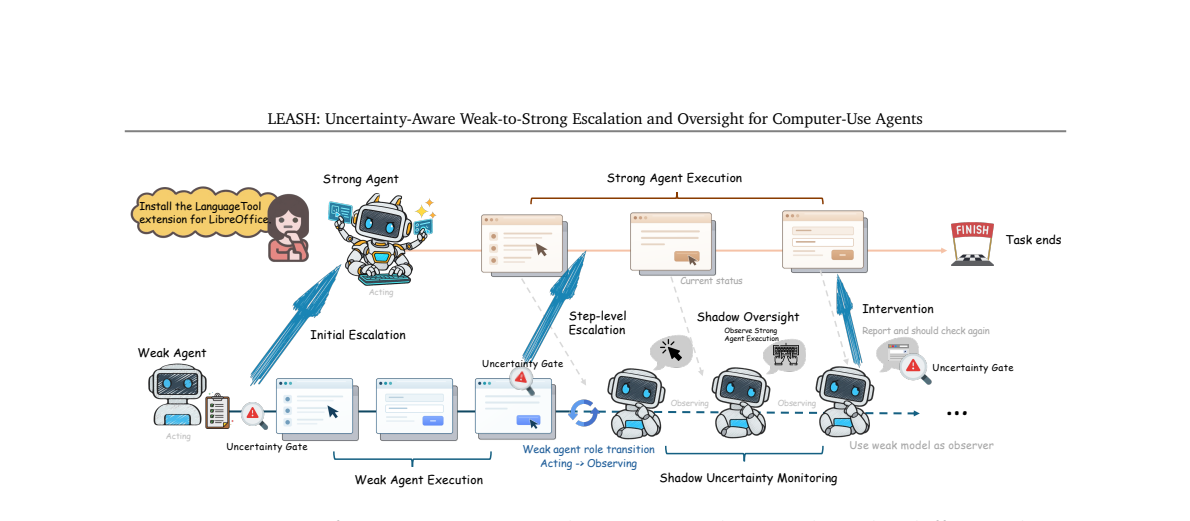
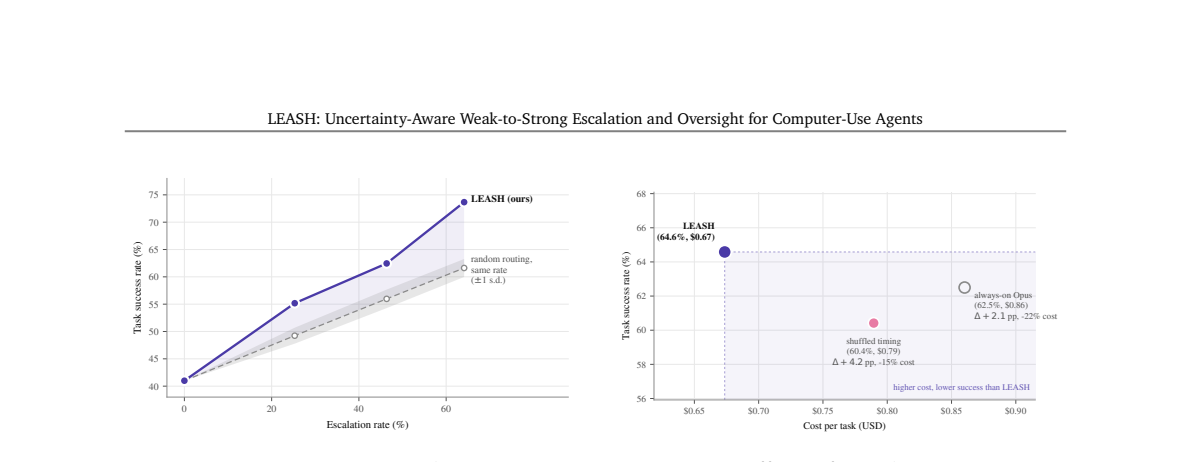
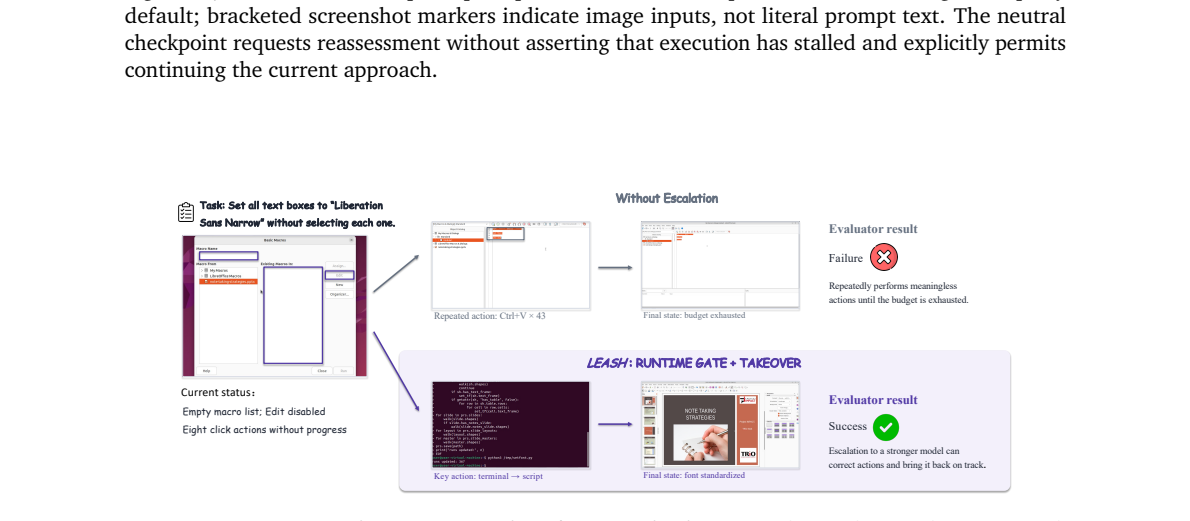
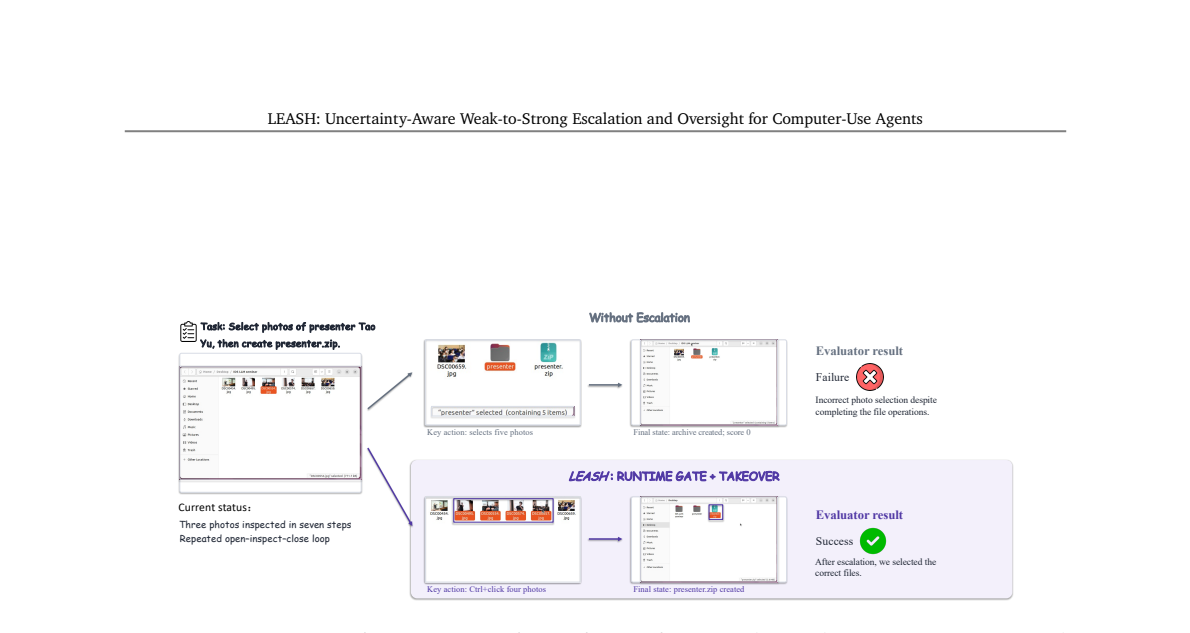
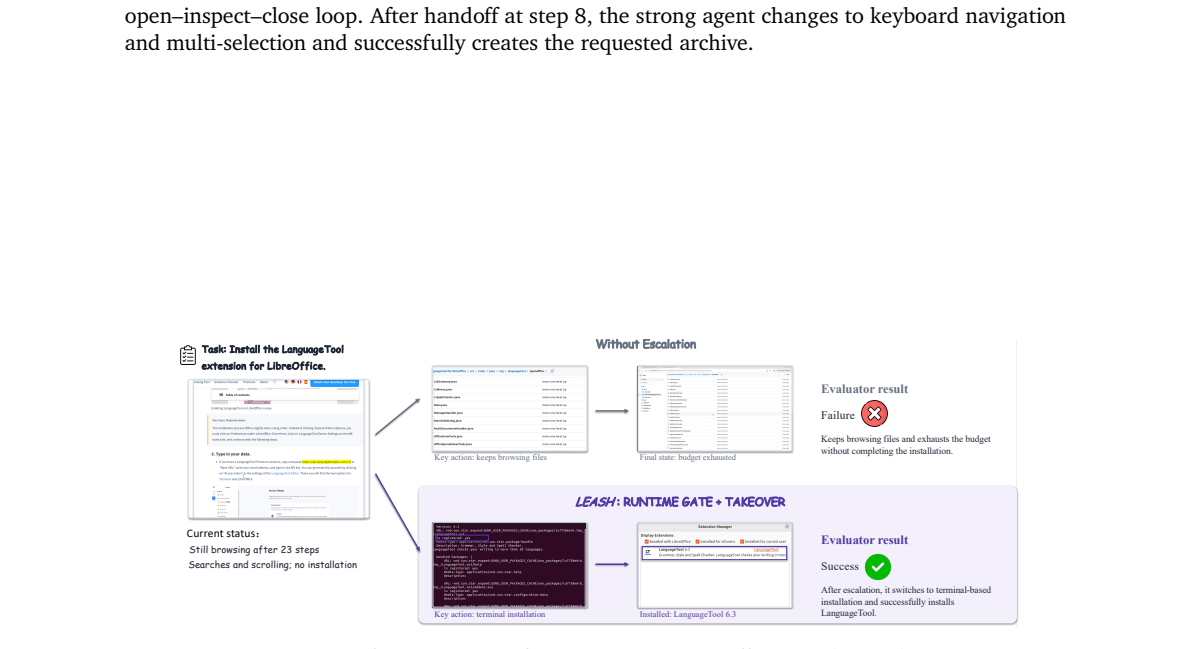
Weak-to-strong escalation offers a middle ground where a weak agent acts by default and hands control to a strong one only when needed. The core challenge is deciding when to escalate, which requires an uncertainty signal cheap enough to check at every step. However, even after handoff, the strong agent can still get lost, but a black-box API that the strong agent is usually served exposes no internals to monitor. To this end, we propose LEASH, a training-free framework that unleashes the strong agent only when the weak agent's latent uncertainty signals it is needed, and keeps it on a leash afterward. LEASH has three layers: (1) initial task uncertainty for early routing, (2) step-level uncertainty for runtime escalation, and, after handoff, (3) a shadow observer for continued oversight of the strong black-box agent. Here, we use latent uncertainty as a fuel for all three layers. Specifically, we compare the weak model's hidden states with those from its past successful and failed trajectories, and a state that looks more like the failures signals higher uncertainty. During weak-agent execution, our uncertainty estimator reuses activations already produced during action generation, so it needs no extra forward pass or dedicated monitor training. Experiments on OSWorld across four contemporary model backbones show that LEASH consistently improves over standalone weak agents and outperforms random escalation by 6.55–11.94 points at matched escalation rates. With Qwen3.5-35B-A3B, LEASH achieves 73.66% task success at $0.4117 per task, matching always-on Claude Opus 5 (72.90%) while reducing inference cost by 19.2%.
from the abstract
Pith says
Machine review · deepseek-v4-flash · 16 Oct 2026 · what was read was not recorded · not checked by a person
It can be wrong. Challenge this review or reply to it.
Holds up, with conditions. A well-evaluated, honest systems paper: the latent-uncertainty escalation result holds up, but the shadow-oversight half of the central claim lacks the random-trigger control the escalation half has. This line is wrong
3 major objections · 6 minor
How often objections from reviews like this one are right: not yet measured
Not checked: figures, code, what the 71 references say.
The paper says, at §3.4, §4.4, Tables 4–5; cf. Limitations
The review did not quote this passage.
A classifier read this sentence of the paper as acknowledging the concern (probability 0.90):
“Finally, post-handoff Shadow monitoring operates under a distribution shift from weak-agent trajectories, and its intervention effect is not causally isolated in our current evaluation. 12 LEASH: Uncertainty-Aware Weak-to-Strong Escalation and Oversight for Computer-Use Agents References R.”
Pith says: Objection 1 of 3 · major
The stress-test concern lands: the second half of the central claim, that the same latent uncertainty signal drives post-handoff oversight, is not causally isolated, and this is load-bearing because the headline result depends on it. The escalation half has the right control (random escalation matched at realized rates, Table 1), but the shadow gate g_sh = 1{u_sh > tau_sh} in …
more of objection 1
… Section 3.4 has no random-trigger counterpart: a checkpoint firing at random probe steps at the same rate would give the strong agent the identical opportunity to reassess, since the checkpoint message is explicitly neutral and permits continuing the current approach (Figure 7). The marginal gain in Table 4 (67.94 -> 73.66) and the triggered-subset gain in Table 5 (64.5 vs 48.4 on 31 tasks, against 51.6% for Opus-only) are therefore consistent with generic checkpoint reflection on hard trajectories; note that the 16.1-point triggered-subset gap is within sampling noise for n = 31. The authors acknowledge in the Limitations that 'its intervention effect is not causally isolated,' but the Abstract and Section 4.4's phrase 'revealing an isolated effectiveness' assert more than the design supports. I recommend adding a random-trigger Shadow control matched to the realized trigger rate and probe schedule; if the authors prefer not to run it, the oversight claims in the Abstract and contributions should be materially softened.
The paper says, at §4.2, Table 1; App. B.1
The review did not quote this passage.
Pith says: Objection 2 of 3 · major
The headline quantitative claims are point estimates with no uncertainty quantification. With a 262-task evaluation pool, the standard error of a single success proportion is roughly 3 percentage points, so the smallest reported margin over random escalation (6.55 points for Qwen3.8-27B) is about two standard errors, and the 0.76-point difference against always-on Opus for Qwen3.5-35B-A3B is well within noise.
more of objection 2
The four rows of Table 1 also share the same task pool and are not independent replications. Because the abstract's specific numbers (73.66% at $0.4117, 19.2% lower cost, 6.55--11.94 points) are the paper's central empirical claims, I ask for task-level bootstrap confidence intervals on the success rates and, for the matched-rate random comparisons, a statement of where LEASH's success falls relative to the 10,000-allocation random distribution.
The paper says, at §4.1–4.2, Table 4; App. B.1
The review did not quote this passage.
Pith says: Objection 3 of 3 · major
The 'matching always-on Opus 5' headline compares LEASH, which includes a per-task Opus-5 Manager performing subgoal decomposition and verification (Section 3.1; the +Manager configuration costs $0.1372 per task in Table 4), against always-on Opus run without any Manager (Appendix B.1).
more of objection 3
The headline success and cost figures therefore bundle the escalation/oversight mechanism with a multi-agent harness, and the Manager's contribution at the operating point is not quantified: Manager alone adds 3.75 points on the weak-only configuration, but its interaction with the escalated phase is untested. I recommend adding an always-on Opus + Manager reference run so that the 19.2% cost saving and the 73.66% success can be attributed to the LEASH mechanism rather than to the presence of the Manager.
6 minor objections
The paper says, at Table 3 / §4.3
Pith says: minor objection 1 of 6
Table 3 reports AUROC only for Nemotron-3 and Qwen3.8-27B; the backbones behind the headline results (EvoCUA-8B and especially Qwen3.5-35B-A3B) are missing, so the reader cannot check the quality of the uncertainty signal in the configurations that carry the abstract's claims.
The paper says, at §4.4
Pith says: minor objection 2 of 6
The phrase 'revealing an isolated effectiveness of the post-handoff intervention' is in tension with the Limitations' statement that the intervention effect is not causally isolated; 'marginal effectiveness' would match the experimental design.
show 4 more
The paper says, at App. A.4
Pith says: minor objection 3 of 6
The in-sample versus out-of-fold closeness check for the shadow threshold tau_sh is reported only for EvoCUA-8B; since the paper's own calibration standard is out-of-fold, please report the same check for the other three backbones.
The paper says, at §4.5, Figure 5
Pith says: minor objection 4 of 6
The shuffled-timing baseline is not defined in the text; please specify whether escalation points are permuted within tasks or across tasks and how the matched escalation rate is enforced, since this control supports one of the paper's two timing claims.
The paper says, at §1 contributions vs §5
Pith says: minor objection 5 of 6
The contribution bullet 'provide theoretical justification for using this score for escalation' would benefit from the caveat, already given at the end of Section 5, that Proposition 1 analyzes only the initial gate; a reader of the bullet alone will overestimate the scope of the theory.
The paper says, at §2, §3.1
Pith says: minor objection 6 of 6
There are several typos and spacing errors, e.g., 'becoming a problemwhen-to-escalate' in Section 3.1 and 'we handle both problem in a single unified fueled by' in Section 2; these should be corrected in the revision.
What would settle it
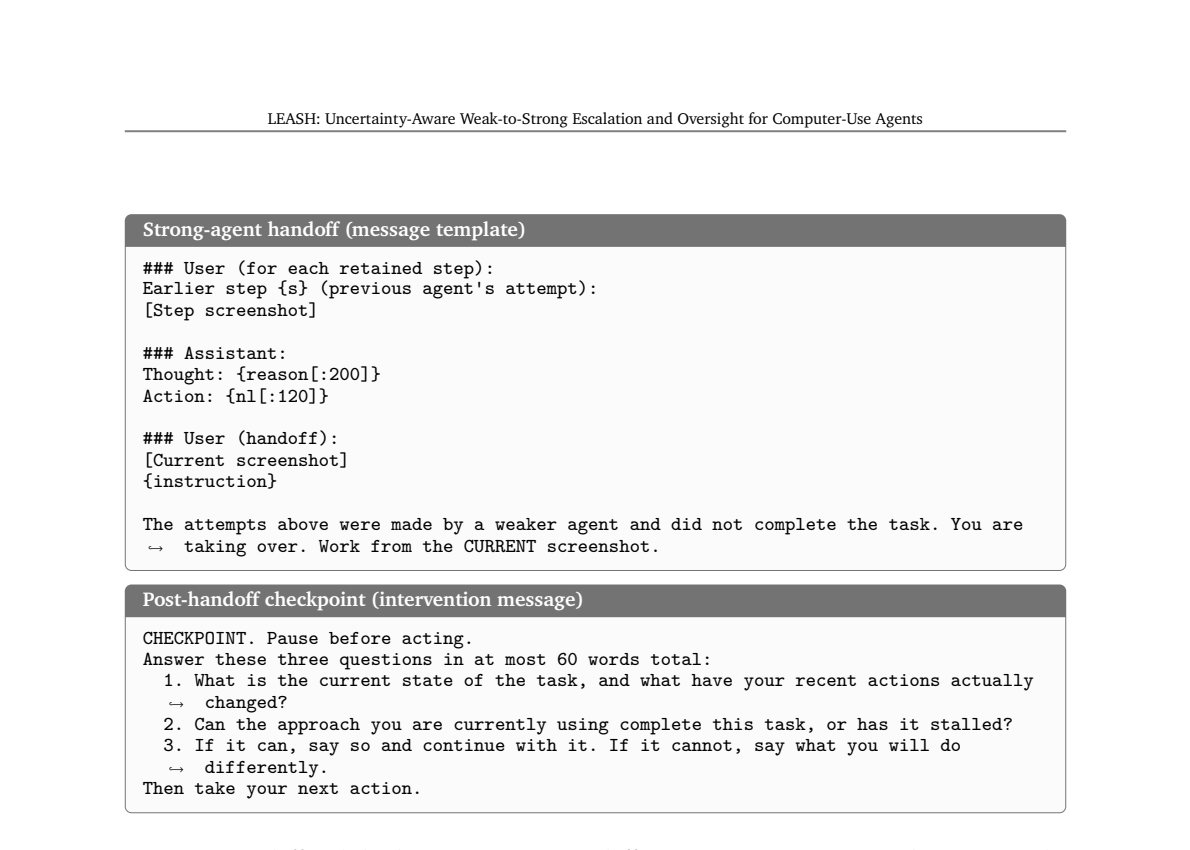
On the same 262-task OSWorld evaluation pool, replace the shadow gate with a Bernoulli trigger at each probe step (every k=3 strong-agent steps), calibrated to realize the same total number of Shadow firings and subject to the same at-most-six-interventions and two-changed-actions suppression rules, reusing the exact checkpoint message from Figure 7. Compare escalated-task success and cost against the LEASH numbers in Tables 4 and 5. If the random-trigger policy matches or exceeds LEASH's 73.66% success and 64.5% on the triggered subset, the uncertainty signal is not responsible for the oversight gain; if LEASH remains clearly higher, the uncertainty-driven timing is supported.
from the skeptic's reading
How the review went
4 readings by deepseek-v4-flash · 16 Oct 2026
- Reader holds up, with conditions
- Skeptic disagrees
- Editor wrote the verdict above
- Referee major revision: 3 major objections, 6 minor
Not run on this paper: the simulated authors' defence.
Pith did not check this review's objections against the paper.
The review in full
The review in brief, machine-written
Quick read on arXiv:2610.22280.
The headline: LEASH is a training-free weak-to-strong escalation framework for computer-use agents. A weak open-weight agent acts by default; a Mahalanobis distance between its current hidden state and a reference bank of its own past successes and failures decides when to hand off to Claude Opus. After handoff, the weak agent shadows the strong black-box agent and can trigger a neutral reflection checkpoint when the same score runs high. The specific combination — one latent signal doing initial routing, runtime escalation, and post-handoff oversight — is new as far as the cited literature goes, and the paper treats it fairly.
What's done well: the evaluation hygiene is above average. Thresholds are calibrated out-of-fold on a disjoint reference set; the random escalation baseline is matched at realized escalation rates and averaged over 10,000 allocations; ablations and sensitivity checks are present. Proposition 1 is a genuine Neyman-Pearson statement under stated Gaussian assumptions, and the authors are explicit that it covers only the initial gate and requires the escalation gain to be nondecreasing in the score — a condition they note can fail when both agents struggle. The load-bearing result, 6.55–11.94 points over random escalation at matched rates across four backbones, holds up.
The soft spots, in proportion. The stress-test note is right: the escalation half has a proper random-trigger control, but the shadow-oversight half does not. A checkpoint firing at random probe steps at the same rate would give the strong agent the same opportunity to reassess a hard trajectory, and Table 5 does not rule that out — nor does it take many points to move, since the triggered subset is 31 tasks. The authors acknowledge the intervention is not causally isolated; that means the full "one signal drives both escalation and oversight" claim is supported only on the escalation side. Second, headline success rates are point estimates with no error bars — 73.66 vs 72.90 is a match within unknown noise, though the matched-rate random comparison is less fragile. Third, the Table 2 comparison with StepWise and Progress Advantage does not clarify whether those baselines include the Manager component, which the ablation credits with about 4 points on its own; that comparison may bundle Manager gains into LEASH. Fourth, minor but curious: the paper's own Table 8 shows initial-plus-runtime gating (67.94) below runtime-only gating (71.65), which undercuts the three-layer framing a bit. No code or data is released, so reproducibility is descriptive.
For whom: anyone working on efficient computer-use agents or LLM routing gets value here. It deserves a serious referee; the shadow control, error bars, and baseline comparability are all fixable in revision. The acknowledged transfer assumption — weak-model uncertainty tracking strong-model benefit — is the main reason to be cautious beyond OSWorld and these backbones.
The strongest objection
The central claim is that one latent uncertainty score drives both escalation and post-handoff oversight. For the escalation half, Section 4.2 provides the right control: random escalation matched at the realized escalation rate (Table 1), which shows the uncertainty signal, not mere strong-model access, produces the gain. No analogous control exists for the oversight half. Section 3.4 defines the shadow gate g_sh = 1{u_sh > tau_sh} and triggers a neutral reflection checkpoint (Figure 7) that explicitly permits the strong agent to continue its current approach. Table 4 shows Shadow adds 67.94 to 73.66 on Qwen3.5-35B-A3B, and Table 5 shows triggered tasks are hard for Opus (51.6% Opus-only) and improve under Shadow (64.5 vs 48.4 without Shadow). These comparisons do not isolate uncertainty-selected timing from a generic checkpoint effect: a checkpoint firing at random probe steps at the same rate gives the strong agent the same opportunity to reassess on hard trajectories. The Limitations sentence acknowledges that the intervention effect is not causally isolated. If a random-trigger checkpoint matches LEASH's oversight gain, then the uncertainty signal is not what drives the second half of the central claim; only the escalation half remains supported.
The reader's weakest assumption is the transfer condition that weak-model uncertainty is monotonically informative about the strong agent's benefit. That condition is explicitly acknowledged in the paper's Limitations and is bounded by the OSWorld evaluation; I do not see a concrete failure of it in the reported data. The more load-bearing gap concerns the second half of the central contribution. The paper establishes escalation via a matched random-escalation baseline, but it never supplies the analogous matched random-trigger baseline for shadow oversight. Table 4 shows that the Shadow component improves success, and Table 5 shows the shadow signal selects hard tasks, but neither result distinguishes uncertainty-selected intervention timing from the generic effect of inserting a neutral reassessment checkpoint. Since the paper's headline claim is that a single uncertainty signal drives both escalation and oversight, this missing control leaves the oversight half of the claim underdetermined. The fix is feasible and inexpensive relative to the existing evaluation. The reader's conditional verdict remains appropriate; I would make the random-trigger control an explicit condition of acceptance rather than a discretionary robustness check.
The referee's report
The potential significance is real if the results hold: a training-free uncertainty signal that reuses existing activations, applied to both escalation and post-handoff oversight, would be a practical and commodity-accessible mechanism for cost-adaptive agentic inference. The paper's experimental hygiene is above average: thresholds are calibrated from task-grouped out-of-fold scores on a reference set disjoint from the 262-task evaluation pool, random escalation is matched at realized rather than targeted rates, a shuffled-timing control is provided for the escalation gate, and the ridge-parameter selection uses a task-grouped split with an explicitly reported leakage check. Proposition 1 is a genuine Neyman--Pearson exchange argument under stated distributional assumptions, not a restatement of the input, and the proofs in Appendix A.1 are complete and correct as far as I checked. My main reservations are causal attribution and statistical precision: the post-handoff oversight gain is not isolated from a generic checkpoint effect, and the headline margins lack uncertainty quantification. Both are experimental gaps that a revision can address within the paper's current scope.
Pith's reading of the paper (a machine's summary, not the authors')
LEASH tackles a cost problem for computer-use agents: small open-weight models fail too often on long-horizon tasks, while running a frontier model on every step is expensive. The paper's central claim is that a single training-free signal — how close the weak model's current hidden state lies to its own past failures rather than its past successes — can decide both when to hand control to a strong agent and when to intervene after handoff. At escalation, the weak agent switches from actor to shadow observer, scoring the strong agent's trajectory with the same uncertainty measure and triggering rollback-and-redecide checkpoints when it rises. On OSWorld with four open-weight backbones, LEASH improves over each standalone weak agent and beats random escalation by 6.55–11.94 points at matched escalation rates; with Qwen3.5-35B-A3B it reaches 73.66% task success at \$0.4117 per task, matching always-on Claude Opus 5 (72.90%) at 19.2% lower estimated inference cost. The framework's reach is bounded by a stated transfer condition: the weak model's uncertainty must rank difficulty for the strong model as well, which the authors note can fail when both agents struggle on the same task.
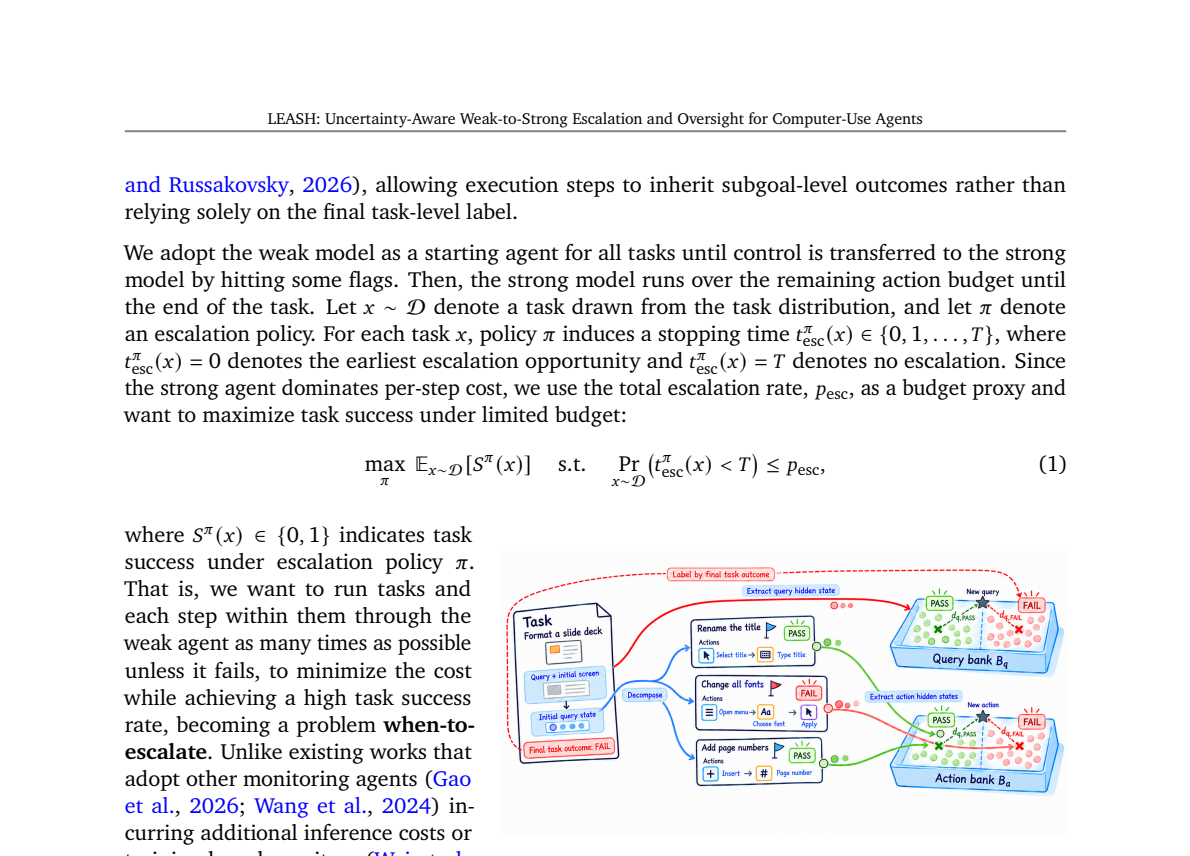
What carries the argument. The central object is the reference-based latent uncertainty score: for a hidden state $h$ and channel $c$ (query or action), $u_c(h) = d^2_{c,\mathrm{Pass}}(h) - d^2_{c,\mathrm{Fail}}(h)$, the difference between squared Mahalanobis distances from $h$ to the weak agent's past-success and past-failure centroids, computed under a regularized pooled within-class covariance in the final-layer representation space. Because the quadratic part of the two distances cancels, $u_c$ reduces to a linear projection onto the failure-separating direction — twice the failure log-odds under the Gaussian model — so thresholding it is a likelihood-ratio test. At runtime during weak-agent execution, the score reuses hidden states the agent already produces while generating actions, so per-step escalation checks add no extra forward pass; initial-routing and shadow probes do run lightweight weak-model inference, and the Gaussian fit needs only per-outcome means and a singular value decomposition, with no gradient training. The paper wires this one scalar into three thresholds: $\tau_q$ on the task-query state, $\tau_a$ on each action state, and $\tau_{sh}$ on the shadow observer's probe of the strong agent's trajectory, with thresholds set as quantiles of reference scores to meet a target escalation budget.
Core claim. LEASH's discovery is that escalation and oversight can be powered by one latent uncertainty score with no training of a monitor. The weak model's final-layer hidden states are collected on a small held-out set — at the task-query prompt and at each generated action token — and labelled by task-level and subgoal-level outcomes to form reference banks. A shared-covariance Gaussian discriminant model (pooled LDA) is fit on each bank, and the score is the difference of squared Mahalanobis distances to the pass and fail centroids, $u_c(h) = d^2_{c,\mathrm{Pass}}(h) - d^2_{c,\mathrm{Fail}}(h)$; a positive score means the state sits closer to past failures. The quadratic terms cancel, so the score is a linear projection along the failure-separating direction, and under the Gaussian model it equals twice the weak agent's failure log-odds. The same score drives three gates: an initial gate on the task query for early routing, a runtime gate on each action for step-level handoff, and — after the strong agent takes over — a shadow gate that scores the weak model's own probe of the strong trajectory and rolls back the pending action for a higher-effort re-decision when triggered. A formal result shows that for a single initial routing decision under Gaussian class-conditional representations, thresholding the score maximizes the fraction of weak-agent failures caught at any fixed escalation rate, and if the escalation gain is nondecreasing in the score it also maximizes task success; the paper notes the analysis covers only the initial gate, leaving the runtime gate to an optimal-stopping formulation as future work.
The premise it rests on. The load-bearing premise is a transfer condition the authors state explicitly: the weak model's uncertainty score — how much closer the current state sits to its past failures than its past successes — must also rank difficulty for the strong model, so that high-score tasks are precisely the ones where escalation pays, and the same ranking must survive the distribution shift after handoff; the paper acknowledges this may fail when both agents struggle on the same task.
If the paper is right (Pith's inferences, not the authors')
Escalation becomes budget-addressable: because each gate's threshold is a quantile of reference scores, a deployment can dial the desired escalation rate (the paper targets 25% initial and 50% overall) before running tasks and reroute more or fewer tasks by moving two numbers.
Black-box strong agents can be kept on a leash after handoff: shadow probes catch trajectories that remain hard even for the frontier model — on the shadow-triggered subset, the full framework reaches 64.5% success versus 48.4% for escalation without shadow, where always-on Opus alone manages 51.6%.
Selective escalation can beat both poles of the accuracy–cost trade-off: at matched escalation rates LEASH outperforms random escalation by 6.55–11.94 points, recovers 75–102% of the weak-to-strong performance gap at 69–81% of always-on cost, and all four configurations beat always-on Claude Sonnet 4.5, three of them at lower estimated cost.
Escalation timing carries independent signal: on escalation-prone tasks, transferring control at the uncertainty-triggered moment beats shuffled timing by 4.2 points at 15% lower cost, so when handoff happens matters beyond how many tasks are handed off.
The approach ports across backbones: consistent gains appear for EvoCUA-8B, Qwen3.5-35B-A3B, Nemotron-3-Nano-Omni, and Qwen3.8-27B, which differ substantially in standalone success, suggesting the mechanism does not depend on one model's quirks.
Because the reference banks are built from the weak model's own past trajectories and the fit is a closed-form SVD, LEASH is naturally recursive: every completed run can enlarge the bank. The paper's own sensitivity table shows initial-gate AUROC rising from 0.701 to 0.770 (Qwen3.5-35B-A3B) as the bank grows from 40 to 99 tasks, hinting that a deployed system could escalate less over time without
The shadow-intervention gain is not causally isolated, as the authors state: an intervention bundles the uncertainty trigger with a generic pause-and-reassess prompt. A frequency-matched control — firing the same checkpoint every k steps regardless of score — would settle how much of the triggered-subset gain comes from the score itself rather than from the interruption.
The recipe should transfer beyond computer-use agents to any white-box/black-box pairing — coding agents, robotic policies, retrieval pipelines — wherever hidden states are accessible and past outcomes can be labelled. The transfer condition (strong-agent difficulty increasing in weak-model uncertainty) is exactly what must be re-verified in each new domain, and it is the place where the mechanism
Check this review
Pith stored no record of this review's passes and took no fingerprint of it. Reviews made by code from 13 Nov 2026 on carry both.
How often reviews like this one are right
Reviews like this one: written by deepseek-v4-flash, where what was read was not recorded.
How often objections from reviews like this one are right: not yet measured
Reviews by people
This review was written by a machine. No person has reviewed this paper on Pith yet. A scientist listed on Pith can review it for a fee, and their review is published here whatever it concludes.
The paper
Abstract
Computer-use agents increasingly tackle long-horizon tasks, where running a frontier model at every step is expensive and a small open-weight model alone often fails. Weak-to-strong escalation offers a middle ground where a weak agent acts by default and hands control to a strong one only when needed. The core challenge is deciding when to escalate, which requires an uncertainty signal cheap enough to check at every step. However, even after handoff, the strong agent can still get lost, but a black-box API that the strong agent is usually served exposes no internals to monitor. To this end, we propose LEASH, a training-free framework that unleashes the strong agent only when the weak agent's latent uncertainty signals it is needed, and keeps it on a leash afterward. LEASH has three layers: (1) initial task uncertainty for early routing, (2) step-level uncertainty for runtime escalation, and, after handoff, (3) a shadow observer for continued oversight of the strong black-box agent. Here, we use latent uncertainty as a fuel for all three layers. Specifically, we compare the weak model's hidden states with those from its past successful and failed trajectories, and a state that looks more like the failures signals higher uncertainty. During weak-agent execution, our uncertainty estimator reuses activations already produced during action generation, so it needs no extra forward pass or dedicated monitor training. Experiments on OSWorld across four contemporary model backbones show that LEASH consistently improves over standalone weak agents and outperforms random escalation by 6.55–11.94 points at matched escalation rates. With Qwen3.5-35B-A3B, LEASH achieves 73.66% task success at $0.4117 per task, matching always-on Claude Opus 5 (72.90%) while reducing inference cost by 19.2%.
The paper's own sentences, arranged, kept beside the review and separate from it. Each label is drawn from a closed vocabulary; the number beside it is the probability the classifier gave that label. No sentence in this record was written by a model.
abstract compiled · 2026-10-16
The authors' main claim, as the classifier picked it out 0.85
“Experiments on OSWorld across four contemporary model backbones show that LEASH consistently improves over standalone weak agents and outperforms random escalation by 6.55--11.94 points at matched escalation rates.”
How the main claim is stated: asserted 1.00
What the abstract itself states, as probabilities: claims first 0.05 · states limitation 0.27 · human participants 0.03 · controlled comparison 0.96 · randomized assignment 0.05 · states quantitative result 0.99 · compares with prior results 0.97 · mentions code or data availability 0.04
The abstract, sentence by sentence
This table labels the abstract only (arXiv listing abstract v1). The number is the probability the classifier gave the label.
| Sentence | Role | The authors' own work | States the main conclusion | Strength |
|---|---|---|---|---|
| Computer-use agents increasingly tackle long-horizon tasks, where running a frontier model at every step is expensive and a small open-weight model alone often fails. | background 1.00 | 0.06 | 0.02 | asserted 0.99 |
| Weak-to-strong escalation offers a middle ground where a weak agent acts by default and hands control to a strong one only when needed. | background 0.99 | 0.05 | 0.04 | asserted 0.99 |
| The core challenge is deciding when to escalate, which requires an uncertainty signal cheap enough to check at every step. | gap 0.58 | 0.06 | 0.03 | asserted 1.00 |
| However, even after handoff, the strong agent can still get lost, but a black-box API that the strong agent is usually served exposes no internals to monitor. | gap 0.69 | 0.07 | 0.03 | asserted 0.84 |
| To this end, we propose LEASH, a training-free framework that unleashes the strong agent only when the weak agent's latent uncertainty signals it is needed, and keeps it on a leash afterward. | contribution 0.95 | 0.67 | 0.27 | asserted 1.00 |
| LEASH has three layers: (1) initial task uncertainty for early routing, (2) step-level uncertainty for runtime escalation, and, after handoff, (3) a shadow observer for continued oversight of the strong black-box agent. | method 0.79 | 0.61 | 0.10 | asserted 1.00 |
| Here, we use latent uncertainty as a fuel for all three layers. | method 0.79 | 0.63 | 0.08 | asserted 0.99 |
| Specifically, we compare the weak model's hidden states with those from its past successful and failed trajectories, and a state that looks more like the failures signals higher uncertainty. | method 1.00 | 0.81 | 0.04 | asserted 0.98 |
| During weak-agent execution, our uncertainty estimator reuses activations already produced during action generation, so it needs no extra forward pass or dedicated monitor training. | method 0.98 | 0.88 | 0.04 | asserted 1.00 |
| Experiments on OSWorld across four contemporary model backbones show that LEASH consistently improves over standalone weak agents and outperforms random escalation by 6.55--11.94 points at matched escalation rates. | result 1.00 | 0.96 | 0.44 | asserted 1.00 |
| With Qwen3.5-35B-A3B, LEASH achieves 73.66% task success at $0.4117 per task, matching always-on Claude Opus 5 (72.90%) while reducing inference cost by 19.2%. | result 1.00 | 0.95 | 0.29 | asserted 1.00 |
What kind of paper the classifier reports this is: method or tool 1.00 · evidence from observation or experiment 1.00
What was examined, and what was not
Sources read
- arXiv listing abstract v1
Not examined
- full text
- figures and tables
- references and citing sentences
- relations to other papers
Levels run
- P abstract
Not run
- S sections
- T body sentences
- C citations
- R cross-paper relations
How the labels were made
Compiled by classifier-1.13.0 via TypeSafe API, question bank abstract-p1-20260923, 2026-10-16: 1 request, 8,450 input tokens.
Every quoted sentence on this record is the authors'. Every label is from Pith's closed vocabulary, with the probability shown beside it. This record as JSON
Figures (10)


Showing 9 of the paper's 10 figures. Figures are the authors', reproduced from the paper.
References (71)
- [1] Osworld: Benchmarking multimodal agents for open-ended tasks in real computer environments , author=. Advances in Neural Information Processing Systems , volume= on Pith
- [2] Neglected Free Lunch from Post-training: Progress Advantage for LLM Agents , author=. arXiv preprint arXiv:2606.26080 , year= on PithPith's reviewarXiv
- [3] Seeclick: Harnessing gui grounding for advanced visual gui agents , author=. Proceedings of the 62nd Annual Meeting of the Association for Computational Linguistics (Volume 1: Long Papers) , pages= on Pith
- [4] Osworld-human: Benchmarking the efficiency of computer-use agents , author=. Proceedings of Machine Learning and Systems , volume= on Pith
- [5] Step-level Optimization for Efficient Computer-use Agents , author=. arXiv preprint arXiv:2604.27151 , year= on PithPith's reviewarXiv
- [6] Frugalgpt: How to use large language models while reducing cost and improving performance , author=. arXiv preprint arXiv:2305.05176 , year= on PithPith's reviewarXiv
- [7] Routellm: Learning to route llms from preference data , author=. International Conference on Learning Representations , volume= on Pith
- [8] Adaptive vision-language model routing for computer use agents , author=. arXiv preprint arXiv:2603.12823 , year= on PitharXiv
- [9] Uncertainty quantification in llm agents: Foundations, emerging challenges, and opportunities , author=. Proceedings of the 64th Annual Meeting of the Association for Computational Linguistics (Volume 1: Long Papers) , pages= on Pith
- [10] Towards uncertainty-aware language agent , author=. Findings of the Association for Computational Linguistics: ACL 2024 , pages= on Pith
- [11] Uncertainty Quantification for Computer-Use Agents: A Benchmark across Vision-Language Models and GUI Grounding Datasets , author=. arXiv preprint arXiv:2606.25760 , year= on PithPith's reviewarXiv
- [12] SafeGround: Know When to Trust GUI Grounding Models via Uncertainty Calibration , author=. arXiv preprint arXiv:2602.02419 , year= on PitharXiv
- [13] Monitoring Web Agents Without Internal Signals: Observable Trajectories and Key-Step Supervision , author=. arXiv preprint arXiv:2609.02057 , year= on PithPith's reviewarXiv
- [14] Reliable weak-to-strong monitoring of llm agents , author=. International Conference on Learning Representations , volume= on Pith
- [15] Evocua: Evolving computer use agents via learning from scalable synthetic experience , author=. arXiv preprint arXiv:2601.15876 , year= on PitharXiv
- [16] Qwen3.5: Towards Native Multimodal Agents , url = on Pith
- [17] Nemotron 3 nano omni: efficient and open multimodal intelligence , author=. arXiv preprint arXiv:2604.24954 , year= on PithPith's reviewarXiv
- [18] Qwen3.8-Max: A New Bar for Coding and Cowork , url = on Pith
- [19] Introducing Claude Opus 5 , author =. 2026 , month = on Pith
- [20] Introducing Claude Sonnet 4.5 , author =. 2025 , month = on Pith
show 51 more
- [21] Language models (mostly) know what they know , author=. arXiv preprint arXiv:2207.05221 , year= on PithPith's reviewarXiv
- [22] The internal state of an LLM knows when it’s lying , author=. Findings of the Association for Computational Linguistics: EMNLP 2023 , pages= on Pith
- [23] Semantic entropy probes: Robust and cheap hallucination detection in llms , author=. arXiv preprint arXiv:2406.15927 , year= on PithPith's reviewarXiv
- [24] No answer needed: Predicting llm answer accuracy from question-only linear probes , author=. arXiv preprint arXiv:2509.10625 , year= on PitharXiv
- [25] Shinn, Noah and Cassano, Federico and Gopinath, Ashwin and Narasimhan, Karthik and Yao, Shunyu , booktitle =. Reflexion: language agents with verbal reinforcement learning , url =. doi:10.52202/075280-0377 , editor = on Pithdoi:10.52202/075280-0377
- [26] Mobile-agent-v2: Mobile device operation assistant with effective navigation via multi-agent collaboration , author=. Advances in Neural Information Processing Systems , volume= on Pith
- [27] Yin, Xunjian and Wang, Xinyi and Pan, Liangming and Lin, Li and Wan, Xiaojun and Wang, William Yang. G. Proceedings of the 63rd Annual Meeting of the A ssociation for C omputational L inguistics (Volume 1: Long Papers). 2025. doi:10.18653/v1/2025.acl-long.1354 on Pithdoi:10.18653/v1/2025.acl-long.1354
- [28] Star: Bootstrapping reasoning with reasoning , author=. Advances in Neural Information Processing Systems , volume= on Pith
- [29] Coact-1: Computer-using multi-agent system with coding actions , author=. International Conference on Learning Representations , volume= on Pith
- [30] AgentCollab: A Self-Evaluation-Driven Collaboration Paradigm for Efficient LLM Agents , author=. arXiv preprint arXiv:2603.26034 , year= on PithPith's reviewarXiv
- [31] Agent s: An open agentic framework that uses computers like a human , author=. International Conference on Learning Representations , volume= on Pith
- [32] Agent s2: A compositional generalist-specialist framework for computer use agents , author=. arXiv preprint arXiv:2504.00906 , year= on PithPith's reviewarXiv
- [33] On the problem of the most efficient tests of statistical hypotheses , author=. Philosophical Transactions of the Royal Society of London. Series A , volume= on Pith
- [34] Reasoningbank: Scaling agent self-evolving with reasoning memory , author=. International Conference on Learning Representations , volume= on Pith
- [35] Yi, Biao and Hu, Xueyu and Chen, Yurun and Zhang, Shengyu and Yang, Hongxia and Wu, Fan , booktitle= on Pith
- [36] Philippe Laban and Hiroaki Hayashi and Yingbo Zhou and Jennifer Neville , booktitle=. 2026 , url= on Pith
- [37] Llms know more than they show: On the intrinsic representation of llm hallucinations , author=. International Conference on Learning Representations , volume= on Pith
- [38] LLM internal states reveal hallucination risk faced with a query , author=. Proceedings of the 7th BlackboxNLP Workshop: Analyzing and Interpreting Neural Networks for NLP , pages= on Pith
- [39] A Simple Unified Framework for Detecting Out-of-Distribution Samples and Adversarial Attacks , author=. Advances in Neural Information Processing Systems , volume= on Pith
- [40] A simple fix to mahalanobis distance for improving near-ood detection , author=. arXiv preprint arXiv:2106.09022 , year= on PithPith's reviewarXiv
- [41] Out-of-distribution detection with deep nearest neighbors , author=. International conference on machine learning , pages=. 2022 , organization= on Pith
- [42] M\". Mahalanobis++: Improving. Proceedings of the 42nd International Conference on Machine Learning , pages =. 2025 , editor = on Pith
- [43] Out-of-Distribution Detection and Selective Generation for Conditional Language Models , author=. The Eleventh International Conference on Learning Representations , year= on Pith
- [44] Weak-to-strong generalization: Eliciting strong capabilities with weak supervision , author=. arXiv preprint arXiv:2312.09390 , year= on PithPith's reviewarXiv
- [45] A transfer learning framework for weak to strong generalization , author=. International Conference on Learning Representations , volume= on Pith
- [46] Weak-to-strong generalization even in random feature networks, provably , author=. arXiv preprint arXiv:2503.02877 , year= on PitharXiv
- [47] Representations shape weak-to-strong generalization: Theoretical insights and empirical predictions , author=. arXiv preprint arXiv:2502.00620 , year= on PithPith's reviewarXiv
- [48] Introducing. 2026 , url = on Pith
- [49] TACIT-Switch: Cost-Aware Model Escalation for LLM Agents from Censored Supervision , author=. arXiv preprint arXiv:2608.27911 , year= on PithPith's reviewarXiv
- [50] Welcome to the era of experience , author=. Google AI , volume= on Pith
- [51] Multi-Agent Computer Use , author=. arXiv preprint arXiv:2606.01533 , year= on PithPith's reviewarXiv
- [52] Schmidhuber, J. G. Artificial general intelligence , pages=. 2007 , publisher= on Pith
- [53] Self-refine: Iterative refinement with self-feedback , author=. Advances in neural information processing systems , volume= on Pith
- [54] Voyager: An open-ended embodied agent with large language models , author=. arXiv preprint arXiv:2305.16291 , year= on PithPith's reviewarXiv
- [55] Recursive Harness Self-Improvement , author=. arXiv preprint arXiv:2607.15524 , year= on PithPith's reviewarXiv
- [56] VAUQ: Vision-Aware Uncertainty Quantification for LVLM Self-Evaluation , author=. Findings of the Association for Computational Linguistics: ACL 2026 , pages= on Pith
- [57] Hide-and-Seek in Trajectories: Discovering Failure Signals for VLA Runtime Monitoring , author=. arXiv preprint arXiv:2605.30834 , year= on PithPith's reviewarXiv
- [58] The use of multiple measurements in taxonomic problems , author=. Annals of Eugenics , volume= on Pith
- [59] Uprop: Investigating the uncertainty propagation of llms in multi-step agentic decision-making , author=. arXiv preprint arXiv:2506.17419 , year= on PithPith's reviewarXiv
- [60] Sample then identify: A general framework for risk control and assessment in multimodal large language models , author=. International Conference on Learning Representations , volume= on Pith
- [61] Trust or escalate: Llm judges with provable guarantees for human agreement , author=. International Conference on Learning Representations , volume= on Pith
- [62] Jitkrittum, Wittawat and Gupta, Neha and Menon, Aditya K and Narasimhan, Harikrishna and Rawat, Ankit and Kumar, Sanjiv , booktitle =. When Does Confidence-Based Cascade Deferral Suffice? , volume =. doi:10.52202/075280-0431 , editor = on Pithdoi:10.52202/075280-0431
- [63] Dekoninck, Jasper and Baader, Maximilian and Vechev, Martin , booktitle =. A Unified Approach to Routing and Cascading for. 2025 , editor = on Pith
- [64] Gupta, Neha and Narasimhan, Harikrishna and Jitkrittum, Wittawat and Rawat, Ankit Singh and Menon, Aditya Krishna and Kumar, Sanjiv , booktitle =. Language Model Cascades: Token-Level Uncertainty And Beyond , url = on Pith
- [65] Afzal, Anum and Matthes, Florian and Chechik, Gal and Ziser, Yftah. Knowing Before Saying: LLM Representations Encode Information About Chain-of-Thought Success Before Completion. Findings of the A ssociation for C omputational L inguistics: ACL 2025. 2025. doi:10.18653/v1/202... on Pithdoi:10.18653/v1/2025.findings-acl.662
- [66] Accurate Failure Prediction in Agents Does Not Imply Effective Failure Prevention , author=. arXiv preprint arXiv:2602.03338 , year= on PitharXiv
- [67] Greenblatt, Ryan and Shlegeris, Buck and Sachan, Kshitij and Roger, Fabien , booktitle =. 2024 , editor = on Pith
- [68] Mukhoti, Jishnu and Kirsch, Andreas and van Amersfoort, Joost and Torr, Philip H.S. and Gal, Yarin , title =. Proceedings of the IEEE/CVF Conference on Computer Vision and Pattern Recognition (CVPR) , month =. 2023 , pages = on Pith
- [69] Chun, Sanghyuk and Yang, William and Dharmasiri, Amaya and Russakovsky, Olga , year= on Pith
- [70] Position: Multiplicity is an Inevitable and Inherent Challenge in Multimodal Learning , author =. Proceedings of the 43rd International Conference on Machine Learning , pages =. 2026 , editor = on Pith
- [71] SelfReflect: Can LLMs Communicate Their Internal Answer Distribution? , author=. International Conference on Learning Representations , volume= on Pith
Cited by 2 Pith papers
Reviewed papers on Pith that cite this one. The full citation record
Challenges and discussion
Disagree with the review, or know something it missed? Leave a comment, or challenge this review formally: a challenge becomes a permanent entry in this paper's record, and its decision is published here.
Come back by email
A short list of the week's newly reviewed papers. Nothing is sent until you confirm from your inbox, and every email has a link that stops it. No account.
No comments yet.
Sign in to comment