Robotics · arXiv:2609.34276 v1 · submitted 28 Sep 2026 · 103 references
NavHarness: Towards Lifelong Embodied Navigation
The paper says
“Frontier models can now perform well on individual embodied navigation tasks through multi-round multimodal reasoning with simple tools.”
more of the abstract
Across successive tasks, however, an agent must also rely on an evolving map and earlier search records, both of which may be incomplete or conflict with new observations. We present NavHarness, a training-free embodied harness towards lifelong navigation that makes memory processing part of the navigation loop. During navigation, its multi-round agentic session draws on maps, task records, and house knowledge, checking them against observations and recording corrections to guide its actions. NavHarness preserves this experience across fresh conversations for new tasks or recovery attempts, while outcome verification and run-end summaries support its later reuse. On GOAT-Bench, NavHarness improves s-SR over context-only independent sessions by 18.6 points with Astra and 22.6 with Opus 5. Using SLAM-estimated poses, NavHarness with GPT-6 Astra achieves state-of-the-art task success of 83.7 s-SR with 36.9 e-SR on GOAT-Bench and 85.9 s-SR on IR2R-CE. To understand these gains, we examine how experience is carried between sessions and find that structured recovery handovers outperform length-matched summaries. In extended deployments across houses, consolidation improves navigation beyond retaining maps and task records, with case studies showing how agents use earlier experience to interpret new goals, investigate unresolved questions, and resume failed searches. We suggest that progress towards lifelong navigation depends on how successive reasoning sessions build on prior experience, alongside improvements in single-task capability.
from the abstract
Pith says
Machine review · deepseek-v4-flash · 30 Sep 2026 · what was read was not recorded · not checked by a person
It can be wrong. Challenge this review or reply to it.
Holds up, with conditions. A well-ablated systems paper whose central design finding — structured handovers beat summaries, and consolidation adds value beyond retained records — holds up; the two honest conditions are the protocol-mixed SOTA table and the unevaluated same-family judge dependency. This line is wrong
2 major objections · 6 minor
How often objections from reviews like this one are right: not yet measured
Not checked: figures, code, what the 103 references say.
The paper says, at Table 3 row C; Appendices B.6 and C.3; Eq. (15)
The review did not quote this passage.
A classifier read this sentence of the paper as acknowledging the concern (probability 0.82):
“An incorrect completion accepted by the judge can propagate into house notes, and correcting one record does not necessarily update its copies or validate other spatial claims.”
Pith says: Objection 1 of 2 · major
The paper's central attribution, that successive sessions build on retained experience and that consolidation (Figure 3, +7.7 s-SR) improves navigation beyond retaining maps and task records, rests on the accuracy of records that are produced, certified, and distilled by the same frontier model family that performs the navigation.
more of objection 1
The paper reports judge accuracy against environment truth (Table 16: 5.2% of claimed completions falsely accepted, 4.1% of true completions rejected), shows a certified false record propagating into house notes and misdirecting a later search (Case 7, Appendix D.2.2), reports successor-task success after false versus true records (Figure 11), and explicitly acknowledges the risk in Section E.9. What remains unmeasured is the sensitivity of the reported gains to record quality: the cross-model judge swap (Table 13) changes navigation s-SR by only -0.4/+0.2 points, but it swaps between two large frontier transformer families, evaluates task success rather than certified-record accuracy or its downstream propagation, and leaves the same-family record-writing and consolidation intact; the judgement audit of Figure 26 is not linked to the size of the consolidation gain. I ask for either a direct manipulation of record quality (for example, seeding or corrupting ledger or house-note entries at controlled error rates and measuring downstream s-SR), or, at minimum, an explicit re-framing of contribution 3 as established within the same-model loop, with the record-accuracy dependence stated as a boundary of the current evidence rather than only discussed in a limitations appendix.
The paper says, at Table 3 row C; Appendices B.6 and C.3; Eq. (15)
The review did not quote this passage.
Pith says: Objection 2 of 2 · major
The matched-length ordinary summary control that supports contribution 1 is not specified enough to reproduce. Eq. (15) defines the structured recovery note as the tuple (S, R, a*, U, ~U, u-hat), including searched places, evidence-supported exclusions, untried options, and a suggested scope, but Appendix B.6 only states that the control 'replaces the structured note with an ordinary summary' and Appendix …
more of objection 2
… C.3 calls it matched-length without saying how the length match is enforced, what prompt or template generates the summary, which model and writing budget produce it, or how the match is verified. Since the 8.3-point gap (95% CI [-11.0, -5.7]) is the paper's evidence that the searched-versus-ruled-out distinction matters rather than sheer content volume, the intervention must be specified exactly (prompt text, length-matching rule, and truncation policy) so that a difference in generation prompting can be excluded as the cause of the gap.
6 minor objections
The paper says, at Appendix A.3, Figure 6
Pith says: minor objection 1 of 6
The input-cost illustration contains a garbled expression, 'With2.4×10 6k input tokens at taskk', which should read as a clearly stated per-task token volume; the caption of Figure 6 should also state explicitly that the $2,520 and $528 figures are illustrative projections under assumed prices ($5 per million tokens) and assumed cache behavior rather than measured API bills.
The paper says, at Figure 5
Pith says: minor objection 2 of 6
Figure 5 compares 'fitted success trends' for NavHarness and the single-session policy, but the fitted model and fitting method are not described anywhere in the text; the disclaimer that the aggregate intervals are not confidence bands is helpful, but the fit itself should be specified or the fitted-curve framing should be replaced with the observed position-level values of Table 5.
show 4 more
The paper says, at Tables 1-2, Appendix B.4
Pith says: minor objection 3 of 6
The headline same-backbone deltas for Qwen3.8-27B, GPT-4o, and GPT-6 Astra (18.6 to 34.8 s-SR points) are reported without the paired confidence intervals that the Opus 5 study receives in Table 3; since these deltas are the abstract's headline numbers, the authors should either add paired intervals for all four executors or state explicitly that only the Opus 5 study was designed to support paired scene-clustered inference.
The paper says, at Table 16
Pith says: minor objection 4 of 6
Cohen's kappa is reported as approximately 0.67 and 0.40, 'computed from the rounded percentages above'; kappa should be computed from the raw contingency counts and reported with the actual value, since computing it from rounded percentages can be materially misleading when cells are small.
The paper says, at Appendix D.2 versus C.5
Pith says: minor objection 5 of 6
The deployment narrative reports that the closing judge accepts false completions on 10%, 1.5%, and 19% of tasks (Houses A, B, C), while Appendix C.5 reports false-acceptance as a share of claimed completions; the denominators should be unified or both stated explicitly wherever acceptance rates are compared across the benchmark and deployment sections.
The paper says, at Appendix B.3
Pith says: minor objection 6 of 6
For reproducibility with proprietary models, the paper should report exact model versions or snapshots and sampling settings (temperature, reasoning effort, date of run) for GPT-4o, Opus 5, and GPT-6 Astra, since the same-backbone comparisons and the SOTA claims depend on model versions that will change over time.
What would settle it
Run the 36-house Opus 5 deployment of §4.4 twice more with a modified record pipeline: after each run, audit every certification verdict and every consolidated house-note assertion against simulator ground truth, then replay the same task sequences with the ledger and house notes filtered to contain only environment-verified records, holding all other mechanisms fixed. If the pooled consolidation gain (claimed +7.7 s-SR, +7.8 SPL) falls below the reported 95% CI, or if later tasks stop being redirected by false certified records as in Case 7, the same-family judge and memory loop is load-bearing for the lifelong-reuse claim. As a complementary check, replace the judge and consolidation model with a different-family vision-language model and compare record accuracy and downstream s-SR against the default configuration.
from the skeptic's reading
How the review went
4 readings by deepseek-v4-flash · 30 Sep 2026
- Reader holds up, with conditions
- Skeptic agrees
- Editor wrote the verdict above
- Referee major revision: 2 major objections, 6 minor
Not run on this paper: the simulated authors' defence.
Pith did not check this review's objections against the paper.
The review in full
The review in brief, machine-written
Solid systems paper. The central finding — structured recovery handovers beat length-matched summaries by 8.3 points, and consolidation adds 7.7 beyond retaining maps and records — is genuinely new, well-ablated, and holds up. The methodology is unusually careful for this line of work: three seeds, scene-clustered paired bootstrap CIs, controlled component ablations, and candid failure reporting. Same-backbone comparisons are honest, and the SOTA numbers use real SLAM-estimated poses rather than simulator ground truth, which is a meaningful bar most of the table doesn't clear. What's actually new: the demonstration that how experience crosses a session boundary matters more than whether you retain it at all. That's a transferable design finding, not another benchmark win. The recovery-scope design (searching vs. ruled-out distinguished by evidence, named exclusions) is thoughtful. The case studies are genuinely informative — Case 7, where a false completion gets certified into house notes and misleads a later search, is the kind of honest reporting you want to see. The conditional verdict is fair, on two counts. First, the SOTA table interleaves the 278-subtask protocol with the full 2,669-subtask protocol. They flag it with a dagger, but the prose glosses over it, and readers will take 83.7 as directly comparable to 72.8. Minor fix: protocol-match the headline comparisons or carry the caveat more prominently. Second, the dependency the stress test names is real. The records inherited across sessions are written, distilled, and validated by the same model family that navigates. The paper's own diagnostics show the judge accepts 5.2% of false claims, and Section E.9 acknowledges the judge can hallucinate and shares family biases — but nothing quantifies how much of the reported gain depends on record accuracy. The cross-model judge swap (Table 13) measures task success, not record accuracy or its propagation into later sessions. Within-benchmark claims aren't invalidated — environment-truth scoring already absorbs any harm from false records — but the lifelong-reuse claim and the attribution of the +7.7 consolidation gain rest on that unevaluated dependency. An independently trained judge, or a measurement of record accuracy's downstream effect, would close it. That said, absolutely send this to a serious referee. The ablated core claims are solid, the methodology is a model for this area, and the failure-case reporting is a credit. I'd expect a conditional-then-accept trajectory. Bring it to reading group — the structured-handover-versus-summary result is worth a discussion slot.
The strongest objection
The central claim that successive sessions can build on retained experience assumes the records they inherit are accurate enough to guide later searches. Those records are written, distilled, and validated by the same frontier-model family that navigates: the acting session writes handovers and recovery notes, the judge session certifies outcomes, and the consolidation session rewrites house notes (§3.4–3.5, Appendix A.4, B.7). The paper's own diagnostics show the loop can certify errors: 5.2% of claimed completions are accepted as true while false, 4.1% of true completions are rejected, and Case 7 (Appendix D.2.2) demonstrates a false completion being written into house notes as 'CERTIFIED' and then misleading a later search. Section E.9 acknowledges that the learned judge can hallucinate and shares model-family biases, but the paper does not measure how much of the reported gain depends on record accuracy. The cross-model judge swap (Table 13) changes navigation s-SR by only −0.4/+0.2, but it swaps between Qwen and Opus, both frontier transformer families, and it measures task success, not the accuracy of certified records or their propagation into later sessions. Thus the within-benchmark ablated claims are not invalidated—environment-truth scoring already includes any harm from false records—but the 'lifelong' generalization and the attribution of the +7.7 consolidation gain to memory quality rest on an unevaluated dependency: generated records must be good enough to help more than they mislead over longer deployments.
The reader's weakest assumption identifies the same load-bearing dependency: experience is produced, distilled, and validated by the same model family that navigates, and the paper itself demonstrates a false completion being certified into house notes and misleading a later search. I agree that this is the most important unresolved condition for the lifelong-memory claim. It does not, however, break the paper's central controlled results: benchmark success is scored by environment truth, so any harm from false records is already reflected in the reported s-SR/SPL numbers, and the handover-versus-summary and consolidation comparisons are measured on those truth-scored outcomes. What remains unquantified is whether the memory mechanism would still deliver its gains, or continue to do so over longer deployments, if records were verified independently of the acting model family. The protocol-mismatch issue in Table 1 is disclosed with a dagger and does not appear to threaten the headline SOTA: even ignoring the dagger-marked subset rows, the strongest unmarked prior (MetaNav at 71.4 s-SR) is below the reported 83.7, and the same-backbone gains use the full split throughout. The strongest concrete check is therefore an oracle-verified re-run of the consolidation comparison, which would settle whether the same-family record loop is load-bearing. Since the reader already conditioned the verdict on an independently trained judge and protocol-matched table, and I find no reason to move beyond CONDITIONAL, the verdict is UNCHANGED.
The referee's report
If the results hold, this is an important demonstration that a training-free outer-loop harness can organize multi-task embodied navigation around successive memory-guided reasoning sessions, and the ablation separating cross-task memory, handover structure, and verification is a useful reference for later work in this growing area. The experimental design is unusually careful for a zero-shot agent paper: all headline comparisons are same-backbone with matched budgets, the GOAT-Bench ablations use three seeds with scene-clustered paired bootstrap confidence intervals (Appendix B.4), the baselines are precisely defined (Appendix B.6), judge accuracy is reported against environment truth (Appendix C.5), and the deployment appendix documents failures as well as successes (Cases 1-14). Because the reported success metrics are scored by the environment rather than by the model-based judge, the same-family navigator/judge/consolidator loop cannot inflate the headline task-success claims.
Pith's reading of the paper (a machine's summary, not the authors')
NavHarness is trying to establish that lifelong embodied navigation improves most when memory processing becomes part of the navigation loop itself, rather than when the system merely retains a map or carries one long conversation across tasks. The paper argues that how experience is carried between reasoning sessions matters more than whether it is retained, and supports this with controlled ablations: structured recovery handovers that distinguish places merely visited from places where the target was ruled out by named evidence beat length-matched summaries by 8.3 success points, and agent-directed retrieval beats fixed-schedule retrieval by 7.0 points. Across four reasoning models, the training-free harness lifts GOAT-Bench task success by 18.6 to 34.8 points over context-only independent sessions, reaching 83.7% s-SR with GPT-6 Astra using SLAM-estimated poses. A reader should care because the result names a design principle for long-horizon agents: open a fresh conversation per task, let it inherit structured records it can check and correct, and keep the completion-judge separate from the navigator's own self-assessment.
What carries the argument. The load-bearing mechanism is the session-boundary handover: a structured record written at task closure or recovery that separates places merely visited from places where the target was ruled out by named evidence, and that lists untried options and remaining uncertainty. A fresh conversation opens for each task and reads these records through file tools, so the next attempt inherits evidence without inheriting the old transcript; a separate judge session verifies completion claims before STOP and certifies them after, and a consolidation session distills task records into four house-note files for later runs. The paired ablations use this machinery to show that what crosses the boundary—not just that something crosses—drives the gain.
Core claim. The central claim is that an embodied navigation agent improves across successive tasks when memory processing is folded into the loop: each fresh reasoning session reads maps, task records, and house notes, checks them against current observations, and records corrections, instead of relying on either a single long conversation or context-only independent sessions. With each reasoning model held fixed, the harness improves GOAT-Bench s-SR by 30.3 points for Qwen3.8-27B, 34.8 for GPT-4o, 22.6 for Opus 5, and 18.6 for GPT-6 Astra; with Astra it reaches 83.7% s-SR and 36.9% e-SR on GOAT-Bench and 85.9% s-SR on IR2R-CE, all with SLAM-estimated poses. The evidence that experience use matters beyond retention comes from controls on what crosses session boundaries: hiding earlier task records costs 9.7 points, clearing the map costs 12.6, structured recovery handovers outperform ordinary summaries by 8.3 points, and run-end consolidation into house notes adds 7.7 points beyond retaining maps and task records.
The premise it rests on. The experience passed between sessions is written and distilled by the same model family that does the navigating, and the same family supplies the judge that certifies completion, so the memory-revision loop depends on those self-generated records being good enough to steer later searches.
If the paper is right (Pith's inferences, not the authors')
If the paper is right, lifelong navigation systems should be built around fresh reasoning sessions per task that inherit structured records, rather than one growing conversation or per-task context windows.
Distinguishing 'searched' from 'ruled out by evidence' in handovers is worth more than writing longer summaries, so memory designs should record evidential status with supporting observations, not just narrative.
Run-end consolidation into distilled house notes adds success beyond merely retaining raw maps and task records, supporting a separate summarization pass at deployment boundaries.
The gain holds across four reasoning models including an open 27B one, so the harness is not tied to the largest frontier models.
Completion checks improve both success and record accuracy: four-view post-stop certification rejects false claims on 12.2% of claimed completions and raises record accuracy from 82.6% to 90.7%.
The searched-versus-ruled-out distinction is portable beyond navigation: any long-horizon agent that revisits locations or resources should record evidential exclusions with their supporting observations, because a visit does not establish absence.
The same-model actor-and-judge design is a potential self-confirming loop, and a testable extension is whether an independent judge preserves the gains while shrinking the 5.2% false-acceptance rate the paper reports.
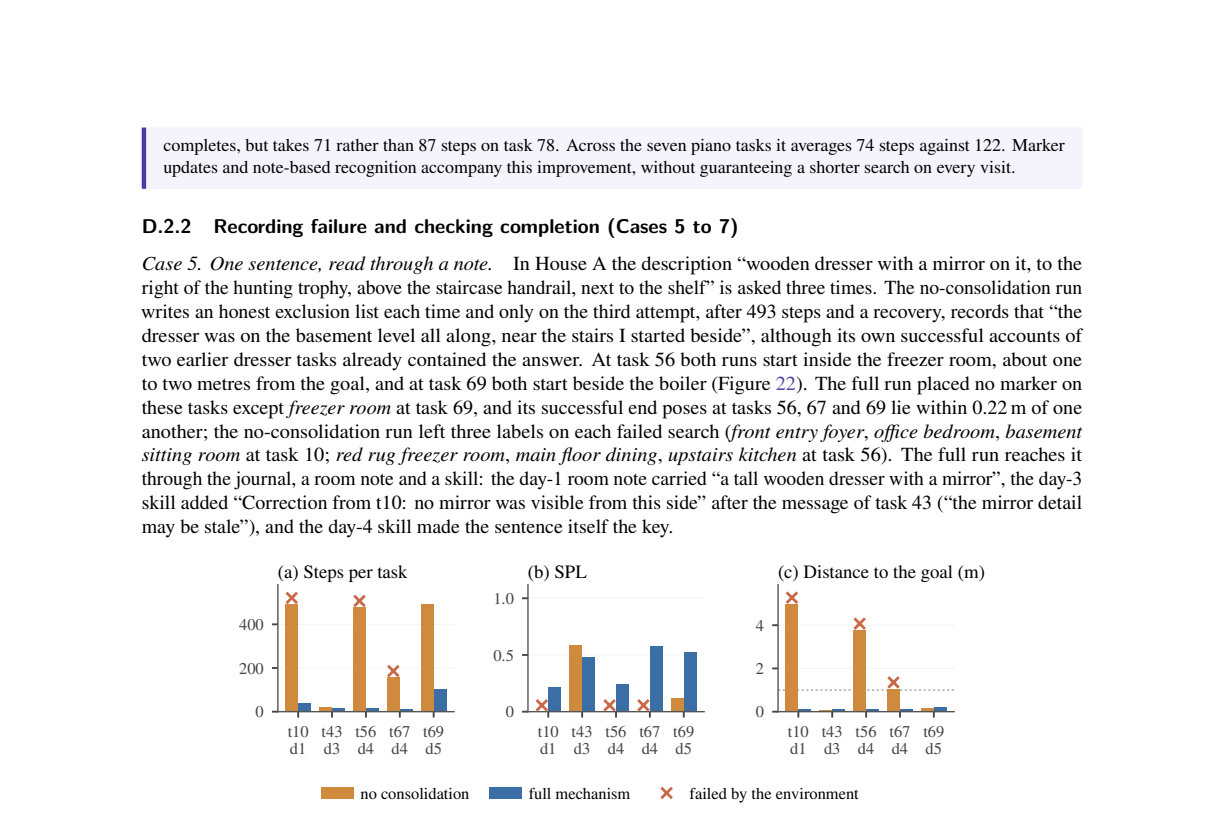
Consolidation is a compression-with-loss boundary: it helps on average, but Case 9 shows the cause of a recurring fault being dropped from the retained note while the remedy survives, suggesting summaries that keep the conditions under which a rule applies should be testable in the same deployment setup.
The harness's small context footprint (~20k tokens per task versus roughly 1M for a single session) is a concrete deployment-cost benefit independent of the navigation results.
Check this review
Pith stored no record of this review's passes and took no fingerprint of it. Reviews made by code from 13 Nov 2026 on carry both.
How often reviews like this one are right
Reviews like this one: written by deepseek-v4-flash, where what was read was not recorded.
How often objections from reviews like this one are right: not yet measured
Reviews by people
This review was written by a machine. No person has reviewed this paper on Pith yet. A scientist listed on Pith can review it for a fee, and their review is published here whatever it concludes.
The paper
Abstract
Frontier models can now perform well on individual embodied navigation tasks through multi-round multimodal reasoning with simple tools. Across successive tasks, however, an agent must also rely on an evolving map and earlier search records, both of which may be incomplete or conflict with new observations. We present NavHarness, a training-free embodied harness towards lifelong navigation that makes memory processing part of the navigation loop. During navigation, its multi-round agentic session draws on maps, task records, and house knowledge, checking them against observations and recording corrections to guide its actions. NavHarness preserves this experience across fresh conversations for new tasks or recovery attempts, while outcome verification and run-end summaries support its later reuse. On GOAT-Bench, NavHarness improves s-SR over context-only independent sessions by 18.6 points with Astra and 22.6 with Opus 5. Using SLAM-estimated poses, NavHarness with GPT-6 Astra achieves state-of-the-art task success of 83.7 s-SR with 36.9 e-SR on GOAT-Bench and 85.9 s-SR on IR2R-CE. To understand these gains, we examine how experience is carried between sessions and find that structured recovery handovers outperform length-matched summaries. In extended deployments across houses, consolidation improves navigation beyond retaining maps and task records, with case studies showing how agents use earlier experience to interpret new goals, investigate unresolved questions, and resume failed searches. We suggest that progress towards lifelong navigation depends on how successive reasoning sessions build on prior experience, alongside improvements in single-task capability.
The paper's own sentences, arranged, kept beside the review and separate from it. Each label is drawn from a closed vocabulary; the number beside it is the probability the classifier gave that label. No sentence in this record was written by a model.
abstract compiled · 2026-09-29
The authors' main claim, as the classifier picked it out 1.00
“We suggest that progress towards lifelong navigation depends on how successive reasoning sessions build on prior experience, alongside improvements in single-task capability.”
How the main claim is stated: hedged possibility 0.96
What the abstract itself states, as probabilities: claims first 0.07 · states limitation 0.26 · human participants 0.06 · controlled comparison 0.93 · randomized assignment 0.02 · states quantitative result 0.99 · compares with prior results 0.95 · mentions code or data availability 0.05
The abstract, sentence by sentence
This table labels the abstract only (arXiv listing abstract v1). The number is the probability the classifier gave the label.
| Sentence | Role | The authors' own work | States the main conclusion | Strength |
|---|---|---|---|---|
| Frontier models can now perform well on individual embodied navigation tasks through multi-round multimodal reasoning with simple tools. | background 1.00 | 0.07 | 0.04 | asserted 0.90 |
| Across successive tasks, however, an agent must also rely on an evolving map and earlier search records, both of which may be incomplete or conflict with new observations. | background 0.51 | 0.09 | 0.03 | asserted 0.58 |
| We present NavHarness, a training-free embodied harness towards lifelong navigation that makes memory processing part of the navigation loop. | contribution 0.99 | 0.89 | 0.13 | asserted 0.99 |
| During navigation, its multi-round agentic session draws on maps, task records, and house knowledge, checking them against observations and recording corrections to guide its actions. | method 0.99 | 0.73 | 0.07 | asserted 1.00 |
| NavHarness preserves this experience across fresh conversations for new tasks or recovery attempts, while outcome verification and run-end summaries support its later reuse. | method 0.79 | 0.83 | 0.08 | asserted 1.00 |
| On GOAT-Bench, NavHarness improves s-SR over context-only independent sessions by 18.6 points with Astra and 22.6 with Opus 5. | result 1.00 | 0.96 | 0.12 | asserted 1.00 |
| Using SLAM-estimated poses, NavHarness with GPT-6 Astra achieves state-of-the-art task success of 83.7 s-SR with 36.9 e-SR on GOAT-Bench and 85.9 s-SR on IR2R-CE. | result 1.00 | 0.95 | 0.11 | asserted 1.00 |
| To understand these gains, we examine how experience is carried between sessions and find that structured recovery handovers outperform length-matched summaries. | interpretation 0.43 | 0.95 | 0.11 | asserted 1.00 |
| In extended deployments across houses, consolidation improves navigation beyond retaining maps and task records, with case studies showing how agents use earlier experience to interpret new goals, investigate unresolved questions, and resume failed searches. | result 0.86 | 0.93 | 0.14 | asserted 0.99 |
| We suggest that progress towards lifelong navigation depends on how successive reasoning sessions build on prior experience, alongside improvements in single-task capability. | interpretation 0.98 | 0.27 | 0.80 | hedged possibility 0.96 |
What kind of paper the classifier reports this is: method or tool 1.00 · evidence from observation or experiment 0.85
What was examined, and what was not
Sources read
- arXiv listing abstract v1
Not examined
- full text
- figures and tables
- references and citing sentences
- relations to other papers
Levels run
- P abstract
Not run
- S sections
- T body sentences
- C citations
- R cross-paper relations
How the labels were made
Compiled by classifier-1.13.0 via TypeSafe API, question bank abstract-p1-20260923, 2026-09-29: 1 request, 7,676 input tokens.
Every quoted sentence on this record is the authors'. Every label is from Pith's closed vocabulary, with the probability shown beside it. This record as JSON
Figures (27)






Showing 24 of the paper's 27 figures. Figures are the authors', reproduced from the paper.
References (103)
- [1] Overcoming Catastrophic Forgetting in Neural Networks , author =. Proceedings of the National Academy of Sciences , volume =. 2017 , doi = on Pith
- [2] Test-Time Training with Self-Supervision for Generalization under Distribution Shifts , author =. Proceedings of the 37th International Conference on Machine Learning , series =. 2020 , url = on Pith
- [3] Wang, Dequan and Shelhamer, Evan and Liu, Shaoteng and Olshausen, Bruno and Darrell, Trevor , booktitle =. 2021 , url = on Pith
- [4] Yin, Hang and Liang, Yinan and Zhang, Jiazhao and Liu, Jiahang and Li, Minghan and Zhang, Zhizheng and Wang, He , year =. 2606.10927 , archivePrefix = on PithPith's reviewarXiv
- [5] Zeng, Shuang and Qi, Dekang and Chang, Xinyuan and Xiong, Feng and Xie, Shichao and Wu, Xiaolong and Liang, Shiyi and Xu, Mu and Wei, Xing and Guo, Ning , year =. 2509.22548 , archivePrefix = on PitharXiv
- [6] Rajasekaran, Prithvi and Dixon, Ethan and Ryan, Carly and Hadfield, Jeremy , year =. Effective Context Engineering for on Pith
- [7] Effective Harnesses for Long-Running Agents , author =. 2025 , howpublished = on Pith
- [8] Harness Design for Long-Running Application Development , author =. 2026 , howpublished = on Pith
- [9] Wang, Xingyao and Li, Boxuan and Song, Yufan and Xu, Frank F. and Tang, Xiangru and Zhuge, Mingchen and Pan, Jiayi and Song, Yueqi and Li, Bowen and Singh, Jaskirat and Tran, Hoang H. and Li, Fuqiang and Ma, Ren and Zheng, Mingzhang and Qian, Bill and Shao, Yanjun and Muennigh... on Pith
- [10] Xu, Wujiang and Liang, Zujie and Mei, Kai and Gao, Hang and Tan, Juntao and Zhang, Yongfeng , booktitle =. 2025 , url = on Pith
- [11] Agentic Context Engineering: Evolving Contexts for Self-Improving Language Models , author =. 2025 , eprint = on Pith
- [12] Li, Xiaochuan and Ming, Ryan and Chu, Meng and Shao, Shuai and Jin, Rong and Xiong, Chenyan , year =. 2607.23809 , archivePrefix = on PithPith's reviewarXiv
- [13] Vision-and-Language Navigation: Interpreting Visually-Grounded Navigation Instructions in Real Environments , author =. Proceedings of the IEEE Conference on Computer Vision and Pattern Recognition , pages =. 2018 , url = on Pith
- [14] Room-Across-Room: Multilingual Vision-and-Language Navigation with Dense Spatiotemporal Grounding , author =. Proceedings of the 2020 Conference on Empirical Methods in Natural Language Processing , pages =. 2020 , doi = on Pith
- [15] Qi, Yuankai and Wu, Qi and Anderson, Peter and Wang, Xin and Wang, William Yang and Shen, Chunhua and van den Hengel, Anton , booktitle =. 2020 , url = on Pith
- [16] History Aware Multimodal Transformer for Vision-and-Language Navigation , author =. Advances in Neural Information Processing Systems , year = on Pith
- [17] Think Global, Act Local: Dual-Scale Graph Transformer for Vision-and-Language Navigation , author =. Proceedings of the IEEE/CVF Conference on Computer Vision and Pattern Recognition , year = on Pith
- [18] An, Dong and Wang, Hanqing and Wang, Wenguan and Wang, Zun and Huang, Yan and He, Keji and Wang, Liang , year =. 2304.03047 , archivePrefix = on PithPith's reviewarXiv
- [19] Zhang, Yixian and Zhang, Huanming and Gao, Feng and Li, Xiao and Liu, Zhihao and Zhu, Chunyang and Qiu, Jiaxing and Yan, Yuchen and Liu, Jiyuan and Tang, Wenhao and Fang, Zhengru and Nie, Yi and Wei, Changxu and Wang, Yu and Ding, Wenbo and Yu, Chao , year =. 2607.08448 , arch... on PithPith's reviewarXiv
- [20] Chen, Yang and Che, Lirong and Huang, Zhenyu and Fu, Wenbo and Wang, Chuang and Cao, Xu and Liu, Daqi and Yang, Yuzhe and Su, Jian and Guo, Lan-Zhe , year =. 2609.15195 , archivePrefix = on PithPith's reviewarXiv
show 80 more
- [21] Chen, Yanzhe and Bai, Zechen and Cao, Zhijun and Zeng, Wenzheng and Lin, Kevin Qinghong and Lin, Yiqi and Liang, Guoqiang and Ma, Kevin Yuchen and Huang, Qiming and Shou, Mike Zheng , year =. 2609.10522 , archivePrefix = on PithPith's reviewarXiv
- [22] Ding, Xin and Mi, Liang and Huang, Mingzhe and Wang, Zixuan and Zhang, Chao and Hao, Zixu and Chen, Fu and Li, Xiangyu and Zheng, Yikai and Guo, Yaoyu and Wang, Weijun and Li, Kun and Wu, Hao and Liu, Yunxin and Cao, Ting , year =. 2608.16590 , archivePrefix = on PithPith's reviewarXiv
- [23] Embodied Agents Take Control: Minimal-Interface Zero-Shot Agents Rival Industrial-Scale Policies in Vision-and-Language Navigation , author =. 2026 , eprint = on Pith
- [24] Campos, Carlos and Elvira, Richard and G. IEEE Transactions on Robotics , volume =. 2021 , doi = on Pith
- [25] Agent Harness for Large Language Model Agents: A Survey , author =. 2026 , howpublished =. doi:10.20944/preprints202604.0428.v3 , url = on PitharXiv
- [26] NaVid: Video-based VLM Plans the Next Step for Vision-and-Language Navigation , author =. RSS , year = on Pith
- [27] Towards Learning a Generalist Model for Embodied Navigation , author =. Proceedings of the IEEE/CVF Conference on Computer Vision and Pattern Recognition , year = on Pith
- [28] OpenVLA: An Open-Source Vision-Language-Action Model , author =. arXiv preprint arXiv:2406.09246 , year = on PithPith's reviewarXiv
- [29] Qwen-RobotNav and Qwen-RobotClaw: A 4B Navigation Foundation Model and Its Long-Episode Harness , author =. 2026 , howpublished = on Pith
- [30] NavGPT: Explicit Reasoning in Vision-and-Language Navigation with Large Language Models , author =. AAAI , year = on Pith
- [31] Chen, Jiaqi and Lin, Bingqian and Xu, Ran and Chai, Zhenhua and Liang, Xiaodan and Wong, Kwan-Yee , booktitle =. 2024 , doi = on Pith
- [32] ESC: Exploration with Soft Commonsense Constraints for Zero-shot Object Navigation , author =. ICML , year = on Pith
- [33] Object Goal Navigation using Goal-Oriented Semantic Exploration , author =. NeurIPS , year = on Pith
- [34] Voyager: An Open-Ended Embodied Agent with Large Language Models , author =. Transactions on Machine Learning Research , year = on Pith
- [35] Iterative Vision-and-Language Navigation , author =. Proceedings of the IEEE/CVF Conference on Computer Vision and Pattern Recognition (CVPR) , pages =. 2023 , url = on Pith
- [36] Khanna, Mukul and Ramrakhya, Ram and Chhablani, Gunjan and Yenamandra, Sriram and Gervet, Theophile and Chang, Matthew and Kira, Zsolt and Chaplot, Devendra Singh and Batra, Dhruv and Mottaghi, Roozbeh , booktitle =. 2024 , url = on Pith
- [37] Scaffolding Foundation Models into Physical-World Agents Pushes the Frontier of Long-Horizon Navigation , author =. 2026 , eprint = on Pith
- [38] Li, Yijian and Li, Changze and Shi, Hantian and Luo, Jiaying and Cai, Jiyuan and Yang, Ming and Qin, Tong , year =. 2606.10577 , archivePrefix = on PithPith's reviewarXiv
- [39] Deng, Yucheng and Lai, Pingrui and Li, Xinhai and Bai, Chenjia and Deng, Xiaoheng and Sun, Chengnuo and Li, Xuelong and Yang, Hua , year =. 2606.08992 , archivePrefix = on PithPith's reviewarXiv
- [40] James, MoniJesu and Fernando, Marcelino Julio and Cabrera, Miguel Altamirano and Tsetserukou, Dzmitry , year =. 2606.13878 , archivePrefix = on PitharXiv
- [41] Niu, Haochen and Zhang, Lantao and Ji, Xingwu and Ying, Rendong and Liu, Peilin and Wen, Fei , year =. 2603.01813 , archivePrefix = on PitharXiv
- [42] Lu, Yiren and Du, Yi and Liu, Disheng and Zhou, Yunlai and Wang, Chen and Yin, Yu , year =. 2603.19137 , archivePrefix = on PitharXiv
- [43] Wang, Sen and Liu, Bangwei and Gao, Zhenkun and Ma, Lizhuang and Wang, Xuhong and Xie, Yuan and Tan, Xin , year =. Explore with Long-term Memory: A Benchmark and Multimodal. 2601.10744 , archivePrefix = on PitharXiv
- [44] Lifelong Embodied Navigation Learning , author =. International Conference on Learning Representations (ICLR) , year = on Pith
- [45] Packer, Charles and Wooders, Sarah and Lin, Kevin and Fang, Vivian and Patil, Shishir G. and Stoica, Ion and Gonzalez, Joseph E. , year =. 2310.08560 , archivePrefix = on PithPith's reviewarXiv
- [46] Cognitive Architectures for Language Agents , author =. Transactions on Machine Learning Research , year = on Pith
- [47] Huang, Jinbang and Hu, Yuanzhao and Li, Zhiyuan and Qi, Ran and Xiao, Yixin and Zhang, Zhanguang and Coates, Mark and Cao, Tongtong and Zhang, Yingxue , year =. 2607.18060 , archivePrefix = on PithPith's reviewarXiv
- [48] Jiang, Huiqiang and Wu, Qianhui and Lin, Chin-Yew and Yang, Yuqing and Qiu, Lili , booktitle =. 2023 , url = on Pith
- [49] Jimenez, Carlos E. and Yang, John and Wettig, Alexander and Yao, Shunyu and Pei, Kexin and Press, Ofir and Narasimhan, Karthik , booktitle = on Pith
- [50] Yang, John and Jimenez, Carlos E. and Wettig, Alexander and Lieret, Kilian and Yao, Shunyu and Narasimhan, Karthik and Press, Ofir , booktitle =. 2024 , url = on Pith
- [51] Yao, Shunyu and Zhao, Jeffrey and Yu, Dian and Du, Nan and Shafran, Izhak and Narasimhan, Karthik and Cao, Yuan , booktitle =. 2023 , url = on Pith
- [52] Reflexion: Language Agents with Verbal Reinforcement Learning , author =. 2023 , eprint = on Pith
- [53] Generative Agents: Interactive Simulacra of Human Behavior , author =. 2023 , eprint = on Pith
- [54] Self-Evolving Embodied Agents via Skill-Harness Evolution , author =. 2026 , eprint = on Pith
- [55] End-to-End Navigation with Vision Language Models: Transforming Spatial Reasoning into Question-Answering , author =. 2024 , eprint = on Pith
- [56] Ji, Zihe and Lin, Huangxuan and Gao, Yue , year =. 2506.15096 , archivePrefix = on PithPith's reviewarXiv
- [57] Ziliotto, Filippo and Campari, Tommaso and Serafini, Luciano and Ballan, Lamberto , booktitle = on Pith
- [58] Zhu, Ziyu and Wang, Xilin and Li, Yixuan and Zhang, Zhuofan and Ma, Xiaojian and Chen, Yixin and Jia, Baoxiong and Liang, Wei and Yu, Qian and Deng, Zhidong and Huang, Siyuan and Li, Qing , booktitle =. Move to Understand a on Pith
- [59] Yang, Yuncong and Yang, Han and Zhou, Jiachen and Chen, Peihao and Zhang, Hongxin and Du, Yilun and Gan, Chuang , booktitle = on Pith
- [60] Explore until Confident: Efficient Exploration for Embodied Question Answering , author =. Robotics: Science and Systems (RSS) , year = on Pith
- [61] Gadre, Samir Yitzhak and Wortsman, Mitchell and Ilharco, Gabriel and Schmidt, Ludwig and Song, Shuran , booktitle = on Pith
- [62] Yokoyama, Naoki and Ha, Sehoon and Batra, Dhruv and Wang, Jiuguang and Bucher, Bernadette , booktitle = on Pith
- [63] From Question Answering to Task Completion: A Survey on Agent System and Harness Design , author =. 2026 , eprint = on Pith
- [64] What Makes a Harness a Harness: Necessary and Sufficient Conditions for an Agent Harness , author =. 2026 , eprint = on Pith
- [65] Chen, Tingyang and Lu, Shuo and Zhao, Kang and Meng, Weicheng and Teng, Hanlin and Li, Tianhao and Li, Chao and Liu, Xule and Liang, Jian and Zhang, Zhizhong and Xie, Yuan and Qu, Heng and Shao, Kun and Luan, Jian , year =. 2606.14249 , archivePrefix = on PithPith's reviewarXiv
- [66] Code as Agent Harness , author =. 2026 , eprint = on Pith
- [67] Kang, Minki and Chen, Wei-Ning and Han, Dongge and Inan, Huseyin A. and Wutschitz, Lukas and Chen, Yanzhi and Sim, Robert and Rajmohan, Saravan , booktitle =. 2026 , url = on Pith
- [68] Beyond Compaction: Structured Context Eviction for Long-Horizon Agents , author =. 2026 , eprint = on Pith
- [69] Hao, Xubin and Meng, Hongjin and Yin, Xin and Zhu, Jiawei and Cao, Chenpeng , year =. 2607.00692 , archivePrefix = on PithPith's reviewarXiv
- [70] Savva, Manolis and Kadian, Abhishek and Maksymets, Oleksandr and Zhao, Yili and Wijmans, Erik and Jain, Bhavana and Straub, Julian and Liu, Jia and Koltun, Vladlen and Malik, Jitendra and Parikh, Devi and Batra, Dhruv , booktitle =. Habitat: A Platform for Embodied on Pith
- [71] Ramakrishnan, Santhosh Kumar and Gokaslan, Aaron and Wijmans, Erik and Maksymets, Oleksandr and Clegg, Alexander and Turner, John and Undersander, Eric and Galuba, Wojciech and Westbury, Andrew and Chang, Angel X. and Savva, Manolis and Zhao, Yili and Batra, Dhruv , booktitle ... on Pith
- [72] Chang, Angel and Dai, Angela and Funkhouser, Thomas and Halber, Maciej and Niessner, Matthias and Savva, Manolis and Song, Shuran and Zeng, Andy and Zhang, Yinda , booktitle = on Pith
- [73] Beyond the Nav-Graph: Vision-and-Language Navigation in Continuous Environments , author =. European Conference on Computer Vision (ECCV) , year = on Pith
- [74] On Evaluation of Embodied Navigation Agents , author =. 2018 , eprint = on Pith
- [75] General Evaluation for Instruction Conditioned Navigation using Dynamic Time Warping , author =. 2019 , eprint = on Pith
- [76] Sim-to-Real Transfer for Vision-and-Language Navigation , author =. Conference on Robot Learning (CoRL) , year = on Pith
- [77] Claude. 2026 , howpublished = on Pith
- [78] 2026 , howpublished = on Pith
- [79] Qwen3 Technical Report , author =. 2025 , eprint = on Pith
- [80] Zhao, Ganlong and Li, Guanbin and Chen, Weikai and Yu, Yizhou , booktitle =. 2024 , url = on Pith
- [81] Han, Zebin and Wang, Xudong and Liu, Baichen and Lyu, Qi and Shang, Zhenduo and Dong, Jiahua and Liu, Lianqing and Han, Zhi , booktitle =. 2026 , url = on Pith
- [82] Zhang, Yunbei and Wang, Janet and Ge, Yingqiang and Xu, Weijie and Hamm, Jihun and Reddy, Chandan K. , year =. Stop Comparing. 2605.23950 , archivePrefix = on PithPith's reviewarXiv
- [83] Where Does Agent Reliability Come From? A Cross-Benchmark Decomposition of Verification Loops, Specialist Models, and Scaffolding in a Production Enterprise Agent , author =. 2026 , eprint = on Pith
- [84] Yang, Xidong and Zhang, Xingyi and Li, Wenhao and Liu, Wenyan and Sheng, Junjie and Hua, Yun and Yin, Wei and Fang, Tao and Shen, Chuyun and Wang, Xiangfeng , year =. 2608.01149 , archivePrefix = on PithPith's reviewarXiv
- [85] Towards the Harness of Embodied Agents , author =. 2026 , eprint = on Pith
- [86] Elmaaroufi, Karim and Svegliato, Justin and Kalade, Sarunas and Schelle, Graham and Seshia, Sanjit A. and Zaharia, Matei , year =. 2606.16458 , archivePrefix = on PitharXiv
- [87] Belikova, Julia and Parchiev, Rauf and Egorov, Evgeny and Davydenko, Grigorii and Gusev, Gleb and Savchenko, Andrey and Makarenko, Maksim , year =. Managing Procedural Memory in. 2606.23127 , archivePrefix = on PithPith's reviewarXiv
- [88] Zhang, Ziao and Shi, Kou and Huang, Shiting and Nie, Avery and Zeng, Yu and Zhao, Yiming and Fang, Zhen and Su, Qishen and Qiu, Haibo and Yang, Wei and Ren, Qingnan and Zou, Shun and Huang, Wenxuan and Chen, Lin and Chen, Zehui and Zhao, Feng , year =. 2604.17308 , archivePrefix = on PithPith's reviewarXiv
- [89] Xu, Zhuo and Chiang, Hao-Tien Lewis and Fu, Zipeng and Jacob, Mithun George and Zhang, Tingnan and Lee, Tsang-Wei Edward and Yu, Wenhao and Schenck, Connor and Rendleman, David and Shah, Dhruv and Xia, Fei and Hsu, Jasmine and Hoech, Jonathan and Florence, Pete and Kirmani, Se... on Pith
- [90] Visual Language Maps for Robot Navigation , author =. IEEE International Conference on Robotics and Automation (ICRA) , year = on Pith
- [91] Hughes, Nathan and Chang, Yun and Carlone, Luca , booktitle =. Hydra: A Real-time Spatial Perception System for. 2022 , url = on Pith
- [92] Werby, Abdelrhman and Huang, Chenguang and B. Hierarchical Open-Vocabulary. Robotics: Science and Systems (RSS) , year = on Pith
- [93] Lost in the Middle: How Language Models Use Long Contexts , author =. Transactions of the Association for Computational Linguistics , volume =. 2024 , url = on Pith
- [94] Zhang, Gengyuan and Ding, Mingcong and Wu, Jingpei and Liao, Ruotong and Tresp, Volker , year =. 2511.19033 , archivePrefix = on PitharXiv
- [95] Li, Ji and Wang, Bo and Xia, Jing and Li, Mingyi and Hu, Shiyan , year =. 2602.15513 , archivePrefix = on PithPith's reviewarXiv
- [96] Stop Wandering: Efficient Vision-Language Navigation via Metacognitive Reasoning , author =. 2026 , eprint = on Pith
- [97] Hypothesis Graph Refinement: Hypothesis-Driven Exploration with Cascade Error Correction for Embodied Navigation , author =. 2026 , eprint = on Pith
- [98] Lee, Taekbeom and Jang, Youngseok and Heo, Jeonghwa and Choi, Jeongjun and Kim, H. Jin , year =. 2606.24068 , archivePrefix = on PithPith's reviewarXiv
- [99] Schperberg, Alexander and Panda, Shivam K. and Vinod, Abraham P. and Bhagawan, Rokaha and Jawed, M. K. and Di Cairano, Stefano , year =. 2606.26046 , archivePrefix = on PithPith's reviewarXiv
- [100] Ge, Zuhao and Jia, Xiaosong and Wu, Chao and Zhou, Yuchen and Wu, Zuxuan and Jiang, Yu-Gang , year =. 2606.03509 , archivePrefix = on PithPith's reviewarXiv
The first 100 of 103 references are listed here. All of them are in this paper's citation record.
Cited by 4 Pith papers
Reviewed papers on Pith that cite this one. The full citation record
- RetroNav: Scene-Grounded Retrospection and Retry for Self-Evolving Lifelong Navigation cs.RO · Oct 2026
- Improve How You Improve: Recursive Policy Self-Improvement for Zero-Shot Open-Vocabulary Multi-Object Navigation cs.RO · Nov 2026
- DualWorldBench: Can Agents Plan Deliveries across Symbolic and Grounded Worlds? cs.AI · Nov 2026
- Ask to Evolve: A Unified Harness for Lifelong Embodied Navigation with Hybrid Action Space and Persistent Memory cs.RO · Oct 2026
Challenges and discussion
Disagree with the review, or know something it missed? Leave a comment, or challenge this review formally: a challenge becomes a permanent entry in this paper's record, and its decision is published here.
Come back by email
A short list of the week's newly reviewed papers. Nothing is sent until you confirm from your inbox, and every email has a link that stops it. No account.
No comments yet.
Sign in to comment