Computation and Language · arXiv:2609.37863 v1 · submitted 29 Sep 2026 · 31 references
It's Not What the Image Shows: Irrelevant Context Destabilises VLM Judges Without Informing Them
The paper says
“Vision-language models (VLMs) are increasingly used in place of human annotators, making it important that substitutability tests reflect the model rather than incidental evaluation conditions.”
more of the abstract
We introduce MIST, the Misleading-Image Stress Test: 200 English sentences, each built around a phrase readable either figuratively or literally and shown with an aligned image depicting its reading, a misleading image depicting the opposite, or no image at all. The guidelines require the label to be decided from the sentence alone, so no image should change any answer. We expected each image to pull a judge's labels toward the sense it depicts, and neither kind did. Across thirteen VLM judges, an aligned image changed 20.5% of labels and a misleading one 19.4%, close for every judge and both above the 11.6% produced by deleting the ignore-the-image instruction with the image left in place. Yet only 37% of the labels that differ between the two images moved toward the sense shown, and agreement with our human annotators is unchanged whether the image is absent, aligned or misleading. The effect is smaller in the seven judges that pass the alt-test than in the six that never do, but present in all of them: what moves a judge is that an image is there, not which of the two it is, so a substitutability verdict describes a configuration as much as a model.
from the abstract
Pith says
Machine review · deepseek-v4-flash · 30 Sep 2026 · what was read was not recorded · not checked by a person
It can be wrong. Challenge this review or reply to it.
Holds up, with conditions. The presence effect is solid and honestly reported; the 'content does not inform' half is plausible but rests on unvalidated images and an unresolved human contrast, so conditional acceptance is the right call. This line is wrong
3 major objections · 4 minor
How often objections from reviews like this one are right: not yet measured
Not checked: figures, code, what the 31 references say.
The paper says, at §3.2, Appendix D
The review did not quote this passage.
Pith says: Objection 1 of 3 · major
The content-independence claim ('what moves a judge is that an image is there, not which of the two it is') rests on the direction statistic (37% below chance on the 1,776 differing cells). This statistic is interpretable as evidence that the image does not inform the judge only if the aligned and misleading images reliably and distinguishably depict the intended readings.
more of objection 1
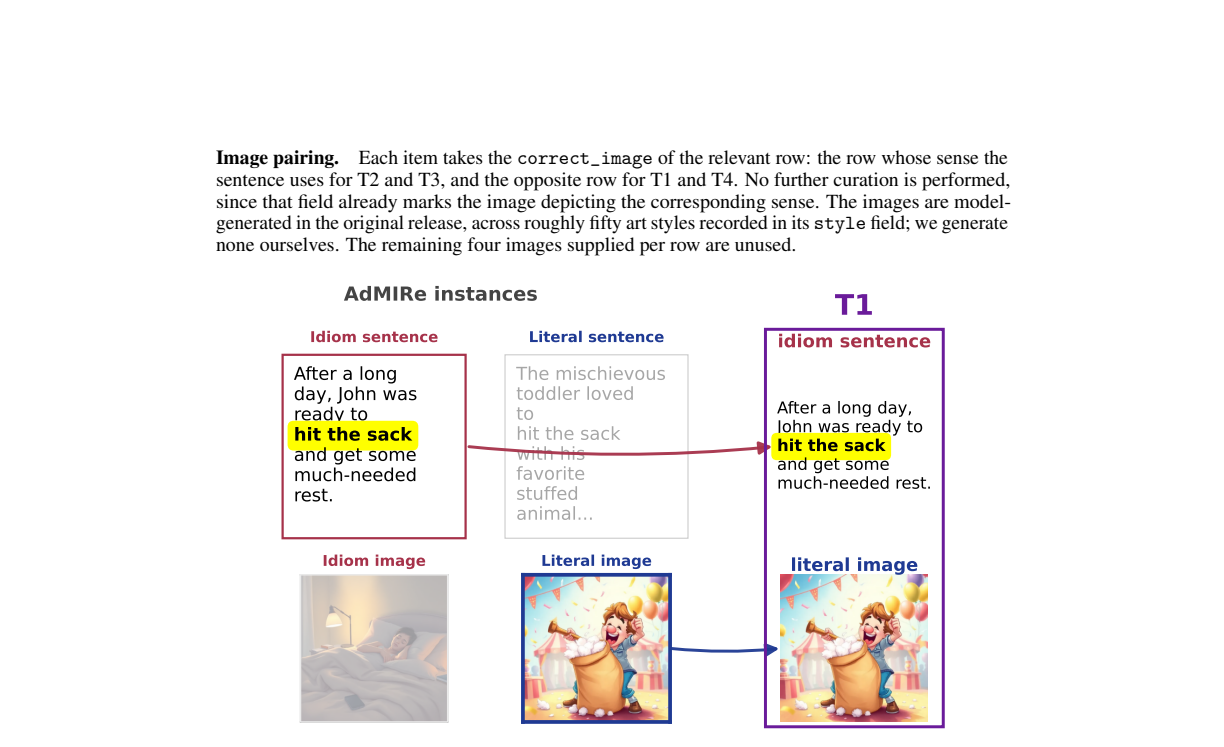
Appendix D states that the images are taken on trust from AdMIRe's correct_image field with 'no further curation is performed', and that the paper neither generates nor independently verifies that the images depict the intended senses. If a material fraction of images are ambiguous, stylistically opaque, or simply not depicting the opposite reading, the direction measure is biased toward a null result regardless of the judges' actual sensitivity to image content. The paper should either (a) provide a human verification study on a random sample of image–sentence pairs (e.g., humans classify whether each image depicts the literal or figurative reading of the target), or (b) explicitly weaken the claim to 'we find no evidence of content influence in our stimuli' and flag the unverified image quality as a central limitation.
The paper says, at §3.2, Table 1 and Appendix G
The review did not quote this passage.
Pith says: Objection 2 of 3 · major
The headline direction figure (37%) is pooled over cells with very different per-judge change rates: Q2-7B changes 42% of labels while GPT-5.2 changes 10%, so the pooled statistic is dominated by the most unstable judges. Although the text notes that every passing judge individually falls below chance, the aggregate 37% is reported prominently in the abstract and discussion without a breakdown of the seven passing judges' direction rates.
more of objection 2
Presenting the direction separately for the seven passing and six failing judges, with standard errors or bootstrap intervals, would sharpen the claim and prevent a misleading impression that the pooled number applies uniformly.
The paper says, at §3.1, §4, Appendix E.1
The review did not quote this passage.
A classifier read this sentence of the paper as acknowledging the concern (probability 0.82):
“A substitutability protocol cannot see this: aggregate agreement conceals instance-level instability, so calling a judge substitutable describes a judge and a configuration at once and names only the first.”
Pith says: Objection 3 of 3 · major
The conclusion that agreement with human annotators is unchanged relies on comparing aggregate agreement across conditions, but the human labels themselves were collected under one condition per item (by design), so the human majority labels for the aligned and misleading conditions come from disjoint item sets and disjoint trios.
more of objection 3
The paper correctly reports the human contrast as unresolved in Appendix E.1, but the body text ('Agreement ... is unchanged') does not carry that caveat. The change in agreement (54.4% vs 53.7% vs 54.7%) could be within noise given the small per-condition samples (50 items per condition per trio), and the aggregate agreement measure is insensitive to the instance-level instability the paper emphasizes. The authors should either present a confidence interval for the agreement differences or explicitly state that the agreement comparison is underpowered for this design.
4 minor objections
The paper says, at Abstract and throughout
Pith says: minor objection 1 of 4
There are several typos: 'analigned' and 'amisleading' in the abstract should be 'an aligned' and 'a misleading'. Please proofread for spacing and article errors.
The paper says, at §3.2, Table 1
Pith says: minor objection 2 of 4
Table 1 reports the 'prompt edited, image fixed' control at 8.8% mean for the seven judges, but the abstract and §3.1 quote the all-thirteen control at 11.6%. This is a minor inconsistency in presentation; clarify that Table 1 is for the seven passing judges while the all-thirteen figure is in Appendix F.
show 2 more
The paper says, at Appendix G
Pith says: minor objection 3 of 4
The description of Table 7's bold selections is dense; a sentence explaining that the choice of 'most favourable to image-following' prompt is a post-hoc selection that could inflate the direction estimate would help readers interpret the intervals reported there.
The paper says, at Appendix I
Pith says: minor objection 4 of 4
The prompt is presented in full, which is valuable for reproducibility, but the 'IMAGE CLAUSE' block is described as being 'present only when an image is attached'. For the silent arm the clause is absent, yet the paper does not show the exact user message for that arm; consider providing a one-line example to avoid ambiguity.
What would settle it
Human forced-choice validation of the image senses: for all 200 items, present the aligned and misleading images alone (no sentence) to naive raters and ask which reading of the target phrase each depicts. Keep the subset of items (est. 60–80%) where at least 80% of raters identify each image's intended sense, then recompute (a) the 37% direction statistic and (b) the aligned-versus-misleading change-rate gap on that validated subset only. If direction stays at or below 40% and the two change rates stay within five points, the content-null is confirmed on genuinely informative images and the central claim stands; if direction rises toward 50% or the rates diverge, the null is an artifact of uninformative pictures and the conclusion must be weakened from judge insensitivity to content to a finding about uninformative stimuli.
from the skeptic's reading
How the review went
4 readings by deepseek-v4-flash · 30 Sep 2026
- Reader holds up, with conditions
- Skeptic agrees
- Editor wrote the verdict above
- Referee major revision: 3 major objections, 4 minor
Not run on this paper: the simulated authors' defence.
Pith did not check this review's objections against the paper.
The review in full
The review in brief, machine-written
Read it. The paper earns its main claim on the presence side and overreaches a bit on the content side; with the evidence as reported, I'd call the substitutability warning solid and the 'not informed' part provisional.
What's new: MIST is a clean invariance setup — same sentence, label fixed by construction, image swapped in two directions, read against an alt-test verdict. The result that attaching an image moves 15.9%/14.7% of labels among the seven passing judges, every judge above its own prompt-edit control, with agreement with humans flat, is well supported and worth knowing. The Appendix G selection analysis is honest: under the prompt most favorable to image-following, the anti-following direction survives, and most intervals contain zero. Releasing the data is also a plus.
Soft spots, in order. First, the 'not which' conclusion rests on the direction statistic (37% toward the depicted sense), and that statistic is only interpretable if the two images reliably and distinguishably depict the two readings. Appendix D says no curation was done beyond AdMIRe's correct_image field, and there is no human or reference-VLM validation of the images. If a material fraction are ambiguous or garbled, the direction number is biased toward null, and the content-independence claim becomes an artifact. This is acknowledged only obliquely, and it is the load-bearing assumption for the second half of the abstract claim. Second, the label-preserving premise for humans is unresolved: Appendix E.1 candidly says the blind trio's interval admits a shift toward misleading images and that no human saw the same item twice. That limits the 'configuration, not model' interpretation more than the paper lets on. Third, the missing confidence interval on 37% is minor — at n=1,776, 37% is far below chance — so don't spend referee time there. The per-condition cells at n≈25 are noisy, but the authors say so themselves.
Overall, the presence effect is real and the paper is honest. The content-null is a plausible hypothesis needing stimulus validation and a human within-subject contrast. That is exactly what a conditional accept should ask for.
Recommendation: send it to peer review. Ask for image validation, or at least a reference-VLM or human rating of the aligned-versus-misleading contrast, and a reported interval on the direction statistic. I'd bring it to reading group regardless — the test design itself is worth discussing before the content claim firms up.
The strongest objection
The paper's distinctive claim is content-independence: 'what moves a judge is that an image is there, not which of the two it is' (abstract, Discussion). The presence half is well supported: attaching an image changes 15.9%/20.5% of labels against an 8.8%/11.6% prompt-edit control, every judge individually above its own control. The 'not which' half rests entirely on the direction statistic (§3.2): on the 1,776 cells (17.1%) where aligned and misleading labels differ, only 37% move toward the depicted sense, below the 50% chance level, and 71% of the movement stays on the same side of the figurative–literal divide. That statistic is interpretable as 'the image does not inform the judge' only if the two images reliably and distinguishably depict the intended readings, so that a directional signal exists either to follow or to suppress. This is never verified. Appendix D states the images are model-generated in the AdMIRe release, taken on trust from its correct_image field, with 'no further curation is performed'; the paper performs no independent check that, for example, a T1 'literal' image clearly depicts the literal reading of a figurative sentence. If a material fraction of 'misleading' images are garbled, stylistically opaque, or ambiguous (fifty art styles are reported), the direction measure is biased toward a null: a judge discarding an uninformative image and anchoring on the sentence will produce at-or-below-chance 'following' numbers that reflect nothing about whether informative content would be used. This is a correctness risk, not a circularity one: it is acknowledged only obliquely (Appendix B's 'both phrase-relevant' line states the contrast design, not the validity of individual images), and §3.2 offers no validation of the images by humans or a reference VLM. The missing CI on 37% is not the binding issue (n=1,776 cells gives SE≈0.0115, so 37% is roughly 13 SEs below chance); the binding issue is the construct validity of the measure.
The reader's weakest_assumption names exactly the concern I find most load-bearing: the content-independence conclusion presumes the aligned and misleading images reliably depict the intended readings, and Appendix D ('No further curation is performed', images taken on trust from AdMIRe's correct_image field) never establishes this. I considered whether another concern bites harder. One candidate was statistical power of the 37% figure; but with 1,776 disagreeing cells the SE is about 0.0115, so 37% is roughly 13 SEs below chance — statistics are not the weakness; construct validity is. Another candidate was the ordinal-scale subtlety (FF/WF vs FL/LL boundaries are different judgments, Appendix B); this is disclosed and partly handled by the 71%-same-side analysis, so it is secondary. A third was the unresolved human label-preserving premise (Appendix E.1); it matters for the substitutability-verdict interpretation ('a verdict describes a configuration') but not for the core VLM empirics, so it is less load-bearing than image validity. I also stress-tested the obvious rebuttal: if the images were pure noise, direction should be about 50%, yet it is 37%, suggesting active suppression rather than indifference. That rebuttal is not decisive, because a systematic failure mode — misleading images too uninformative to use, so the judge anchors on the sentence — would also push 'following' below chance; a direction measure on unvalidated stimuli cannot distinguish 'judge ignores informative content' from 'stimuli carry no usable content.' A human forced-choice validation of the 200 image–sense pairs, with the headline statistics recomputed on the validated subset, settles this. The presence effect survives independently of this concern, and the authors' disclosures in Appendices B, D and E.1 are honest. Hence CONDITIONAL remains the right verdict: ACCEPT would require the image-validation check to pass, while REJECT is not warranted because the central presence finding is solid and the limitation is genuinely testable rather than fatal.
The referee's report
If the results hold, this is an important and novel contribution to the VLM-as-judge literature. The presence effect is well supported: the design includes a within-judge prompt-edit control, the change rates exceed that control for every judge individually, and the measurement is reproducible with a released dataset. The direction result, if trustworthy, would be striking: it would imply that even judge-appropriate content does not guide label changes. The paper also ships a curated evaluation resource that practitioners could reuse. However, the content-independence claim rests on the unverified assumption that the aligned and misleading images reliably and distinguishably depict the intended readings; if that assumption fails, the headline conclusion is not supported.
Pith's reading of the paper (a machine's summary, not the authors')
This paper tries to establish that vision-language models used as evaluation judges are destabilized by context they are explicitly instructed to disregard. The authors build MIST, 200 English idiom sentences whose answer is fixed by the text alone, and present each with an aligned image, a misleading image showing the opposite reading, or no image at all. Even under instructions to judge only the sentence, attaching a picture changes roughly a fifth of a judge's labels, and it barely matters which picture it is: aligned and misleading images move almost the same number of labels, and the changed labels do not move toward the sense shown. Because agreement with human annotators is unchanged on average, aggregate substitutability verdicts cannot see this instability, so a verdict that a model may replace a human panel describes the test configuration as much as the model.
What carries the argument. MIST, the Misleading-Image Stress Test: 200 English items, each a sentence whose potentially idiomatic target phrase reads either figuratively or literally, presented with an aligned image depicting that reading, a misleading image depicting the opposite, or no image. Because the label must be decided from the sentence alone, swapping the image is label-preserving by construction, so any label change is an error. The design's leverage is that both images depict a reading of the target, which isolates 'which reading is shown' from 'whether an image is present at all' and lets the paper test content against mere presence directly.
Core claim. The central claim is that what perturbs a VLM judge is the mere presence of an image, not its content. Among the seven judges that pass the alternative-annotator test in at least one configuration, attaching an aligned image changes 15.9% of labels and a misleading one 14.7%, and both figures exceed the 11.6% produced by deleting the ignore-the-image instruction with the picture left in place; across all thirteen judges the figures are 20.5% and 19.4%. Only 37% of the labels that differ between the two images move toward the sense depicted, where chance is 50%, and agreement with the human majority stays flat at roughly 54% whether the image is absent, aligned, or misleading. The paper's inference is that an image a judge is told to ignore destabilises its labels without informing them, so a substitutability verdict names a configuration as much as a model.
The premise it rests on. The conclusion that image content does not matter assumes the aligned and misleading images reliably depict their two opposite readings, but the images are AI-generated and taken on trust from the source release, so if they are garbled or ambiguous the null content effect is an artifact of uninformative pictures rather than of judge insensitivity.
If the paper is right (Pith's inferences, not the authors')
A substitutability verdict from the alternative-annotator test is not robust to evaluation context: the same judge can be found replaceable under one configuration and not under another.
Evaluation and deployment reports should state the prompt used and any irrelevant context attached, since that context moves labels without changing aggregate agreement.
Accuracy-style measures computed from overall agreement cannot see this instability; instance-level change rates are needed to detect it.
Because the effect appears in all thirteen judges across seven model families and a tenfold parameter range, it is not a quirk of one vendor or one model size.
The images reshuffle labels mostly within the same side of the figurative-literal divide, so the instability is a label-selection effect rather than a change in which reading the judge believes.
The 'presence not content' pattern may extend beyond images to any decorrelated channel a judge is told to ignore, such as a prefix message, formatting, or conversation history, so the same label-preserving stress-test design could probe text context.
The strongest reading the paper cannot rule out is that the AI-generated images are too unreliable to depict the intended senses, which would make the null content effect an artifact of uninformative pictures; a human verification study of the images would settle which reading is correct.
If the effect is a generic response to added modality rather than to images specifically, substitutability verdicts may need to be reported as a function of the full input configuration, not just of the prompt and judge.
The drift-grid results showing aligned-to-misleading movement unstable across prompts suggest the content term is near noise at this item count, so a larger or curated image set would be needed to detect any true content effect.
Check this review
Pith stored no record of this review's passes and took no fingerprint of it. Reviews made by code from 13 Nov 2026 on carry both.
How often reviews like this one are right
Reviews like this one: written by deepseek-v4-flash, where what was read was not recorded.
How often objections from reviews like this one are right: not yet measured
Reviews by people
This review was written by a machine. No person has reviewed this paper on Pith yet. A scientist listed on Pith can review it for a fee, and their review is published here whatever it concludes.
The paper
Abstract
Vision-language models (VLMs) are increasingly used in place of human annotators, making it important that substitutability tests reflect the model rather than incidental evaluation conditions. We introduce MIST, the Misleading-Image Stress Test: 200 English sentences, each built around a phrase readable either figuratively or literally and shown with an aligned image depicting its reading, a misleading image depicting the opposite, or no image at all. The guidelines require the label to be decided from the sentence alone, so no image should change any answer. We expected each image to pull a judge's labels toward the sense it depicts, and neither kind did. Across thirteen VLM judges, an aligned image changed 20.5% of labels and a misleading one 19.4%, close for every judge and both above the 11.6% produced by deleting the ignore-the-image instruction with the image left in place. Yet only 37% of the labels that differ between the two images moved toward the sense shown, and agreement with our human annotators is unchanged whether the image is absent, aligned or misleading. The effect is smaller in the seven judges that pass the alt-test than in the six that never do, but present in all of them: what moves a judge is that an image is there, not which of the two it is, so a substitutability verdict describes a configuration as much as a model.
The paper's own sentences, arranged, kept beside the review and separate from it. Each label is drawn from a closed vocabulary; the number beside it is the probability the classifier gave that label. No sentence in this record was written by a model.
abstract compiled · 2026-09-30
The authors' main claim, as the classifier picked it out 1.00
“The effect is smaller in the seven judges that pass the alt-test than in the six that never do, but present in all of them: what moves a judge is that an image is there, not which of the two it is, so a substitutability verdict describes a configuration as much as a model.”
How the main claim is stated: asserted 1.00
What the abstract itself states, as probabilities: claims first 0.09 · states limitation 0.82 · human participants 0.44 · controlled comparison 0.94 · randomized assignment 0.04 · states quantitative result 0.99 · compares with prior results 0.87 · mentions code or data availability 0.04
The abstract, sentence by sentence
This table labels the abstract only (arXiv listing abstract v1). The number is the probability the classifier gave the label.
| Sentence | Role | The authors' own work | States the main conclusion | Strength |
|---|---|---|---|---|
| Vision-language models (VLMs) are increasingly used in place of human annotators, making it important that substitutability tests reflect the model rather than incidental evaluation conditions. | background 1.00 | 0.05 | 0.04 | asserted 0.98 |
| We introduce MIST, the Misleading-Image Stress Test: 200 English sentences, each built around a phrase readable either figuratively or literally and shown with an aligned image depicting its reading, a misleading image depicting the opposite, or no image at all. | method 0.74 | 0.91 | 0.03 | asserted 0.93 |
| The guidelines require the label to be decided from the sentence alone, so no image should change any answer. | method 0.97 | 0.14 | 0.05 | asserted 0.96 |
| We expected each image to pull a judge's labels toward the sense it depicts, and neither kind did. | result 0.71 | 0.62 | 0.12 | asserted 0.64 |
| Across thirteen VLM judges, an aligned image changed 20.5% of labels and a misleading one 19.4%, close for every judge and both above the 11.6% produced by deleting the ignore-the-image instruction with the image left in place. | result 1.00 | 0.96 | 0.14 | asserted 1.00 |
| Yet only 37% of the labels that differ between the two images moved toward the sense shown, and agreement with our human annotators is unchanged whether the image is absent, aligned or misleading. | result 0.98 | 0.94 | 0.26 | asserted 1.00 |
| The effect is smaller in the seven judges that pass the alt-test than in the six that never do, but present in all of them: what moves a judge is that an image is there, not which of the two it is, so a substitutability verdict describes a configuration as much as a model. | interpretation 0.93 | 0.93 | 0.79 | asserted 1.00 |
What kind of paper the classifier reports this is: empirical study 0.68 · evidence from observation or experiment 1.00
What was examined, and what was not
Sources read
- arXiv listing abstract v1
Not examined
- full text
- figures and tables
- references and citing sentences
- relations to other papers
Levels run
- P abstract
Not run
- S sections
- T body sentences
- C citations
- R cross-paper relations
How the labels were made
Compiled by classifier-1.13.0 via TypeSafe API, question bank abstract-p1-20260923, 2026-09-30: 1 request, 5,850 input tokens.
Every quoted sentence on this record is the authors'. Every label is from Pith's closed vocabulary, with the probability shown beside it. This record as JSON
Figures (2)

Figures are the authors', reproduced from the paper.
References (31)
- [1] Nitay Calderon, Roi Reichart, and Rotem Dror. The alternative annotator test for llm-as-a-judge: How to statistically justify replacing human annotators with llms. InProceedings of the 63rd Annual Meeting of the Association for Computational Linguistics (Volume 1: Long Papers)... on Pith
- [2] Tuhin Chakrabarty, Arkadiy Saakyan, Debanjan Ghosh, and Smaranda Muresan. Flute: Fig- urative language understanding through textual explanations. InProceedings of the 2022 Conference on Empirical Methods in Natural Language Processing, pages 7139–7159, 2022 on Pith
- [3] Dongping Chen, Ruoxi Chen, Shilin Zhang, Yinuo Liu, Yaochen Wang, Huichi Zhou, Qihui Zhang, Yao Wan, Pan Zhou, and Lichao Sun. Mllm-as-a-judge: Assessing multimodal llm-as-a- judge with vision-language benchmark.arXiv preprint arXiv:2402.04788, 2024 on PithPith's reviewarXiv
- [4] Ailin Deng, Tri Cao, Zhirui Chen, and Bryan Hooi. Words or vision: Do vision-language models have blind faith in text? In2025 IEEE/CVF Conference on Computer Vision and Pattern Recognition (CVPR), pages 3867–3876. IEEE, 2025 on Pith
- [5] Gemma Team. Gemma 3 technical report.arXiv preprint arXiv:2503.19786, 2025 on PithPith's reviewarXiv
- [6] Fabrizio Gilardi, Meysam Alizadeh, and Maël Kubli. Chatgpt outperforms crowd workers for text-annotation tasks.Proceedings of the National Academy of Sciences, 120(30), July 2023. ISSN 1091-6490. doi: 10.1073/pnas.2305016120. URL http://dx.doi.org/10.1073/ pnas.2305016120 on Pithdoi:10.1073/pnas.2305016120
- [7] Hila Gonen, Terra Blevins, Alisa Liu, Luke Zettlemoyer, and Noah A Smith. Does liking yellow imply driving a school bus? semantic leakage in language models. InProceedings of the 2025 Conference of the Nations of the Americas Chapter of the Association for Computational Lingui... on Pith
- [8] Google DeepMind. Gemini 3. https://ai.google.dev/gemini-api/docs/models, 2025 on Pith
- [9] Hessel Haagsma, Johan Bos, and Malvina Nissim. Magpie: A large corpus of potentially idiomatic expressions. InProceedings of the Twelfth Language Resources and Evaluation Conference, pages 279–287, 2020 on Pith
- [10] Kai Golan Hashiloni, Lior Livyatan, Ofri Hefetz, Alon Mannor, Bar Cohen, and Kfir Bar. ID10M-JAM: Stress-testing idiom identification under challenging context. In Maria Li- akata, Viviane P. Moreira, Jiajun Zhang, and David Jurgens, editors,Findings of the Associ- ation for C... on Pithdoi:10.18653/v1/2026.findings-acl.1045
- [11] Jiaman He, Zikang Leng, Dana McKay, Damiano Spina, and Johanne R Trippas. Can we hide machines in the crowd? quantifying equivalence in llm-in-the-loop annotation tasks. InProceed- ings of the 2025 Annual International ACM SIGIR Conference on Research and Development in Inform... on PitharXiv
- [12] InternVL Team. Internvl3.5: Advancing open-source multimodal models in versatility, reason- ing, and efficiency.arXiv preprint arXiv:2508.18265, 2025 on PithPith's reviewarXiv
- [13] Kimi Team. Kimi-vl technical report.arXiv preprint arXiv:2504.07491, 2025 on PithPith's reviewarXiv
- [14] Dawei Li, Bohan Jiang, Liangjie Huang, Alimohammad Beigi, Chengshuai Zhao, Zhen Tan, Amrita Bhattacharjee, Yuxuan Jiang, Canyu Chen, Tianhao Wu, et al. From generation to judg- ment: Opportunities and challenges of llm-as-a-judge. InProceedings of the 2025 Conference on Empiri... on Pith
- [15] Maggie Mi, Aline Villavicencio, and Nafise Sadat Moosavi. Rolling the dice on idiomaticity: How llms fail to grasp context. InProceedings of the 63rd Annual Meeting of the Association for Computational Linguistics (Volume 1: Long Papers), pages 7314–7332, 2025 on Pith
- [16] Mistral AI. Mistral small 3.2. https://huggingface.co/mistralai/Mistral-Small-3. 2-24B-Instruct-2506, 2025 on Pith
- [17] Omer Nahum, Nitay Calderon, Orgad Keller, Idan Szpektor, and Roi Reichart. Are llms better than reported? detecting label errors and mitigating their effect on model performance. In Proceedings of the 2025 conference on empirical methods in natural language processing, pages 2... on Pith
- [18] OpenAI. Gpt-4o system card.arXiv preprint arXiv:2410.21276, 2024 on PithPith's reviewarXiv
- [19] OpenAI. Gpt-5.2.https://platform.openai.com/docs/models/gpt-5.2, 2025 on Pith
- [20] Thomas Pickard, Aline Villavicencio, Maggie Mi, Wei He, Dylan Phelps, and Marco Idiart. Semeval-2025 task 1: Admire-advancing multimodal idiomaticity representation. InPro- ceedings of the 19th International Workshop on Semantic Evaluation (SemEval-2025), pages 2597–2609, 2025 on Pith
show 11 more
- [21] Qwen Team. Qwen2.5-vl technical report.arXiv preprint arXiv:2502.13923, 2025 on PithPith's reviewarXiv
- [22] Qwen Team. Qwen3-vl technical report.arXiv preprint arXiv:2511.21631, 2025 on PithPith's reviewarXiv
- [23] Qwen Team. Qwen3.6.https://huggingface.co/Qwen/Qwen3.6-27B, 2026 on Pith
- [24] Marco Tulio Ribeiro, Tongshuang Wu, Carlos Guestrin, and Sameer Singh. Beyond accuracy: Behavioral testing of nlp models with checklist. InProceedings of the 58th annual meeting of the association for computational linguistics, pages 4902–4912, 2020 on Pith
- [25] Arkadiy Saakyan, Shreyas Kulkarni, Tuhin Chakrabarty, and Smaranda Muresan. Understanding figurative meaning through explainable visual entailment. InProceedings of the 2025 Conference of the Nations of the Americas Chapter of the Association for Computational Linguistics: Hum... on Pith
- [26] Freda Shi, Xinyun Chen, Kanishka Misra, Nathan Scales, David Dohan, Ed H Chi, Nathanael Schärli, and Denny Zhou. Large language models can be easily distracted by irrelevant context. InInternational conference on machine learning, pages 31210–31227. PMLR, 2023 on Pith
- [27] Aline Villavicencio, Francis Bond, Anna Korhonen, and Diana McCarthy. Introduction to the special issue on multiword expressions: Having a crack at a hard nut, 2005 on Pith
- [28] Peng Wang, Shuai Bai, Sinan Tan, Shijie Wang, Zhihao Fan, Jinze Bai, Keqin Chen, Xuejing Liu, Jialin Wang, Wenbin Ge, Yang Fan, Kai Dang, Mengfei Du, Xuancheng Ren, Rui Men, Dayiheng Liu, Chang Zhou, Jingren Zhou, and Junyang Lin. Qwen2-vl: Enhancing vision- language model’s p... on PithPith's reviewarXiv
- [29] Jason Wei, Xuezhi Wang, Dale Schuurmans, Maarten Bosma, Fei Xia, Ed Chi, Quoc V Le, Denny Zhou, et al. Chain-of-thought prompting elicits reasoning in large language models. Advances in neural information processing systems, 35:24824–24837, 2022 on Pith
- [30] Ron Yosef, Yonatan Bitton, and Dafna Shahaf. Irfl: Image recognition of figurative language. InFindings of the Association for Computational Linguistics: EMNLP 2023, pages 1044–1058, 2023 on Pith
- [31] Lianmin Zheng, Wei-Lin Chiang, Ying Sheng, Siyuan Zhuang, Zhanghao Wu, Yonghao Zhuang, Zi Lin, Zhuohan Li, Dacheng Li, Eric Xing, et al. Judging llm-as-a-judge with mt-bench and chatbot arena.Advances in neural information processing systems, 36:46595–46623, 2023. 6 A Related ... on Pith
Cited by 1 Pith paper
Reviewed papers on Pith that cite this one. The full citation record
Challenges and discussion
Disagree with the review, or know something it missed? Leave a comment, or challenge this review formally: a challenge becomes a permanent entry in this paper's record, and its decision is published here.
Come back by email
A short list of the week's newly reviewed papers. Nothing is sent until you confirm from your inbox, and every email has a link that stops it. No account.
No comments yet.
Sign in to comment