Computation and Language · arXiv:2611.26073 v1 · submitted 19 Nov 2026 · 107 references
AltRA-Test: An Alternative Annotator Test for LLM Judges Without Shared Annotators
The paper says
“Large language models (LLMs) are increasingly used as judges and graders to replace human annotators, raising the question of when such replacement is statistically justified.”
more of the abstract
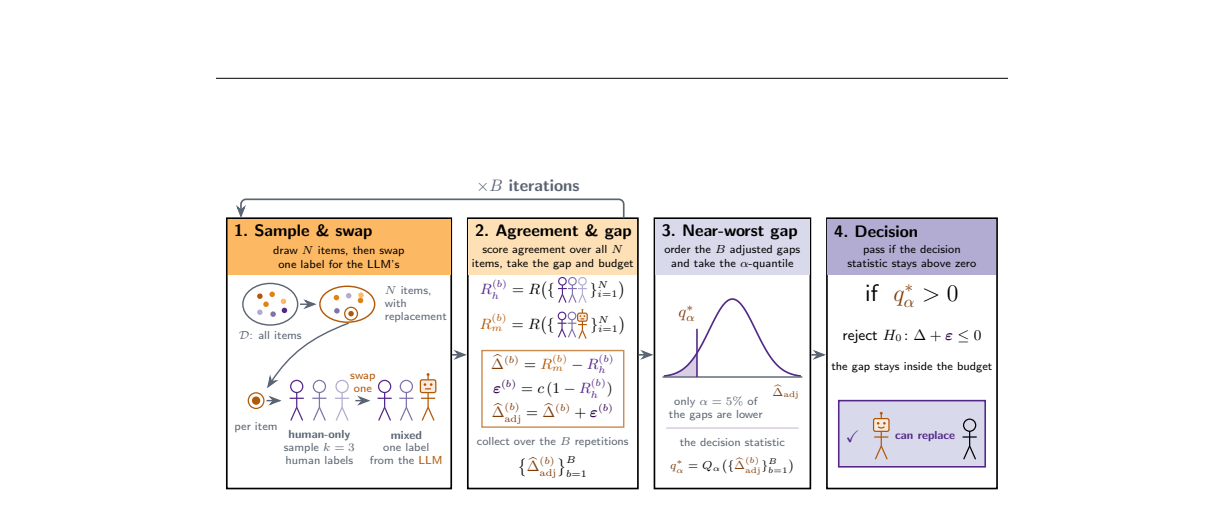
To support such decisions, the Alternative Annotator Test (Alt-Test) was introduced for dense settings where all items are annotated by the same annotators. However, in many large-scale annotation settings, items are annotated by different subsets of annotators. We therefore propose the Alternative Annotator Test with Resampled Annotations (AltRA-Test), a statistical test that does not require that all items are annotated by the same annotators. AltRA-Test uses a bootstrap that resamples items, draws k human annotations for each item, and substitutes one of them with an LLM annotation. This produces paired all-human and mixed human-LLM panels. A replacement is supported when the inter-annotator agreement (IAA) of the mixed panel is statistically non-inferior to the IAA of the all-human panel, i.e., when the LLM preserves the signal that the human annotators share. We establish that AltRA-Test is a consistent test of asymptotic level alpha. We then evaluate it through simulations and real-world experiments in which we test 18 LLMs and 5 prompting techniques on 20 datasets across text, image, audio, and video. Across these evaluations, about 100 items often suffice for the test. In simulations, where we know whether the LLM is a better or a worse annotator than the humans, AltRA-Test makes more correct replacement decisions than existing baselines. In real-world data experiments, LLMs pass the test in about half of the setups, depending mainly on the task. Since replacement is not always justified, we encourage researchers to test it for their task.
from the abstract
Pith says
Machine review · deepseek-v4-flash · 20 Nov 2026 · read the full text (250,947 characters) · not checked by a person
It can be wrong. Challenge this review or reply to it.
Holds up. AltRA-Test relaxes the shared-annotator requirement of prior replacement tests and dominates them in simulations, but its real-world value depends on whether the human annotations carry a meaningful shared signal. This line is wrong
8 minor · 1 open question
How often objections from reviews like this one are right: not yet measured
The paper, first character to last
The reviewer was given the whole text, 250,947 characters. Not checked: figures, code, what the 107 references say.
8 minor objections
The paper says, at §3.1 (The AltRA-Test)
Pith says: minor objection 1 of 8
The description of the paired bootstrap says 'draws k human annotations for each sampled item, replaces one of them with the LLM annotation'. It should clarify whether the replaced annotation is chosen uniformly at random from the k drawn annotations. The algorithm (Algorithm 1) states 'replacing one random annotation', which is clear, but the main text could be more explicit.
The paper says, at §4.1 (Experimental Setup)
Pith says: minor objection 2 of 8
The simulation generates human annotations with noise level η_h and LLM annotations with noise level η_f. The paper states 'with probability η, it returns a label sampled from the same label prior'. This means errors are independent of the item's true label.
more of objection 2
This is a reasonable but strong assumption. The paper later relaxes this with personal bias and shared bias simulations, which is good. However, the basic simulation's error model should be stated more prominently in the main text rather than only in the appendix.
show 6 more
The paper says, at Table 1 (Main results)
Pith says: minor objection 3 of 8
The table reports mixed-panel agreement R̄_m but does not report the human-only agreement R̄_h for each dataset in a way that is easily comparable. The column for R̄_h is given but the values are small and the table is dense. Consider adding a visual indicator (e.g., a horizontal line or shading) to separate datasets where R̄_h ≥ 0.2 from those below, since the paper recommends applying the test only when IAA ≥ 0.2.
The paper says, at §5.2 (Results)
Pith says: minor objection 4 of 8
The paper states 'Under CoT, 49 of the 71 passing cells have R̄_m > R̄_h, and 59 have R̄_m ≥ R̄_h.' This is informative, but it would be helpful to also report how many of the failing cells have R̄_m > R̄_h, to quantify how often the test correctly rejects when the point estimate favors the LLM but uncertainty is large.
The paper says, at §6 (Conclusion)
Pith says: minor objection 5 of 8
The conclusion mentions 'We leave for future work an extension of the test that considers the distribution of the LLM annotations for each item'. This is a reasonable direction, but the paper could also mention the possibility of using multiple LLM samples per item (e.g., temperature sampling) to estimate the LLM's annotation distribution, which would be a natural extension.
The paper says, at Appendix §A.3 (Theoretical Guarantees)
Pith says: minor objection 6 of 8
The proof uses the notation D_{e,h} for expected chance disagreement. The paper should note that D_{e,h} > 0 is required for the agreement coefficient to be well-defined. This is stated in Proposition A.1 but could be emphasized in the main theorem statement.
The paper says, at Throughout
Pith says: minor objection 7 of 8
The paper uses the term 'consistent test of asymptotic level α'. In standard statistical terminology, a test is 'consistent' if its power approaches 1 as sample size grows, and has 'asymptotic level α' if its size approaches α. The paper's Theorem A.1 establishes both properties, but the phrasing 'consistent test of asymptotic level α' could be misinterpreted. Consider rephrasing to 'consistent and asymptotically level-α test'.
The paper says, at §4.2 (Simulation Results)
Pith says: minor objection 8 of 8
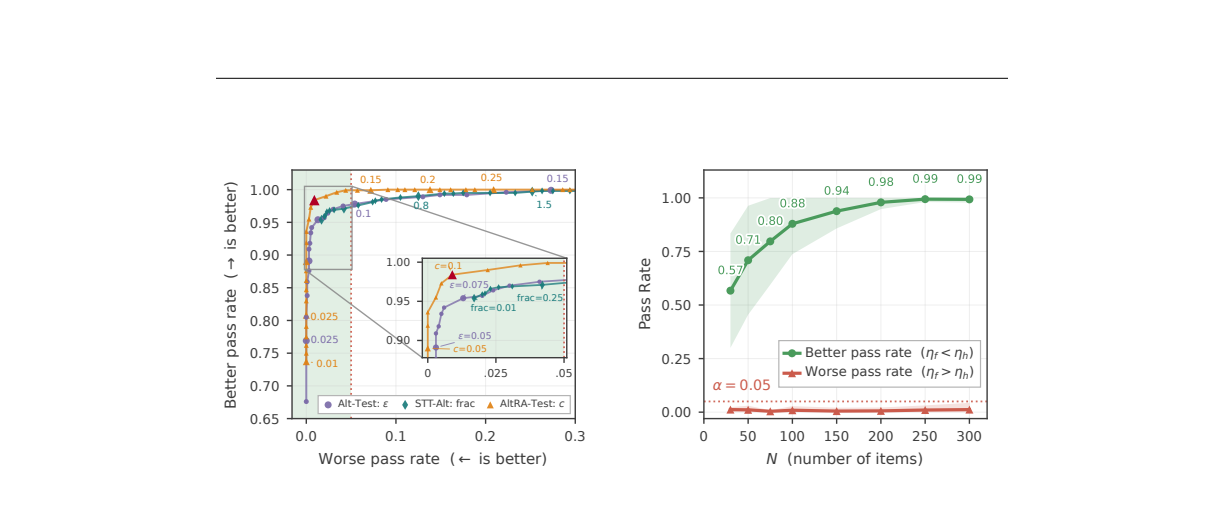
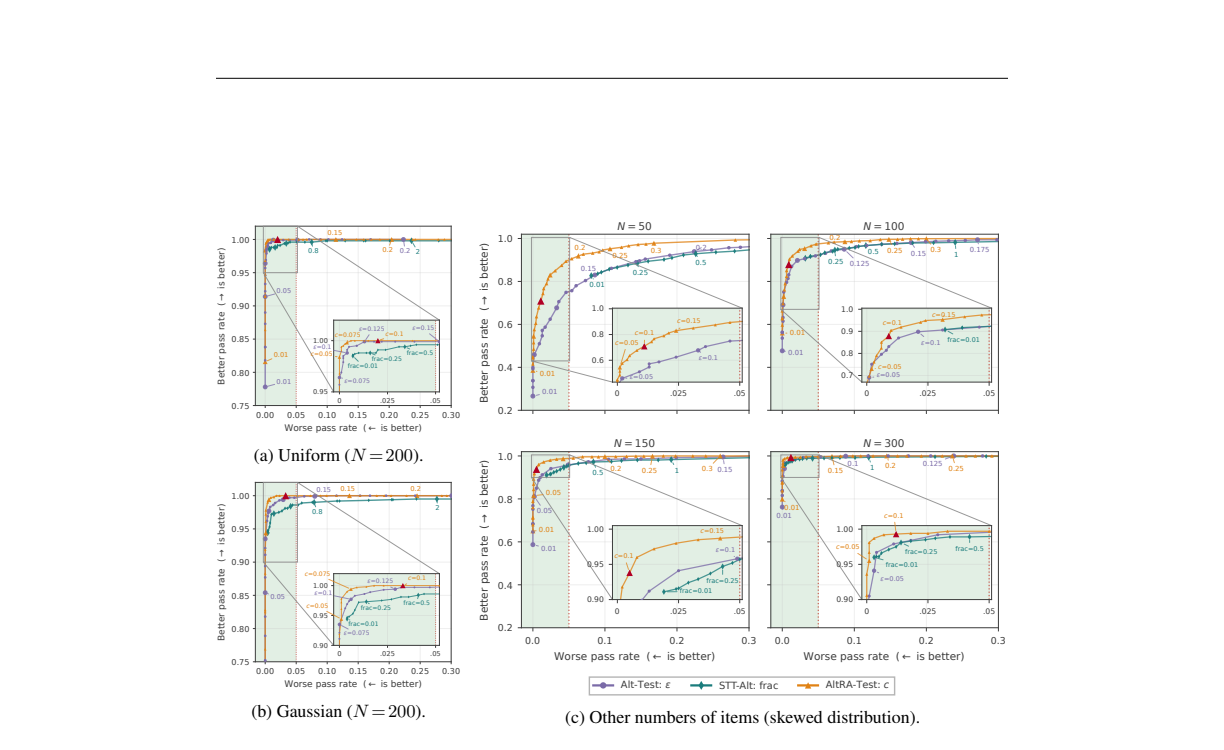
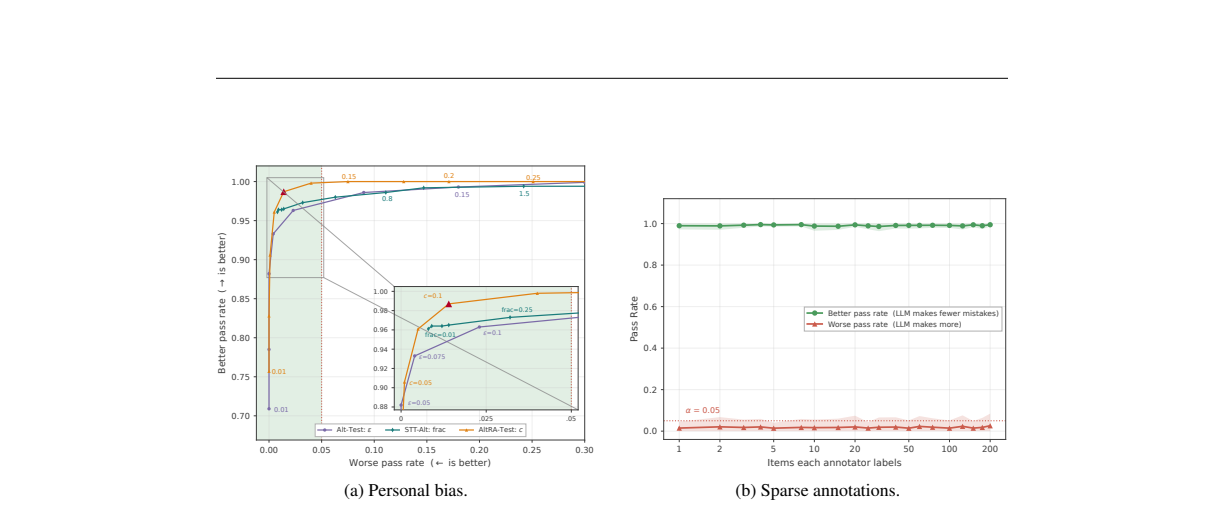
Figure 2 (left) shows the Pareto frontier comparison. The caption says 'The green region marks the valid regime, where the worse-model pass rate is below 0.05.' It would be helpful to also mark the point corresponding to c=0.1 on the curve, as is done in Figure 10 for the bias simulation. The current figure does not show this, making it harder to see where the recommended default lies on the curve.
Open questions (1)
Pith raised these and could not confirm them against the text of the paper it read. They are questions for the authors, not findings.
- §3.2 (Adaptive margin) and §4.2 (Simulation results) Pith raised a concern here that it could not check against the text of the paper it was given, so it is not published as an objection.
What would settle it
A concrete observation that would challenge the central claim: if a dataset with human IAA >= 0.2 is found where an LLM that is known to be worse than humans (e.g., by accuracy on a held-out gold standard) consistently passes the AltRA-Test, or where a known better LLM consistently fails it, that would indicate the test's decisions do not align with ground truth.
from Pith's summary of the paper
How the review went
5 passes by deepseek-v4-flash · 20 Nov 2026
- Reader holds up
- Skeptic concern withdrawn: Pith's reviewer misread the paper
- Referee 8 minor
- Check against the paper kept 0 of 4 objections
- Editor wrote the verdict above
Not run on this paper: the simulated authors' defence.
Pith's passes raised 4 objections. A check against the paper's text kept 0, withdrew 3 (3 Pith's reviewer misread the paper) and left 1 as a question.
The review in full
The review in brief, machine-written
This paper extends the Alternative Annotator Test (Alt-Test) to the common setting where different items are labeled by different subsets of annotators. The core idea is sound: use a paired bootstrap that resamples items and draws k human annotations per item, replacing one with the LLM annotation, then test whether the mixed-panel IAA is non-inferior to the human-only IAA. The adaptive margin, scaled by observed human disagreement, is a sensible way to handle tasks with different agreement levels.
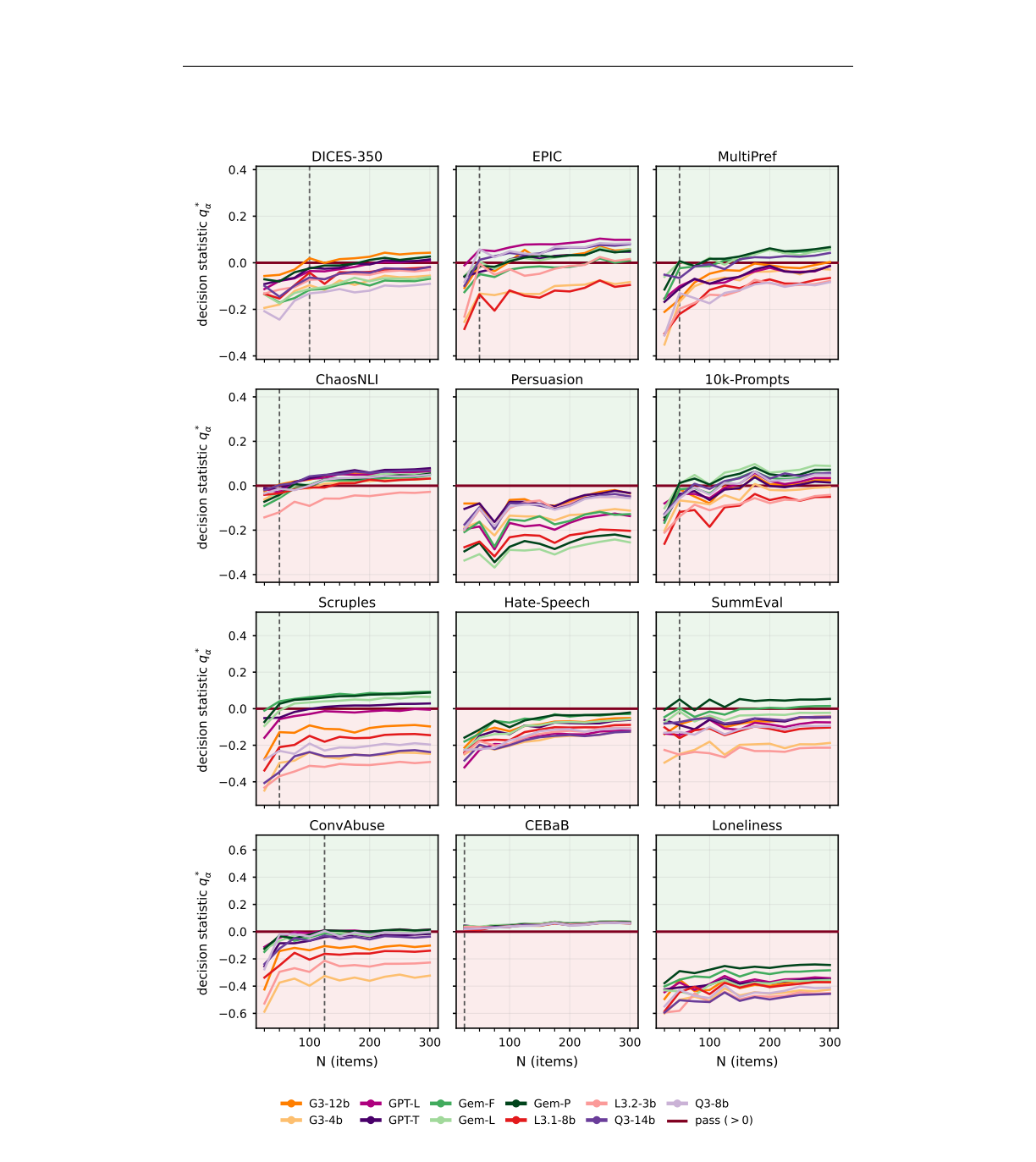
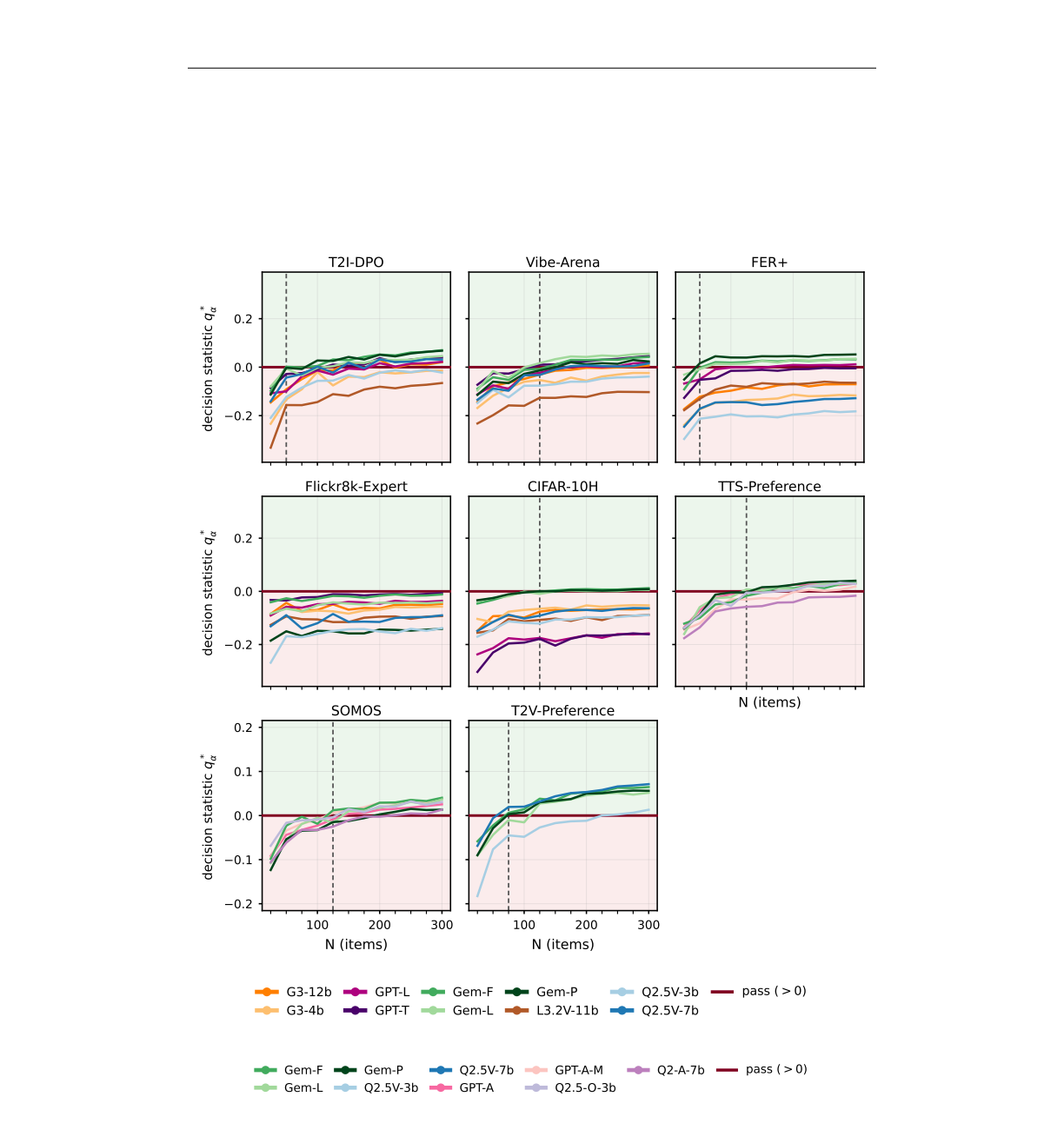
The theoretical proof of consistency and asymptotic level alpha is provided, and the simulations are thorough. The paper shows that AltRA-Test dominates Alt-Test and STT in simulations, achieving a higher better-model pass rate at any given worse-model pass rate. The real-world experiments are extensive: 20 datasets across text, image, audio, and video, with 18 LLMs and 5 prompting techniques. The finding that about 100 items often suffice is practically useful.
The main soft spot is that the test's meaning depends on the human annotations carrying a shared signal. The authors acknowledge this and recommend applying the test only when human IAA is at least 0.2. When human agreement is very low, an uninformative LLM can pass. This is a genuine limitation, not a flaw in the method, but it means the test is most useful for tasks where human annotators already agree to a non-trivial degree. The paper also notes that the test cannot detect errors shared by humans and the LLM, which is a limitation of any test that uses human annotations as the reference.
The paper is a solid incremental contribution. It solves a real practical problem and does so with careful theory and extensive experiments. The writing is clear and the limitations are honestly discussed.
Recommendation: This paper deserves peer review. It is methodologically sound, addresses a practical need, and the claims are supported by the evidence presented. A referee should check the regularity conditions for the asymptotic theory and whether they hold in typical NLP settings, but the core contribution is valuable.
The stress test's concern
Withdrawn: Pith's reviewer misread the paper.
The paper says
“Assume further that $\sigma^2>0$, that the bootstrap replicates are conditionally independent and use fresh independent panel draws, and that $B_N\to\infty$.”
The referee's report
Not published. Pith's referee wrote this assessment before its objections were checked against the paper, and 3 of its 3 major objections did not survive that check.
Pith's reading of the paper (a machine's summary, not the authors')
The paper proposes a statistical test, the Alternative Annotator Test with Resampled Annotations (AltRA-Test), to decide whether an LLM can replace a human annotator in a labeling task. The test works by resampling items and annotations to create paired all-human and mixed human-LLM panels, then checking whether the inter-annotator agreement (IAA) of the mixed panel is non-inferior to that of the all-human panel. Unlike prior tests, it does not require the same annotators to label every item, making it applicable to many real-world annotation settings. The authors establish that the test is consistent and of asymptotic level alpha, and they evaluate it through simulations and on 20 real-world datasets across text, image, audio, and video. They find that about 100 items often suffice, and that replacement decisions are strongly dataset-dependent.
What carries the argument. The central object is the paired percentile bootstrap procedure. In each bootstrap iteration, N items are resampled with replacement, k human annotations are drawn without replacement for each item, and one of those annotations is replaced by the LLM's annotation. The IAA (Krippendorff's alpha) is computed for both the all-human panel and the mixed panel, and the adjusted substitution gap Delta_adj = (R_m - R_h) + c*(k_c/k)*(1 - R_h) is calculated. The empirical alpha-quantile of the bootstrap distribution of Delta_adj is used as the test statistic; the LLM passes when this quantile is positive. The adaptive margin c*(k_c/k)*(1 - R_h) scales with observed human disagreement, allowing the test to accommodate both objective and subjective tasks.
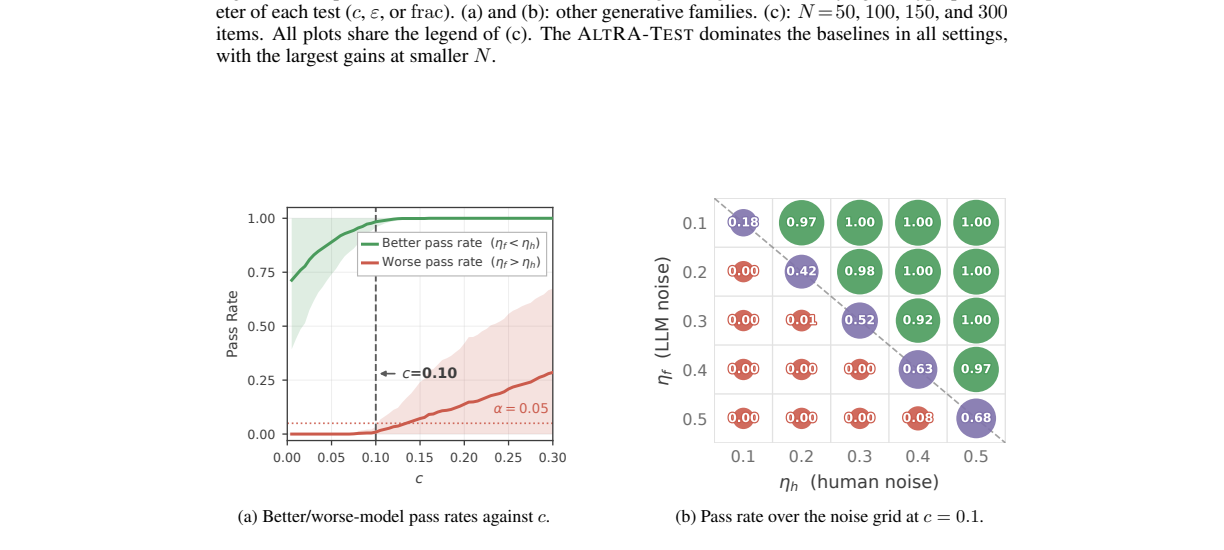
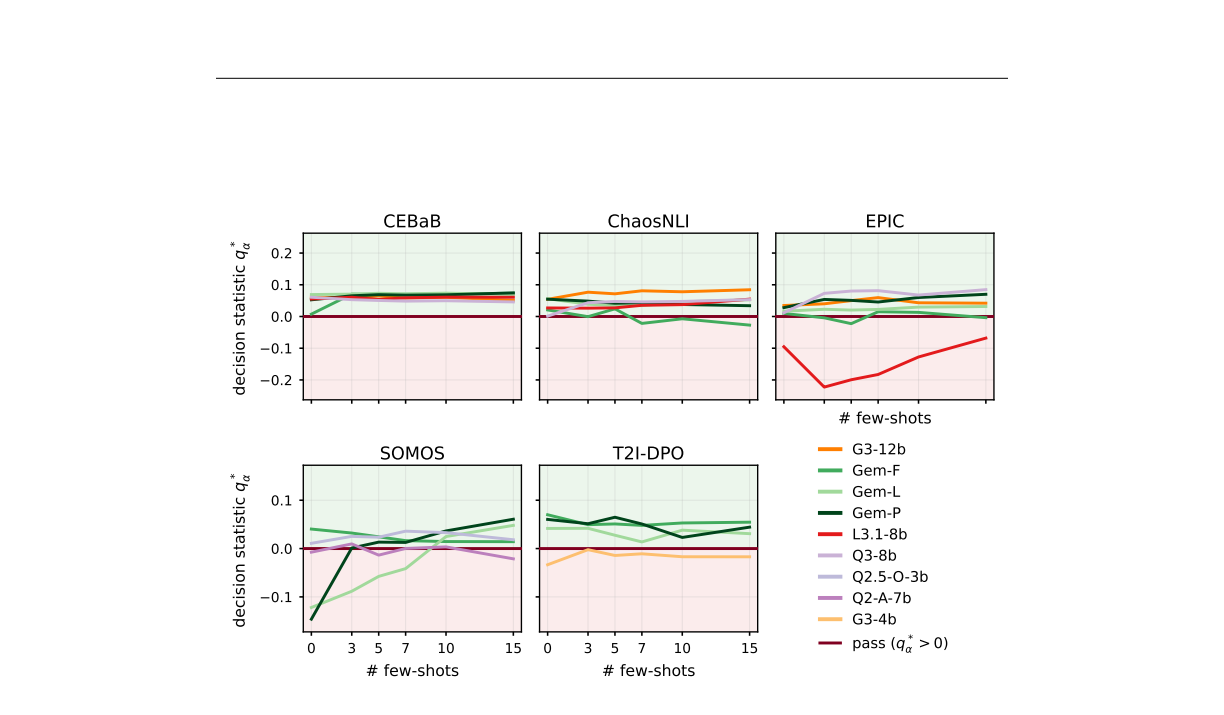
Core claim. The paper introduces the AltRA-Test, a bootstrap-based non-inferiority test that determines whether an LLM can replace a human annotator by comparing the inter-annotator agreement (IAA) of a mixed human-LLM panel to that of a human-only panel. The key innovation is that the test resamples annotations within each item, so it does not require annotator identities or that the same annotators label all items. The authors prove that the test is consistent and of asymptotic level alpha, and they calibrate a default margin constant c=0.1 through simulations. In simulations where ground truth is known, the AltRA-Test dominates existing tests (Alt-Test and STT) by achieving a higher better-model pass rate at any given worse-model pass rate. On real-world data, LLMs pass the test in about half of the setups, with the outcome depending more on the dataset than on the judge or prompting technique.
The premise it rests on. The test assumes that the human annotations carry a shared signal that is meaningful for the task; if human agreement is very low (IAA < 0.2), the test may accept an uninformative LLM.
If the paper is right (Pith's inferences, not the authors')
Researchers can now statistically justify replacing human annotators with LLMs even when different annotators label different items, which covers most crowdsourcing and preference-annotation settings.
The test provides a principled way to compare LLM judges within a dataset using the mean mixed-panel agreement, enabling model selection for annotation tasks.
The finding that replacement is strongly dataset-dependent implies that LLM annotators should be validated per task rather than adopted as a general practice.
The test's adaptive margin allows it to be applied across a wide range of tasks, from objective (high IAA) to subjective (low but non-negligible IAA), with a single calibrated parameter.
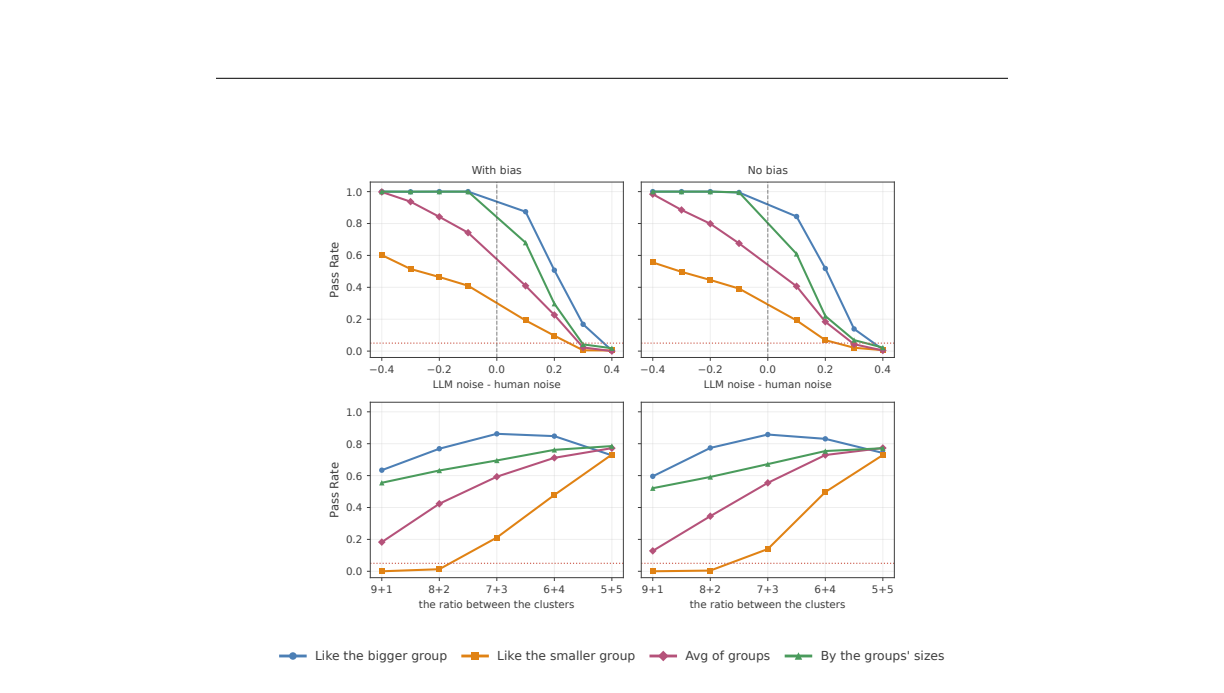
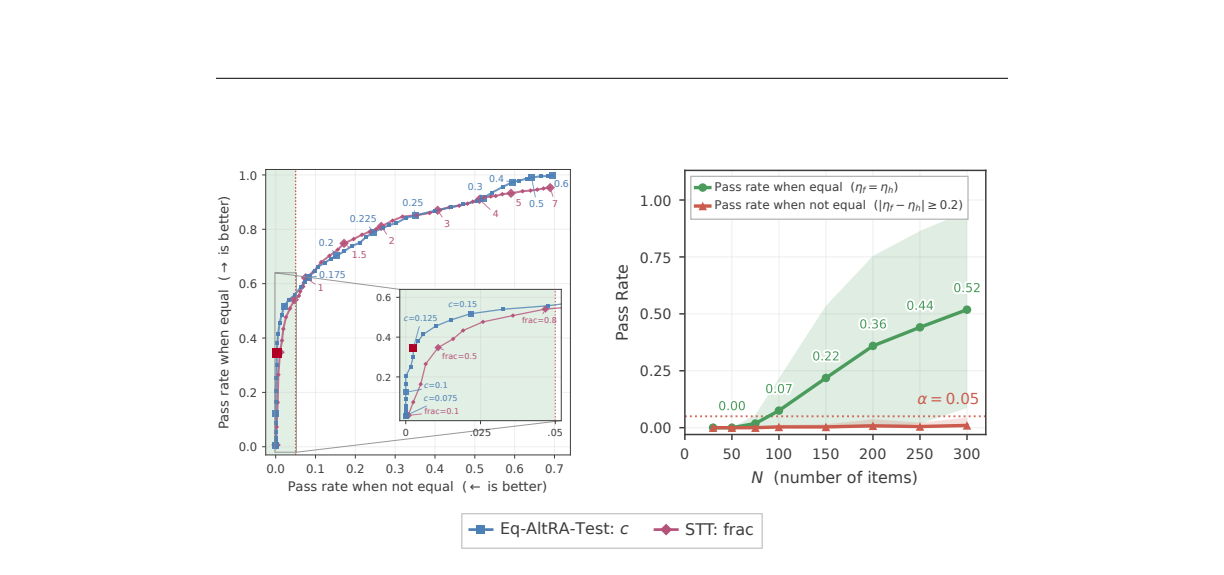
The group-wise and equivalence variants of the test extend its applicability to settings where annotator perspectives or variation must be preserved.
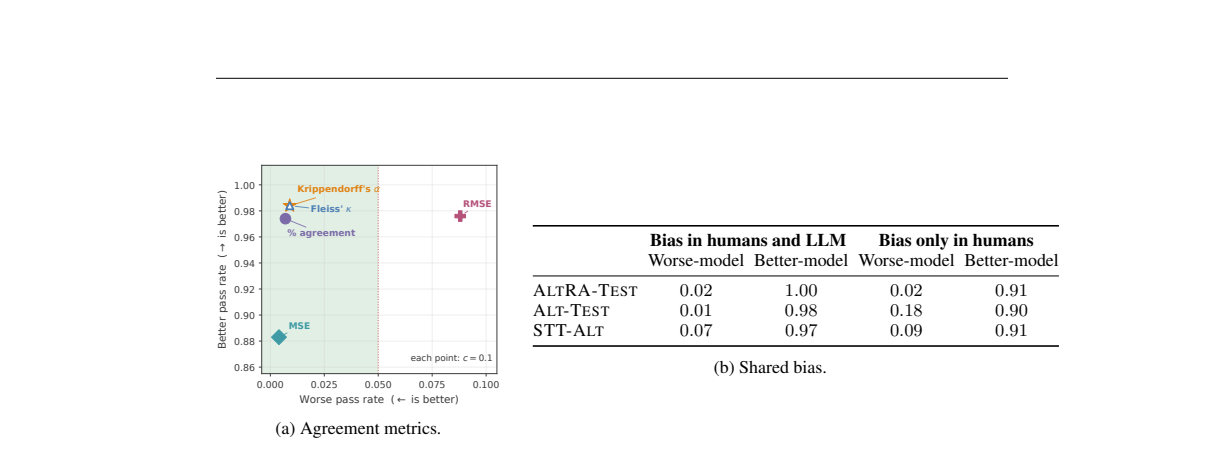
The test's reliance on human IAA as the reference means it cannot detect errors that the LLM shares with the human annotators, a limitation that future work could address by incorporating external validation or gold-standard labels when available.
The finding that about 100 items often suffice suggests that the test could be integrated into iterative annotation pipelines, where a small pilot set is used to decide whether to deploy an LLM annotator at scale.
The test's design implicitly assumes that the human annotations carry a shared signal; in tasks where disagreement is the object of study (e.g., perspectivist approaches), the standard test is not appropriate, and the proposed variants or future distributional extensions should be used.
The calibration of c=0.1 on simulated data with known ground truth provides a principled default, but researchers working on tasks with very high or very low human agreement might consider recalibrating c for their specific setting.
Check this review
What was read
The passes were given all 250,947 characters of the paper's LaTeX source.
Fingerprint of that text (SHA-256): 696a32e4697264e62bdd8cc6c54de83fabf800a0884daf1f48ceaf28a25b3a4a
Pith does not keep that text. Rebuilt from the paper's source or PDF by the same code, it has this fingerprint if it is the same text. From a copy of Pith's code:
PYTHONPATH=. python scripts/review_input_check.py 2611.26073
The passes, in the order they ran
- Reader deepseek-v4-flash · medium effort · $0.0079 · instructions of the Reader, fingerprint f9ead7300382…
- Skeptic deepseek-v4-flash · medium effort · $0.0076 · instructions of the Skeptic, fingerprint 8f88c0f61488…
- Referee deepseek-v4-flash · medium effort · $0.0080 · instructions of the Referee, fingerprint a852d99aea0d…
- Check against the paper deepseek-v4-flash · medium effort · $0.010 · instructions of the Check against the paper, fingerprint 6c7a6883d551…
- Editor deepseek-v4-flash · medium effort · $0.0091 · instructions of the Editor, fingerprint e7211f6a3d27…
- Circularity check deepseek-v4-flash · medium effort · $0.0075 · instructions of the Circularity check, fingerprint e9946e39d67b…
- Summary for the page deepseek-v4-flash · medium effort · temperature 0.2 · $0.0079 · instructions of the Summary for the page, fingerprint e4f56bf568e7…
The passes cost $0.058 in model calls together.
Version stamped on this review: pith-pipeline@v1.4.1-daily-deepseek-or-medium+deepseek/deepseek-v4-flash+p.d60f54226f00
Each link opens a pass's instructions as plain text, the exact bytes its fingerprint was taken over. Every stored set of instructions.
curl -s https://pith.science/methodology/prompts/f9ead730038216984cfb56d7cb34332bdf691828296a1de4245f3d6667d4bf56 | sha256sum
prints the fingerprint of the reader's instructions. The same works for every pass.
The receipt
The review's fingerprint was taken on 20 Nov 2026. The review you are reading still matches it.
Fingerprint of the review (SHA-256): 07ad9f31e16a6464e35b938ccadefa74cfdba51a361d30d26671753bddb1261a
curl -s 'https://pith.science/api/v1/verdicts/2611.26073?form=canonical' | sha256sum
prints the fingerprint of the review as it stands now. The rule, in four steps.
A matching fingerprint shows the review has not changed since that date. It does not show that the review is right.
How often reviews like this one are right
Reviews like this one: written by deepseek-v4-flash, from the paper's LaTeX source.
How often objections from reviews like this one are right: not yet measured
Reviews by people
This review was written by a machine. No person has reviewed this paper on Pith yet. A scientist listed on Pith can review it for a fee, and their review is published here whatever it concludes.
The paper
Abstract
Large language models (LLMs) are increasingly used as judges and graders to replace human annotators, raising the question of when such replacement is statistically justified. To support such decisions, the Alternative Annotator Test (Alt-Test) was introduced for dense settings where all items are annotated by the same annotators. However, in many large-scale annotation settings, items are annotated by different subsets of annotators. We therefore propose the Alternative Annotator Test with Resampled Annotations (AltRA-Test), a statistical test that does not require that all items are annotated by the same annotators. AltRA-Test uses a bootstrap that resamples items, draws k human annotations for each item, and substitutes one of them with an LLM annotation. This produces paired all-human and mixed human-LLM panels. A replacement is supported when the inter-annotator agreement (IAA) of the mixed panel is statistically non-inferior to the IAA of the all-human panel, i.e., when the LLM preserves the signal that the human annotators share. We establish that AltRA-Test is a consistent test of asymptotic level alpha. We then evaluate it through simulations and real-world experiments in which we test 18 LLMs and 5 prompting techniques on 20 datasets across text, image, audio, and video. Across these evaluations, about 100 items often suffice for the test. In simulations, where we know whether the LLM is a better or a worse annotator than the humans, AltRA-Test makes more correct replacement decisions than existing baselines. In real-world data experiments, LLMs pass the test in about half of the setups, depending mainly on the task. Since replacement is not always justified, we encourage researchers to test it for their task.
The paper's own sentences, arranged, kept beside the review and separate from it. Each label is drawn from a closed vocabulary; the number beside it is the probability the classifier gave that label. No sentence in this record was written by a model.
abstract compiled · 2026-11-20
The authors' main claim, as the classifier picked it out 0.75
“Since replacement is not always justified, we encourage researchers to test it for their task.”
How the main claim is stated: asserted 0.74
What the abstract itself states, as probabilities: claims first 0.09 · states limitation 0.82 · human participants 0.51 · controlled comparison 0.93 · randomized assignment 0.05 · states quantitative result 0.97 · compares with prior results 0.95 · mentions code or data availability 0.03
The abstract, sentence by sentence
This table labels the abstract only (arXiv listing abstract v1). The number is the probability the classifier gave the label.
| Sentence | Role | The authors' own work | States the main conclusion | Strength |
|---|---|---|---|---|
| Large language models (LLMs) are increasingly used as judges and graders to replace human annotators, raising the question of when such replacement is statistically justified. | background 1.00 | 0.04 | 0.04 | asserted 0.99 |
| To support such decisions, the Alternative Annotator Test (Alt-Test) was introduced for dense settings where all items are annotated by the same annotators. | background 0.98 | 0.10 | 0.03 | asserted 1.00 |
| However, in many large-scale annotation settings, items are annotated by different subsets of annotators. | gap 0.64 | 0.10 | 0.02 | asserted 0.98 |
| We therefore propose the Alternative Annotator Test with Resampled Annotations (AltRA-Test), a statistical test that does not require that all items are annotated by the same annotators. | contribution 1.00 | 0.88 | 0.16 | asserted 1.00 |
| AltRA-Test uses a bootstrap that resamples items, draws k human annotations for each item, and substitutes one of them with an LLM annotation. | method 1.00 | 0.78 | 0.04 | asserted 1.00 |
| This produces paired all-human and mixed human-LLM panels. | method 1.00 | 0.79 | 0.03 | asserted 1.00 |
| A replacement is supported when the inter-annotator agreement (IAA) of the mixed panel is statistically non-inferior to the IAA of the all-human panel, i.e., when the LLM preserves the signal that the human annotators share. | method 0.89 | 0.23 | 0.18 | asserted 0.99 |
| We establish that AltRA-Test is a consistent test of asymptotic level alpha. | contribution 0.63 | 0.93 | 0.09 | asserted 1.00 |
| We then evaluate it through simulations and real-world experiments in which we test 18 LLMs and 5 prompting techniques on 20 datasets across text, image, audio, and video. | method 0.56 | 0.96 | 0.05 | asserted 0.99 |
| Across these evaluations, about 100 items often suffice for the test. | result 1.00 | 0.92 | 0.07 | asserted 0.66 |
| In simulations, where we know whether the LLM is a better or a worse annotator than the humans, AltRA-Test makes more correct replacement decisions than existing baselines. | result 1.00 | 0.96 | 0.14 | asserted 1.00 |
| In real-world data experiments, LLMs pass the test in about half of the setups, depending mainly on the task. | result 1.00 | 0.96 | 0.28 | asserted 1.00 |
| Since replacement is not always justified, we encourage researchers to test it for their task. | future work 0.93 | 0.14 | 0.31 | asserted 0.74 |
What kind of paper the classifier reports this is: method or tool 1.00 · evidence from observation or experiment 0.86
What was examined, and what was not
Sources read
- arXiv listing abstract v1
Not examined
- full text
- figures and tables
- references and citing sentences
- relations to other papers
Levels run
- P abstract
Not run
- S sections
- T body sentences
- C citations
- R cross-paper relations
How the labels were made
Compiled by classifier-1.13.0 via TypeSafe API, question bank abstract-p1-20260923, 2026-11-20: 1 request, 9,551 input tokens.
Every quoted sentence on this record is the authors'. Every label is from Pith's closed vocabulary, with the probability shown beside it. This record as JSON
Figures (13)
Figures are the authors', reproduced from the paper.
References (107)
- [1] Nitay Calderon and Roi Reichart and Rotem Dror , editor =. The Alternative Annotator Test for LLM-as-a-Judge: How to Statistically Justify Replacing Human Annotators with LLMs , booktitle =. 2025 , url =. doi:10.18653/V1/2025.ACL-LONG.782 , timestamp = on Pithdoi:10.18653/v1/2025.acl-long.782
- [2] Eldar David Abraham and Karel D'Oosterlinck and Amir Feder and Yair Ori Gat and Atticus Geiger and Christopher Potts and Roi Reichart and Zhengxuan Wu , editor =. CEBaB: Estimating the Causal Effects of Real-World Concepts on. Advances in Neural Information Processing Systems ... on Pith
- [3] Yixin Nie and Xiang Zhou and Mohit Bansal , editor =. What Can We Learn from Collective Human Opinions on Natural Language Inference Data? , booktitle =. 2020 , url =. doi:10.18653/V1/2020.EMNLP-MAIN.734 , timestamp = on Pithdoi:10.18653/v1/2020.emnlp-main.734
- [4] Amanda Cercas Curry and Gavin Abercrombie and Verena Rieser , title =. CoRR , volume =. 2021 , url =. 2109.09483 , timestamp = on PithPith's reviewarXiv
- [5] Lora Aroyo and Alex S. Taylor and Mark D. Advances in Neural Information Processing Systems 36: Annual Conference on Neural Information Processing Systems 2023, NeurIPS 2023, New Orleans, LA, USA, December 10 - 16, 2023 , year = on Pith
- [6] Simona Frenda and Alessandro Pedrani and Valerio Basile and Soda Marem Lo and Alessandra Teresa Cignarella and Raffaella Panizzon and Cristina Marco and Bianca Scarlini and Viviana Patti and Cristina Bosco and Davide Bernardi , editor =. Proceedings of the 61st Annual Meeting ... on Pithdoi:10.18653/v1/2023.acl-long.774
- [7] Pratik S. Sachdeva and Renata Barreto and Geoff Bacon and Alexander Sahn and Claudia von Vacano and Chris J. Kennedy , editor =. The Measuring Hate Speech Corpus: Leveraging Rasch Measurement Theory for Data Perspectivism , booktitle =. 2022 , url = on Pith
- [8] Lester James Validad Miranda and Yizhong Wang and Yanai Elazar and Sachin Kumar and Valentina Pyatkin and Faeze Brahman and Noah A. Smith and Hannaneh Hajishirzi and Pradeep Dasigi , editor =. Hybrid Preferences: Learning to Route Instances for Human vs. Proceedings of the 63r... on Pithdoi:10.18653/v1/2025.acl-long.355
- [9] Nicholas Lourie and Ronan Le Bras and Yejin Choi , title =. Thirty-Fifth. 2021 , url =. doi:10.1609/AAAI.V35I15.17589 , timestamp = on Pithdoi:10.1609/aaai.v35i15.17589
- [11] Joshua C. Peterson and Ruairidh M. Battleday and Thomas L. Griffiths and Olga Russakovsky , title =. 2019. 2019 , url =. doi:10.1109/ICCV.2019.00971 , timestamp = on Pithdoi:10.1109/iccv.2019.00971
- [12] Emad Barsoum and Cha Zhang and Cristian Canton. Training deep networks for facial expression recognition with crowd-sourced label distribution , booktitle =. 2016 , url =. doi:10.1145/2993148.2993165 , timestamp = on Pithdoi:10.1145/2993148.2993165
- [13] Micah Hodosh and Peter Young and Julia Hockenmaier , title =. J. Artif. Intell. Res. , volume =. 2013 , url =. doi:10.1613/JAIR.3994 , timestamp = on Pithdoi:10.1613/jair.3994
- [14] Shengqu Cai and Eric Ryan Chan and Yunzhi Zhang and Leonidas J. Guibas and Jiajun Wu and Gordon Wetzstein , title =. 2025 , url =. doi:10.1109/CVPR52734.2025.01718 , timestamp = on Pithdoi:10.1109/cvpr52734.2025.01718
- [15] Georgia Maniati and Alexandra Vioni and Nikolaos Ellinas and Karolos Nikitaras and Konstantinos Klapsas and June Sig Sung and Gunu Jho and Aimilios Chalamandaris and Pirros Tsiakoulis , editor =. 23rd Annual Conference of the International Speech Communication Association, Int... on Pithdoi:10.21437/interspeech.2022-10922
- [16] Xuan He and Dongfu Jiang and Ping Nie and Minghao Liu and Zhengxuan Jiang and Mingyi Su and Wentao Ma and Junru Lin and Chun Ye and Yi Lu and Keming Wu and Benjamin Schneider and Quy Duc Do and Zhuofeng Li and Yiming Jia and Yuxuan Zhang and Guo Cheng and Haozhe Wang and Wangc... on Pithdoi:10.48550/arxiv.2509.22799
- [17] Anand Siththaranjan and Cassidy Laidlaw and Dylan Hadfield. Distributional Preference Learning: Understanding and Accounting for Hidden Context in. The Twelfth International Conference on Learning Representations,. 2024 , url = on Pith
- [18] Omer Nahum and Nitay Calderon and Orgad Keller and Idan Szpektor and Roi Reichart , editor =. Are LLMs Better than Reported? Detecting Label Errors and Mitigating Their Effect on Model Performance , booktitle =. 2025 , url =. doi:10.18653/V1/2025.EMNLP-MAIN.1360 , timestamp = on Pithdoi:10.18653/v1/2025.emnlp-main.1360
- [19] Dawei Li and Bohan Jiang and Liangjie Huang and Alimohammad Beigi and Chengshuai Zhao and Zhen Tan and Amrita Bhattacharjee and Yuxuan Jiang and Canyu Chen and Tianhao Wu and Kai Shu and Lu Cheng and Huan Liu , editor =. From Generation to Judgment: Opportunities and Challenge... on Pithdoi:10.18653/v1/2025.emnlp-main.138
- [20] Lakshya A. Agrawal and Shangyin Tan and Dilara Soylu and Noah Ziems and Rishi Khare and Krista Opsahl. CoRR , volume =. 2025 , url =. doi:10.48550/ARXIV.2507.19457 , eprinttype =. 2507.19457 , timestamp = on PithPith's reviewarXivdoi:10.48550/arxiv.2507.19457
- [21] Jason Wei and Xuezhi Wang and Dale Schuurmans and Maarten Bosma and Brian Ichter and Fei Xia and Ed H. Chi and Quoc V. Le and Denny Zhou , editor =. Chain-of-Thought Prompting Elicits Reasoning in Large Language Models , booktitle =. 2022 , url = on Pith
show 80 more
- [22] Tianyi Zhang and Varsha Kishore and Felix Wu and Kilian Q. Weinberger and Yoav Artzi , title =. 8th International Conference on Learning Representations,. 2020 , url = on Pith
- [23] Team Qwen , title =. CoRR , volume =. 2025 , url =. doi:10.48550/ARXIV.2505.09388 , eprinttype =. 2505.09388 , timestamp = on PithPith's reviewarXivdoi:10.48550/arxiv.2505.09388
- [24] Team Llama , title =. CoRR , volume =. 2024 , url =. doi:10.48550/ARXIV.2407.21783 , eprinttype =. 2407.21783 , timestamp = on PithPith's reviewarXivdoi:10.48550/arxiv.2407.21783
- [25] Team Gemma , title =. CoRR , volume =. 2025 , url =. doi:10.48550/ARXIV.2503.19786 , eprinttype =. 2503.19786 , timestamp = on PithPith's reviewarXivdoi:10.48550/arxiv.2503.19786
- [26] Team Qwen , title =. CoRR , volume =. 2025 , url =. doi:10.48550/ARXIV.2511.21631 , eprinttype =. 2511.21631 , timestamp = on PithPith's reviewarXivdoi:10.48550/arxiv.2511.21631
- [27] Jin Xu and Zhifang Guo and Jinzheng He and Hangrui Hu and Ting He and Shuai Bai and Keqin Chen and Jialin Wang and Yang Fan and Kai Dang and Bin Zhang and Xiong Wang and Yunfei Chu and Junyang Lin , title =. CoRR , volume =. 2025 , url =. doi:10.48550/ARXIV.2503.20215 , eprint... on PithPith's reviewarXivdoi:10.48550/arxiv.2503.20215
- [28] Yunfei Chu and Jin Xu and Qian Yang and Haojie Wei and Xipin Wei and Zhifang Guo and Yichong Leng and Yuanjun Lv and Jinzheng He and Junyang Lin and Chang Zhou and Jingren Zhou , title =. CoRR , volume =. 2024 , url =. doi:10.48550/ARXIV.2407.10759 , eprinttype =. 2407.10759 ,... on PithPith's reviewarXivdoi:10.48550/arxiv.2407.10759
- [29] Answering the call for a standard reliability measure for coding data , author=. Communication methods and measures , volume=. 2007 , publisher= on Pith
- [30] Measuring nominal scale agreement among many raters. , author=. Psychological bulletin , volume=. 1971 , publisher= on Pith
- [31] Jiaman He and Zikang Leng and Dana McKay and Damiano Spina and Johanne R. Trippas , title =. Proceedings of the 2025 Annual International. 2025 , url =. doi:10.1145/3767695.3769508 , timestamp = on Pithdoi:10.1145/3767695.3769508
- [32] Fabrizio Gilardi and Meysam Alizadeh and Ma. ChatGPT Outperforms Crowd-Workers for Text-Annotation Tasks , journal =. 2023 , url =. doi:10.48550/ARXIV.2303.15056 , eprinttype =. 2303.15056 , timestamp = on PithPith's reviewarXivdoi:10.48550/arxiv.2303.15056
- [33] Petter T. ChatGPT-4 Outperforms Experts and Crowd Workers in Annotating Political Twitter Messages with Zero-Shot Learning , journal =. 2023 , url =. doi:10.48550/ARXIV.2304.06588 , eprinttype =. 2304.06588 , timestamp = on PithPith's reviewarXivdoi:10.48550/arxiv.2304.06588
- [34] Joachim Baumann and Paul R. Large Language Model Hacking: Quantifying the Hidden Risks of Using LLMs for Text Annotation , journal =. 2025 , url =. doi:10.48550/ARXIV.2509.08825 , eprinttype =. 2509.08825 , timestamp = on Pithdoi:10.48550/arxiv.2509.08825
- [35] Lianmin Zheng and Wei. Judging LLM-as-a-Judge with MT-Bench and Chatbot Arena , booktitle =. 2023 , url = on Pith
- [36] Multiparameter hypothesis testing and acceptance sampling , author=. Technometrics , volume=. 1982 , publisher= on Pith
- [37] Hui Wei and Shenghua He and Tian Xia and Andy Wong and Jingyang Lin and Mei Han , title =. CoRR , volume =. 2024 , url =. doi:10.48550/ARXIV.2408.13006 , eprinttype =. 2408.13006 , timestamp = on PithPith's reviewarXivdoi:10.48550/arxiv.2408.13006
- [38] Nagham Omar and Maya Rozenshtein and Evgeny Mishlyakov and Avigdor Gal , editor =. Train Smarter, Not Harder: Switching Signal-Guided Training in Active Learning , booktitle =. 2026 , url = on Pith
- [39] Zhen Tan and Dawei Li and Song Wang and Alimohammad Beigi and Bohan Jiang and Amrita Bhattacharjee and Mansooreh Karami and Jundong Li and Lu Cheng and Huan Liu , editor =. Large Language Models for Data Annotation and Synthesis:. Proceedings of the 2024 Conference on Empirica... on Pithdoi:10.18653/v1/2024.emnlp-main.54
- [41] Nagham Omar and Mahmoud Jabarin and Kinan Ibraheem and Lotem Peled. It's Not What the Image Shows: Irrelevant Context Destabilises. CoRR , volume =. 2026 , url =. doi:10.48550/ARXIV.2609.37863 , eprinttype =. 2609.37863 , timestamp = on PithPith's reviewarXivdoi:10.48550/arxiv.2609.37863
- [42] Xiaobao Wu , editor =. A Comprehensive Survey on Learning from Rewards for Large Language Models: Reward Models and Learning Strategies , booktitle =. 2025 , url =. doi:10.18653/V1/2025.FINDINGS-EMNLP.970 , timestamp = on Pithdoi:10.18653/v1/2025.findings-emnlp.970
- [43] Yi. Generalist Reward Models: Found Inside Large Language Models , journal =. 2025 , url =. doi:10.48550/ARXIV.2506.23235 , eprinttype =. 2506.23235 , timestamp = on PithPith's reviewarXivdoi:10.48550/arxiv.2506.23235
- [44] Koki Wataoka and Tsubasa Takahashi and Ryokan Ri , title =. CoRR , volume =. 2024 , url =. doi:10.48550/ARXIV.2410.21819 , eprinttype =. 2410.21819 , timestamp = on PithPith's reviewarXivdoi:10.48550/arxiv.2410.21819
- [45] Lin Shi and Chiyu Ma and Wenhua Liang and Xingjian Diao and Weicheng Ma and Soroush Vosoughi , editor =. Judging the Judges:. Proceedings of the 14th International Joint Conference on Natural Language Processing and the 4th Conference of the Asia-Pacific Chapter of the Associa... on Pithdoi:10.18653/v1/2025.ijcnlp-long.18
- [46] Peiyi Wang and Lei Li and Liang Chen and Zefan Cai and Dawei Zhu and Binghuai Lin and Yunbo Cao and Lingpeng Kong and Qi Liu and Tianyu Liu and Zhifang Sui , editor =. Large Language Models are not Fair Evaluators , booktitle =. 2024 , url =. doi:10.18653/V1/2024.ACL-LONG.511 ... on Pithdoi:10.18653/v1/2024.acl-long.511
- [47] Annalisa Szymanski and Noah Ziems and Heather A. Eicher. Limitations of the LLM-as-a-Judge Approach for Evaluating. Proceedings of the 30th International Conference on Intelligent User Interfaces,. 2025 , url =. doi:10.1145/3708359.3712091 , timestamp = on Pithdoi:10.1145/3708359.3712091
- [48] Yu. Evaluating Large Language Models as Expert Annotators , journal =. 2025 , url =. doi:10.48550/ARXIV.2508.07827 , eprinttype =. 2508.07827 , timestamp = on PithPith's reviewarXivdoi:10.48550/arxiv.2508.07827
- [49] Sourabrata Mukherjee and Hamna and Kalika Bali and Sunayana Sitaram , title =. CoRR , volume =. 2026 , url =. doi:10.48550/ARXIV.2606.03043 , eprinttype =. 2606.03043 , timestamp = on PithPith's reviewarXivdoi:10.48550/arxiv.2606.03043
- [50] Barbara Plank , editor =. The "Problem" of Human Label Variation: On Ground Truth in Data, Modeling and Evaluation , booktitle =. 2022 , url =. doi:10.18653/V1/2022.EMNLP-MAIN.731 , timestamp = on Pithdoi:10.18653/v1/2022.emnlp-main.731
- [51] We need to consider disagreement in evaluation , author=. Proceedings of the 1st workshop on benchmarking: past, present and future , pages= on Pith
- [52] Anna Bavaresco and Raffaella Bernardi and Leonardo Bertolazzi and Desmond Elliott and Raquel Fern. LLMs instead of Human Judges?. Proceedings of the 63rd Annual Meeting of the Association for Computational Linguistics (Volume 2: Short Papers),. 2025 , url =. doi:10.18653/V1/20... on Pithdoi:10.18653/v1/2025.acl-short.20
- [53] Noah Lee and Na An and James Thorne , editor =. Can Large Language Models Capture Dissenting Human Voices? , booktitle =. 2023 , url =. doi:10.18653/V1/2023.EMNLP-MAIN.278 , timestamp = on Pithdoi:10.18653/v1/2023.emnlp-main.278
- [54] Search arena: Analyzing search-augmented llms , author=. International Conference on Learning Representations , volume= on Pith
- [55] Mihran Miroyan and Tsung. Search Arena: Analyzing Search-Augmented LLMs , journal =. 2025 , url =. doi:10.48550/ARXIV.2506.05334 , eprinttype =. 2506.05334 , timestamp = on Pithdoi:10.48550/arxiv.2506.05334
- [56] Zhuoran Jin and Hongbang Yuan and Kejian Zhu and Jiachun Li and Pengfei Cao and Yubo Chen and Kang Liu and Jun Zhao , title =. CoRR , volume =. 2025 , url =. doi:10.48550/ARXIV.2510.23451 , eprinttype =. 2510.23451 , timestamp = on Pithdoi:10.48550/arxiv.2510.23451
- [57] Shu Pu and Yaochen Wang and Dongping Chen and Yuhang Chen and Guohao Wang and Qi Qin and Zhongyi Zhang and Zhiyuan Zhang and Zetong Zhou and Shuang Gong and Yi Gui and Yao Wan and Philip S. Yu , editor =. Judge Anything:. Proceedings of the 31st. 2025 , url =. doi:10.1145/3711... on Pithdoi:10.1145/3711896.3737409
- [58] Jongwoo Ko and Sungnyun Kim and Sungwoo Cho and Se. Flex-Judge: Text-Only Reasoning Unleashes Zero-Shot Multimodal Evaluators , booktitle =. 2025 , url = on Pith
- [59] Anastasios N. Angelopoulos and Stephen Bates and Clara Fannjiang and Michael I. Jordan and Tijana Zrnic , title =. CoRR , volume =. 2023 , url =. doi:10.48550/ARXIV.2301.09633 , eprinttype =. 2301.09633 , timestamp = on PithPith's reviewarXivdoi:10.48550/arxiv.2301.09633
- [60] Chen Feng and Minghe Shen and Ananth Balashankar and Carsten Gerner. Noisy but Valid: Robust Statistical Evaluation of LLMs with Imperfect Judges , journal =. 2026 , url =. doi:10.48550/ARXIV.2601.20913 , eprinttype =. 2601.20913 , timestamp = on Pithdoi:10.48550/arxiv.2601.20913
- [61] Chungpa Lee and Thomas Zeng and Jongwon Jeong and Jy. How to Correctly Report LLM-as-a-Judge Evaluations , journal =. 2025 , url =. doi:10.48550/ARXIV.2511.21140 , eprinttype =. 2511.21140 , timestamp = on PithPith's reviewarXivdoi:10.48550/arxiv.2511.21140
- [62] A comparison of the two one-sided tests procedure and the power approach for assessing the equivalence of average bioavailability , author=. Journal of pharmacokinetics and biopharmaceutics , volume=. 1987 , publisher= on Pith
- [63] Using significance tests to evaluate equivalence between two experimental groups. , author=. Psychological bulletin , volume=. 1993 , publisher= on Pith
- [64] Nirit Nussbaum. CoRR , volume =. 2026 , url =. doi:10.48550/ARXIV.2606.05972 , eprinttype =. 2606.05972 , timestamp = on PithPith's reviewarXivdoi:10.48550/arxiv.2606.05972
- [65] Nitay Calderon and Liat Ein. Multi-Domain Explainability of Preferences , booktitle =. 2025 , url =. doi:10.18653/V1/2025.EMNLP-MAIN.736 , timestamp = on Pithdoi:10.18653/v1/2025.emnlp-main.736
- [66] Shir Lissak and Nitay Calderon and Geva Shenkman and Yaakov Ophir and Eyal Fruchter and Anat Brunstein Klomek and Roi Reichart , editor =. The Colorful Future of LLMs: Evaluating and Improving LLMs as Emotional Supporters for Queer Youth , booktitle =. 2024 , url =. doi:10.186... on Pithdoi:10.18653/v1/2024.naacl-long.113
- [67] Testing statistical hypotheses of equivalence and noninferiority , author=. 2010 , publisher= on Pith
- [68] Reporting of noninferiority and equivalence randomized trials: extension of the CONSORT 2010 statement , author=. Jama , volume=. 2012 , publisher= on Pith
- [69] Alexandra Uma and Tommaso Fornaciari and Dirk Hovy and Silviu Paun and Barbara Plank and Massimo Poesio , title =. J. Artif. Intell. Res. , volume =. 2021 , url =. doi:10.1613/JAIR.1.12752 , timestamp = on Pithdoi:10.1613/jair.1.12752
- [70] Lora Aroyo and Chris Welty , title =. 2015 , url =. doi:10.1609/AIMAG.V36I1.2564 , timestamp = on Pithdoi:10.1609/aimag.v36i1.2564
- [71] Pat Verga and Sebastian Hofst. Replacing Judges with Juries: Evaluating. CoRR , volume =. 2024 , url =. doi:10.48550/ARXIV.2404.18796 , eprinttype =. 2404.18796 , timestamp = on PithPith's reviewarXivdoi:10.48550/arxiv.2404.18796
- [73] Theoretical Statistics. Lecture 1 , author=. 2013 , url= on Pith
- [74] Theoretical Statistics. Lecture 16 , author=. 2013 , url= on Pith
- [75] A proof of the central limit theorem using the 2 -Wasserstein metric , author=. L’Enseignement Math on Pith
- [76] What teachers should know about the bootstrap: Resampling in the undergraduate statistics curriculum , author=. The american statistician , volume=. 2015 , publisher= on Pith
- [77] Bradley Efron and Robert Tibshirani , title =. 1993 , url =. doi:10.1007/978-1-4899-4541-9 , isbn = on Pithdoi:10.1007/978-1-4899-4541-9
- [78] Computing Krippendorff's alpha-reliability , author= on Pith
- [79] Probabilistic Systems Analysis and Applied Probability, Lecture 12 , author=. 2013 , howpublished= on Pith
- [80] Probabilistic Systems Analysis and Applied Probability, Lecture 19 , author=. 2013 , howpublished= on Pith
- [81] Probabilistic Systems Analysis and Applied Probability , author= on Pith
- [82] Asymptotic Statistics , author=. 1998 , publisher= on Pith
- [83] Asymptotic statistics , author=. 2000 , publisher= on Pith
- [84] Ron Artstein and Massimo Poesio , title =. Comput. Linguistics , volume =. 2008 , url =. doi:10.1162/COLI.07-034-R2 , timestamp = on Pithdoi:10.1162/coli.07-034-r2
- [85] Peter Bailey and Nick Craswell and Ian Soboroff and Paul Thomas and Arjen P. de Vries and Emine Yilmaz , editor =. Relevance assessment: are judges exchangeable and does it matter , booktitle =. 2008 , url =. doi:10.1145/1390334.1390447 , timestamp = on Pithdoi:10.1145/1390334.1390447
- [87] Bosheng Ding and Chengwei Qin and Linlin Liu and Yew Ken Chia and Boyang Li and Shafiq Joty and Lidong Bing , editor =. Is. Proceedings of the 61st Annual Meeting of the Association for Computational Linguistics (Volume 1: Long Papers),. 2023 , url =. doi:10.18653/V1/2023.ACL-... on Pithdoi:10.18653/v1/2023.acl-long.626
- [88] Ganqu Cui and Lifan Yuan and Ning Ding and Guanming Yao and Bingxiang He and Wei Zhu and Yuan Ni and Guotong Xie and Ruobing Xie and Yankai Lin and Zhiyuan Liu and Maosong Sun , editor =. Forty-first International Conference on Machine Learning,. 2024 , url = on Pith
- [89] Maria Kunilovskaya and Gagan Bhatia and Lisa Sophie Albertelli and Yanran Chen and Christian Greisinger and Lotta Kiefer and Christoph Leiter and Subhadeep Roy and Tewodros Achamaleh and Muhammad Arslan Manzoor and Sebastian Pohl and Yufang Hou and Steffen Eger , title =. CoRR... on PithPith's reviewarXivdoi:10.48550/arxiv.2606.02255
- [90] Katelyn Xiaoying Mei and Yi. Illusions of the Gold Standard:. Proceedings of the 64th Annual Meeting of the Association for Computational Linguistics (Volume 1: Long Papers),. 2026 , url =. doi:10.18653/V1/2026.ACL-LONG.635 , timestamp = on Pithdoi:10.18653/v1/2026.acl-long.635
- [91] Harrison Lee and Samrat Phatale and Hassan Mansoor and Thomas Mesnard and Johan Ferret and Kellie Lu and Colton Bishop and Ethan Hall and Victor Carbune and Abhinav Rastogi and Sushant Prakash , editor =. Forty-first International Conference on Machine Learning,. 2024 , url = on Pith
- [92] Aryo Pradipta Gema and Joshua Ong Jun Leang and Giwon Hong and Alessio Devoto and Alberto Carlo Maria Mancino and Rohit Saxena and Xuanli He and Yu Zhao and Xiaotang Du and Mohammad Reza Ghasemi Madani and Claire Barale and Robert McHardy and Joshua Harris and Jean Kaddour and... on Pithdoi:10.18653/v1/2025.naacl-long.262
- [93] Curtis G. Northcutt and Anish Athalye and Jonas Mueller , editor =. Pervasive Label Errors in Test Sets Destabilize Machine Learning Benchmarks , booktitle =. 2021 , url = on Pith
- [94] David Cheng. Can Large Language Models Be an Alternative to Human Evaluations? , booktitle =. 2023 , url =. doi:10.18653/V1/2023.ACL-LONG.870 , timestamp = on Pithdoi:10.18653/v1/2023.acl-long.870
- [95] Naoki Egami and Musashi Hinck and Brandon M. Stewart and Hanying Wei , editor =. Using Imperfect Surrogates for Downstream Inference: Design-based Supervised Learning for Social Science Applications of Large Language Models , booktitle =. 2023 , url = on Pith
- [96] Kristina Gligoric and Tijana Zrnic and Cinoo Lee and Emmanuel J. Cand. Can Unconfident. Proceedings of the 2025 Conference of the Nations of the Americas Chapter of the Association for Computational Linguistics: Human Language Technologies,. 2025 , url =. doi:10.18653/V1/2025.... on Pithdoi:10.18653/v1/2025.naacl-long.179
- [97] Angelina Wang and Jamie Morgenstern and John P. Dickerson , title =. Nat. Mac. Intell. , volume =. 2025 , url =. doi:10.1038/S42256-025-00986-Z , timestamp = on Pithdoi:10.1038/s42256-025-00986-z
- [98] Michael J. Q. Zhang and Zhilin Wang and Jena D. Hwang and Yi Dong and Olivier Delalleau and Yejin Choi and Eunsol Choi and Xiang Ren and Valentina Pyatkin , editor =. Diverging Preferences: When do Annotators Disagree and do Models Know? , booktitle =. 2025 , url = on Pith
- [99] Aparna Elangovan and Lei Xu and Jongwoo Ko and Mahsa Elyasi and Ling Liu and Sravan Babu Bodapati and Dan Roth , title =. The Thirteenth International Conference on Learning Representations,. 2025 , url = on Pith
- [100] David Rein and Betty Li Hou and Asa Cooper Stickland and Jackson Petty and Richard Yuanzhe Pang and Julien Dirani and Julian Michael and Samuel R. Bowman , title =. CoRR , volume =. 2023 , url =. doi:10.48550/ARXIV.2311.12022 , eprinttype =. 2311.12022 , timestamp = on PithPith's reviewarXivdoi:10.48550/arxiv.2311.12022
- [101] Kaitlyn Zhou and Jena D. Hwang and Xiang Ren and Maarten Sap , editor =. Relying on the Unreliable: The Impact of Language Models' Reluctance to Express Uncertainty , booktitle =. 2024 , url =. doi:10.18653/V1/2024.ACL-LONG.198 , timestamp = on Pithdoi:10.18653/v1/2024.acl-long.198
- [102] Large language models lack essential metacognition for reliable medical reasoning , author=. Nature communications , volume=. 2025 , publisher= on Pith
- [103] Minghao Wu and Alham Fikri Aji , editor =. Style Over Substance: Evaluation Biases for Large Language Models , booktitle =. 2025 , url = on Pith
- [104] Vikas C. Raykar and Shipeng Yu and Linda H. Zhao and Gerardo Hermosillo Valadez and Charles Florin and Luca Bogoni and Linda Moy , title =. J. Mach. Learn. Res. , volume =. 2010 , url =. doi:10.5555/1756006.1859894 , timestamp = on Pithdoi:10.5555/1756006.1859894
The first 100 of 107 references are listed here. All of them are in this paper's citation record.
Challenges and discussion
Disagree with the review, or know something it missed? Leave a comment, or challenge this review formally: a challenge becomes a permanent entry in this paper's record, and its decision is published here.
Come back by email
A short list of the week's newly reviewed papers. Nothing is sent until you confirm from your inbox, and every email has a link that stops it. No account.
No comments yet.
Sign in to comment