Robotics · arXiv:2610.06184 v1 · submitted 5 Oct 2026 · 35 references
Arm-wise Compositional Generalization in Dual-Arm Vision-Language-Action Models
The paper says
“Generalization in multi-arm collaboration can be studied as composing familiar atomic skills in new ways across arms. However, existing evaluations offer limited insight into which training and architectural choices support this ability under different coordination requirements.”
more of the abstract
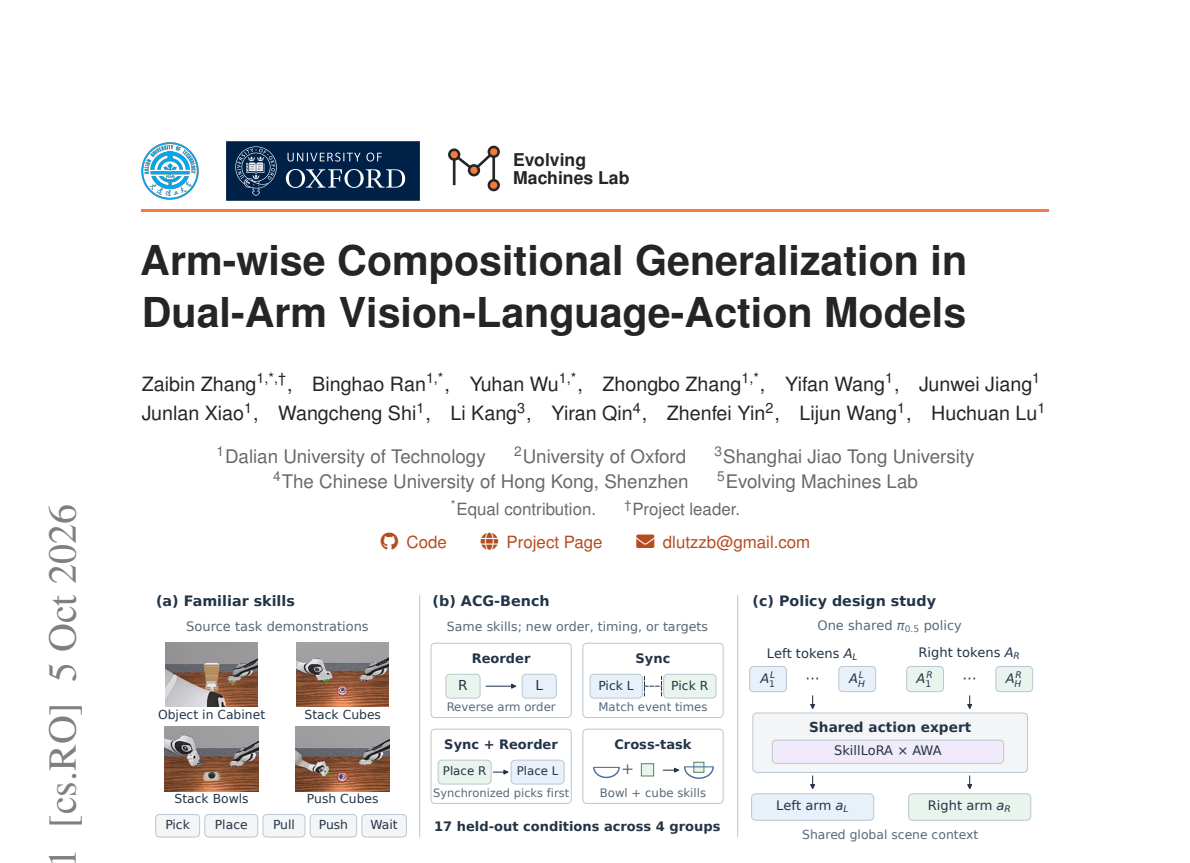
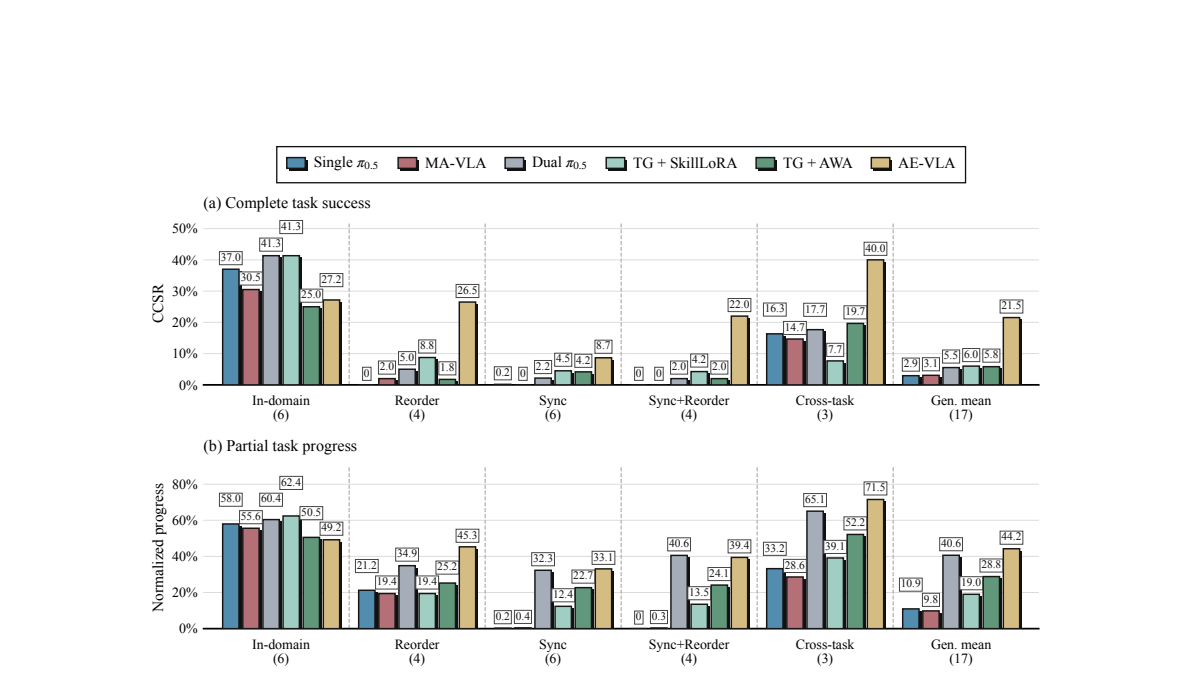
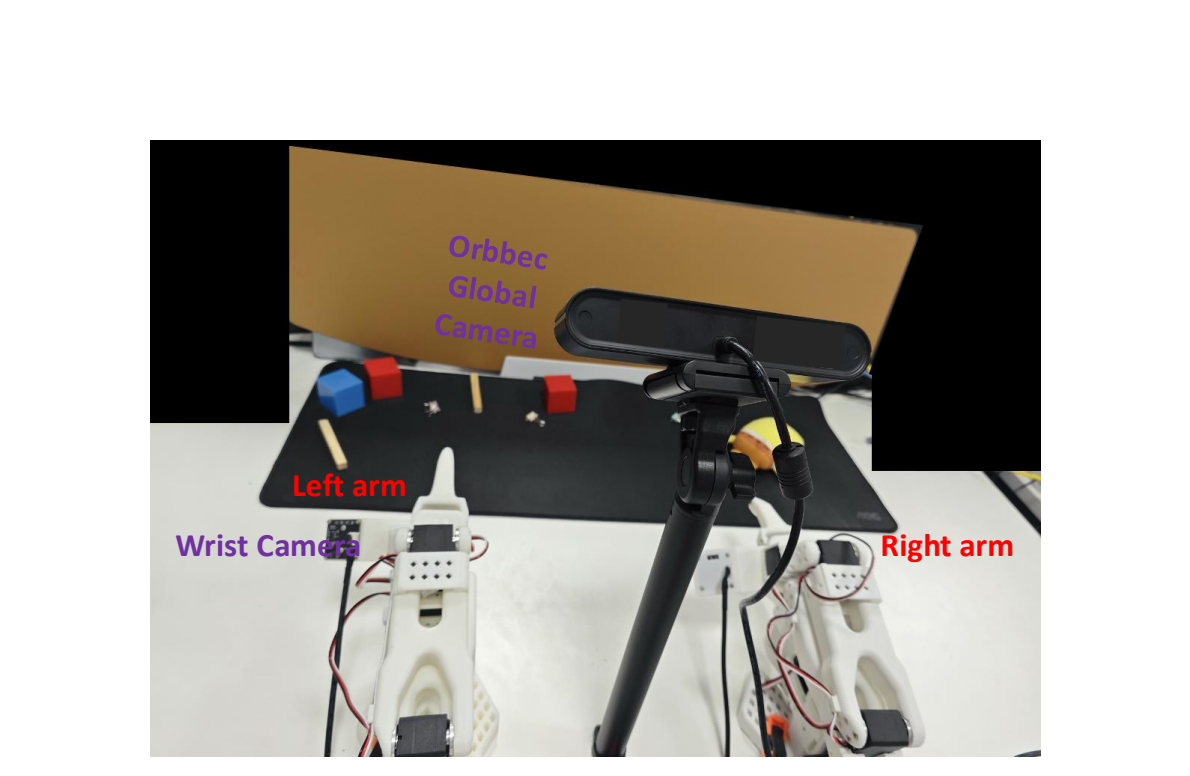
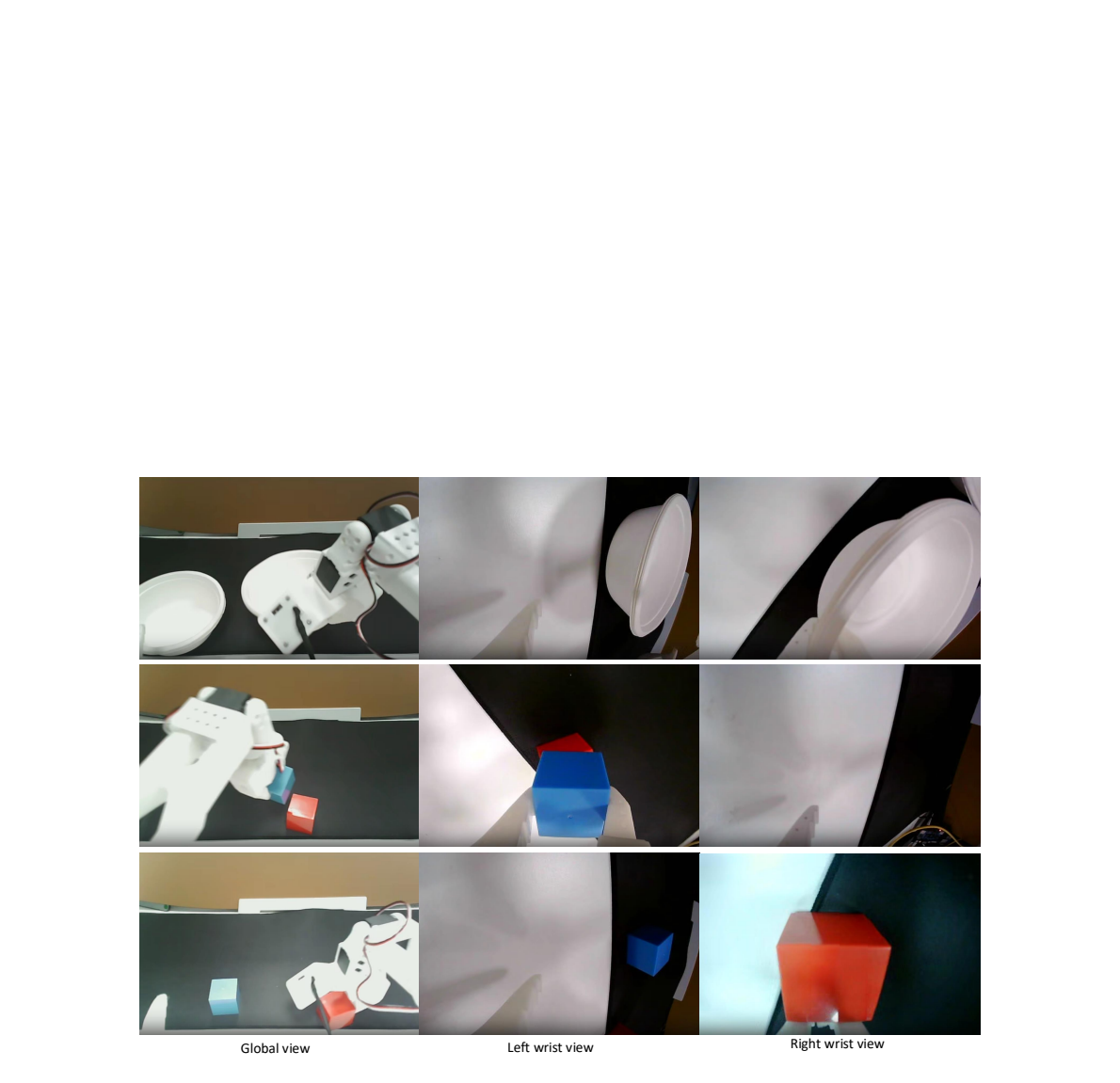
We introduce \textbfACG-Bench, a benchmark for Arm-wise Compositional Generalization that provides a common testbed for studying skill recomposition in dual-arm policies. It contains 23 task–condition pairs across 8 task families, with 6 in-domain conditions and 17 unseen compositions covering reordering, synchronization, their combination, and cross-task composition. All methods receive the same per-arm atomic prompts, and success requires achieving the task goal while satisfying physical milestones and specified order or timing constraints. Using π0.5 as a common vision-language-action backbone, we compare representative data-augmentation and architectural strategies with shared source data and a common evaluation protocol. Our architectural study examines arm-token grouping, skill-specific LoRA adapters (SkillLoRA), and arm-wise attention (AWA), highlighting the complementarity of skill-conditioned parameters and attention structure. Combining these choices yields \textbfAE-VLA, which achieves 21.53% generalization success in simulation, compared with 2.94% for Single π0.5, 3.06% for MA-VLA, and 5.53% for two independently controlled π0.5 policies. On physical SO101 robots, AE-VLA reaches 39.00% mean success across five unseen conditions, compared with 10.00% for the strongest baseline. These findings provide empirical guidance for designing dual-arm policies that generalize beyond fixed training routines.
from the abstract
Pith says
Machine review · deepseek-v4-flash · 6 Oct 2026 · what was read was not recorded · not checked by a person
It can be wrong. Challenge this review or reply to it.
Holds up, with conditions. ACG-Bench's controlled protocol is the real contribution; the engineering result is credible, but the headline 'complementarity' design insight rides on a 13.53-point interaction that neither axis isolates. This line is wrong
2 major objections · 4 minor
How often objections from reviews like this one are right: not yet measured
Not checked: figures, code, what the 35 references say.
The paper says, at Section 5.3, Table 2 and Sections 4.2-4.3
The review did not quote this passage.
A classifier read this sentence of the paper as acknowledging the concern (probability 0.95):
“The comparison also has limits: SkillLoRA adds both weights and router supervision; AWA changes both cross-arm and within-chunk attention.”
Pith says: Objection 1 of 2 · major
The third contribution, the claimed complementarity of skill-conditioned parameters and arm-wise attention, rests on the 13.53-point interaction in Table 2 (AWA adds 2.00 points without SkillLoRA and 15.53 with it). Both interacting factors bundle more than the named mechanism: SkillLoRA adds low-rank weight banks together with a router cross-entropy loss that can also update prefix features (Eq.
more of objection 1
(4) and Appendix B.2), while AWA simultaneously blocks cross-arm action attention and makes each action block lower triangular, changing within-chunk temporal attention (Eq. (3) and Appendix B.3). The manuscript openly acknowledges these confounds in Section 5.3 and notes in B.2 that a shared-adapter or shuffled-label control could separate the effects, but no such control is reported, so the interaction could be driven by the auxiliary router supervision or by the causal within-chunk mask rather than by the named components. I recommend decoupling ablations on the Token Group base: skill-selected versus shared adapters with matched parameter count and no router loss, and an AWA mask that blocks only cross-arm action access while keeping each action block bidirectional. Given that two legs of the factorial in Table 2 (2.94 to 3.82 and 3.82 to 5.82) are small relative to per-condition noise with 100 episodes, reporting confidence intervals or paired tests (seeds are shared across variants) for the four cells of the interaction would also help.
The paper says, at Appendix C.4
The review did not quote this passage.
Pith says: Objection 2 of 2 · major
The rescoring of the Single pi0.5 and MA-VLA logs after the final synchronization windows were fixed is disclosed transparently, and the statement that the same scorer reproduces the cached flags for the other five variants is reassuring. Since these two baselines anchor the headline comparison in Section 5.2 (2.94% and 3.06% versus 21.53%), the report should state explicitly whether the …
more of objection 2
… phase scheduler's prompt transitions could depend on the synchronization windows at the time those logs were generated (if so, the rescored baselines were executed under a different prompt schedule and rescoring cannot fully correct the behavior), and how many of the 2,300 episodes per method changed success status under rescoring.
4 minor objections
The paper says, at Section 5.1 and Table 3
Pith says: minor objection 1 of 4
No confidence intervals or statistical tests accompany the reported means in Tables 1-3; this matters for the physical results (20 trials per condition in Table 3) and for the small legs of the factorial in Table 2, and the shared seeds across methods make paired comparisons feasible.
The paper says, at Appendix B.3
Pith says: minor objection 2 of 4
Token Group also changes the suffix length from H to 2H relative to Single pi0.5, so the grouping effect in Table 2 is not isolated from an increase in sequence length; a control with 2H ungrouped joint tokens would disentangle the two, at least to confirm the direction of the effect.
show 2 more
The paper says, at Section 5.1
Pith says: minor objection 3 of 4
Because MA-VLA is the authors' own recent method adapted from pi0 to pi0.5, a sentence stating which MA-VLA components beyond Arm Shuffle were retained or dropped would help readers judge the strength of this baseline.
The paper says, at AI Use Statement and Reproducibility Statement
Pith says: minor objection 4 of 4
The AI Use Statement ends with the truncated word 'pape', and the Reproducibility Statement contains the stray fragment '.ility for the final content.'; these are formatting artifacts that should be corrected.
This objection may describe the copy Pith gave the reviewer, not the paper.
What would settle it
Extend the Table 2 two-by-two with two decoupling cells on the same 23-condition protocol (seeds 1000-1099): (1) SkillLoRA-decoupled: keep the 10 rank-4 adapters, routers, and 0.1 router loss, but tie all adapters to one shared matrix so the router's argmax has no functional effect; if the 13.53-point interaction collapses, skill-conditioned action weights are necessary; if it persists, the SkillLoRA side is explained by the router classification signal or added capacity. (2) AWA-decoupled: use Eq. 3 minus the within-chunk change, blocking cross-arm action attention while keeping each block bidirectional; if the interaction survives, causal within-chunk attention is not the driver and the 'arm-wise attention' framing stands. Report per-group means.
from the skeptic's reading
How the review went
4 readings by deepseek-v4-flash · 6 Oct 2026
- Reader holds up, with conditions
- Skeptic agrees
- Editor wrote the verdict above
- Referee major revision: 2 major objections, 4 minor
Not run on this paper: the simulated authors' defence.
Pith did not check this review's objections against the paper.
The review in full
The review in brief, machine-written
Zaibin et al. — the benchmark is the contribution, not the mechanism story. That's the one thing to remember before you read the abstract's third bullet.
What's genuinely new: ACG-Bench. A shared pi0.5 backbone, a shared phase-scheduler protocol with identical per-arm atomic prompts for every method, and a CCSR metric that rejects order and timing violations instead of crediting final-state reach. That last piece matters — most composition benchmarks would count a run that knocks the bowl over but lands the goal out of order. This one doesn't. The per-condition tables (1 and 10) are honest, showing where AE-VLA loses: Push Cubes, Object in Cabinet, Burger & Fries Sync, and in-domain generally (27.17% versus 45% for plain Token Group). The real-robot transfer is a genuine extra signal, not decoration.
The engineering result is credible. 21.53% gen-CCSR versus 5.53% for the strongest baseline, on a fixed pretrained backbone, with held-out compositions feeding no training data and a consistent rescoring check. I don't doubt the numbers.
What I doubt is the mechanism claim. The third contribution — 'complementarity of skill-conditioned parameters and attention structure' — rests entirely on the 13.53-point interaction in Table 2, and both axes bundle more than the named mechanism. SkillLoRA adds ten LoRA banks plus a router classification loss (weight 0.1) that also updates prefix features. AWA blocks cross-arm action attention AND makes each action block lower-triangular, changing within-chunk temporal decoding. Either confound, or both, could drive the interaction. The authors acknowledge all of this (b106, b161, b162, b370), even naming the decoupling controls. That's to their credit. But the abstract still sells the complementarity as established, and it isn't. The stress-test is right to set aside noise as the explanation — the interaction concentrates on Stack Bowls Reorder (+47) and Cube in Bowl Cross-task (+49), so it's real, just unassigned.
Smaller concerns, in proportion. Single and MA-VLA logs were rescored after the final sync windows were set; the consistency check helps but it's a post-hoc patch. The manual collision overrides on Dual pi0.5 are documented and plausible. Sync counts are small (100 sim episodes, 20 real trials) with no error bars. And the code link is garbled with no artifacts shipped — reproducibility is 'described in detail,' not 'run this.'
Who uses this paper: anyone working on dual-arm VLA design. The benchmark protocol and the controlled comparison are worth the read even if you skip AE-VLA. Send it to serious peer review — but referees should require the decoupling ablation (shared-adapter control, and AWA with only cross-arm blocking) before the complementarity claim ships. As is, the engineering result is solid and the mechanism story is over-sold.
The strongest objection
The paper's third contribution, the design insight of 'complementary benefits from skill-conditioned parameters and arm-wise attention,' rests entirely on the 13.53-point interaction in Table 2: AWA adds 2.00 gen-CCSR points without SkillLoRA (3.82 to 5.82) but 15.53 with it (6.00 to 21.53). Both axes bundle more than the named mechanism. SkillLoRA (Section 4.2, Eq. 4) adds low-rank skill banks together with a router cross-entropy loss (weight 0.1) that also updates prefix features; the authors state that a shared-adapter or shuffled-label control would separate these effects (sentence b370), and no such control is reported. AWA (Section 4.3, Eq. 3) simultaneously blocks cross-arm action attention and makes each action block lower-triangular, changing within-chunk temporal attention; the paper tests the whole mask rather than isolating cross-arm blocking (Appendix B.3). The interaction could therefore be (i) auxiliary skill supervision interacting with attention restriction, (ii) causal within-chunk decoding interacting with adapters, or (iii) the named complementarity. The progress numbers do not disambiguate: TG+AWA progress (28.84) already exceeds TG+SL (19.02) while full success trails (5.82 versus 6.00), so the two choices act on different parts of the pipeline. The engineering result is honestly reported, per-condition (Tables 1 and 10), and plausible; what is not established is the mechanism claim. Condition-level noise is an unlikely explanation (the interaction concentrates at +47 on Stack Bowls Reorder and +49 on Cube in Bowl Cross-task in Table 10), so the missing piece is attribution.
The empirical headline is reasonably supported: a fixed pi0.5 initialization, shared source data, a common scheduler and scoring protocol, honest per-condition reporting (Tables 1 and 10), documented trade-offs (in-domain penalty b160; Sync difficulty b179), and a real-robot transfer set. The 16-point gap over Dual, like the 13.53-point interaction, is too large to be per-episode noise, and the interaction's concentration in Stack Bowls Reorder/Sync+Reorder and Cube in Bowl Cross-task strengthens, rather than weakens, the need for mechanism-level evidence. The paper deserves credit for a genuine two-by-two design, super-additive progress (44.25 versus the 36.88 additive expectation), and dramatic real-robot Sync Stack Bowls results (12/20 versus 0/20 for baselines): something real is happening. The unresolved step is attribution, exactly as the reader's weakest_assumption says: both design axes are compound interventions, the authors acknowledge this explicitly (b106, b161, b162, b370), and the controls they name in b370 are not run. My concrete_test targets the two confounds separately; its outcome decides whether the third contribution stands as 'skill-conditioned parameters times arm-wise attention' or must be reframed. I considered, and did not elevate, the baseline rescoring and collision overrides (Appendix C.4): they are documented, small in magnitude relative to the 16-point gap, and for Single/MA-VLA the rescoring direction is not obviously favorable to AE-VLA. No separate load-bearing flaw emerged in the benchmark protocol or the comparison design. Verdict remains CONDITIONAL as the reader set it; the conditions should be the two decoupling ablations plus the reader's reproducibility items (corrected code link and uncertainty reporting).
The referee's report
If the results hold, the paper's engineering claim is valuable: moderate architectural modifications of a shared pretrained VLA policy achieve large gains in compositional generalization without new demonstrations or a planning module. The benchmark is a genuine community asset with controlled conditions, fixed pretrained initialization, per-condition reporting in Tables 1 and 10, a documented consistency check and manual collision overrides in Appendix C.4, and physical robot validation on SO101. I checked the reported group means in Figure 3 against Tables 1 and 2 and they are internally consistent. The mechanism-level complementarity claim, however, is not yet established because both interacting axes bundle more than the named mechanisms; the paper acknowledges this (Sections 4.2, 5.3, B.2) but still states complementarity as a headline result in the abstract and conclusion. The hypothesis is plausible and the needed controls are within scope, so the gap is fixable rather than terminal.
Pith's reading of the paper (a machine's summary, not the authors')
This paper asks whether a dual-arm robot policy can recombine skills it already knows — pick, place, push, wait — into orders, timings, and cross-task combinations that never appeared in training. To answer it, the authors build ACG-Bench, a benchmark of 23 task–condition pairs with 17 held-out compositions, and compare strategies on one shared pi0.5 backbone: arm-shuffle augmentation, independent per-arm policies, and three targeted architectural changes. The central claim is that combining the three architectural changes — arm-token grouping, skill-specific LoRA adapters (SkillLoRA), and an arm-wise attention mask (AWA) — inside one shared policy gives AE-VLA, which reaches 21.53% generalization success in simulation against 5.53% for the strongest baseline, and 39.00% mean success on physical SO101 arms against 10.00%. If correct, compositional generalization can be bought with modest within-policy design rather than new demonstrations or a separate planning module.
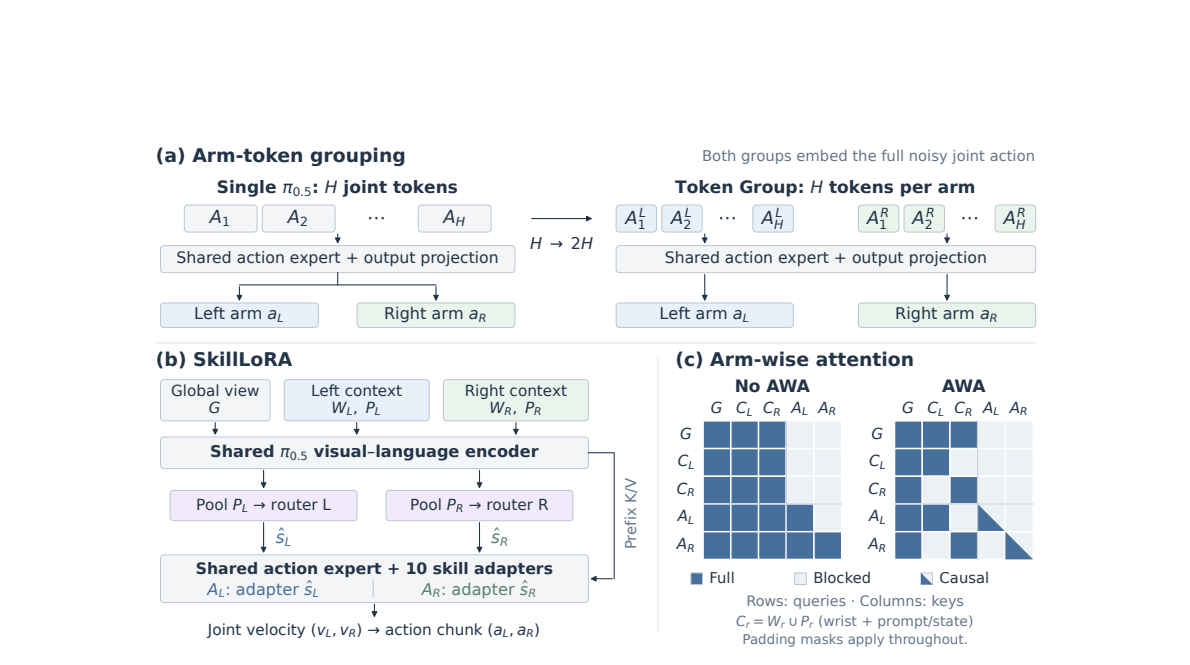
What carries the argument. The central mechanism is the interaction between a weight-level and a connectivity-level change inside one shared flow-matching VLA policy. SkillLoRA is a bank of $K=10$ rank-4 low-rank adapters, one per atomic skill, applied to the action expert's attention and feed-forward layers and selected by a per-arm two-layer router trained with a cross-entropy classification loss; AWA is an attention mask in which each action token may read only its own arm's prefix and earlier action tokens plus the global view, blocking cross-arm action attention and making each action block lower triangular. Arm-token grouping supplies the per-arm token ranges that both mechanisms key off: two blocks of $H=50$ action tokens, each embedding the full noisy joint action, decoded by a shared action expert. The benchmark-side machinery is the event graph — nodes are skill executions with specified arm, object, and target, edges are order constraints, and synchronization requires two completion milestones within a time window — scored by a constraint-compliant success rate (CCSR) that counts only episodes reaching the goal with the required order and timing.
Core claim. The core claim is that executing familiar arm-level skills under training-time-unseen coordination constraints improves sharply when three small architectural choices are made within a single shared pi0.5 policy. Arm-token grouping gives each arm its own block of 50 action tokens; SkillLoRA attaches a bank of ten rank-4 low-rank adapters indexed by atomic skill type, with a per-arm router selecting which adapter to use; arm-wise attention blocks direct cross-arm action attention while retaining shared global context and making each action block lower triangular. Individually the changes give modest generalization gains (3.82%, 6.00%, and 5.82% CCSR), but together they reach 21.53%, which the paper reads as evidence of complementarity: AWA's gain is 2.00 points without SkillLoRA and 15.53 with it. The configuration is validated on physical SO101 arms, where AE-VLA reaches 39.00% mean success across five unseen conditions versus 10.00% for the strongest baseline, at the cost of lower in-domain success than the baselines (27.17% versus up to 45.00%). Pure synchronization remains the weakest group at 8.67%.
The premise it rests on. The headline complementarity claim — that skill-conditioned parameters and arm-wise attention support each other — is not mechanically isolated, because each change bundles two interventions at once: SkillLoRA adds weights plus a router classification loss, and AWA changes both cross-arm attention and within-chunk temporal attention, so the 13.53-point interaction could be driven by the extra router supervision or the temporal mask rather than by the named mechanisms. The paper states this limitation openly.
If the paper is right (Pith's inferences, not the authors')
If correct, compositional generalization over familiar skills can be bought through architectural co-design in a shared policy, without new demonstrations or a separate planning module.
The complementarity of skill-conditioned parameters and attention structure suggests a design principle: weight sharing and attention connectivity should be designed together rather than tuned independently.
Pure synchronization (8.67% generalization) remains the hardest group, marking a concrete target for future work on timing control.
Local progress does not imply completion: AE-VLA and Dual pi0.5 complete similar milestone fractions (44.25% versus 40.64%) yet differ sharply in full success, so progress metrics mislead about compositional ability.
The in-domain cost — AWA cuts Token Group from 45.00% to 25.00% in-domain CCSR — indicates a trade-off that future designs must manage.
The paper's complementarity claim rests on an interaction that its design does not isolate: SkillLoRA bundles added weights with a router classification loss, and AWA bundles cross-arm blocking with a temporal lower-triangular change; a parameter-matched shared-adapter control with shuffled skill labels could settle which mechanism drives the 13.53-point interaction, a control the paper itself nam
Because the router picks one adapter per arm for the whole chunk, the method implicitly tests whether atomic skill identity is readable from prompt and state features; failures such as Cube in Bowl/Sync at 11% could mark conditions where skill identity and timing interact and might be improved by per-step routing.
The event-graph framing — same skills, new order and timing relations — transfers naturally to other shared-backbone coordination settings, such as humanoid limbs or multi-agent teams, where the open question is how coordination structure generalizes rather than how new behavior is learned.
Check this review
Pith stored no record of this review's passes and took no fingerprint of it. Reviews made by code from 13 Nov 2026 on carry both.
How often reviews like this one are right
Reviews like this one: written by deepseek-v4-flash, where what was read was not recorded.
How often objections from reviews like this one are right: not yet measured
Reviews by people
This review was written by a machine. No person has reviewed this paper on Pith yet. A scientist listed on Pith can review it for a fee, and their review is published here whatever it concludes.
The paper
Abstract
Generalization in multi-arm collaboration can be studied as composing familiar atomic skills in new ways across arms. However, existing evaluations offer limited insight into which training and architectural choices support this ability under different coordination requirements. We introduce \textbfACG-Bench, a benchmark for Arm-wise Compositional Generalization that provides a common testbed for studying skill recomposition in dual-arm policies. It contains 23 task–condition pairs across 8 task families, with 6 in-domain conditions and 17 unseen compositions covering reordering, synchronization, their combination, and cross-task composition. All methods receive the same per-arm atomic prompts, and success requires achieving the task goal while satisfying physical milestones and specified order or timing constraints. Using π0.5 as a common vision-language-action backbone, we compare representative data-augmentation and architectural strategies with shared source data and a common evaluation protocol. Our architectural study examines arm-token grouping, skill-specific LoRA adapters (SkillLoRA), and arm-wise attention (AWA), highlighting the complementarity of skill-conditioned parameters and attention structure. Combining these choices yields \textbfAE-VLA, which achieves 21.53% generalization success in simulation, compared with 2.94% for Single π0.5, 3.06% for MA-VLA, and 5.53% for two independently controlled π0.5 policies. On physical SO101 robots, AE-VLA reaches 39.00% mean success across five unseen conditions, compared with 10.00% for the strongest baseline. These findings provide empirical guidance for designing dual-arm policies that generalize beyond fixed training routines.
The paper's own sentences, arranged, kept beside the review and separate from it. Each label is drawn from a closed vocabulary; the number beside it is the probability the classifier gave that label. No sentence in this record was written by a model.
abstract compiled · 2026-10-06
The authors' main claim, as the classifier picked it out 0.91
“These findings provide empirical guidance for designing dual-arm policies that generalize beyond fixed training routines.”
How the main claim is stated: asserted 0.94
What the abstract itself states, as probabilities: claims first 0.10 · states limitation 0.21 · human participants 0.04 · controlled comparison 0.95 · randomized assignment 0.02 · states quantitative result 0.99 · compares with prior results 0.98 · mentions code or data availability 0.04
The abstract, sentence by sentence
This table labels the abstract only (arXiv listing abstract v1). The number is the probability the classifier gave the label.
| Sentence | Role | The authors' own work | States the main conclusion | Strength |
|---|---|---|---|---|
| Generalization in multi-arm collaboration can be studied as composing familiar atomic skills in new ways across arms. | background 1.00 | 0.07 | 0.04 | asserted 0.67 |
| However, existing evaluations offer limited insight into which training and architectural choices support this ability under different coordination requirements. | gap 1.00 | 0.06 | 0.02 | asserted 0.99 |
| We introduce \textbf{ACG-Bench}, a benchmark for \emph{Arm-wise Compositional Generalization} that provides a common testbed for studying skill recomposition in dual-arm policies. | contribution 1.00 | 0.93 | 0.05 | asserted 1.00 |
| It contains 23 task--condition pairs across 8 task families, with 6 in-domain conditions and 17 unseen compositions covering reordering, synchronization, their combination, and cross-task composition. | method 0.73 | 0.87 | 0.03 | asserted 1.00 |
| All methods receive the same per-arm atomic prompts, and success requires achieving the task goal while satisfying physical milestones and specified order or timing constraints. | method 0.99 | 0.60 | 0.03 | asserted 1.00 |
| Using $\pi_{0.5}$ as a common vision-language-action backbone, we compare representative data-augmentation and architectural strategies with shared source data and a common evaluation protocol. | method 0.99 | 0.92 | 0.03 | asserted 0.94 |
| Our architectural study examines arm-token grouping, skill-specific LoRA adapters (SkillLoRA), and arm-wise attention (AWA), highlighting the complementarity of skill-conditioned parameters and attention structure. | method 0.69 | 0.90 | 0.10 | asserted 0.97 |
| Combining these choices yields \textbf{AE-VLA}, which achieves 21.53\% generalization success in simulation, compared with 2.94\% for Single $\pi_{0.5}$, 3.06\% for MA-VLA, and 5.53\% for two independently controlled $\pi_{0.5}$ policies. | result 1.00 | 0.97 | 0.52 | asserted 1.00 |
| On physical SO101 robots, AE-VLA reaches 39.00\% mean success across five unseen conditions, compared with 10.00\% for the strongest baseline. | result 1.00 | 0.97 | 0.23 | asserted 1.00 |
| These findings provide empirical guidance for designing dual-arm policies that generalize beyond fixed training routines. | interpretation 1.00 | 0.79 | 0.74 | asserted 0.94 |
What kind of paper the classifier reports this is: dataset or benchmark 0.98 · evidence from observation or experiment 0.97
What was examined, and what was not
Sources read
- arXiv listing abstract v1
Not examined
- full text
- figures and tables
- references and citing sentences
- relations to other papers
Levels run
- P abstract
Not run
- S sections
- T body sentences
- C citations
- R cross-paper relations
How the labels were made
Compiled by classifier-1.13.0 via TypeSafe API, question bank abstract-p1-20260923, 2026-10-06: 1 request, 7,828 input tokens.
Every quoted sentence on this record is the authors'. Every label is from Pith's closed vocabulary, with the probability shown beside it. This record as JSON
Figures (6)
Figures are the authors', reproduced from the paper.
References (35)
- [1] Robotwin 2.0: A scalable data generator and benchmark with strong domain randomization for robust bimanual robotic manipulation , author=. arXiv preprint arXiv:2506.18088 , year= on PithPith's reviewarXiv
- [2] pi0: A Vision-Language-Action Flow Model for General Robot Control , author=. arXiv preprint arXiv:2410.24164 , year= on PithPith's reviewarXiv
- [3] RoboBallet: Planning for multirobot reaching with graph neural networks and reinforcement learning , author=. Science Robotics , volume=. 2025 , publisher= on Pith
- [4] pi05: a Vision-Language-Action Model with Open-World Generalization , author=. arXiv preprint arXiv:2504.16054 , year= on PithPith's reviewarXiv
- [5] pi06: a VLA That Learns From Experience , author=. arXiv preprint arXiv:2511.14759 , year= on PithPith's reviewarXiv
- [6] Fast: Efficient action tokenization for vision-language-action models , author=. arXiv preprint arXiv:2501.09747 , year= on PithPith's reviewarXiv
- [7] Rlbench: The robot learning benchmark & learning environment , author=. IEEE Robotics and Automation Letters , volume=. 2020 , publisher= on Pith
- [8] Calvin: A benchmark for language-conditioned policy learning for long-horizon robot manipulation tasks , author=. IEEE Robotics and Automation Letters , volume=. 2022 , publisher= on Pith
- [9] Maniskill: Generalizable manipulation skill benchmark with large-scale demonstrations , author=. arXiv preprint arXiv:2107.14483 , year= on PithPith's reviewarXiv
- [10] Libero: Benchmarking knowledge transfer for lifelong robot learning , author=. Advances in Neural Information Processing Systems , volume= on Pith
- [11] Vlabench: A large-scale benchmark for language-conditioned robotics manipulation with long-horizon reasoning tasks , author=. Proceedings of the IEEE/CVF International Conference on Computer Vision , pages= on Pith
- [12] Clevrskills: Compositional language and visual reasoning in robotics , author=. Advances in Neural Information Processing Systems , volume= on Pith
- [13] Robotwin: Dual-arm robot benchmark with generative digital twins , author=. Proceedings of the computer vision and pattern recognition conference , pages= on Pith
- [14] Roboeval: Where robotic manipulation meets structured and scalable evaluation , author=. arXiv preprint arXiv:2507.00435 , year= on PithPith's reviewarXiv
- [15] Robofactory: Exploring embodied agent collaboration with compositional constraints , author=. Proceedings of the IEEE/CVF International Conference on Computer Vision , pages= on Pith
- [16] Openvla: An open-source vision-language-action model , author=. arXiv preprint arXiv:2406.09246 , year= on PithPith's reviewarXiv
- [17] pi07: a Steerable Generalist Robotic Foundation Model with Emergent Capabilities , author=. arXiv preprint arXiv:2604.15483 , year= on PithPith's reviewarXiv
- [18] Cast: Counterfactual labels improve instruction following in vision-language-action models , author=. arXiv preprint arXiv:2508.13446 , year= on PithPith's reviewarXiv
- [19] Rt-1: Robotics transformer for real-world control at scale , author=. arXiv preprint arXiv:2212.06817 , year= on PithPith's reviewarXiv
- [20] Rt-2: Vision-language-action models transfer web knowledge to robotic control , author=. Conference on Robot Learning , pages=. 2023 , organization= on Pith
show 15 more
- [21] Octo: An open-source generalist robot policy , author=. arXiv preprint arXiv:2405.12213 , year= on PithPith's reviewarXiv
- [22] RDT2: Exploring the Scaling Limit of UMI Data Towards Zero-Shot Cross-Embodiment Generalization , author=. arXiv preprint arXiv:2602.03310 , year= on PitharXiv
- [23] GR00T N1: An Open Foundation Model for Generalist Humanoid Robots , author=. 2025 , eprint= on Pith
- [24] Dexvla: Vision-language model with plug-in diffusion expert for general robot control , author=. arXiv preprint arXiv:2502.05855 , year= on PithPith's reviewarXiv
- [25] RMBench: Memory-Dependent Robotic Manipulation Benchmark with Insights into Policy Design , author=. arXiv preprint arXiv:2603.01229 , year= on PithPith's reviewarXiv
- [26] Peract2: Benchmarking and learning for robotic bimanual manipulation tasks , author=. CoRL 2024 Workshop on Whole-body Control and Bimanual Manipulation: Applications in Humanoids and Beyond , year= on Pith
- [27] Bigym: A demo-driven mobile bi-manual manipulation benchmark , author=. arXiv preprint arXiv:2407.07788 , year= on PithPith's reviewarXiv
- [28] RoboCOIN: An Open-Sourced Bimanual Robotic Data COllection for INtegrated Manipulation , author=. arXiv preprint arXiv:2511.17441 , year= on PithPith's reviewarXiv
- [29] Cadene, Remi and Alibert, Simon and Soare, Alexander and Gallouedec, Quentin and Zouitine, Adil and Palma, Steven and Kooijmans, Pepijn and Aractingi, Michel and Shukor, Mustafa and Aubakirova, Dana and Russi, Martino and Capuano, Francesco and Pascal, Caroline and Choghari, J... on Pith
- [30] Im, Hokyun and Jeong, Euijin and Kolobov, Andrey and Fu, Jianlong and Lee, Youngwoon , booktitle=. 2026 , url= on Pith
- [31] Zhai, Xuanran and Huang, Zekai and Wu, Longyan and Zhao, Qianyou and Yu, Qiaojun and Ren, Jieji and Hao, Ce and Soh, Harold , journal=. 2026 , url= on Pith
- [32] Wu, Zenan and Wei, Bingqing and Liu, Lu and He, Zheqi and Wang, Xi and Liu, Jiakang and Li, Zehui and Yao, Guocai and Zheng, Jing-Shu and Yang, Xi and Wang, Yongtao , journal=. 2026 , url= on Pith
- [33] Jiang, Yunfan and Gupta, Agrim and Zhang, Zichen and Wang, Guanzhi and Dou, Yongqiang and Chen, Yanjun and Fei-Fei, Li and Anandkumar, Anima and Zhu, Yuke and Fan, Linxi , booktitle=. 2023 , url= on Pith
- [34] Zhang, Zaibin and Xiao, Junlan and Zhang, Zhongbo and Wang, Yifan and Kang, Li and Qin, Yiran and Xia, Changxing and Zhou, Heng and Fu, Talas and Zhou, Enshen and Zhang, Ruimao and Yin, Zhenfei and Lu, Huchuan and Wang, Lijun , journal=. 2026 , url= on Pith
- [35] RoboDojo: A unified sim-and-real benchmark for comprehensive evaluation of generalist robot manipulation policies , author=. arXiv preprint arXiv:2607.04434 , year= on PithPith's reviewarXiv
Cited by 1 Pith paper
Reviewed papers on Pith that cite this one. The full citation record
Challenges and discussion
Disagree with the review, or know something it missed? Leave a comment, or challenge this review formally: a challenge becomes a permanent entry in this paper's record, and its decision is published here.
Come back by email
A short list of the week's newly reviewed papers. Nothing is sent until you confirm from your inbox, and every email has a link that stops it. No account.
No comments yet.
Sign in to comment